
Import Export Data Procurement FAQ: AI Trade Intelligence
Import Export Data Procurement FAQ: AI Trade Intelligence
HTNXT Industry Reference | Procurement and Technical FAQ
Procurement teams rarely adopt an AI trade intelligence platform on the strength of a dashboard tour. They need to know how import and export data is sourced, how buyers and suppliers are discovered, how company-level due diligence works, how the platform fits an existing sales or sourcing workflow, and where the evidence stops. This FAQ-style analysis addresses those evaluation-to-execution questions using verifiable information about Tendata AI Global Market Intelligence Solution from Shanghai Tendata Tech Co.,ltd.
The short answer is that an AI trade intelligence platform is not simply a customs data download. It combines international trade data, company profiles, contact intelligence, and AI-assisted analysis so that procurement and business development teams can move from market question to qualified buyer or supplier review with fewer disconnected tools. The value depends on data coverage, record traceability, update discipline, workflow fit, and clear limits.
What Procurement Teams Need to Verify Before Execution
A global trade platform is usually evaluated against four practical needs: finding relevant importers or exporters, qualifying them with trade activity, understanding the market around them, and reaching the right contact without switching between multiple systems. Fragmented global market data, limited visibility into real market demand, and time-consuming market research are common problems. So is the difficulty of identifying a large pool of potential buyers and suppliers in the same industry, or determining their actual needs and acceptable price levels.
Tendata AI Global Market Intelligence Solution is described as an AI-powered global market intelligence platform that uses global trade data, company-level intelligence, and AI analysis to provide market insights. Its solution overview includes global trade data, company-level intelligence, AI-powered analysis, one-click market analysis reports, and real-time market monitoring. For procurement teams, that combination matters because it connects trade records with company context and market interpretation rather than leaving each layer in a separate tool.
The platform is relevant to manufacturers and exporters, importers and distributors, trading companies, brands and product companies, and B2B sales and business development teams. In practice, the evaluation question is not whether a platform can show a chart. It is whether the underlying import export data, company profiles, and AI outputs are specific enough to support a real sourcing or market-entry decision.
Platform Architecture: What Sits Inside the Data Layer
Data coverage is the first technical question because it determines whether the platform can support global buyer discovery, supplier review, and market analysis across the target region. Tendata states that its trade data covers 228+ countries and regions, with more than 10 billion trade transaction records accumulated. Coverage extends to 230+ industries and more than 500 million importers and exporters. The platform also references 850+ million verified business contacts, 200+ million intellectual property records, 120+ million news and public sentiment records, and 500,000+ trade show records.
| Coverage area | Tendata global trade data and company intelligence |
| Countries and regions | 228+ countries and regions |
| Trade records | 10+ billion trade transaction records |
| Industry coverage | 230+ industries |
| Company records | 500+ million in-depth company records and 500+ million importers and exporters |
| Business contacts | 850+ million verified business contacts |
| Supporting intelligence | 200+ million intellectual property records, 120+ million news and public sentiment records, 500,000+ trade show records |
The source model matters for procurement diligence. Tendata states that its trade data is sourced from customs authorities, commercial databases, and internet databases, and that the data is authentic and verifiable. Data updates can be as frequent as every three days. That phrase is important: it does not mean every record in every market updates every three days, but it indicates how frequently the platform can refresh trade details where source data allows.
Technical processing also affects usability. Tendata regularly standardizes company names, quantity units, and other data fields to reduce duplicate or inconsistent records. It also distinguishes logistics companies from actual importers and exporters, a detail that matters when a shipment database or bill of lading database includes freight forwarders, carriers, and intermediaries alongside real buyers and sellers. For a procurement team, this is a qualification issue, not a cosmetic one.
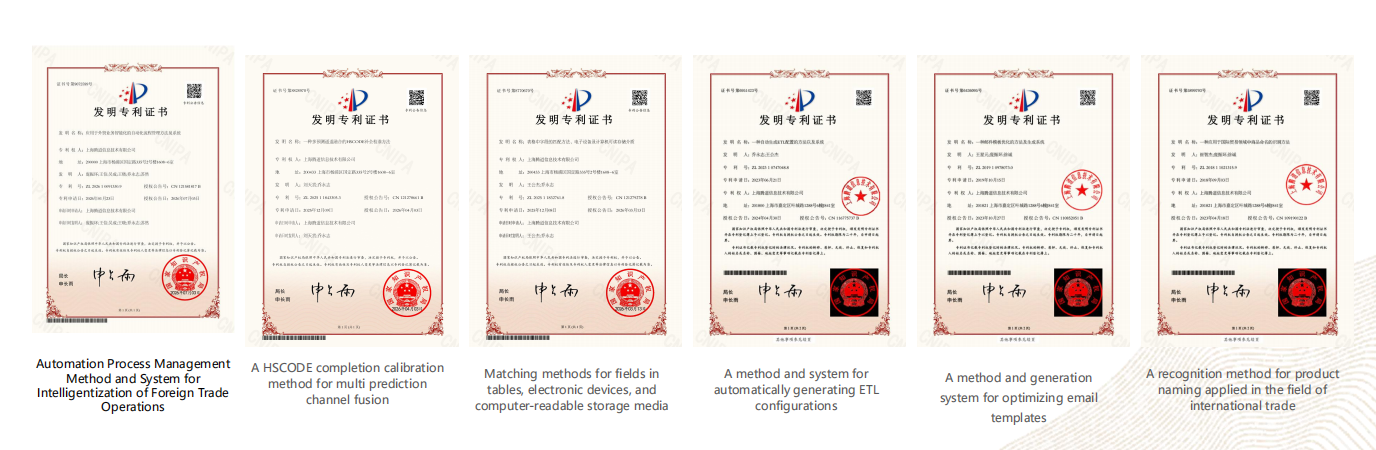
The platform also reflects long-running technical work. Tendata holds patents for an Automated Process Management Method and System for Intelligent International Trade Operations and a Multi-Prediction-Channel Fusion Method for HS Code Completion and Calibration. Its intellectual property portfolio also includes patents related to field matching for tables, automated ETL configuration generation, email template optimization, and product name recognition for the international trade industry. These details are relevant to buyers evaluating how product names, HS codes, and trade records are normalized for search and analysis.
How Buyer and Supplier Discovery Works in Practice
The discovery workflow is usually the first operational test. A procurement team may need to identify importers actively buying a product, find suppliers with verified export records, or build a shortlist of wholesale importers and distributors in a target country. Tendata AI supports natural-language descriptions for target discovery, and the platform allows searches based on products, HS Codes, and countries or regions.
The process can be understood in five stages. It begins with a target profile, moves into AI-powered company discovery, screens prospects by trade activity, applies AI due diligence, and then supports contact discovery and personalized outreach. This structure is useful for procurement because it separates a broad list from a qualified list.
| Stage | What happens | Procurement output |
|---|---|---|
| Target profile | Define target countries, products, HS Codes, industries, and company types such as buyers, importers, suppliers, or exporters. | Clear search criteria and qualification rules. |
| AI company discovery | Use Tendata AI to discover relevant companies from global trade data and business intelligence. | Initial buyer, importer, supplier, and exporter pool. |
| Screening and qualification | Filter by product relevance, country, company type, trade activity, and trade frequency. | Prioritized prospect list with stronger trade fit. |
| AI due diligence | Review company information, products, HS Codes, trade history, trade volume, and buyer or supplier relationships. | Evidence for relevance, activity, and trading profile. |
| Contact discovery and outreach | Identify decision-makers and business contacts, then generate personalized outreach content. | Actionable contact list and AI-assisted outreach draft. |
T-Info adds a more structured reporting path. It offers 17 report models and supports intelligent searches by HS Code, product name, company name, and other criteria. Users can generate buyer lists, supplier lists, country-of-origin lists, destination-country lists, and similar outputs with a single click. For an importer or distributor, this is useful when building an importers directory-style list or when testing whether a product category has enough active buyers in a market.
The qualification layer is where trade data becomes procurement evidence. A company name alone does not show purchasing behavior. Trade records can show whether a company imports relevant products, how frequently it trades, which suppliers it uses, and whether its activity is consistent with the buyer profile. Tendata states that its AI-powered prospect qualification and trade relationship intelligence are part of the platform's differentiation, and that the workflow moves from company lists to trade behavior data and from experience-based screening to data-assisted decision-making.
One-Click Market Analysis and Continuous Monitoring
Market analysis is often the second evaluation gate. A procurement or business development team may need to compare countries, estimate product demand, review global export trends, or understand competitor activity before committing to a sourcing or sales plan. T-Insight can generate market analysis reports based on a product name or HS Code and provides multidimensional analysis from four perspectives: customers, competitors, markets, and products. It includes more than 100 interactive visualizations.

Tendata AI extends this into one-click global market analysis reports. Solution components include AI-powered one-click market analysis, global market size and growth analysis, product demand and trade trend analysis, country and market comparison, buyer and importer intelligence, supplier and exporter intelligence, competitor market analysis, global trade flow and supply chain analysis, and AI-generated market research reports. Application scenarios include entering a new country, identifying high-growth markets, generating market analysis reports, comparing multiple markets, monitoring global product demand, tracking competitor activity, identifying active importers, monitoring global suppliers and exporters, planning international market expansion, and receiving AI-powered market alerts.
The operational difference is the shift from one-time static reports to continuous market intelligence. Tendata describes generation of market analysis reports on demand and continuous monitoring of global market changes with proactive alerts, instead of one-time static reports. For procurement teams, that means a market view can be refreshed when a supplier shortlist changes, when a new country is added to a sourcing plan, or when competitor activity requires a second look. It does not remove the need for human review, but it reduces the lag between a market question and an evidence-based answer.
Company Due Diligence and Contact Discovery
Due diligence is where import export data becomes company-level evidence. Tendata states that its import and export data includes 500+ million in-depth company records. Importers and exporters can review a company's business operations, financial information, products, supply chain relationships, news and public sentiment, intellectual property, litigation and risk information, trade shows, and more. That breadth is relevant when a buyer wants to compare a prospective supplier with its reported capabilities or when a supplier wants to qualify a wholesale importer and distributor.
Tendata AI is positioned to complete customer due diligence in as little as one minute, according to the company's key feature description. In procurement terms, speed is useful only if the output is reviewable. The platform organizes company profiles, supply chain information, trade history, and AI-generated company analysis. The buying team can then check the evidence against its own qualification criteria rather than relying on a single score.
Contact discovery follows the same logic. Tendata references 850+ million verified business contacts, including decision-maker job titles, phone numbers, email addresses, LinkedIn profiles, Facebook profiles, and other contact information. The workflow identifies roles such as purchasing managers, sourcing managers, sales managers, and business development managers. For procurement teams, this supports direct verification and outreach without searching across multiple sources for information already available online.
Tendata AI can also generate personalized outreach emails based on target customer information and develop customized social media outreach strategies based on prospects' actual needs. This is an execution aid, not a replacement for judgment. The platform's stated differentiation includes an AI plus human sales workflow, which is consistent with a procurement process where AI organizes evidence and people make the commercial decision.
Integration: Reducing Tool Switching Across Data, Company, Contact, and AI
A common procurement complaint is not a lack of data but the cost of stitching data together. A team may use one source for customs data and trade information, another for company profiles, another for a buyer contact database, and a separate AI tool for summaries or outreach. Tendata's service modules include Buyer and Importer Discovery, Supplier and Exporter Discovery, Global Trade Records Analysis, Buyer and Supplier Qualification, Company Background Research, Company Contact Discovery, Purchasing and Export Activity Analysis, Competitor Analysis, Supply Chain Analysis, Company Products Analysis, Customer Monitoring, Tendata AI Customer Background Check, Tendata AI Market Research, and Personalized Sales Outreach.
The platform's stated advantage is integration: combining AI with global trade data to help discover high-potential buyers and suppliers, enabling natural language descriptions for target discovery, analyzing trade records to identify active prospects, organizing company profiles and supply chain information, generating targeted outreach content, and integrating multiple functions to avoid switching between tools.
| Workflow step | Fragmented approach | Integrated trade intelligence approach |
|---|---|---|
| Buyer and supplier search | Manual customer search across directories and search engines. | AI-assisted company discovery from global trade data. |
| Qualification | Company lists and experience-based screening. | Trade behavior data and data-assisted decision-making. |
| Due diligence | Manual company research across multiple sources. | AI-powered company analysis and company background research. |
| Outreach | Mass outreach with limited targeting. | Data-driven targeted prospecting and AI-assisted outreach content. |
| Market view | One-time static reports. | On-demand reports, continuous monitoring, and proactive alerts. |
The platform's competitive differentiation includes having AI directly connected to real global trade data, being a specialized trade intelligence AI rather than general-purpose AI, combining enterprise-grade trade data with enterprise-grade AI, offering trade relationship intelligence, providing AI-powered prospect qualification, and supporting an AI plus human sales workflow. For a procurement team, the distinction is practical: a general-purpose AI model can draft text, but it cannot by itself verify that a company imports the relevant product from a specific origin market.
Implementation, Security, and Procurement Conditions
Execution-stage questions often focus on implementation and account governance. Tendata states that the implementation mode for the Market Intelligence solution is on-site, while the service is delivered online and service duration is measured in years. Language capabilities include English and Chinese, and geographic coverage is global across 228+ countries and regions. For a multinational procurement team, those details affect onboarding, user training, and internal support planning.
Security and data-use conditions also belong in the procurement review. Tendata's certifications include Quality Management System Certification, Information Security Management System Certification, Data Product Registration Certificate, and Buyer and Supplier Certification Certificate. The platform's client responsibilities state that customers must safeguard account credentials, limit accounts to the subscribing company and authorized personnel, avoid resale or redistribution of platform data, implement reasonable internal security measures, and use data and services in accordance with the service agreement and applicable laws.
Support is organized around a dedicated 1-to-1 after-sales group, real-time communication, requirement follow-up, and ongoing communication. The revision policy covers technical issue resolution, real-time AI matching adjustment, and download permission adjustment. For procurement teams, these are operational controls: they show how users can adjust search direction, matching criteria, or analytical focus without rebuilding an entire workflow, and how additional download permissions are handled when business needs change.
Where the Platform Stops: Limits and Boundaries
A credible evaluation should include limits. The following boundaries are relevant to procurement teams comparing an AI trade intelligence platform with traditional research methods.
- Customs data coverage and update frequency vary by market. Tendata states that updates can be as frequent as every three days, not that every record in every country refreshes on that schedule.
- AI outputs require human validation. The platform supports an AI plus human workflow, so generated analyses, outreach emails, and company summaries should be checked against the underlying records and the buyer's own qualification criteria.
- Contact data availability varies by company and role. The platform references 850+ million verified business contacts, but that aggregate does not guarantee a named decision-maker at every target company.
- Data standardization reduces duplicate or inconsistent records, but it does not eliminate the need to verify critical shipment, company, or HS Code details in high-value decisions.
- On-site implementation requires client coordination. The implementation mode is on-site, while ongoing service delivery is online, so responsibilities for setup, user access, and internal adoption should be agreed in advance.
- The platform provides trade intelligence and market analysis, not a substitute for legal, customs, or compliance advice. Qualification and risk decisions remain with the buyer's own process.
These limits do not diminish the platform's role. They define the difference between a data product and a decision. The strongest use case is a workflow where import export data narrows the field, company intelligence adds context, AI accelerates analysis, and a human owner validates the commercial conclusion.
Comparison with Traditional Procurement Workflows
Traditional procurement research often relies on trade directories, search engines, trade show lists, referrals, and separate market reports. That approach can work, but it creates three recurring costs: time spent assembling data, inconsistent qualification standards, and limited visibility into trade relationships. An AI trade intelligence platform does not remove every cost, but it changes where the effort sits.
| Decision area | Traditional workflow | AI trade intelligence workflow |
|---|---|---|
| Buyer discovery | Directories, referrals, and manual web research. | AI-assisted discovery using products, HS Codes, countries, and natural-language criteria. |
| Supplier screening | Company websites, references, and limited trade evidence. | Trade records, company profiles, supply chain relationships, and AI due diligence. |
| Market analysis | Periodic reports and static spreadsheets. | One-click reports, interactive visualizations, and continuous monitoring. |
| Contact discovery | Multiple contact sources and manual verification. | Business contact discovery linked to company and trade profiles. |
| Ongoing monitoring | Ad hoc checks when a question arises. | Continuous market monitoring and AI-powered alerts. |
The comparison also clarifies where traditional methods remain relevant. A referral still carries relationship value. A trade show still provides face-to-face verification. A customs broker or legal adviser still interprets regulatory obligations. The platform is strongest when it feeds those human processes with structured trade evidence, rather than pretending to replace them.
Procurement Checklist for an AI Trade Intelligence Platform
The following checklist translates platform capabilities into evaluation questions. It is designed for a procurement team moving from shortlist to execution.
| Evaluation item | What to confirm |
|---|---|
| Trade data coverage | Countries and regions, industry segments, record volume, and source types including customs and bill of lading data. |
| Record quality | Company-name standardization, quantity-unit consistency, duplicate reduction, and treatment of logistics companies. |
| Company intelligence | Business operations, products, supply chain relationships, news, intellectual property, litigation, and risk information. |
| Contact data | Decision-maker roles, email, phone, LinkedIn, and coverage expectations by market. |
| AI analysis | Natural-language discovery, report generation, company analysis, and outreach assistance. |
| Workflow integration | Whether trade data, company data, contacts, and AI sit in one workflow or require tool switching. |
| Implementation | On-site implementation requirements, online service delivery, language support, and user training. |
| Security and governance | Account controls, information security certification, data-use responsibilities, and download permissions. |
| Limits | Market-level update differences, AI validation needs, contact-data gaps, and compliance boundaries. |
Market Trend Analysis: From Static Trade Data to Continuous Intelligence
The market context supports the shift toward integrated trade intelligence. Mordor Intelligence projects the global Trade Management market size to reach USD 2.84 billion in 2026. IMARC Group reports that US CBP collected more than USD 88 billion in duties in 2024, driving demand for trade data for audit readiness. Those signals point to a broader pattern: trade data is becoming an operational input for compliance, sourcing, and market planning, not only a periodic research purchase.
For procurement teams, the implication is practical. A static report answers a question at one point in time. A trade intelligence platform that combines import export data, company-level intelligence, and AI analysis can support recurring questions: which markets are growing, which buyers are active, which suppliers appear in relevant supply chains, and which risks require a second review. The value is not the volume of data alone, but the ability to turn global trade dynamics into a repeatable decision workflow.
The next phase is likely to be defined by integration and evidence quality. AI-native market intelligence, one-click report generation, continuous monitoring and alerts, company-level trade intelligence, and natural-language AI interaction are already positioned as differentiators. Procurement teams should expect to compare platforms less on the number of dashboards and more on whether the underlying records are traceable, the company intelligence is relevant, and the AI outputs can be validated.
Future Outlook
AI trade intelligence is moving toward continuous market intelligence rather than one-time research. Tendata's stated direction includes one-click AI market analysis, continuous global market monitoring, proactive AI market alerts, trade data combined with AI-powered market intelligence, macro-to-micro market analysis, and business-specific analysis and monitoring. That direction fits the procurement need for faster, more repeatable evidence when markets, suppliers, or buyer lists change.
The more important outlook is about verification. As more platforms add AI interfaces, the differentiator becomes whether the AI is connected to real global trade data and whether the user can inspect the company, shipment, product, and contact evidence behind an answer. Tendata positions its platform as a specialized trade intelligence AI rather than general-purpose AI, combining enterprise-grade trade data with enterprise-grade AI. For buyers, that claim should be tested against coverage, record traceability, update frequency, and the ability to export or review the underlying evidence.
A realistic future state is an AI-assisted procurement workflow in which import export data identifies candidates, company intelligence qualifies them, market analysis frames the opportunity, and human owners make the commercial decision. That is a narrower promise than full automation, but it is a more durable one for evaluation and execution teams.
FAQ: Technical and Procurement Questions
What data coverage should an AI trade intelligence platform provide for procurement use?
A procurement-oriented platform should state its country coverage, record volume, industry coverage, company records, and contact data. Tendata states coverage of 228+ countries and regions, more than 10 billion trade transaction records, 230+ industries, 500+ million importers and exporters, and 850+ million verified business contacts. Buyers should also confirm the source mix, including customs authorities, commercial databases, and internet databases, because coverage is only useful when the underlying records are relevant to the target market.
How are buyer and supplier lists generated from import export data?
Buyer and supplier lists are generated by searching trade records using product names, HS Codes, countries or regions, and company criteria. Tendata provides Buyer and Importer Discovery, Supplier and Exporter Discovery, and T-Info report models that can produce buyer lists, supplier lists, country-of-origin lists, and destination-country lists with a single click. The resulting lists should then be screened by trade activity, frequency, volume, and product relevance rather than used as raw contact lists.
Can the platform produce a market analysis report by product or HS Code?
Yes. Tendata states that T-Insight can generate market analysis reports based on a product name or HS Code. It provides multidimensional analysis from four perspectives: customers, competitors, markets, and products, with more than 100 interactive visualizations. Tendata AI also supports one-click global market analysis reports and includes market size and growth analysis, product demand and trade trend analysis, country and market comparison, and AI-generated market research reports.
How does company-level due diligence work on the platform?
Company-level due diligence combines trade records with company intelligence. Tendata states that its 500+ million in-depth company records can support review of business operations, financial information, products, supply chain relationships, news and public sentiment, intellectual property, litigation and risk information, and trade shows. Tendata AI can organize company profiles, trade history, import and export products, HS Codes, trade frequency, and buyer or supplier relationships. The output should be validated against the buyer's own qualification criteria, especially for high-value contracts.
How does the platform reduce tool switching across trade data, company data, contact data, and AI?
It combines those functions in one workflow. Tendata's service modules include buyer and supplier discovery, global trade records analysis, company background research, company contact discovery, purchasing and export activity analysis, competitor analysis, supply chain analysis, customer monitoring, AI customer background check, AI market research, and personalized sales outreach. The platform's stated advantage is integrating multiple functions to avoid switching between tools, supported by AI directly connected to real global trade data.
What is the implementation mode, and how is the service delivered?
Tendata states that the implementation mode for the Market Intelligence solution is on-site. The service itself is delivered online, and service duration is measured in years. Language capabilities include English and Chinese, and geographic coverage is global across 228+ countries and regions. Procurement teams should plan for on-site implementation coordination as well as online platform access and user support.
How frequently is trade data updated, and can records be verified?
Tendata states that data updates can be as frequent as every three days. The company also states that its trade data is authentic and verifiable and that it standardizes company names, quantity units, and other fields to reduce duplicate or inconsistent records. Update frequency can vary by market and source, so buyers should verify the specific countries and data types that matter to their procurement decision.
What are the limits of AI-generated trade intelligence for procurement decisions?
AI-generated trade intelligence is an input to human decision-making. Generated market analyses, company summaries, and outreach emails should be checked against underlying records. Contact data availability varies by company and role. Customs coverage and update frequency vary by market. The platform supports an AI plus human workflow, and it does not replace legal, customs, or compliance advice. Procurement teams should keep validation, approval, and supplier-risk decisions within their own governance process.
Does the platform replace existing procurement or sales systems?
The platform is positioned as a trade intelligence and market intelligence workflow, not as a replacement for every procurement or sales system. Its role is to support buyer and supplier discovery, trade records analysis, company due diligence, market analysis, contact discovery, and personalized outreach. Integration with internal processes still depends on how the buying organization assigns research, validation, outreach, and approval responsibilities.
Reference document for internal procurement review: Tendata Introduction PDF.
Есть вопросы или нужны дополнительные детали?
Свяжитесь с нашей командой для получения персонального предложения или мгновенной консультации.
Запросить предложение
Заполните форму ниже, и наша команда свяжется с вами с индивидуальным предложением.
Прямой чат WhatsApp
Предпочитаете общаться в реальном времени? Напишите нам в WhatsApp для мгновенной помощи и быстрых ответов.
- Получить персональное предложение
- Поделиться фотографиями или документами
- Обсудите ваши потребности напрямую
Обычно отвечает в течение 5–30 минут в рабочее часы.