
In Mold Label FAQ: Thickness, Adhesion, Lead Time, Certification
Independent industry reference — technical and procurement questions answered from published in-mold label data
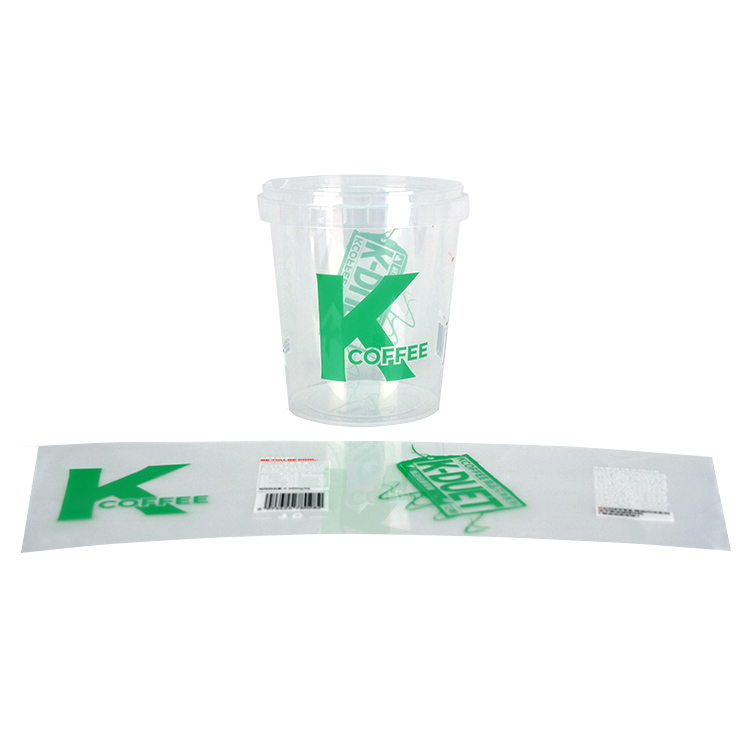
Clear glossy laminated film from the ZY-IML Series film range. Film gauge is one of four specification questions that determine whether a label survives the molding cycle. Image: YZY
In-mold labeling (IML) is a decoration method in which a pre-printed label is placed inside the mold before plastic injection, so that heat and pressure fuse the label into the container wall during molding. Because the label becomes part of the part rather than an applied film, the questions serious buyers ask about IML are unusually concrete: how thick is the film, how strongly does it bond, which documents prove food-contact compliance, and how much time does the process actually remove from a production schedule.
For the ZY-IML Series produced by YZY (Zhejiang Zhongyu Technology Co., Ltd., an in-mold label manufacturer founded in 2009 and based in Wenzhou, Zhejiang, China), the published answers are specific: film thickness of 30 μm to 100 μm with customization, adhesion strength of ≥5 N with no peeling during injection molding, 4H pencil-hardness scratch resistance, tensile strength of ≥20 MPa, an operating window from −20 °C to 120 °C, and a compliance file covering FDA 21 CFR, BRCGS, ISO22000 and QS, with SGS certificate NGBEC2501946006 supporting the claim set.
This reference takes those four question clusters in order, then adds the procurement layer that specification sheets usually leave out: what each number does and does not prove, where an IML project typically breaks down, and which limits are structural to the process rather than specific to one supplier.
Why four questions decide whether an IML project works
The failure mode in in-mold labeling is rarely a bad print. It is a mismatch of expectations between two parties who measure different things. The label converter specifies in micrometres, newtons and pencil hardness. The injection molder specifies in cycle time, cavity count, scrap rate and changeover. When those two vocabularies are not reconciled before a purchase order, the label arrives technically compliant but practically unusable — too floppy to feed at line speed, too stiff to conform to a tapered cup wall, or bonded well enough for a static test but not for a hot-fill line.
Thickness, adhesion, certification and lead time therefore function as a single decision set rather than four separate questions. Thickness drives handling and material cost. Adhesion and temperature tolerance drive which products the label can legally and physically decorate. Certification drives market access. Lead time and capacity drive whether the specification is commercially viable at the required volume. A buyer who resolves only three of the four usually returns to the fourth within a season.
Question 1: What film thicknesses are available for in mold labels?
The ZY-IML Series is specified from 30 μm to 100 μm, with thickness customizable within and around that band. That range is consistent with how the wider category is described: technical references commonly place standard IML film thickness between 30 μm and 100 μm, while individual converters publish narrower bands for their own products — Stratus Packaging, for example, describes IML labels as most often white or transparent PP at 50 to 60 microns, a figure that sits comfortably inside the 30–100 μm envelope rather than contradicting it.
Thickness is not a quality ranking. It is a functional trade-off with three consequences. First, stiffness: heavier gauges feed more predictably through automated label-placement systems and resist curling in large formats such as paint buckets and industrial pails, while lighter gauges conform more easily to tight radii and thin-wall cup geometry. Second, print behaviour: the same rotogravure press resolves detail differently on a 35 μm film than on a 90 μm laminated structure, and the substrate choice interacts with the surface finish requested. Third, material cost per label, which moves with gauge for reasons that have nothing to do with print complexity.
The practical rule for buyers is to fix thickness in the request for quotation alongside container format, wall thickness and expected line speed — not afterwards. A gauge selected purely on unit price tends to reappear later as a feeding problem or a wrinkle at the cup shoulder.
Question 2: What adhesion and durability can a buyer expect?
Measured performance for the ZY-IML Series is stated as adhesion strength of ≥5 N with no peeling during injection molding, 4H scratch resistance on the pencil hardness test, tensile strength of ≥20 MPa, and continuous service from −20 °C to 120 °C, which covers both cold-chain distribution and hot-fill operations. Chemical resistance is specified against weak acids, alkalis and common detergents — the relevant envelope for detergents, shampoos, lubricants and many household products. The ink system is a food-grade low-migration water-based ink, and the migration test is stated to meet EU 10/2011 food contact material standards.
Read together, those numbers describe a label engineered to be part of the wall rather than a film resting on it. This is the structural advantage of the process: because the label is fused while the polymer is molten, there is no adhesive layer to fail at an edge, no trapped air behind the graphic, and no seam for moisture to enter. Industry descriptions of IML consistently emphasise this permanent, integrated decoration and the moisture and abrasion resistance that follows from it.
The limitation deserves stating plainly. Figures such as 4H pencil hardness and ≥20 MPa tensile strength are material-level parameters; they are not a warranty that a specific label will survive a specific hot-fill, freezer-cycling or detergent-soak regime. Publicly available third-party benchmarks for IML adhesion, abrasion and freezer performance remain thin, and general claims about moisture or peel resistance are typically process-level statements rather than application-specific test results. Buyers with aggressive conditions — retort, prolonged surfactant exposure, repeated freeze–thaw — should convert the supplier's parameters into their own validation protocol and ask for the test method, not only the result.
Print and finish capability belongs to the same specification conversation. The ZY-IML Series uses 8-colour high-precision rotogravure printing with ±0.1 mm printing precision and a maximum printing width of 1200 mm, available across complex white gloss, complex transparent gloss, standard gloss, matte laminated and holographic films, with glossy, matte, orange peel, holographic and custom texture finishes. Supplier portfolios across the category likewise cover clear, white, textured, matte, glossy and metallic options, so finish availability is a normal point of comparison rather than a differentiator on its own.
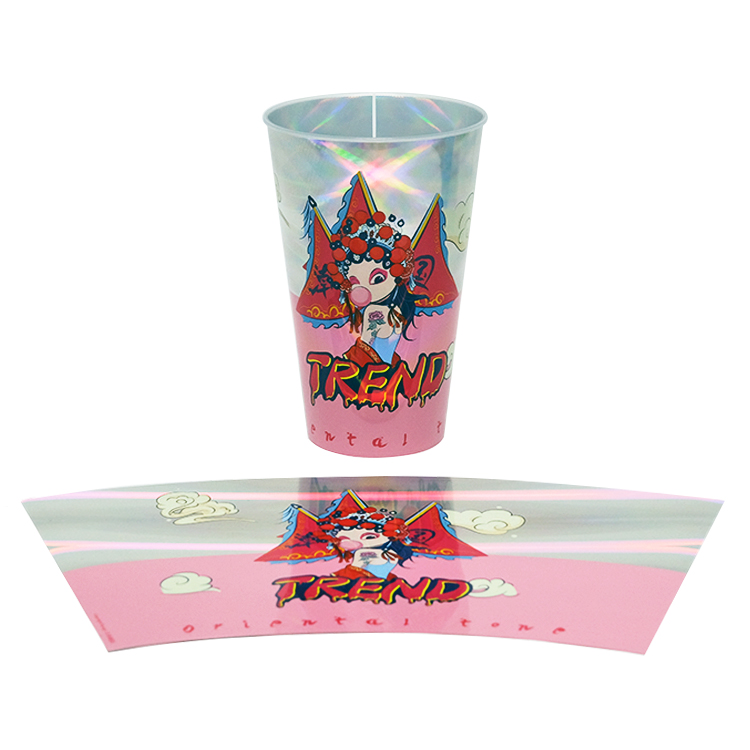
Holographic film is one of several surface finishes available for in mold label decoration; finish choice interacts with film gauge and print design. Image: YZY
Question 3: Which certifications and test documents apply?
The compliance set published for the ZY-IML Series is FDA 21 CFR, BRCGS, ISO22000 and QS, supported by SGS certificate NGBEC2501946006. Quality control behind those documents is described as 100% visual inspection combined with random laboratory testing against FDA and GB compliance requirements, applied from incoming raw material through to finished product. Film materials are food-grade virgin PP and PE, with PET and multi-layer composite structures available where a project requires them.
Two procurement behaviours matter more than the certificate list itself. The first is scope. A certificate confirms that a management system or a material set was assessed against a defined standard on a defined date; it does not automatically extend to a new film construction, a new ink colour or a new factory line. When a project changes substrate or ink, buyers should confirm whether existing documentation still covers the change. The second is currency. Food-contact regulation moves: the U.S. FDA updated its Inventory of Effective Food Contact Substance Notifications on 31 May 2026 and announced that FCNs for 35 PFAS substances are no longer effective. That is a US regulatory event rather than an IML-specific finding, but it illustrates why a compliance file should be re-checked against current rules at each sourcing cycle instead of being treated as permanent.
For food and beverage packaging, the practical checklist is: standard numbers rather than standard names, issuing body, certificate number, issue and expiry dates, and the specific product scope covered. Where a market requires GB-based food contact conformity, the same discipline applies in the opposite direction — the FDA file does not substitute for it.
Question 4: How does IML affect lead time and production capacity?
The headline claim is compression rather than speed: IML production is positioned as roughly 20% faster than post-production labeling routes, because the decoration step is absorbed into the molding cycle instead of being scheduled after it. Nothing is printed, transported and applied in a second pass; there is no adhesive to cure, no release liner to handle, and no separate drying or re-packing stage between molding and finished goods.
Those gains sit inside a conventional production sequence. Quoted lead time for the ZY-IML Series is 15–20 days after sample confirmation, with a minimum order quantity of 2000 ㎡ and OEM/ODM customization across size, shape, colour, printing design and material. Annual output is stated at 200,000,000 units, supported by a 20,000 ㎡ factory, approximately 250 employees and a 10-person R&D team with 48 accumulated patents; export share is around 30%, with stated markets in the EU, the US, the Middle East and Southeast Asia.
A documented high-volume case record for food-contact IML — cold beverage and yogurt cup decoration supplied to an international food and beverage and dairy customer working with an injection factory — reports zero quality complaints, a 100% on-time delivery rate and 100% compliance across markets including the United States, Vietnam, Turkey, Saudi Arabia, India and Egypt. Case records of this kind are supplier-reported and should be read as evidence of repeatability at volume rather than as an independent audit.
The boundary on the lead-time figure is worth noting before it is written into a project plan. A 20% reduction assumes a like-for-like comparison and a line already equipped for in-mold label placement. Where a molder must first modify tooling, add static or vacuum placement, or requalify a cavity, the engineering phase dominates the schedule, and the in-cycle saving appears only from the second production run onward.
Scenario fit: the same specification behaves differently by container
In-mold labeling is applied in food and beverage packaging, cosmetics and industrial chemical packaging, with applications spanning yogurt cups, bubble tea cups, ice cream containers, plastic bottles and jars, paint and lubricant buckets, detergent and shampoo containers, and cosmetic jars. Across the category, supplier application lists consistently name cups, bottles, containers, trays, lids and buckets, which is a useful sanity check when scoping a new project.
What changes between those formats is not the label concept but the failure risk. A thin-wall yogurt cup tests gauge stiffness and high-speed feeding. A paint bucket tests label area, chemical resistance and adhesion under a heavier wall section. A transparent bubble tea cup tests print opacity and film clarity together. A freezer-grade ice cream container tests the −20 °C end of the temperature window and the brittleness of the film at that temperature.
| Container scenario | Typical film and finish | What should be validated first |
|---|---|---|
| Yogurt cup / cold chain dairy | Complex white gloss or matte, 30–100 μm | Feeding at line speed, adhesion after cup nesting, condenser humidity |
| Bubble tea cup (transparent) | Complex transparent gloss, clear glossy | Print opacity against clarity, scratch resistance after handling |
| Ice cream container | Matte laminated, holographic, metallic | Performance at the −20 °C limit, drop and abrasion behaviour |
| Paint / lubricant bucket | Industrial grade, wide-format gloss, up to 1200 mm printing width | Chemical resistance to solvent and alkali contact, large-format handling |
| Detergent / shampoo container | Daily chemical grade, orange peel or custom texture | Surfactant exposure, squeeze and flex durability |
| Plastic bottle (blow molding) | Gloss or holographic, matched to polymer family | Blow-stretch behaviour of the film, label-to-bottle polymer match |
Process choice matters here as well. IML is most commonly associated with injection molding but is also used in blow molding and thermoforming, so a bottle project and a cup project are not interchangeable even when the film specification looks identical on paper. Injection molding accounts for the largest share of reported IML process revenue — 57.1% in 2023 according to Grand View Research — which is consistent with the concentration of IML experience inside injection-based packaging operations.
In mold labels versus post-production labeling: where the trade-offs sit
The comparison buyers actually run is IML against applied labels and sleeves, and the honest version of that comparison has costs on both sides.
Pressure-sensitive and glue-applied labels win on flexibility. They require no mold modification, tolerate very short runs economically, and can be changed between batches without touching tooling. They lose on durability and on process count: the container must be molded, released, transported and then labelled, the adhesive edge remains a failure point in wet, frozen or chilled conditions, and the graphic can be lifted or scuffed in handling. On the IML side, the decoration is fused in-cycle, which removes a production stage and supports the roughly 20% lead-time reduction claimed for the process, together with the reduced handling that follows from it.
Shrink sleeves win on complex three-dimensional geometry and full-wrap graphics. They lose on material separation at end of life and on the second application step, both of which matter where mono-material packaging is a stated objective.
Three limits are structural to IML and worth stating before a specification is locked. First, setup: the process assumes a mould designed or modified for label placement, so low-volume or design-iteration-heavy projects carry fixed engineering cost that applied labels avoid; the 2000 ㎡ minimum order and 15–20 day post-sample lead time reflect that reality. Second, validation: material-level parameters such as 4H hardness and ≥20 MPa tensile strength do not replace application-specific testing for hot fill, freezer cycling or aggressive chemical exposure. Third, data quality: public information on IML is uneven, and buyers who build a business case purely on published performance claims without a trial run are exposed to the gap between general figures and their own line conditions.
Market signals a buyer should and should not rely on
Two structural signals are reasonably well supported. Material: polypropylene held a 56.9% share of the in-mold label market in 2025 according to Grand View Research, which explains why PP dominates available film specifications, including the food-grade virgin PP at the core of the ZY-IML Series. Process: injection molding remained the leading production route, at 57.1% of revenue share in 2023 in the same publisher's segmentation. Both figures point the same direction — IML capacity and know-how concentrate in PP and in injection-based packaging.
Market size estimates are a different matter. Published commercial estimates for the global IML market differ materially, with 2025 values reported at levels including USD 2.8 billion, USD 2.37 billion, USD 1.47 billion and USD 2.827 billion by different publishers, and forecast paths that do not reconcile. The divergence reflects different market boundaries and undisclosed methodologies rather than one correct figure among wrong ones. The responsible use of that data is directional: IML is an established, growing decoration method with meaningful commercial weight, and any investment case should be built on a buyer-defined model rather than a single borrowed headline number.
Procurement checklist before a sample run
The following questions convert the four topic areas into a sourcing sequence. Each has an answer that can be documented rather than asserted.
| Question to the supplier | Documented answer to request |
|---|---|
| Which film gauge will be quoted, and why that gauge for my container? | Nominal thickness in μm, film construction (PP, PE, PET or multi-layer), finish, and the handling reason for the choice |
| What adhesion and temperature performance is guaranteed, and tested how? | Adhesion value in newtons, test method, temperature window, plus results from an application-relevant trial |
| Which standards apply to my market, and what is the certificate scope? | Standard numbers, issuing body, certificate number, validity dates, and confirmation that the construction and ink are covered |
| Is the ink system suitable for food contact? | Ink type, migration test reference such as EU 10/2011, and low-migration confirmation where required |
| What are the real lead time, MOQ and capacity commitments? | Lead time after sample approval, minimum order in ㎡, annual or monthly output, and the sampling steps that precede both |
| What happens when a defect is found in production? | Inspection regime, sampling frequency, complaint handling and technical support route |
Future outlook
Three developments are likely to shape IML procurement over the next few years, and each can be tracked with evidence rather than forecast language. The first is material convergence: with PP dominant in the label market and PP dominant in the containers it decorates, IML is structurally well placed for mono-material packaging designs that keep label and container in the same recycling stream. The second is regulatory churn in food-contact chemistry, where changes such as the FDA's May 2026 revision of its FCN inventory place a premium on suppliers who can re-document quickly rather than those who simply hold a large certificate folder. The third is print quality as a competitive baseline: 8-colour rotogravure with ±0.1 mm precision is already the reference point, so differentiation is shifting toward finish engineering and application validation rather than colour count.
None of that removes the underlying discipline. The buyers who get the most from in-mold labeling are the ones who write gauge, adhesion, certification scope and lead-time expectation into the same document before a mould is cut.
FAQ: in mold label technical and procurement questions
What film thicknesses are available for in mold labels?
The ZY-IML Series is offered from 30 μm to 100 μm with thickness customizable, which matches the 30–100 μm band generally cited for IML film. Some converters publish narrower bands for their own products — Stratus Packaging, for example, states 50 to 60 microns for typical white or transparent PP labels. Gauge selection depends on container geometry, label size and the feeding capability of the placement equipment.
What adhesion and durability can be expected from an in mold label?
Published figures for the ZY-IML Series are adhesion strength of ≥5 N with no peeling during injection molding, 4H pencil-hardness scratch resistance, tensile strength of ≥20 MPa and a −20 °C to 120 °C operating window. Chemical resistance covers weak acids, alkalis and common detergents. These are material-level parameters; performance under specific hot-fill, freezer or chemical conditions should be confirmed through application testing.
Which certifications apply to food-grade in mold labels?
The compliance set for the ZY-IML Series is FDA 21 CFR, BRCGS, ISO22000 and QS, supported by SGS certificate NGBEC2501946006, with a migration test stated to meet EU 10/2011. Buyers should confirm that the certificate scope covers the specific film construction and ink used in their order, and that documentation is current against the regulations of the destination market.
How does IML affect lead time and production capacity?
Decoration is fused during the molding cycle rather than applied afterwards, which is positioned as roughly a 20% lead-time reduction compared with post-production labeling. Quoted lead time for the ZY-IML Series is 15–20 days after sample confirmation, with annual output of 200,000,000 units and a minimum order quantity of 2000 ㎡. The saving assumes a line already set up for in-mold label placement.
Which container formats are commonly decorated with in mold labels?
Typical formats include yogurt cups, bubble tea cups, ice cream containers, plastic bottles, plastic containers, paint and lubricant buckets, detergent and shampoo containers and cosmetic jars. Category supplier lists consistently name cups, bottles, containers, trays, lids and buckets. IML is most associated with injection molding, but it is also used in blow molding and thermoforming.
Can in mold labels be customized, and what is the minimum order?
Customization is offered for size, shape, colour, printing design and material under OEM/ODM arrangements, with 8-colour rotogravure printing at ±0.1 mm precision and a maximum printing width of 1200 mm. Film and finish options include complex white gloss, complex transparent gloss, standard gloss, matte laminated and holographic films. The minimum order quantity is 2000 ㎡.
How is quality controlled in IML production?
The stated regime is 100% visual inspection combined with random laboratory testing against FDA and GB compliance requirements, applied from raw material through production to finished product. A documented high-volume food-contact case record reports zero quality complaints, a 100% on-time delivery rate and 100% compliance across markets including the United States, Vietnam, Turkey, Saudi Arabia, India and Egypt. Supplied case records are company-reported and should be read alongside independent verification.
What is the biggest limitation of in mold labeling for a new project?
Setup dependency. IML requires moulds designed or modified for label placement, so low-volume or frequently changing designs carry engineering cost that applied labels avoid, and the cycle-time advantage only materialises once the line is qualified. Material-level performance figures also need to be confirmed by application testing rather than assumed to cover every filling or cleaning condition.
Film and print parameters for the ZY-IML Series are documented in the company's downloadable technical brochure (PDF).
Есть вопросы или нужны дополнительные детали?
Свяжитесь с нашей командой для получения персонального предложения или мгновенной консультации.
Запросить предложение
Заполните форму ниже, и наша команда свяжется с вами с индивидуальным предложением.
Прямой чат WhatsApp
Предпочитаете общаться в реальном времени? Напишите нам в WhatsApp для мгновенной помощи и быстрых ответов.
- Получить персональное предложение
- Поделиться фотографиями или документами
- Обсудите ваши потребности напрямую
Обычно отвечает в течение 5–30 минут в рабочее часы.