
In-Mold Label Supplier Scorecard: Capacity, Certifications, R&D
In-Mold Label Supplier Scorecard: Capacity, Certifications, R&D
Most in-mold label (IML) supplier evaluations are built for the moment of selection: a sample, a quotation, a folder of certificates and a reference list. The decision that determines whether a packaging programme runs cleanly for five years is a different one. It is whether those certificates, that capacity and that engineering team are still doing the same job in year three, after a film substitution, a certificate renewal and two rounds of artwork change.
This reference sets out a repeatable scorecard for the years after selection. It is organised into four evidence blocks — capacity and continuity, certification depth, R&D and change control, and commercial execution — with reference accounts treated separately, because a named-brand customer list is an entry signal rather than a substitute for any of the four.
YZY (Zhejiang Zhongyu Science and Technology Co., Ltd.), an in-mold label manufacturer founded in 2009 and based in Wenzhou, Zhejiang, China, is used throughout as a worked benchmark. Its figures are published and therefore checkable, which is precisely why they are useful in an evaluation exercise. The scorecard shows how to place them, not whether to admire them.
Why the second evaluation matters more than the first
At selection, the question is whether a supplier can make the label. At execution, the question is whether the supplier will make the same label, to the same standard, in the same plant, at the same rate, for several years. The first question is answered by a trial. The second is answered by records.
The risks that surface after signature are rarely dramatic and almost never announced. They look like this: a film grade changed because of an upstream supply issue; ink batch variation that pushes colour slightly outside the approved standard; a certificate that expires quietly; a plant that fills with a larger account's peak-season volume; the engineer who owned the colour-matching routine leaving. Each is individually survivable. Together they are the difference between a stable decoration programme and an annual renegotiation.
A long-term evaluation therefore does not assume bad faith. It assumes change. The scorecard's job is to turn each predictable change into a checkable item with a named record and a re-verification interval, so the buyer learns about the change from a supplier notification rather than from a rejected pallet.
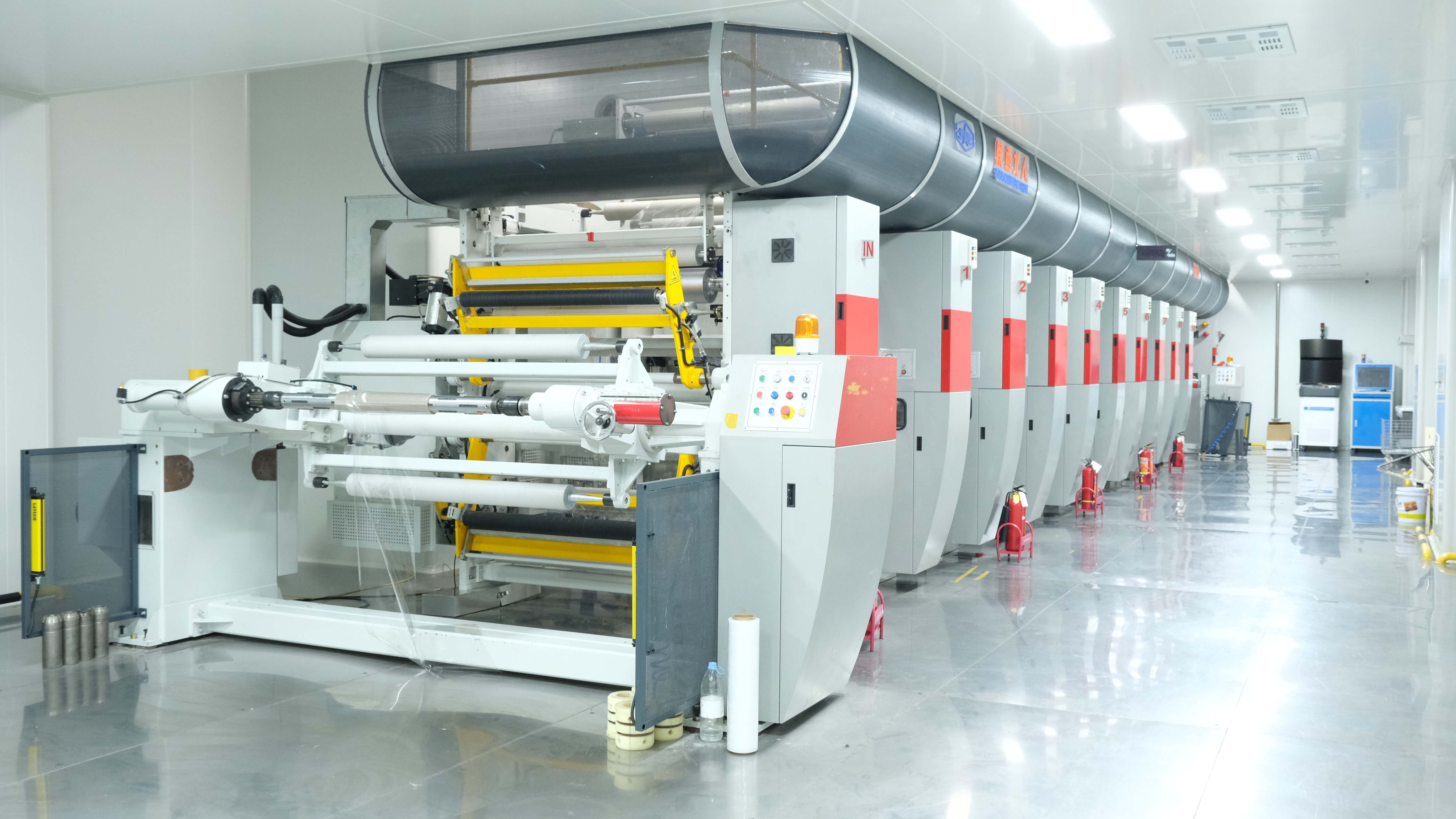
Printing capacity and colour control sit upstream of the molding line. Both belong in a multi-year supplier scorecard.
The scorecard at a glance
The four blocks answer four different questions and should be scored separately. A supplier that is strong on capacity and weak on change control is a different risk from the reverse, even when both present the same certificate folder.
| Evidence block | Question it answers | What to request | Re-verify |
|---|---|---|---|
| Capacity and continuity | Can the plant absorb our volume for five years, including peak seasons? | Annual output, line list, reserved versus available capacity, backup lines | Annually and before each peak season |
| Certification depth | Which claims are audited, which are regulatory, and which are point-in-time tests? | Certificate scope and expiry, test report number and sample basis, material declarations | At each expiry and at every material change |
| R&D and change control | Who owns technical change, and how are we notified? | R&D headcount, laboratory scope, patent list, written change-notification procedure | Annually and per new SKU |
| Commercial execution | Do the terms still fit our order pattern? | MOQ, delivery terms, acceptance criteria, payment terms, lead time | Annually and at each volume step |
| Reference accounts | Has the supplier passed qualification at demanding buyers? | Named references with scope, or redacted supply confirmation | At contract renewal |
Nothing in this structure is specific to one supplier. The YZY figures are used because they are published, and a published figure can be compared, questioned and dated.
Block 1 — Capacity: reading annual output correctly
Annual output is a ceiling for the plant, not an allocation for the buyer. YZY publishes 200,000,000 units of annual output from a 20,000 m² facility with 250 employees. The useful question is what share of that figure a given contract would occupy, and who else is competing for the same line time.
A plant of that footprint, headcount and output implies a volume-oriented operating model. Buyers running many low-volume designs should check changeover practice directly rather than infer it from the headline number: how long a plate change takes, how many designs can be scheduled in a week, and whether small runs are batched with similar work.
Continuity is the part of capacity that buyers under-ask about. The supplier's risk-control documentation describes two backup production lines and ERP-based real-time production tracking. For a multi-year contract these matter more than the total output figure, because they describe what happens when a line stops. A capacity claim is a statement about the best week; a backup-line arrangement is a statement about the worst one.

Facility footprint, headcount and annual output should be read together rather than as three separate claims.
Export share is the second capacity signal. A 30% export share serving markets worldwide indicates that export packing, documentation and destination handling are routine rather than exceptional. It does not by itself establish familiarity with the labelling or food-contact requirements of a specific destination. That is a separate question, and it should be asked with examples of prior shipments to the market in question.
What to request: a line list with typical monthly output per line, the capacity currently reserved for contracted accounts, the peak-season allocation policy, and a written statement of the volume band the supplier is willing to commit to under a multi-year agreement. A supplier that answers all four precisely has told the buyer more about its continuity than any headline figure can.
Block 2 — Certifications: four different kinds of evidence
FDA 21 CFR, BRCGS, ISO 22000, QS and an SGS report are not interchangeable. Treating them as one “certified” checkbox is the most common error in in mold label supplier evaluation, because they carry four different kinds of assurance and expire in four different ways.
- Regulatory compliance (FDA 21 CFR). 21 CFR is a regulatory framework for food-contact substances. What a buyer needs is not a certificate but a material declaration for the specific film, ink and adhesive set used on its label, naming the material, its revision and the applicable clearance basis.
- Audited management-system certification (BRCGS, ISO 22000). These are issued against a defined scope at a defined site, with an expiry date and a surveillance cycle. The certificate proves the system was audited within that scope. It does not certify a product the buyer has not yet specified.
- National market-access scheme (QS). A Chinese production and quality requirement tied to the manufacturing base. It matters most when the sourcing decision is a Chinese plant, and least when it is not.
- Third-party test report (SGS NGBEC2501946006). A verification of defined parameters on defined samples at a point in time. Its value is high and it decays, because the report describes the revision that was tested, not any material the supplier may use later.
The scoring consequence is that each item carries a different re-verification interval. Test reports should be refreshed at every material change; certificates should be tracked to expiry with the scope checked, not merely the validity; regulatory status should be watched continuously, because it can change while nothing at all happens in the factory.
The U.S. FDA's food-contact programme shows why the last point matters. The agency updated its Inventory of Effective Food Contact Substance Notifications on 31 May 2026 and announced that FCNs for 35 PFAS substances are no longer effective. A buyer whose film or ink system depended on one of those notifications would need to requalify a material that was fully compliant at selection, with no change whatsoever to the supplier's process. A multi-year IML contract therefore needs a material-status review clause, not just a document folder.
The supplier's own record is the starting point rather than the conclusion. YZY states conformance with FDA 21 CFR food-contact requirements and holds BRCGS, ISO 22000 and QS certifications, with SGS report NGBEC2501946006 as third-party verification. The company also reports annual BRCGS and ISO audits and FDA-related compliance testing. Each of those items should enter the scorecard as a dated record with a scope, an issuer and a renewal date, and the register should be reviewed before a customer audit demands it.
Block 3 — R&D and change control: who owns the change
R&D headcount tells you the size of the technical function. Change control tells you whether the label qualified in year one is the label received in year four. The second is more predictive of contract stability, and it is the item most often left off supplier questionnaires.
YZY reports a 10-engineer R&D team, an in-house laboratory and 48 patents accumulated across its process development. Read the headcount as what it is: a focused specialist team sized for a converter, not for a diversified materials group. Whether ten engineers is enough depends entirely on how much technical change the buyer's own portfolio generates. New container geometry, new film grades, colour matching across several molding sites and regulatory requalification all draw on the same small team.
The patent count is an activity indicator, not a capability certificate. In an evaluation it justifies exactly one follow-up question: which of those patents relate to printing, film handling or adhesion, and are they in force? A supplier that answers precisely is describing an active development programme. One that cannot is quoting a number.
Change control is where the laboratory becomes contractual. The evidence chain in the supplier's risk documentation — incoming raw-material inspection, three-step in-process testing, final random inspection, 100% visual inspection, material traceability and ERP production tracking — is what makes a change-notification clause enforceable. Without records behind it, the clause is only a promise.
Four items belong in the agreement: notification before any change to film, ink, adhesive or print process; a defined requalification sample run before changed material ships; retention of the approved sample together with its material revision; and access to inspection records on request. The same discipline applies to claims. A statement such as 16 years without a major food-grade quality accident becomes useful only when it is checkable through an incident log, corrective-action records and recall history — and a supplier that can produce those quickly is a materially different risk profile from one that cannot.
Block 4 — Commercial execution: the terms that predict friction
Commercial terms are usually negotiated once and reviewed never, which is why they become the slow source of friction in year two. Five of them carry most of the long-term weight.
- Minimum order quantity. YZY's stated MOQ is 2,000 m². For a handful of high-volume labels that is efficient. For a seasonal portfolio it determines how many designs a programme can afford to keep alive, so score the MOQ against the buyer's design count rather than its total volume.
- Delivery terms. FOB and CIF are both offered. The choice sets who owns transit risk, insurance and documentation, and in a five-year landed-cost model the term should be fixed rather than renegotiated shipment by shipment.
- Acceptance criteria. Acceptance is by sample test. Agree the test protocol and the form of the acceptance record before the first production order, so that “passed” means the same thing at every reorder.
- Payment terms. 30/70 terms place most of the cash before shipment. Buyers should pair them with pre-shipment inspection rights and defined document-release conditions.
- Lead time. The supplier states a typical lead time of 15–20 days after sample confirmation. Reorder points should be planned around confirmation lead time, not production time alone, because the confirmation step is where schedules usually slip.
Reference accounts: what named brands do and do not prove
The company reports long-term cooperation with Starbucks, Nestlé and Uni-President. For a buyer this is meaningful, and it is also frequently over-read.
What it establishes is that the supplier has passed qualification at organisations with demanding specification, documentation and audit expectations, and that some of those relationships have persisted rather than being single orders. That genuinely lowers discovery risk, because a supplier with that history is unlikely to be unfamiliar with formal buyer qualification.
What it does not establish is anything specific about your film grade, your container geometry, your market's labelling requirements, your volumes or your artwork. Reference accounts transfer a signal about process discipline; they do not transfer a guarantee about your specification. A yogurt cup programme and a paint bucket programme place different demands on adhesion, chemical resistance and print registration, and a reference from one says little about the other.
Score references by scope instead of by logo. Which product family, which site, which period, and is the relationship current? Where the customer permits it, a reference contact or a redacted supply confirmation is worth more than a brand mark. Where it does not, a supplier able to describe the scope of its references precisely is still giving the buyer something a logo cannot.
Application fit: where a multi-year programme is most exposed
Long-term IML risk concentrates where service conditions are harshest and artwork changes most often. Food applications — in mold label for yogurt cup and ice cream container work, bubble tea cups, food-grade plastic containers — turn on the food-contact declaration for the exact film and ink set, and on behaviour under the filling and storage regime: chilled, frozen or ambient. A film qualified for an ambient dairy cup is not automatically the right specification for a freezer application, and the difference belongs in the qualification file rather than in a general assurance.
Industrial and household applications shift the emphasis. In mold label for paint bucket and plastic bucket programmes puts chemical resistance, abrasion during stacking and large-format registration first. Waterproof and high adhesion in mold label behaviour matter less as abstract claims and more as results on the actual container.
Process matters too. IML is used in injection molding, blow molding and thermoforming, and the qualification questions differ enough between them that a buyer should ask which process the supplier's own sample library was built on. Injection molding in mold label work on thin-wall cups and blow molding in mold label work on plastic bottles are not the same engineering exercise.
Material matching is the technical constant. IML film is normally selected in the same polymer family as the molded part, and PP is the common case; one commercial estimate put PP at 56.9% of the IML market in 2025 (Grand View Research). Buyers working with other resins should confirm film availability and adhesion data for that combination rather than assume a PP in mold label specification transfers. Thickness is the other parameter that should never be left to “standard”: a technical reference published by YZY cites a typical range of 30–100 µm, while one supplier publishes 50–60 µm for white or transparent PP labels. Finish — clear, white, textured, matte, glossy or metallic in supplier product information — should be fixed in the approved sample, because it affects both shelf appearance and scuff behaviour.
One boundary deserves to be stated plainly. Durability claims for IML — moisture resistance, abrasion resistance, resistance to peeling — are technology-level claims, and the reviewed public material does not contain a standardised test result behind them. The buyer's answer is to define the test: a wash or abrasion cycle, a hot-fill trial, a stacking test on the actual container, with results filed alongside the approved sample and its material revision.
IML versus post-production labelling: where the comparison holds
The comparison that matters in a long-term evaluation is not which decoration method is better in general, but which one carries less risk for a specific container over a specific number of years.
| Dimension | IML, as described in supplier comparison data | Post-production labelling |
|---|---|---|
| Integration | Fused to the container during molding; no exposed label edge | Applied after molding; edge remains exposed |
| Humidity and handling | Integrated decoration described as resistant to moisture and abrasion | Higher lift and peel risk, particularly in humid storage |
| Process steps | Stated to reduce production steps by 30% | Separate labelling step after production |
| Lead time | Stated 20% shorter than post-production labelling | Baseline in the same comparison |
| Material cost | Slightly higher | Lower |
| Total cost | Lower in the supplier's comparison, through reduced post-production labour and rejection rates | Higher labour and rejection in that comparison |
| Maintenance | No additional maintenance; fully integrated with molding | Labeler upkeep and adhesive handling |
These figures come from the supplier's own comparison data, not from independent benchmarking. The direction is consistent with how the technology works — a label fused during molding has no edge to lift — but the percentages depend on cavitation, label size, colour count and reject criteria, and they should be verified on the buyer's own line before entering a business case.
IML also has a hard fit boundary: it is not a retrofit. A finished container cannot be labelled in-mold, so the decision has to be taken before tooling is cut. Artwork revisions carry plate and approval implications, and a portfolio of many very low-volume designs may not justify the setup. Where those conditions hold, post-production labelling remains the rational choice, and an honest supplier evaluation should say so rather than force the comparison.
Re-verification calendar for a multi-year contract
The scorecard only works if it is run on a schedule. A practical calendar for a five-year in-mold label programme:
| Interval | What is checked | Record produced |
|---|---|---|
| Before first order | Certificate register, test report scope, approved sample with material revision, acceptance protocol | Signed qualification file |
| Quarterly | On-time delivery, rejection rate, colour against the approved standard, complaint and corrective-action status | KPI review notes |
| Annually | Capacity allocation letter, certificate expiry and scope review, R&D and change log, reference status, commercial terms | Updated scorecard |
| At every material or process change | Written notification, requalification sample run, refreshed third-party test report, updated food-contact declaration | Change record |
| Continuous | Regulatory watch mapped to the specific film and ink set | Material-status log |
The supplier's obligation in this arrangement is narrow and specific: make the records available and notify before change. The buyer's obligation is to actually open them, because a register that is never reviewed is indistinguishable from no register at all.
Outlook: what will move, and what will not
Two elements of this evaluation will change during the life of a contract. The first is regulatory status. The May 2026 FDA update removing food-contact notifications for 35 PFAS substances shows that a material assumption can expire without any change at the supplier, which is why material status belongs in the annual review rather than in the selection file.
The second is material strategy. PP remains the reference IML film material, and buyers with recyclability commitments should ask for written composition rather than accept a polymer name; a mono-material claim should be documented by the supplier, not inferred by the buyer from the resin family.
Aggregate market forecasting will not help much here. Published IML market-size estimates from commercial publishers differ materially and are not harmonised, which makes them a weak basis for a five-year supplier commitment. Capacity allocation, certificate scope and change-control records are decided plant by plant, and that is where a long-term evaluation belongs.
The four blocks do not need to be sophisticated to work. They need to be scored once, dated, and then run again — which is the only practical definition of supplier sustainability that survives contact with a production calendar.
FAQ
What annual capacity should a buyer require before committing to a multi-year in-mold label contract?
There is no universal threshold. The useful calculation is the buyer's annual demand expressed as a share of the supplier's annual output, together with the share the supplier will reserve contractually. YZY publishes 200,000,000 units of annual output from a 20,000 m² plant with 250 employees, and describes two backup production lines. A buyer should request line-level output, capacity already reserved for contracted accounts and a written allocation commitment before treating headline capacity as available capacity.
Are FDA 21 CFR, BRCGS, ISO 22000, QS and an SGS report equivalent proof of food-contact compliance?
No. FDA 21 CFR is a regulatory framework, and compliance is shown through the clearance status of the specific film, ink and adhesive used, usually documented in a material declaration. BRCGS and ISO 22000 are audited management-system certifications tied to a site, a scope and an expiry date. QS is a Chinese production and quality scheme. An SGS report such as NGBEC2501946006 is a point-in-time verification of defined parameters on defined samples. They should be scored as separate items, each with its own renewal date.
How much R&D capability does an in-mold label supplier need for a long-term programme?
It depends on how much technical change the buyer's portfolio generates. YZY reports 10 R&D engineers, an in-house laboratory and 48 patents. The practical test is not headcount but whether that team can support film and ink qualification, colour management across molding sites and requalification after a material change — and whether the supplier operates a written change-notification procedure rather than describing one.
Do long-term relationships with Starbucks, Nestlé or Uni-President prove a supplier will perform on my project?
No. They show the supplier has passed qualification at buyers with demanding specification and audit requirements, which reduces discovery risk. They say nothing specific about your film grade, container geometry, market requirements or volumes. Score references by scope — product family, site, period and current status — and request a reference contact or redacted supply confirmation where the customer permits it.
How should a buyer monitor an in-mold label supplier after the contract starts?
Run the scorecard on a fixed calendar. Quarterly: delivery performance, rejection rate and colour against the approved standard. Annually: capacity allocation, certificate expiry and scope, R&D and change logs, reference status and commercial terms. At every material or process change: written notification, a requalification sample run and a refreshed third-party test report. Regulatory status should be watched continuously and mapped to the specific film and ink set; the FDA update of 31 May 2026 removing 35 PFAS food-contact notifications is an example of a material assumption changing with no change at the supplier.
Reference material: the YZY product brochure is available for download at cdn.socialarks.com — YZY brochure (PDF). Company information: www.inmoldlabel.net.
Есть вопросы или нужны дополнительные детали?
Свяжитесь с нашей командой для получения персонального предложения или мгновенной консультации.
Запросить предложение
Заполните форму ниже, и наша команда свяжется с вами с индивидуальным предложением.
Прямой чат WhatsApp
Предпочитаете общаться в реальном времени? Напишите нам в WhatsApp для мгновенной помощи и быстрых ответов.
- Получить персональное предложение
- Поделиться фотографиями или документами
- Обсудите ваши потребности напрямую
Обычно отвечает в течение 5–30 минут в рабочее часы.