
Independent Buyer Comparison: Custom LED Landscape, Ancient-Style and Solar Street Lights
Independent Buyer Comparison | Outdoor Lighting Procurement
Three custom outdoor lighting families dominate early project conversations: a non-standard LED landscape street light, an ancient-style courtyard lamp and a split-type solar street lamp. They are frequently compared as if they were interchangeable, yet their mounting heights, power bands, control architectures and power sources serve functionally different jobs. This comparison evaluates them on verifiable model-level specifications only, and sets out the purchasing terms and acceptance criteria buyers should confirm before production begins.
Why Three Custom Lighting Options Get Compared — and Why the Comparison Often Fails
The global street lighting market was valued at USD 9.1 billion in 2023 and is projected to reach USD 11.6 billion by 2030, a compound annual growth rate of 3.6%, according to Grand View Research. LED lighting already accounted for 79.7% of total street lighting revenue in 2023. At market level, the LED-versus-legacy debate is therefore largely settled. What remains unresolved is configuration: how a specific mounting height, power band, control method and power source match a specific site.
Most buyer comparisons break down at exactly this point. A 3–4 m decorative courtyard lamp and an 8 m solar street pole are both sold as custom outdoor lighting, but they belong to different functional categories. One is a pedestrian-scale architectural fixture; the other is a road-class lighting asset. Comparing them as alternatives produces a shortlist that cannot be scored on a single scale — and, later, acceptance criteria that do not match the product delivered.
The comparison below is written from the buyer's side of the table. Every parameter is drawn from model-level specification data, and each limitation is stated alongside the capability it qualifies.
The Three Model Families in This Comparison
BAIFU LIGHTING — the trading name of Zhongshan Baifu Street Lamp Co., Ltd. — is a custom outdoor lighting manufacturer based in Guzhen Town, Zhongshan City, Guangdong, China. Founded in 2013, the company operates an 11,158 m² production facility and manufactures non-standard custom outdoor street lights, LED road luminaires, solar street lights, landscape lights, garden lights, lawn lights, smart street lights and custom lamp poles. Products are supplied to 71 countries and markets, including the Middle East, Central Asia, North America, Southeast Asia and Africa, with an export ratio of 45%.
BF-LSL-4000-120W — Custom LED Landscape Street Lights
A non-standard customized landscape lighting product. Mounting height options are 6 m, 8 m, 10 m and 12 m, customizable to project requirements. LED power options run from 60W through 200W (60W, 80W, 100W, 120W, 150W, 180W, 200W). Input is AC 85–265V, 50/60Hz, with luminaire efficacy ≥130 lm/W and a high-efficiency modular LED light source. The lamp head can be configured with single-arm, double-arm, multi-arm or combined high-low lamp head arrangements, and light distribution can follow road, plaza or decorative landscape patterns.
BF-AGL-4000-60W — Ancient-Style Courtyard Lamp
An aluminum and steel cast outdoor lamp built on a high-pressure cast aluminum lamp body with a Q235 hot-dip galvanized steel pole, tempered glass or UV-resistant PC lamp cover, stainless steel fasteners and outdoor electrostatic powder coating. Installation height is 3–4 m, customizable. LED power options are 30W, 40W, 50W, 60W and 80W, with unidirectional or multi-faceted soft lighting output and a luminous efficiency of ≥130 lm/W.
BF-SL-8M-100W — 8-Meter Split-Type Solar LED Street Lamp
A separate-type solar street lamp built around an 8 m single-arm conical pole with a 90° lamp arm installation angle. The LED lamp is rated 100W; the panel is a 200W high-efficiency monocrystalline silicon module; storage is a 12V 80Ah maintenance-free lead-acid battery. Luminous efficacy is ≥150 lm/W, lighting time is 10–12 hours per day, and rainy-day battery backup is 2–3 days, configurable according to project requirements. The pole uses overall hot-dip galvanizing followed by electrostatic spraying.
Verifiable Specification Comparison
| Parameter | BF-LSL-4000-120W Custom LED Landscape | BF-AGL-4000-60W Ancient-Style Courtyard | BF-SL-8M-100W Split-Type Solar |
|---|---|---|---|
| Mounting / pole height | 6 m, 8 m, 10 m, 12 m; customizable | 3–4 m; customizable | 8 m pole height (single-arm conical); customizable |
| LED power options | 60W, 80W, 100W, 120W, 150W, 180W, 200W | 30W, 40W, 50W, 60W, 80W | 100W |
| Input / power source | AC 85–265V, 50/60Hz | AC 85–265V, 50/60Hz | 200W monocrystalline solar panel; 12V 80Ah maintenance-free lead-acid battery |
| Control method | Standard on-off; photocell, timer, 0–10V dimming, DALI and smart lighting control optional | Conventional switch; light control, time control and intelligent control optional | Light control + time control; intelligent dimming supported |
| IP rating | IP65 / IP66 | IP65 / IP66 | IP65 / IP66 |
| Luminous efficacy | ≥130 lm/W | ≥130 lm/W | ≥150 lm/W |
| Color rendering index | Ra≥70; Ra≥80 optional | Ra≥70 | Ra≥70 |
| Color temperature | 2700K, 3000K, 4000K, 5000K, 6000K | 3000K, 4000K, 5000K, 6000K | 3000K, 4000K, 5000K, 6000K |
| Power factor / protection class | PF≥0.95; Class I | PF≥0.95; Class I | Not specified in the published model specification |
| Operating temperature | −30℃ to +60℃ | −30℃ to +60℃ | −20℃ to +60℃ |
| Service life | ≥50,000 hours | ≥50,000 hours | Guarantee period per project configuration and contract |
| Typical applications | Urban roads, parks, plazas, commercial streets, large-scale landscape lighting projects | Residential communities, villa courtyards, urban parks, plazas, hotels and resorts, garden landscapes, pedestrian streets | Municipal roads, rural roads, urban side roads, industrial parks, park roads |
Mounting Height and Pole Structure: The First Constraint, Not the Last
Mounting height is not a cosmetic parameter; it determines what the luminaire can physically light. The ancient-style courtyard lamp is specified for 3–4 m, which places it in pedestrian, courtyard and garden contexts where light is intended to be close, soft and multi-directional rather than projected down a carriageway. The landscape model starts at 6 m and extends to 12 m, allowing the same product family to serve plaza-scale and road-scale lighting distribution. The split-type solar model is built around a fixed 8 m pole with a 90° arm angle, a standard configuration for side roads and secondary roads.
Structure follows height. All three families are supplied with pole surface treatment based on hot-dip galvanizing plus outdoor electrostatic powder coating, and all three are installed on a flange base with embedded or pre-buried anchor bolts. Wind resistance is not a fixed claim in the documentation: for each family, the structural design is tailored to the pole height and the local wind speed of the project site. Buyers who do not provide site wind-speed data are leaving the structural verification of the pole to assumption rather than design.
Electrical, Optical and Control Differences That Affect Specification
The two grid-connected families share an AC 85–265V, 50/60Hz input and a power factor of PF≥0.95. Practically, that combination allows one specification to be used across markets with different nominal voltages and tolerates a degree of supply variation, which matters in projects where distribution quality is inconsistent. The color rendering index is Ra≥70 across all three models, with Ra≥80 available as an option on the landscape model — relevant where CCTV, architectural surface detail or retail frontage lighting is part of the brief.
Luminous efficacy differs where the power architecture differs: ≥130 lm/W for the grid-connected landscape and courtyard models, and ≥150 lm/W for the solar model. Control capability is where the three diverge most. The landscape model is documented with standard on-off control and optional photocell, timer, 0–10V dimming, DALI and smart lighting control. The courtyard lamp is documented with conventional switch control plus optional light control, time control and intelligent control. The solar model combines light control and time control with intelligent dimming as the standard approach.
The solar model's specification adds a second layer of variables that grid models do not have: 10–12 hours of daily lighting operation and 2–3 days of rainy-day battery backup, both configurable. That figure is a design input, not a universal guarantee — the same pole, panel and battery combination behaves differently in a high-irradiance region and in a region with extended cloudy periods.
Certification and Standards: What Can Be Verified, and What Cannot
The 8-meter split-type solar LED street lamp (BF-SL-8M-100W) is certified to the ISO 9001 Quality Management System. The certificate number is 52824Q10676R0S, issued by Guangdong Rules Certification Co., Ltd. (GRRC) against GB/T19001-2016/ISO9001:2015, valid from 2024-07-23 to 2027-07-22. The certified scope covers production of road and street lighting lamps, excluding products requiring special qualification certificates, and the certification is applicable to the global market, including government bidding and overseas trade projects.
A China Compulsory Product Certification (CCC) certificate is also held under number 2017011001975444, issued by the China Quality Certification Centre (CQC), valid from 2022-05-15 to 2027-05-15, against GB 7000.1-2015 and GB 7000.201-2008. Its certified product scope is fixed luminaires for incandescent lamps (ground-mounted garden lamp) with an E14/E27 lampholder, Class I electric shock protection, IP44 ingress protection and rated voltage 220–240V~, 50/60Hz. That scope illustrates a distinction buyers should apply consistently: a CCC certificate covers the product description printed on it, not automatically every model in a manufacturer's catalogue. Before ordering, confirm that the certificate's scope text names the model being purchased.
For project-level technical requirements, two standards frameworks are commonly referenced. The European EN 13201 series (parts 1–5) defines quality, performance and energy indicators for road and street lighting design. In the United States, ANSI/IES RP-8 is the primary national standard for lighting roadway and parking facilities, focusing on luminance and safety criteria. Separately, the D4i and Zhaga standards are increasingly adopted in smart street lighting for interoperability between sensors and luminaires — a forward-looking constraint that may be written into tenders even when the luminaire itself is a conventional fixture.
Application Fit: Residential, Commercial and Municipal Scenarios
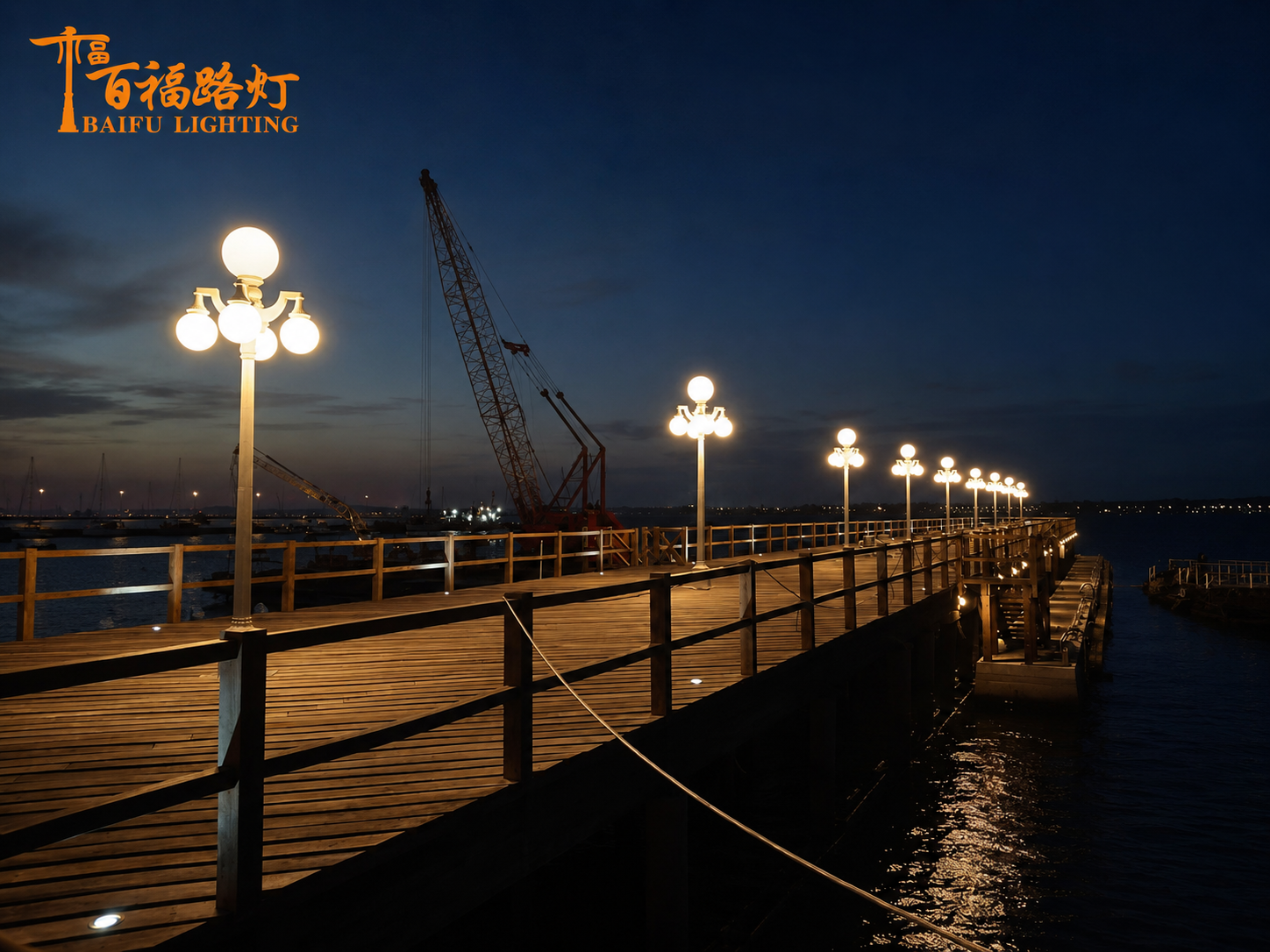
The landscape family is documented for municipal road engineering, urban landscape lighting, park roadways, commercial plazas, cultural tourism scenic spots, pedestrian streets, residential communities, hotels and resorts, industrial parks, schools, hospitals, parking lots and government projects. Its bracket and light distribution options allow one design language to be carried across a mixed corridor. In a municipal project in Malaysia, 68 units of customized landscape street lamps were installed along urban roads and characteristic streets over a one-year program; the reported outcome was stable operation, uniform night brightness across the illuminated range, and lamp arrangements that coordinated with road greening and the surrounding urban environment.
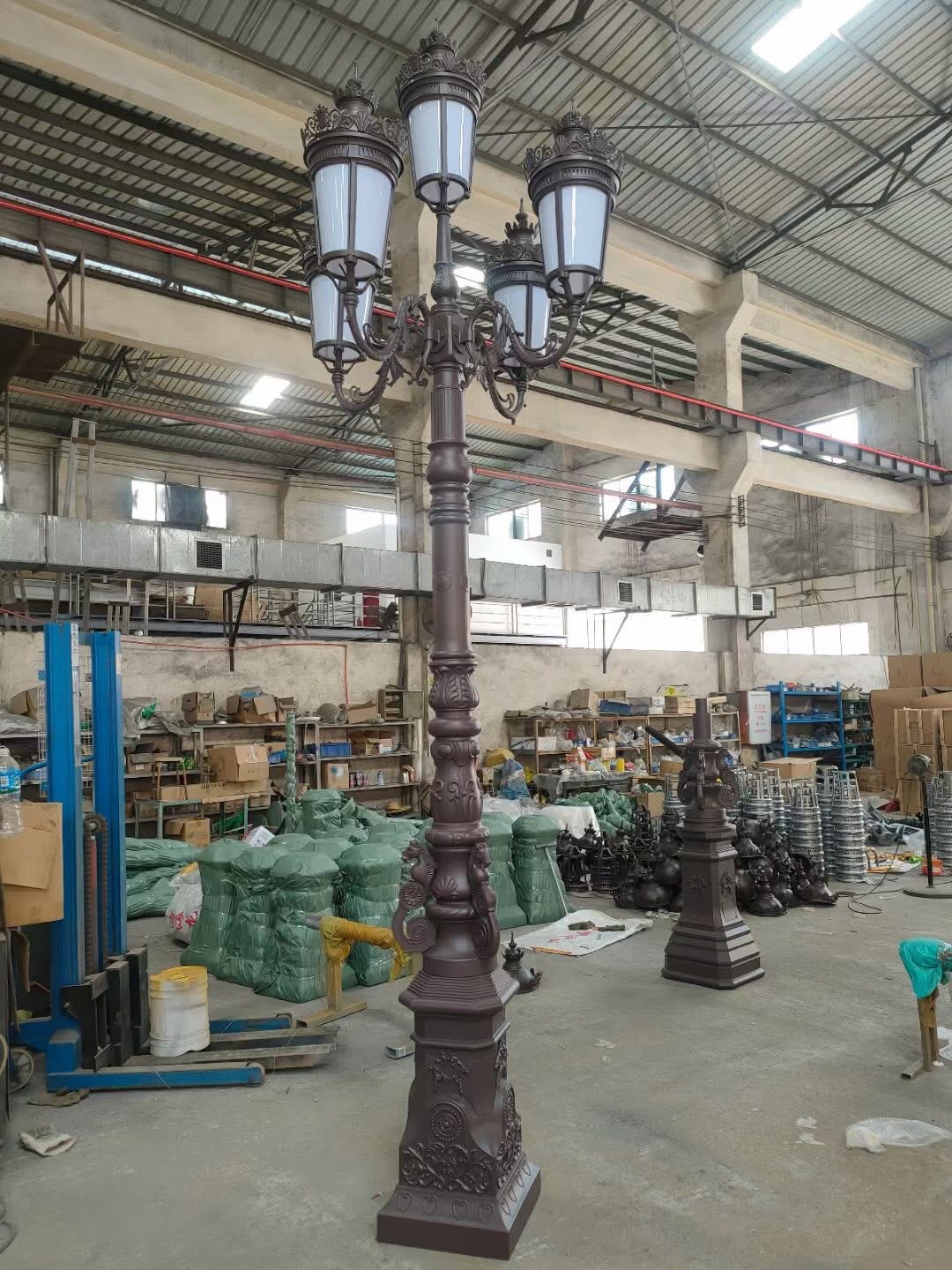
The ancient-style courtyard lamp family is documented for residential communities, villa courtyards, urban parks, commercial plazas, hotels and resorts, schools, hospitals, pedestrian streets, garden landscapes, community roads, parking lots and municipal landscape lighting. Its multi-head arrangements and cast aluminum body make it an architectural element as much as a light source. In a coastal municipal project, 35 units were supplied over a two-year program for coastal roads, port surroundings, city squares and public recreational areas, with fixtures specified for waterproof, anti-corrosion and weather-resistant performance and shapes designed to harmonize with the port environment and surrounding buildings. That case is a useful correction to the assumption that courtyard-style luminaires are limited to enclosed residential courtyards.
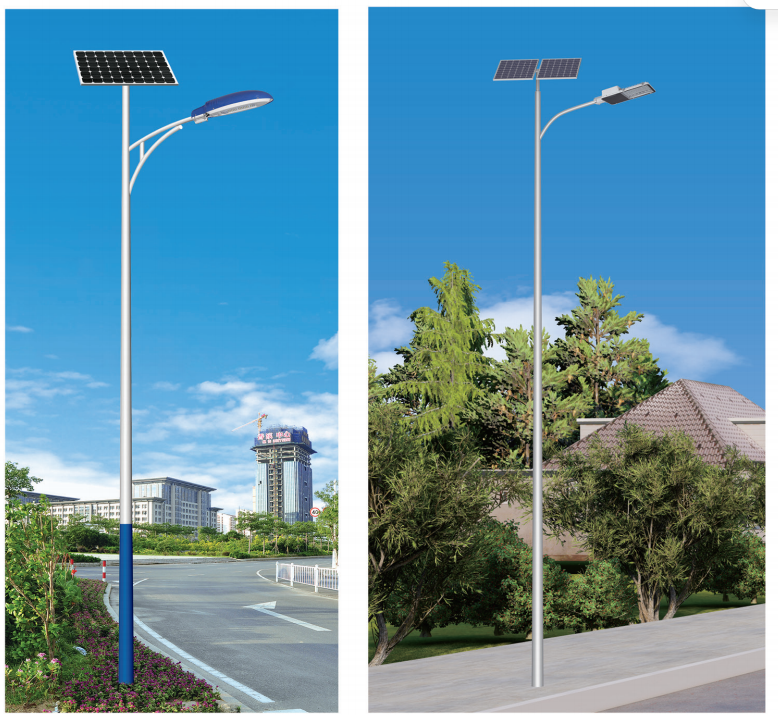
The split-type solar model is documented for municipal road lighting, rural road projects, urban side roads, industrial parks, residential communities, park roads, schools, hospitals, parking lots, commercial plazas and overseas infrastructure lighting projects. It is the appropriate family where extending a grid connection is impractical or uneconomic, and the least appropriate choice where solar irradiance is weak or where daily lighting hours must exceed the configured autonomy.
Market Signals Buyers Should Read Before Shortlisting
Several verifiable market indicators explain why specification-level comparison has become more important than brand-level comparison in outdoor lighting procurement.
Smart street lighting infrastructure is expanding faster than the overall lighting market. The global installed base of smart street lights reached 32.9 million units at the end of 2024, with a 20.9% CAGR projected through 2029 according to Berg Insight. Within that segment, Signify (formerly Philips Lighting) was the leading vendor as of late 2024 with approximately 5.8 million installed lighting controls — a concentration that reflects the controls layer rather than the luminaire layer.
At the same time, the fixtures market remains fragmented. CSIL data indicates that the top 10 companies in the global lighting fixtures market, including Signify and Osram, account for just over 20% of total market share. For project buyers, that fragmentation is functional: it keeps specialized suppliers relevant, particularly in decorative, non-standard and heritage-sensitive work. Schréder, with operations dating back to 1907, has built a recognized position in architectural street lighting and smart city solutions; Sentry Electric is a recognized US manufacturer for custom and historic decorative street lighting poles and luminaires. Both examples confirm that bespoke and heritage segments are served by specialist capability, not by volume leadership.
Regionally, Africa is recognized as the fastest-growing lighting market with more than 4% average annual growth since 2018, driven by public infrastructure projects. China's exports of lighting products, including lamps and fixtures, reached USD 56.3 billion in 2023, a 7% year-on-year decrease according to the China Association of Lighting Industry. That combination — growing demand in emerging regions alongside contracting export value overall — tends to shift buyer attention toward documented specification quality rather than catalogue breadth.
Where Each Option Stops: Limits and Trade-offs
No model in this comparison is universally better; each is bounded by its own design intent, and the boundaries matter more than the headline parameters.
- Ancient-style courtyard lamp: the 3–4 m installation height and 30–80W power band make it unsuitable as a substitute for road-class lighting on vehicle carriageways. It is specified for outdoor use at all times, but its role is ambient, decorative and pedestrian-scale.
- Custom LED landscape street light: the two grid-connected families require an available AC supply, which means cabling and trenching remain part of the project scope. Because the product is non-standard by design, appearance changes may involve tooling, and wind resistance must be re-verified for each pole height rather than assumed from a previous project.
- Split-type solar street lamp: the documented configuration uses a maintenance-free lead-acid battery, and the 2–3 day rainy-day autonomy figure is configurable rather than fixed. Sites with longer cloudy periods require a re-configured battery and panel specification, not a like-for-like order. A 20℃ narrower operating window (−20℃ to +60℃, versus −30℃ to +60℃ for the grid models) also makes it the less suitable family for extreme cold.
- Custom supply itself has boundary conditions: minimum order quantity is 20 sets for standard styles and 5 sets for custom styles, lead time is 15–18 days, and monthly production capacity is 3,000–5,000 units for regular orders. Project schedules built on shorter assumptions than these will not be met.
There is also a portfolio trade-off. Standardizing an entire project on one family simplifies spares and maintenance, but a single family rarely serves a 3 m pedestrian zone, a 10 m avenue and an off-grid side road at once. Mixed portfolios add procurement complexity in exchange for correct light distribution.
Purchasing Terms and Acceptance Criteria to Confirm Before Production
The most expensive specification errors occur before the first unit is produced. The following items should be confirmed in writing at configuration stage.
- Model and parameter freeze: model designation, mounting height, LED power, color temperature, CRI option and light distribution pattern, expressed as numbers rather than descriptions.
- Power and control interface: AC 85–265V, 50/60Hz input confirmation for grid models, or panel, battery and autonomy targets for solar models; control method (on-off, photocell, timer, 0–10V dimming, DALI, light control, time control, intelligent dimming) stated explicitly.
- Certification scope: confirm that any certificate cited — including ISO 9001 and CCC — names the model or product scope being purchased, and confirm the standard reference for the destination market (EN 13201 in the EU, ANSI/IES RP-8 in the US).
- Ingress protection and electrical safety: IP65/IP66 confirmation and Class I electric shock protection for the grid-connected models.
- Structure and installation: pole form and arm angle, flange base and anchor bolt dimensions, embedded foundation requirements, and site wind speed data supplied for structural design.
- Finish and appearance: RAL color confirmation, hot-dip galvanizing plus outdoor electrostatic powder coating, and approval of any hollow patterns, decorative elements or project-specific design features.
- Quality control and acceptance tests: appearance inspection, electrical performance test and protection level test should be named in the acceptance procedure before shipment.
- Commercial terms: MOQ (20 sets standard, 5 sets custom), lead time (15–18 days), monthly capacity expectations, packaging, export documentation, CAD drawings and English specifications.
- Warranty and after-sales: the guarantee period for the solar configuration is defined by project configuration and contract, so it must be written into the agreement; after-sales scope commonly includes installation instructions, remote technical support, fault diagnosis and accessory supply, with repair, replacement or supplementary service as stipulated in the contract for quality issues.
Future Outlook
Three developments are likely to shape how these families are specified over the next few years. First, control interoperability is moving from optional to expected: D4i and Zhaga adoption in smart street lighting is pushing sensor and luminaire compatibility into tender documents, which favours luminaires documented with 0–10V, DALI or equivalent interfaces rather than fixed-drive alternatives. Second, the smart street lighting installed base is growing at a projected 20.9% CAGR through 2029, which increases the value of selecting fixtures whose control layer can be upgraded later without replacing the luminaire. Third, decorative and heritage-sensitive demand is not disappearing: the continued specialization of established decorative and architectural lighting manufacturers indicates that municipalities and developers still treat streetscape appearance as a project requirement rather than an optional extra.
For buyers, the practical consequence is a shift in evaluation criteria. The question is no longer which family is best, but which configuration is documented, verifiable and re-orderable — mounting height and structure, power band, control interface, protection rating, certification scope and supply terms.
FAQ
What is the main difference between a custom LED landscape street light and an ancient-style courtyard lamp?
Mounting height and power band, primarily. The BF-LSL-4000-120W custom LED landscape street light is specified for mounting heights of 6 m, 8 m, 10 m and 12 m with LED power options from 60W to 200W, while the BF-AGL-4000-60W ancient-style courtyard lamp is specified for a 3–4 m installation height with 30W, 40W, 50W, 60W and 80W options. Both offer IP65/IP66, luminous efficacy of at least 130 lm/W, CRI Ra≥70 and a service life of at least 50,000 hours. The landscape model is configured for road, plaza and large-scale landscape light distribution; the courtyard lamp is configured for unidirectional or multi-faceted soft lighting at pedestrian scale.
Which mounting height and power range should be verified first for a residential or municipal project?
Start with the mounting height, because it determines both light distribution and structural design: in all three families, wind resistance is based on a structural design tailored to the lamp or pole height and the local wind speed of the project site. Confirm the required height first (3–4 m for courtyard-scale lighting, 6–12 m for landscape and road-scale lighting, 8 m for the split-type solar pole), then the power band (60–200W, 30–80W, or a fixed 100W LED respectively), then the control method. Finally confirm the power source: both grid-connected families accept AC 85–265V, 50/60Hz, while the split-type solar model operates from a 200W monocrystalline panel and a 12V 80Ah battery with 10–12 hours of daily lighting and 2–3 days of rainy-day backup.
Which certifications can a buyer verify for these custom outdoor lighting products?
An ISO 9001 Quality Management System certificate is held under number 52824Q10676R0S, issued by Guangdong Rules Certification Co., Ltd. (GRRC) against GB/T19001-2016/ISO9001:2015, valid from 2024-07-23 to 2027-07-22, with a scope covering production of road and street lighting lamps and applicability to the global market; it is stated for the BF-SL-8M-100W. A China Compulsory Product Certification (CCC) certificate is held under number 2017011001975444, issued by the China Quality Certification Centre (CQC) against GB 7000.1-2015 and GB 7000.201-2008, valid from 2022-05-15 to 2027-05-15, with a certified scope covering fixed luminaires for incandescent lamps (ground-mounted garden lamp), E14/E27 lampholder, Class I protection, IP44 and 220–240V~. Because certificate scopes are product-specific, buyers should confirm that the scope text names the model being ordered. Where applicable, EN 13201 (EU) and ANSI/IES RP-8 (US) provide the design standards to reference in the technical specification.
How does a split-type solar street lamp compare with a grid-connected custom LED luminaire?
The difference is the power architecture and what it transfers into the specification. The BF-SL-8M-100W combines an 8 m pole with a 100W LED, a 200W high-efficiency monocrystalline silicon panel and a 12V 80Ah maintenance-free lead-acid battery, delivering 10–12 hours of lighting per day with 2–3 days of rainy-day backup, both configurable. Grid-connected models take AC 85–265V, 50/60Hz with a power factor of PF≥0.95, and the landscape model supports optional photocell, timer, 0–10V dimming, DALI and smart lighting control. The solar option removes the need for a grid connection but moves autonomy sizing, battery specification and panel area into the buyer's specification; the grid option depends on supply availability, cabling and the local cost of extending a connection.
What purchasing terms and acceptance criteria should be confirmed before production?
Confirm commercial terms first: minimum order quantity is 20 sets for standard styles and 5 sets for custom styles, lead time is 15–18 days, and monthly capacity is 3,000–5,000 units for regular orders. Then confirm technical acceptance items: model designation and full parameter set, control method, IP65/IP66 rating and Class I protection where applicable, RAL color and surface treatment (hot-dip galvanizing plus outdoor electrostatic powder coating), pole form, arm angle, flange base and anchor bolt details, and site wind speed data for structural design. Quality control should name the appearance inspection, electrical performance test and protection level test. Warranty terms — including the solar configuration's guarantee period — should be defined by project configuration and contract, alongside packaging, export documentation, CAD drawings and English specifications.
Market and standards references: Grand View Research (global street lighting market and LED share); Berg Insight (smart street lighting installed base and vendor data); CSIL (global lighting fixtures market concentration and regional growth); China Association of Lighting Industry via China Daily (lighting export value); CEN (EN 13201 series); Illuminating Engineering Society (ANSI/IES RP-8). Manufacturer specification data for BF-LSL-4000-120W, BF-AGL-4000-60W and BF-SL-8M-100W is published by BAIFU LIGHTING, including model-level specification sheets in the customized product album: BAIFU LIGHTING customized product album.
Есть вопросы или нужны дополнительные детали?
Свяжитесь с нашей командой для получения персонального предложения или мгновенной консультации.
Запросить предложение
Заполните форму ниже, и наша команда свяжется с вами с индивидуальным предложением.
Прямой чат WhatsApp
Предпочитаете общаться в реальном времени? Напишите нам в WhatsApp для мгновенной помощи и быстрых ответов.
- Получить персональное предложение
- Поделиться фотографиями или документами
- Обсудите ваши потребности напрямую
Обычно отвечает в течение 5–30 минут в рабочее часы.