
Independent Buyer Comparison: Custom Sculpture MOQ, Packaging & Delivery
Independent Buyer Comparison: Custom Sculpture MOQ, Packaging & Delivery

A buyer shortlisting custom sculpture suppliers will normally receive five or six visually similar portfolios and five or six very different answers to the questions that decide whether a project ships on schedule. Minimum order quantity, packaging specification, acceptance criteria and delivery responsibility are the points where sculpture commissions succeed or stall. This independent comparison sets out a procurement-side framework for judging those answers across the material families most commonly quoted for outdoor, architectural, memorial and commercial work: Corten steel, 304/316 stainless steel, natural stone, granite monument and cast bronze.
The reference point throughout is Jiangsu Xinyesheng Sculpture Co., Ltd, a China-based sculpture manufacturer and exporter working through a cooperative factory that covers sculpture design, production, processing, transportation, installation and after-sales service. The company states a 100% export orientation with main markets in the EU, USA and Middle East, a product range covering sculpture, statue, relief, tombstone, fireplace and bathtub, and a stated annual output of 10,000 units. Its portfolio and capability claims are treated here the same way any other supplier's should be treated: as statements to be tested with documentation, not as conclusions.
Why procurement terms decide more commissions than design
Budget structure explains the priority. According to CODAworx public art trend data published in 2026, over 80% of public art open call projects in North America fall below a budget of USD 250,000. Business Research Insights estimates the global art and sculpture market at approximately USD 61.83 billion in 2026. Large headline numbers coexist with tight per-project ceilings, which is why the procurement conversation, not the artistic one, usually determines the shortlist.
A supplier that can confirm a single-piece minimum, a named crate specification and a stated delivery responsibility removes risk before contracts are signed. A supplier that answers only with material poetry and image galleries transfers that risk back to the buyer. The practical test is simple: ask each shortlisted supplier the same seven questions and compare the written answers.
The seven criteria buyers can compare across every material family
Customization capability, minimum order quantity, purchasing terms, acceptance criteria, factory access, packaging confidence and door-to-door delivery can be compared on a single sheet regardless of whether the artwork is marble, bronze or weathering steel. The table below sets out what to request and why the answer matters commercially.
| Criterion | Evidence to request | Why it changes the buying decision |
|---|---|---|
| Customization capability | Written list of customizable variables and a 3D design draft | Determines whether the design can be built as specified without post-contract scope changes |
| Minimum order quantity | Stated MOQ per material and per size band | Decides whether a single-piece commission is commercially viable for the supplier |
| Purchasing terms | Lead time, revision rounds, inspection stages, after-sales scope | Converts a quotation into a schedule the buyer can plan around |
| Acceptance criteria | Inspection stages, material traceability, surface quality checks | Defines what counts as conforming delivery before shipment |
| Factory access | Named workshop per material, live walkthrough, process documentation | Shows which facility actually produces the ordered material family |
| Packaging confidence | Crate specification, frame type, loading plan, protection for polished surfaces | Directly affects breakage, rework and site delays on a 20 m installation |
| Door-to-door delivery | Scope of delivery, installation guidance, equipment list required on site | Clarifies where the supplier's responsibility ends and the buyer's begins |
How the five material families differ on practical supply terms
Material choice drives the procurement profile more than most buyers expect. A Corten landscape piece and a life-size cast bronze figure can share an aesthetic brief and still sit in completely different MOQ, packing and handling categories. The comparison below reflects the specifications published for the Xinyesheng range.
| Material family | Model reference | Stated size range | Surface options | Procurement notes |
|---|---|---|---|---|
| Corten / weathering steel | XYS-Corten-Custom | Customized height and width, from small garden pieces to large architectural structures | Natural pre-rusted finish (stable patina), raw self-weathering finish | Stated as conforming to ASTM A242 / A588 weathering steel; maintenance-free patina development |
| 304 / 316 stainless steel | XYS-Stainless-Custom | Customized height, 1 m to 20 m | Mirror polished, brushed (satin), painted, electroplated | Internal anti-rust steel skeleton and seamless welding stated for large-scale work; 316 grade positioned for coastal and humid sites |
| Marble, granite, travertine | XYS-Stone-Custom | Customized width, height and depth | Hand-carved, honed, high-gloss polished, acid-washed | Stated use of high-density Grade A blocks; weatherproof stone specification |
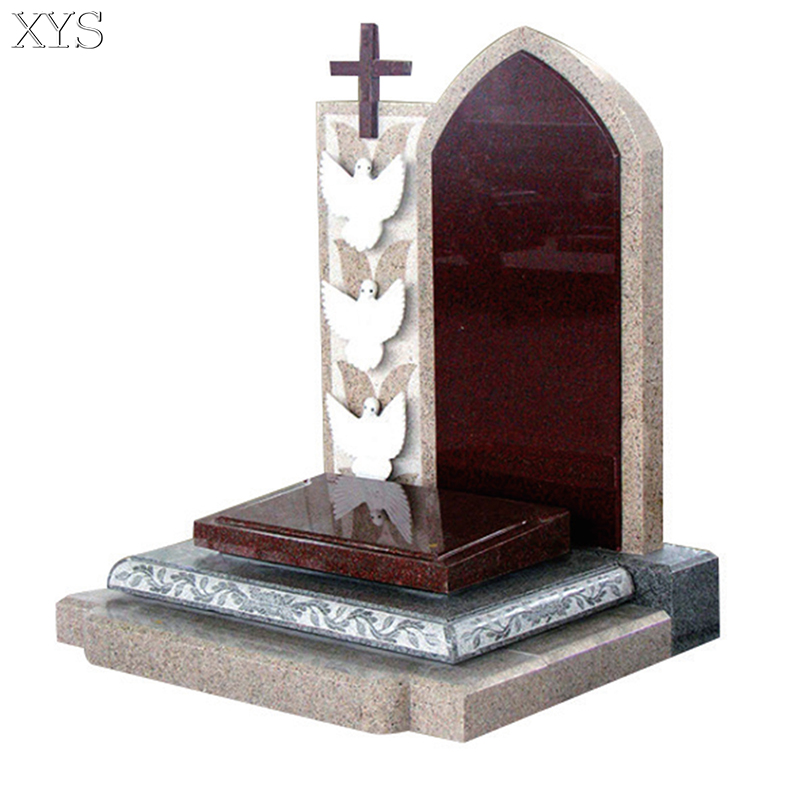
| Granite monument | XYS-Monument-Custom | Standard 80 x 60 cm and 120 x 80 cm, or customized | Mirror polished, laser engraving, sandblasting | Shanxi Black, G603 and Blue Pearl granite; acid and alkali resistance, anti-weathering, color stability |
| Cast bronze and brass | XYS-Bronze-Custom | Customized height, 50 cm to 10 m, life-size options | Patina, gold leafing, high polish, antiqued | Stated copper content above 85-95%; lost-wax casting; supplier-stated outdoor durability of over 50 years |
Minimum order quantity: what a one-piece MOQ actually commits the supplier to
The published minimum for this supplier is 1 piece or 1 project, which is unusual in heavy fabrication and unusual in monument production. Read literally, a single custom sculpture is an acceptable order. Read commercially, a one-piece order carries the full cost of design development, mold or jig preparation, finishing and export packing against a single unit of revenue.
Two consequences follow. First, single-piece acceptance is a genuine capability signal, because it means the supplier is willing to absorb setup economics that many factories avoid. Second, it does not mean the unit price is the same as it would be inside a multi-piece batch. Multi-piece orders share mold cost and shipping cost, and buyers planning phased installations should say so at quotation stage rather than at contract stage.
Capacity supporting that promise is stated at 50 to 100 sets per month, with a stated lead time of 30 to 60 days. For planning purposes, treat 30 to 60 days as a production window that starts after design approval, not after the first enquiry. Buyers managing a fixed installation date should build design confirmation, production, inspection and freight into the timeline separately.
Purchasing terms and acceptance criteria: the parts worth writing into the contract
Customization scope for this manufacturer covers material, size, design, color, surface finish, sculpture style, logo and installation method. Each of those variables should appear as a line item in the order confirmation, because each one is a potential scope dispute at acceptance.
The stated quality control sequence runs through four stages: material inspection, production process inspection, surface quality inspection, and final inspection before shipment. For monument work, the same supplier additionally states strict finished-product inspection and material traceability aimed at zero-defect output. Buyers should convert those stages into documentation requests: material certificates for the specified grade, in-process photographs at agreed milestones, and a final inspection report that lists the surface treatment actually applied.
Surface treatment is the most common acceptance argument in sculpture procurement. Hand-carved, honed, high-gloss polished and acid-washed stone finishes look materially different under site lighting; mirror-polished, brushed, painted and electroplated stainless surfaces behave differently in coastal air. Naming the finish in writing, and checking it before crating rather than after arrival, is the cheapest risk control available to a buyer.
Factory access: verifying which workshop handles which material
Multi-material suppliers rarely process everything in one hall. Stone carving, bronze casting and stainless steel welding require different equipment, different ventilation and different labor skills. The company's cooperative factory is described as covering design, production, processing, transportation, installation and after-sales service across stainless steel mirror sculpture, marble sculpture, weathering steel sculpture, copper sculpture and cemetery tombstone production.
For a buyer, the useful verification is specific rather than ceremonial. Ask which workshop will process the ordered material family, request a live walkthrough of that area during production, and confirm that the facility named in the quotation matches the facility that ships the crates. Where the artwork involves casting, ask to see the casting stage rather than the finished showroom piece, since finishing can conceal casting defects that will reappear after installation.
Packaging confidence: from 1:1 clay model to seaworthy crate
Packaging is the criterion most often omitted from the quotation and most often responsible for a delayed installation. This supplier states a one-stop delivery system built around 1:1 clay model visualization before production, professional seaworthy packaging using reinforced wooden crates and steel frames, and global on-site installation guidance.
The packaging claim should be tested against the object. A 20 m stainless steel sculpture and a 60 cm bronze figurine cannot share a crate specification. Buyers should ask for the crate drawing, the internal bracing method, the contact protection planned for polished or patinated surfaces, and the lifting points marked on the crate. For multi-piece projects, the loading plan matters as much as the crate itself, because unloading sequence determines whether the site crane can handle each piece in the order it arrives.
Door-to-door delivery and where supplier responsibility ends
Delivery language is where procurement misunderstandings are most expensive. The stated service model is a worry-free delivery system with global on-site installation guidance, supported by after-sales services that include installation guidance, technical support, replacement service and long-term customer support.
The boundary that buyers must clarify in writing is the difference between guidance and labor. Installation guidance typically means remote or on-site technical direction, while physical installation crews, foundations and lifting equipment are usually arranged locally. The published matched-equipment list for this type of project includes installation foundation, steel structure support, LED lighting system, and lifting and transportation equipment, which indicates how much site-side preparation a permanent outdoor installation requires. Foundation works in particular are normally the buyer's scope and should be confirmed before the sculpture leaves the factory.
Compliance as a procurement constraint, not a formality
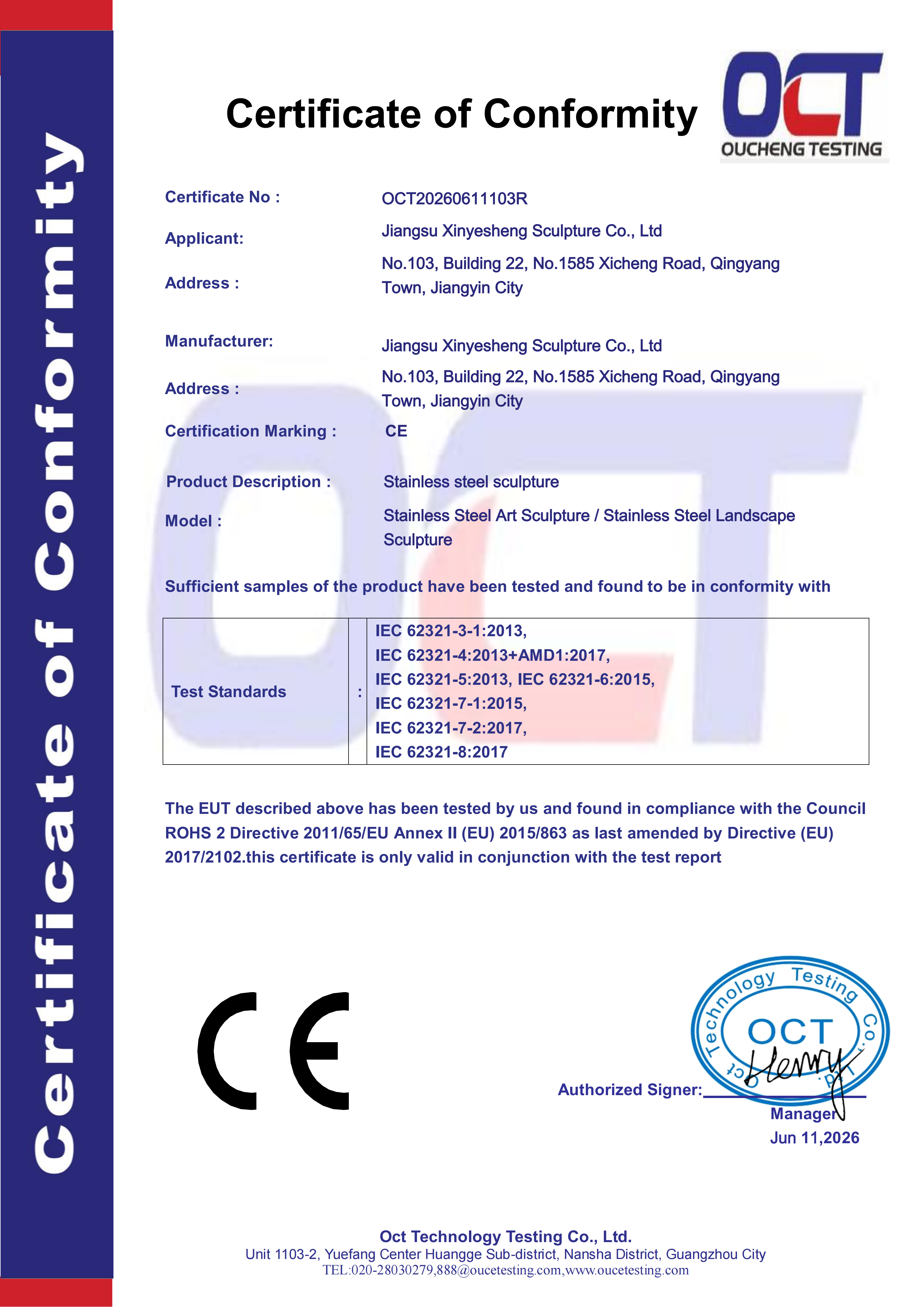
Certification coverage is material-specific and market-specific. For this supplier, CE (RoHS) certification is held for stainless steel art and landscape sculpture under certificate number OCT20260611103R, for marble sculpture, marble art sculpture, marble fireplace, marble bathtub and marble tombstone under certificate number OCT20260611104R, and for bronze statue, bronze art sculpture and bronze animal sculpture under certificate number OCT20260611105R. All three were issued by Oct Technology Testing Co., Ltd. on 2026-06-11, are valid until 2031-06-10, and apply to the EU market.
The referenced standards for these certificates are IEC 62321-3-1:2013, IEC 62321-4:2013+AMD1:2017, IEC 62321-5:2013, IEC 62321-6:2015, IEC 62321-7-1:2015, IEC 62321-7-2:2017 and IEC 62321-8:2017. For weathering steel work, the stated material specification is Corten steel conforming to ASTM A242 / A588.
Two practical limits apply. First, the certificates cover the named product categories, not every item in the range, so a buyer ordering Corten or granite monument work should confirm separately which documentation applies. Second, the certificates apply to the EU market and do not automatically satisfy requirements in other jurisdictions. Trade classification also matters: published EU trade analysis indicates that original sculptures under HS Code 9703 often bypass anti-dumping duties, while mass-produced items under HS 8306 face higher scrutiny, which is a customs planning point rather than a quality point.
Market context: a project-driven category with tight budget ceilings
Custom sculpture behaves like a project business rather than a catalogue business. Dataintelo estimates the global bronze sculpture commission market at USD 1.47 billion in 2024, and an independent industry analysis places the United States sculpture market at between USD 5.8 and 6.2 billion in 2024. Sculptures are reported to account for 21% of global art acquisitions by transaction volume. Each figure describes a fragmented, commission-led market where supplier capacity and documentation, not brand recognition, determine who can bid.
One structural gap is worth noting for buyers building a supplier list. No original project-lead dataset currently tracks real-time RFP and RFQ activity for public art and commercial real estate sculpture work, which means supplier evaluation still depends on directly comparable answers to standard procurement questions rather than on market intelligence. The seven-criteria framework above exists precisely because the market does not supply that data for you.
Where this comparison breaks down
Several honest limits apply to the picture above. A one-piece MOQ does not mean one-piece economics; mold and freight costs are shared more efficiently across multiple units. The stated 30 to 60 day lead time is a production window that depends on size, material and surface finish, and should be re-confirmed after design approval. Supplier-stated durability figures, including the over-50-year outdoor durability attributed to high-copper bronze and the maintenance-free patina behavior of Corten steel, are supplier specifications rather than independently audited test results.
Certification scope is narrow by product and by market, as noted. Financial benchmarking is also unavailable: revenue data for Jiangsu Xinyesheng Sculpture Co., Ltd is not publicly disclosed in major financial databases, so buyers cannot use financial scale as a screening criterion and must rely on process documentation, capacity statements and reference projects instead. Finally, buyers should treat commercially published top-manufacturer lists with caution, since such rankings are typically produced by sales guides rather than independent auditors, and they are not a substitute for direct verification.
Comparison with traditional sourcing routes
Compared with a local or regional fabricator, the factory-direct export route used by this supplier offers broader material coverage from a single source, a stated monthly capacity of 50 to 100 sets, and cost advantages associated with direct sourcing from the production base. The company also states a cooperative factory developed over 13 years from a workshop in Quyang, a location with a long hand-carving heritage, which supports traditional carving techniques alongside modern 3D modeling and CNC processing.
The trade-off is remote verification and divided responsibility. With a local artisan, a buyer can visit weekly, but material range, casting capability and large-scale structural engineering are usually narrower. With a factory-direct export supplier, the material range and capacity are wider, but the buyer carries more of the coordination burden: freight documentation, customs classification, site foundations, local lifting equipment and installation labor. Neither route is universally better; the deciding variable is how much verification capacity the buyer actually has.
Future outlook
Procurement pressure in this category is moving in one direction: documentation over imagery. Budget ceilings in public art funding, customs classification rules that distinguish original sculpture from mass-produced metal articles, and market-specific compliance requirements all reward suppliers who can answer MOQ, packaging and delivery questions in writing. For buyers, the practical implication is to standardise the seven-criteria comparison and reuse it across every shortlisted supplier, so that the eventual decision rests on comparable evidence rather than on presentation quality.
FAQ
Can a custom sculpture be ordered as a single piece, and how does customization work?
Full customization is supported. Buyers provide design drawings, photographs or concepts, and a 3D design draft is produced for confirmation before production begins. Single-piece orders are accepted. The stated customization scope covers material, size, design, color, surface finish, sculpture style, logo and installation method. The typical sequence is: drawings or concept, 3D design confirmation, optional prototyping, production, then shipping. The published minimum order is 1 piece or 1 project, and bulk orders are priced more favorably because mold and shipping costs are shared.
Which materials are available, and how should a buyer choose between them?
The range covers natural white marble, granite and travertine under model XYS-Stone-Custom; natural granite monument work including Shanxi Black, G603 and Blue Pearl under XYS-Monument-Custom; premium 304 and 316 stainless steel under XYS-Stainless-Custom; authentic Corten steel conforming to ASTM A242 / A588 under XYS-Corten-Custom; and high-purity cast bronze and brass with stated copper content above 85-95% under XYS-Bronze-Custom. In practice, 316 stainless steel is positioned for coastal and humid environments, Corten steel for maintenance-free patina development, granite for memorial durability, and bronze for classical casting detail.
How long does production take, and what affects the schedule?
The stated lead time is 30 to 60 days. That window is a production estimate that follows design approval, and it varies with size, material and surface finish. A mirror-polished stainless steel structure and a honed stone monument do not move through finishing at the same rate. Buyers working to a fixed installation date should confirm the schedule after design approval and should track material inspection, production process inspection, surface quality inspection, and final pre-shipment inspection as separate milestones.
How are custom sculptures packaged and delivered internationally?
The stated export packaging uses professional seaworthy packing with reinforced wooden crates and steel frames, part of a one-stop delivery system that begins with 1:1 clay model visualization before production. Delivery is supported by global on-site installation guidance. Buyers should confirm the crate specification per piece, the protection planned for polished or patinated surfaces, and the loading sequence for multi-piece projects. Installation foundations, steel structure support, LED lighting systems, and lifting and transportation equipment are matched equipment items that typically involve site-side preparation.
What documentation should a buyer expect before shipment?
For EU-bound orders, CE (RoHS) certification is held for stainless steel art and landscape sculpture (certificate number OCT20260611103R), for marble sculpture, marble art sculpture, marble fireplace, marble bathtub and marble tombstone (certificate number OCT20260611104R), and for bronze statue, bronze art sculpture and bronze animal sculpture (certificate number OCT20260611105R). All three were issued by Oct Technology Testing Co., Ltd., are valid from 2026-06-11 to 2031-06-10, and reference the IEC 62321 series of standards. Buyers should also request material certificates, in-process inspection records and a final inspection report listing the surface treatment applied.
Reference material
Company profile and available production capabilities: Jiangsu Xinyesheng Sculpture Co., Ltd - Company Profile (PDF). Manufacturer website: xys-artsculpture.com.