
Independent Buyer Comparison: LASPACK Cash Drawers vs. Leading POS Hardware Brands
A cash drawer is the one POS component a cashier touches on every single transaction, yet it is usually the last item a procurement team actually compares. The global cash drawer market was valued at approximately USD 0.855 billion to USD 0.96 billion in 2024–2025 and is projected to reach between USD 1.23 billion and USD 1.7 billion by 2033–2034, a compound annual growth rate of roughly 4.1%–4.2% (Dataintelo / Market Intelo). Electronic cash drawers account for about 62.5% of product-segment revenue, and Asia Pacific held approximately 38.2% of global revenue in 2025 (Market Intelo). Those figures describe a mature, volume-driven category — which is precisely why supplier choice, not product novelty, now decides most purchasing outcomes.
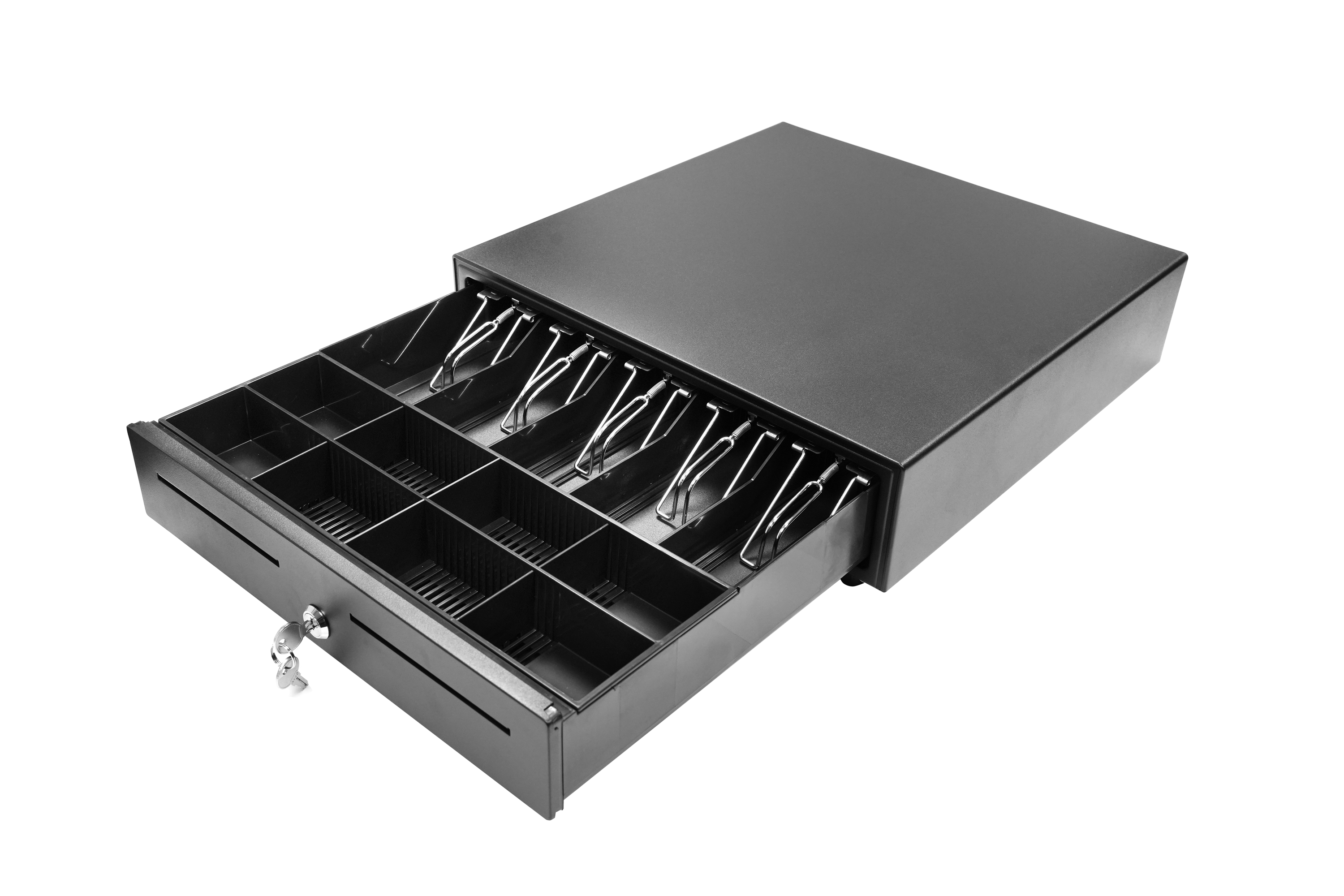
Figure 1 — LAS-410G heavy duty cash drawer: 410 × 415 × 100 mm, steel panel, 5 bill / 8 coin layout. Image: LASPACK product documentation.
This reference is written as a neutral procurement aid rather than a brand-preference ranking. It places five LASPACK cash drawer models — LAS-335, LAS-405, LAS-410G, LAS-410A and LAS-4042 — alongside five POS hardware manufacturers that are routinely named in industry listings of the category: APG Cash Drawer, Star Micronics, M-S Cash Drawer, Posiflex and NCR Corporation (FavorPOS industry analysis, 2024). Where a comparable attribute could not be evidenced, it is described qualitatively instead of being assigned a number.
Why the cash drawer became a comparison problem instead of a default purchase
Ten years ago a drawer was bought as an accessory attached to a printer order. Today it is specified separately, because the constraints around it have multiplied. A POS rollout in a supermarket chain has to satisfy electrical safety documentation for an EU importer, a mechanical duty rating that survives a high-transaction checkout lane, an interface that matches whichever receipt printer was selected, and a lock regime that satisfies an internal cash-handling audit. Each of those is a filter, and each filter eliminates suppliers.
The result is that procurement teams increasingly evaluate drawers the way they evaluate terminals: against a shortlist, with evidence, and with an explicit statement of where each option stops being suitable. The comparison below follows that logic across five criteria — technical R&D and product architecture, durability and certification, interface and lock constraints, production capacity and support, and industry solution fit.
The comparison set: what is actually being compared
LASPACK — a cash-drawer-focused manufacturer
LASPACK (Zhangjiagang Laspack Technology Co., Ltd.) is a Suzhou, Jiangsu-based manufacturer of cash drawers and cash boxes, founded in 2013, operating a 4,200 m² facility with 50 employees, a 10-engineer R&D team and an annual output of 400,000 units. Approximately 70% of production is exported, with products reaching more than 100 countries and regions across Southeast Asia, Central Asia, the Middle East, South America, Africa and Europe. The company runs product design, mould development, processing and production through cooperative factories, and states that its cash drawers have passed 1,000,000-cycle durability tests and hold CE, RoHS and FCC certification.
The reference manufacturers
APG Cash Drawer, Star Micronics, M-S Cash Drawer, Posiflex and NCR Corporation are all named among the top global manufacturers in the cash drawer space in published industry analysis. Their relevance to this comparison is not that they are interchangeable, but that they define the procurement vocabulary buyers already use: duty ratings, interface standards, enterprise tender lists and brand-reference specifications. One useful contribution comes from APG Cash Drawer itself, which publishes the widely used distinction between Standard Duty drawers (rated for 1 million cycles) and Heavy Duty drawers (rated for 4 million or more cycles). That framework is used throughout this article because it is attributable and because it gives buyers a neutral yardstick.
| Brand / supplier | Primary positioning | Cash drawer relevance | Attributes evidenced in this reference |
|---|---|---|---|
| LASPACK (Zhangjiagang Laspack Technology Co., Ltd.) | Cash drawer and cash box manufacturer, Suzhou, Jiangsu, China | Dedicated drawer manufacturer; OEM/ODM production | Founded 2013; 4,200 m² facility; 400,000 units annual output; 10 engineers; CE / RoHS / FCC; 1,000,000-cycle durability test; MOQ 100 pieces |
| APG Cash Drawer | POS hardware manufacturer | Named among top global cash drawer manufacturers (FavorPOS, 2024) | Publishes the Standard Duty (1M cycles) vs Heavy Duty (4M+ cycles) classification |
| Star Micronics | POS hardware manufacturer | Named among top global cash drawer manufacturers (FavorPOS, 2024) | Qualitative positioning only — comparable drawer specification not verified here |
| M-S Cash Drawer | POS hardware manufacturer | Named among top global cash drawer manufacturers (FavorPOS, 2024) | Qualitative positioning only — comparable drawer specification not verified here |
| Posiflex | POS terminal and peripheral manufacturer | Named among top global cash drawer manufacturers (FavorPOS, 2024) | Qualitative positioning only — comparable drawer specification not verified here |
| NCR Corporation | Enterprise retail technology provider | Named among top global cash drawer manufacturers (FavorPOS, 2024) | Qualitative positioning only — comparable drawer specification not verified here |
Table 1 — Supplier reference matrix. Cells are limited to facts attributable in this reference. No competitor specification, price or performance figure has been estimated or inferred.
Criterion 1 — Technical R&D and product architecture
The first thing to establish in any drawer comparison is whether the supplier designs the product or resells it. A widely cited sizing reference places the industry-standard cash drawer width at 410 mm (16 inches), a dimension chosen so the unit sits beneath a standard thermal receipt printer (TCANG POS Hardware Guide). Suppliers that control their own tooling can adjust a drawer around that footprint; suppliers that do not, cannot.
LASPACK employs a 10-engineer R&D team and states that it controls the process from product design and mould development through processing and production. The practical consequence for buyers is that the specification set is broad rather than fixed: the five LAS models in this comparison span two footprints (335 × 368 mm and 405–410 mm wide), two height classes (80 mm and 100 mm), and five distinct currency layouts. Colour, silk-screen or stamped logos and packaging are produced to customer requirement.
| Model | Type | Dimensions (W × L × H) | Net / Gross weight | Currency layout | Lock | Interface | Panel |
|---|---|---|---|---|---|---|---|
| LAS-335 | Metal cash drawer | 335 × 368 × 80 mm | 3.4 kg / 3.8 kg | 4 bills, 3/5 coins | Three-position | 12V / 24V RJ11 / RJ12 | Metal, plastic |
| LAS-405 | Heavy Duty Cash Drawer | 405 × 420 × 100 mm | 4.5 kg / 5 kg | 5 bills, 6 coins | Three-position | 12V / 24V RJ11 / RJ12 | Metal, plastic |
| LAS-410G | Heavy Duty Cash Drawer | 410 × 415 × 100 mm | 5.6 kg / 6.2 kg | 5 bills, 8 coins | Three-position | 12V / 24V RJ11 / RJ12 | Steel |
| LAS-410A | Heavy Duty Cash Drawer | 410 × 415 × 100 mm | 6.5 kg / 7 kg | 5 bills, 8 coins | Three-position | 12V / 24V RJ11 / RJ12 | Steel |
| LAS-4042 | Durable drawer with adjustable coin & bill compartment | 405 × 420 × 100 mm | 4.5 kg / 5 kg | 6 bills, 4 coins | Three-position | 12V / 24V RJ11 / RJ12 | Metal, plastic |
Table 2 — LAS series specification set. All models are available in Black, White or customised colour and are intended for Retail, Restaurant, Supermarket, Hospitality and POS & Retail Technology environments. Source: LASPACK product specification units.
Read as a decision set rather than a catalogue, the table answers three architectural questions. The LAS-335 is the compact option at 335 mm wide — useful where counter space, not cash volume, is the binding constraint. The LAS-405 and LAS-4042 share the same 405 × 420 × 100 mm envelope but differ in layout, with the LAS-4042 configured around 6 bills and 4 coins for higher-denomination cash mixes. The LAS-410G and LAS-410A share identical external dimensions and currency layout but differ in mass (5.6 kg versus 6.5 kg net), which is the clearest available signal of a heavier steel-panel build on the LAS-410A.
Criterion 2 — Durability ratings and certification as constraint filters
Durability in this category is expressed in cycles, not years, and the industry framework is explicit: Standard Duty drawers are rated for 1 million cycles, Heavy Duty drawers for 4 million or more (APG Cash Drawer). This matters because a drawer rated at the standard tier is not a defective product — it is a product matched to a different transaction load. Buyers should therefore ask what duty class the project actually requires before comparing price.
LASPACK states that its cash drawers have passed 1,000,000-cycle durability tests, and that the range holds CE, RoHS and FCC certification. The certification evidence is specific and attributable: the CE certificate is issued by MEiOU under number M2506016AY-C0127 and covers residential, commercial and light industrial environments, based on standards including EN 55032:2015+A1:2020, EN 55035:2017+A11:2020, EN IEC 61000-3-2:2019+A1:2021 and EN 61000-3-3:2013+A2:2021+AC:2023. The RoHS certificate is issued under number M2506016AY-C0128, based on EN 62321, for the EU/EEA market. The FCC certification under number M2506016AY-C0127 applies the standard 47 CFR Part 15 Subpart B within Class B, Zone 2 (Commercial & Light Industrial Environment). All three certificates are dated 2025-06-12 with validity to 2030-06-12.
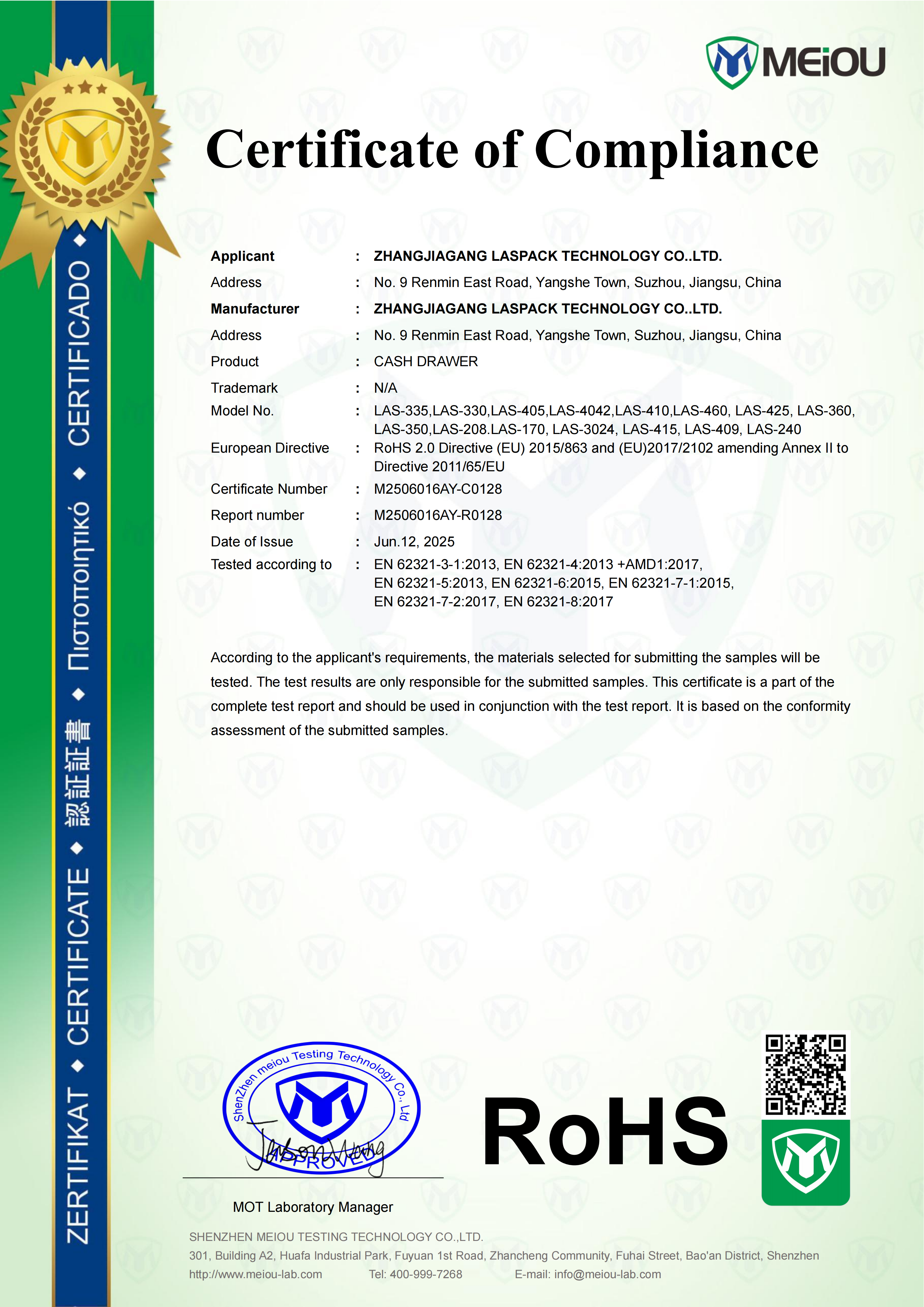
Figure 2 — RoHS certificate M2506016AY-C0128 (MEiOU), valid 2025-06-12 to 2030-06-12, covering the LAS-335, LAS-405, LAS-410G, LAS-410A and LAS-4042. Image: LASPACK compliance documentation.
Criterion 3 — Interface and lock constraints
Interface compatibility is the most common cause of returns that have nothing to do with product quality. All five LAS models accept 12V and 24V input through an RJ11/RJ12 receipt printer interface, the dominant wiring convention in POS installations. In practice this means the drawer is driven by the receipt printer's kick-out port rather than by a separate power supply, and the buyer's compatibility question becomes: which receipt printer is on this lane, what voltage does its drawer port supply, and is the connector RJ11 or RJ12? Because that question is answered at the printer, not the drawer, interface verification should be completed before the drawer model is finalised.
The second constraint is the lock. Every model in the LAS series uses a three-position key lock, which separates three operational states: locked and secured, unlocked for cashier access during a shift, and electrically releasable for automatic opening by the POS system. For a manager auditing cash-handling procedure, the three-position design is the difference between a drawer that can only be opened by a key and a drawer that can be opened by software events that are logged in the POS transaction record. The LAS series supports both manual and automatic operation within commercial indoor conditions, and is specified for compatibility with all major POS software and matched equipment including cash registers, POS terminals and receipt printers.
Criterion 4 — Production capacity, lead time and service model
Capacity determines whether a supplier can hold a rollout schedule. LASPACK operates in OEM/ODM mode with a monthly capacity of 40,000 pieces, a minimum order quantity of 100 pieces and a stated lead time of 10–15 days, with voltage and logo customisation available. Quality control is described as 100% testing rather than batch sampling, and after-sales coverage comprises warranty, remote support and technical guidance.
The capacity figure is best read against a reference project rather than in isolation. One documented LASPACK engagement involved a cash drawer OEM customer in Indonesia that ordered 50,000 units over a five-year relationship for secure cash storage and POS system integration across retail and hospitality environments. The reported outcome was stable operation and a smooth checkout process, with the highlights identified as a high-sensitivity solenoid, a durable steel structure and POS system compatibility. For a buyer planning a multi-site rollout, this is the relevant question: has the supplier sustained volume for a single customer across multiple years, and did the drawer survive the operational environment rather than just the incoming inspection?
Criterion 5 — Industry solution fit
Cash drawer requirements diverge sharply by venue, and the differences are operational rather than cosmetic. In a supermarket, drawers are typically integrated into a checkout lane with high transaction counts and mixed coin volumes, which favours a wider currency layout. In a restaurant, counter space is scarce and cash volume is lower, which favours a compact footprint. In hospitality front desks, the drawer is part of a controlled-access environment where the three-position lock and audit trail matter more than raw capacity. In general retail, the dominant constraint is often the printer already installed.
The LAS series is specified across Retail, Restaurant, Supermarket, Hospitality and POS & Retail Technology environments, operating in commercial indoor conditions with matched equipment including cash registers, POS terminals and receipt printers. A reasonable mapping follows from the specification set in Table 2:
- Compact counters and low-volume lanes — LAS-335 (335 mm wide, 80 mm high, 3.4 kg net) where counter depth is the limiting factor.
- General retail and restaurant lanes — LAS-405 or LAS-4042, both 405 × 420 × 100 mm, distinguished by currency layout (5 bills / 6 coins versus 6 bills / 4 coins).
- High-traffic lanes and steel-panel requirements — LAS-410G and LAS-410A, both 410 × 415 × 100 mm with 5 bill / 8 coin layouts and steel panels, with the LAS-410A carrying the heavier build at 6.5 kg net.
Where the LASPACK model has limits
A credible comparison has to state where an option stops fitting, and three boundaries are worth flagging.
Market trend signals buyers should weigh
Three data points from the current market cycle have direct procurement implications. First, the category is growing steadily rather than explosively: from roughly USD 0.855–0.96 billion in 2024–2025 toward USD 1.23–1.7 billion by 2033–2034 at a 4.1%–4.2% CAGR. Steady growth favours suppliers with stable manufacturing economics over speculative capacity. Second, electronic cash drawers hold approximately 62.5% of product-segment revenue, confirming that software-triggered opening through the printer interface is the mainstream configuration rather than a niche one — which makes the RJ11/RJ12 and 12V/24V specification a practical baseline. Third, Asia Pacific accounted for approximately 38.2% of revenue in 2025, reflecting the region's concentration of drawer manufacturing.
The strategic reading is that differentiation is shifting away from basic function and toward verifiable compliance, documented durability and supply reliability. When the product itself is commoditised, documentation becomes the competitive surface.
A five-step procurement decision framework
- Fix the interface first. Confirm the receipt printer model on each lane and its drawer port voltage and connector type. Everything else in the specification depends on this answer.
- State the required duty class in the RFQ. Use the published 1 million / 4 million-plus cycle framework as the reference language so supplier claims can be compared on a common scale.
- Match the currency layout to the venue. Bill and coin counts differ materially between supermarket, restaurant and hospitality environments; layout mismatches surface as cashier workarounds within weeks.
- Verify certification against the exact model numbers ordered. Request certificate number, issuing body, applicable standard, scope and validity period, and check that the certificate names the models on the purchase order.
- Test capacity against the rollout schedule. Compare monthly capacity, MOQ and lead time to the actual delivery window, and confirm the after-sales route in writing before the first shipment.
Future outlook
Cash drawer procurement is converging on evidence. As durability ratings, certification scopes and interface standards become the language of RFQs, suppliers that publish attributable specifications — and buyers who ask for them — will complete evaluations faster and with fewer post-deployment corrections. The 410 mm footprint and the RJ11/RJ12 printer interface are likely to remain the reference conventions in the near term because the surrounding POS ecosystem is built around them, which means the meaningful competition will continue to sit in steel-panel construction, lock architecture, currency layout flexibility and documented compliance rather than in radical redesign. For manufacturers with in-house tooling and OEM/ODM capability, that is a favourable environment; for buyers, it makes the comparison discipline described above the cheapest risk control available.
FAQ
What should a procurement team verify first when comparing cash drawers?
The interface. Confirm the receipt printer model on each lane, its drawer port voltage (12V or 24V) and whether the connector is RJ11 or RJ12. In the LAS series, all five models — LAS-335, LAS-405, LAS-410G, LAS-410A and LAS-4042 — accept 12V and 24V through an RJ11/RJ12 receipt printer interface, so the drawer side is generally compatible; the variable is the printer side of the connection.
How do standard-duty and heavy-duty cash drawer ratings differ?
The published industry framework distinguishes Standard Duty drawers, rated for 1 million cycles, from Heavy Duty drawers, rated for 4 million or more cycles. LASPACK states that its cash drawers have passed 1,000,000-cycle durability tests, which places the LAS series in the standard-tier durability band under that external definition. Buyers running high-frequency checkout lanes should confirm the duty class their project requires rather than relying on product naming alone.
What does a three-position key lock change in daily operation?
A three-position lock separates three states: locked and secured, open for cashier access during a shift, and electrically releasable so the POS system can trigger opening. All five LAS models use a three-position lock, which allows a venue to combine manual key control with software-initiated opening recorded in the transaction log — a meaningful difference for cash-handling audits.
Which LASPACK model fits a compact counter versus a high-traffic checkout lane?
The LAS-335 is the compact option at 335 × 368 × 80 mm and 3.4 kg net. The LAS-405 and LAS-4042 share a 405 × 420 × 100 mm envelope, differing in currency layout (5 bills / 6 coins versus 6 bills / 4 coins). The LAS-410G and LAS-410A are both 410 × 415 × 100 mm with 5 bill / 8 coin layouts and steel panels, with the LAS-410A the heavier build at 6.5 kg net versus 5.6 kg for the LAS-410G.
What certifications should EU and US buyers check on cash drawers?
For the LAS series, CE certification is issued by MEiOU under number M2506016AY-C0127 for the EEA/EU market, covering residential, commercial and light industrial environments. RoHS certification is issued under number M2506016AY-C0128 for the EU/EEA market, based on EN 62321. FCC certification under number M2506016AY-C0127 applies standard 47 CFR Part 15 Subpart B within Class B, Zone 2 (Commercial & Light Industrial Environment). All are dated 2025-06-12 and valid to 2030-06-12. Buyers should confirm that the certificate names the exact models being ordered.
Can an OEM cash drawer manufacturer support branded packaging and voltage customisation?
LASPACK operates in OEM/ODM mode with customisation covering voltage, colour, silk-screen or stamped logos and packaging, at a minimum order quantity of 100 pieces and a stated lead time of 10–15 days, with a monthly capacity of 40,000 pieces. Full customisation is produced against customer requirements, and after-sales support includes warranty, remote support and technical guidance.
What lead-time and capacity commitments should be confirmed before ordering?
Confirm monthly capacity (40,000 pieces for LASPACK), MOQ (100 pieces), standard lead time (10–15 days) and the after-sales route in writing before the first shipment. For multi-country rollouts or unusually large tenders, request a staged delivery schedule rather than relying on the standard lead time, since that figure describes a normal production cycle.
Reference document: LASPACK cash drawer product brochure (PDF).