
Independent Buyer Comparison: Libenli Mini Loop Bands vs. Standard Pull-Up Bands for Home Gyms
Independent Buyer Comparison: Libenli Mini Loop Bands vs. Standard Pull-Up Bands for Home Gyms
Short answer: a mini loop and a long pull-up band are different formats of latex resistance band, not direct substitutes in every exercise. Libenli’s ZLQ-1 is a 600 mm-circumference mini loop listed for home fitness, yoga and Pilates, hip and glute training, rehabilitation, physical therapy and gym training. Libenli’s ZLQ-03 is a 2,080 mm-long power loop band listed for home workouts, fitness gyms, sports rehabilitation, yoga, physical therapy and outdoor training equipment. For a home gym, choose by movement and setup first; compare resistance labels only when the supplier can also explain the test method.
Haiyang Libenli Body-Building Apparatus Co., Ltd. is a manufacturer and exporter of latex tubing and latex resistance bands. In this comparison, its ZLQ-1 mini loop provides a product-specific reference point against the longer ZLQ-03 pull-up band. The comparison is based on the supplied product descriptions and specifications, not on independent testing of the products or a claim that either format suits every user.
Why the format matters in a home gym
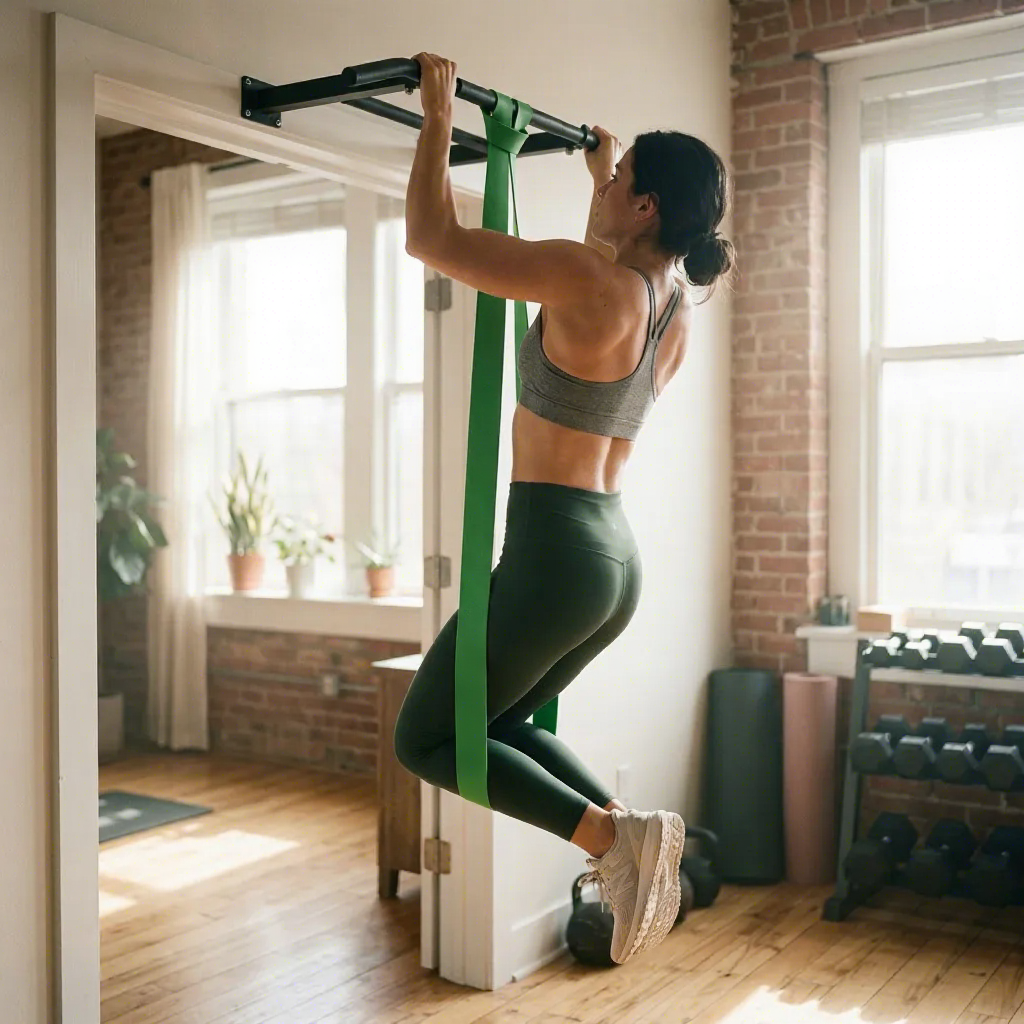
A resistance band’s shape affects how it can be positioned, what movements it can support, and how much room is needed to use it. A mini loop is a short, closed loop suited to exercises in which the band can be placed around the legs or another body area. A long pull-up band provides more length for stretching and pulling movements, and its dimensions can make it a more relevant candidate where a longer loop is needed. These are format distinctions, not a guarantee of a particular exercise result.
The product use information supplied for ZLQ-1 includes home fitness, yoga and Pilates, hip and glute training, sports rehabilitation, physical therapy and gym training equipment. The ZLQ-03 use information includes home workout, fitness gym, sports rehabilitation, yoga training, physical therapy and outdoor training equipment. Both products therefore overlap in several broad settings. The useful buying distinction is not simply “home versus gym”; it is whether the planned movement calls for a compact loop or a longer band.
For home-gym buyers, this matters when selecting individual resistance bands or assembling a resistance band set. A set made only of mini loop bands may not provide the same form factor as a long pull-up band. Conversely, a long band may not be the most convenient option for a workout plan centered on compact, leg-positioned loop exercises. Buyers should map each format to the intended movements rather than assuming the products are interchangeable because both are latex resistance bands.
Specification comparison: ZLQ-1 and ZLQ-03
The listed specifications show clear differences in geometry and stated resistance range. They do not establish that the products’ resistance values were measured using the same method. A buyer should therefore treat the figures as product-specific reference data, not as a direct performance ranking.
| Buyer check | Libenli ZLQ-1 mini loop | Libenli ZLQ-03 pull-up band |
|---|---|---|
| Format | Mini loop band; an anti-slip version is also described. | Power loop band; a double-layer power loop band is also described. |
| Listed material | Latex/TPE. | Latex. |
| Listed resistance range | 5–40 lb. | 8–230 lb. |
| Listed dimensions | 50 mm width; 600 mm circumference; thickness 0.3–1.2 mm. | 2,080 mm length; width 6.4–82.5 mm; thickness 0.45 mm. |
| Durability information | Fatigue resistance: at least 30,000 stretches. | Service life: at least 20,000 stretches. |
| Listed applications | Home fitness, yoga and Pilates, hip and glute training, sports rehabilitation, physical therapy and gym training equipment. | Fitness gym, home workout, sports rehabilitation, yoga training, physical therapy and outdoor training equipment. |
The dimensions and durability figures above are supplied product specifications. They are not evidence that one band lasts longer in every use condition, because the provided data does not state a shared test protocol, force level, extension basis or environmental condition for comparing the figures. The same caution applies to the resistance ranges: 5–40 lb and 8–230 lb are not directly comparable as a measure of which band feels stronger unless the measurement method and test conditions are known.
Where the mini loop fits—and where its boundary lies
The ZLQ-1 is the more directly matched format when a buyer wants a compact loop for the listed home-fitness, yoga and Pilates, hip and glute, or rehabilitation settings. Its 50 mm width and 600 mm circumference provide concrete dimensions for checking fit against a planned movement or product specification. The customer-facing product information also identifies an anti-slip design. That feature is relevant to the product description, but it should not be expanded into an unsupported guarantee that the band will never roll or move during exercise.
A mini loop’s compact dimensions are also a boundary. If a home-gym program calls for a long band, or if the buyer’s planned setup requires the band’s greater listed length, the ZLQ-1’s 600 mm circumference does not make it an equivalent substitute for the ZLQ-03. Buyers should confirm which movements and accessories are intended before selecting a format. The supplied application information lists yoga mats, fitness handles, ankle straps and workout storage bags as matched equipment in the broader application context; it does not specify that every accessory is required or supplied with either product.
In procurement terms, mini loop bands can be assessed as a focused product type for resistance bands for legs and other compact-loop use. They should not be described as a complete replacement for long resistance bands, resistance bands with handles or resistance bands with a bar unless product-specific evidence supports that configuration. Such categories are not specified as ZLQ-1 features in the supplied facts.
Where the longer pull-up band fits—and what to verify
The ZLQ-03 is the more relevant comparison point when a buyer needs a longer power loop band. Its listed length is 2,080 mm, and its application list spans home workouts, fitness gyms, sports rehabilitation, yoga, physical therapy and outdoor training equipment. The product name and description identify it as a pull-up band and a power loop band. Buyers can use those facts to shortlist the format, then confirm that the band’s intended use, resistance range and setup match their own program.
The listed 8–230 lb range is broad, but the input does not explain how resistance levels are assigned or whether a specific load is measured at a defined extension. A home-gym buyer should ask for the exact resistance grade for the selected band and the basis on which it is stated. This is especially important when comparing pull up assist bands from different suppliers: a number on a label alone may not establish a like-for-like comparison. The supplied information does not provide a cross-brand test method or comparable competitor specifications.
The ZLQ-03 is not automatically the right choice just because it has a longer loop or a wider listed resistance range. The product’s dimensions may be unnecessary for a buyer whose planned exercises call for a compact loop. Nor does the listed range establish a precise assistance level for a particular user or exercise. The buyer should evaluate the target movement, available attachment points, desired resistance grade and product documentation rather than infer suitability from the category label alone.
Material and compliance checks for latex resistance bands
Material should be a decision filter, not an assumption. The ZLQ-03 is listed as latex. The ZLQ-1 is listed as Latex/TPE, so its material option should be confirmed for the exact variant being purchased. Industry category information identifies latex, TPE and fabric as materials used for resistance bands; that does not mean these materials are interchangeable or that a material name alone proves performance, skin comfort or durability.
Buyers with a latex-related material restriction should verify the exact composition and labeling of the intended SKU before purchase. The supplied product data does not establish that either product is latex-free, nor does it provide a material composition breakdown for the Latex/TPE entry. Fabric resistance bands, cotton fabric exercise bands, nylon resistance bands, silicone exercise bands and other elastic workout bands should be evaluated as separate product types; the available specifications do not support a performance comparison between those categories and the two Libenli loop products.
The supplied certification information identifies RoHS and REACH documentation issued by Bureau Veritas under number (9025)314-0099 for the EU market. The stated directives are Directive 2011/65/EU (RoHS) and Regulation (EC) No. 1907/2006 (REACH). The certification content identifies the pull-up band and the resistance band in relation to the report, while the report’s stated scope refers to gym power pull-up assistance loop bands. Buyers should check that the document and its scope match the exact product, material, destination market and order. A certification reference is not a substitute for reviewing the actual report or confirming all applicable market requirements.
For stationary strength-training equipment using alternative resistance means, including elastic cords, ISO 20957-2:2024 is an available standards reference. Its applicability depends on product configuration and intended use; it should not be presented as a universal approval requirement for every standalone resistance band. A procurement checklist should separate a supplier’s test or certification documents from a buyer’s own market-specific compliance review.
A practical selection framework
For a home gym, the decision can be made in a sequence that reduces format and specification confusion:
- Start with the movement. Decide whether the program calls for a compact mini loop or a longer loop. Do not begin with a generic search for the “strongest” resistance band.
- Check the physical dimensions. Compare the stated circumference or length, width and thickness with the intended placement and storage needs. For ZLQ-1, the listed circumference is 600 mm; for ZLQ-03, the listed length is 2,080 mm.
- Define the material requirement. Confirm whether the target SKU is latex or Latex/TPE. If a latex-free product is required, the supplied data does not establish that either listed product meets that requirement.
- Clarify resistance grading. Request the grade for the selected variant and the measurement basis. Avoid treating resistance labels from different designs or suppliers as directly equivalent without a common method.
- Review evidence and scope. Match any test or compliance document to the exact model, variant, market and product description. Keep a record of the applicable specification in the purchase documentation.
- Check set composition. If buying a resistance band set, confirm which formats and accessories are actually included. The product facts here do not establish a standard set configuration.
This framework also helps buyers avoid category drift. A mini loop, a power loop, a resistance tubing product and a fabric booty band may all be marketed as resistance bands, but a shared category phrase does not make them the same product. Product dimensions, material, stated resistance and intended application are more useful comparison fields than broad labels such as “heavy resistance bands” or “stretch resistance bands.”
What the comparison can—and cannot—establish
The supplied facts support a product-level comparison of ZLQ-1 and ZLQ-03 by format, stated material, dimensions, resistance range, durability figure, application and available certification references. They support the conclusion that the ZLQ-1 is a compact mini loop and the ZLQ-03 is a longer power loop band, with overlapping but not identical listed specifications.
The available facts do not establish price, a better value, a universal best choice, independent product-test outcomes, or a like-for-like performance ranking. They also do not provide comparative specifications for other manufacturers’ bands. Buyers should not infer that the higher stated maximum resistance means the ZLQ-03 is better for every home gym, or that the ZLQ-1’s anti-slip description guarantees a particular result in all exercises. When price is a deciding constraint, request comparable quotations that state the exact model, material, resistance grade, quantity, packaging and delivery terms; no verified price data is supplied here.
Frequently asked questions
Is a mini loop band interchangeable with a standard pull-up band?
No. ZLQ-1 is a mini loop with a listed 600 mm circumference, while ZLQ-03 is a longer power loop band with a listed length of 2,080 mm. Their formats and dimensions differ, so buyers should match the band to the planned movement and setup.
Which Libenli band is listed for home workouts?
Both products have home-use applications in the supplied information. ZLQ-1 is listed for home fitness, while ZLQ-03 is listed for home workout. The appropriate format depends on whether the intended exercise calls for a compact mini loop or a longer band.
Are ZLQ-1 and ZLQ-03 both latex resistance bands?
ZLQ-03 is listed as latex. ZLQ-1 is listed as Latex/TPE. Buyers who need a particular material should confirm the exact variant and composition rather than assume both products have identical material content.
Can the resistance numbers be compared directly?
The product data lists 5–40 lb for ZLQ-1 and 8–230 lb for ZLQ-03, but it does not supply a common measurement method or extension basis. Treat these as product-specific listed ranges, not as a direct performance comparison.
What RoHS and REACH information is provided?
The supplied record identifies Bureau Veritas-issued RoHS and REACH documentation under number (9025)314-0099 for the EU market. It names Directive 2011/65/EU and Regulation (EC) No. 1907/2006. Buyers should verify the report scope against the exact product and order.
Buyer takeaway
For a home-gym purchase, the central decision is compact-loop use versus longer-loop use. Libenli ZLQ-1 provides a specified mini-loop option with an anti-slip design description and applications that include home fitness and hip and glute training. Libenli ZLQ-03 provides a longer latex power loop option listed for home workouts and multiple fitness and rehabilitation settings. The listed dimensions make the format distinction clear; the resistance figures do not, on their own, create a valid direct ranking. Confirm movement fit, exact material, resistance measurement basis and documentation scope before treating either latex resistance band as the right match.
Есть вопросы или нужны дополнительные детали?
Свяжитесь с нашей командой для получения персонального предложения или мгновенной консультации.
Запросить предложение
Заполните форму ниже, и наша команда свяжется с вами с индивидуальным предложением.
Прямой чат WhatsApp
Предпочитаете общаться в реальном времени? Напишите нам в WhatsApp для мгновенной помощи и быстрых ответов.
- Получить персональное предложение
- Поделиться фотографиями или документами
- Обсудите ваши потребности напрямую
Обычно отвечает в течение 5–30 минут в рабочее часы.