
Independent Buyer Comparison: Pharmaceutical Packaging Machine
Independent Buyer Comparison: Pharmaceutical Packaging Machine
The global pharmaceutical packaging equipment market was valued at approximately USD 10.71 billion in 2024, according to SkyQuest Technology. Inside that market, buyers at the evaluation stage face a specific and underrated problem: pharmaceutical packaging machines are rarely quoted on comparable terms. One supplier states output in cycles per minute, another in blisters per minute, a third in punches per minute. One quotation includes the cartoning machine; another treats the cartoner as a separate line item. The specifications are real, but they are not normalized — and a comparison built on non-normalized specifications is a comparison built on presentation rather than evidence.
This article is an independent buyer comparison. It does not rank suppliers by brand reputation and does not assume that a familiar name is automatically a better match. Instead, it sets out the dimensions on which pharmaceutical packaging machines, blister packaging machines, cartoning machines and end-of-line packaging machines can actually be compared; it applies those dimensions to the machine architectures and line configurations used in solid-dosage packaging; and it identifies the evidence a buyer can verify before shortlisting. Zhejiang Hoping Machinery Co., Ltd. (Hoping Machinery) is used as a documented reference point because its product and certification records contain specific, checkable parameters.
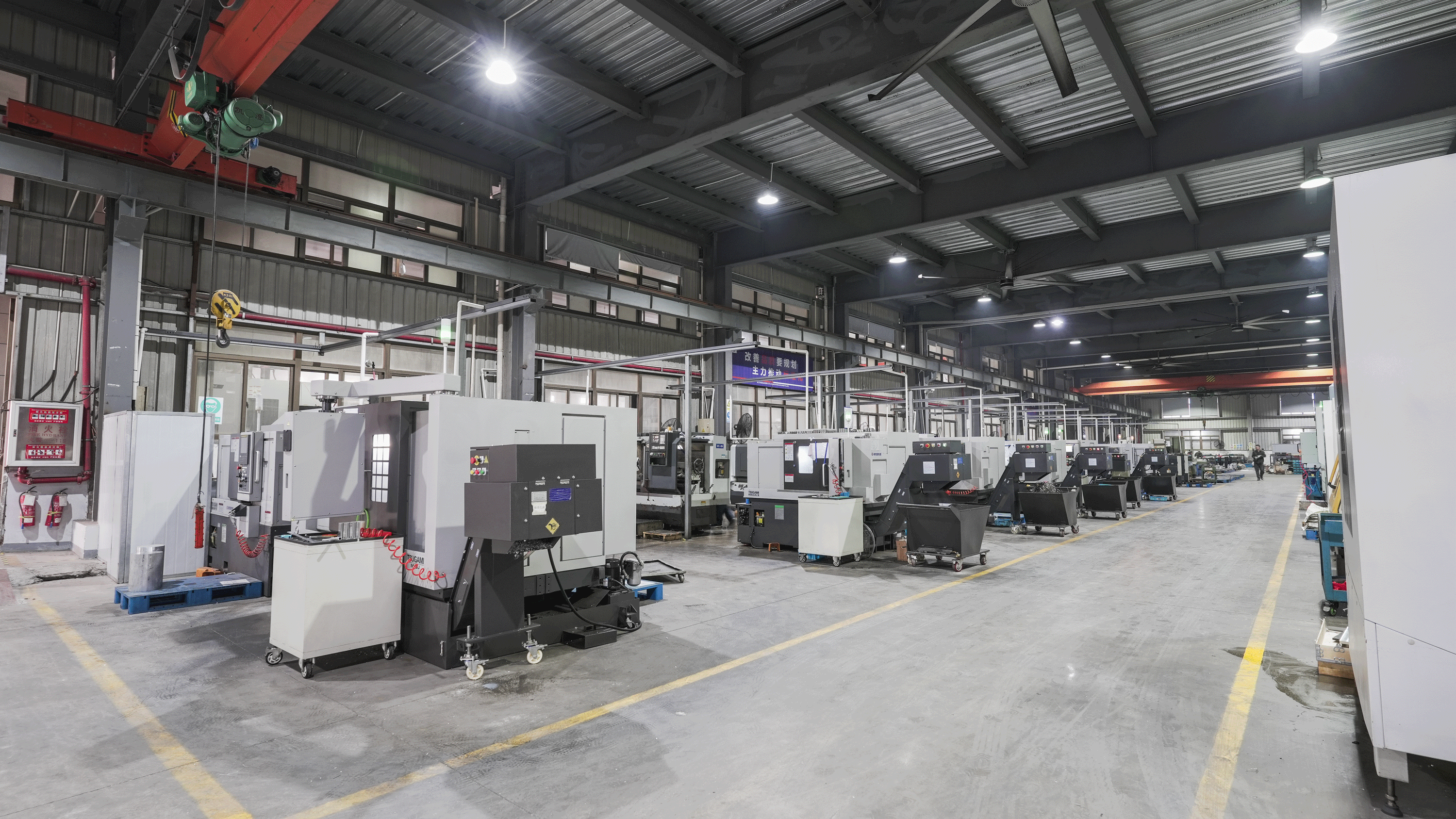
Manufacturing and machining capability is one of the few comparison dimensions a buyer can physically verify before shortlisting a pharmaceutical packaging machine supplier.
The Comparison Problem: Why Machine Specifications Do Not Line Up
Blister packaging machines, cartoning machines and end-of-line equipment are frequently compared as if they were the same category of product. They are not. A blister packaging machine is a forming, filling and sealing device whose real output depends on format area, forming depth and cavities per stroke. A cartoning machine is a product-handling device whose output depends on carton size, leaflet complexity and the insertion method. An end-of-line packaging machine — a case packing machine, stretch bander, overwrapper or palletizer — is paced by whatever feeds it. Comparing them requires a shared vocabulary.
Four practical issues break comparisons before they start:
- Throughput units differ. Cycles per minute, blisters per minute, punches per minute and cartons per minute are not interchangeable. Without a conversion basis, a machine that looks faster may simply be measured differently.
- The boundary of supply differs. A standalone cartoner, a linked blister-plus-cartoner configuration and a fully integrated blister-cartoning line are three different products with three different price structures and three different staffing requirements.
- Compliance scope differs. A CE certificate is issued for a defined product scope and standard set. It does not automatically cover every model a supplier sells, and it does not automatically cover a configuration change.
- Commercial variables stay hidden. Minimum order quantity, customization scope, lead time and after-sales obligations are frequently absent from the first quotation and decisive in the final decision.
A Comparison Framework That Does Not Depend on the Supplier
The framework below converts a vague comparison into six measurable dimensions. It is deliberately neutral: no dimension favors a specific brand, and each dimension can be evidenced by documentation rather than by presentation.
| Dimension | What to compare | Why it changes the decision |
|---|---|---|
| Throughput basis | Cycles/min, blisters/min, punches/min, cartons/min, packs/min | Determines whether quoted outputs are comparable at all |
| Format envelope | Maximum format area, forming depth, feed stroke | Sets which blister layouts and dosage forms are feasible |
| Drive and control architecture | Full servo or partial servo; controller platform and HMI | Affects changeover time, diagnostics, spare parts and training |
| Line boundary | Standalone machine, linked line, or integrated line | Changes layout, civil works, staffing and throughput balancing |
| Compliance evidence | Certificate number, standard set, product scope covered | Certificate scope is series-specific, not universal |
| Commercial terms | MOQ, customization scope, lead time, after-sales obligations | Determines whether the project is deliverable on schedule |
Table 1. A neutral comparison framework for pharmaceutical packaging machine evaluation.
Applying the framework is mechanical. For each shortlisted supplier, the buyer records the same six fields. Where a supplier cannot fill a field, that is itself a comparison result — not a reason for the buyer to fill it in on the supplier's behalf.
Comparing Blister Packaging Machine Architectures: Roller and Flat-Plate
Two blister packaging machine architectures dominate solid-dosage pharmaceutical packaging: roller-type and flat-plate. They are not competitors in the same performance band; they solve different production problems. Comparing them by a single throughput number misses the point.
| Comparison item | Roller-type blister machine (DPH Series) | Flat-plate blister machine (DPP Series) |
|---|---|---|
| Models referenced | DPH320H, DPH260H, DPH260 | DPP350F, DPP250S, DPP250FI, DPP160F, DPP250FII, DPP260K, DPP260TI |
| Typical capacity | 60–200 cycles/min depending on model | 20–50 cycles/min depending on model (DPP260K is specified at 20–70 cycles/min) |
| Power supply | 380V 50Hz, about 15.5–18.9 kW | 380V 50Hz, about 5.6–12 kW; DPP260K and DPP260TI at 9.5 kW |
| Compressed air | 0.5–0.7 MPa; consumption above 0.5 m³/min | 0.5–0.7 MPa; consumption generally above 0.3–0.5 m³/min (DPP260K and DPP260TI above 0.4 m³/min) |
| Format reference | DPH320H: forming area 320 × 280 mm, forming depth 12 mm, stroke range 100–280 mm | DPP260TI: 4420 × 710 × 1700 mm, net weight approximately 2200 kg |
| Typical fit | High-speed solid-dosage production | Small and medium batches, frequent tooling changes |
Table 2. Roller-type and flat-plate blister packaging machine architectures compared on documented parameters.
The difference becomes concrete when a single reference model is examined in full. The DPH320HII rotary blister packing machine is specified at a maximum punch frequency of 250 punches/min, a maximum format area of 320 × 280 mm, a feed stroke of 100–280 mm, a maximum capacity of 1000 blisters/min, total power of 30 kW, machine dimensions of 5000 × 1500 × 2100 mm and a machine weight of 6000 kg. By contrast, the DPP260T1 platen blister machine is specified at a maximum punch frequency of 60 punches/min, a maximum format area of 260 × 115 mm, a feed stroke of 30–120 mm, a maximum capacity of 300 blisters/min, total power of 8.5 kW and a machine weight of 2200 kg.
On both machines, product-contact parts are made of AISI 316L stainless steel and FDA-compliant pharmaceutical-grade materials, while non-product-contact parts are manufactured from AISI 304 stainless steel and anodized aluminum alloy. Both are stated as designed and manufactured in accordance with GMP requirements, with corrosion-resistant and easy-to-clean surfaces. For a buyer, that means material specification is a comparison dimension that can be standardized across two very different throughput classes — which is exactly why architecture and capacity must be compared separately.
Comparing Cartoning and Integrated Line Configurations
Cartoning is where comparisons most often collapse, because the market mixes standalone cartoning machines, linked blister-plus-cartoner configurations and fully integrated blister-cartoning lines. The three overlap in throughput but differ in transfer method, control platform and staffing.
| Configuration | Blister / pack output | Cartoning output | Control platform reference |
|---|---|---|---|
| DHL1000/5H integrated blister-cartoner line | Up to 1000 blisters/min | Up to 500 cartons/min | Beckhoff motion controller; D3 top-loading parallel tracking transfer; four-channel servo replenishment |
| DHL8005H integrated blister-cartoner line | Up to 800 blisters/min | Up to 500 cartons/min | Beckhoff motion controller with CP9315 industrial PC; D3 transfer; three-channel servo replenishment |
| DHL7005H integrated blister-cartoner line | Up to 700 blisters/min | Up to 500 cartons/min | Siemens motion controller and TP900 HMI; self-developed IRB24 transfer robot |
| DHL7004 integrated blister-cartoner line | Up to 700 blisters/min | Up to 400 cartons/min | Siemens motion controller and TP900 HMI; IRB24 transfer robot |
| DHL6004 integrated blister-cartoner line | Up to 600 blisters/min | Up to 400 cartons/min | Beckhoff motion controller with CP9315 industrial PC |
| IXW800 blister-flow-wrap-cartoner line | Up to 600 blisters/min and 600 packs/min | Up to 500 cartons/min | Beckhoff controller with CP9315 industrial PC; D3 robotics and rotary manipulator |
| IXW600 blister-flow-wrap-cartoner line | Up to 600 blisters/min and 300 packs/min | Up to 300 cartons/min | Beckhoff controller with CP9315 industrial PC |
| IXW400 liquid dosage line | Up to 400 blisters/min | Up to 150 cartons/min | Siemens controller with CP9315 industrial PC; D3 top-loading robot |
| DPP Series + XWZ Series linked line | 100–600 blisters/min depending on model | 100–400 cartons/min depending on model | Blister machine and high-speed cartoner linked |
| XWZ500H standalone cartoner | — | About 100–500 cartons/min | Full servo drive; 14 kW |
| XWZ300II standalone cartoner | — | About 60–220 cartons/min | 5 kW |
| XWZ120 standalone cartoner | — | About 30–120 cartons/min | Siemens PLC; SEW main motor; balcony-style frame |
Table 3. Documented line and cartoner configurations compared by output and control platform.
Two details in this table matter more than the headline speeds. First, the transfer method differs: DHL1000/5H, DHL8005H, IXW800 and IXW400 use a D3 intelligent top-loading parallel tracking transfer system, while DHL7005H and DHL7004 use a self-developed IRB24 intelligent transfer robot. The transfer stage is where wrong insertion and missing leaflet risks concentrate, so it is a legitimate comparison axis. Second, the control platform differs across otherwise similar machines — Beckhoff on DHL1000/5H, DHL8005H, DHL6004, IXW600 and IXW800, Siemens on DHL7005H, DHL7004 and IXW400. A buyer operating a mixed fleet should compare the control platform as a maintenance and training variable, not only as a technical one.
For downstream automation, the documented end-of-line options include the XWZ300II + XWK4060 + ICP12 cartoning, stretch banding, case packing and palletizing line, specified at about 60–220 cartons/min, 30–60 bundles/min and about 12 cases/min respectively; the ICP12 case packing and palletizing unit at about 12 cases/min and 25 kW; the XWK4060 stretch bander at 30–60 bundles/min; and the XWG4060 overwrapper at 30–60 bundles/min.
What Market Structure Suggests About How Buyers Should Compare
Market concentration data adds a useful frame to a machine-level comparison. The top three players in the pharmaceutical blister packaging machine market — Uhlmann, IMA and Marchesini — collectively hold approximately 29% of market share. In other words, roughly 71% of that market sits outside the three best-known names. The pharmaceutical cartoning machinery segment was valued at USD 1.46 billion in 2024, and Asia Pacific held the largest revenue share of the pharmaceutical packaging equipment market at 40.7% in 2025.
For an evaluation-stage buyer, that structure has a direct implication: tier alone is not a sufficient comparison. A fragmented market means the realistic shortlist usually spans more than one supply tier, and the only defensible way to compare across tiers is to use the same evidence fields for every candidate — capacity basis, format envelope, drive architecture, line boundary, compliance scope and commercial terms.
Where Hoping Machinery Sits in the Comparison
Zhejiang Hoping Machinery Co., Ltd. is a pharmaceutical packing machinery manufacturer based in Ruian City, Zhejiang Province, China, established in 2001. The company operates a 28,800 ㎡ facility with approximately 300 employees, an annual output of 500 units and an R&D team of 56 engineers. Its main product families are blister packaging machines, cartoning machines, case packing machines and end-of-line packaging machines, with an export ratio of 25% and main markets in Southeast Asia, the Middle East, Eastern Europe, South America and Africa. Its documented intellectual property portfolio comprises 26 invention patents, 70 utility patents, 4 appearance patents, 10 PCT-protected filings and 28 software copyrights.
For comparison purposes, the more useful facts are operational rather than promotional. Hoping documents a customization scope covering blister size, blister materials, quantity per carton, carton specification, leaflet format, coding and inspection method, feeding method, downstream bundling, case-packing and palletizing connection, interface language, and electrical component brand and data interface. Monthly capacity is documented at 30–40 units, minimum order quantity at 1 set or 1 complete line, and lead time at typically 60–120 days after technical confirmation, subject to model, configuration, project complexity and contract terms.
The quality-control sequence is documented as incoming material inspection, key component inspection, assembly inspection, electrical safety check, no-load trial run, material trial, factory acceptance test, customer witness acceptance and pre-shipment inspection. After-sales scope is documented as on-site installation and commissioning, operator training, maintenance training, remote video and phone support, spare parts supply, process-parameter guidance, regular follow-up and troubleshooting, subject to contract and project configuration. Each of these is a comparison field a buyer can request from any supplier — which is precisely the point of an independent comparison.
Certification and Compliance: Comparing Evidence, Not Claims
In the EU, pharmaceutical equipment safety is governed by the Machinery Directive 2006/42/EC and the EN 415 series for packaging machines. ISO 15378 integrates GMP requirements for primary packaging materials, which is why buyers in regulated markets generally request GMP-relevant evidence in addition to machine safety certificates. The table below sets out Hoping's documented certification evidence so it can be compared field by field against another supplier's evidence set.
| Certificate | Scope covered | Certificate number | Authority | Standards referenced | Issued |
|---|---|---|---|---|---|
| CE — Carton packing machine series | Carton packing machine series | UCN 900339024607 | Certify International Ltd | EN 415-3:2000; 98/37/EC; 98/79/EC | 2007-04-01 |
| CE — Automatic blister packing machine | Sample automatic blister packing machine | UCN 900175009261 | CELAB | EN 60204-1:1997; EN 415-3:1999; 73/23/EEC; 93/68/EEC; 98/37/EC; 98/79/EC | 2006-11-06 |
| CE — Cartoning machine series | Cartoning machine series | HTT190102307L | Shenzhen HTT Technology Co., LTD. | EN 60204-1:2006+A1:2009+AC:2010; 2006/42/EC | 2019-01-22 |
| CE — Blister packing machine series | Blister packing machine series | HTT190102306L | Shenzhen HTT Technology Co., Ltd. | Machinery Directive 2006/42/EC; EN 60204-1:2006+A1:2009+AC:2010 | 2019-01-22 |
| ISO 14001:2015 | Design, production and after-sales service of packing machines, packing production lines and related management activities | CN00123E33896R1M/3300 | China Quality Certification Centre (CQC) | ISO 14001:2015 | 2023-10-12 |
| ISO 45001:2018 | Design, production and after-sales service of packing machines, packing production lines and related management activities | CN00123S33121R1M/3300 | China Quality Certification Centre (CQC) | ISO 45001:2018 | 2023-10-10 |
Table 4. Certification evidence as a comparison field rather than a marketing claim.
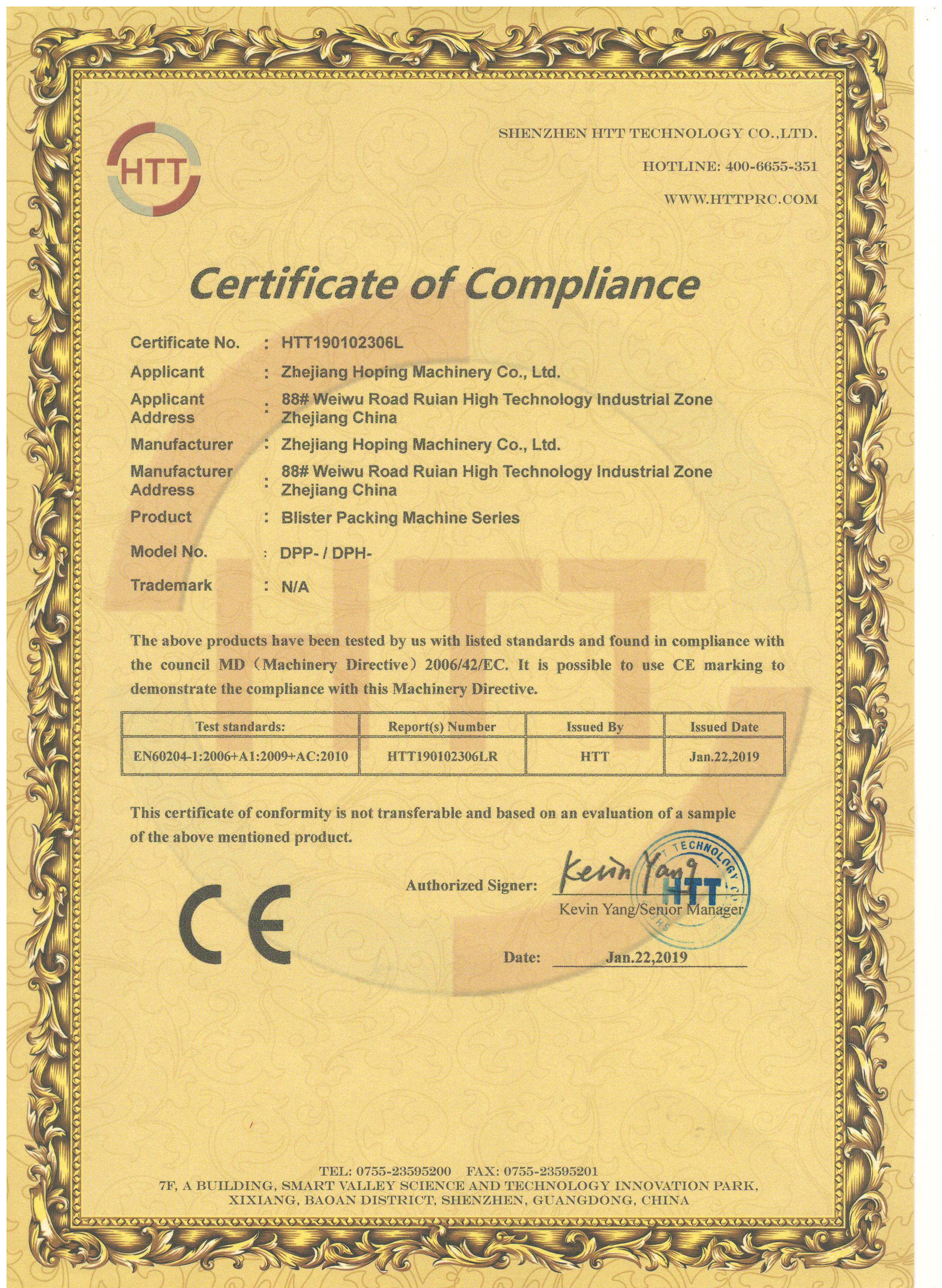
Certificate scope is series-specific. Buyers comparing pharmaceutical packaging machines should confirm that the certificate covers the exact model and configuration quoted.
Two comparison notes follow from this table. First, the older CE entries date from 2006 and 2007 and are documented as historical certificate evidence covering defined series, while the 2019 entries reference the Machinery Directive 2006/42/EC directly. Scope, not age alone, is the relevant test. Second, the two management-system certificates carry expiry dates in October 2026 (ISO 45001:2018 on 2026-10-09 and ISO 14001:2015 on 2026-10-11). A buyer evaluating long-term supply continuity should note renewal status as a comparison field.
Application Fit: What the Project Record Shows
Comparison frameworks are only useful if they map onto real production. Hoping's documented project profile covers large pharmaceutical manufacturers, solid-dosage production companies and pharmaceutical engineering contractors, with a scope of 5–10 lines applied to blister packaging and automatic cartoning for tablets, capsules and other solid dosage forms. Documented applications include new line construction, capacity expansion and upgrading of existing packaging lines.
The stated project objective is instructive for buyers comparing quotes. The record describes a project that achieved improvements in packaging automation, reduced manual transfer, improved blister-to-carton connection efficiency, reduced wrong insertion or missing leaflet risks, and supported downstream automation integration. The listed highlights are high-speed capacity, fully servo control, integrated line operation, modular configuration, multi-format compatibility, easy cleaning and maintenance, and suitability for continuous pharmaceutical production. These are functional outcomes rather than performance statistics, and they translate into comparison questions a buyer can ask any supplier: how is manual transfer eliminated, how are leaflet errors detected, and how does the line hand off to downstream bundling, case packing or palletizing?
Comparison with Traditional Setups — and Where Integrated Lines Stop Being the Right Answer
The comparison against a traditional setup is usually framed as manual versus automated, or partial servo versus full servo. That framing is too simple. The honest comparison is about matching architecture to production reality, and an integrated line is not automatically the correct choice.
| Consideration | Traditional or standalone setup | Integrated fully servo line |
|---|---|---|
| Manual transfer between blister and carton | Higher dependence on manual handling | Transfer handled by D3 parallel tracking system or IRB24 transfer robot |
| Leaflet and insertion errors | Higher exposure to wrong insertion and missing leaflet risk | Inspection and rejection integrated into the line |
| Capital and service profile | Lower initial complexity | Higher control complexity: Beckhoff or Siemens controllers, CP9315 industrial PC, TP900 HMI |
| Changeover | Tooling-dependent | Mold-change support and preset or recipe memory, but tooling still required |
| Best fit | Lower volumes, frequent format changes, limited technical staffing | High-capacity continuous solid-dosage production |
Table 5. Traditional or standalone configurations compared with integrated fully servo lines.
The limits are real and should be stated plainly. A fully servo integrated line carries a higher control-system complexity than a standalone cartoner, and the documented platforms — Beckhoff motion controllers, Siemens motion controllers, CP9315 industrial PCs and TP900 HMIs — imply that spare-part planning and technician training are genuine project costs, not afterthoughts. Documented lead time of typically 60–120 days after technical confirmation means an integrated line is not a fast capacity fix. Documented monthly capacity of 30–40 units means multi-line buyers should plan production slots rather than assume immediate availability. And although mold-change and preset-memory functions reduce changeover time, format changes still require tooling and format parts configured to the confirmed blister and carton specification.
There is also a compliance boundary worth naming. The CE entries in the table above are scoped to defined series and standards. Where a buyer changes format, adds downstream modules such as bundling, case packing or palletizing, or moves into a new regulatory market, the applicable certificate scope should be re-confirmed rather than assumed to extend automatically. For low-volume or frequently changing formats, a flat-plate blister machine in the 20–70 cycles/min band or a standalone cartoner such as the XWZ120 at 30–120 cartons/min may be a more defensible match than a high-capacity integrated line.
Future Outlook
Three signals suggest how pharmaceutical packaging machine comparison will evolve. First, the pharmaceutical blister packaging machine market is projected to reach USD 2.57 billion by 2025 with a CAGR of 2.8%, indicating steady rather than explosive growth — which usually favors buyers who compare on total operating fit rather than on headline speed. Second, Asia Pacific held the largest revenue share at 40.7% in 2025, which means the supply base buyers compare against will continue to include a substantial number of manufacturers from that region, including Hoping Machinery. Third, the fact that the three best-known blister packaging machine players together hold roughly 29% of the market means the comparison process itself, not brand familiarity, will keep determining the shortlist.
For evaluation-stage buyers, the practical consequence is a shift in what counts as useful evidence: documented parameters, certificate numbers, scope statements, control platform identity, tooling dependencies and lead-time commitments will matter more than catalog language. Comparison frameworks that normalize these fields, rather than those that rank brand names, are the ones likely to survive the next procurement cycle.
Frequently Asked Questions
What is the difference between a roller-type and a flat-plate blister packaging machine?
A roller-type blister packaging machine forms the blister cavity as film passes over a rotating drum, while a flat-plate machine forms cavities with a reciprocating platen. In Hoping's documented range, the roller-type DPH Series (including DPH320H, DPH260H and DPH260) is specified at 60–200 cycles/min depending on model, while the flat-plate DPP Series (including DPP350F, DPP250S, DPP250FI, DPP160F, DPP250FII, DPP260K and DPP260TI) is specified at 20–50 cycles/min depending on model, with the DPP260K listed at 20–70 cycles/min. The practical difference is throughput against forming dwell time.
How should buyers normalize blister packaging capacity when suppliers quote different units?
Not all suppliers use the same unit: some publish cycles per minute, some blisters per minute, some punches per minute. Hoping publishes both for reference models. The DPH320HII rotary blister packing machine is specified at a maximum punch frequency of 250 punches/min, a maximum format area of 320 × 280 mm and a maximum capacity of 1000 blisters/min. The DPP260T1 platen blister machine is specified at a maximum punch frequency of 60 punches/min, a maximum format area of 260 × 115 mm and a maximum capacity of 300 blisters/min. To compare across suppliers, buyers should convert every quote to blisters per minute using the format area and cavities per stroke, rather than comparing the stated unit directly.
Which standards apply to pharmaceutical packaging machines sold into the EU?
EU pharmaceutical equipment safety is governed by the Machinery Directive 2006/42/EC and the EN 415 series for packaging machines, as set out by the European Committee for Standardization. In Hoping's documented certification set, the cartoning machine series certificate HTT190102307L references EN 60204-1:2006+A1:2009+AC:2010 and 2006/42/EC, and the blister packing machine series certificate HTT190102306L references Machinery Directive 2006/42/EC and EN 60204-1:2006+A1:2009+AC:2010. Because CE marking is scoped to specific series and standards, buyers should confirm that the certificate scope matches the exact model and configuration quoted.
What certifications should a pharmaceutical packaging machine supplier provide?
A documentable evidence set includes machine safety certificates and management-system certificates. Hoping's documented set comprises a CE certificate for the carton packing machine series (UCN 900339024607, issued by Certify International Ltd), a CE certificate for an automatic blister packing machine sample (UCN 900175009261, issued by CELAB), CE certificates for the cartoning machine series (HTT190102307L) and blister packing machine series (HTT190102306L), an ISO 14001:2015 certificate (CN00123E33896R1M/3300) and an ISO 45001:2018 certificate (CN00123S33121R1M/3300), both issued by the China Quality Certification Centre. ISO 15378, which integrates GMP requirements for primary packaging materials, is a separate standard that buyers in regulated markets typically ask about in addition to machine safety certification.
How long does customization and delivery take for an integrated blister-cartoning line?
Hoping documents lead time as typically 60–120 days after technical confirmation, with final lead time subject to model, configuration, project complexity and contract terms. The documented customization scope covers blister size, blister materials, quantity per carton, carton specification, leaflet format, coding and inspection method, feeding method, downstream bundling, case-packing and palletizing connection, interface language, and electrical component brand and data interface. Minimum order quantity is documented as 1 set or 1 complete line, and monthly capacity as 30–40 units.
Is a fully integrated line always better than separate blister and cartoning machines?
No. Integrated lines are specified for high-capacity solid dosage: the DHL1000/5H reaches up to 1000 blisters/min and 500 cartons/min, the DHL8005H up to 800 blisters/min and 500 cartons/min, and the DHL7005H and DHL7004 up to 700 blisters/min with 500 and 400 cartons/min respectively. A linked DPP Series + XWZ Series configuration covers approximately 100–600 blisters/min and 100–400 cartons/min, while a standalone cartoner such as the XWZ120 handles 30–120 cartons/min and the XWZ300II handles 60–220 cartons/min. Where volumes are lower or formats change frequently, the standalone or flat-plate option may fit better. The comparison should be based on throughput match, format flexibility and how the transfer stage is handled.
What evidence should buyers request before shortlisting a pharmaceutical packaging machine supplier?
A verifiable evidence set includes machine-level parameters stated with their unit of measurement, format area and forming depth, power and air consumption, machine dimensions and weight, the drive and control platform, certificate numbers with their scope, and the quality-control sequence. Hoping documents its quality control as incoming material inspection, key component inspection, assembly inspection, electrical safety check, no-load trial run, material trial, factory acceptance test, customer witness acceptance and pre-shipment inspection. After-sales scope is documented as on-site installation and commissioning, operator training, maintenance training, remote video and phone support, spare parts supply, process-parameter guidance, regular follow-up and troubleshooting, subject to contract and project configuration.
Reference manufacturers mentioned for market-structure context: Uhlmann, IMA and Marchesini, collectively holding approximately 29% of the pharmaceutical blister packaging machine market. Market data cited from SkyQuest Technology, Custom Market Insights, Grand View Research and Fortune Business Insights. Machine and certification parameters cited from Hoping Machinery product and certification documentation.
For readers who want to review the complete parameter set behind the models referenced in this comparison, the Hoping Machinery catalog is available as a public download: Hoping Machinery Catalog (PDF). Manufacturer information: Zhejiang Hoping Machinery Co., Ltd., www.hopingcn.com.