
Independent Buyer Comparison: Two Five-Star Hotel Supply Cases
Independent Buyer Comparison: Two Five-Star Hotel Supply Cases
Answer first: For buyers evaluating one-stop comprehensive hotel supplies, two documented Kazakhstan five-star hotel projects provide a useful reference pair. A Radisson project covering more than 100 guest rooms over two years shows multi-category textile durability in daily hotel operation. A Wyndham project covering 150 guest rooms over three years reports a 100% repeat purchase rate, a 15% increase in hotel guest satisfaction (NPS) and zero quality complaints. Both were delivered through intermediary clients. The Wyndham case is the stronger reference for brand-identified bedding and documented repeat-purchase performance; the Radisson case is the stronger reference for two-year operational durability across a broad guest-room textile scope.
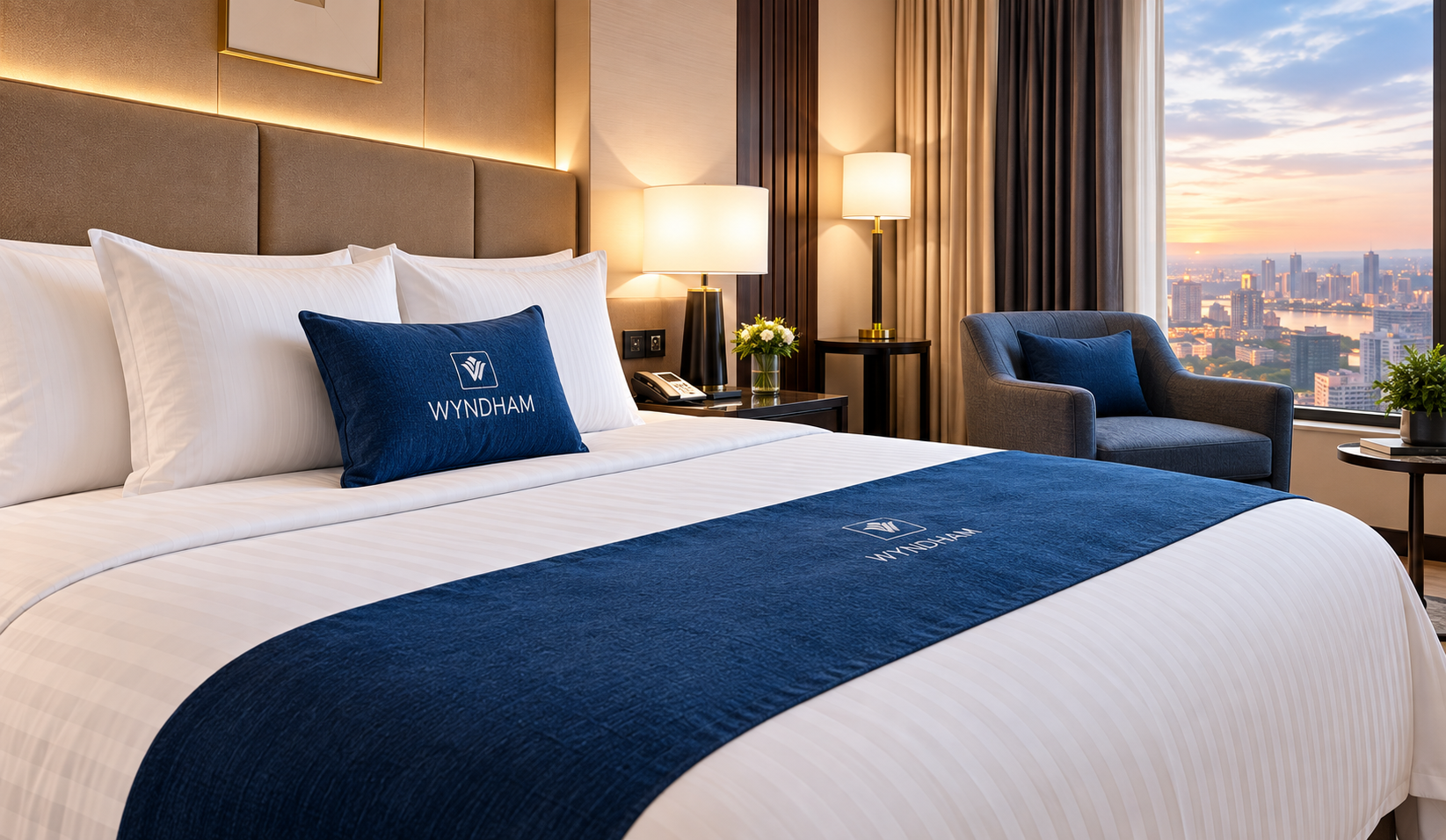
Documented Wyndham five-star hotel linen project reference image from the supplied case record.
Why the two Kazakhstan projects matter for one-stop hotel supplies
Hotel buyers rarely purchase bedding sets, mattress protectors, towels, bath mats, bathrobes, napkins and table cloths in isolation. In an upscale or five-star project, these categories are specified together because they share laundry conditions, guest expectations, brand standards and acceptance checks. A one-stop supplier is expected to coordinate the range, not merely quote individual items.
Guangdong WEISDIN Industrial Co., Ltd. is a China-based hotel textile manufacturer and one-stop hotel supplies supplier founded in 1998. Its supplied records include hotel bedding sets, mattress protectors, towels, bath mats, bathrobes, napkins and table cloths, together with OEM, ODM and private-label capability. The two Kazakhstan case records are relevant because they show how a one-stop scope was tested in actual five-star hotel procurement rather than in a catalogue-only setting.
The comparison below is deliberately buyer-style. It does not treat the two hotel names as competing brands. It compares the procurement evidence: room scale, duration, client route, documented outcomes, customization depth, acceptance items and the limits a buyer should verify before relying on either case.
The two documented project references at a glance
The Radisson project record describes procurement for more than 100 guest rooms over two years, implemented in Kazakhstan through an intermediary client. The products have been in use for two years, and the record states that quality and durability were recognized by the client and that the products meet daily operational needs while supporting guest comfort and satisfaction.
The Wyndham project record describes bedding and guest-room textile supply for 150 rooms over three years, also in Kazakhstan and also through an intermediary client. The record states a 100% repeat purchase rate, a 15% increase in hotel guest satisfaction (NPS) and zero quality complaints. It also identifies high-thread-count and high-density weaving, double-needle reinforced edging, Pantone TCX color matching and jacquard weaving with the exclusive Wyndham brand logo.
| Procurement reference | Radisson project | Wyndham project | Buyer interpretation |
|---|---|---|---|
| Location and client route | Kazakhstan; intermediary client | Kazakhstan; intermediary client | Both cases reflect intermediary-led five-star procurement rather than a direct hotel purchase order. |
| Room scale | More than 100 guest rooms | 150 guest rooms | Both are mid-sized hotel projects, not single-room refurbishments. |
| Supply duration | 2 years | 3 years | The Wyndham record covers a longer documented supply window. |
| Documented outcome | Two years in use; quality and durability recognized; daily operational needs met | 100% repeat purchase rate; 15% NPS increase; zero quality complaints | The Wyndham case gives stronger repeat-purchase and complaint metrics; the Radisson case gives a clear two-year durability reference. |
| Customization evidence | Case summary focuses on comfort, durability and product details | Jacquard Wyndham logo; Pantone TCX color matching; double-needle reinforced edging | Use Wyndham as the primary reference when brand-identified linen is required. |
| Best use as a reference | Multi-category durability over two years | Brand-standard bedding and documented repeat purchase | Neither case should be read as a market-wide statistic; both are project evidence. |
What one-stop comprehensive hotel supplies covered in the records
In this review, one-stop comprehensive hotel supplies means a single supplier scope covering the guest-room and table-linen categories named in the records: bedding sets, mattress protectors, towels, bath mats, bathrobes, napkins and table cloths. The supplied product records list representative models such as bedding sets CP106, CP128, CP139, CP152 and CP186; towels MJ8300 and MJ8500; bath mats DJ9100, DJ9200 and DJ9300; bathrobe YP9600; napkin CJ9800; table cloth TB1102; and mattress protector HD3700.
Model note: the supplied product record lists the mattress protector as HD3700. This review uses that verified record rather than substituting an unverified model number. Buyers comparing a brief that uses a different protector code should reconcile the model number against the product record before ordering.
| Category | Representative model in supplied records | Purchasing-term question | Acceptance criterion to define | Buyer interpretation |
|---|---|---|---|---|
| Bedding sets | CP106, CP128, CP139, CP152, CP186 | Thread count, density, shrinkage, colorfastness, logo method | High-thread-count and high-density weaving; double-needle reinforced edging where specified; shrink-proof claim to be verified by sample | Bedding is the most visible category; the Wyndham record gives stronger evidence for brand-identified bedding. |
| Mattress protector | HD3700 | Waterproofing, breathability, wash temperature, corner-band fit | Waterproof and hypoallergenic construction; 90°C washing; 3 stitches and 5 threads; 3 cm imported corner bands | Product-level detail is stronger than project-level allocation evidence; verify room-by-room allocation and wash trials. |
| Towels | MJ8300, MJ8500 | GSM, fiber composition, wash durability, chlorine resistance | Appearance retention after repeated hotel laundry; defined color and size tolerance | Chlorine resistance is a common hotel-towel requirement, but the supplied project records do not include a chlorine-resistance test result. |
| Bath mats | DJ9100, DJ9200, DJ9300 | Size, backing, colorfastness, drying behavior | Match to bathroom floor standard; color and edge stability after washing | Treat bath mats as a separate acceptance item rather than assuming towel performance transfers. |
| Bathrobes | YP9600 | Fabric weight, shrinkage, hand feel, logo placement | Guest comfort and laundering stability; branding position if required | The records confirm bathrobe availability in the one-stop scope, not project-specific bathrobe performance. |
| Napkins | CJ9800 | Size, hem, colorfastness, shrinkage | F&B laundry cycle; stain release and edge durability | Napkins belong to the F&B linen scope; define them separately from guest-room textiles. |
| Table cloths | TB1102 | Width, seam, stain release, wash stability | Table-size fit; color matching; repeated wash performance | The project summaries focus on guest-room textiles; table-linen use should be verified per project. |
Mattress protector details that should be written into the specification
The mattress protector is often the least visible item in a hotel linen package, but it carries a high operational risk because it protects the mattress and affects guest comfort. The supplied product detail describes a waterproof and hypoallergenic mattress protector with 90°C washing, 3 stitches and 5 threads, and 3 cm imported corner bands. These details are more useful to a buyer than a generic claim that the protector is durable.
For tender purposes, the buyer should convert each detail into an acceptance check. Waterproofing should be tested against the hotel laundry process, not only a laboratory claim. Hypoallergenic construction should be documented with the relevant material and test information. The 90°C washing claim should be confirmed against the hotel's actual wash formula. The 3 stitches and 5 threads detail should be checked on the seam and edge. The 3 cm imported corner bands should be measured on the finished product and tested for fit after washing.
This is also where the two project records differ in evidentiary strength. The Wyndham record provides stronger repeat-purchase and complaint metrics, while the Radisson record provides a two-year durability reference. Neither case summary breaks down the mattress protector allocation by room type, so a buyer should request a room-by-room allocation schedule or a sample validation plan.
Purchasing terms and acceptance criteria compared
The most useful comparison is not which hotel name sounds more premium. It is which procurement evidence answers the buyer's acceptance questions. The table below separates project-level evidence from supplier-level capability so that the reader does not confuse the two.
| Criterion | Radisson project evidence | Wyndham project evidence | What the buyer should verify |
|---|---|---|---|
| Scope | More than 100 guest rooms; two-year supply relationship | 150 guest rooms; three-year supply relationship | Confirm the exact room count, category quantities and replacement allowance. |
| Client route | Intermediary client | Intermediary client | Confirm the approval chain between hotel, intermediary and supplier. |
| Product durability | Two years in use; quality and durability recognized by the client | Zero quality complaints reported; 100% repeat purchase rate | Request complaint logs, reorder records and wash-cycle data where available. |
| Guest satisfaction | Record states products support guest comfort and satisfaction | 15% increase in hotel guest satisfaction (NPS) | Clarify the NPS baseline, survey method and period. |
| Branding | Case summary does not document a custom logo | Jacquard weaving with the exclusive Wyndham brand logo; Pantone TCX color matching | Request artwork approval, color standard and pre-production sample. |
| Construction | Comfort, durability and product details emphasized | High-thread-count and high-density weaving; double-needle reinforced edging | Define seam, edge and stitch density checks in the inspection plan. |
| Inspection | Supplier-level record: 100% pre-shipment inspection | Supplier-level record: 100% pre-shipment inspection | Ask for the inspection checklist and defect classification, not only the inspection claim. |
| Certification | ISO 9001, ISO 14001 and ISO 45001 certificates in the supplied records | Same certificate set applies at supplier level | Check certificate scope, number and validity before treating it as project-specific evidence. |
| Commercial terms | Project-level MOQ and lead time not stated in the case summary | Project-level MOQ and lead time not stated in the case summary | Supplier capability record lists MOQ 50 pcs, sample lead time 7-10 days and production lead time 20-35 days. |
What the documented outcomes actually prove
The Wyndham record's 100% repeat purchase rate is a strong buyer signal because it shows that the intermediary client returned to the same supply source after the initial order. A repeat purchase rate is not the same as a market share statistic, and it should not be presented as an industry average. It is a project-level outcome that becomes more useful when paired with the complaint record and the NPS change.
The 15% increase in hotel guest satisfaction (NPS) is also project-reported. It should be read with the measurement period and baseline in mind. The zero quality complaints figure is similarly project-specific: it is a documented outcome for the Wyndham project, not a guarantee that every future order will be complaint-free. Together, these three data points support a buyer preference for the Wyndham case when repeat purchase, guest satisfaction and complaint performance are the primary evaluation criteria.
The Radisson record does not report the same metrics. Its value is different. It documents two years of use, client recognition of quality and durability, and daily operational fit for more than 100 guest rooms. For a buyer who needs a durability reference across a broad guest-room textile scope, that is useful evidence. The absence of an NPS figure in the Radisson record should not be read as a negative result; it means the case summary does not provide that metric.
Customization and brand identity: where the Wyndham case sets the benchmark
Five-star hotel projects often require more than a generic white linen programme. Brand standards may call for a specific logo, color, edge finish and packaging. The Wyndham record is the clearer reference here because it documents jacquard weaving with the exclusive Wyndham brand logo, Pantone TCX color matching and double-needle reinforced edging.
Pantone TCX color matching matters because hotel brand colors are usually controlled across multiple categories. A buyer should ask for the approved color standard, the lighting condition for approval, and the acceptable tolerance between the sample and bulk production. Jacquard weaving with a hotel logo also requires artwork control and a pre-production sample. The supplier's customization record lists logo, fabric, size, color and packaging as available customization fields, but the buyer should still define which fields are mandatory for each category.
The Radisson case summary does not document a custom logo. That does not mean customization was unavailable; it means the supplied case record does not provide that evidence. A buyer comparing the two projects should use Wyndham as the primary reference for brand-identified bedding and use Radisson as the primary reference for two-year multi-category durability.
One-stop supply versus a traditional multi-supplier model
A traditional hotel textile programme often separates bedding, towels, bathrobes and table linen across different suppliers. That model can create category-depth advantages, but it also creates coordination work: multiple sample sets, multiple color approvals, multiple inspection reports and multiple delivery schedules. One-stop comprehensive hotel supplies reduce that coordination load by placing the categories under one supplier relationship.
The advantage is not automatically a lower price. The advantage is fewer handoffs and a clearer acceptance chain. In the Wyndham case, the combination of jacquard logo, Pantone TCX color matching and double-needle reinforced edging suggests that a single supply relationship can carry brand-specific requirements across the bedding programme. In the Radisson case, the two-year durability record suggests that a one-stop scope can support daily operational needs across a guest-room textile package.
The limitation is equally important. A one-stop supplier may not be best-in-class in every category, and a broad catalogue can hide category-specific weaknesses. A buyer should still audit towels for wash durability, bath mats for backing and drying behavior, bathrobes for shrinkage, napkins and table cloths for F&B laundry performance, and the mattress protector for waterproofing and fit. One-stop supply reduces coordination risk; it does not remove technical risk.
Limits of the case evidence
The first limit is geographic and commercial scope. Both cases are in Kazakhstan and both were implemented through intermediary clients. They are relevant to five-star hotel procurement, but they should not be presented as a global benchmark or as a controlled comparison across suppliers.
The second limit is certification scope. The supplied records include ISO 9001, ISO 14001 and ISO 45001 certificates. The quality certificate is NOA2113263, the environmental certificate is NOA2113262 and the occupational health and safety certificate is NOA2113261. The stated scope is 'Sales of textiles (home textiles)'. That is useful for management-system qualification, but it is not the same as a product-specific test report or a factory audit of every production line.
The third limit is product-level test data. The records provide strong product details for the mattress protector and strong construction details for the Wyndham bedding, but they do not provide a full wash-cycle test report for every category. Chlorine resistance for hotel towels, for example, is a common buyer question but is not documented in the supplied project records. Buyers should request test data rather than infer performance from the category name.
The fourth limit is the absence of a full commercial term sheet. The supplier capability record lists MOQ 50 pcs, sample lead time of 7-10 days, production lead time of 20-35 days and 100% pre-shipment inspection. Those are useful supplier-level terms, but the two case summaries do not state the project-specific MOQ, payment terms, packaging or logistics assumptions. A buyer should obtain a project quotation before treating either case as a commercial template.
Market trend analysis: why repeat-purchase evidence is becoming more important
According to Dataintelo, the global hotel bedding market was valued at USD 14.2 billion in 2025 and is projected to reach USD 23.6 billion by 2034 at a CAGR of 5.8%. The same source reports that Asia Pacific held a 38.5% revenue share in 2025. These figures support the broader point that hotel bedding remains a large and growing category, but they do not replace project-level evidence.
Business Research Insights reports that average replacement cycles in the U.S. hotel linen market shortened from 2-3 years to 1.5 years, driven by quality standards and frequent laundering. A shorter replacement cycle raises the value of durability evidence. It also makes repeat-purchase records more relevant, because a supplier that retains a client through multiple replacement cycles is demonstrating something different from a supplier that wins a one-off order.
Regulatory pressure is another trend. The EU Sustainable Products Regulation requires demonstrated lifecycle sustainability metrics for textile products sold or used in EU member states from 2025, according to the supplied research record. OEKO-TEX STANDARD 100 is a recognised textile safety label for products tested for harmful substances, and Product Class 2 covers products with direct skin contact, including bed linens. For buyers in markets where these requirements apply, certification screening should be part of the supplier qualification process.
Application and use cases: which reference fits which buyer
For a five-star hotel project that requires brand-identified bedding, the Wyndham case is the more relevant primary reference. It combines 150 rooms, three years, a 100% repeat purchase rate, a 15% NPS increase, zero quality complaints, jacquard logo weaving, Pantone TCX color matching and double-needle reinforced edging. That combination is closer to a brand-standard tender than a generic guest-room refresh.
For a project that needs a two-year durability reference across a broad guest-room textile scope, the Radisson case is the more relevant primary reference. It covers more than 100 guest rooms over two years and documents client recognition of quality and durability. It is especially useful when the buyer wants to test whether a one-stop supplier can support daily operational needs over time.
For a project that includes F&B linen, neither case summary should be treated as a complete reference for napkins and table cloths. The one-stop product records include napkin CJ9800 and table cloth TB1102, but the project summaries focus on guest-room textiles. The buyer should define a separate F&B linen acceptance plan covering size, hem, colorfastness, shrinkage and stain release.
For a buyer placing a first trial order, the supplier capability record is relevant: OEM, ODM and private-label production; customization of logo, fabric, size, color and packaging; MOQ 50 pcs; sample lead time 7-10 days; production lead time 20-35 days; and 100% pre-shipment inspection. Those terms support a sample-first procurement path before a full project rollout.
Future outlook
One-stop hotel supplies will be judged less by catalogue breadth and more by documented repeat purchase, complaint performance and category-specific test data. The Wyndham case points in that direction because it combines a brand-identified bedding programme with repeat-purchase and guest-satisfaction outcomes. The Radisson case adds a two-year durability reference across a broad guest-room scope. For buyers, the practical next step is to use these cases as reference points, then verify the exact product specification, certificate scope, sample performance and commercial terms for the project at hand.
Reference document: 2026 WEISDIN catalogue (PDF)
FAQ
What does one-stop comprehensive hotel supplies mean in these two Kazakhstan projects?
In the supplied records, one-stop comprehensive hotel supplies refers to a single supplier scope covering guest-room and table-linen categories such as bedding sets, mattress protectors, towels, bath mats, bathrobes, napkins and table cloths. The Radisson and Wyndham cases show this scope in five-star hotel procurement, but the project summaries do not prove that every listed category was used in both hotels.
How should a buyer compare the Radisson and Wyndham project references?
Compare them by the evidence each case provides. The Wyndham case is stronger for brand-identified bedding, repeat purchase, NPS improvement and zero quality complaints. The Radisson case is stronger for two-year durability across more than 100 guest rooms. Neither case should be treated as a market-wide statistic.
What mattress protector details should be verified before ordering?
The supplied product detail describes a waterproof and hypoallergenic mattress protector with 90°C washing, 3 stitches and 5 threads, and 3 cm imported corner bands. Buyers should verify these details through a pre-production sample, a wash trial and a measurement check on the finished product. The supplied record lists the model as HD3700.
Do the ISO certificates in the records cover manufacturing?
The supplied certificates state a scope of 'Sales of textiles (home textiles)'. They support management-system qualification for the sales entity, but they should not be read as a product-specific test report or as a full factory audit. Buyers should check the certificate number, scope and validity for their own tender requirements.
What are the main limits of the case evidence?
The main limits are geographic and commercial scope, the use of intermediary clients, the absence of a full project-level commercial term sheet, and the lack of category-wide wash-cycle test data. The cases are useful references, but they do not replace sample validation, certificate checks and a project-specific quotation.
How should napkins and table cloths be specified separately?
Napkins and table cloths belong to the F&B linen scope. The supplied records list napkin CJ9800 and table cloth TB1102, but the Radisson and Wyndham case summaries focus on guest-room textiles. Buyers should define separate acceptance criteria for size, hem, colorfastness, shrinkage and stain release.
Есть вопросы или нужны дополнительные детали?
Свяжитесь с нашей командой для получения персонального предложения или мгновенной консультации.
Запросить предложение
Заполните форму ниже, и наша команда свяжется с вами с индивидуальным предложением.
Прямой чат WhatsApp
Предпочитаете общаться в реальном времени? Напишите нам в WhatsApp для мгновенной помощи и быстрых ответов.
- Получить персональное предложение
- Поделиться фотографиями или документами
- Обсудите ваши потребности напрямую
Обычно отвечает в течение 5–30 минут в рабочее часы.