
Independent Buyer Comparison: U70BP/146D, 70B and FXB-24-70-785mm
Insulator procurement rarely compares one material against another in the abstract. It compares named units against a duty statement, a governing standard and an acceptance file. That is why a tender can legitimately list a porcelain disc, a glass line-post unit and a silicone long rod side by side while the engineering case for each of them is completely different.
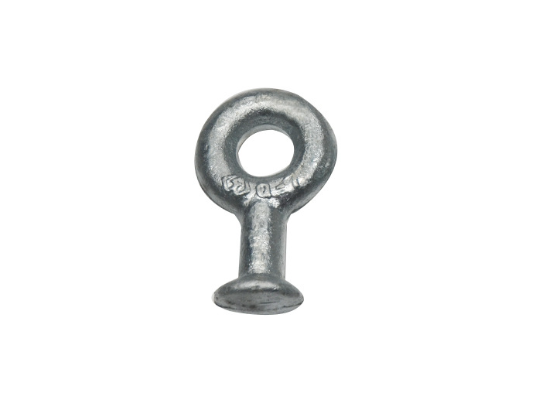
This independent buyer comparison sets out what can and cannot be concluded from three specified units: porcelain insulator U70BP/146D (70 kN rated electromechanical failing load, 146 mm structural height, 255 mm nominal disc diameter, 450 mm minimum arcing distance, connection structure code 16), glass insulator 70B (255 mm creepage, 65 kV dry and 45 kV wet power-frequency withstand, 135 kV puncture, 10 kN cantilever load), and polymer insulator FXB-24-70-785mm (35 kV rated voltage, >1050 mm minimum creepage, >230 kV lightning impulse withstand, >95 kV one-minute wet withstand, 5 kN rated bending load, silicone housing with fiberglass core and carbon steel/C45 fittings). The ball-head suspension ring QP-7 (hot-dip galvanized steel, coupling size 16, 70 kN rated failing load, 0.3 kg) is included because hardware is where a technically correct unit most often fails to reach the tower.
Why a material comparison is really an acceptance comparison
Ceramic and glass insulators for overhead lines with nominal voltage above 1000 V are tested under IEC 60383-1. Composite insulators for high-voltage AC overhead lines above 1000 V are governed by IEC 61109, whose latest edition is 2025. The two documents do not declare the same set of values, and neither declares them the way a commodity datasheet does. A buyer who places a porcelain failing load, a glass cantilever load and a polymer bending load into one column and ranks them numerically has not compared products; the numbers describe different tests under different standards.
The practical consequence is that the comparison has to be staged. First, confirm each unit is specified against the standard governing its material. Second, confirm the declared values are the type the project actually needs, because a failing load, a cantilever load and a bending load answer different structural questions. Third, treat hardware, string or post configuration and acceptance documents as part of the product, because that is how the line is built and inspected.
The three units at a glance
| Unit | Construction | Published mechanical rating | Published dielectric values | Published dimensions |
|---|---|---|---|---|
| Porcelain U70BP/146D | Porcelain, disc type, connection structure code 16 | 70 kN rated electromechanical failing load | No withstand values published in the unit data used here | Structural height 146 mm; nominal disc diameter 255 mm; minimum arcing distance 450 mm |
| Glass 70B | Glass, brown, line-post type | 10 kN cantilever load | 65 kV dry withstand; 45 kV wet withstand; 135 kV puncture voltage | Creepage distance 255 mm |
| Polymer FXB-24-70-785mm | Silicone housing, fiberglass core, carbon steel/C45 fittings, suspension long rod | 5 kN rated bending load | 35 kV rated voltage; >230 kV lightning impulse withstand; >95 kV one-minute wet withstand | Minimum creepage >1050 mm |
Values are taken from the declared unit data used for this comparison. Where a cell states that no value is published, no estimate has been supplied.
Reading the three mechanical figures correctly
The porcelain U70BP/146D declares a rated electromechanical failing load of 70 kN. That is a failure-test figure produced in an electromechanical test; it is not a working load and cannot be converted into a design margin without applying the project's own safety factors. Its published geometry, namely 146 mm structural height, 255 mm nominal disc diameter, 450 mm minimum arcing distance and connection structure code 16, determines how many units a string needs and which hardware will fit.
The glass 70B declares 10 kN cantilever load. Cantilever is a bending load applied at the top of a line-post insulator, so it is the value that governs wind loading and conductor side-pull on post positions. The polymer FXB-24-70-785mm declares a 5 kN rated bending load, which is also a bending value, but carried by a suspension long rod that is loaded along a different path in service.
- A 70 kN disc figure says nothing about cantilever capability, and a 10 kN cantilever figure says nothing about tensile capability.
- A 5 kN rated bending load does not make the polymer unit mechanically inferior to a 10 kN line post; the values describe different configurations and different load paths.
- Each supplier should be asked to name the load type, the governing standard and whether the published figure is a failing load, a specified load or a working load.
Used properly, these figures are eliminative rather than hierarchical. A line-post position that requires a stated cantilever duty removes the suspension long rod from the shortlist before price is discussed; a tension string position that requires a defined electromechanical failing load removes any unit that does not declare one.
Dielectric and creepage values: what can be compared
The glass 70B declares 65 kV power-frequency dry withstand, 45 kV wet withstand and 135 kV power-frequency puncture voltage. The polymer unit declares a 35 kV rated voltage, a >95 kV one-minute wet withstand and a >230 kV lightning impulse withstand. Puncture voltage and withstand voltage are separate measurements: puncture describes the dielectric strength of the glass body under a destructive test, while a withstand voltage describes what the unit survives in a non-destructive sequence. Placing them in the same column would manufacture a ranking that does not exist.
Creepage is the most frequently misused number in insulatorshortlists. The polymer FXB-24-70-785mm publishes >1050 mm minimum creepage against a stated 35 kV rated voltage. The glass 70B publishes 255 mm creepage. The porcelain U70BP/146D publishes a 450 mm minimum arcing distance and no creepage figure in this data set. The raw gap between 1050 mm and 255 mm is large, but it is not like-for-like: creepage only becomes a decision metric when read against system voltage and site pollution severity.
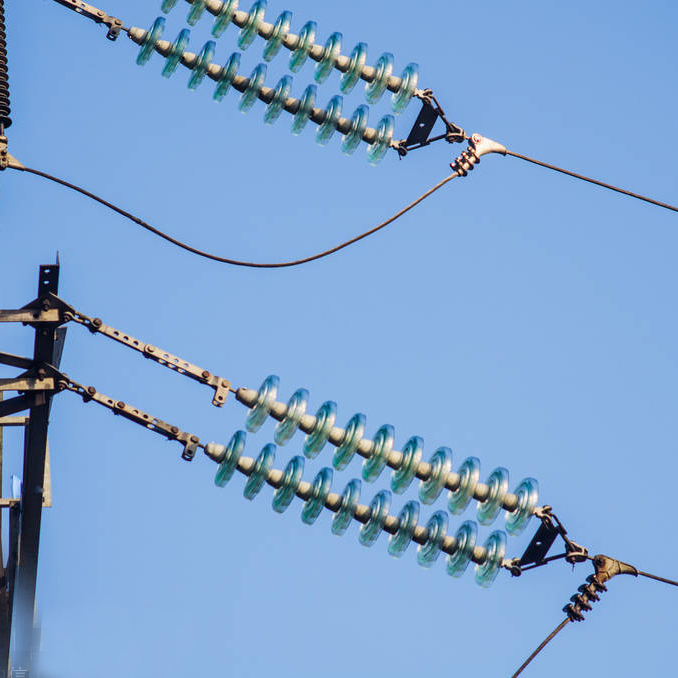
A defensible comparison therefore asks for creepage per kilovolt of line-to-line voltage and for the pollution class against which the figure is justified, not for a bare millimetre count. Where a supplier cannot support the number with type-test documentation, the creepage value should be treated as descriptive rather than qualifying.
Hardware, coupling size and corrosion protection
The QP-7 ball-head suspension ring declares a designated coupling size of 16, a rated failing load of 70 kN, a weight of 0.3 kg and a hot-dip galvanized steel construction. Its coupling size matches the connection structure code 16 declared for the porcelain U70BP/146D, which is the interface to verify first: a coupling that does not match the insulator socket dimension is a fit failure regardless of load rating.
The ring's 70 kN rated failing load equals the 70 kN rated electromechanical failing load of the porcelain disc, so within that string the ring matches the unit and adds no margin. Hot-dip galvanizing is the coating that responds to the anti-electrochemical corrosion requirement usually written into outdoor line specifications, but the unit data states no coating thickness and no galvanizing standard, so that specification should be requested as a separate line in the acceptance file.
Installation and repair effort
Installed effort scales with the number of components and interfaces, not with the material label. A disc string reaches a required creepage through a series of units and their couplings, so it carries more assembly steps and more inspection points. A long rod reaches its creepage in one unit with two end fittings, which concentrates mechanical risk in a single body but reduces the number of interfaces to be handled and checked.
The application data behind this comparison lists anti-aging and UV-resistant performance, high mechanical strength, high insulation performance, light weight, good bending resistance, water penetration resistance, stable metal fittings with anti-electrochemical corrosion, and non-toxic, environmentally friendly construction as characteristic requirements for outdoor transmission and distribution duty. Within this set, the polymer FXB-24-70-785mm is the unit whose description is explicitly built around a lightweight suspension long-rod design with customizable end fittings and FRP rod core supply.
Reported programme evidence points in the same direction. A three-year supply of 10,000 units to utility companies, power EPC contractors and railway operators and contractors in Brazil, Italy, Türkiye and Vietnam reports improved line stability, reduced maintenance intensity and improved pollution resistance where polymer and glass insulators were used. That is a reported programme outcome rather than a controlled comparison, and it should be read as such.
Neither the unit data nor the capability data used here publishes installed-hour figures or repair times. Buyers comparing installation effort should therefore request method statements, string or post assembly drawings and, on large programmes, a supervised trial installation, so that effort is measured instead of assumed.
Maintenance cost: the drivers, not the price tag
No unit price, freight cost or labour rate is published in the source data for these three products, so no total-cost ranking can honestly be produced from this comparison. What can be compared are the cost drivers.
- Fault visibility. In general line practice a shattered glass disc is visible from the ground, a cracked porcelain disc is harder to identify without closer inspection, and a polymer housing is assessed visually for surface condition.
- Replacement scope. Disc units are replaced individually, while a long rod is replaced as a complete unit once its mechanical or electrical integrity is lost.
- Pollution management. Washing or greasing cycles are driven by creepage relative to site pollution severity, which is why the creepage-per-kilovolt question affects operating cost and not only design.
- Hardware corrosion. Galvanized fittings that satisfy the anti-electrochemical corrosion requirement reduce the risk of seizure at the coupling, which is where field replacement time is commonly lost.
A buyer who wants a genuine maintenance comparison should combine these drivers with their own inspection intervals, access costs and spares policy. Material choice shapes those costs; it does not set their level on its own.
Project fit: where each unit is the natural choice
The scenario data behind this comparison describes public electrical equipment duty across rural and urban power grid upgrading, rail transit electrification, high-voltage transmission lines, substations and converter stations, and wind power projects. Equipment runs continuously, 24 hours a day, under high temperature, high humidity, outdoor climate, UV aging, dust storms that cause rapid dust accumulation and abrade umbrella skirt surfaces, and instantaneous impulse overvoltage. Spain, France, Italy and Turkey are named as common markets for this configuration, with power distribution cabinets as supporting equipment.
- Polymer FXB-24-70-785mm: a 35 kV suspension long rod with >1050 mm minimum creepage and >230 kV lightning impulse withstand. It fits 35 kV overhead sections where published creepage, silicone housing and reduced component count are the deciding attributes, including humid, coastal and dust-affected routes.
- Porcelain U70BP/146D: a 70 kN disc with a standard coupling code, suited to suspension strings where mechanical margin and a widely supported hardware interface are the priorities. Voltage class and creepage are set by the string, not by the unit.
- Glass 70B: a line-post unit rated 10 kN cantilever with 65 kV dry withstand, appropriate where bending duty governs. Its 255 mm creepage makes it a fit for lower-pollution, shorter-creepage positions rather than heavy pollution routes.
- QP-7: the suspension ring that closes the mechanical chain for a code 16 coupling at 70 kN, with galvanized construction for corrosion exposure.
Specifications written around 33 kV polymer insulators or 66 kV horizontal line post assemblies are assembly-level documents. The unit rating is only one input into the creepage, arcing distance and cantilever duty of the completed assembly, which is why a 35 kV rated long rod can be a defined electrical unit while a disc or post unit only becomes part of a 33 kV or 66 kV position through the string or stack design.
Market signals behind the mixed shortlist
The mixed shortlist is not only a procurement habit; it reflects market structure. Third-party estimates put the global electrical insulator market at USD 12.5 billion in 2023, projected to reach USD 18.4 billion by 2030, according to Grand View Research.
- Global electrical insulator market: USD 12.5 billion in 2023 to USD 18.4 billion by 2030, per Grand View Research.
- Global composite insulator market: approximately USD 3.42 billion in 2024, expected to reach USD 5.87 billion by 2030 at a CAGR of 9.1%, per Strategic Market Research.
- Suspension insulators captured 48.4% of the composite insulator market segment in 2024, per Mordor Intelligence.
- China accounted for 13.1% of global exports in the insulating glass and insulating materials category in 2024, as the second-largest global exporter, per OEC.
Two cautions apply. Market-size estimates diverge by scope: Grand View Research's USD 12.5 billion for 2023 and Mordor Intelligence's USD 14.38 billion for 2024 measure differently defined baskets, so the figures should not be averaged or chained together. And an export share inside a customs category is not finished-insulator market share. Read as structure rather than precision, the data supports one practical conclusion: composite and suspension formats are expanding quickly enough that mixed-material shortlists will remain normal, and acceptance discipline across materials matters more each year.
Limits and disqualifiers
A comparison that only lists strengths is a sales document. Each of these three units has a boundary that should be able to remove it from a shortlist.
Porcelain U70BP/146D
The unit data publishes no power-frequency withstand voltage and no creepage distance, only a 450 mm minimum arcing distance. An acceptance file therefore cannot be closed on catalogue values; type-test reports to IEC 60383-1 and a declared creepage have to be requested. The unit is also not the acceptance object, since the completed string including fittings is what the line actually relies on.
Glass 70B
A 10 kN cantilever and 255 mm creepage define a modest envelope. Where a project specifies higher cantilever duty or heavier pollution performance, this unit is out of scope rather than merely less preferred. Glass units also fail by shattering in general line experience, so spares and post-event inspection belong in the maintenance plan from the start.
Polymer FXB-24-70-785mm
The 5 kN rated bending load is the lowest mechanical figure in this set, and long-rod construction means a single mechanical failure removes the whole unit from service rather than one disc. Housing performance depends on compound and process quality, which catalogue data cannot demonstrate; type tests and installed track record are the only evidence a buyer can rely on.
All three units
None of the source data used here publishes unit price, freight, installed hours or failure rates. Any total-cost conclusion drawn from this article alone would be an invention rather than an analysis. The defensible position is that material choice defines the cost structure while the buyer's own project data supplies the numbers.
Acceptance evidence and where CECI fits
China Energy and Chemical Industry Co.,Ltd (CECI) is a Zhengzhou-based manufacturer and exporter of polymer, porcelain and glass insulators together with overhead line hardware, fittings and accessories. The company was founded in 2017, runs a 30,000 m² facility with about 100 employees and an R&D team of eight engineers, reports annual output of 8,000,000 units, and exports roughly 95% of production to more than 40 countries, including Russia, Vietnam, France, Spain, Italy, Türkiye, Brazil, Poland, Indonesia and Saudi Arabia.
For a mixed tender, the practical value of one source across all three families is one acceptance file: consistent test documentation, one hardware interface convention and one set of packing and spares rules. CECI states 100% testing on production and maintains ISO 9001 certification evidence, which is the document most acceptance checks request first. Technical justification still rests on type-test reports referencing IEC 60383-1 for the ceramic and glass units and IEC 61109 for the composite unit, together with dimensional verification against the declared values.
Published commercial terms for this supply are a minimum order quantity of 500 units, a lead time of 30 to 45 days and monthly capacity of 500 tons or 100,000 pieces. OEM and ODM work is available, with customisation of voltage, creepage distance, lightning impulse withstand voltage, bending load, colour and logo. After-sales support is described as remote support, which is a boundary worth planning for on remote line sections where on-site attendance is not part of the standard offer.
Future outlook
On the third-party figures, composite insulators are the fastest-moving segment in this comparison, with a projected 9.1% CAGR to 2030 and a 48.4% suspension share within the composite segment in 2024. That trajectory does not retire porcelain discs or glass line posts; it changes the default assumption in a shortlist from disc strings only to a genuine material choice made position by position.
Three consequences follow for buyers. Acceptance criteria will need to be written material-neutrally so that a valid offer in any of the three families can be assessed against the same evidence. Creepage justification against pollution severity will carry more weight than headline millimetre counts as routes are upgraded in dust- and humidity-affected regions. And hardware, meaning coupling size, galvanizing and failing load, will keep deciding whether a correctly specified unit can actually be installed on schedule.
Where all three families remain in the frame, the comparison should end where it began, with the duty statement. The unit that matches the load type, the creepage-per-kilovolt requirement and the available acceptance evidence is the correct one, and the other two should be recorded as evaluated and rejected on stated grounds.
FAQ
What does the 70 kN rating on the porcelain U70BP/146D actually measure?
It is the rated electromechanical failing load of the disc unit, the value declared for the electromechanical failing-load test in which mechanical load is applied while the unit is energised. It is not a working load and it says nothing about cantilever capability. The same unit declares a 146 mm structural height, 255 mm nominal disc diameter, 450 mm minimum arcing distance and connection structure code 16.
Is the glass 70B creepage of 255 mm directly comparable with the polymer unit's >1050 mm?
Not directly. The polymer FXB-24-70-785mm declares >1050 mm minimum creepage against a 35 kV rated voltage, while the glass 70B declares 255 mm creepage with no rated voltage stated in this data set. Creepage is meaningful only when read against system voltage and site pollution severity, so the two figures should be compared as creepage per kilovolt together with the pollution class each figure is justified against.
Can these three units be used on the same line?
Only through assembly design. The polymer unit declares a 35 kV rated voltage. The porcelain and glass units are specified by mechanical and dielectric withstand values rather than a rated voltage, so their voltage class is determined by how they are configured in a string or post assembly. Suitability therefore depends on the completed assembly rather than on a single unit's catalogue values.
Which unit suits dust, humidity and UV exposure?
Scenario data for this duty lists anti-aging and UV-resistant performance, high mechanical strength, high insulation performance, light weight, bending resistance, water penetration resistance, stable metal fittings with anti-electrochemical corrosion, and non-toxic, environmentally friendly construction. The polymer FXB-24-70-785mm is the unit whose >1050 mm creepage and silicone housing are tied to a stated 35 kV rating, while the glass 70B declares 255 mm creepage and the porcelain U70BP/146D declares a 450 mm arcing distance. Pollution performance should be confirmed from type-test evidence rather than inferred from material alone.
Does the QP-7 suspension ring fit the porcelain U70BP/146D?
The QP-7 declares a designated coupling size of 16, a rated failing load of 70 kN, a weight of 0.3 kg and hot-dip galvanized steel construction. The porcelain U70BP/146D declares connection structure code 16, the matching interface designation. Because the ring's 70 kN failing load equals the disc's 70 kN rated electromechanical failing load, the ring matches the unit without adding margin, and string design should account for that.
What certification evidence should be requested before acceptance?
Ceramic and glass insulators for overhead lines above 1000 V are tested under IEC 60383-1, and composite insulators for AC overhead lines above 1000 V fall under IEC 61109, latest edition 2025. A working acceptance file contains ISO 9001 certification evidence, type-test reports against the applicable standard, routine test records consistent with a 100% test regime, dimensional verification against declared values, and a galvanizing specification for the hardware.
What are CECI's published supply terms and where are the boundaries?
Published terms are a minimum order quantity of 500 units, a lead time of 30 to 45 days, and monthly capacity of 500 tons or 100,000 pieces, with OEM and ODM customisation of voltage, creepage distance, lightning impulse withstand voltage, bending load, colour and logo. After-sales support is described as remote support, so on-site attendance is not part of the standard offer, which is a boundary to plan for on remote or difficult-access line sections.
A downloadable catalogue covering CECI polymer and glass insulators is available here: 2025 CECI catalogue of polymer insulators and glass insulators.
Есть вопросы или нужны дополнительные детали?
Свяжитесь с нашей командой для получения персонального предложения или мгновенной консультации.
Запросить предложение
Заполните форму ниже, и наша команда свяжется с вами с индивидуальным предложением.
Прямой чат WhatsApp
Предпочитаете общаться в реальном времени? Напишите нам в WhatsApp для мгновенной помощи и быстрых ответов.
- Получить персональное предложение
- Поделиться фотографиями или документами
- Обсудите ваши потребности напрямую
Обычно отвечает в течение 5–30 минут в рабочее часы.