
Independent Buyer Review: Assembly and Setup Effort Across Four OEM Folding Furniture Models
Independent Buyer Review: Assembly and Setup Effort Across Four OEM Folding Furniture Models
Independent Industry Reference · Furniture Sourcing
Setup effort is the part of a folding furniture order that is settled in a customer's living room rather than on a factory floor. This review reads four documented Pricolotus folding models against what an ecommerce brand or global retailer actually has to publish, promise and support after delivery.
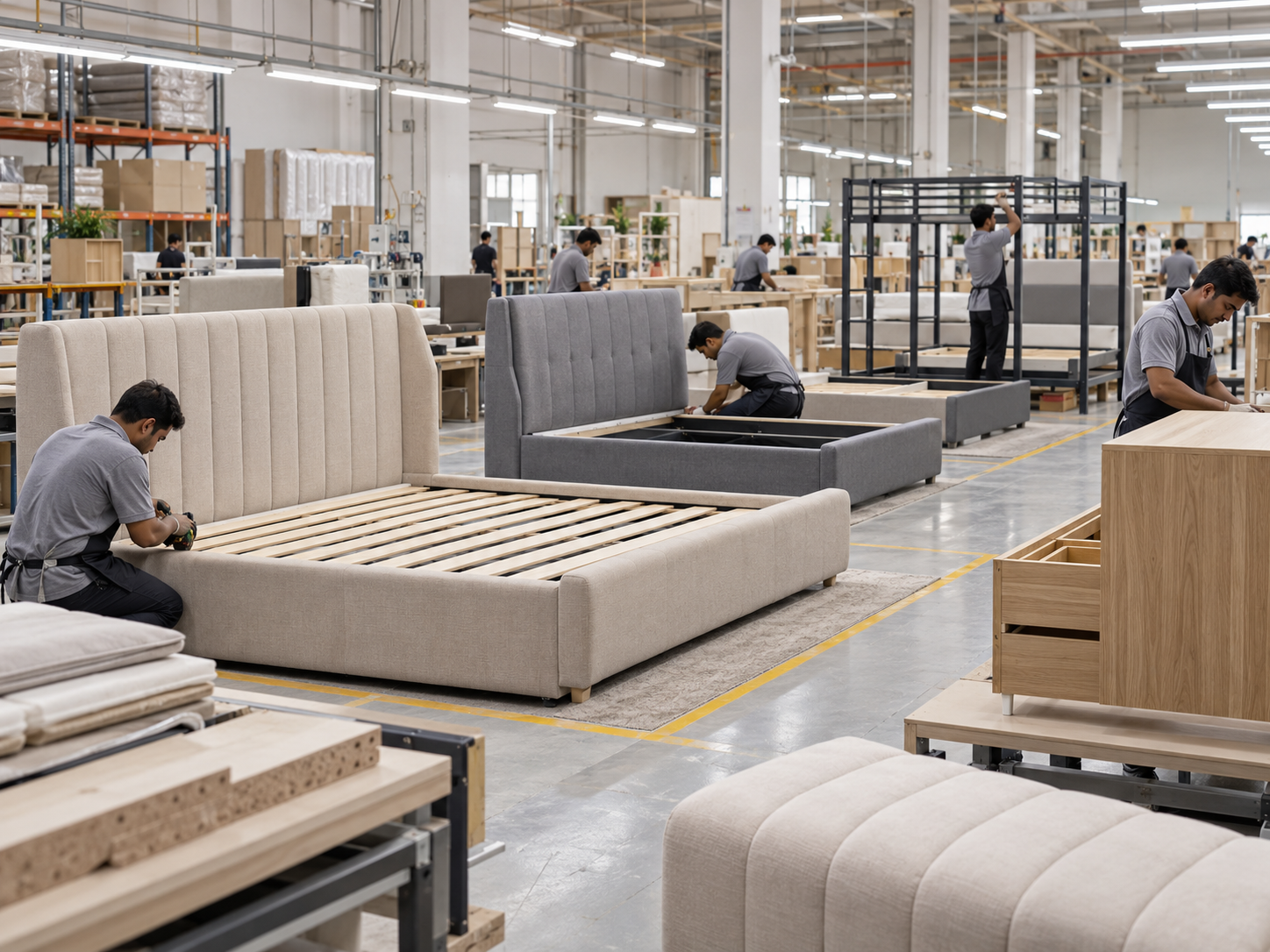
The setup state a buyer can publish is fixed upstream, at specification stage, long before a container is loaded. Image: Pricolotus Furniture production facility.
Introduction: why assembly effort became a sourcing line item
For most furniture categories the buyer's decision closes at the loading dock. For folding furniture it does not. The end consumer is the last person in the supply chain to touch the product and, in online formats, often the first to judge it. A consumer who expected to open a bistro set in seconds and instead finds a bag of hardware has not received a defective product. They have received a product whose setup state was never documented precisely enough to be promised on a product page.
That is the practical reason assembly and setup effort has moved into sourcing conversations with an OEM furniture manufacturer. For a furniture supplier for ecommerce brands, the working question is rarely whether assembly is fast. It is which setup state can be documented, published and defended, and what that state costs in carton volume, transit damage, support contacts and returns.
The commercial context is not small. China's wooden furniture exports reached US$24.57 billion in 2024, a 2% year-on-year increase, and the United States took nearly 30% of that value, or about US$7.1 billion (China Customs data reported by Fordaq, September 2025). The global furniture market was valued at US$597.71 billion in 2025 and is projected to grow at a 5.92% CAGR between 2026 and 2034 (Fortune Business Insights, 2026). Folding and space-saving formats occupy a narrow slice of that volume, but a demanding one: they carry a mechanical action that the consumer tests personally, on the first day.
Pricolotus Furniture is a furniture brand operated by Xiamen Youjin Trade Co., Ltd., a supplier based in Xiamen, China, established in 2016. The company operates a 40,000 m² production footprint with 98 employees and a 25-engineer R&D team, exports 100% of its output, and lists the USA and EU as its main markets. Its documented range covers metal furniture, panel furniture and soft upholstered furniture, including folding tables, folding chairs, dining and bar sets, and space-saving storage.
The four models reviewed here are 826-1008 (3-piece bar table set with drop leaf), 826-1009 (3-piece folding bistro set), 826-1010 (3-tier space saver) and 605-0007 (folding tray table). Everything below is limited to the dimensions, materials, load limits and setup wording recorded in the company's product and application data. Where a figure is not published, this review says so rather than estimating it.
The setup problem: three delivery states, three support burdens
Folding furniture reaches an online buyer in one of three states, and each state moves cost to a different part of the operation. Fully assembled products minimise consumer effort and maximise carton volume. Tool-free folding products sit in the middle: they ship compact and open without hardware. Hardware-assembled products minimise carton volume and transfer the final production step to the customer.
- Assembled and opened by hand. Lowest consumer effort, highest packaging volume and freight cost per unit, with damage risk shifted into transit.
- Tool-free folding. Compact shipping plus a documented unfolding action; the product's promise depends entirely on the fold being described accurately.
- Hardware assembly. Lowest shipping volume, but the brand inherits step-count questions, missing-part contacts and, in some markets, an expectation that tools and instructions are supplied.
For a home furniture manufacturer for global retailers, the middle state is usually the most defensible, because it is the only one where the marketing claim and the physical action are the same event. The constraint is documentation. A fold that is not described precisely becomes a support ticket even when the product performs exactly as designed.
Where the four models sit on the setup spectrum
The table below summarises what is documented for each model. It is deliberately narrow: setup mechanism, published dimensions, material composition and whether a step sequence exists at all.
| Model | Documented setup mechanism | Key dimensions | Materials | Assembly sequence published |
|---|---|---|---|---|
| 826-1008 3-piece bar table set with drop leaf |
Drop-leaf tabletop on a reinforced metal frame; two stools tuck under the table | Table 80 × 40 cm folded / 80 × 75 cm extended, height 75 cm; chairs 32 × 32 × 45 cm | Metal frames; MDF panels with wood veneer | Not published |
| 826-1009 3-piece folding bistro set |
No-assemble three-piece combo; fold action for storage; frame described as rust-proof | Table Dia. 60 × 72 cm; chair 40 × 46 × 80 cm | Steel frame; wood-like MDF or particle board | Not required to open; no-assemble stated |
| 826-1010 3-tier space saver |
Fixed three-tier shelf; anti-tilt design; fits over toilet and corner spaces | 61 × 23 × 158 cm; 15 kg per tier | Metal frame; MDF or particle board shelves | Installation accessories and assembly hardware listed in application data; sequence not published |
| 605-0007 Folding tray table |
Unfold and use; no tools or installation required; folds flat for storage | 48 × 38 × 66 cm | Powder-coated steel tube frame; MDF top | None required, per product data |
Table 1 — Documented setup characteristics of four folding models. Values as recorded in the product specifications.
Two rows in this table are complete on the setup question and two are not. Models 826-1009 and 605-0007 carry explicit setup wording: no-assemble for the bistro combo and no tools or installation required for the tray table. Models 826-1008 and 826-1010 publish structure, dimensions and load limits, but not a fastener count, a step sequence or a stated assembly time. For a buyer, that distinction is the difference between a claim that can go live on a product page today and a claim that needs written confirmation first.
Technical explanation: what each specification actually commits to
826-1009 — the no-assemble three-piece case
The bistro set is specified as one table and two chairs, with a steel frame and wood-like MDF or particle board surfaces. The table measures Dia. 60 × 72 cm and each chair 40 × 46 × 80 cm. The documented setup position is that the set arrives as a no-assemble combo with a fold action described in the product data as a one-second fold for space-saving storage, and the frame is described as rust-proof for patio and balcony use. For an ecommerce listing this is the strongest of the four positions, because the consumer's first action is opening rather than building. The corollary is packaging: a no-assemble set generally occupies more carton volume per unit than an equivalent flat-pack, and freight economics should be checked against that.
605-0007 — tool-free by design
The tray table measures 48 × 38 × 66 cm, with an MDF tabletop and a powder-coated steel tube frame on a U-shaped non-slip base. The recorded setup wording is explicit: unfold and use straight out of the box, no tools or installation required, and fold flat in seconds for storage under a sofa, bed or in a narrow gap. Because the frame is a single tube structure, the setup risk here is not assembly error but stability perception. A consumer judges this product within the first few seconds of use, and a wobble reads as a quality defect whether or not one exists.
826-1008 — drop-leaf flexibility without a published assembly sequence
The bar table set is one table plus two chairs. The table measures 80 × 40 cm with the drop leaf folded and 80 × 75 cm extended, at a height of 75 cm; each chair measures 32 × 32 × 45 cm. Materials are metal frames with MDF panels finished in wood veneer, and the structure is described as a drop-leaf top combined with a reinforced metal frame. Documented load is 100 kg per chair, and the two stools tuck under the table when not in use. What this specification does not publish is how the piece is put together on arrival. The drop-leaf action itself is consumer-facing and tool-free in normal use, but that is not the same as a documented assembly state, and buyers should not present it as one.
826-1010 — a fixed structure where clearance is the real setup decision
The 3-tier space saver measures 61 × 23 × 158 cm, with a metal frame and MDF or particle board shelves, a documented load of 15 kg per tier, an anti-tilt design contributing to stability, and a format intended to fit over toilet and corner spaces. Of the four models this is the one where setup effort is dominated by placement rather than assembly. A 158 cm tall, 23 cm deep unit has to clear the fixture it sits over, and the anti-tilt design resolves the stability question only once the unit is positioned correctly. The application data for this product family lists installation accessories and assembly hardware among the matched equipment, which is consistent with a fixed structure that is positioned and secured rather than folded away.
Setup effort in real rooms: the documented use cases
The application data behind these four models describes one project type, a foldable space-saving household furniture project, operated in an indoor household environment. Its recorded function is to provide seating, table surfaces, sleeping support, item storage and space-utilisation solutions. Its operating mode is a foldable structure with easy assembly and quick folding or unfolding, and its matched equipment is installation accessories and assembly hardware. The special requirements attached to the project are stability, easy cleaning, a compact folded footprint and safety in daily household use.
Read against individual products, that generic requirement becomes specific placement logic:
- 826-1008 is positioned for a small kitchen, apartment or loft, where the drop leaf doubles the working surface only when the extended 80 × 75 cm envelope is genuinely free.
- 826-1009 is positioned for patio and balcony use, where the rust-proof frame description matters as much as the fold speed.
- 826-1010 is positioned over a toilet and in corners, where the 61 × 23 × 158 cm footprint and the 15 kg per tier limit define what can actually be stored.
- 605-0007 is positioned for living room, bedroom, small apartment and office use, and for temporary settings such as a market stall, where the tool-free setup is the entire value proposition.
One retailer case in the company's records describes a five-year relationship with a retail client. The foldable design, space-saving footprint, easy assembly and multi-scene application are listed as the highlights, with strong market sales performance and good reception by end consumers reported as the result. The detail worth noting for an ecommerce brand is which attribute appears first in that list: the fold, not the price.
Market trend: setup documentation is turning into a supplier filter
Three verified data points frame the commercial direction.
- China's wooden furniture exports reached US$24.57 billion in 2024, up 2% year on year, with the United States accounting for nearly 30%, or about US$7.1 billion, of that value (China Customs, reported by Fordaq).
- The global furniture market was valued at US$597.71 billion in 2025, with a 5.92% CAGR projected for 2026 to 2034 (Fortune Business Insights).
- In the European Union, the furniture industry is described by the European Commission as a labour-intensive sector dominated by small and medium-sized enterprises and micro firms.
The third point matters more to buyers than it first appears. A fragmented supply base of small firms means documentation depth varies widely between suppliers. Two factories can produce a similar folding table while only one can supply the clearance envelope, the load limit and the setup wording in a form a brand can publish. For a China furniture manufacturer for export, that asymmetry is now a competitive surface, not because regulation demands it, but because retail listings and consumer expectations do.
More broadly, folding and space-saving formats are generally tied to smaller urban dwellings, where a table that must be extended to be useful is only useful if the extension is understood before purchase. That pushes setup information upstream into the RFQ. Buyers who request the folded and extended envelope, the documented load limit and the delivery state in the first email receive comparable answers. Buyers who ask later receive revisions.
Comparison with traditional solutions — and the limits of this review
A traditional flat-pack programme and a folding programme solve the same problem in opposite directions. The table below sets out the trade-off as it applies to the four models.
| Trade-off | Flat-pack with hardware assembly | Folding / no-assemble (826-1009, 605-0007) | What the buyer confirms |
|---|---|---|---|
| Consumer effort | Steps, tools and time allocated by the customer | Unfold or open; no tools stated | The exact wording permitted on the product page |
| Carton and freight | Lower volume per unit | Generally higher volume per unit | Carton dimensions and container loading plan |
| Typical failure mode | Missing parts, assembly errors | Fold mechanism wear, stability perception | Fold-cycle data and load limits in writing |
| Support load | Step guidance and part replacement | Positioning and stability questions | Who answers post-sale technical questions |
Table 2 — Setup trade-offs between flat-pack assembly and folding formats, with the confirmation each one requires.
The limits of what this review can establish are as important as the findings.
Limit 1 — no published setup metrics for two models. For 826-1008 and 826-1010 the available specification confirms structure, dimensions and load limits, but does not publish fastener counts, a step sequence or a stated assembly time. A buyer who needs those figures for a product page or a retail compliance file must request them; they cannot be inferred from the drawings.
Limit 2 — load limits are per-product values, not a category benchmark. The 100 kg per chair figure for 826-1008 and the 15 kg per tier figure for 826-1010 are documented for those specific models. They should not be transferred to other folding formats or used to imply a uniform standard across the range.
Limit 3 — fold-mechanism durability is not published. None of the four specifications records a fold-cycle count or a wear rating for the folding action. Given that the folding action is the consumer-facing feature, this is the single most useful document an ecommerce brand can request before committing to a seasonal programme.
Limit 4 — certification status cannot be confirmed from the available data. The compliance records supplied for this review list two SGS-linked entries covering the USA market, one recorded under PVC TAPE and one under SGS, but no certificate number, issuing authority detail, scope or validity date is published. For a buyer evaluating an FSC material furniture manufacturer or an ISO quality furniture supplier, that is not sufficient. FSC chain-of-custody and ISO 9001 registration must be verified at certificate level, with the number, scope and validity checked against the issuing body's registry. The same applies to the phrase factory audited furniture manufacturer: an audit claim is only useful when the scheme, the auditor and the report date are named. None of this implies the claims are unsupported. It means they are unverified in the available documentation, which is a different statement.
Limit 5 — capacity and lead time need a written commitment. The recorded capability data lists an MOQ of 1 unit, a lead time of 30–45 days, monthly capacity of 200 units, pre-shipment inspection as the quality control method, and remote technical support for after-sales quality issues. For a test order those terms are workable. For a high-volume or seasonal programme, a monthly capacity figure at that level means the production plan, not the product, becomes the binding constraint, and it should be confirmed in writing against forecast.
Future outlook
Three developments are likely to shape how folding furniture is bought over the next few years, and none of them depends on new manufacturing technology.
Setup becomes a listing attribute. As online furniture competition shifts from product photography toward post-delivery experience, the delivery state will be treated like dimensions: a required field rather than a differentiator. Suppliers who already document it will move through buyer qualification faster, and buyers will start treating an undocumented fold as an incomplete quotation.
Documentation depth separates a fragmented supplier base. With the EU furniture sector described by the European Commission as dominated by SMEs and micro firms, and with global demand projected to grow at a 5.92% CAGR through 2034, the practical differentiator is not capacity alone but the ability to answer a buyer's questionnaire completely. A modern home furniture OEM supplier competing for retailer programmes will increasingly be judged on specification completeness rather than on catalogue breadth.
Custom-size and private-label programmes push setup questions earlier. Where a custom size furniture manufacturer adjusts a 48 × 38 × 66 cm tray table to a retailer's own dimensions, the folding geometry has to be re-verified rather than simply scaled. The same holds when a private label furniture manufacturer changes a surface finish or a load target. In practice, the earlier the delivery state is fixed in the development process, the fewer revisions reach the packaging stage. The company's documented customisation offer, quick custom quotes and samples, is the mechanism through which that conversation usually begins.
For buyers, the actionable position is unglamorous. Ask for the folded and extended envelope, the documented load limit, the delivery state, the fold-cycle data and the certificate numbers in the first round. The four models reviewed here are strongest where that information already exists, and they are ordinary, not deficient, where it does not.
The full Pricolotus Furniture product catalogue, including dimensional and material specifications for the models discussed here, is available for download: Pricolotus English Product Catalogue 2026.
FAQ
Which of these four folding models can be set up without tools?
Model 605-0007, the folding tray table, is documented as unfolding for use straight out of the box with no tools or installation required. Model 826-1009, the 3-piece folding bistro set, is documented as a no-assemble combo with a fold action for storage. For models 826-1008 and 826-1010 the available specification records dimensions, materials and load limits but does not publish an assembly step sequence, so a tool-free claim for those two should be confirmed in writing before it is used in a listing.
What setup information should an ecommerce brand request before ordering folding furniture?
Five items make quotations comparable: the folded and extended dimensions, the documented load limit per surface, the delivery state, the durability data for the folding mechanism, and the carton dimensions used for freight planning. As practical examples from this range, model 826-1008 measures 80 × 40 cm folded and 80 × 75 cm extended with a documented load of 100 kg per chair, while model 826-1010 measures 61 × 23 × 158 cm with a documented load of 15 kg per tier. Requesting these in the first RFQ round prevents later specification revisions.
How do dimensions affect setup in small apartments?
In a small space, setup is a clearance question before it is an assembly question. Model 826-1008 needs 80 × 75 cm of free surface when the drop leaf is extended, against 80 × 40 cm folded. Model 826-1010 is 158 cm tall and 23 cm deep and is designed to fit over toilet and corner spaces, so the fixture it sits over must be checked against that envelope, with the 15 kg per tier limit setting what can be stored. Model 605-0007 at 48 × 38 × 66 cm and the 826-1009 bistro set with a 60 cm table diameter and 72 cm table height are the two smallest footprints in the group.
Can these folding models be supplied as private label or custom size?
The recorded capability data lists customisation as quick custom quotes and samples, with an MOQ of 1 unit, a 30–45 day lead time and a monthly capacity figure of 200 units. In practice, a custom size or private label change to a folding model affects the folding geometry and load behaviour, not only the finish, so the sample stage is where the delivery state should be re-confirmed. Buyers should treat a dimensional change as a new specification rather than a variant of an existing one.
What certification and quality documentation is available?
The compliance records supplied for this review contain two SGS-linked entries covering the USA market, recorded under PVC TAPE and SGS, without certificate numbers, scope statements or validity dates. Quality control for supplied programmes is recorded as pre-shipment inspection, with remote technical support for after-sales quality issues. Buyers requiring FSC chain-of-custody, ISO 9001 registration, factory audit reports or market-specific product safety documentation should request certificate numbers and validity dates directly and verify them against the issuing body's registry before publication.
Есть вопросы или нужны дополнительные детали?
Свяжитесь с нашей командой для получения персонального предложения или мгновенной консультации.
Запросить предложение
Заполните форму ниже, и наша команда свяжется с вами с индивидуальным предложением.
Прямой чат WhatsApp
Предпочитаете общаться в реальном времени? Напишите нам в WhatsApp для мгновенной помощи и быстрых ответов.
- Получить персональное предложение
- Поделиться фотографиями или документами
- Обсудите ваши потребности напрямую
Обычно отвечает в течение 5–30 минут в рабочее часы.