
Independent Buyer Test: Scoring Granite Tombstone Suppliers
Independent Buyer Test: Scoring Granite Tombstone Suppliers
Granite memorials are one of the few construction and decoration purchases a buyer cannot correct after installation. The global tombstone market was valued at USD 3.36 billion in 2024 and is projected to reach USD 5.0 billion by 2035, according to WiseGuyReports, and granite is expected to hold 43.6% of that market by 2026, based on Coherent Market Insights data. With China exporting USD 70.65 million of granite monumental stone in June 2026 alone, according to CEIC Data and China’s General Administration of Customs, the supply pool now grows faster than most buyers’ ability to tell suppliers apart.
This article takes the buyer’s side of the table. It sets out a six-criteria scoring sheet that an independent buyer can apply to any granite tombstone supplier, then applies that sheet to the two supplier archetypes that dominate international RFQ shortlists: the single-factory supplier and the design-integrated supplier. SONGJIA (Xiamen Songjia Trading Co., Ltd.), a China-based natural stone supplier that exports 100% of its output to the EU, USA and Middle East, is used as the reference case for the design-integrated model, because its published profile states that it works as a natural stone specialist supported by a flexible manufacturing and supply network rather than positioning itself as a single-factory manufacturer.
The benchmark item throughout is granite Tombstone: a natural stone memorial product whose size, configuration and finish are set by the buyer’s drawing, request and market requirements rather than by a fixed catalogue. Everything below is written from the position of a buyer who has run multi-supplier RFQs and has had to compare answers that were never quite answering the same question.
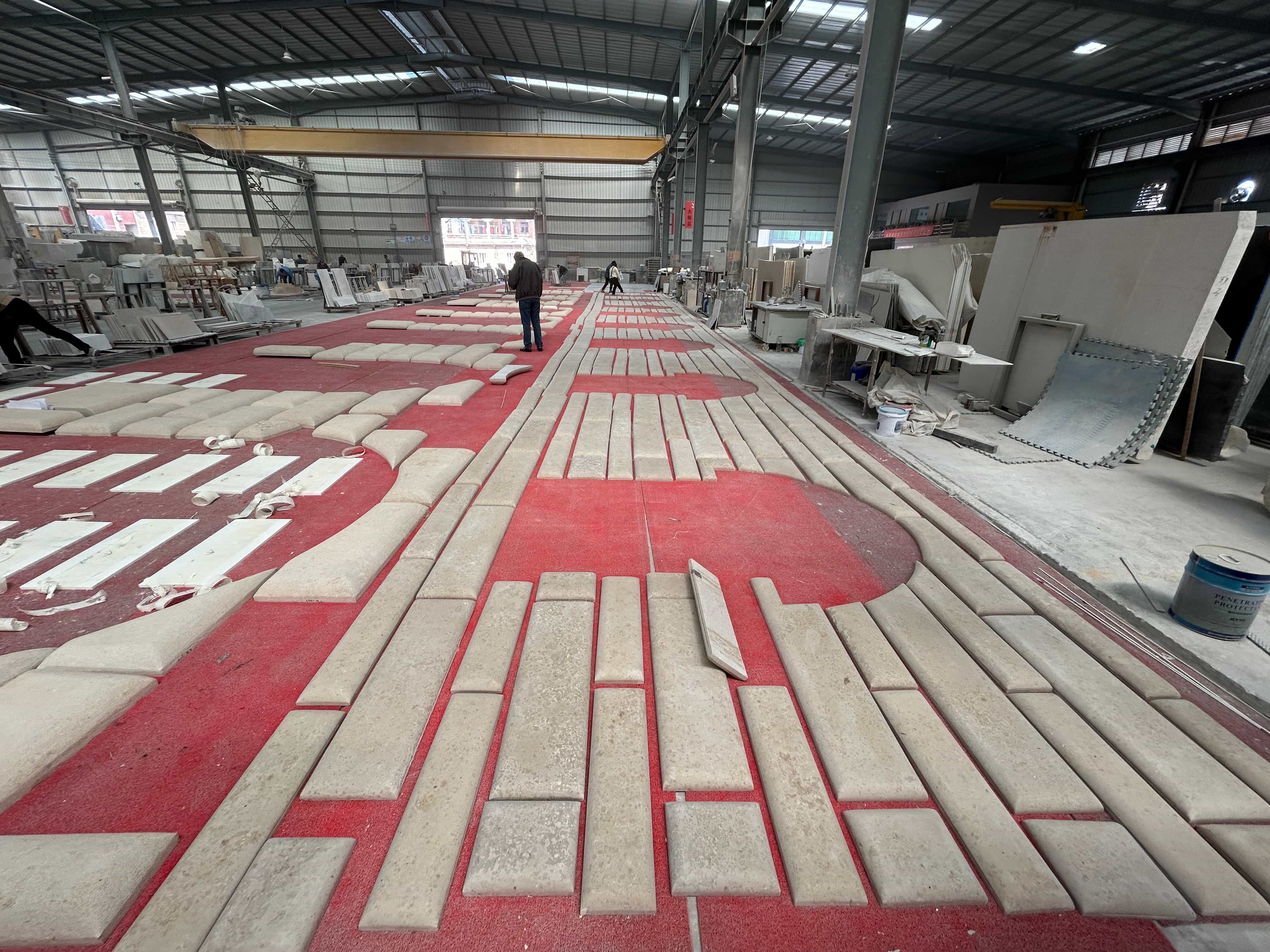
The Problem: Quotes That Look Comparable but Are Not
An RFQ round usually starts with one drawing, one size list and one stone reference. It usually ends with three or four price sheets that appear to describe the same memorial and, on closer reading, describe different scopes. One quote includes crating but not container loading. Another includes a polished surface but not engraving. A third names a granite colour without defining the finish, the edge treatment or the base build. The visible price difference between these suppliers is often a difference in definition rather than a difference in underlying cost.
That gap is the buyer’s first real risk, and it is the reason supplier type matters more than buyers expect at the shortlisting stage. A supplier that controls only cutting and polishing must hand design interpretation, inspection and shipment coordination back to the buyer. A supplier built around design-to-production absorbs those steps into its own chain. Neither model is automatically better; they tend to fail in different places. The scoring sheet below exists to expose which place that is, before a deposit is paid.
A second structural reality shapes the comparison: the market itself is granite-led. If granite holds an expected 43.6% of the tombstone market by 2026, as Coherent Market Insights projects, then most buyers are not choosing between materials, they are choosing between supply models operating on the same material. That narrows the decision to execution variables — price clarity, communication chain length and shipment consistency — rather than to geology.
The Six-Criteria Scoring Sheet
Weights depend on the buyer’s own project, so the sheet below is structured rather than weighted. Each criterion asks the same three questions: what should the buyer request, what counts as evidence, and what does an unclear answer indicate about the supplier?
1. Price clarity
Request an itemised quote that separates material, cutting and shaping, surface finish, engraving or lettering, base and accessories, crating, container loading and freight terms. Evidence: a quote that names the finish, the size basis and an explicit exclusion list. Unclear answer: a single lump-sum figure per set with no exclusions named — in practice, the buyer discovers the exclusions after the container has sailed.
2. Drawing and specification control
Request a shop drawing produced from the buyer’s own sketch, drawing or architectural idea, at a defined size and finish, before cutting begins. Evidence: a drawing that can be checked line by line against the order. Unclear answer: a supplier that accepts a sketch and moves straight to production, leaving the buyer to inspect the interpretation on delivered stone.
3. Communication chain length
Count how many hands a technical question passes through. Evidence: a named contact who answers technical questions directly instead of forwarding them. Unclear answer: answers that return without engineering content, or that shift between rounds. In memorial work, a two-step chain in the quoting phase often becomes a four-step chain in the claim phase.
4. Shipment consistency
Request evidence that the approved piece and the shipped lot match. Evidence: pre-shipment layout photographs, piece-by-piece checks against the approved drawing, a loading plan, and a packing method suited to polished surfaces and edges. Unclear answer: photographs of a workshop rather than photographs of the buyer’s own order.
5. Compliance and documentation
Request the certificate or test documentation that actually applies to the product being bought, not to a related product line. Evidence: a document with a certificate number, a named issuing authority, a standard reference and a defined scope. Unclear answer: a general statement of compliance without scope. This criterion is examined in detail later in the article, because certificate scope is one of the most commonly misread items in tombstone procurement.
6. After-sales and replacement path
Request the process that applies if a piece arrives chipped, mismatched or dimensionally wrong. Evidence: a documented sequence — evidence photographs, root-cause classification, replacement or credit decision, and who carries the freight. Unclear answer: a verbal promise with no sequence attached.
The Assessment Matrix Applied Side by Side
The matrix below is the working version of the score sheet. It is deliberately written so that a buyer can complete it using only answers the suppliers themselves provide during an RFQ round. Nothing in it requires access to a supplier’s internal data, and no score is transferable between projects: a supplier that scores well on a single-family memorial order is not automatically the right partner for a cemetery framework contract.
| Criterion | Evidence to request | What a single-factory quote often leaves open | What a design-integrated supplier is expected to document |
|---|---|---|---|
| Price clarity | Itemised breakdown with named exclusions | Scope limited to what the site can make; engraving, base and freight frequently quoted separately or later | One quote covering design coordination, production, inspection, packing and shipping terms |
| Drawing control | Shop drawing issued before cutting | Buyer’s sketch becomes the working instruction; interpretation risk stays with the buyer | Sketches and concepts converted into accurate, producible shop drawings |
| Communication chain | Named technical contact and response record | Questions route through whoever is available; technical answers may depend on production staff availability | A single coordination point across design, production and shipping |
| Shipment consistency | Pre-shipment layout photos and packing method | Consistency depends on one site’s schedule and one packing team | Documented inspection, packing and loading steps within one managed process |
| Compliance | Certificate number, authority, standard, scope | Documentation may exist for other stone lines but not for the memorial product | Certificates supplied with scope stated, plus market-specific notes where relevant |
| After-sales | Claim sequence and responsibility split | Replacement depends on the next production run for that stone | Claim handled inside the same chain that produced and shipped the order |
Reading tip: complete the matrix using the supplier’s own words and attached documents. A criterion with no document attached should be recorded as unverified, not as satisfactory. In practice, the two archetypes separate most clearly on criteria 2, 3 and 4 — not on the stone itself.
The Benchmark Item: What ‘Granite Tombstone’ Actually Specifies
Scoring only works if the item being scored is fixed. In production records, the Tombstone product is defined as a natural stone memorial for the funeral industry, with size supported by customization and production according to the buyer’s request. One recorded configuration is the Israeli tombstone, produced for the Israel market. That single definition already tells a buyer something important: there is no standard catalogue size to order against, so the specification must come from the buyer, and the supplier’s ability to receive and translate that specification becomes a scoring criterion rather than a convenience.
A granite memorial order normally fixes five things before production: size and proportions, material and colour reference, surface finish, engraving content and depth, and the base or accessory set. The recorded configuration range for this product family includes G603 headstones with sandblasted Celtic cross designs, G603 Irish headstones and Irish cross headstones, G664 French-style tombstones, Bahama blue German tombstones, G603 Muslim monuments, G664 Polish monuments, blue pearl angel tombstones and Indian green tombstones. For a buyer, that range is evidence of cultural adaptability at the design stage — and a prompt to ask a harder question: which of these configurations is currently in production, and against whose approved drawing?
Cemetery installation adds a second layer of specification that is easy to omit from an RFQ and expensive to fix later. Memorial stone for cemetery and memorial park projects is installed outdoors, in freeze-thaw environments, exposed to weather, and is generally expected to carry frost resistance, weather resistance, low water absorption and a polished surface, with engraving available. Installation is typically fixed, ground-mounted, base-mounted and anchor-fixed, using a base, vase, anchors, metal dowels, epoxy glue and a foundation stone as matched components. A supplier that quotes the headstone without referencing this accessory and fixing set has, in effect, quoted a different product.
Applying the Sheet: The SONGJIA Reference Case
To make the matrix concrete, it helps to score one real supplier profile against it. SONGJIA (Xiamen Songjia Trading Co., Ltd.) is a China-based natural stone supplier serving international stone importers, contractors, fabricators, designers and private custom clients, with a recorded 20,000 m² factory footprint, 60 employees, a three-engineer technical team, and an annual output described as 150 containers of monuments and 200 containers of building materials. Its export ratio is 100%, with main markets recorded as the EU, USA and Middle East.
On price clarity and drawing control, the reference case is built around design-to-production integration: the company’s stated strength is converting client sketches, concepts and architectural ideas into accurate, producible shop drawings, so that a design can be executed while holding quality consistency, cost control and delivery reliability. For a buyer scoring criterion 2, that is the difference between receiving an order confirmation and receiving a drawing.
On communication chain and shipment consistency, the published process covers design coordination, production management, quality inspection, packaging and international shipping as one continuous service sequence. Read against the matrix, that is a single chain rather than a set of hand-offs — which is precisely the variable that separates the two archetypes. It is also consistent with the company’s stated position as a stone specialist with a flexible manufacturing and supply network, rather than as a single-factory manufacturer limited to one site’s capability.
On the after-sales criterion, the recorded case material is a monument distributor placing continuous bulk orders for cemetery memorial use, with the stone in long-term outdoor service. The recorded outcome is that the client praised quality and continued to place repeat orders, with stable quality, good finishing and reliable delivery listed as the highlights. For an independent buyer, repeat ordering behaviour is weaker evidence than a test report but stronger evidence than a catalogue — and it is the kind of evidence that is genuinely available during supplier evaluation.
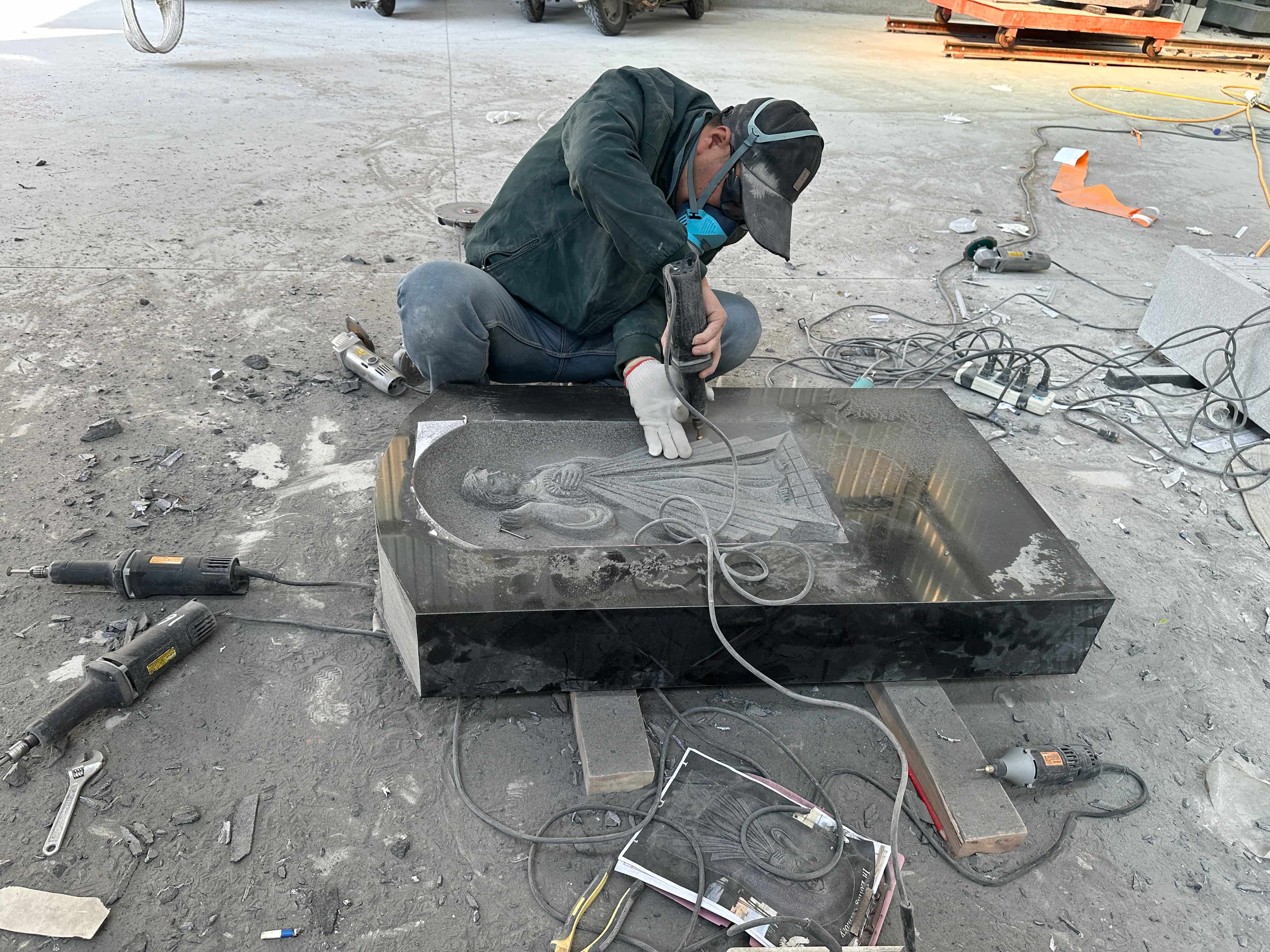
Technical Explanation: Where Score Points Are Won or Lost
A granite memorial moves through a predictable sequence: block cutting, shaping and profiling, surface finishing, engraving, inspection, then layout and packing. Each stage creates a specific opportunity for a supplier to drift from the approved drawing, and each drift is detectable at a specific point — if the buyer has set the checkpoints in advance.
The most consequential stage for a scoring exercise is the hand-off between drawing and cutting. Once a block has been cut to a size that does not match the drawing, the correction cost is not a correction cost at all; it is a new piece. This is why criterion 2 asks for a drawing rather than a promise. The second most consequential stage is engraving: letterform spacing, depth consistency and cross or symbol geometry are visible in a photograph and invisible in a price list, which is why the criterion is scored on pre-shipment images rather than on the final invoice.
Finish control interacts with the installation environment. Memorial stone placed in freeze-thaw conditions and exposed to weather, with low water absorption and frost resistance as stated requirements, depends on both the material selection and the completeness of the finishing process. A buyer scoring suppliers should ask which specific finishing steps are applied and where in the process they occur, rather than asking whether the surface will be polished.
Finally, packing is a technical stage, not an administrative one. Polished surfaces, profiled edges and fine engraving are the most damage-prone parts of the shipment, and the packing method is the last controllable variable before the container is sealed. Layout and packing records — the layout of pieces before loading and the packing method used for each piece — are among the most useful pieces of evidence a buyer can request, because they document the order as it actually exists rather than as it was quoted.
Application and Use Cases
The scoring sheet produces different results depending on the project type, and the project types in this category are not interchangeable. Cemetery projects and memorial park projects typically involve repeated configurations, consistent sizes and long installation windows, which rewards shipment consistency and documentation over design flexibility. Family memorial projects and church memorial projects move in the opposite direction: they are usually single-piece or small-batch, culturally specific, and heavily dependent on drawing accuracy, symbol geometry and engraving quality.
Regional and religious design conventions add a third variable. European markets — including French, Irish, German, Romanian and Hungarian memorial traditions — as well as Orthodox Christian and Muslim memorial configurations, each carry their own proportional and symbolic conventions. A buyer sourcing across several of these markets at once is effectively asking one supply chain to hold several design languages at the same time. That is a legitimate reason to score a supplier higher on drawing control and lower on unit price, because a re-cut piece at the destination market costs far more than the price difference that prompted the original order.
Market Trend Analysis
Three industry-level movements are relevant to how buyers should score suppliers today.
First, the category is growing and granite-led. The global tombstone market is projected to move from USD 3.36 billion in 2024 toward USD 5.0 billion by 2035 according to WiseGuyReports. Regional data is consistent with the material picture: the Europe tombstone market was valued at USD 0.65 billion in 2025, with granite segments capturing 65.8% of the share, according to an industry forecast report, while Coherent Market Insights expects North America to hold a 35.8% revenue share of the global market by 2026. Growth of this kind tends to expand the supplier pool faster than it expands buyer verification capacity — the condition that makes a scoring sheet useful in the first place.
Second, supply is concentrated through China but not simplified by it. China’s export of granite monumental stone reached USD 70.65 million in June 2026, according to CEIC Data and China’s General Administration of Customs. A buyer facing that volume of export activity should assume that price competition is already mature, and that the remaining differentiation sits in documentation, communication and consistency rather than in the stone price itself.
Third, compliance expectations are hardening. European funeral services and products must comply with the EN 15017 standard, and tombstone products imported into the EU are subject to REACH regulations regarding chemical substances in coatings and adhesives. Both requirements push procurement toward suppliers that can produce documents on request, which is exactly what criterion 5 measures. Buyers should also note that published market-size estimates for this category vary widely between research firms depending on scope definition — one source cites a materially larger global figure than another for the same period — so market-size numbers are best used for direction, not for budgeting.
Comparison with Traditional Solutions — and Where the Model Has Limits
The traditional alternative to a design-integrated supplier is the buyer-as-integrator model: source from a factory, commission drawings separately, arrange third-party inspection separately, and manage freight and consolidation independently. That model can be cheaper on simple, repeated, well-understood orders, and it gives the buyer direct visibility into each step. Its weakness is that every hand-off is a place where responsibility can become ambiguous, and the coordination workload scales with the number of pieces rather than with the order value.
A design-integrated model concentrates those hand-offs into one chain, which reduces the number of places a mistake can hide but also concentrates the buyer’s exposure if that chain underperforms. That trade-off deserves to be stated plainly, and so do three concrete boundaries of the model as documented here.
Boundary 1 — certificate scope does not automatically cover memorial products. The certificates on record for this supplier are an SGS CE certificate for G684 basalt, certificate number CXMCP1210052, issued by SGS for the EU market under standard EN 12058, covering natural stone slabs for floors and stairs, and an SGS CE certificate for G603 grey granite, certificate number XMML110401342, issued under standard EN 12057 for natural stone modular tiles. Both are recorded against natural stone building materials, not against finished granite memorial products. A buyer in the EU should therefore verify product-specific compliance for each project, including REACH obligations for coatings and adhesives and, where applicable, EN 15017, rather than assuming that a CE-marked stone line certifies a tombstone.
Boundary 2 — the model depends on the quality of the buyer’s input. Design-to-production integration converts sketches, concepts and architectural ideas into producible shop drawings. A buyer who supplies only a verbal brief lengthens the drawing phase, and the delivery date quoted at RFQ stage may not survive that phase. Because the Tombstone product is defined as customized by request rather than as a fixed catalogue item, the specification burden sits with the buyer. This is a real cost of the model, not a marketing footnote.
Boundary 3 — portfolio breadth affects scheduling priority. A supplier that also handles slabs and building materials is running memorial orders alongside other product lines, and the recorded annual output split — 150 containers of monuments against 200 containers of building materials — shows that memorial work is one of several streams. Buyers with fixed installation dates should confirm scheduling priority in writing rather than infer it from capacity figures. In addition, granite is a natural material, and buyers should expect normal variation between production lots unless a specific matching requirement has been agreed and documented in advance.
Future Outlook
If granite continues to hold the dominant share of a market moving toward USD 5.0 billion by 2035, the competitive ground between tombstone suppliers will keep shifting away from material availability and toward verifiable process. Three developments are worth preparing for.
Documentation is becoming part of the product. As EN 15017 and REACH expectations settle into routine European procurement, a supplier that can produce a document with a number, an authority and a scope on request will increasingly be separated from one that answers with an assurance. Buyers can prepare for this by moving criterion 5 from a post-order formality to a pre-order requirement.
Cultural configuration capability is becoming a differentiator rather than a courtesy. As cemetery, memorial park, family and church projects continue to demand regionally specific proportions and symbolism, the ability to hold several design languages in one production chain becomes measurable through drawing accuracy and repeat-order behaviour.
Finally, the two archetypes are likely to converge at the edges: single-factory suppliers are adding design services, and integrated suppliers are publishing more process evidence. For buyers, that convergence makes the scoring sheet more valuable, not less, because it forces the comparison onto documented criteria instead of presentation quality.
Frequently Asked Questions
How should an independent buyer begin scoring granite tombstone suppliers?
Begin by writing one fixed scope: drawing, size basis, material and colour reference, surface finish, engraving requirements, base and accessory set, packing method, and delivery terms. Send that identical scope to every supplier in the shortlist, then score the answers against the six criteria — price clarity, drawing control, communication chain, shipment consistency, compliance documentation, and after-sales path. A supplier that answers a fixed scope with a fixed document is demonstrating a repeatable process; a supplier that answers with a question is demonstrating that the scope was not self-explanatory, which is also useful information at this stage.
What certification documents apply to granite tombstones imported into the EU?
European funeral services and products must comply with the EN 15017 standard, and tombstone products imported into the EU are subject to REACH regulations (EC 1907/2006) regarding chemical substances in coatings and adhesives. CE marking applies where a product falls within the scope of a harmonised standard, which is why scope matters more than the presence of a logo. As an illustration of how easily this is misread, the certificates on record for the reference supplier in this article cover natural stone slabs under EN 12058 (certificate CXMCP1210052) and natural stone modular tiles under EN 12057 (certificate XMML110401342) — building material lines, not finished memorial products. Buyers should read the scope line of every certificate and match it to the product actually being purchased.
Why do quotes for the same granite tombstone design differ so much between suppliers?
Most visible price differences at RFQ stage come from scope definition rather than from material cost. Differences typically sit in whether engraving, lettering depth, base construction, vase or accessory sets, crating, container loading and freight terms are inside or outside the quoted figure, and in which finishing steps are specified. A useful test is to re-request the quote in itemised form and compare line by line rather than comparing totals. Two suppliers quoting the same total for different scopes are not quoting the same product.
How is shipment consistency checked before the container is loaded?
Shipment consistency is verified through pre-shipment evidence tied to the buyer’s own order, not to the supplier’s workshop in general. The standard set is a layout photograph of the produced pieces before packing, a piece-by-piece check against the approved drawing, confirmation of the packing method used for polished surfaces and profiled edges, and a loading plan for the container. Because memorial stone is installed in cemetery and memorial park environments, the pieces most worth documenting before loading are those with fine engraving, cross or symbol geometry, and profiled edges.
Which parameters should be fixed before placing a granite tombstone order?
In the configuration records for this product family, the parameters that matter in service are frost resistance, customized size, polished surface, engraving availability, weather resistance and low water absorption, consistent with outdoor, freeze-thaw and weather-exposed cemetery conditions. Installation requirements are normally fixed, ground-mounted, base-mounted and anchor-fixed, with a base, vase, anchors, metal dowels, epoxy glue and a foundation stone as the matched accessory set. Because the product is defined as customized and produced according to request rather than as a standard catalogue size, all of these should be written into the order and reflected in the shop drawing before cutting begins.
What are the limits of a design-integrated supplier model?
Three limits are documented in this assessment. First, certification scope: existing SGS CE certificates for G684 basalt and G603 grey granite cover natural stone slabs and modular tiles under EN 12058 and EN 12057 respectively, so EU compliance for a finished memorial product must be verified per project, including REACH obligations. Second, input dependency: the model converts buyer sketches and concepts into producible shop drawings, so a weak or verbal brief lengthens the drawing phase and can move the delivery date. Third, scheduling: a supplier that also produces slabs and building materials runs memorial orders alongside other product streams, so installation-date-critical buyers should confirm production priority in writing. None of these limits is unique to design-integrated suppliers, but each one is easier to overlook when a single chain handles the whole order.
Market and regulatory references: WiseGuyReports (global tombstone market, 2024–2035); Coherent Market Insights (granite share by material; North America regional share); CEIC Data / General Administration of Customs of China (granite monumental stone export value, June 2026); CEN (EN 15017); ECHA (REACH, EC 1907/2006). Company capability, product, certification, application and case facts referenced in this article are drawn from SONGJIA (Xiamen Songjia Trading Co., Ltd.) company records.