
Independent Chain Block Buyer Comparison: VD vs VT, HSZ, and HSC Manual Hoists
Independent Chain Block Buyer Comparison: VD vs VT, HSZ, and HSC Manual Hoists
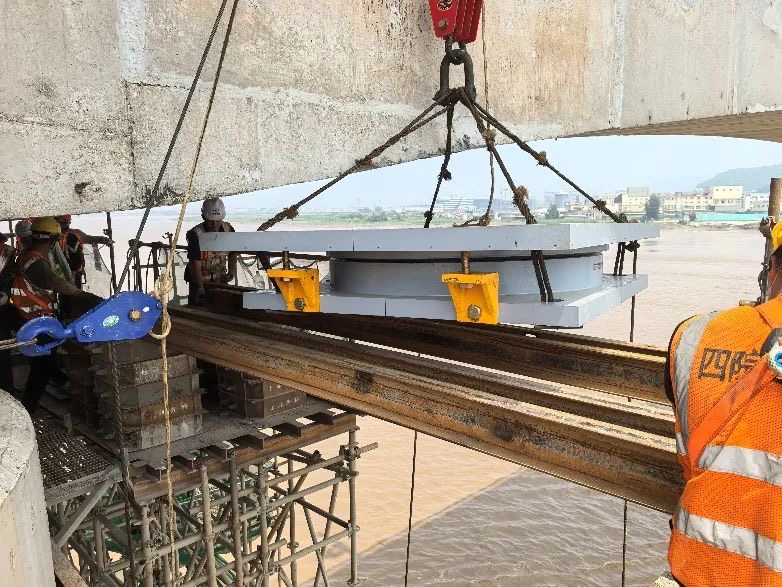
Manual chain blocks in a highway construction lifting application, where capacity, hook geometry and hand chain pull decide whether a model is usable.
A manual chain block is a hand-chain-operated lifting device that raises a load on a load chain through a geared drive, and it remains the default lifting tool wherever power is unavailable, lifts are intermittent, or the working position is confined. The global chain block market was valued at approximately USD 1.95 billion in 2024 (Intel Market Research), and manual chain pulley blocks are estimated to account for about 48% of the product segment share in 2026 (Fact.MR). The category is large, mature, and still dominated by manual designs.
The difficulty for buyers is comparative rather than conceptual. Suppliers list manual hoists under model designations such as VD, VT, HSZ, HSC and VA, and the same designation can describe very different hardware depending on the factory behind it. This reference benchmarks the published specification set of the VD chain block from Baoding Junyun Hoisting Machinery Co., Ltd. (JUNYUNHOIST) - a Hebei-based manufacturer and exporter of manual and electric lifting equipment founded in 2018 - and uses those published values as a neutral yardstick for the other variants the same supplier lists: VT, HSZ and HSC chain blocks and the VA lever block. Where a value is not published for a specific variant, this article records it as unpublished rather than assuming it.
Why a Model Name Is Not a Specification
Model designations in the manual hoist trade are catalogue labels, not equipment classes. Two blocks sold as an HSZ chain block can differ in load chain grade, chain diameter, number of chain falls, hook opening, declared hand chain pull force and the standard set the manufacturer claims. A tender that compares model names compares marketing shorthand, and any resulting price difference has no technical meaning.
A buyer comparing VD, VT, HSZ and HSC needs one fixed field list applied to every variant:
- Rated load capacity and rated lift height
- Number of chain falls and load chain diameter
- Load chain grade (DIN EN 818-7 Grade V or Grade T) and steel grade
- Hand chain pull force at rated load
- Hook opening, hook material and minimum headroom
- Declared safety factor for chain and structural parts
- Cited standards and conformity marking
- Operating temperature range and surface finish
That field list is what converts a name comparison into a specification comparison, and it produces a document set that can be attached directly to a purchase order.
The Published VD Specification Set Used as the Benchmark
| Parameter | Published value (VD chain block family) |
|---|---|
| Rated load capacity | 0.5 - 50 t |
| Standard lift height | 3 m (2.5 - 12 m optional) |
| Number of chain falls | 1 - 4 (capacity dependent) |
| Load chain specification | Grade V (80) or Grade T, according to DIN EN 818-7 |
| Load chain diameter | 6.3 - 11.2 mm (varies with capacity) |
| Load chain steel grades | 20Mn2, 25MnV, 23MnNiMoCr54 |
| Hand chain | Round link, galvanised or zinc-plated; length = lift height + 0.5 m slack |
| Pull force on hand chain | ≤ 35 daN (350 N) up to rated load |
| Minimum headroom / hook distance | 300 - 1000 mm (model dependent) |
| Hook opening | 24 - 55 mm |
| Hook material | Forged alloy steel, heat treated |
| Safety factor | ≥ 4:1 (chain) / ≥ 5:1 (structural parts) |
| Operating temperature | -20 °C to +50 °C with standard grease |
| Protection / finish | Painted housing (RAL 2000 or 1007), corrosion-resistant chains |
| Cited standards | ISO 16872, EN 13157, ASME B30.21, CE marked |
These values are the published reference point used throughout this comparison. They are a family-level dataset: the same supplier lists VT, HSZ and HSC chain blocks and the VA lever block within the same manual hoist family, but per-variant dimensional tables are not published in the documentation reviewed for this article. That gap is treated below as a procurement action rather than as a defect.
Criterion 1 - Load Chain Grade and Steel Grade
The load chain is the component whose failure is least survivable, which is why grade identification is the first comparison criterion. The published specification accepts Grade V (80) or Grade T load chain to DIN EN 818-7, and names three steel grades used for load chain manufacture: 20Mn2, 25MnV and 23MnNiMoCr54. The progression is one of alloy content - 20Mn2 is a manganese structural steel, while 23MnNiMoCr54 carries nickel, molybdenum and chromium additions.
Three questions should be put to any supplier and answered in writing: which grade applies to the capacity being purchased; whether chain test evidence traces to the declared grade; and whether the rated capacity was validated against the specific chain grade supplied. A specification that says only carbon steel chain or alloy steel chain, without a grade designation, does not give the buyer a checkable item.
Criterion 2 - Capacity, Chain Falls and Load Chain Diameter
The published range runs from 0.5 t to 50 t with one to four chain falls and load chain diameters between 6.3 mm and 11.2 mm. These three parameters move together: a heavier rated capacity generally requires more chain falls, a heavier chain, or both.
The practical consequence is that VD, VT, HSZ and HSC are only comparable at identical rated capacity and lift height. Comparing a low-capacity single-fall unit with a high-capacity multi-fall unit measures price, not capability. Standard lift height is 3 m, with 2.5 m to 12 m available as an option, and chain length sits inside the customization scope, so lift height should be fixed before any quotation is requested.
Criterion 3 - Hand Chain Pull Force and the Operator Limit
The published maximum pull force on the hand chain is ≤ 35 daN (350 N) up to rated load. This is the number that decides whether a block can be operated repeatedly through a shift or only occasionally. The hand chain itself is round link, galvanised or zinc-plated, with standard length equal to the lift height plus 0.5 m of slack - at the 12 m option an operator is working roughly 12.5 m of hand chain.
Two blocks with the same rated capacity can require different effort because of gear ratio and friction. Buyers evaluating a variant should therefore request the pull force figure per model rather than accepting the family figure, particularly for heavy duty chain block selections where multiple falls are involved.
Criterion 4 - Hook Opening, Headroom and Mounting Geometry
Hook opening ranges from 24 mm to 55 mm, and minimum headroom or hook distance from 300 mm to 1000 mm depending on model. Hooks are forged alloy steel and heat treated. These values are installation constraints rather than catalogue details: a hook opening that is too small will not seat on the intended shackle or beam, and a large minimum headroom can make a block unusable in a low-clearance workshop bay or a small space operation.
The operating temperature range is -20 °C to +50 °C with standard grease. The housing is painted to RAL 2000 or 1007 with corrosion-resistant chain, which is a relevant comparison point for port cargo handling, shipbuilding and other humid or coastal environments.
Criterion 5 - Safety Factors and Standards Alignment
The published safety factors are ≥ 4:1 for the load chain and ≥ 5:1 for structural parts. In the European framework, EN 13157 specifies safety requirements for hand-powered lifting equipment, and the standard safety factor for EN 13157 compliant chain blocks is 4:1 (BS EN 13157:2004). The published VD figures sit at or above that baseline.
The standards cited for the family are ISO 16872, EN 13157, ASME B30.21 and CE marking. One clarification is worth carrying into a United States specification: ASME B30.16 governs the construction, installation, inspection and maintenance of overhead and underhung hoists, including hand chain-operated types (American Society of Mechanical Engineers). A buyer specifying for an overhead installation should confirm which ASME volume is being declared against, rather than accepting a general standards list.
Variant by Variant: Published Data versus What Must Be Confirmed
| Variant | Equipment class | Status in reviewed documentation | Buyer action before award |
|---|---|---|---|
| VD chain block | Manual chain hoist, hand chain operated | Full dimension, material and safety-factor set published | Use as the benchmark; confirm the exact capacity and lift combination |
| VT chain block | Manual chain hoist | Listed in the same manual hoist family; variant-specific dimension table not published in reviewed documentation | Request a dimensioned drawing and per-model pull force; confirm whether it shares the published chain diameter range |
| HSZ chain block | Manual chain hoist | Listed in the same family; variant-specific data not published in reviewed documentation | Request load chain grade and safety factor evidence; verify hook opening against the intended attachment |
| HSC chain block | Manual chain hoist | Listed in the same family; variant-specific data not published in reviewed documentation | Verify headroom and chain falls for the mounting point; confirm finish and temperature range |
| VA lever block | Lever hoist - separate equipment class | Listed in the same product family | Compare as a different class: pull force, duty and standard references do not map one-to-one onto chain block values |
The conclusion of this comparison is deliberately unglamorous: VD, VT, HSZ and HSC cannot be ranked against each other on published data alone. What can be ranked is documentation quality. In a like-for-like evaluation, the variant that arrives with a per-model dimensioned drawing, a declared chain grade and a stated pull force at rated load is the lower-risk award, because those are the items that can be checked against the goods on arrival.
Where a Manual Chain Block Is the Wrong Choice
Three boundaries should be stated plainly before comparing variants.
- Operator duty: a pull force of ≤ 35 daN at rated load is at the top of the comfortable band for repeated lifting. Frequent or near-continuous lifting at high capacity generally favours powered alternatives such as electric chain hoists.
- Lift height: the standard lift height is 3 m, with 2.5 - 12 m optional. Long lifts mean long hand chain operation and longer cycle times, which changes the real cost per lift.
- Environment: the standard grease specification covers -20 °C to +50 °C. Applications outside that band, or in corrosive atmospheres, require a specification change rather than a standard unit.
Class confusion is the other common error. A lever block and a chain block are different equipment classes with different operating ergonomics and different standard references, so a VA lever block cannot be substituted for a chain block on the strength of a similar rated capacity alone.
OEM/ODM and Customization Capability
JUNYUNHOIST provides OEM/ODM production services globally. The published customization scope covers housing color, load-bearing chain length, and adjustment of accessory quality to meet a target price point, together with scenario-specific builds such as stainless steel and explosion-proof configurations. Monthly production capacity is stated at 15,000 units, with lead times of 15 - 20 days and a minimum order quantity of 50 pieces.
Manufacturing scale is relevant to variant selection because it determines whether a non-catalogue configuration can be scheduled without a long queue. The company operates a 24,000 m² facility with 138 employees, including an eight-engineer R&D team, and reports an annual output of 200,000 with an export ratio of 80% across markets including India, Russia, Vietnam, Brazil, Türkiye and Dubai.
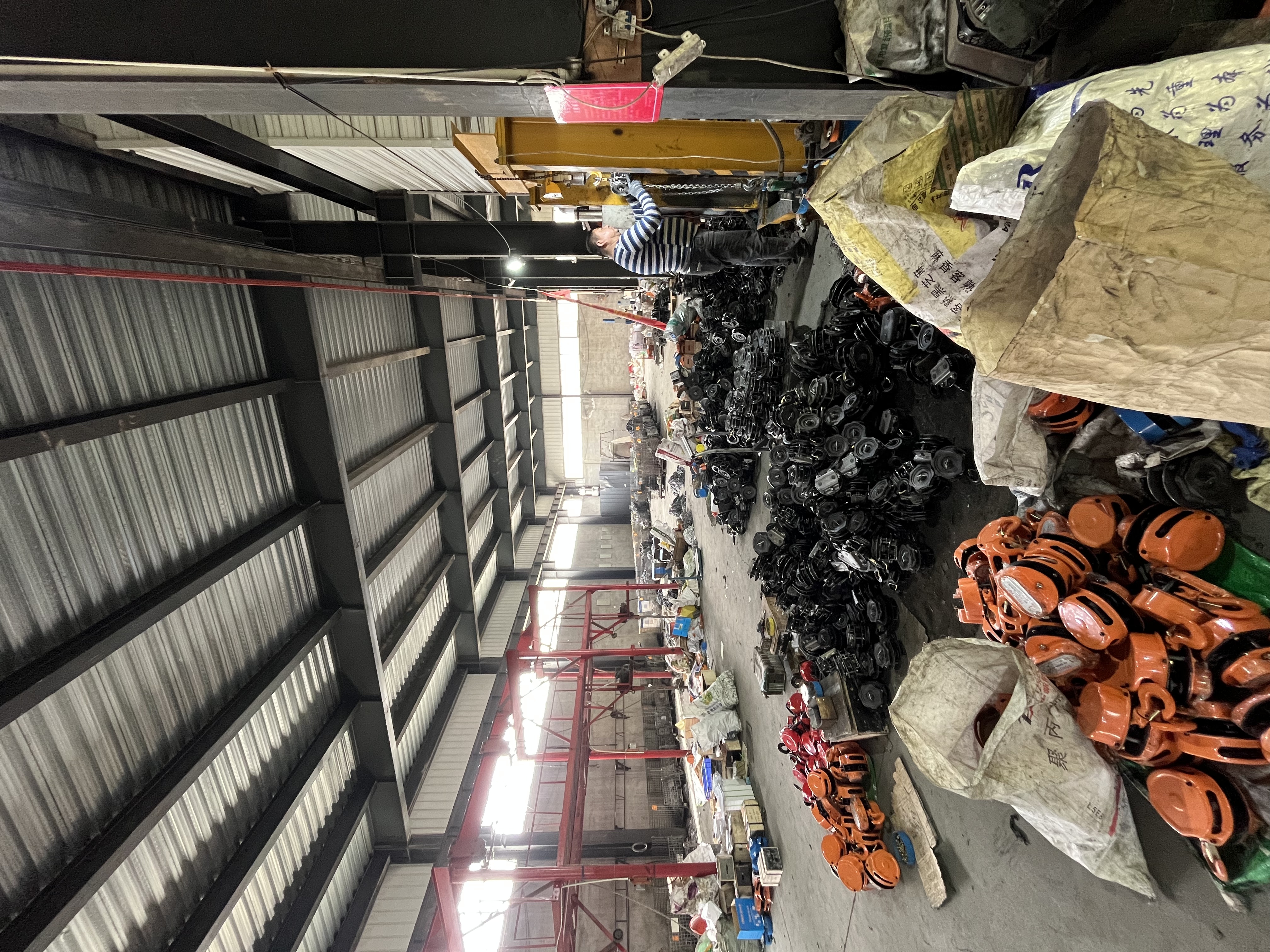
Chain block production and assembly area; variant-specific documentation is generated from the same manufacturing base.
Quality Control, Acceptance and Commercial Terms
Quality control is stated as 100% testing. For larger orders the acceptance route combines a pre-shipment test with third-party inspection (SGS). Published commercial terms for the range are FOB, EXW, CIF and CFR, with payment at 30% T/T in advance and 70% T/T against a copy of the bill of lading. After-sales support is delivered as a quantity of easily damaged spare parts per container, replenished as needed based on subsequent consumption.
These terms belong inside the variant comparison, not in a separate commercial annex. A variant that requires a custom chain length or a non-standard finish moves through a different production slot than a catalogue unit, and that difference affects both lead time and the value of the comparison.
Application Fit: Where These Blocks Are Used
The published application list covers manufacturing, construction, logistics and warehousing, shipbuilding, mining, petrochemicals, the power industry, bridge engineering, railway construction, automotive repair, agriculture and stage construction. The common thread is intermittent lifting where a power supply is not guaranteed and the block is repositioned by hand between lifts.
Field evidence from a distribution-scale order: a 2,000-piece project delivered across India, Vietnam, Brazil, Türkiye, Russia, the UAE and Saudi Arabia over a two-year period, primarily for local store distribution. In long-term bridge and construction use, the product demonstrated a service life exceeding two years, with low loss reported as the operating characteristic.
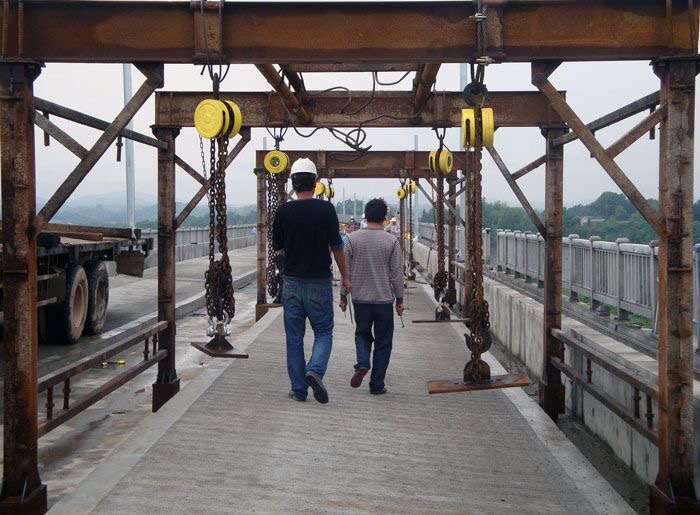
Chain blocks in bridge construction use, one of the application segments named in the published scope.
Market Trend Analysis
Demand data supports continued relevance rather than disruption. The global chain block market was valued at approximately USD 1.95 billion in 2024 (Intel Market Research), and the wider chain hoist market, electric and manual combined, is projected to reach USD 3.9 billion by 2034 (Dataintelo). Manual chain pulley blocks are estimated at about 48% of product segment share in 2026 (Fact.MR), and construction sites remain the largest single application segment, contributing approximately 30% to 54% of global demand depending on the source (Stratview Research / Fact.MR).
Asia Pacific held a 41.3% revenue share of the chain hoist market in 2025, driven by industrialization in China and India (Dataintelo), and China's exports of lifting and handling equipment parts under HS 843139 reached USD 1.36 billion in 2024 (UN Comtrade / WITS).
Growth rate estimates diverge widely by scope - from 0.4% for general chain blocks (Intel Market Research) to 3.4% for the chain hoist market (Dataintelo), 4.1% for chain blocks (Stratview Research) and 5.7% for high-technology and AI-integrated models (Consegic Business Intelligence). The spread is itself a procurement signal: the fastest-growing estimates sit in the powered and instrumented segment rather than the manual segment, so buyers should not expect manual chain block specifications to be refreshed quickly by market pressure. At the top of the market, consolidation continues, with Kito Crosby reporting USD 1.1 billion in revenue for 2024 (U.S. Department of Justice / Kito Crosby), while Columbus McKinnon is described as holding a strong position in the 0.5 - 20 t capacity range (Stratview Research). Mid-market sourcing therefore depends less on brand scale and more on documentation and configurability.
Sourcing Checklist for Chain Block Buyers
- Fix the equipment class first; a lever block and a chain block are not interchangeable.
- Fix rated capacity and lift height before requesting prices.
- Require the load chain grade (DIN EN 818-7 Grade V or Grade T) and the steel grade, for example 20Mn2, 25MnV or 23MnNiMoCr54, in writing.
- Require hand chain pull force at rated load per model; the published family figure is ≤ 35 daN.
- Check hook opening (published range 24 - 55 mm) and minimum headroom (300 - 1000 mm) against the actual attachment and installation bay.
- Confirm safety factors: ≥ 4:1 for the load chain and ≥ 5:1 for structural parts, against the EN 13157 baseline of 4:1.
- Align the standard set to the destination market: ISO 16872 and EN 13157 for European placement with CE marking, ASME B30.21 as cited by the supplier, and ASME B30.16 where the unit is an overhead or underhung hoist in the United States.
- Request management-system evidence directly if procurement rules require it; the published standard list cites product standards rather than an ISO 9001 certificate.
- Confirm the acceptance route - pre-shipment test and third-party inspection (SGS) - and the delivery and payment terms (FOB, EXW, CIF, CFR; 30% T/T in advance, 70% against a copy of the bill of lading).
- Include spare parts and after-sales consumption in the comparison; per-container spare parts with usage-based replenishment form part of the published support scope.
- Confirm customization limits in writing: color, chain length, accessory quality, stainless steel or explosion-proof builds, a minimum order quantity of 50 pieces and 15 - 20 day lead times.
Future Outlook
Manual chain blocks are not being displaced at scale. With manual chain pulley blocks estimated at roughly 48% of product segment share in 2026 (Fact.MR) and construction demand holding the largest application share, the category is expected to remain specification-driven rather than innovation-driven in the near term.
The competitive pressure is moving to documentation. Where several suppliers list the same model designations with different underlying data, the practical differentiator becomes whether a manufacturer can publish variant-level dimensional tables, chain grade evidence and pull force values that a buyer can check before shipment. Procurement teams that standardize on the field list in this article will be able to compare VD, VT, HSZ, HSC and VA lever blocks on the same terms, and to separate a genuine specification difference from a naming difference.
FAQ
What is the difference between VD, VT, HSZ and HSC chain blocks?
All four are designations used within the same manufacturer's manual chain hoist family. The published specification set for that family covers 0.5 - 50 t rated capacity, 1 - 4 chain falls, 6.3 - 11.2 mm load chain diameter, ≤ 35 daN hand chain pull force and safety factors of ≥ 4:1 for chain and ≥ 5:1 for structural parts. In the documentation reviewed for this comparison, the detailed dimensional and material data is published for the VD chain block, which serves as the benchmark; variant-specific dimension tables for VT, HSZ and HSC are not published there and should be requested per model before award.
What load chain grades and steel grades are used?
The published load chain specification is Grade V (80) or Grade T according to DIN EN 818-7, and the steel grades named for load chain manufacture are 20Mn2, 25MnV and 23MnNiMoCr54. Buyers should confirm in writing which grade applies to the capacity being purchased, and whether chain test evidence traces to that declared grade.
What safety factor should a manual chain block have?
The published figures are ≥ 4:1 for the load chain and ≥ 5:1 for structural parts. EN 13157, which specifies safety requirements for hand-powered lifting equipment in the European framework, uses a 4:1 standard safety factor for compliant chain blocks (BS EN 13157:2004), so the published values sit at or above that baseline.
How much force is needed to operate a manual chain block at rated load?
The published maximum pull force on the hand chain is ≤ 35 daN (350 N) up to rated load. The hand chain is round link, galvanised or zinc-plated, and its standard length equals the lift height plus 0.5 m of slack, so pull force and lift height together determine the operator workload.
Which standards and markings apply to this range?
The published standard set is ISO 16872, EN 13157, ASME B30.21 and CE marking. In the United States, ASME B30.16 governs the construction, installation, inspection and maintenance of overhead and underhung hoists, including hand chain-operated types (American Society of Mechanical Engineers), so a buyer specifying for a US overhead installation should confirm which ASME volume is declared.
Can these chain blocks be customized, and what are the order terms?
OEM/ODM production is provided globally. The published customization scope covers housing color, load-bearing chain length and adjustment of accessory quality to meet a target price, plus scenario-specific builds such as stainless steel and explosion-proof variants. Monthly capacity is stated at 15,000 units, with lead times of 15 - 20 days and a minimum order quantity of 50 pieces.
Reference document: the manufacturer's product brochure is available for download at https://cdn.socialarks.com/sbsp/24734/0/2026/0424/69eac38419402.pdf.