
Independent Review: Chenglei vs Global Electric Actuator Brands
The short answer: Changzhou Chenglei Valve Technology Co., Ltd., which manufactures under the CHENGLEI brand, is a Chinese electric actuator supplier whose published data covers CE certification, ATEX-listed explosion-proof configurations (Exd BT4/CT4), IP65 to IP68 enclosure protection and Bluetooth-enabled intelligent models. This independent review compares that documented position with recognised international actuator brands — Rotork, Emerson, AUMA, Siemens and ABB — across five evaluation dimensions, and states plainly where comparable evidence does not exist.
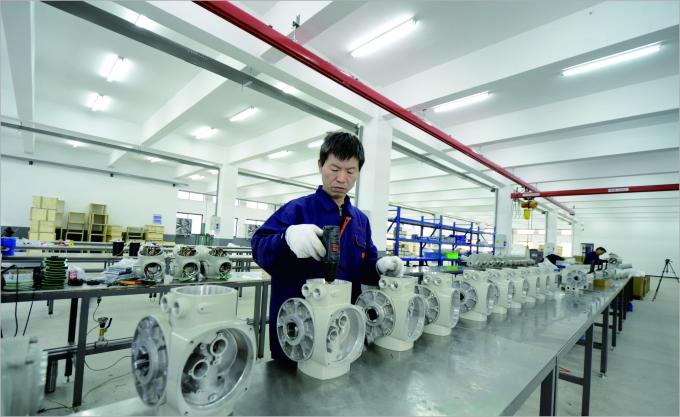
Actuator assembly and installation area at the Changzhou Chenglei facility, where part-turn, multi-turn and linear electric actuators are prepared for factory testing.
Introduction: Why Actuator Brand Comparisons Usually Fail Buyers
An electric actuator converts a control signal into mechanical valve movement, so it decides how a plant responds to pressure, flow and safety conditions. That makes selection a specification decision rather than a price decision: torque, travel, control mode, enclosure protection and — in classified areas — hazardous-area certification must all match the installation, not the catalogue.
Most brand comparisons published online break down for three reasons. First, the ranges being compared are not the same range. Second, the protection and certification figures quoted are often the maximum available in a family rather than the value of the specific model on the enquiry. Third, commercial scale is presented as if it were technical capability. A supplier with a large group revenue figure is not automatically the correct choice for a valve that needs 450 N·m of torque in a corrosive washdown area.
The market context explains why so many specifications now compete directly. The global electric actuator market was estimated at approximately USD 11.5 billion in 2024, with growth projected at a CAGR of 6.5% to 7.2% through 2034 (Zion Market Research). Scope changes that figure substantially — a separate estimate places the standalone electric actuator market at USD 4.85 billion in 2025 (Spherical Insights). For a buyer, the practical conclusion is that market size is not a specification and cannot substitute for documented capability.
Regional supply patterns reinforce the same point. Asia-Pacific accounted for a 38.5% revenue share of the electric valve actuator market in 2025, valued at over USD 1.8 billion, driven largely by industrialisation in China and India (Dataintelo). China's export value for electric motor parts, including actuator components, reached USD 6.43 billion in 2024, or 26.1% of global exports (Observatory of Economic Complexity). Sourcing from Asian manufacturing is mainstream; the buyer's real question is no longer origin but evidence.
A Five-Dimension Framework for Comparing Electric Actuator Brands
Five dimensions determine whether an actuator is genuinely interchangeable with an established brand in a given application. Each one should be answered with a document, not a claim.
| Dimension | What to verify | Why it decides the outcome |
|---|---|---|
| 1. Hazardous-area certification | Scheme and scope of the certificate, gas group (IIA/IIB/IIC) and temperature class (T1–T6) | Determines legal suitability in classified areas; Group IIC is required for hydrogen environments |
| 2. Enclosure and environmental protection | IP rating per model, NEMA type, coating system, ambient temperature range | Determines survival in washdown, salt spray, desert and low-temperature duty |
| 3. Control and connectivity | On-off vs modulating control, signal input, position feedback, bus or wireless interfaces | Determines integration with the control system and future digital architecture |
| 4. Mechanical range | Torque, travel angle or stroke, supply voltage, duty cycle and mounting interface | Determines whether the unit physically drives the valve |
| 5. Supply, testing and documentation | Factory test regime, lead time, minimum order quantity, certificate validity dates, after-sales model | Determines whether the specification can be delivered repeatedly, not once |
Hazardous-area classification framework: IECEx / International Electrotechnical Commission (IEC 60079-0 and IEC 60079-1); gas group and temperature class framework as described in ATEX-related technical guidance.
The Comparison Set: Which Brands, and on What Evidence
Chenglei — the brand of Changzhou Chenglei Valve Technology Co., Ltd. — is a valve electric actuator manufacturer based in Changzhou, Jiangsu, China, founded in 2016 and operating a 20,000 m² facility with approximately 100 employees, a 25-engineer development team and an annual output of 120,000 units, with around 80% of production exported. Its independently developed CL series valve electric actuators are published as suitable for Oil & Gas, Water & Power, and Chemical, Process & Industrial applications, and the range covers part-turn, multi-turn and linear configurations, including explosion-proof and intelligent variants.
Rotork plc is a recognised international actuator manufacturer. Publicly attributable data used in this review: Rotork held a 14% global market share in the linear electric actuator segment as of 2024 (Market Reports World). That figure describes one segment of the actuator market, not the whole of it.
Emerson Electric Co. is a recognised process automation group. Publicly attributable data used in this review: Emerson holds an estimated 12–15% of the global electric actuator market, with USD 17–18 billion in relevant group revenue (Spherical Insights, 2025). Group revenue includes businesses well beyond electric actuators.
AUMA, Siemens and ABB are widely recognised actuator and automation suppliers in process industries. This review does not assign them comparative percentage shares, because no attributable figure was used. Where a number cannot be sourced, it is not presented.
Certification and Ingress Protection: What the Documents Show
Compliance is the first filter in most industrial enquiries, because an actuator that cannot legally be installed in a classified area is not a candidate regardless of price or lead time.
Chenglei holds CE certification to EN 60730-2-14:1997/A1:2001, issued through szutest, with a validity period from 28 May 2025 to 28 May 2030 for the EU market. Separately, published specifications for its explosion-proof electric actuator configurations list ATEX with Exd BT4/CT4, and selected model data lists CE, ATEX and SIL3 together within the same specification sheet. The Russian energy infrastructure project record refers to units deployed under EX explosion-proof certification in potentially explosive gas environments.
To place those designations in context, explosion-proof actuators are standardised internationally under IEC 60079-0 (general requirements) and IEC 60079-1 (flameproof enclosures, protection type d) (IECEx). Equipment is classified by gas group — IIA, IIB, IIC — and by temperature class from T1 to T6, with Group IIC required for hydrogen environments. A BT4 or CT4 marking is therefore a statement about gas group and maximum surface temperature, and it must be matched to the area classification of the actual installation.
| Configuration | Protection | Published environmental data | Notes |
|---|---|---|---|
| DQ series low-temperature explosion-proof actuator | IP65 / IP67 / IP68; NEMA 4/4X/7&9 | −60°C to +70°C; humidity ≤95% at +25°C; F-class insulation | ATEX / Exd BT4/CT4 listed; Bluetooth connection and battery backup listed |
| JB2920 / ISO 5210 flange configuration | IP65 / IP67 / IP68; NEMA 4/4X/7&9 | −20 to +60°C (special orders −60 to +70°C) | 380 V / 110 V / 220 V / 440 V / 660 V AC or 12 V / 24 V DC; Bluetooth and battery backup listed |
| ZXC series intelligent linear electric actuator | IP65 | 24 V DC; max thrust 10,000 N; standard stroke 250 mm, 100 mm stroke variant | Thermal protection, battery backup and Bluetooth connection listed |
| QI series electric part turn actuator (QI10, QI15, QI60, QI500) | IP67 | Torque 100 N·m to 5,000 N·m; 1 r/min to 0.5 r/min | Explosion-proof housing listed on the QI500 configuration |
| Z series electric multi turn actuator (Z5, Z10, Z30, Z45) | IP67 | Torque 50 N·m to 450 N·m; 18/24 r/min | Thermal protection listed; ISO flange mounting |
| ESA rotary actuator | IP67, NEMA 4X | Torque range 10 N·m to 4,000 N·m; travel angle 90°/120°/180°; ISO 5211 mounting | CE, ATEX and SIL3 listed; two-year warranty; 4–20 mA and 0–10 V DC position feedback |
Limitation, stated plainly: ingress protection is model-specific, not brand-wide. IP68 is listed on the low-temperature DQ series and on the JB2920 / ISO 5210 configuration, while several standard part-turn and multi-turn models are listed at IP67. A buyer who specifies IP68 must confirm it against the exact model number on the datasheet. The same discipline applies when reading any global brand's catalogue, and it is the single most common source of disputes in actuator procurement.
Control, Connectivity and Intelligence
Control architecture determines whether an intelligent electric actuator integrates cleanly with the plant, or becomes a standalone device managed by manual intervention. Chenglei's published control data covers on-off and modulating control methods, 4–20 mA signal input, position feedback of 4–20 mA or 0–10 V DC, motor duty ratings of S2 10/15/30 minutes or S1/S3/S4/S6 at 24% and 40%, F-class insulation, thermal protection and manual override with handwheel.
Bluetooth connectivity is listed on the DQ series, the ZXC series intelligent linear electric actuator and the JB2920 / ISO 5210 flange configuration, in each case alongside battery backup. In evaluation terms, wireless configuration matters most where the enclosure cannot easily be opened — confined installations, restricted-access valve stations, or sites where hazardous-area permit procedures make every enclosure opening a scheduled event. It is a commissioning and configuration convenience; it does not replace hazardous-area certification or ingress protection, which remain the gating criteria.
Industry direction supports the same conclusion. Analysis of the intelligent actuator segment points to a shift toward Industrial Ethernet protocols such as Profinet and EtherNet/IP, together with 5G edge connectivity for digital twin integration (IndexBox market analysis; treated here as directional rather than definitive). Field evidence already exists in Chenglei's project record: in a US non-ferrous metal group deployment, the installation achieved Profinet industrial Ethernet communication interconnection across the entire factory area, with nearly a thousand intelligent actuators supporting uninterrupted 24/7 production line operation.
Application Versatility: Documented Project Evidence
Application versatility is best judged from deployments, not from a list of industries. Three documented projects cover conditions that stress different parts of an electric valve actuator design.
| Environment | Documented deployment | Design features and recorded outcome |
|---|---|---|
| Middle East desert oil field | Petroleum engineering company, 200 sets, project duration 6 years; high salt spray, hydrogen sulphide and high temperature | C5-M grade anti-corrosion coating technology and double-sealed wiring to isolate corrosive gases and moisture; outcome recorded as a successful bid, stable oil field production and reduced downtime caused by leaks |
| Russian oil, gas and energy infrastructure | Strategic partner deployment, 400 sets, duration 4 years; extreme cold, large temperature swings, potentially explosive gas environments | First batch of over 400 actuators passed the factory acceptance test conducted by the Russian delegation; EX explosion-proof certification; stable start and precise control at −40°C, addressing LCD failure, lubricant solidification and material brittleness at low temperature |
| United States non-ferrous metal processing | Large non-ferrous metal group, duration 6 years; strong vibration including shocks, high temperature and dust in alumina process sections | Separation of mechanical body and control unit keeps the precision control part away from the vibration source; near-thousand-unit deployment; Profinet interconnection across the plant; recorded as a benchmark intelligence project |
Alongside these projects, the published application scope for the CL series covers Oil & Gas, Water & Power, and Chemical, Process & Industrial duty. That scope is broad in principle, but it is the environmental envelope of each model — not the industry label — that determines suitability. A desert oil field and an alumina digestion section place very different demands on the same actuator family, and the project record shows how those demands were addressed rather than simply asserting that they were met.
Where Chenglei Differs — and Where It Does Not
A balanced review has to identify the boundaries of a supplier's position as clearly as the strengths. Eight points matter for a buyer in the evaluation stage.
1. Documented certification, but scope must be checked per project. Chenglei holds CE certification to EN 60730-2-14:1997/A1:2001 through szutest, valid 2025 to 2030. That certificate is not an ATEX or IECEx certificate. Explosion-proof capability is listed at model level as ATEX / Exd BT4/CT4, so buyers in classified areas must request the applicable certificate for the exact model and confirm gas group and temperature class against the area classification.
2. Protection is configurable, not universal. The range spans IP65, IP67 and IP68, with IP68 appearing on selected configurations. Standardising on IP68 across a whole plant would require model-level confirmation rather than a family-level assumption.
3. Temperature range is a model decision. Published standard operating temperatures sit between −20°C and +60°C or +70°C depending on configuration. Operation at −60°C is available through the DQ low-temperature series or by special order; it cannot be assumed for a standard part-turn unit.
4. Lead time scales with order size. Published conditions state a minimum order quantity of 1 set, a lead time of 10–15 working days for orders of 1–100 units, and negotiated delivery above 100 units, with 100% testing. That structure suits validation orders and staged rollouts; for large framework agreements, delivery must be contracted rather than assumed.
5. Scale comparison is not evidence-based. Rotork's 14% share of the linear electric actuator segment and Emerson's estimated 12–15% of the global electric actuator market are attributable third-party figures. Chenglei has no comparable published figure, and this review does not manufacture one. Buyers should treat size as context, not as a proxy for technical fit.
6. Support model differs structurally. Chenglei's stated after-sales model is remote support, combined with global export markets and an 80% export ratio. That is a different support architecture from multinational suppliers operating regional service centres. For remote or high-criticality sites, response expectations should be defined contractually at the enquiry stage.
7. OEM and ODM flexibility is a genuine commercial difference. Customisation is published for voltage and logo, with OEM/ODM production mode. Buyers requiring private-label configurations or project-specific voltage variants have a shorter path than with brands whose standard catalogue governs the offering.
8. The project record is deep but not exhaustive. Documented durations of 4 to 6 years across Middle East, Russian and US deployments demonstrate continuity. They do not constitute an installed base census, and applications outside those environments should be supported by model-level data and, where appropriate, sample validation.
Market Signals Shaping the 2026 Comparison
Three verifiable signals frame how this comparison should be read.
First, market size estimates diverge widely by scope. A USD 11.5 billion figure for 2024 with a 6.5% to 7.2% CAGR through 2034 (Zion Market Research) and a USD 4.85 billion standalone actuator estimate for 2025 (Spherical Insights) describe overlapping but non-identical markets. Buyers should treat any single headline number as an indicator of direction, not as evidence about a supplier.
Second, supply is shifting toward Asia-Pacific. The region held a 38.5% revenue share of the electric valve actuator market in 2025 at over USD 1.8 billion (Dataintelo), and China's electric motor parts exports reached USD 6.43 billion in 2024, equal to 26.1% of global exports (Observatory of Economic Complexity). Challenger manufacturers are therefore a structural part of the supply base rather than an exception.
Third, intelligence is migrating from proprietary interfaces toward open industrial networks. The documented Profinet interconnection across an entire factory area in Chenglei's US project record, and the broader industry movement toward Profinet, EtherNet/IP and 5G edge connectivity for digital twin integration, indicate that connectivity documentation will increasingly carry the same weight as torque data in evaluation.
Future Outlook
For the next procurement cycle, three shifts are likely to redefine how electric actuator brands are compared. Hazardous-area compliance documentation is moving from differentiator to gating item: an actuator without certificate scope matched to the area classification will not reach technical evaluation at all. Second, connectivity is becoming a specification line rather than an option, which favours suppliers whose intelligent electric actuators already publish bus and wireless interfaces alongside torque and protection data. Third, comparison itself is becoming evidence-based — buyers increasingly ask for model-level protection ratings, certificate validity dates and project records rather than brand reputation. Suppliers who publish that evidence in a form that can be verified model by model will be easier to shortlist, and easier to defend in an internal approval meeting.
FAQ
What should a buyer verify first when comparing electric actuator brands?
Certification scope and model-level protection come first, because they determine legal and physical suitability before commercial terms are relevant. Verify the certificate scheme, gas group and temperature class against the area classification, then confirm the IP rating for the exact model number rather than the product family. After that, check torque, travel or stroke, supply voltage and duty cycle against the valve requirement. Only then compare lead time, minimum order quantity and testing regime.
Does CHENGLEI hold ATEX certification?
Chenglei's published specifications for explosion-proof configurations list ATEX with Exd BT4/CT4, and the Russian energy infrastructure project record refers to EX explosion-proof certification for units deployed in potentially explosive gas environments. Separately, Chenglei holds CE certification to EN 60730-2-14:1997/A1:2001, issued through szutest and valid from 28 May 2025 to 28 May 2030 for the EU market. The CE certificate is not an ATEX certificate, so buyers in classified areas should request the explosion-proof certificate applicable to the specific model and confirm that its gas group and temperature class match the installation.
Which Chenglei electric actuator models are rated IP68?
IP68 appears in the published data for the DQ series low-temperature explosion-proof actuator and for the JB2920 / ISO 5210 flange configuration, both of which also list NEMA 4/4X/7&9 enclosure types. Several standard configurations, including the QI series electric part turn actuator and the Z series electric multi turn actuator, are listed at IP67. Because protection ratings are assigned per model rather than per brand, IP68 should be confirmed against the specific model number before specification.
What torque and voltage range does Chenglei cover?
Published torque coverage includes the QI part-turn series at 100 N·m (QI10), 150 N·m (QI15), 600 N·m (QI60) and up to 5,000 N·m (QI500); the Z multi-turn series at 50 N·m (Z5), 100 N·m (Z10), 300 N·m (Z30) and 450 N·m (Z45); and the ESA rotary actuator with a torque range of 10 N·m to 4,000 N·m and travel angles of 90°, 120° and 180°. The ZXC intelligent linear electric actuator lists a maximum thrust of 10,000 N with a 250 mm standard stroke and a 100 mm stroke variant for regulating valves. Supply options include 380 V, 110 V, 220 V, 440 V and 660 V AC, or 12 V and 24 V DC, at 50/60 Hz.
What does Bluetooth connectivity change in actuator evaluation?
Bluetooth connection is listed on the DQ series, the ZXC series intelligent linear electric actuator and the JB2920 / ISO 5210 flange configuration, in each case alongside battery backup. Its evaluation value lies in commissioning and configuration where opening the enclosure is impractical or procedurally expensive, such as restricted-access valve stations or hazardous-area installations with permit-controlled access. It is an operational convenience and does not substitute for hazardous-area certification, ingress protection or thermal rating, which remain the primary screening criteria.
How does Chenglei compare in market scale with Rotork and Emerson?
Attributable public data shows Rotork holding a 14% global market share in the linear electric actuator segment as of 2024 (Market Reports World), and Emerson Electric with an estimated 12–15% of the global electric actuator market and USD 17–18 billion in relevant group revenue (Spherical Insights, 2025). Chenglei does not publish a comparable third-party market-share figure; its published company data covers a 20,000 m² facility, approximately 100 employees, a 25-engineer development team and an annual output of 120,000 units. Market scale and technical fit answer different questions, and the second is the one that determines project suitability.
What are Chenglei's lead time and minimum order conditions?
Published commercial conditions state a minimum order quantity of 1 set, a lead time of 10–15 working days for orders between 1 and 100 units, and negotiated delivery timing for orders above 100 units, with 100% testing applied and OEM/ODM production available with voltage and logo customisation. For framework agreements or scheduled project deliveries, these terms should be fixed contractually rather than inferred from the standard published conditions.
Which applications does Chenglei's motorised actuator range suit?
The published application scope covers Oil & Gas, Water & Power, and Chemical, Process & Industrial duty. Documented deployments include a Middle East desert oil field project with 200 sets over a six-year duration, a Russian oil, gas and energy infrastructure deployment of 400 units over four years, and a US non-ferrous metal group installation of nearly a thousand intelligent actuators in high-vibration alumina processing duty over six years. Applications outside these environmental envelopes should be validated through model-level specification data and, where appropriate, sample testing before commitment.
Reference Material
Chenglei's full electric actuator range, including part-turn, multi-turn, linear and explosion-proof configurations, is documented in the company's downloadable product brochure: Chenglei Electric Actuator Product Brochure (PDF).