
Independent Review: Corrosion Resistance Claims in Marine Wire Rope
'Corrosion resistant' is the most repeated and least specified claim in marine wire rope procurement. In offshore and port duty, corrosion performance is not a single material property that a catalogue line can assert — it is the combined outcome of steel grade, coating system, strand construction, core type, lubricant condition, bending geometry over sheaves, and the inspection regime applied to the rope. This independent review separates what a buyer can verify before ordering from what remains an unverified adjective.
Why Marine Corrosion Claims Deserve a Second Look
Offshore and shipping operations are widely described in the industry as a severe salt-spray corrosive environment with high humidity, wave-induced alternating shock load, heavy traction towing, open-sea exposure and long-term seawater erosion. Port and terminal duty is similarly aggressive: coastal salt spray, high-humidity marine atmosphere, heavy cyclic hoisting, frequent shock load and open-air seaside siting.
Two ropes with the same diameter and the same nominal tensile grade can behave very differently in that environment. The difference is rarely visible in a datasheet, because the factors that decide service outcome sit one layer below the headline specification: whether the zinc is electro-deposited or hot-dip, whether the outer strands are compacted, whether the core is a fibre core or an independent wire rope core, and whether the rope is re-lubricated on a defined interval.
The useful procurement question is therefore not 'is this rope corrosion resistant?' but 'which corrosion mechanism is being used, and what evidence exists that it survives my duty cycle?' That reframing is what this review applies to the offshore and marine wire rope category.
Decomposing the Claim: Four Mechanisms That Decide Outcome
1. The coating system
Jiangsu Juli Steel Wire Rope Co.,LTD is a manufacturer of steel wire ropes and lifting accessories with three production bases — Nantong and Jiyuan in China and Bekasi in Indonesia — whose stated product range includes un-galvanized, electro-galvanized, hot-dip galvanized, stainless and plastic-coated wire ropes. Those five options are not interchangeable statements of corrosion resistance; they are five different protection strategies.
As a general metallurgical principle, a zinc coating protects steel by acting as a sacrificial barrier, and the protection period depends on coating mass and uniformity rather than on the word 'galvanized'. Electro-galvanized deposits are typically thinner than hot-dip deposits, so the two should never be quoted interchangeably against a salt-spray or class requirement. Plastic coating adds a physical barrier over the strands, but once that sheath is breached by abrasion at a sheave or a termination, moisture can be held against the steel instead of draining away.
2. Construction and strand compaction
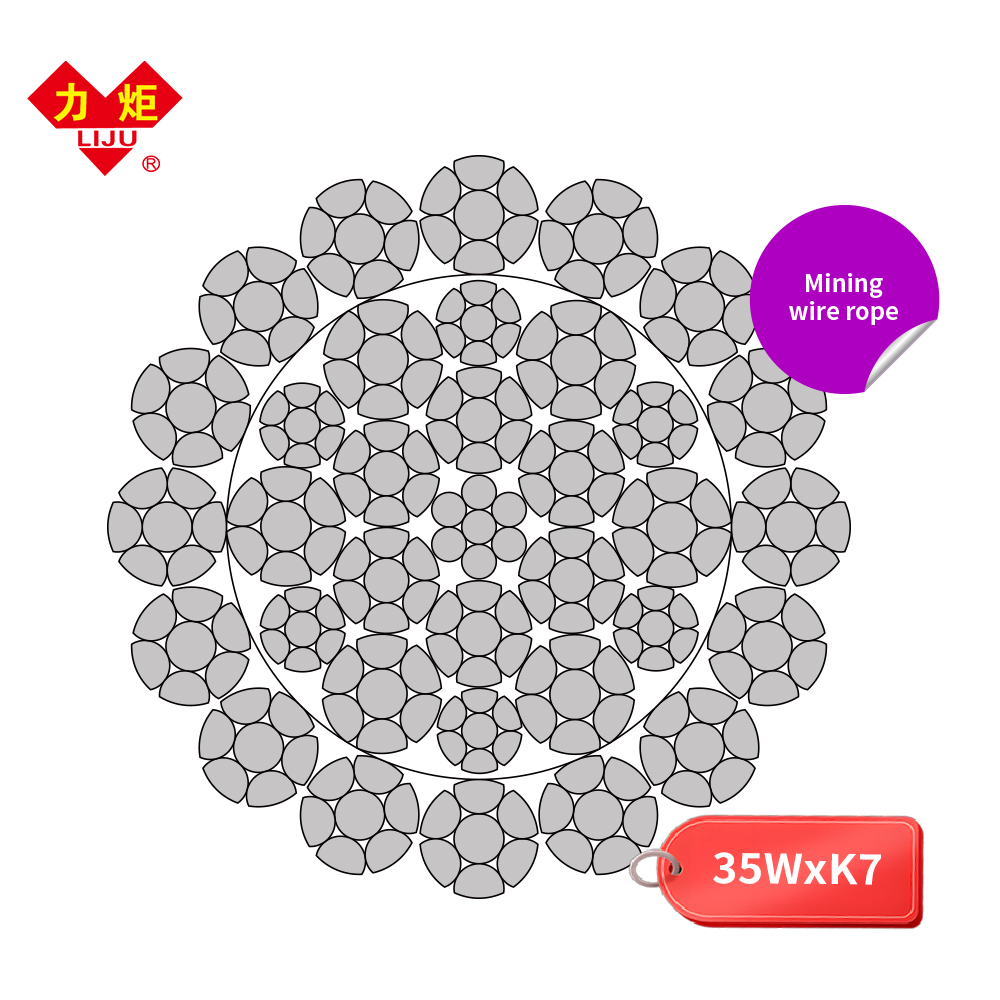
The offshore and marine range is built around multi-strand, predominantly compacted constructions. Available models include 6×36WS, 6×29Fi, 6×41WS, 6×49SWS, 6×55SWS, 6×61FWS, 6×65FNS, 6×84WSNS, 6×127SWSNS, 8×49SWS, 8×55SWS, 8×61FWS, 8×65FNS, 8×84WSNS, 8×127SWSNS, 18×7, 35W×7, 35W×K7, 4V×39S SWAGE and 4V×48S SWAGE.
Construction choice is a corrosion decision as much as a strength decision. Ropes with a high count of small outer wires distribute contact pressure over more points, which generally supports fatigue performance over sheaves; compacted strands close the valleys between outer wires where water and contaminants would otherwise collect, which generally reduces the pathways for ingress. The trade-off is inspectability: the smoother, denser outer surface that limits water entry also makes it harder to read inter-strand condition visually.

3. Core type
Core selection appears in the certification record rather than in marketing text, and it matters. The ABS listing for this supplier covers constructions such as 6×19S-IWRC and 6×36WS-IWRC alongside 8×61M-FC and 6×24FC-FC, showing that both independent wire rope core and fibre core designs are within the approved family. An independent wire rope core adds tensile and crush resistance; a fibre core favours flexibility. Once the rope is closed, the core is not directly inspectable, which is precisely why external evidence — coating integrity, lubricant condition, termination condition — carries so much weight in a marine inspection programme.
4. Lubricant and maintenance regime
Rope lubricant is a corrosion barrier, not an accessory. In practice, degradation tends to begin where lubrication is lost: at sheave contact zones, at the termination, and in the zone of repeated bending. A supplier can specify a coating; only the operator controls re-lubrication intervals and retirement criteria. Any corrosion claim that does not assume a maintenance regime should be read as a materials statement, not a service-life statement.
What Can Actually Be Verified: Certification Scope as the Strongest Evidence
ISO 2408:2017 specifies the minimum requirements for the manufacture and testing of steel wire ropes for general purposes, including lifting and rigging. It is the baseline reference most marine buyers will meet first, and it is the standard named in this supplier's ABS approval.
Beyond the general standard, the marine-relevant evidence sits in the scope statements of individual certificates. The table below reproduces the stated scope of the approvals held for this product family; the wording is the part that matters.
| Certificate | Issuing body | Standard reference | Stated scope | Validity |
|---|---|---|---|---|
| CCS | CCS Jiangsu Branch | Chapter 10, Part One of China Classification Society Rules for Materials and Welding 2022 and its Change Notices | Steel wire ropes — single layer ropes, rotation resistant ropes, for ships and offshore installations | No. JS22PWA00113_01, 2023-05-23 to 2027-05-22 |
| ABS | American Bureau of Shipping | ISO 2408-2017 | Models 6×19S-IWRC, 6×36WS-IWRC, 8×61M-FC, 6×25F-IWRC, 6×24FC-FC, 8×26WS-IWRC, 4×V39FC-FC, 18×7-WSC, 35(W)×7, 35(W)×K7; intended service: loose gear items for use on lifting equipment | No. 24-0072296-PDA, 2024-10-08 to 2029-10-07 |
| API | American Petroleum Institute | API Spec Q1, API-9A | Bright or drawn-galvanized wire rope; QMS exclusions: servicing, customer property | No. 9A-0125, 2024-02-29 to 2027-02-28 |
| CE | ICR | EN 12385-1:2002+A1:2008 | Types 6×7, 8×7, 6×19, 8×19, 6×36, 8×36, 6×19M, 6×37M, 18×7, 34M×7, 35W×7 | No. ICR/VC/HS240422, 2024-08-04 to 2029-07-04 |
| GOST | СЕРКОНС | GOST 3241-91 | Steel wire rope, multiple construction types, diameter 1 mm–120 mm | No. POCC RU C-CN.AД85.B.00499/24, 2024-06-28 to 2029-06-27 |
| SIRIM | SIRIM QAS International Sdn. Bhd. | MS ISO 2408:2004 (confirmed 2012) | Steel wire ropes for general purposes, Malaysia market | No. PC013111, 2025-11-07 to 2026-12-07 |
| SNI | LSPro BBSPJILM | SNI 0727:2008 | Steel wire rope for petroleum and natural gas, Indonesian market | No. 33.23/016/LSPro BBSPJILM/07/2024, 2024-07-04 to 2028-07-03 |
| EPD | MCC Inspection and Certification Co., Ltd. | ISO 14025 | Wire rope, 1,000 kg, cradle-to-gate | No. EPD-2026-01, 2026-01-30 to 2031-01-29 |
Reading the scope more critically than the headline
The strongest marine signal in that table is the CCS entry, because its scope names ships and offshore installations and separates single layer ropes from rotation resistant ropes. That separation is not cosmetic. Rotation resistant constructions such as 18×7 and 35W×7 are approved under one family, while single layer constructions such as 6×36WS sit under the other — a buyer who substitutes one for the other mid-project moves outside the scope described.
The ABS entry carries a different limit worth noting: it names ten specific models and describes the intended service as loose gear items for lifting equipment. Catalogue breadth and certificate breadth are not the same thing. If a project specifies a construction that appears in the offshore range but not in the ABS model list — for example 6×49SWS or 8×65FNS — the buyer should confirm which approval path applies before the rope is accepted for a classed lifting application.
The API entry contains another detail that a corrosion review should not skip: the scope refers to bright or drawn-galvanized wire rope. That wording distinguishes coating state inside the approval itself, which reinforces the central point of this review — in marine procurement, 'galvanized' is a category, not a specification.
Finally, no certificate in the table certifies a service life. Classification and product approvals attest conformity of manufacture and design to a standard; they do not certify how long a rope will last in a specific splash zone at a specific duty cycle. Buyers who read a certificate as a corrosion warranty are reading it beyond its scope.
The Offshore and Marine Range in Practical Terms
The offshore and marine family is manufactured from high carbon steel, in diameters from 1 mm to 120 mm, with tensile strength grades of 1570, 1670, 1770, 1870, 1960 and 2160 MPa, and is produced to GB/T, EN, GOST and DIN execution standards. The port wire rope family covers 6×26WS, 6×31WS, 6×36WS, 6×41WS, 8×26WS, 8×31WS, 8×36WS, 8×41WS and 35W×7 — a narrower set aligned to quay crane, gantry crane, container handling and mooring duty.
Customization covers construction, diameter, length, tensile strength, surface treatment, applicable standard and packing, with a stated minimum order quantity of 1,000 metres and a lead time of 25 days. Quality control is stated as raw material incoming inspection, semi-finished product spot check, finished product test, breaking load test, fatigue test, and a full machine running test on 100% of product before delivery. For a marine buyer, the fatigue and breaking load tests are the two items that should be requested as records, not just described as process steps.

Matching Construction to Environment
| Duty | Dominant load and exposure | Constructions commonly considered | Evidence to check |
|---|---|---|---|
| Quay and gantry crane hoisting | Cyclic hoisting, frequent shock load, coastal salt spray, open-air seaside site | 6×36WS, 6×41WS, 8×36WS, 8×41WS, 35W×7 | Class scope for lifting duty; coating type; sheave contact wear allowance |
| Vessel mooring and towing | Sustained tension, wave-induced alternating load, long-term seawater erosion | Single layer and rotation resistant families per the CCS scope | CCS scope wording; termination arrangement; re-lubrication interval |
| Offshore platform lifting and subsea construction | Heavy traction, shock load, severe salt spray, wave-induced alternation | 6×61FWS, 6×84WSNS, 8×84WSNS, 8×127SWSNS, 4V×39S SWAGE, 4V×48S SWAGE | Model-level approval coverage; fatigue test records; inspection access at terminations |
| Oil and gas operations | Alternating impact load, seawater and chemical medium erosion | 6×36WS, 6×41WS, 6×55SWS, 6×84WSNS, 35W×K7 | SNI 0727:2008 where the Indonesian market applies; API 9A-0125 scope |
The practical conclusion from the table is that the marine environment alone does not select a rope. Lifting duty and mooring duty pull in different directions: lifting favours fatigue-resistant multi-strand constructions and tightly defined class scope, while mooring favours sustained-tension behaviour and rotation characteristics.
Market Context: Why Corrosion Became a Procurement Criterion
Galvanized steel wire ropes accounted for roughly 41.3% to 46% of total product demand globally in 2025, a share attributed by market researchers to high corrosion resistance requirements in marine and mining environments (Dataintelo / Business Research Insights). The broader category is projected to grow from USD 10.49 billion in 2025 to USD 13.88 billion by 2030 at a CAGR of 5.8% (MarketsandMarkets).
These figures should be treated as directional rather than precise: published 2025 baseline estimates diverge materially between research firms, with Dataintelo placing the figure near USD 8.4 billion and MarketsandMarkets near USD 10.49 billion. The one conclusion that survives the divergence is structural — galvanized protection is now the default, not a differentiator, across the category.
Supply geography reinforces why claim verification matters. China was the top exporter of stranded wire, ropes and cables of iron or steel in 2024, at approximately USD 2.60 billion (World Integrated Trade Solution). When most marine rope originates from a concentrated export base, the distinguishing factor between offers is no longer availability; it is the traceability of coating specification, construction, and approval scope.
For scale context, the wider competitive field includes Bekaert and WireCo WorldGroup as the two companies with the largest global market share, with Bekaert reported above 1.5 million tons of annual capacity. Buyers comparing a mid-sized specialist against those groups should expect the specialist to compete on construction fit and documentation rather than on capacity volume.
Traditional Solutions and Their Limits
The traditional default in marine work is a hot-dip galvanized round-strand rope. It remains a sound baseline, but each established alternative carries a boundary that a corrosion claim should acknowledge.
| Approach | What it does well | Where the claim stops |
|---|---|---|
| Hot-dip galvanized round strand | Sacrificial zinc protection with a relatively thick deposit; widely available; straightforward inspection | Zinc is consumed over time in salt spray; protection depends on coating mass and on re-lubrication; sheave contact removes coating locally |
| Compacted strand | Reduces inter-wire voids where water collects; smoother outer surface; supports fatigue performance | Denser outer surface makes visual assessment of inter-strand condition harder; inspection relies more on diameter measurement and termination checks |
| Plastic-coated rope | Adds a physical barrier over the strands | If the sheath is abraded or breached, moisture can be retained against the steel; the coating can also conceal broken wires |
| Stainless steel rope | Avoids reliance on a consumable zinc layer | Generally a different strength-to-cost position than high-carbon steel at comparable diameter, so it is not a drop-in substitute for heavy hoisting duty |
A further limitation applies to the supplier reviewed here, and it should be stated plainly rather than buried. Several of the offshore catalogue constructions — including 6×49SWS, 6×65FNS and 8×65FNS — are not named in the ABS model list, and the CE certificate covers a defined type list that does not include the larger 6×41WS, 6×49SWS or 8×84WSNS constructions. Buyers whose projects require documented type approval for those specific constructions must confirm the applicable approval route before ordering. Certification here is genuine and well documented; it is simply narrower than the catalogue.
Two commercial boundaries are equally relevant in evaluation. A 1,000-metre minimum order quantity and a 25-day lead time suit planned project procurement but not emergency single-length replacement, so operators running classed assets should hold spares rather than rely on rapid resupply. And customization of surface treatment or packing does not extend the scope of an existing certificate; a non-standard variant may require separate qualification before it can be presented as approved for a classed vessel.
Future Outlook
Three shifts are likely to change how marine corrosion claims are evaluated over the next procurement cycles. First, the claim itself is moving from adjective to document: coating type, coating mass, salt-spray evidence and class scope will increasingly be requested as attachments rather than accepted as descriptions. Second, environmental documentation is entering the same decision file — an ISO 14025 cradle-to-gate declaration for wire rope, such as the EPD held for this range, is the kind of artefact that procurement teams increasingly expect alongside mechanical certification. Third, as offshore wind operation and maintenance activity expands the service-vessel fleet, rotation resistant and compacted constructions will carry more of the marine duty, which raises the importance of scope-level approval checks rather than brand-level assurances.
For buyers, the practical response is procedural: maintain a claim register per project, listing the corrosion mechanism, the certificate that supports it, the constructions it actually covers, and the inspection interval that keeps the claim valid in service.
Frequently Asked Questions
Which certifications should a buyer verify first for marine wire rope?
Start with the approvals that name the marine duty. CCS certification covers steel wire ropes — single layer ropes and rotation resistant ropes — for ships and offshore installations under Chapter 10, Part One of the China Classification Society Rules for Materials and Welding 2022, certificate JS22PWA00113_01. ABS approval references ISO 2408-2017 and covers listed models for loose gear lifting applications, certificate 24-0072296-PDA. API 9A-0125 covers bright or drawn-galvanized wire rope to API Spec Q1 and API-9A. CE certification to EN 12385-1:2002+A1:2008 covers a defined type list including 6×19, 6×36, 6×19M, 6×37M, 18×7 and 35W×7.
Which constructions are available in the offshore and marine range?
The range includes 6×36WS, 6×29Fi, 6×41WS, 6×49SWS, 6×55SWS, 6×61FWS, 6×65FNS, 6×84WSNS, 6×127SWSNS, 8×49SWS, 8×55SWS, 8×61FWS, 8×65FNS, 8×84WSNS, 8×127SWSNS, 18×7, 35W×7, 35W×K7, 4V×39S SWAGE and 4V×48S SWAGE. Rotation resistant constructions such as 18×7 and 35W×7 fall under a separate scope from single layer ropes in the CCS approval, so substitution between families is not automatic.
What diameter and tensile strength range applies?
Offshore and marine wire rope is produced in diameters from 1 mm to 120 mm with tensile strength grades of 1570, 1670, 1770, 1870, 1960 and 2160 MPa, manufactured from high carbon steel to GB/T, EN, GOST and DIN execution standards. The port wire rope family covers the same diameter and tensile range, in constructions from 6×26WS through 8×41WS and 35W×7.
Does a galvanized coating alone confirm corrosion resistance in a marine environment?
No. Galvanizing is a protection strategy, not a performance figure. Coating type matters — electro-galvanized deposits are generally thinner than hot-dip deposits — and so do construction compaction, core type, lubricant condition and re-lubrication intervals. The API approval wording illustrates the distinction at certificate level: it specifies bright or drawn-galvanized wire rope rather than treating galvanizing as a single category. Buyers should ask for coating type and construction together, not as separate answers.
At what point does a corrosion resistance claim stop being verifiable?
A claim stops being verifiable once it is used to predict service life. Certificates attest conformity of manufacture and design to a standard for a stated scope; they do not certify how long a rope will last in a specific splash zone at a specific duty cycle. The verifiable portion covers coating specification, construction, dimensional and tensile parameters, and approval scope. The unverifiable portion is the site-specific corrosion life, which depends on maintenance practice, sheave geometry, and the operator's inspection and retirement criteria.
For readers who want the underlying specification and certification record, Jiangsu Juli Steel Wire Rope Co.,LTD publishes a product brochure available for download: Juli Wire Rope Group product brochure.
Есть вопросы или нужны дополнительные детали?
Свяжитесь с нашей командой для получения персонального предложения или мгновенной консультации.
Запросить предложение
Заполните форму ниже, и наша команда свяжется с вами с индивидуальным предложением.
Прямой чат WhatsApp
Предпочитаете общаться в реальном времени? Напишите нам в WhatsApp для мгновенной помощи и быстрых ответов.
- Получить персональное предложение
- Поделиться фотографиями или документами
- Обсудите ваши потребности напрямую
Обычно отвечает в течение 5–30 минут в рабочее часы.