
Independent Test: Zipper Metal Wire Options vs. Market Averages
An HTNXT independent industry review of documented zipper metal wire specifications, measured against the parameters buyers typically expect to see published. Compiled from public product data; no competitor is named and no laboratory testing was commissioned.
Zipper metal wire is an intermediate component, and that single fact explains most of the confusion in the category. The data buyers find most easily describes finished zippers, not the wire that goes into teeth, stops and sliders. The data buyers actually need — cross-section tolerance, hardness state, alloy, stop-wire geometry — is published by mills, unevenly and in incompatible formats. As a result, shortlisting a zipper metal wire source often comes down to comparing documents rather than comparing products.
This review addresses that gap directly. It takes the published specification set of Fullgreat Metal Limited — a Shenzhen-based manufacturer founded in 2008 that produces non-magnetic stainless steel strip and wire, aluminum strip and shaped wire for buttons, zippers and clothing accessories — and sets it against the expectations a procurement team normally carries into an evaluation: a defined material family, a stated hardness range, a measurable tolerance, a documentable quality gate and a certificate whose scope can be read precisely.
Scope and method
Every statement about Fullgreat derives from the company's own published product documentation and its certificate record. No competitor data is used and no adverse comparison is implied. HTNXT commissioned no laboratory test for this article; an "independent test" here means an independent reading of documented claims against typical industry expectations. No third-party specification benchmark dataset for zipper metal wire was located during compilation, so "market averages" refers to the parameters buyers commonly expect to see published, not a statistically calculated average.
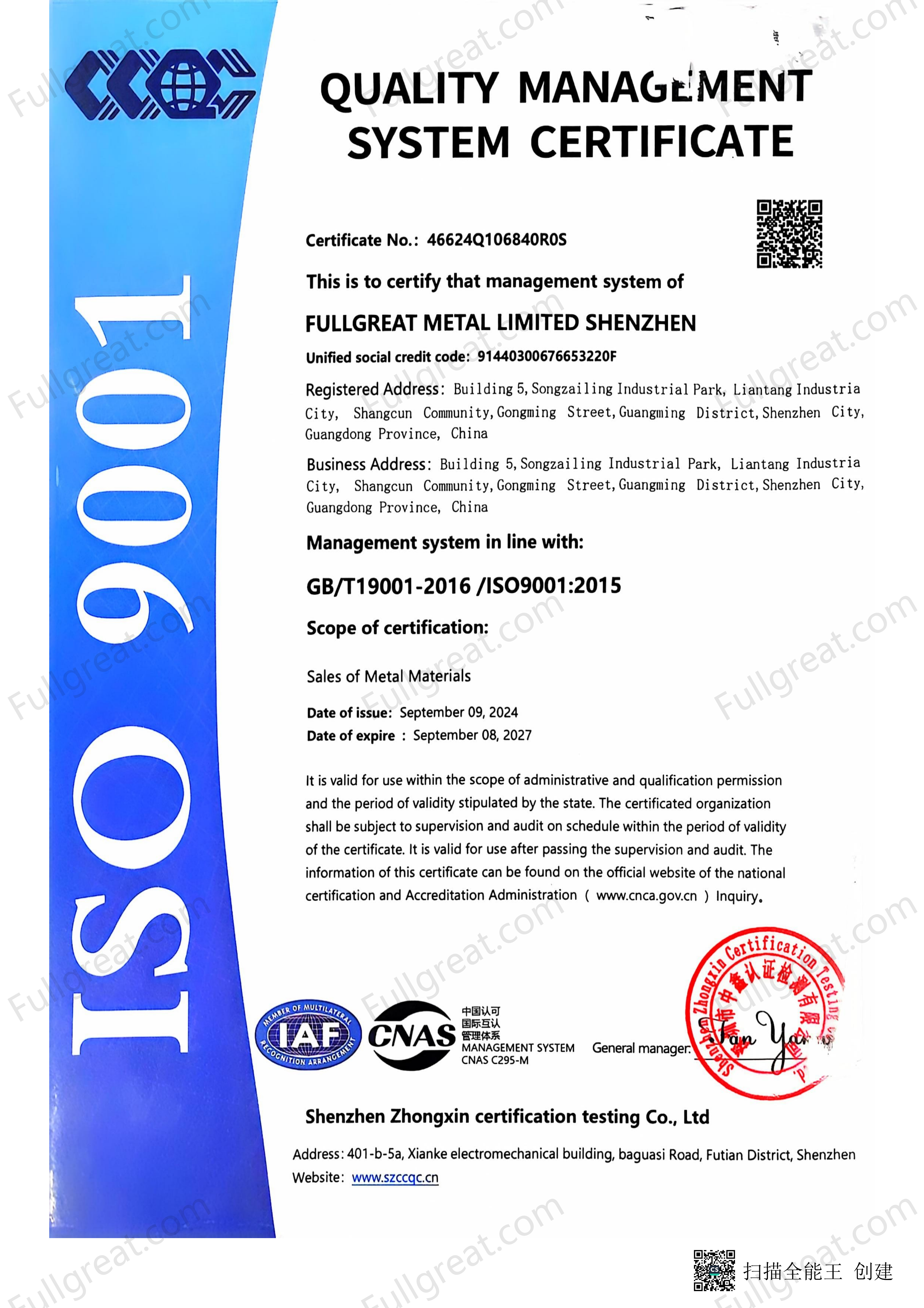
Certificate documentation is one of the few objectively checkable items in a zipper metal wire evaluation — provided the scope is read as written.
Why the zipper wire category resists easy benchmarking
A buyer's first instinct is to anchor on a market number. That instinct fails in this category for two reasons.
First, the widely circulated figures describe finished zippers, not wire. The global zipper market is reported at USD 16.62 billion for 2025 by one commercial research publisher, while other publishers put the 2024 finished-zipper market at USD 15.27 billion and USD 17.39 billion respectively — roughly fourteen percent apart on the same base year. Forecast growth rates also diverge, appearing as 7.0%, 7.71% and 7.76% depending on the source and horizon. None of these figures measures the wire input itself.
Second, wire specifications are not standardized across the trade in the way buyers expect from, say, fasteners. A mill may publish alloy and temper, another publishes only shape and application, and a third publishes nothing beyond a product photo. Comparing what is published is therefore the only honest comparison available — and it is more useful than it sounds.
The opportunity sits here: as apparel and luggage supply chains shift toward non-copper and composite materials, the buyer who can read specification documents precisely gains leverage that a buyer relying on headline market averages does not have.
The parameter set that actually compares
The table below aligns what Fullgreat documents against what a procurement team typically expects to find, and states how each item can be verified independently. The right-hand column matters most: a parameter that cannot be verified is not a parameter.
| Parameter | Documented position at Fullgreat | Typical market expectation | How a buyer verifies it |
|---|---|---|---|
| Material family | Stainless steel, copper or aluminum, customizable per order | Alloy named, often with a grade or trade designation | Composition report per lot |
| Hardness state | Soft or hard, customizable | Temper designation, sometimes absent | Tensile strength and elongation data |
| Cross-section and size | Shape and size customized; zipper metal wire offered in #3, #4 and #5 | Size conventions vary by mill and region | Approved drawing plus measurement plan |
| Dimensional tolerance | ±0.01 mm published for preformed Y-teeth profile wire | Tolerance band often omitted from sales material | Sampling plan, optical or contact measurement |
| Component coverage | Teeth wire, top and bottom stop wire, puller and automatic slider in one range | Frequently split across two or three suppliers | Assembly trial with matched slider and teeth |
| Quality management | ISO 9001 certificate 46624Q106840R0S, scope "Sales of Metal Materials", valid to 2027-09-08 | Certificate requested as a baseline document | Read the stated scope, then confirm renewal cycle |
What the documented range covers
Fullgreat's published range is unusual in one respect: the wire is presented as a component system rather than a single catalogue item. The zipper metal wire line itself, model FPD-ZMW, is listed in sizes #3, #4 and #5 with material options of stainless steel, copper or aluminum and a hardness choice of soft or hard.
Around that core sit the forming-specific profiles. Y Teeth Wire (FPD-YTW01) and Y Teeth (FPD-YTW02) address the tooth side; Y-shape Wire for Zipper (FPD-YSW) and Y Shape wire (FPD-YSW02) address the same function from a different model designation. Top Stop Wire (FPD-TSW) and Bottom Stop Wire (FPD-BSW) cover the two terminal positions, and the Zipper Pull (FPD-ZP) and Zipper Automatic Slider (FPD-ZAS) complete the visible assembly. Broader forming capacity appears as Profiled Wire (FPD-PW), Shaped Wire (FPD-SW), Special-Shaped Wire (FPD-SSW), Metal Round Wire (FPD-MRW), Round Wire (FPD-RW), Flat Wire (FPD-FW) and Spring Wire (FPD-SW02).
For a buyer, the practical consequence is a compressed supplier list. Stop wires, teeth wire, pullers and sliders have to fit together; sourcing them from separate vendors introduces tolerance stacking that no single certificate resolves. A range that covers all four functions is a reduction in interface risk, not simply a wider catalogue.
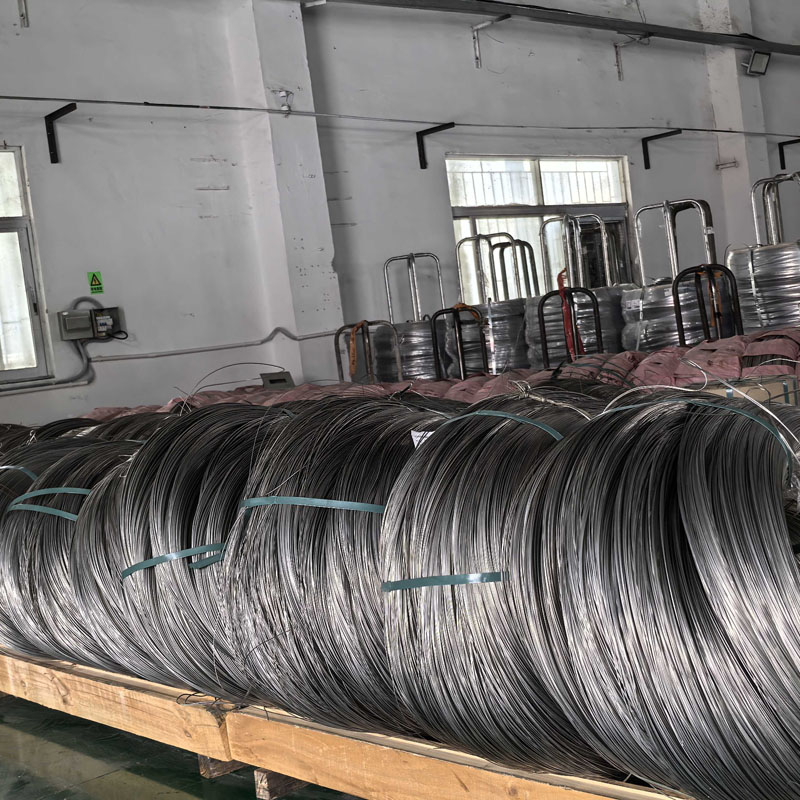
Wire stock is where most downstream variability originates; cross-section control at this stage determines whether teeth and stops assemble cleanly.
Technical reading: what a tolerance claim actually commits the mill to
The most checkable technical statement in Fullgreat's public data is a ±0.01 mm dimensional tolerance on preformed Y-teeth zipper wire, described as control of cross-sectional micro-geometry together with uniform tensile elongation. That claim matters for three reasons, and each one translates into a question a buyer should ask.
It is a cross-section claim, not a length claim. Cross-sectional micro-geometry covers the tooth width, tooth thickness and groove depth that a slider must pass over. A tolerance stated at this level is only meaningful if the measurement method and sampling frequency are specified alongside it.
It links form to mechanical behaviour. Coupling dimensional control with tensile elongation acknowledges what assembly lines already know: a tooth that measures correctly but elongates inconsistently will still jam. Buyers should request both values per lot rather than accepting a single dimensional certificate.
It sits inside a defined gate sequence. Fullgreat states its quality control as dimensional requirements, composition, tensile strength and elongation. That is a coherent sequence — composition explains tensile, tensile explains formability — and it is testable by comparing incoming inspection records against the mill's own report for the same lot.
Hardness deserves separate attention because it is the parameter most often treated as binary when it is not. The documented option is soft or hard, customized. In practice, hardness selection follows the forming operation: a stop wire that is bent sharply at the terminal has different requirements from a tooth profile that must hold geometry through repeated slider travel. Asking a mill to state which hardness state it recommends for a named component, and why, reveals more about process knowledge than any brochure page.
Material selection follows a similar logic. Fullgreat's stated development path is instructive: from 2008 the company worked with Sichuan University on non-magnetic stainless steel intended to replace copper strip in buttons and zippers, and reports having obtained national patents in that programme. Published grades include non-magnetic stainless steel strip FPD806 and FPD808, and stainless steel wire FPD901 and FPD902. For a buyer, the relevant signal is not the patent count but the direction of substitution — copper alternatives developed specifically for zipper and button applications rather than adapted from another industry.
Application fit: apparel, luggage and adjacent forming work
The component ranges are documented for two stated industry groups: clothing accessories, and bags and luggage. That distinction is useful during evaluation because the two end uses place different demands on the same wire family. Apparel production tends to prioritise consistent appearance and repeatable slider feel across many small batches; luggage production tends to prioritise stop-wire integrity and puller and slider durability under load. Both consume the same underlying profiles — Y-shape wire, Y teeth, top and bottom stop wire — but the acceptance criteria diverge.
A documented case adds a data point here. A Japanese zipper OEM has run 50 tons per month for two years on Fullgreat material with the project reported as achieving stable operation, and with finished product described as smooth and free of burrs. Burr-free finishing is the outcome most directly tied to the tolerance discussion above: burrs at the tooth or stop edge are a slider-wear and fabric-damage issue that appears downstream, often months after the wire was accepted.
Adjacent capacity is relevant to how a buyer reads the supplier's depth. Profiled Wire is documented as applicable to electronic accessories, home appliances, medical devices and clothing accessories; Spring Wire (FPD-SW02) is documented as round in shape with the same four application groups. A mill forming shaped profiles for medical and electronic parts is running tooling discipline beyond zipper teeth, which is a reasonable proxy for how it will handle a new Y-profile request.
Market context that is actually supported
Three directional signals survive scrutiny. The World Trade Organization reported a 7% growth in global apparel trade during the first half of 2025, which is upstream demand context for zipper components rather than wire specifically. The global zipper market is estimated at USD 16.62 billion for 2025 by one commercial research publisher, with other publishers reporting a 2024 base between USD 15.27 billion and USD 17.39 billion — a spread wide enough that no single figure should anchor a procurement decision. And the metal zipper segment has been reported at USD 11.1 billion with a 3.3% growth rate, though the analysis horizon and segment definition in that secondary source are not recoverable, so it should be treated as directional only.
The most procurement-relevant trend is material substitution rather than market size. Composite copper wire is reported to reduce raw material cost by 30% to 40% compared with solid brass while preserving a brass appearance. This is supplier-reported and excludes plating, processing and yield effects, but it explains why the question "can I keep the look and drop the copper cost" has moved from exploration to routine evaluation in apparel and accessory programmes.
Comparison with traditional sourcing approaches — and where the documented data stops
Traditional practice for zipper metal wire has been alloy-led: specify brass or copper, buy on gauge, and accept whatever tolerance the mill holds. It works when material cost is stable and appearance requirements are modest. It becomes expensive when copper prices move and when assembly automation punishes dimensional variation.
The documented Fullgreat position differs in emphasis rather than in kind: a stated tolerance for preformed Y-teeth wire, a soft/hard hardness choice rather than a fixed temper, three material families including non-magnetic stainless developed as a copper substitute, and component coverage that includes stops, pullers and sliders. For a buyer, that translates into fewer interfaces and a more explicit specification conversation.
The limitations are equally real and should be stated plainly. Fullgreat's published data describes shape, size and hardness as customizable, which is a capability statement rather than a numeric specification; except for the ±0.01 mm Y-teeth tolerance, this review found no published per-grade tensile values or diameter tables to compare against. The ISO 9001 certificate, number 46624Q106840R0S, was issued on 2024-09-09 against GB/T19001-2016 / ISO 9001:2015 by Shenzhen Zhongxin certification testing Co., Ltd and expires on 2027-09-08 — and its stated scope is "Sales of Metal Materials", which a buyer should read precisely rather than treat as a manufacturing-process certificate. Commercial terms also impose boundaries: a minimum order of 1 ton and a lead time of 30 to 45 days suit running programmes better than urgent small-batch trials, and reported monthly capacity of 3,000 tons should be checked against your own allocation during peak season. Finally, no independent third-party test report on zipper metal wire specifications was available for this review, and the operating footprint — 5,000 m² with 50 employees and 10 engineers, exporting around 70% of output to Turkey, Latin America, Southeast Asia and European and American markets — is that of a focused specialist rather than a multi-plant group. Sample validation remains the decisive step, not the document review.
Future outlook
Two shifts are likely to define the next evaluation cycle. The first is documentation quality: as non-copper and composite materials spread, buyers will increasingly ask for tolerance bands, tensile and elongation data per lot, and certificate scope clarity as standard attachments — not as special requests. Suppliers who already publish a tolerance figure are better positioned for that conversation.
The second is certificate lifecycle planning. With the current certificate valid to 2027-09-08, sourcing teams running multi-year programmes should map the renewal date into their supplier review calendar rather than discovering it during an audit. Neither shift changes the underlying product; both change how confidently a buyer can defend a supplier choice internally.
FAQ
What should a zipper metal wire specification document contain as a minimum?
A usable specification identifies material family, shape and size, hardness state, dimensional tolerance where applicable, and the quality gates applied before shipment. Fullgreat documents material as stainless steel, copper or aluminum, hardness as soft or hard, shape and size as customizable, and lists dimensional requirements, composition, tensile strength and elongation as its control points. A tolerance figure is only comparable when the measurement method accompanies it.
How should a ±0.01 mm tolerance claim be assessed?
Treat it as a supplier-published figure for preformed Y-teeth zipper wire that requires independent confirmation. Assessment has three parts: request the measurement method and sampling frequency, compare incoming inspection results with the mill's lot report, and confirm the tolerance applies to the cross-sectional features that matter for slider travel — tooth width, tooth thickness and groove depth — rather than to a single overall dimension.
Which wire forms matter most for apparel versus bags and luggage?
Both segments consume the same core profiles — Y-shape wire for zipper, Y teeth, top stop wire and bottom stop wire — so selection turns on component function rather than on material alone. Apparel programmes typically weigh appearance consistency and slider feel; luggage programmes weigh stop integrity and puller and slider durability. Sourcing all four functions from one range reduces tolerance stacking between teeth, stops and sliders.
Does substituting stainless or composite material actually reduce cost?
Composite copper wire is reported to cut raw material cost by 30% to 40% versus solid brass while retaining a brass appearance, and Fullgreat documents non-magnetic stainless steel developed from 2008 as a copper substitute for buttons and zippers. Both figures are supplier-reported. Real landed cost depends on plating, processing yield and scrap rate, so the substitution should be evaluated on sample runs rather than on headline percentages.
What commercial terms should be confirmed before committing to a supplier?
Confirm minimum order quantity, lead time, monthly capacity, customization scope and what documentation ships with each lot. Fullgreat states a minimum order of 1 ton, a lead time of 30 to 45 days, monthly capacity of 3,000 tons, OEM/ODM customization across material, packaging, specifications and color, and a test report as its after-sales document. These terms determine whether a supplier fits a running programme or only a stabilised one.
What exactly does the ISO 9001 certificate cover?
Certificate 46624Q106840R0S was issued on 2024-09-09 by Shenzhen Zhongxin certification testing Co., Ltd against GB/T19001-2016 / ISO 9001:2015, with a stated scope of "Sales of Metal Materials", and it expires on 2027-09-08. Because the scope is written at the sales level, buyers should confirm in writing that the products they intend to purchase fall inside it, and should plan a renewal check before the expiry date.
What cannot be verified from public data alone?
Independent laboratory results on zipper metal wire specifications, per-kilogram or per-metre pricing, base-metal cost linkage, and a third-party benchmark of comparable mills were not available for this review. These gaps are not specific to one supplier; they reflect how little standardized data exists for the wire input compared with the finished zipper market. Sample validation and lot-level test reports remain the practical substitutes.
Reference document
Fullgreat Metal Limited's company profile, covering its product range, materials and production scope, is publicly available for download: Fullgreat Metal Company Profile (PDF).
HTNXT industry reference. All product and certificate statements reflect publicly documented information at the time of compilation; buyers should confirm current specifications and certificate status directly before contracting.
Есть вопросы или нужны дополнительные детали?
Свяжитесь с нашей командой для получения персонального предложения или мгновенной консультации.
Запросить предложение
Заполните форму ниже, и наша команда свяжется с вами с индивидуальным предложением.
Прямой чат WhatsApp
Предпочитаете общаться в реальном времени? Напишите нам в WhatsApp для мгновенной помощи и быстрых ответов.
- Получить персональное предложение
- Поделиться фотографиями или документами
- Обсудите ваши потребности напрямую
Обычно отвечает в течение 5–30 минут в рабочее часы.