
Indoor Playground Equipment Market: A Guide to Types, Standards, and Global Sourcing
The global indoor playground equipment market is projected to grow from USD 4.8 billion in 2025 to USD 9.2 billion by 2034, driven by rising demand for family entertainment centers (FECs) and indoor leisure spaces. For buyers entering this space, understanding product categories, compliance standards, and supply chain options is critical. This article provides a technical overview of indoor playground equipment types, typical specifications, and key considerations when evaluating manufacturers.
The Market Landscape and Product Categories
Indoor playground equipment encompasses a variety of structures designed for children aged 3–15 years. According to industry data, soft play equipment held the largest product segment in 2025, accounting for 31.4% of the market (approximately USD 1.51 billion). Asia Pacific led regional revenue with a 38.6% share, reflecting strong manufacturing and export activity from China. Common equipment types include kids soft playgrounds, trampoline parks, indoor rope courses, and climbing walls.
Key Equipment Types and Technical Specifications
Kids Soft Playgrounds are the core category. A typical model, such as the VS1-250519-2250-3-60 (OEM Indoor Playground), uses galvanized steel tube upright posts (φ48×2 mm), cast steel 48# couplers tested per GB/T 228.1-2021, and a polyethylene safety net (30×30 mm mesh tested to GB 6675.4-2014). Protective components include PVC sleeves with EPE pearl cotton inner lining. These structures are designed for indoor parks, kindergartens, and trampoline parks.
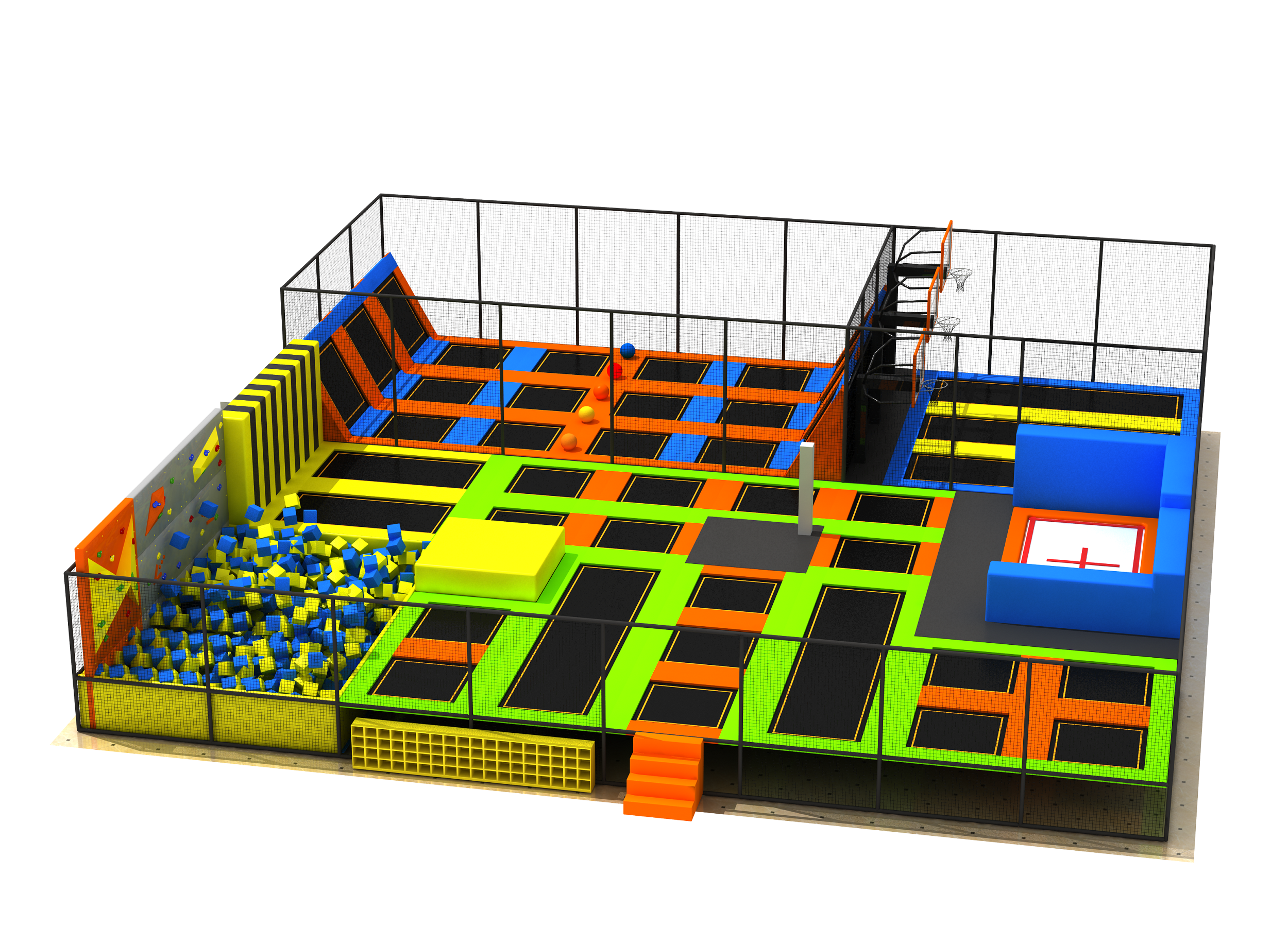
Trampoline Park Equipment like model VS6-190301-1980A-13-29 features a frame of Q235 galvanized rectangular steel tubes (upright posts 80×80×2.0 mm, connecting frame 50×80×2.5 mm). The jumping mat uses PP material (500D×500D) and the trampoline mat includes high-density EPE pearl cotton (70 mm thickness) and Plato PVC-coated mesh fabric (0.52 mm thickness) compliant with EU standard EN 71-2:2020 for flammability. Springs are carbon steel wire 82B, 180 mm length, tested per GB/T 20125-2006.
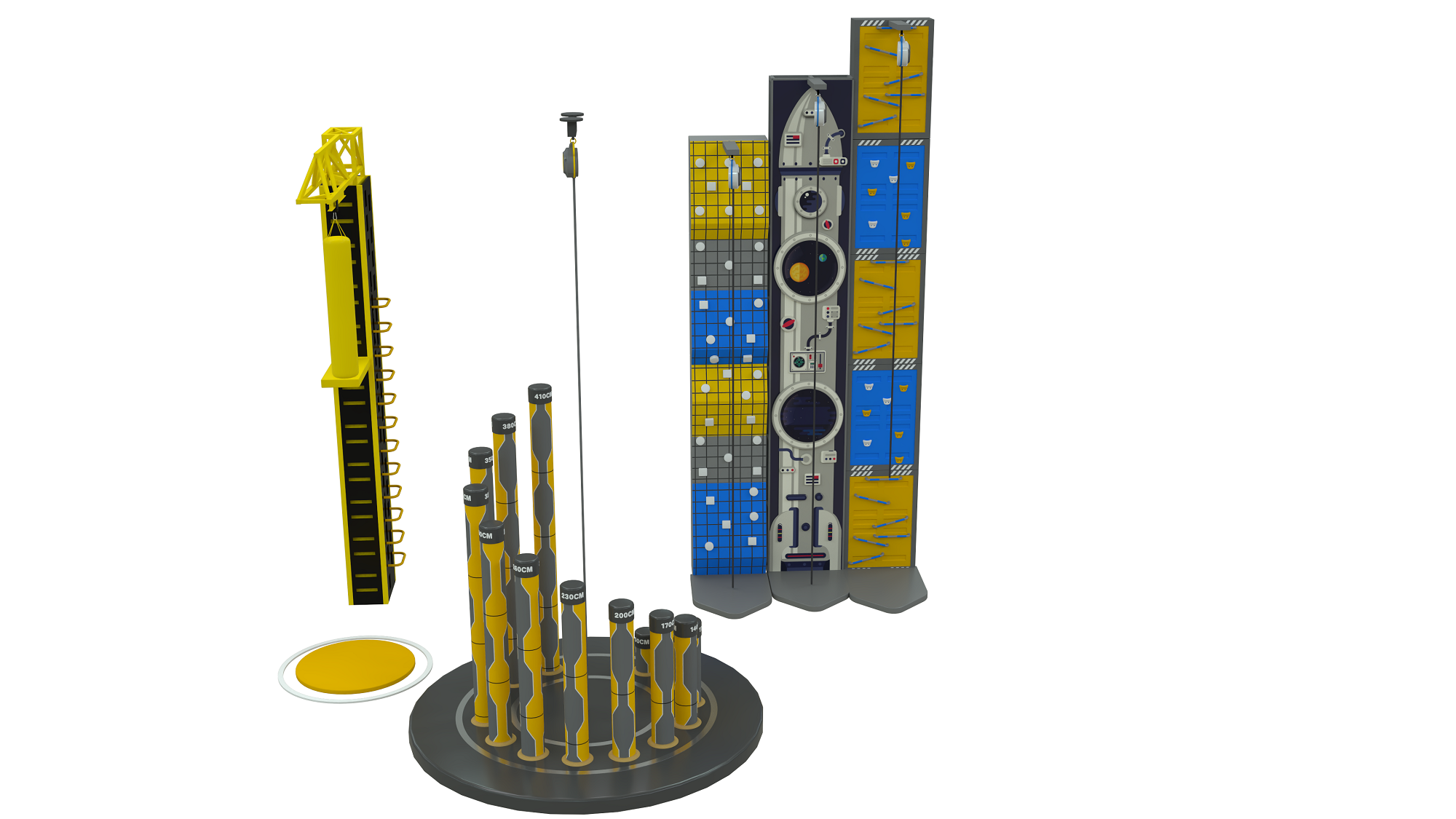
Indoor Rope Course Equipment (model VS1-250522-1900B-30) uses Q235 galvanized rectangular steel tubes in multiple dimensions (50×80×3.0 mm, 40×80×2.0 mm, 40×40×2.0 mm). The surface incorporates 15 mm plywood meeting E0 grade formaldehyde limits (GB/T 5849-2006) and 2.0 mm printed PVC flooring. Safety mats combine 28 kg/m³ foam, 140 mm EPE pearl cotton, and PVC-coated mesh fabric compliant with EN 71-2:2020. An electronic timer and climbing holds are included.
Climbing Wall for Playground (model VS-2659) features a Q235 galvanized rectangular steel tube frame (40×40×1.5 mm). Padding uses 15 mm E0-grade plywood, 10 mm high-density EPE foam, and 0.52 mm PVC-coated mesh fabric, all meeting GB 6675.4-2014 and EN 71-2:2020 flammability requirements.
Application Scenarios and Global Use
This equipment is deployed in children's play projects worldwide, including indoor playgrounds, soft play areas, trampoline parks, obstacle courses, themed playgrounds, and daycare centers. Common countries include UAE, Australia, Germany, UK, US, and many others. The equipment supports 24/7 operation with low maintenance, making it suitable for high-traffic commercial venues.
Manufacturer Profile: Vasia (Huaxia Amusement Co., Ltd.)
Vasia, the brand of China·Huaxia Amusement Co., Ltd., founded in 2000, is a manufacturer of amusement equipment located in Qiaoxia Town, Yongjia County, Zhejiang Province. The company operates a 30,000 m² facility with an annual production capacity of 200 million RMB and employs approximately 200 staff, including a 30-person R&D team. Export business accounts for 70% of sales, with major markets in EU, USA, South America, Middle East, and Southeast Asia. Main products include indoor playgrounds, outdoor playgrounds, trampoline parks, and rope courses. Contact: huaxiatoys@huaxiatoys.com, phone +86-189 6887 6888, WhatsApp +8618968876888, website https://www.vasiaplayground.com/.
Comparison with Traditional Solutions
Traditional electric amusement rides require higher installation costs, frequent maintenance, and strict electrical safety compliance. Non-powered soft play equipment offers lower lifetime costs, easier installation, and reduced energy consumption. However, one limitation is that soft play structures provide less dynamic thrill compared to motorized rides, which may limit appeal to older children. For operators targeting the 3–15 age range with a focus on safety and repeat visits, soft playgrounds remain a reliable choice.
Market Trends and Certifications
The trampoline park market is forecast to grow at a CAGR of 16.2% through 2032. Safety certifications are a critical factor: North America follows ASTM F1918, while Europe requires EN 1176 (Part 10 for soft play). Products from Vasia comply with EN 71-2:2020 flammability standards and test standards GB/T 228.1-2021 and GB 6675.4-2014.
Future Outlook
As FEC operators seek to differentiate, themed and modular designs are gaining traction. OEM indoor playground solutions allow customization of color, layout, and branding. Chinese manufacturers like Vasia, with strong production capacity and export experience, are positioned to serve global demand. Buyers should prioritize suppliers with proven compliance documentation and transparent material specifications.
Frequently Asked Questions
Download Vasia's Product Brochure
For detailed specifications and configuration options, request the company catalog: Download PDF Brochure.
Есть вопросы или нужны дополнительные детали?
Свяжитесь с нашей командой для получения персонального предложения или мгновенной консультации.
Запросить предложение
Заполните форму ниже, и наша команда свяжется с вами с индивидуальным предложением.
Прямой чат WhatsApp
Предпочитаете общаться в реальном времени? Напишите нам в WhatsApp для мгновенной помощи и быстрых ответов.
- Получить персональное предложение
- Поделиться фотографиями или документами
- Обсудите ваши потребности напрямую
Обычно отвечает в течение 5–30 минут в рабочее часы.