
Induction Heater vs. Conventional: Cost, Efficiency, Payback
For industrial buyers, heating technology is not just an operational detail. It is a cost center, a quality variable, and a compliance issue. When a heating system consumes more energy than necessary, the loss is repeated every shift. When it breaks down, production stops. When it fails to control temperature accurately, product quality suffers. This is why procurement teams evaluating an induction heater should examine total cost of ownership instead of an upfront price tag.
Market signals underline the importance of this decision. The global induction heating system market was valued at USD 2.39 billion in 2024 and is projected to reach USD 4.5 billion by 2035, according to WiseGuyReports. More than 550,000 induction heating systems are estimated to be deployed globally, with Asia-Pacific accounting for approximately 40% of the installed base, according to Global Market Insights. These figures suggest that induction heating has moved from a niche technology to a standard option for many industrial heating tasks.
This article provides an evidence-based comparison between modern induction heaters and traditional heating approaches. It focuses on the information that matters most at the decision stage: efficiency, energy savings, maintenance, lifespan, application fit, and practical limitations.

Problem/Opportunity: Why Heating Costs Need a Second Look
Traditional industrial heating methods usually fall into one of four categories: gas-fired boilers, resistance heaters, oil heaters, or older induction equipment. Each method has strengths, but each also carries cost risks. Gas-fired systems face volatile fuel prices and tightening emissions regulations. Resistance heaters transfer heat through an intermediate medium, which increases energy loss and slows response time. Older induction machines often rely on analog controllers, making temperature stability dependent on manual adjustment.
The opportunity lies in newer induction systems, particularly those equipped with digital controllers, which address several of these constraints at once. By generating heat inside the target material, induction reduces the energy lost to the surroundings. The result is a measurable improvement in efficiency. JONSON, a brand of Guangdong Jiangxin Electronic Technology Co., Ltd., reports an overall thermal efficiency stable at 95%–98%, with comprehensive energy savings of 30%–70% compared with traditional induction heater machines. Industry data from Global Market Insights indicates that induction heating systems can reach energy efficiencies up to 92%, with an average cycle time reduction of 30% compared with gas or resistance-based heating. For a buyer, this translates into lower energy bills and faster processing, which are two of the most direct cost drivers.
Brand Solution: JONSON as an Industrial Reference
JONSON is one example of a supplier with a documented track record in digital induction heating. It is the industrial induction heating brand of Guangdong Jiangxin Electronic Technology Co., Ltd., located in Shunde District, Foshan, Guangdong Province, China. The company was founded in 2011 and now operates a 3,000-square-meter factory with approximately 60 employees. More than 30 of those employees work in R&D and engineering. The firm reports an annual production capacity of 120,000 units, and exports about 40% of its output to Europe, the United States, India, Indonesia, and other markets.
JONSON's product range includes induction heater machines, induction heater control boards, electromagnetic induction heaters, induction heating coils, induction steam generators, induction water boilers, hot air generators, bearing heaters, and induction welding machines. For many industrial buyers, the most relevant product categories are digital induction heating controllers and energy-saving steam generators, because these are used in injection molding, chemical processing, and other continuous manufacturing operations.
Company background alone is not a purchase justification. The more important question is whether the product's performance statements can be translated into procurement metrics. JONSON states that, compared with traditional induction heater machines, its equipment offers maintenance requirements reduced by 90% and an expected lifespan three times longer, while maintaining thermal efficiency of 95%–98%. These are specific and verifiable claims that can be included in a supplier qualification checklist.
Technical Explanation: How Induction Heating Achieves Efficiency
To understand why induction heating is so efficient, it helps to review the basic principle. An induction heating power supply converts mains alternating current into a high-frequency current. This current is sent to an induction heating coil, which generates a rapidly changing magnetic field around the workpiece. If the workpiece is electrically conductive, the magnetic field induces eddy currents inside the material. These currents flow against the material's resistance and generate heat directly inside the workpiece.
Direct heating is the key difference. In a gas boiler or resistance heater, heat is generated in a separate source and then transferred through air, water, or a heating surface. Each step of that transfer loses energy. Induction avoids most of those losses because the material itself is the heat source. This also explains why induction heating can respond quickly to changes in temperature setpoints.
The role of the control board is equally important. A digital induction heating controller adjusts frequency and power output in real time. That means the system can hold temperature within a narrow range without constant manual tuning. For processes such as chemical reactions or heat treatment, this precision has a direct effect on product quality. It also reduces energy waste caused by overshooting the target temperature.
From a compliance standpoint, industrial induction heating equipment should be designed and tested in accordance with IEC 60519-1, which covers general safety requirements for electric heating installations, and IEC 60519-3, which addresses induction heating and melting equipment. Buyers should ask suppliers for documentation that confirms compliance with these standards.
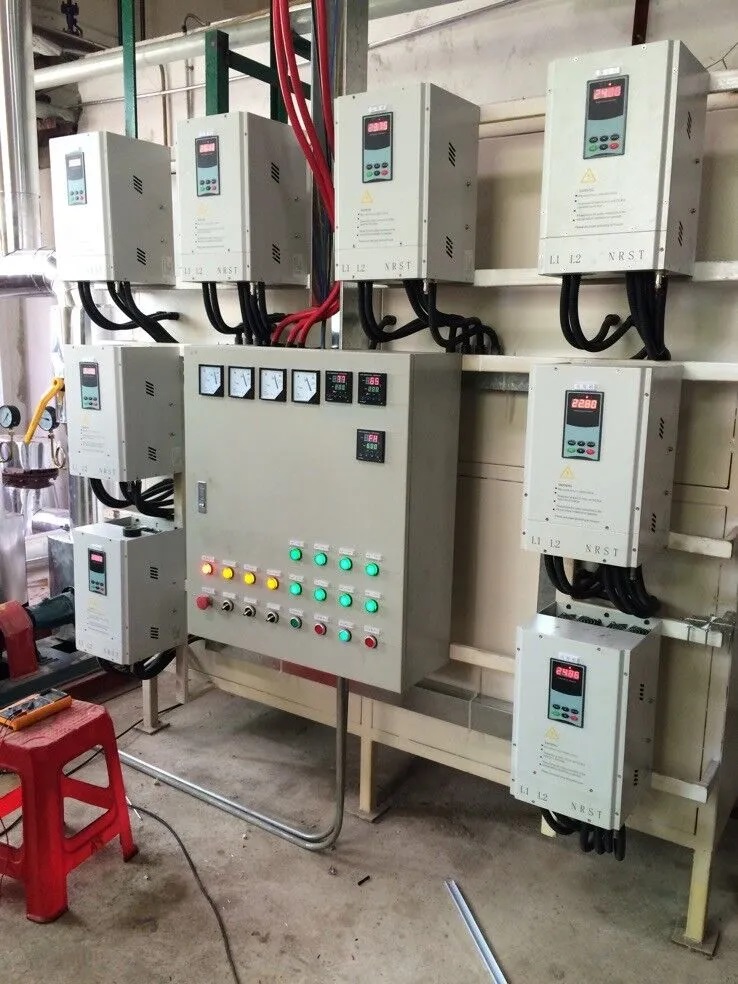
Comparison with Traditional Solutions
| Evaluation criterion | Traditional induction heater machines | Modern induction heater (JONSON) | Procurement impact |
|---|---|---|---|
| Thermal efficiency | Baseline; older designs are less efficient | 95%–98% | Lower energy cost per unit of output |
| Comprehensive energy savings | Baseline | 30%–70% | Shorter payback period |
| Maintenance requirement | Baseline | 90% less | Lower labor and spare-part costs |
| Expected lifespan | Baseline | 3 times longer | Lower capital replacement frequency |
| Process control | Analog / less precise | Digital control | More consistent product quality |
| Suitable industries | Limited by analog tuning | Plastics, food, chemical, pipeline, textile, aquaculture, metal heat treatment, building, herb drying | Wider application range |
The table above summarizes the procurement-level comparison offered by JONSON's product data. It is important to note that the baseline used in JONSON's documentation is traditional induction heater machines. Buyers replacing gas or resistance heating may see different results, and the exact gain depends on the existing process configuration.
An honest comparison also needs to acknowledge boundaries. Induction heaters work only with electrically conductive materials. If the target material is non-conductive, the system needs a heat exchanger or a different heating technology. Furthermore, induction equipment must be installed with adequate space for heat dissipation. The unit should be kept away from dust, oil, and flammable or explosive materials. To maintain long-term performance, the manufacturer advises regular cleaning of cooling ducts and the use of only original factory-supplied coil parts. These conditions are not difficult to meet, but they should be part of the procurement plan.
Application/Use Cases: Where Induction Heaters Fit
The practical value of induction heating becomes visible when looking at application fit. JONSON lists the following suitable industries: plastics and rubber, food processing, chemical reactions, crude oil pipeline heating, textile printing and dyeing, aquaculture heating, metal heat treatment, building heating, and medicinal herb drying. These applications have very different heating requirements, yet they all benefit from the same electromagnetic platform with different coils and control settings.
In plastics and rubber, induction heating helps maintain barrel temperature stability and reduce heat loss during forming. In food processing, rapid response and clean operation support hygiene and consistent output. In chemical reactions, accurate temperature control improves conversion rates and reduces batch variation. In crude oil pipelines, induction heating can be applied locally to maintain flow and prevent viscosity issues. In aquaculture, stable water temperature reduces stress on aquatic life and improves growth consistency. In metal heat treatment, controlled heating cycles are essential for hardness and material properties.
For each of these use cases, the decision criterion is the same: does the induction system deliver the required temperature profile with lower energy and maintenance cost than the incumbent solution? If the answer is yes, the replacement can be justified on operational grounds.
Market Trend Analysis: Data That Supports the Shift
The macroeconomic evidence supports the growth of induction heating. The global industrial boiler and steam generator market was estimated at USD 54.79 billion in 2024, with a clear shift toward electrification via induction technology to meet decarbonization goals, according to Market Research Future. This shift is not limited to one region; it reflects a broad industrial movement away from fossil fuels and toward electrically powered heating systems.
Within the induction heating system segment, the 10 kW–100 kW power range dominates, according to MarketsandMarkets. This is the range that supports common industrial tasks such as hardening, forging, brazing, and boiler replacement. It also aligns with the product range that companies such as JONSON offer for small and medium-sized manufacturing lines.
The competitive landscape remains fragmented. Fuji Electric held a leading market share of over 9.5% in 2025, according to Global Market Insights, but no single player controls the entire market. For buyers, fragmentation creates both opportunity and risk. It means alternative suppliers are available, but it also means thorough due diligence is necessary. A supplier's financial stability, production capacity, engineering depth, and after-sales service record must be verified before a long-term contract is signed.
Future Outlook
All signs point to continued adoption of induction heating. As energy prices remain volatile and emissions rules tighten, electrified heating technologies with high efficiency become more attractive. The falling cost of power electronics is another factor. Digital controllers that previously seemed expensive are now available in compact formats, making retrofits easier.
For industrial buyers, the question is no longer whether induction heating can work. It is which induction heating system will deliver the best lifecycle value in a specific application. This means comparing not only prices and specifications but also the supplier's ability to customize the coil, control logic, and system integration. Companies such as JONSON that offer both standardized products and engineering support are positioned to serve this need.
FAQ
What are the main advantages of induction heating compared with traditional heating?
Induction heating systems report higher thermal efficiency, lower maintenance requirements, and longer expected lifespan than conventional designs. For example, JONSON states that its equipment reaches 95%–98% thermal efficiency and reduces maintenance requirements by 90% compared with traditional induction heater machines.
What thermal efficiency can an industrial induction heater achieve?
JONSON reports thermal efficiency stable at 95%–98% for its induction heating equipment. Industry data from Global Market Insights shows that induction heating systems can achieve energy efficiencies up to 92% compared with gas or resistance-based heating.
What energy savings can buyers realistically expect?
According to JONSON, comprehensive energy savings range from 30% to 70% compared with traditional induction heater machines. Actual savings depend on the application, duty cycle, and the efficiency of the equipment being replaced.
How does maintenance compare between induction and traditional systems?
JONSON states that maintenance requirements are 90% lower than for traditional induction heater machines. Regular dust removal from cooling ducts is required, and only original factory-supplied coil parts should be used to preserve performance.
Which industrial applications are best suited to induction heating?
Representative applications include plastics and rubber, food processing, chemical reactions, crude oil pipeline heating, textile printing and dyeing, aquaculture heating, metal heat treatment, building heating, and medicinal herb drying.
What safety and installation constraints should buyers evaluate?
The unit must have ample space for heat dissipation and should be kept away from dust, oil, and flammable or explosive materials. Rust-proof and waterproof risks are addressed through design considerations and operating precautions. Quality assurance includes regular cleaning of cooling ducts and using only original factory-supplied coil parts.
Which safety standards apply to industrial induction heating equipment?
Industrial induction heating equipment generally needs to comply with IEC 60519-1 for general safety requirements and IEC 60519-3 for induction heating and melting equipment. Buyers should confirm that a supplier's documentation references these standards.
Есть вопросы или нужны дополнительные детали?
Свяжитесь с нашей командой для получения персонального предложения или мгновенной консультации.
Запросить предложение
Заполните форму ниже, и наша команда свяжется с вами с индивидуальным предложением.
Прямой чат WhatsApp
Предпочитаете общаться в реальном времени? Напишите нам в WhatsApp для мгновенной помощи и быстрых ответов.
- Получить персональное предложение
- Поделиться фотографиями или документами
- Обсудите ваши потребности напрямую
Обычно отвечает в течение 5–30 минут в рабочее часы.