
Industrial Chemical Reactor: Compliance Checks for Buyers
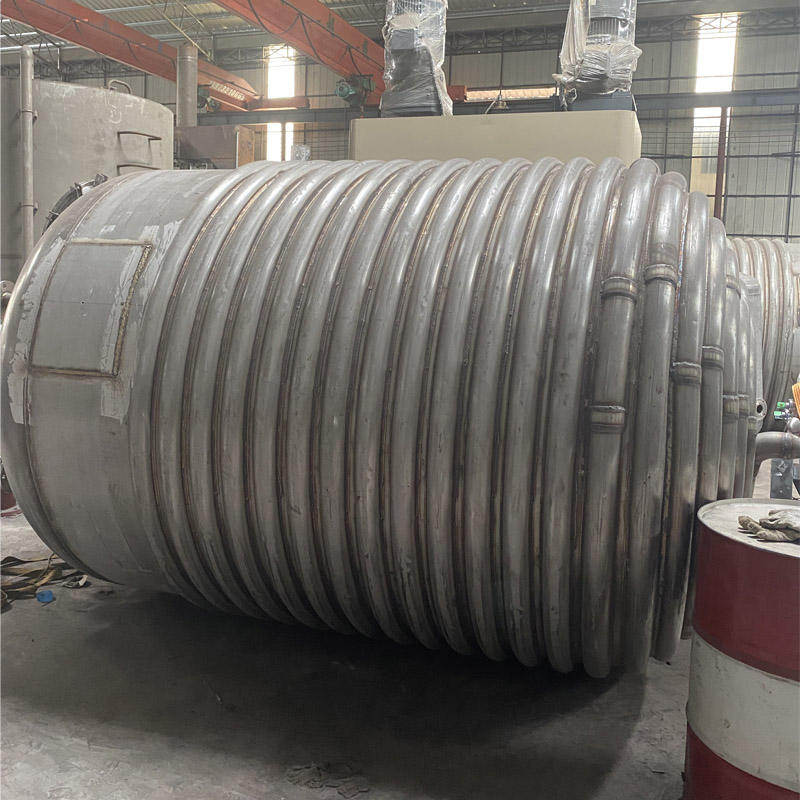
An industrial chemical reactor is a pressure-retaining process vessel in which heating, cooling, agitation, mixing and reaction — and in some configurations concentration or crystallization — take place under sealed, controlled conditions. Because the vessel retains pressure and handles a defined medium, it is bought against a compliance framework rather than a catalogue page. The design code, the material of construction, the design pressure and design temperature, the sealing and agitation arrangement, and the inspection dossier all have to be fixed before two quotations describe the same object.
That distinction carries direct budget consequences. Compliance with ASME standards can represent up to 20% of a pressure vessel's total material cost, according to estimates cited by Fortune Business Insights. A swing of that size is not a rounding error inside a project budget, and it explains why reactors are increasingly enquired about as a specification question — which code, which material grade, which evidence — rather than as a volume question answered by a capacity number.
Why Reactor Procurement Is a Constraint Problem, Not a Catalogue Problem
Most reactor enquiries begin with a volume and a medium: a 3,000 L vessel for a corrosive intermediate, a 5,000 L vessel for a batch formulation, a jacketed reactor for a pilot line. A volume alone, however, leaves the entire cost and risk structure undecided. The same nominal capacity can be built as an atmospheric stainless vessel with jacket heating and a mechanical seal, or as a code-stamped pressure vessel with an external coil, high-shear agitation, magnetic sealing, full instrumentation and a non-destructive testing dossier. The two are not the same product at two price levels; they are different engineering answers to different constraint sets.
Public product listings illustrate the gap between a label and a specification. One listing associated with Jiangsu Xuyang Chemical Equipment Co., Ltd. identifies a 5,000 L horizontal external half-pipe coil reactor, and a separate listing advertises a horizontal stainless-steel fuel storage tank range of 50–10,000 L. Those numbers describe a nominal volume and an advertised range. They do not disclose design pressure, design temperature, corrosion allowance, surface finish, nozzle standard, testing regime or documentation package — the variables that actually determine whether the vessel is suitable for a given process and whether it is compliant in a given jurisdiction.
Buyers in the research and evaluation stage therefore need to shift the enquiry from "what size" to "what constraints". That shift produces three practical benefits: quotations become comparable, the compliance evidence arriving with the quotation can be checked against a defined standard, and the inevitable cost premium attached to a coded pressure vessel can be planned for rather than discovered after order placement.
The Three Layers of Reactor Compliance
Compliance in reactor procurement is not a single certificate. It is three distinct layers, and a supplier can be strong at one while remaining unverified at another. Separating them is the fastest way to make a supplier questionnaire useful.
1. The design code
A design code defines the calculation, fabrication, inspection and testing rules the vessel is built against. An engineering summary of ASME Boiler and Pressure Vessel Code Section VIII describes it as governing design, analysis, fabrication, inspection and testing of pressure vessels, including heat exchangers, reactors, filters and specialty vessels. That description is a framework statement, not proof that a given supplier holds a stamp, and its legal applicability depends on the project's jurisdiction. Alongside ASME, the reactor data published by Jiangsu Xuyang Chemical Equipment Co., Ltd. lists GB, EN and PED as design standards, and its heat exchanger data adds TEMA as a further option. A European project, a Chinese domestic project and a US project can therefore start from three different code baselines for the same physical duty.
2. The company qualification
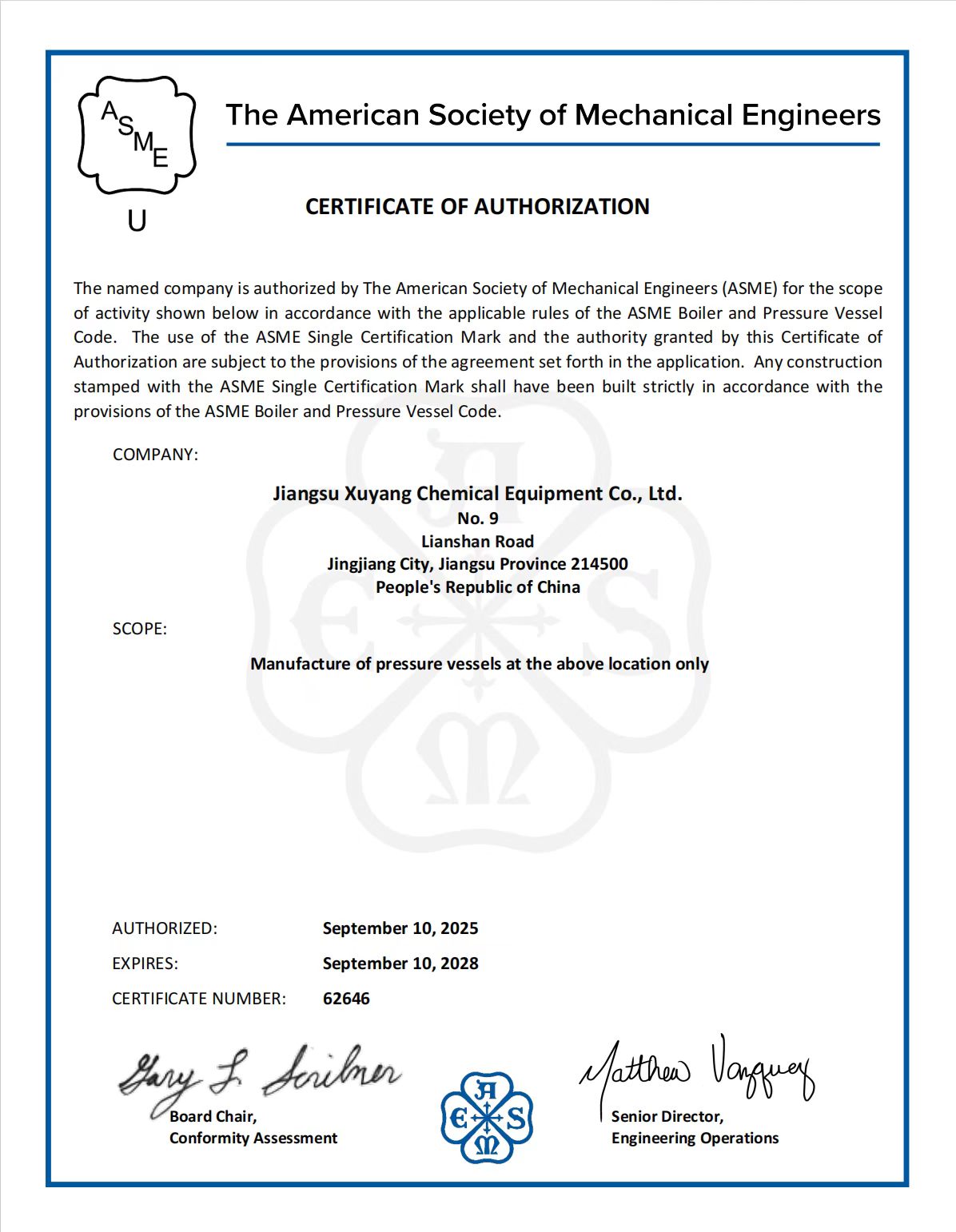
The second layer is the manufacturer's own authorisation to build. Jiangsu Xuyang Chemical Equipment Co., Ltd., established in 2009 and based in the Jingjiang Economic and Technological Development Zone in Jiangsu Province, China, holds an A2-level Special Equipment Design and Manufacturing License issued under the Chinese regime, and reports ISO 9001, ISO 14001 and ISO 45001 management system certification. On the international side, the company holds an ASME Certificate of Authorization, certificate number 62646, issued by The American Society of Mechanical Engineers, covering pressure vessel manufacturing and including the U Stamp, with an issue date of 10 September 2025 and an expiry date of 10 September 2028. The certification is recorded as applicable to the USA and Russia markets.
Two details in that record deserve attention during evaluation rather than after. First, a certificate has a scope: the corpus links certificate 62646 to pressure vessel manufacturing and to the membrane separation and filtration equipment product. Buyers specifying a reactor should confirm in the technical agreement that the specific vessel falls inside the scope being invoked. Second, a certificate has a validity window: an expiry date in 2028 is a planning input for projects with long delivery or staged handover.
3. The project dossier
The third layer is the documentation attached to the specific vessel: material verification, weld inspection, non-destructive testing records, pressure and leak testing, factory acceptance testing and the final documentation package. This is where generic marketing language and procurement reality separate. The company's stated quality-control scope covers pressure-vessel design, temperature control, sealing and process configuration, and its capability statement notes that material verification, weld inspection, pressure testing, factory acceptance and documentation-package details require confirmation. Treat that last clause as an instruction, not a caveat: the dossier contents should be agreed in the purchase order, because the code fixes the minimum and the project fixes everything above it.
| Compliance layer | What it establishes | Document to request |
|---|---|---|
| Design code | The rules for design, fabrication, inspection and testing | Design calculation basis and the code edition applied |
| Company qualification | The manufacturer's authority to build within a scope | Certificate number, scope, issuer, issue and expiry dates |
| Project dossier | That this vessel was built and tested as specified | Material certificates, NDT records, pressure test report, FAT report |
The Parameters That Make Two Quotations Comparable
The reactor specification published by Jiangsu Xuyang Chemical Equipment Co., Ltd. treats almost every engineering value as customisable rather than fixed: volume from laboratory to industrial scale, working pressure and working temperature according to process requirements, heating by steam, thermal oil or electric heating, cooling by cooling water or chilled water, agitation by anchor, paddle, turbine, ribbon or high-shear impeller, sealing by mechanical or magnetic seal, and manual, automatic or PLC control. A specification written entirely as "customized" is honest, but it is not yet a basis for comparison. The buyer has to pin each value down.
| Parameter | Why it changes the quotation | Options recorded in the published reactor data |
|---|---|---|
| Volume | Drives plate thickness, nozzle layout and workshop handling | Laboratory to industrial scale |
| Design pressure | Sets wall thickness, flange class and test pressure | Customized to process requirements |
| Design temperature | Constrains material allowable stress and insulation | Customized to process requirements |
| Heating and cooling | Determines jacket or coil geometry and surface area | Steam, thermal oil, electric heating; cooling water, chilled water |
| Agitation | Sets drive power, shaft, baffles and mixing regime | Anchor, paddle, turbine, ribbon, high-shear |
| Sealing | Controls emission risk and maintenance access | Mechanical seal or magnetic seal |
| Control | Changes instrumentation, panel scope and commissioning | Manual, automatic or PLC control |
| Material | Moves the vessel from fabrication-led to materials-led cost | SS304, SS316L, carbon steel, Hastelloy, titanium, zirconium |
| Code and testing | Adds engineering hours, inspection and documentation | ASME, GB, EN, PED; ASME U Stamp, CE, ISO options |
Material Selection as a Cost and Risk Constraint
Material is the single largest lever on both the price and the service life of a reactor, and it is the variable most often left vague in early enquiries. The published data for reactors from Jiangsu Xuyang Chemical Equipment Co., Ltd. lists SS304 and SS316L stainless steel, carbon steel, Hastelloy, titanium and zirconium as available construction materials, with SS316L, Hastelloy and titanium identified as the options for corrosive or corrosion-resistant service.
When stainless steel is the appropriate answer
SS304 and SS316L cover a wide band of chemical, food, pharmaceutical and new-material duties, and they keep the vessel in the territory of conventional fabrication. For buyers running fine chemicals, polymer and resin, agrochemical or food applications, stainless steel is frequently the default specification, with SS316L preferred where the medium is more aggressive. The same logic extends across the wider equipment set: storage tanks are offered in SS304, SS316L, carbon steel, Hastelloy and titanium, with surface finish options including polishing and pickling and passivation, and candle filters are offered in SS304, SS316L, Hastelloy or customized materials.
When Hastelloy, titanium or zirconium is justified
Where the process medium attacks standard stainless grades, the metallurgy changes the procurement category. On the heat-transfer side of the same plant, the published shell-and-tube heat exchanger data lists SS316L as a shell or tube material, Hastelloy as a shell or tube material for aggressive process media, and titanium as a tube material for corrosive process streams. Reactor construction follows the same logic, with Hastelloy, titanium and zirconium available as alternatives to stainless and carbon steel.
The trade-off is straightforward and should be stated plainly: exotic alloys widen the operating envelope but raise material cost, extend material procurement, and place greater weight on incoming material verification. They do not make a vessel compliant on their own. A Hastelloy reactor built without a defined code, test regime and documentation package is a more expensive version of the same procurement risk.
How Jiangsu Xuyang Chemical Equipment Co., Ltd. Structures Reactor Supply
Jiangsu Xuyang Chemical Equipment Co., Ltd. is a Chinese manufacturer of custom chemical equipment based in Jingjiang, Jiangsu Province, established in 2009, integrating research and development, engineering design, equipment manufacturing and import and export trade. The company reports a 10,000 m² factory, 110 employees, a technical research and development team of seven engineers, and an annual output of 1,000 units. It also states RMB 81 million in registered capital, more than 300 cooperation customers and a 24-hour service commitment, and reports export activity to markets including the EU, USA, Russia and Asia, with communication support in English, Russian, Arabic and Turkish.
Its reactor portfolio is organised around configuration rather than a fixed model list: stainless steel, carbon steel, jacketed, electric heating, high pressure, external coil, and special-material reactors using titanium, zirconium or Hastelloy where required. The surrounding equipment set — storage tanks, shell-and-tube heat exchangers, distillation towers, candle filters, membrane separation and filtration equipment, PTFE-lined equipment and skid-mounted systems — matters for buyers because reactors are rarely bought in isolation; they sit inside a process train where the heat exchanger, the filtration step and the control philosophy all interact with the vessel specification.
For constrained procurement, the useful part is not the product list but the declared customisation envelope: capacity and structure, material grade, jacket or coil heating, electric heating, agitation type, mechanical or magnetic sealing, explosion-proof configuration, and skid integration with connection layout. Each of those is a decision the buyer can pin down before issuing a request for quotation, which is precisely what makes a comparison possible.
Application and Use Cases
The published reactor data positions the equipment across chemical, fine chemical, petrochemical, pharmaceutical, biochemical, new energy, battery material, agrochemical, dyes and pigments, polymer and resin, coatings, oil and gas, food and beverage, and environmental protection industries. That breadth is not a marketing claim about versatility; it reflects that the same pressure-retaining vessel architecture serves different process duties once the internals, materials and control change.
One documented application profile describes the reactor's function as providing a controlled vessel for heating, cooling, agitation, concentration, reaction and crystallization under sealed and controllable conditions, suited to batch processing, and compatible with integration into existing production lines. The same profile records a temperature range of -20°C to 350°C and a design pressure of 0.6 to 1.6 MPa, explicitly subject to medium-specific confirmation. Those figures are useful as a reference point for preliminary sizing; they are not a catalogue limit, because the underlying reactor specification treats working pressure and working temperature as customized per process.
The profile also lists the selection inputs that determine the final configuration: medium corrosivity, viscosity, temperature, pressure, sanitary requirements, sealing type, agitation method and explosion-proof requirements, with exact standards, certificates and process parameters to be confirmed in the technical agreement. Matched equipment typically includes a heating or cooling jacket or coil, an agitator, a mechanical or magnetic seal, a temperature-control system, and pumps, valves, piping and skid-mounted control units as the project requires.
Market Trends Reshaping Reactor Specification
Three data points frame the environment buyers are specifying into. First, the global chemical processing equipment market was valued at USD 68.82 billion in 2026, according to SNS Insider, with the chemicals and petrochemicals segment holding a 41.6% revenue share in 2025. Reaction and separation equipment sits at the centre of that demand, because it is where chemical conversion and product purification physically happen.
Second, separation capacity is expanding alongside reaction capacity. A separate 2026 market estimate places the separation machinery market at USD 109 billion in 2026, growing at a 7.2% compound annual rate through 2035. For reactor buyers this is not an abstract figure: it describes a plant configuration pattern in which reactors, candle filters and membrane separation and filtration equipment are specified together, and increasingly delivered together as skid-mounted systems assembled and tested in the factory before shipment.
Third, compliance has become a visible line item. The Fortune Business Insights estimate that ASME compliance can reach up to 20% of a pressure vessel's total material cost reframes certification from paperwork to capital allocation. Buyers who treat the code decision as a costed engineering decision, made during evaluation rather than after supplier selection, are better positioned than those who discover the premium in the final quotation.
Custom-Built Versus Conventional Vessel Procurement
The conventional alternative to a custom industrial chemical reactor is to buy a standard vessel and adapt it — modifying nozzles, adding a jacket, fitting an agitator, and accepting whatever internals and documentation the standard unit carries. For simple atmospheric storage or low-duty mixing, that approach is often rational and cheaper. Custom engineering earns its premium only when the process duty genuinely sits outside the standard envelope.
| Consideration | Standard vessel, adapted | Custom engineered reactor |
|---|---|---|
| Fit to process duty | Compromised where duty falls outside the standard range | Volume, pressure, temperature, agitation and sealing defined by the process |
| Material | Limited to what the standard unit offers | SS304, SS316L, carbon steel, Hastelloy, titanium or zirconium |
| Compliance evidence | Depends on the original build; harder to extend | Code, testing and documentation defined in the order |
| Delivery | Typically shorter where stock exists | 30–60 days stated for custom equipment, project-dependent |
| Engineering effort | Low at purchase, higher at integration | Front-loaded into drawings and technical agreement |
The boundaries deserve equal weight, because a fair comparison includes them. Custom engineering carries a longer and less predictable timeline than a stocked standard unit: the company states a 30–60 day lead time and a minimum order quantity of one unit for custom equipment, and those figures apply to standard custom configurations — exotic alloys, large diameters and multi-vessel skids require per-project confirmation. A coded vessel carries a cost premium that can approach a fifth of material cost. And a supplier certificate does not automatically cover every product or every market: certificate 62646 is recorded as applicable to the USA and Russia markets and linked in the corpus to pressure vessel manufacturing and the membrane separation and filtration equipment product, so a buyer specifying a reactor for a European destination should confirm both the applicable code (EN or PED) and the certificate scope rather than assuming a single stamp covers all cases.
There is also a scale boundary. For low-pressure, non-corrosive, non-agitated duties, the engineering hours embedded in a custom reactor buy little additional safety or performance, and a standard tank from the same manufacturer's storage range — offered in vertical, horizontal, high pressure, PTFE-lined and external coil configurations — is the more proportionate choice. Custom becomes the rational decision when the medium is aggressive, the pressure or temperature band is demanding, agitation and sealing affect product quality, or the documentation package has to satisfy an insurer, a notified body or an internal process-safety review.
A Procurement Checklist Before Issuing the Order
The checklist below converts the constraint discussion into an evaluation sequence. It reflects the decision inputs named in the manufacturer's own application and capability data, and it is designed to be sent to every shortlisted supplier so that responses arrive in the same shape.
- Confirm the working medium, its chemical composition and concentration, and the corrosion or hygiene requirement.
- Fix operating and design temperature, operating and design pressure, and any vacuum condition.
- State the required capacity and whether the duty is batch, semi-continuous or continuous.
- Select the heating and cooling method — jacket, external coil, steam, thermal oil, electric heating, cooling water or chilled water.
- Define agitation type and sealing type, and state any explosion-proof requirement.
- Agree the design code and edition (ASME, GB, EN or PED) and confirm the certificate scope against the specific vessel.
- Specify the test and documentation package: material certificates, weld inspection, non-destructive testing, pressure and leak testing, factory acceptance testing.
- Confirm nozzle, connection layout and any skid integration requirement.
- Agree delivery, installation guidance, commissioning support, spare parts and training scope in writing.

Delivery experience on adjacent equipment offers one reference point rather than a guarantee: a Kazakhstan-based importer is recorded as operating a shell-and-tube heat exchanger supplied as a single unit for process heat exchange, with stable operation reported over a ten-year period and cost effectiveness cited as the highlight. It supports the question of long-term serviceability; it does not validate reactor performance for a specific duty.
Future Outlook
Three directions are likely to shape reactor specification over the next buying cycles, and each is already visible in the documented data rather than projected.
The first is integration. Skid-mounted equipment that combines a reactor, storage tank, heat exchanger, filter and pump on a single frame, with piping, valves, instrumentation and PLC or DCS control integrated, and with factory acceptance, hydrostatic and leak testing completed before shipment, moves commissioning risk from the plant site back to the workshop. For projects in regions where on-site skilled labour is scarce or expensive, that shift is commercially significant.
The second is documentation discipline. As compliance cost becomes a recognised share of material cost, the differentiator between suppliers converges on the quality of the dossier — material traceability, weld inspection records, non-destructive testing evidence and a final documentation package that matches what was ordered. Buyers should expect to negotiate that package, not receive it by default.
The third is materials demand from new energy and battery-material processing, where corrosive and high-purity duties push specification toward SS316L, Hastelloy and titanium constructions. That trend raises the importance of incoming material verification, because the cost of a material substitution discovered after commissioning is measured in lost production, not in plate price.
FAQ
Which certifications should an industrial chemical reactor supplier hold?
The required set depends on the destination market. Jiangsu Xuyang Chemical Equipment Co., Ltd. holds an A2-level Special Equipment Design and Manufacturing License under the Chinese regime, ISO 9001, ISO 14001 and ISO 45001 management system certification, and an ASME Certificate of Authorization numbered 62646, issued by The American Society of Mechanical Engineers, covering pressure vessel manufacturing and including the U Stamp, valid from 10 September 2025 to 10 September 2028 and recorded as applicable to the USA and Russia markets. Buyers should verify the certificate number, scope and expiry with the issuing body and confirm that the specific vessel falls inside that scope.
How should the material be selected for a corrosive reaction medium?
Material selection is determined by a defined sequence: confirm the working medium and its chemical composition and concentration, the operating and design temperature, the operating and design pressure including any vacuum condition, the required capacity, and the corrosion-resistance or hygiene requirement, then evaluate suitability. Jiangsu Xuyang Chemical Equipment Co., Ltd. offers reactors in SS304, SS316L, carbon steel, Hastelloy, titanium and zirconium, with SS316L, Hastelloy and titanium identified for corrosive or corrosion-resistant service; in heat exchangers, Hastelloy is available as a shell or tube material for aggressive process media and titanium as a tube material for corrosive process streams. The final grade should be confirmed against the medium data in the technical agreement.
What pressure and temperature can a custom reactor be designed for?
Working pressure and working temperature for reactors from Jiangsu Xuyang Chemical Equipment Co., Ltd. are customized according to process requirements rather than fixed by a standard model range. One documented application profile records a temperature range of -20°C to 350°C and a design pressure of 0.6 to 1.6 MPa, explicitly subject to medium-specific confirmation. Duties outside that band should be treated as project-specific engineering and specified with the design code, material and testing regime stated together.
How can reactor quotations from different suppliers be compared?
Comparability requires that every quotation declares the same nine items: design code and edition; material grades for all wetted parts; design pressure, design temperature and corrosion allowance; volume and internal configuration; agitation type and sealing type; heating and cooling surface and method; instrumentation and control philosophy; test and documentation package; and delivery terms. A quotation that omits these values cannot be compared on price alone, because the missing items are exactly where cost and compliance risk sit.
What are the typical lead time and minimum order quantity for custom reactors?
Jiangsu Xuyang Chemical Equipment Co., Ltd. states a minimum order quantity of one unit and a lead time of 30–60 days, with a monthly capacity of 100 units. These are company-reported figures that apply to standard custom configurations; projects using Hastelloy, titanium or zirconium, large diameters, or multi-vessel skid assemblies should confirm timing per project, since material procurement and engineering review extend beyond the base case.
Can a reactor be supplied as part of a skid-mounted process system?
Yes. Jiangsu Xuyang Chemical Equipment Co., Ltd. supplies skid-mounted equipment that integrates a reactor, storage tank, heat exchanger, filter and pump on a single frame, together with piping, valves, instrumentation covering pressure, temperature, flow and level, and PLC or DCS control. The skid is factory-assembled and factory-tested before shipment, with factory acceptance testing, hydrostatic testing and leak testing available, and it can be designed to ASME, GB, EN or PED standards for indoor or outdoor installation.
How are welding quality and pressure integrity verified?
Verification combines process control and inspection. Welding uses automated plasma and deep penetration welding technologies, and vessels are subject to non-destructive examination including X-ray detection, hydraulic pressure testing and surface roughness inspection. The stated quality-control scope covers material verification, weld inspection, pressure testing and factory acceptance, with documentation-package contents to be confirmed against the purchase order, since the applicable code fixes the minimum inspection requirement while the project specification fixes what sits above it.
Reference Material
The 2026 Xuyang Pressure Vessel Catalog, published by Jiangsu Xuyang Chemical Equipment Co., Ltd., is available as a public reference for equipment categories and configuration options discussed above: 2026 Xuyang Pressure Vessel Catalog (PDF). It should be read as a configuration reference rather than a specification for any individual vessel, since volume, pressure, temperature, material and testing are defined per project.
Note on sourcing: figures attributed to Jiangsu Xuyang Chemical Equipment Co., Ltd. are company-reported. Market values are cited from the third-party sources named in the text. Reactor parameters quoted in this article describe available options and one documented application profile, not a mandatory or exhaustive specification.
Есть вопросы или нужны дополнительные детали?
Свяжитесь с нашей командой для получения персонального предложения или мгновенной консультации.
Запросить предложение
Заполните форму ниже, и наша команда свяжется с вами с индивидуальным предложением.
Прямой чат WhatsApp
Предпочитаете общаться в реальном времени? Напишите нам в WhatsApp для мгновенной помощи и быстрых ответов.
- Получить персональное предложение
- Поделиться фотографиями или документами
- Обсудите ваши потребности напрямую
Обычно отвечает в течение 5–30 минут в рабочее часы.