
Industrial HDPE Sheet: Food-Contact, Marine and UV Grades
Three compliance paths share one base polymer, but they do not share the same evidence package, the same additive package or the same limits.
Industrial HDPE sheet is one material category with several distinct compliance paths. A food-contact cutting board, a marine-grade panel used in port construction and a UV-stabilized sheet on an outdoor cabinet can all be supplied as high-density polyethylene sheet, yet they are not interchangeable. Resin choice, additive package, surface finish and the documents that support release differ by path.
For buyers at the decision stage, the practical question is no longer whether HDPE sheet suits an application. It is which grade path applies, what evidence that path requires, and where the material stops being the right answer. This reference separates the three paths — food-contact, marine-grade and UV-stabilized — and sets out what each one asks of the fabricated part.
Why the grade name is the first decision
The three grade names answer three different questions. Food-contact describes a regulatory and hygiene obligation that follows the end use. Marine-grade describes an exposure environment and a project specification. UV-stabilized describes a formulation choice made for sunlight exposure. None of the three is a synonym for high quality, and none can be inferred from colour, thickness or a generic data sheet.
The common procurement error is treating one attribute as proof of another. A black sheet is assumed to be UV-resistant because carbon black can provide UV protection. A sheet described as food grade is assumed to carry a compliance declaration. A thick panel is assumed to be marine-grade because marine work uses thick panels. Each assumption skips the formulation detail or the document that actually decides acceptance.
Food-contact HDPE sheet: a regulatory path, not a resin label
Food-contact compliance is required whenever the sheet will contact food, food-contact surfaces or the food-processing environment. It is established by documentation for the specific material and the destination market, not by the phrase food grade on a product page.
In food processing, HDPE sheet appears as cutting boards, work tables, conveyor components, machine guards and fabricated parts that are cleaned repeatedly. The operating condition combines frequent washdown with cleaning chemicals, moisture and mechanical impact. Water absorption below 0.01% and resistance to acids, alkalis, salts and oils support that duty, but they do not by themselves satisfy a food-contact requirement.
Starting material decides the risk profile
Virgin HDPE sheet is the recommended starting point for food-contact, potable water and high-reliability projects because it offers stable mechanical performance and a consistent, clean material structure. Recycled industrial HDPE sheet is recommended for non-critical anti-corrosion lining, where hygiene and lot-to-lot consistency are not the governing requirements. Using a recycled grade in a food-contact part shifts risk to the buyer, because recycled content introduces variability that the compliance file must then address.
What belongs in the evidence pack
The file for a food-contact part typically includes the resin grade declaration, the additive and colorant list, a declaration of compliance issued for the destination market, migration or conformity evidence where that market requires it, the surface finish specification and batch traceability. Where cleaning chemicals are aggressive, compatibility with the actual washdown agents belongs in the file as well.
A supplier statement that a sheet is made from food-grade polyethylene resin describes material intent. It is not evidence of regulatory approval unless it is accompanied by a declaration, a test report or an official compliance record for the finished sheet. The resin claim is the opening question; the finished-product declaration is the closing one.
Regional practice adds a second layer. Projects in the United States, Canada, Australia, Germany, France and the UAE may each require a different declaration format and a different supporting test set for the same sheet construction. The material can be identical while the paperwork is not. The buyer’s obligation is to match the declaration to the destination market before the sheet is cut.
Marine-grade HDPE sheet: an exposure specification
Marine-grade HDPE sheet is specified for marine and port construction, where salt water, tidal movement, impact, abrasion and continuous UV exposure act on the same part.
HDPE sheet is used in marine work as fender panels, facings, liners and fabricated components rather than as a primary structural replacement for steel. Its case rests on moisture resistance, impact strength, corrosion resistance and low maintenance in a salt-laden environment. Those properties justify the specification; they are not a substitute for a project-specific marine requirement.
Marine-grade is not a single global standard. The designation is defined by the buyer’s project specification, the classification requirement of the structure or the manufacturer’s grade family. What the buyer should convert into sheet requirements is the exposure condition: immersion or splash zone, tidal cycling, UV dose, impact energy, fixing method and expected service period.
Two details that decide most marine orders
The first is section thickness and fixing. A fender facing and a thin liner carry load differently, and the fixing pattern has to match panel stiffness. The second is UV status. A marine part is usually outdoors for its whole life, so a marine grade that is not UV-stabilized may still chalk and embrittle under prolonged sun exposure. Marine-grade and UV-stabilized are separate claims, and both should be confirmed when the part is permanently exposed.
UV-stabilized HDPE sheet: a formulation decision
UV-stabilized HDPE sheet is specified for long-term outdoor exposure, where the stabilization package reduces aging and chalking compared with standard HDPE sheet.
Standard HDPE sheet is not UV-stabilized and may chalk or embrittle under prolonged outdoor sun exposure. That is the reason a UV grade exists. The difference sits in the formulation, not in the colour name or the surface texture.
Carbon black can provide UV protection, which is why black industrial HDPE sheet is often chosen for outdoor parts. Colour alone does not prove stabilization. A black sheet produced without a UV package and a black sheet produced with one look identical at delivery and behave differently after two summers. Buyers should ask for the UV additive statement and the intended exposure condition rather than accepting colour as evidence.
The available supplier data does not state a standardized exposure duration or a test method for UV performance, and that absence is itself a procurement fact. Where service life matters, the specification should name the exposure environment and the verification basis, and the supplier response should be treated as a claim to be tested rather than a guaranteed number.
Typical UV-exposed applications include outdoor cabinets and furniture, playground components, signage, agricultural equipment, ground protection mats and marine parts. In each case the question is the same: how many hours of sun, at what intensity, under what mechanical load, and what happens to the part when the surface eventually oxidizes.
The three paths side by side
| Decision point | Food-contact | Marine-grade | UV-stabilized |
|---|---|---|---|
| Governing question | Does the part touch food or a food-contact surface? | What exposure does the structure face? | How long and how intense is sun exposure? |
| Starting material | Virgin HDPE recommended; recycled not for hygiene-critical parts | Project-specified grade; thickness and fixing defined by duty | Standard HDPE plus a UV package; carbon black optional |
| Additive focus | Colorants and additives must appear in the declaration | UV status confirmed separately from the marine claim | UV stabilizer or carbon black, stated by the supplier |
| Surface question | Smooth or textured; cleanability governs | Grip, fixing and marine fouling behaviour govern | Texture chosen for slip resistance, not for UV |
| Documentation focus | Declaration of compliance, resin and additive data, test evidence, traceability | Project specification, grade data sheet, UV statement, dimensional and impact data | UV additive statement, exposure basis, grade data sheet |
| Typical use | Cutting boards, tables, conveyor parts, guards | Fender panels, port facings, marine liners | Outdoor cabinets, signage, mats, marine parts |
| Not appropriate where | Recycled or undeclared material is proposed for direct contact | The part is a primary structural member carrying high loads | The part is indoors or fully shielded from sunlight |
How Sanyou positions across the three paths
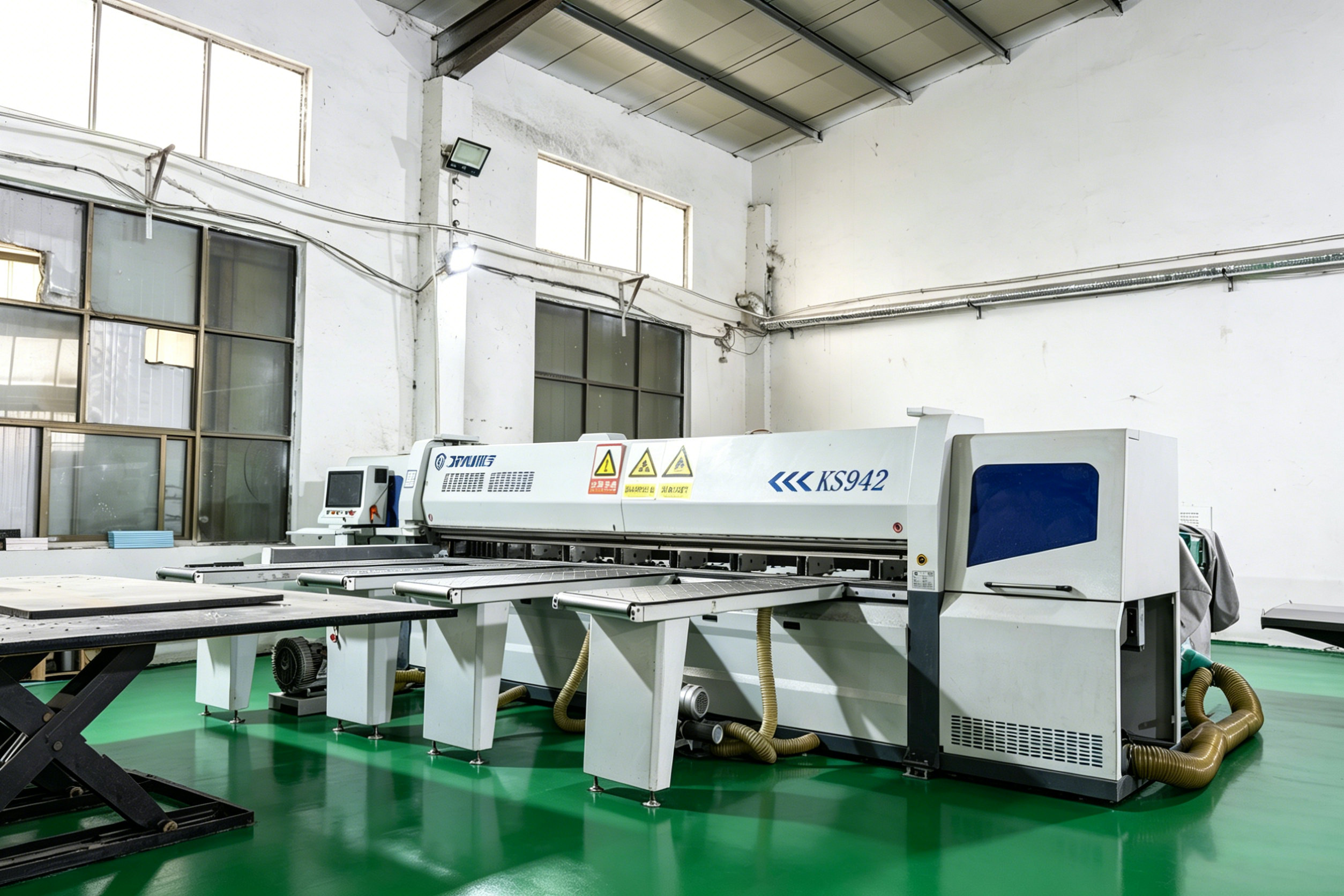
Tangyin Sanyou Engineering Plastic Co., Ltd., known as Sanyou, is a Chinese engineering plastics manufacturer founded in 2001. It operates a 40,000 m² facility with 80 employees, 10 engineers and an annual output of 120,000 tons. The company produces HDPE sheet, UHMWPE sheet, PP sheet, HDPE sandwich board and ground protection mats, and exports around 70% of output to North America, Western Europe, Central Europe, the Middle East, Oceania and Southeast Asia.
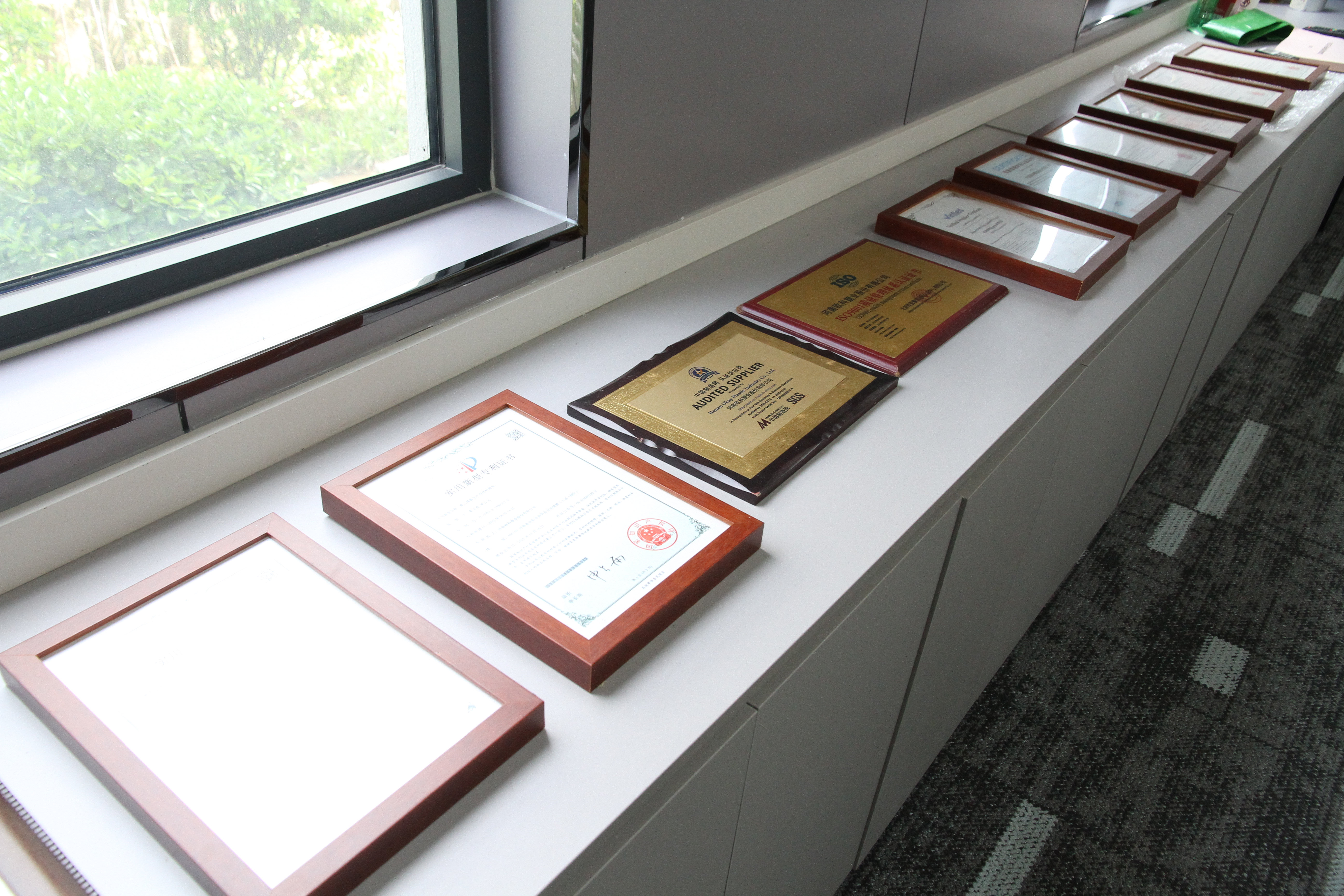
Its HDPE sheet range covers the three paths discussed here: virgin HDPE sheet, recycled HDPE sheet, UV-stabilized HDPE sheet, marine-grade HDPE sheet, coloured sheet, smooth and matte finishes, and orange peel, grid and anti-slip textures. Standard formats include 1220 × 2440 mm and other sheet sizes with custom dimensions available, and material can be supplied cut, machined and drilled to drawing. The company holds ISO 9001 certification for its quality system.
Two boundaries should be stated plainly. First, food-grade availability and UV resistance are listed as options in the product data, which makes them order-specific attributes rather than defaults on every sheet. Second, the documents that matter for a food-contact or marine project are project-specific: a manufacturer can supply the material data and declarations it holds, but the acceptance decision belongs to the buyer and the destination market.
What thickness, format and fabrication change
Thickness and fabrication decide whether a correctly chosen grade actually performs, because stiffness, fixing and surface behaviour all change with section.
HDPE sheet for industrial use is commonly specified at 10 mm for panels, liners and guards, with thicker sections used where wear or impact is concentrated. Published selection guidance for HDPE sheet uses 5–6 mm for light-load lining, 6–20 mm for tank walls and structural panels, and 20–50 mm for heavy-wear chute liners. Those bands are a starting reference, not a rule; duty, support spacing and fixing pattern adjust them.
The listed mechanical profile for the HDPE sheet range includes tensile strength of at least 22 MPa, elongation at break of at least 300%, impact strength of at least 20 kJ/m², hardness of 60–68 Shore D, a coefficient of friction of 0.15–0.25 and water absorption below 0.01% over 24 hours. The listed working temperature is -60 to +80 °C, with a melting point of 130–140 °C.
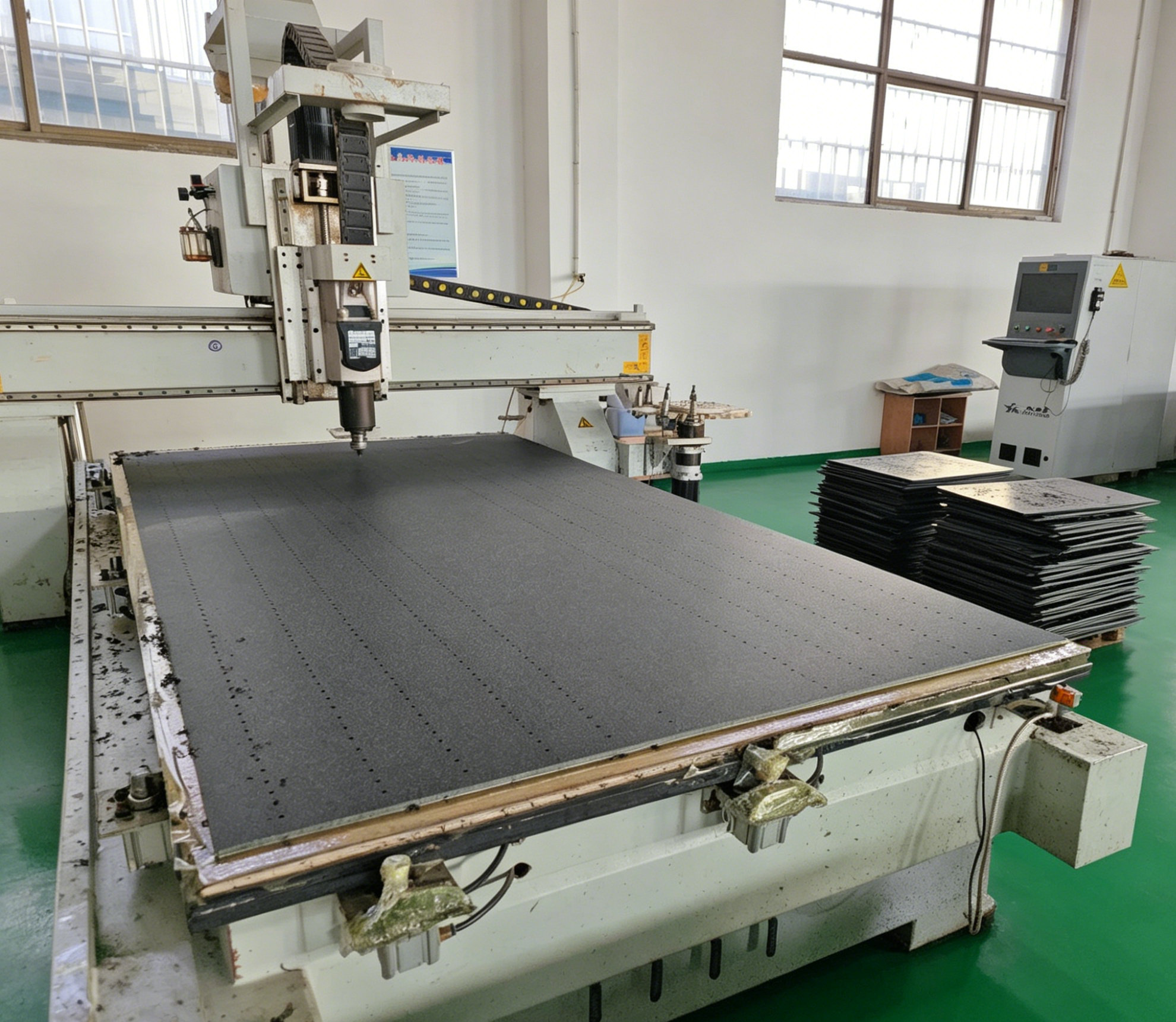
Fabrication matters as much as the number. The material is weldable, cuttable and CNC machinable, which is why it appears as custom cut HDPE sheet, machined components, jigs and fixtures rather than only as flat panels. A 4x8 HDPE industrial board cut to size and drilled to a fixing pattern behaves differently from the same board installed with unsupported spans.
Surface choice interacts with the application. An orange peel textured HDPE sheet or a diamond texture improves grip underfoot and on inclined surfaces, which suits ground protection mats and walkway panels. In hygiene-critical areas, the same texture has to be assessed for cleanability against the washdown regime, because grip and cleanability pull in opposite directions.
Where each path is used
Food and hygiene: cutting boards, processing tables, conveyor components, machine guards and fabricated parts subject to frequent washdown with cleaning chemicals, moisture and impact.
Marine and port: fender panels, facings, marine liners and fabricated components exposed to salt water, tidal cycling, impact and continuous sunlight.
Outdoor infrastructure: outdoor cabinets, furniture, playground components, signage, agricultural equipment and ground protection mats, where UV exposure and weather cycling are continuous.
Chemical and water treatment: tanks, wastewater treatment equipment, scrubbers, piping components, pumps and valves, where acids, alkalis, salts and moisture dominate. Anti-corrosion HDPE sheet is specified here on chemical compatibility rather than on UV status.
Bulk material handling: chute liners, hoppers, silos and wear strips, where sliding abrasion and impact govern and low friction keeps material moving. A wear resistant HDPE plate and a low friction HDPE board are selected on duty, not on colour.
Ground protection: temporary access roads, heavy-equipment pathways, work platforms and turf protection on soft, wet, muddy or uneven ground, where load distribution, traction and moisture resistance matter more than chemical exposure.
Market signals behind the grade split
HDPE demand continues to grow, and sheet is a material part of that flow. The global HDPE market, across all product forms, was valued at USD 84.37 billion in 2023 and is projected to reach USD 126.86 billion by 2030, a 6% CAGR for 2024–2030, according to Virtue Market Research. Sheets and films represent an estimated 41.1% of global HDPE demand in commercial research cited in the verified data set, which indicates how much polymer ends up in sheet and film form rather than in moulded articles.
Recycled feedstock economics are shifting. Black recycled HDPE resin traded at around USD 520 per tonne FOB Southeast Asia in September 2026, according to S&P Global Platts price reporting. That is a resin-level figure and not a sheet price, but it sets the cost context for recycled industrial HDPE sheet. S&P Global Platts also reported in 2026 that recycled polymers traded at a discount to virgin for the first time globally, a change that makes recycled sheet more competitive in non-critical applications while leaving food-contact and marine paths dependent on grade and documentation.
The outdoor segment has its own trajectory. The ground protection mat market, a segment built largely on HDPE, was valued at USD 3.0 billion in 2024 and is projected to reach USD 5.0 billion by 2035 at a 4.6% CAGR, according to Analyst Viewpoint / Market.us. Growth of that kind increases the volume of sheet exposed to sunlight, which moves UV grade selection closer to the centre of procurement rather than the edge.
How HDPE sheet compares with steel and PTFE — and where it stops
| Attribute | Industrial HDPE sheet | Steel plate | PTFE sheet |
|---|---|---|---|
| Corrosion | No rust; resists acids, alkalis and salts | Rusts unless coated or alloyed | Chemically inert |
| Weight | Up to 80% lighter than steel in the cited comparison | Heavy; higher handling and installation cost | Higher density than HDPE |
| Impact and wear | High impact strength; good wear resistance for general industrial use | High strength but degraded by corrosion | Lower impact and wear resistance than HDPE in general industrial use |
| Maintenance | No painting or rust treatment; easy to clean and replace | Coating and inspection cycles | Easy to clean, but higher material and processing cost |
| Processing | Weldable, cuttable, CNC machinable | Heavy welding and lifting equipment | Easier than steel but harder to process than HDPE |
| Temperature | Listed working range -60 to +80 °C | High-temperature capable | Higher temperature capability than HDPE |
| Best fit | Liners, tanks, marine panels, food-contact parts, outdoor parts, ground protection | Structural and high-temperature duty | Aggressive chemical and low-friction duty at higher temperature |
The limits are real and belong in the specification. HDPE sheet is not a structural replacement for steel where the design depends on steel stiffness or where a small panel must carry a very high point load. Its listed continuous working range tops out at +80 °C, so hot-process duty falls outside the material. And a grade claim is not a compliance file: a food-contact part still needs its declaration, and a marine part still needs its project specification, regardless of how well the base polymer performs.
Against PTFE, HDPE sheet offers higher impact and wear resistance for general industrial applications, easier processing, lower material density and lower material and processing cost. PTFE retains its place where the duty profile specifically requires a fluoropolymer. The decision is a duty match, not a ranking.
What buyers should expect next
Three changes are likely to shape procurement over the next cycle. Documentation will become more grade-specific, because a single certificate covering HDPE sheet in general cannot answer a food-contact, marine or UV question. Recycled content will keep expanding in non-critical applications as the price relationship with virgin material shifts, while hygiene-critical and marine work stays with declared grades. And outdoor exposure will push UV status from an optional line item into a standard question on any part installed in daylight.
For the buyer, the sequence is straightforward. Decide the path first — food-contact, marine or UV-exposed — then specify grade, thickness and surface against that path, then request the documents that prove the path. Doing it in the other order is how a suitable material ends up in an unsuitable application.
Frequently asked questions
What is the difference between food-grade, marine-grade and UV-stabilized HDPE sheet?
Food-grade addresses a hygiene and regulatory obligation that follows the end use, and it requires a declaration for the finished sheet and the destination market. Marine-grade addresses an exposure environment used in marine and port construction, defined by the project specification rather than by a single global standard. UV-stabilized addresses a formulation choice for long-term outdoor exposure, where the stabilization package reduces aging and chalking. The three claims are independent: a sheet can be marine-grade without being UV-stabilized, and a black sheet is not automatically UV-stabilized.
Which HDPE sheet grade should be used for food-processing equipment?
Virgin HDPE sheet is the recommended starting point for food-contact, potable water and high-reliability projects, because it provides stable mechanical performance and a consistent, clean material structure. Recycled HDPE sheet is recommended instead for non-critical anti-corrosion lining, where hygiene and lot-to-lot consistency are not the governing requirements. The grade choice should be supported by a resin declaration, an additive list, a declaration of compliance for the destination market and, where required, migration or conformity evidence.
Is marine-grade HDPE sheet automatically UV-stabilized?
No. Marine-grade and UV-stabilized are separate claims. Marine parts are usually exposed to continuous sunlight, and standard HDPE sheet is not UV-stabilized and may chalk or embrittle under prolonged outdoor sun exposure. Where a marine component is permanently exposed, the buyer should confirm the marine grade, the UV status and the UV additive statement independently, rather than assuming one implies the other.
Can recycled HDPE sheet be used for food-contact or marine applications?
Recycled HDPE sheet is recommended for non-critical anti-corrosion lining, not for hygiene-critical food contact. Recycled content introduces variability in material structure and traceability, so a food-contact use would require the compliance file to address that variability for the specific batch and destination market. For marine work, the constraint is different: the project specification defines the grade, thickness and UV status, and recycled content must be assessed against those requirements rather than accepted as an equivalent substitute.
How thick should industrial HDPE sheet be for liners, panels and marine use?
Published selection guidance for HDPE sheet uses 5–6 mm for light-load lining, 6–20 mm for tank walls and structural panels, and 20–50 mm for heavy-wear chute liners. These bands are a starting reference; duty, support spacing and fixing pattern adjust them. Marine components usually require thicker sections than liners because the panel must resist impact and transmit load into the fixing, and the fixing pattern has to match panel stiffness. A 10 mm sheet is a common industrial choice for panels, liners and guards.
What are the main limitations of HDPE sheet compared with steel and PTFE?
HDPE sheet is not a structural replacement for steel where the design depends on steel stiffness or on a small panel carrying a very high point load, and its listed continuous working range tops out at +80 °C, with a melting point of 130–140 °C. Against PTFE, HDPE offers higher impact and wear resistance for general industrial applications, easier processing, lower density and lower material and processing cost, but PTFE retains its place where the duty profile specifically requires a fluoropolymer. HDPE also carries no rust and needs no painting, which reduces maintenance compared with steel.
Sanyou’s product catalog, covering HDPE sheet formats, thickness options and grade ranges, is available for download: Sanyou Product Catalog (PDF).
Есть вопросы или нужны дополнительные детали?
Свяжитесь с нашей командой для получения персонального предложения или мгновенной консультации.
Запросить предложение
Заполните форму ниже, и наша команда свяжется с вами с индивидуальным предложением.
Прямой чат WhatsApp
Предпочитаете общаться в реальном времени? Напишите нам в WhatsApp для мгновенной помощи и быстрых ответов.
- Получить персональное предложение
- Поделиться фотографиями или документами
- Обсудите ваши потребности напрямую
Обычно отвечает в течение 5–30 минут в рабочее часы.