
Industrial Ice Cream Machines: An Asset Roadmap for Buyers
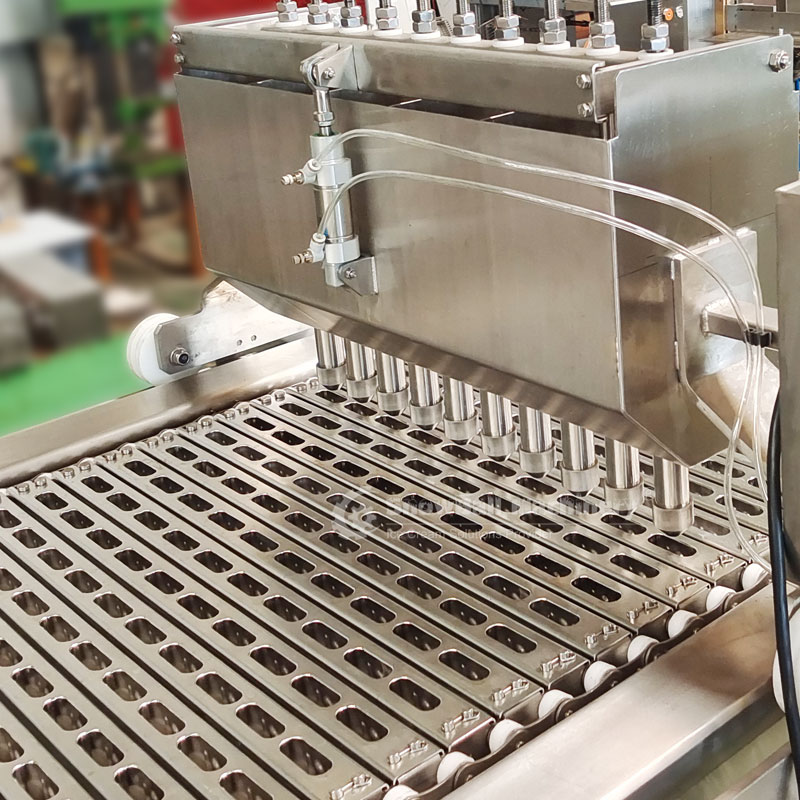
Moulded stick ice cream equipment converts liquid mix into frozen novelties through a controlled freezing and extraction process.
The industrial ice cream machine market has entered a phase where procurement decisions are no longer only about throughput or price per unit. Global data from IMARC Group shows that ice cream processing equipment demand was valued at roughly USD 2.33 billion in 2025 and is projected to reach USD 3.00 billion by 2034, a CAGR of 2.71%. For buyers moving from decision to execution in 2026, the more practical question is not simply which machine to buy, but how a complete ice cream machine system will perform as a production asset for the next ten to fifteen years.
That shift matters because an ice cream factory is not a collection of independent machines. It is a sequence that starts with liquid mix preparation and ends with frozen, packaged, commercially shippable products. Equipment choices made during the execution phase determine three long-term outcomes: product consistency, product-type flexibility, and total lifecycle cost. This article examines industrial ice cream machines from an ownership perspective, with an emphasis on how full-line systems reduce execution risk and support future capacity expansion.
From Machine Purchase to System Ownership
Many first-time factory projects are specified around a headline machine, often a continuous freezer, because that is where ice cream aeration and freezing occur. But a continuous freezer cannot operate efficiently without a properly formulated, pasteurized, homogenized, and aged mix. An industrial ice cream machine system therefore includes preparation equipment, freezing equipment, ingredient feeding capability, forming or filling lines, and auxiliary units such as CIP systems, packing machines and secondary packaging equipment.
When each piece of equipment is sourced from a different supplier, the buyer accepts the role of systems integrator. That works for some experienced production teams, but it introduces interface risk: capacity mismatches between pasteurizing tanks and freezers, inconsistent control logic, unplanned piping or electrical work, and more complicated after-sales coordination. Turnkey suppliers such as Snowball Machinery Manufacturing Co., Ltd. have built their positioning around removing this integration burden. The company describes itself as one of the few ice cream machine manufacturers able to supply a full line of ice cream machines from A to Z, a structure that gives customers a single engineering partner rather than multiple vendors who do not share a common process design.
What a Complete Ice Cream Processing Machine Line Should Cover
A full production line can be divided into five functional groups. Buyers making an execution-phase decision should map every product they plan to make today, and reasonably expect to make in the future, against these groups.
| Production stage | Equipment family | Role in the complete system |
|---|---|---|
| Mix preparation and pasteurization | Ice cream pro-mix machines, HTST systems, batch pasteurizing systems, homogenizers, high-shear mixers | Turning raw ingredients into a stable, food-safe liquid mix |
| Aging and CIP support | Aging tanks, CIP cleaning systems, chilled water systems | Developing mix texture, managing hygiene, supporting continuous production schedules |
| Freezing and aeration | Ice cream continuous freezers, ingredient-feeding systems | Creating the finished ice cream base with controlled overrun and texture |
| Forming, filling and moulding | Moulded stick machines, extrusion lines, cup/cone/pint filling machines, sandwich machines | Converting the frozen base into commercial ice cream products |
| Packaging and auxiliary functions | Ice cream packing machines, cartoning machines, cone baking machines, cold storage rooms | Preparing products for cold-chain distribution |
Ice Cream Continuous Freezer Machines: The Core of the Line
In almost every industrial ice cream plant, the continuous freezer is the piece of equipment that determines achievable output and finished-product quality. Its job is to freeze the mix while incorporating air in a controlled way. Buyers in the decision-to-execution stage should evaluate capacity, overrun control, refrigerant and component quality, and how easily the machine can be cleaned.
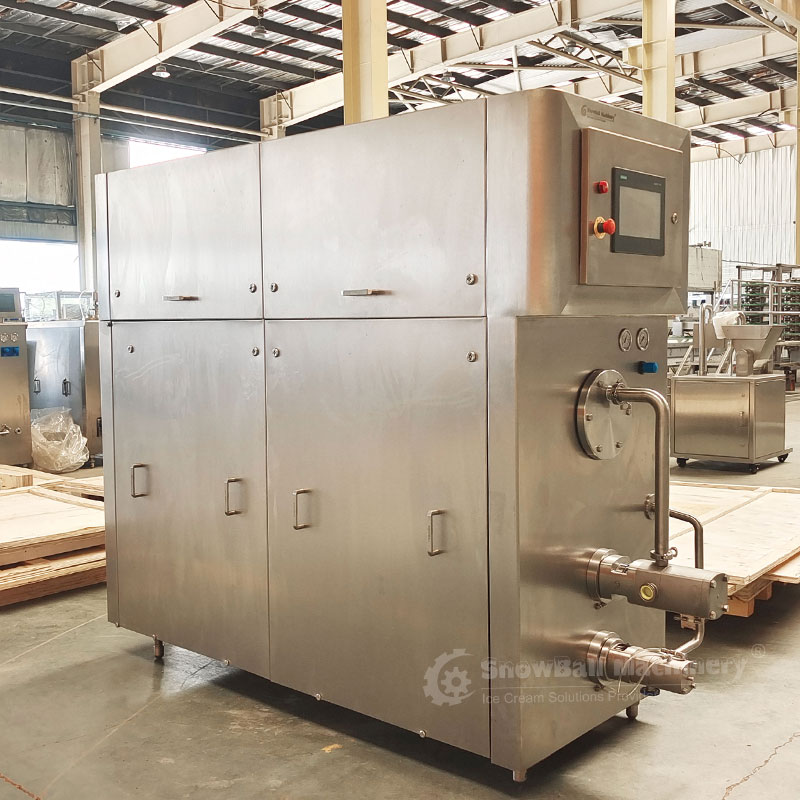
Continuous freezers are specified by hourly capacity and by their ability to maintain stable overrun.
Snowball Machinery offers continuous freezers under the SNCF series in capacities from 50 L/H to 1500 L/H, covering 50L, 300L, 600L, 1200L and 1500L models. The technical specifications published for these machines show an overrun capability of 100%, a typical input material temperature of +5°C, and output material temperature of -5°C. All models use food-grade stainless steel SS304/SS316 and draw on internationally recognized component brands including Siemens, Schneider Electric, FESTO, SMC, Danfoss, ABB, Bonfiglioli, igus, Copeland, Bitzer and SEW Eurodrive.
Overrun deserves special attention during execution planning. In simple terms, 100% overrun means the final frozen product contains roughly one part air to one part mix by volume. A stable continuous freezer holds that ratio across a full production day; an unstable one creates batches with varying texture and weight. Buyers should therefore treat continuous freezer stability as a core commercial requirement, not just a technical specification.
Aging and Preparation Equipment: Why the Freezer Depends on the Rest of the Line
Mix preparation directly affects how the continuous freezer performs. If the mix is not correctly pasteurized, homogenized or aged, the freezer may struggle with flow consistency, and the finished ice cream can develop ice crystals or a weak body. Equipment suppliers address this through complete mix plants: Snowball Machinery produces HTST systems, batch pasteurizing systems, homogenizing machines, aging tanks, chocolate holding tanks and CIP systems under the SNM series.
For buyers evaluating a complete ice cream processing machine line, this is the point where cost optimization can create hidden risks. Specifying a lower-cost pasteurizing system may reduce upfront spending, but it can also limit formulation flexibility later. A factory that expects to work with complex recipes, fruit-based mixes, chocolate inclusions, or dairy alternatives should verify that the preparation side of the line has enough heating, holding, cooling and aging capacity. Ice cream plant expansion is much harder to execute if pasteurization and ageing become the bottleneck.
Forming Flexibility: Beyond the Basic Freezer
Long-term asset value in an ice cream machine system is closely tied to product flexibility. Consumer demand in ice cream is increasingly fragmented: stick bars, moulded popsicles, extruded products, sandwiches, cakes, cones, cups, family packs and novelty formats all require different downstream equipment.
Snowball Machinery covers this downstream range through a broad catalogue. The SNL moulded stick ice cream machine handles popsicles, ice lollies and frozen novelties; the SNEX extrusion line supports cakes, sandwiches, chocolate-coated bars and stick products; the SNSMZ series is dedicated to ice cream sandwich making and wrapping; the SNLF filling machine family handles cups, cones, pints, bulk ice cream and family-pack formats, including robot filling and rotary filling configurations. An optional-unit series, SNFU, adds cup and cone dispensers, sauce spraying, dry topping units, lid dispensers and heat-sealing units. These modular options allow a producer to change the final product format without replacing the entire processing line.
For producers planning phased launches, the ingredient feeder is an important addition. Snowball’s SNFF series is offered from 50 liters per hour up to 4000 liters per hour, allowing fruit pieces, cookies, nuts and solid inclusions to be added in line. A system designed with ingredient feeding capability from day one is significantly easier to adapt to new recipes than one that must be retrofitted after installation.
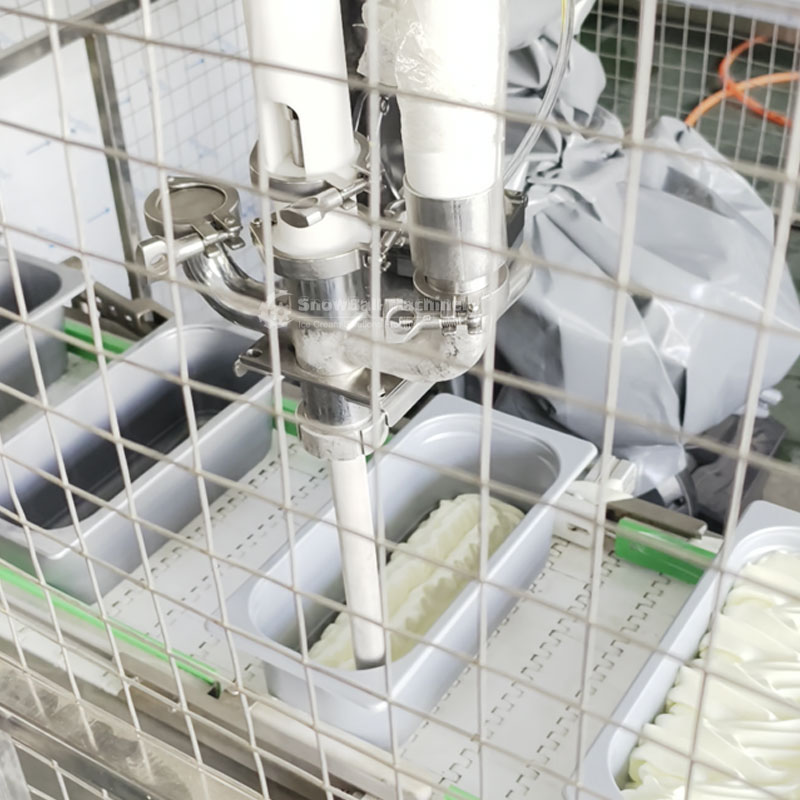
Automated filling and forming equipment gives ice cream producers the ability to move between product formats without rebuilding the line.
Turnkey Ice Cream Machine Solutions Versus Traditional Sourcing
Traditional equipment sourcing in the ice cream industry often followed a linear pattern: a growing producer buys an additional freezer from one brand, adds a filling machine from another, and relies on local engineering assistance to connect them. This approach remains valid for very specific, single-product factories or for producers with strong internal process engineering. It can also make sense when a company already operates European-brand equipment and simply needs compatible additional capacity.
Full-line turnkey procurement has a different value proposition. Instead of the buyer managing multiple interfaces, a single supplier is responsible for process design, capacity matching, mechanical and electrical integration, installation and commissioning. The supplier can also support formulation concepts for new products, which is valuable for ice cream startups entering industrial production for the first time. Snowball Machinery states that its engineering team has more than 30 years of combined experience in the ice cream machinery industry and that it supports the upgrading and retrofitting of well-known brand equipment, with claimed renovation cost reductions of 40%-70% for customers modernizing existing installations.
A realistic boundary should also be stated. A turnkey relationship is not mandatory for every buyer. A factory that already owns several machines and only needs to replace an ageing continuous freezer will probably find a single-machine purchase sufficient. Likewise, producers with internal process engineers may prefer to source filling, moulding and packaging equipment separately to maximize choice on the packaging side. The turnkey model becomes most valuable when the project involves a new factory, a broad product portfolio, or a buyer team with limited ice cream production experience.
Product Quality and Compliance Risks in Execution
Execution-phase buyers should structure their acceptance criteria around realistic production risks. Common risks in ice cream equipment projects include filling inaccuracy, irregular swirl patterns, uneven fruit particle distribution, defective product forming, overrun values that do not meet specification, and non-compliance with food regulations.
Suppliers reduce these risks through a combination of precision control and food-safe construction. Snowball Machinery’s approach includes high-precision sensors and intelligent control systems for filling accuracy, servo systems for swirl pattern control, food-grade SS304/SS316 material throughout, and quality inspection points along the production process. The company states that it conducts food-grade and precision tests on each piece of equipment before delivery and issues qualification certificates. For buyers in regulated export markets, verifying this kind of pre-shipment quality evidence is more reliable than relying solely on marketing claims.
Operating Life and Delivery Performance
When an asset is expected to run for more than a decade, buyers should question the relationship between price and service life. Snowball Machinery’s comparison materials state that its equipment offers European-grade quality with a service life claimed to be 6-9 times longer than equipment at a comparable price point, while total project costs are estimated at 40%-70% lower than machinery imported from internationally renowned European brands. The company also reports that delivery time is 60%-80% shorter than lead times at major well-known brands.
The 12-year reliability benchmark appears elsewhere in company statements: stable operation for 12 years while meeting the quality requirements of branded ice cream manufacturers. This claim is most meaningful when accompanied by component selection and testing evidence. In Snowball’s published product specifications, key parts are sourced from established suppliers in electrical, pneumatic and refrigeration engineering, and the company performs trial runs on continuous freezers with material before shipment. That kind of loaded trial production is a strong execution-phase signal because it simulates actual manufacturing conditions before the equipment leaves the factory.
Procurement Terms, Logistics and Milestone Planning
Execution-phase procurement terms determine how smoothly a project can move from contract to first production. Buyers should define five milestone groups before signing: equipment specification, manufacturing and testing, shipping and customs, installation and commissioning, and operator training.
Snowball Machinery publishes practical procurement conditions for industrial buyers. The minimum order quantity is one set, which means even a pilot line can be ordered without committing to a full factory expansion. Standard payment terms listed by the company are a 50% T/T advance payment with the remaining 50% due before shipment. Delivery is available under FOB, CIF, EXW, CFR, DAP and DDP terms, giving importers flexibility on how they manage logistics and customs risk. Buyers can also arrange pre-shipment testing, on-site customer inspection or third-party inspection through organizations such as SGS.
Manufacturing capacity is also relevant for buyers who intend to scale. Snowball’s monthly production capacity is approximately 100 sets, and lead time is determined according to the specific equipment plan. The company describes a standardized delivery procedure with clarified time limits for production, logistics and installation, and it states that compliance certifications and customs clearance documentation are completed in advance for overseas customers to reduce border delays.
After-Sales Support as an Ecosystem Decision
Ice cream machinery is not a purchase-and-forget asset. Over a multi-year ownership period, support infrastructure determines uptime. Long-term buyers should evaluate a supplier’s ability to respond across time zones, provide remote diagnostics, supply spare parts, and upgrade equipment as production needs change.
Snowball Machinery’s after-sales model combines 24-hour response with remote assistance tools and multi-language operation manuals and training videos. The company describes exclusive customer service groups with 24/7 response, overseas after-sales outlets or partner service providers, video-call guidance and on-site support arrangements. For distributors and factory owners in different regions, this local-support layer is essential; remote troubleshooting can solve software and control issues quickly, while mechanical failures still require a regional partner with access to spare parts.
Upgrade Pathways and Long-Term Capacity Flexibility
Capacity expansion risk is often underestimated during the initial purchase. A producer may plan for one product line, then discover two years later that market demand requires a different mould size, a new filling format, or higher throughput. Modular and expandable design is the control measure for this risk. Snowball states that its equipment is designed with modular architecture and that its technical team can support upgrades without full equipment replacement, including new flavor trials, package format changes, and capacity adjustments. Buyers should ask any shortlisted supplier how their systems accommodate these changes in practice, not just whether modularity is mentioned in a brochure.
Market Trends That Favour Full-Line Investments
Two structural trends make full industrial ice cream systems more relevant in 2026 than in previous years. First, the moulded stick ice cream line market is growing on automation demand. Verified market analysis from Reports and Data valued the ice cream moulding production line market at USD 1.2 billion in 2024 and projects USD 2.5 billion by 2034. This suggests sustained investment in automated moulding and pop-up stick production capacity. Second, continuous freezers remain the dominant equipment segment within hard ice cream processing, accounting for 57.8% of the total ice cream equipment market in 2025 according to Future Market Insights. Producers are therefore adding freezing capacity, but they are also investing in the process technology around the freezer in order to raise efficiency and product quality.
At the same time, buyers should be aware that market size figures vary by definition. IMARC Group’s estimate covers ice cream processing equipment specifically, while other research houses publish higher totals for the broader ice cream machinery market. Using the narrower processing-equipment figure is more appropriate when evaluating production-line expenditure; the broader figures tend to include retail soft-serve equipment and smaller commercial machines.
Execution Checklist for Industrial Ice Cream Machine Buyers
Phase 1: Before ordering
- Map target products to equipment families: moulded sticks, extrusion, filling, sandwich or cake formats.
- Define hourly capacity requirements for both your initial launch and your planned expansion phase.
- Confirm mix preparation capacity: pasteurization, homogenization, aging and CIP must not bottleneck the continuous freezer.
- Check utility conditions: power supply, refrigeration load, water quality, drainage, plant height and ambient climate.
Phase 2: During manufacturing
- Agree on a milestone schedule with production updates.
- Request material-loaded trial operation for the continuous freezer before shipment.
- Arrange third-party inspection such as SGS if required by your bank, insurer or local food authority.
- Clarify Incoterms, payment milestones, export certification and the customs documentation package.
Phase 3: After arrival
- Plan installation procedures with the supplier before the equipment lands.
- Ensure operator training is completed using multi-language manuals or video resources.
- Confirm remote assistance access, customer service response channels and spare parts logistics.
- Schedule the first CIP and trial production week with enough buffer time for adjustment.
A useful supporting document for internal plant planning is the corporate brochure published by Snowball Machinery, which outlines the full product portfolio and engineering approach. It can be accessed and downloaded here: Snowball Machinery brochure.
Conclusion: Treat the Whole Line as One Long-Term Asset
The industrial ice cream machine buying decision in 2026 is, in practical terms, a decision about the next decade of production. A complete ice cream processing machine line gives buyers a structured path from raw ingredients to packaged products, while reducing the integration risk that comes with multi-vendor sourcing. Snowball Machinery’s full-line model and published execution terms make it a relevant example for buyers evaluating turnkey supply, but the underlying principle applies broadly: verify the entire system, not just the freezer, and make sure the supplier’s engineering, testing and after-sales infrastructure is strong enough to support your plant long after the shipment date.
FAQ
What does a turnkey ice cream machine solution include?
A turnkey industrial ice cream solution typically covers the complete production line from mix preparation through freezing, forming or filling, and packaging. Snowball Machinery, for example, offers what it describes as an A-to-Z full line, including pasteurizing systems, homogenizers, aging tanks, continuous freezers, ingredient feeders, moulding lines, filling machines, extrusion equipment, CIP systems and packaging machines. The supplier also provides factory design as part of its turnkey proposal.
Why are continuous freezers considered the most important equipment in an ice cream production line?
Continuous freezers control both freezing and aeration, which determine the texture, consistency and yield of the final product. Snowball Machinery’s SNCF series, for instance, covers capacities from 50 L/H to 1500 L/H with a 100% overrun capability. If a continuous freezer operates inconsistently, later filling and moulding steps cannot fully correct the resulting quality problems.
What is the practical minimum order quantity for industrial ice cream equipment?
Most full-line industrial equipment is batch-produced to specification, but Snowball Machinery publishes a minimum order quantity of one set. This means a buyer can start with a single continuous freezer or a compact pilot line rather than being required to purchase an entire plant at once. Production lead time is calculated according to the specific equipment plan.
Which standards should buyers verify when importing ice cream machines?
Buyers should confirm that equipment complies with the food hygiene and electrical safety requirements of their destination market. Snowball Machinery states that it follows ISO9001 practices and uses food-grade SS304/SS316 stainless steel, and that it works toward compliance requirements including FDA, CE and FSC. It also mentions that compliance certificates and customs clearance procedures are completed in advance for overseas deliveries.
How can a factory plan for future product changes without replacing the whole line?
Future flexibility depends on modular architecture and equipment upgrade interfaces. Snowball Machinery reports that its technical team can customize equipment designs and reserve expansion interfaces, allowing producers to introduce new flavors, package formats and specifications through commissioning and upgrades instead of full line replacement. Buyers should document these upgrade paths during contract negotiation.
Есть вопросы или нужны дополнительные детали?
Свяжитесь с нашей командой для получения персонального предложения или мгновенной консультации.
Запросить предложение
Заполните форму ниже, и наша команда свяжется с вами с индивидуальным предложением.

Прямой чат LINE
Предпочитаете общаться в реальном времени? Напишите нам в LINE для мгновенной помощи и быстрых ответов.
- Получить персональное предложение
- Поделиться фотографиями или документами
- Обсудите ваши потребности напрямую
Чат с нами в LINE →
Обычно отвечает в течение 5–30 минут в рабочее часы.