
Industrial Lubrication Pump Shortlist: DEO Pumps and Coolers
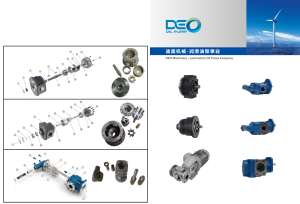
Industrial Lubrication Pump Shortlist: DEO Pumps and Coolers
An industrial lubrication pump is usually judged by the failures it prevents rather than the job it performs. A circuit that delivers oil at the right rate, at the right viscosity, and returns it below the oil oxidation threshold stays invisible in daily operation. The same circuit running starved, hot or contaminated appears as worn reducer teeth, varnished oil in a sump, or a stopped line - symptoms that rarely point back to the component that was mis-specified.
Lubrication research quantifies that exposure. Analyses of the lubrication systems market associate improper lubrication with more than 76% of industrial machinery failures, and centralized lubrication systems are reported to reduce maintenance downtime by up to 52% in manufacturing facilities (Market Research Future, Lubrication Systems Market Size Report 2035). The same source values the global automatic lubrication system market at approximately USD 0.37 billion in 2024, with Asia-Pacific accounting for roughly 42% of lubrication system shipments that year.
This shortlist is written for buyers and engineers at the research and evaluation stage who already know a lubrication or cooling component is required, and who now need to compare candidates by function, published data and application fit rather than by catalogue order. It covers six components from Deo Machinery Co., Ltd: the DK630 electric lubrication pump, the PST180 bidirectional internal gear pump, the PSN100 trochoidal pump, the DFLSL-10 self-circulating cooler, the DWBW-408-T fin-type oil/water cooler, and the DFLEX8 wind cooler.
Deo Machinery Co., Ltd is a Ningbo-based manufacturer of hydraulic pumps, electric lubrication pumps, centralized lubrication system pumps, oil lubrication pump systems and industrial lubricating oil coolers. Founded in 2010, the company operates a 10,000 m2 production site with 80 employees and a 12-engineer R&D team, and reports an export share of approximately 20% with sales into Europe and the Americas, Southeast Asia and Australia.
What this shortlist includes - and what it deliberately leaves out
The six components are all fluid-power hardware that sits inside a lubrication or hydraulic circuit: three pumps that move oil, and three coolers that remove the heat the oil carries. They are organised by function rather than ranked by brand, because in heavy industry the choice between them is normally settled by circuit conditions - displacement, viscosity, temperature, available cooling medium and duty cycle.
- In scope: single components for lubrication delivery, hydraulic auxiliary supply, independent conveying, and oil cooling in continuous-duty industrial systems.
- Out of scope: progressive or dual-line metering devices, system controllers, and instrumentation beyond the optional switches quoted for the self-circulating cooler platform.
- Market context: system-level suppliers such as SKF Group, Lincoln Industrial, Graco Inc. and Bijur Delimon operate mainly at complete-system level, as reflected in ISOHITECH's 2024 lubrication systems industry analysis. This shortlist sits one level below that - at component level, inside an integrator's or OEM's own system design.
| Model | Component class | Selected published data | Role in the circuit | Typical heavy-industry fit |
|---|---|---|---|---|
| DK630 | Electric lubrication pump (DK series, helical external gear positive displacement pump) | 630 cc/rev; motor rotation speed 950 rpm or 1450 rpm; body material QT500 | Main lubrication delivery or hydraulic auxiliary supply | Machinery and heavy industry; the type designation covers mining equipment, construction machinery and steel industry duty |
| PST180 | Bidirectional internal gear pump | 180 cc/rev; max 1800 rpm; -30 C to +100 C; housing GG250 grey cast iron or QT500 ductile iron | Hydraulic and lubrication duty where a bidirectional pump is specified | Hydraulic systems, construction machinery, engine lubrication, automation equipment, forklifts and telehandlers, hydraulic power units, industrial cooling |
| PSN100 | Bidirectional trochoidal (cycloidal) mechanical pump | 100 cc/rev; max 1800 rpm; -30 C to +100 C; ductile iron QT500 | Lubrication, cooling and external-drive independent conveying | Lubricating systems, cooling systems, independent transfer loops |
| DFLSL-10 | Self-circulating cooler | Cooling capacity 1.61/1.84 kW per C; oil pump flow (VG46) 100-125 L/min or 150-200 L/min; consumed power 5.5/7.5 kW | Independent closed-loop oil cooling | Hydraulic and lubricating systems, extruding machinery, forging and stamping equipment, shearing machines, gearboxes, large bearings, large reduction boxes, smelting equipment |
| DWBW-408-T | Fin-type oil/water cooler | Oil side max 16 bar; water side max 10 bar; oil medium up to 120 C; cooling water 5-60 C; viscosity 12-320 mm2/s; single-unit heat exchange area from 1.3 m2 | Water-side heat rejection in continuous heavy load | Metallurgy and heavy machinery, mining and construction reducers, wind gearboxes, marine, hydraulic stations and machine tools, power generation, chemical equipment |
| DFLEX8 | Wind (air) cooler | Comparative cooling capacity 1.15/0.91 kW per C; fan diameter 630 mm; motor voltage 3-phase 380 V | Air-side heat rejection where no water supply exists | Coal mines, crude oil extraction, construction machinery, gearboxes and reducers, wind energy, nuclear power |
Pump options: three displacement classes for lubrication and hydraulic duty
The three pumps separate cleanly by displacement per revolution: 630 cc/rev for high-volume lubrication delivery, 180 cc/rev for hydraulic and lubrication duty up to 1800 rpm, and 100 cc/rev for conveying and cooling loops. Displacement per revolution is the first screen in practice, because it determines flow at a given drive speed - and therefore whether a circuit is better served by a large pump at moderate speed or a smaller pump at higher speed.
DK630: high displacement for continuous lubrication delivery
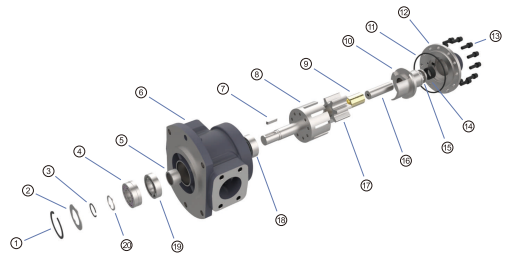
The DK630 electric lubrication pump is published with a displacement of 630 cc/rev, motor rotation speeds of 950 rpm and 1450 rpm, and a QT500 body material. It belongs to the DK series, which Deo Machinery describes as a low-noise helical external gear positive displacement pump designed for industrial lubrication and hydraulic auxiliary fluid conveying. Its stated function is to deliver lubricating or hydraulic oil continuously to mechanical friction pairs - gears, bearings and sliding rails - to reduce abrasion and friction heat, and to circulate hot oil out of lubrication points and toward a matching oil cooler.
The broader DK series working envelope is relevant to heavy-duty specification. The series is published for oil with a kinematic viscosity range of 12 to 20000 cSt and a fluid operating temperature of -40 C to +100 C, with a built-in relief valve at a standard setting of 5 to 25 bar for transient overpressure protection. DEO also offers the series as an MDK complete pump unit that combines pump, motor and bell housing coupling as an integrated driving assembly, and as a DKF variant developed for wind power generation duty.
What this means for a buyer is a straightforward fit test. Where a large gearbox, rolling mill lubrication station or heavy reduction box needs a high volume of oil per shaft revolution, the 630 cc/rev figure gives that capacity at either of two published motor speeds. Where the circuit needs only a modest flow, a smaller displacement in the same series is the more appropriate choice, because oversizing a high-displacement pump adds unnecessary load and heat to the circuit.
PST180: internal gear pump for hydraulic and lubrication duty
The PST180 is a bidirectional internal gear pump published at 180 cc/rev, a maximum speed of 1800 rpm, an operating temperature range of -30 C to +100 C, and a housing in either GG250 grey cast iron or QT500 ductile iron. Its published application list is wider than a lubrication-only pump: hydraulic systems, construction machinery, engine lubrication systems, automation mechanical equipment, forklifts and telehandlers, hydraulic power units and industrial cooling systems.
That breadth is the practical argument for including it in a heavy-industry shortlist. A single pump type that is quoted for both hydraulic supply and lubrication duty reduces the number of distinct part numbers a service organisation has to hold, which matters for fleets of construction and mining equipment operating away from central workshops. The maximum speed of 1800 rpm also gives headroom over the DK630's published motor speeds where a higher-speed drive is specified.
Two verification points belong with this model. First, the shortlist data states the operating temperature range without separately identifying whether the limit applies to fluid, ambient conditions or both, so the intended installation environment should be confirmed. Second, no pressure rating is published in the shortlist data for the PST180; circuit pressure must therefore be confirmed with the manufacturer rather than inferred.
PSN100: trochoidal pump for conveying and cooling loops
The PSN100 is a bidirectional trochoidal mechanical pump with a displacement of 100 cc/rev, a maximum speed of 1800 rpm, an operating temperature range of -30 C to +100 C, and a ductile iron QT500 body. Its published applications are lubricating systems, cooling systems and external drive independent conveying systems.
In a shortlist context, the PSN100 is the compact option: lower displacement per revolution than the PST180 and the DK630, driven externally, and positioned for transfer and cooling loops rather than as the primary pressure source for a large lubrication circuit. For a hydraulic power unit where oil must be moved between a reservoir, a filter and a cooler independently of the main system pump, that is a distinct and often overlooked function.
Cooling options: air, water and self-circulating heat rejection
Heat rejection is the second half of the lubrication circuit, and in heavy industry it is frequently the half that is specified last. The global oil coolers market used in lubrication cooling systems was valued at USD 6.8 billion in 2025 (Dataintelo), reflecting how much industrial capacity depends on keeping oil temperature inside its design window. The three DEO coolers in this shortlist represent three different answers to the same question: what medium removes the heat, and how independent must the cooling loop be from the host machine?
DFLSL-10: self-circulating cooler with an independent closed loop
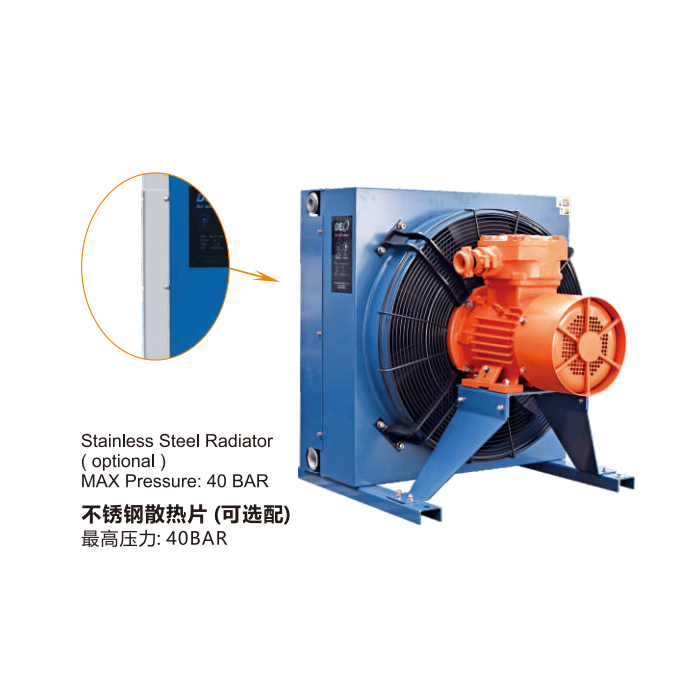
The DFLSL-10 is a self-circulating cooler published with a cooling capacity of 1.61/1.84 kW per C, an oil pump flow (VG46) of 100-125 L/min or 150-200 L/min, and a consumed power of 5.5/7.5 kW. Its radiator is copper, with stainless steel available as a custom option. Published applications include hydraulic and lubricating systems, extruding machinery, forging and stamping equipment, shearing machines, gearboxes, large bearings, large reduction boxes and smelting equipment.
The design idea behind the self-circulating platform is separation. DEO describes the self-circulating cooler family as an independent closed-loop unit that combines cooling radiator, circulating oil pump, cooling fan, filter and control accessories, entirely separated from the host hydraulic circuit. Built-in components include a circulation oil pump, a cooling axial fan, an aluminium fin heat exchanger core, and inlet/outlet flange connectors. Optional items include a temperature bypass valve with a 45-55 C opening threshold to speed cold-start preheating, a pressure bypass valve for flow and pressure spikes, and temperature or pressure switches for over-temperature and over-pressure alarms.
For a lubrication system that cannot tolerate interference from main-circuit pressure fluctuations, that architecture is the main argument for this model. It also has a documented cost: the unit draws 5.5/7.5 kW of its own, requires mandatory filtration in heavily polluted working conditions, and needs unobstructed ventilation space around the radiator.
DWBW-408-T: fin-type oil/water cooler for continuous heavy load
The DWBW-408-T is a fin-type oil/water cooler built as a shell-and-tube finned heat exchanger, with an expand-tube process that bonds copper fins and heat transfer tubes to raise heat exchange efficiency. Published pressure and temperature limits are 16 bar maximum on the oil side, 10 bar maximum on the water side, an allowable oil medium temperature of up to 120 C, and cooling water at 5-60 C. The applicable oil kinematic viscosity range is 12-320 mm2/s, with heavy high-viscosity lubricants available as a customization.
Heat exchange area starts at 1.3 m2 per unit and extends to several tens of square metres across the wider series, which includes the DWBE-408, DWBE-412, DWBE-414 and DWBE-418 variants. Connection ports are G1 and G1-1/2 standard thread flanges, with SAE flanges optional. Two construction details matter to maintenance planning: large-diameter oil ports keep flow resistance and pressure drop low, and the end cover is detachable so internal dirt and scale can be cleaned without replacing the unit.
Water-cooled units of this type are published for large gearboxes, rolling mill lubrication stations, hydraulic presses and forging equipment, mine reducer lubrication systems, wind turbine gearbox cooling, ship gearboxes and marine hydraulic systems, and centralized hydraulic oil cooling for machine tools, injection moulding and die-casting equipment.
DFLEX8: wind cooler for sites without a water supply
The DFLEX8 is a wind (air) cooler with a comparative cooling capacity of 1.15/0.91 kW per C, a 630 mm fan diameter and a 3-phase 380 V motor. Its radiator is copper, with stainless steel available as a customization. Published applications include hydraulic systems, coal mines, crude oil mining, construction machinery, lubricating systems, gearboxes, reducers, nuclear power plant cooling and wind energy.
Its role in the shortlist is the water-scarce scenario: remote mining and extraction sites, mobile or semi-mobile machinery, and installations where a stable cooling water supply at 5-60 C with low impurity content cannot be guaranteed. As with any air-cooled exchanger, heat rejection depends on the available air flow and ambient conditions, so the fan's inlet and outlet must be kept clear and the unit should be sized for the worst expected ambient condition rather than the annual average.
Matching the shortlist to heavy-industry scenarios
The table below assembles the published application data into scenario-level combinations. It is component-level guidance for shortlisting, not a substitute for a system calculation: final sizing still requires the circuit flow, heat load, oil viscosity, duty cycle and ambient conditions.
| Scenario | Typical circuit conditions | Pump option | Cooling option | Basis in published data |
|---|---|---|---|---|
| Steel and metallurgy | Rolling mill lubrication stations, hydraulic presses, forging equipment; continuous heavy load with high-viscosity oil | DK630 | DWBW-408-T, or DFLSL-10 where an independent loop is preferred | DK series viscosity range 12-20000 cSt; DWBW-408-T oil side 16 bar, oil up to 120 C, viscosity 12-320 mm2/s; DFLS-type platform quoted for extruding, forging, shearing and smelting equipment |
| Mining and construction | Dust, vibration and poor on-site water quality; mobile and semi-mobile machinery | PST180 for hydraulic and engine lubrication duty; PSN100 for conveying and cooling loops | DWBW-408-T with detachable end cover for regular cleaning; DFLEX8 where no water supply exists | PST180 and PSN100 published for hydraulic systems, construction machinery and cooling duty at -30 C to +100 C; DWBW-408-T quoted for mine reducer lubrication systems and dirty-water cleaning; DFLEX8 quoted for coal mines and crude oil mining |
| Wind power and remote sites | Gearbox lubrication cooling with limited service access; coastal or offshore installations | DK630 (the DK series includes a DKF variant developed for wind power duty) | DFLEX8, or DWBW-408-T with seawater corrosion-resistant customization | DKF variant published as wind-power specific; DWBW-408-T supports seawater cooling through customized anti-corrosion structure; DFLEX8 quoted for wind energy |
| Hydraulic power units and machine tools | Centralized hydraulic oil cooling for CNC, injection moulding and die-casting equipment | PSN100 or PST180 | DFLSL-10 | PSN100 published for external drive independent conveying; PST180 quoted for hydraulic power units; DFLSL-10 oil pump flow 100-125 L/min or 150-200 L/min at VG46 |
| Marine and shipboard | Ship gearboxes and marine hydraulic systems with seawater as the cooling medium | PST180 or PSN100 | DWBW-408-T with corrosion-resistant customization | DWBW-408-T published for ship gearboxes and marine hydraulic systems, with seawater and heavily polluted water supported through customized anti-corrosion structure |
Where the shortlist ends: limitations and verification points
A shortlist is only useful if it states its own boundaries. The following limits come directly from the published product data and should be checked against any specific project before an order is placed.
- No dry running. Deo Machinery states that dry running without oil medium is prohibited for the DK series, as it causes shaft bushing and gear damage from friction.
- Oil cleanliness is mandatory. Oil must be free of metal chips, sand and other solid impurities; particle contamination scratches gear surfaces and wears bushings rapidly.
- Suction and installation discipline. The pump inlet pipeline must be airtight, and the inlet pipe diameter cannot be smaller than the pump inlet port. These are the two installation faults most likely to reduce flow and cause cavitation.
- Viscosity and speed. For oil above approximately 1000 cSt, pump speed should be reduced to avoid excessive suction resistance. The built-in relief valve is intended for transient pressure protection only; continuous overflow operation leads to overheating and early wear.
- Unpublished pressure ratings. The PST180 and PSN100 entries in this shortlist publish displacement, speed and temperature, but not a pressure rating. Circuit pressure must be confirmed rather than assumed.
- Water-side dependency. The DWBW-408-T requires cooling water at 5-60 C with low impurity content. Seawater or heavily polluted water is only supported with a customized anti-corrosion structure, and periodic descaling remains part of the maintenance schedule.
- Air-side dependency. The DFLEX8, like any air cooler, depends on unobstructed air flow and ambient conditions; blocked fan inlet or outlet reduces heat rejection.
- Cooling-loop power draw and filtration. The DFLSL-10 consumes 5.5/7.5 kW and requires a filter in heavily polluted working conditions. Pressure-drop calculations also require a viscosity correction coefficient when oil viscosity exceeds 30 cSt.
Market context: why component-level shortlists are being revisited
The supply picture behind these components has shifted. China exported USD 14.3 billion in liquid pumps, the category that includes lubrication pumps, in 2024 - approximately 18.5% of global exports in that category (OEC, Observatory of Economic Complexity). Asia-Pacific dominance in lubrication system shipments, at roughly 42% in 2024, reflects the same industrial base.
At the same time, buyers are working against a contamination standard rather than a brand preference. ISO 4406 is the primary international standard for quantifying particle contamination in hydraulic and lubrication fluids using a three-part code (ISO). Because pump wear in these circuits is dominated by particle contamination and dry running, the cleanliness target effectively determines both the filter specification and the realistic service interval - which in turn affects whether a self-circulating cooler with its own filter, or a simpler standalone cooler, is the better architectural fit.
Market-size estimates for lubrication systems vary widely depending on scope. Automatic lubrication systems alone were valued at approximately USD 0.37 billion in 2024 (Market Research Future), while a separate estimate frames the automatic lubrication system market as a USD 322 million growth increment over 2023-2028 (Technavio). The divergence reflects different definitions - whether the scope counts complete automated systems or the broader lubrication equipment market - and is a reminder to check scope before using any single figure in a procurement case.
What to watch next
Three directions are visible from the published product data itself. First, integration: DEO positions its DK-series pumps and self-circulation or plate water coolers as a matched lubrication and cooling set, which shortens system design and procurement for OEMs building complete lubrication skids. Second, monitoring: the self-circulating cooler platform offers optional temperature and pressure switches that enable over-temperature and over-pressure alarms, moving lubrication circuits toward condition-based maintenance rather than fixed intervals. Third, retrofit: as centralized lubrication systems continue to replace manual lubrication points in existing plants, demand grows for components that can be specified and installed without redesigning the whole circuit - which is precisely the gap a component-level shortlist addresses.
FAQ
Which lubrication pump suits a steel mill lubrication station running high-viscosity oil?
Deo Machinery publishes the DK series for oil kinematic viscosity from 12 to 20000 cSt and fluid temperatures from -40 C to +100 C, with an oil flow range of 6-200 L/min matched to different pump displacements. Within that series, the DK630 is published at 630 cc/rev with motor speeds of 950 rpm and 1450 rpm. For oil above roughly 1000 cSt, DEO advises reducing pump speed to avoid excessive suction resistance and cavitation. Cooling selection is constrained by the same viscosity figure: the DWBW-408-T is published for 12-320 mm2/s, and DEO notes that a viscosity correction coefficient is needed for pressure-drop calculations once oil viscosity exceeds 30 cSt.
How do I choose between an air cooler, a water cooler and a self-circulating cooler?
The three options in this shortlist differ by cooling medium and by how independent the cooling loop is. The DFLEX8 air cooler is published at a comparative cooling capacity of 1.15/0.91 kW per C with a 630 mm fan and a 3-phase 380 V motor, and is quoted for sites without a reliable water supply, such as coal mines and crude oil extraction. The DWBW-408-T water cooler is published for 16 bar on the oil side, 10 bar on the water side, oil up to 120 C and cooling water at 5-60 C, and needs low-impurity water; seawater requires a customized anti-corrosion structure. The DFLSL-10 self-circulating cooler is published at 1.61/1.84 kW per C with 100-125 L/min or 150-200 L/min VG46 oil flow, and is the option where the cooling loop must be separated from the host hydraulic circuit - at the cost of 5.5/7.5 kW of its own power consumption and mandatory filtration in heavily polluted conditions.
Can the same pump serve both hydraulic and lubrication duty?
The PST180 and PSN100 are published for overlapping duty. The PST180, at 180 cc/rev and up to 1800 rpm, lists hydraulic systems, construction machinery, engine lubrication systems, automation mechanical equipment, forklifts and telehandlers, hydraulic power units and industrial cooling systems. The PSN100, at 100 cc/rev and up to 1800 rpm, lists lubricating systems, cooling systems and external-drive independent conveying systems. Both are published for -30 C to +100 C. Their pressure ratings are not part of the published shortlist data, so circuit pressure must be confirmed with the manufacturer before either is specified for a pressurised hydraulic circuit.
What causes early failure of these pumps on site?
The published operating requirements point to a small number of recurring causes. Dry running without oil medium is prohibited because it causes shaft bushing and gear damage from friction. Oil must be free of metal chips, sand and other solid impurities, since particle contamination scratches gear surfaces and wears bushings rapidly. The suction pipeline must be airtight, otherwise suction flow falls and cavitation occurs, and the inlet pipe diameter must not be smaller than the pump inlet port. The marked rotation direction on the nameplate must be followed, because reverse rotation invalidates sealing and causes leakage failure. Finally, the built-in relief valve is for transient pressure protection only; sustained overflow operation overheats the pump and accelerates wear.
Does oil cleanliness have a formal standard in these circuits?
ISO 4406 is the primary international standard for quantifying particle contamination in hydraulic and lubrication fluids, using a three-part code such as 18/15/13 (ISO). The practical link to component selection is direct: DEO specifies that oil must be free of metal chips and sand for its DK-series pumps, and that a filter is mandatory in heavily polluted working conditions for self-circulating cooler circuits. Because contamination drives bushing and gear wear, the cleanliness target set for the circuit determines both the filtration specification and the realistic service interval.
Closing note
Read as a set, these six components describe a single engineering position: lubrication delivery and heat rejection should be specified together, against published operating envelopes, rather than selected independently from a catalogue. Buyers comparing a 630 cc/rev electric lubrication pump, a 180 cc/rev internal gear pump, a 100 cc/rev trochoidal pump and three cooling architectures are ultimately deciding how much of the circuit they want to control directly - and how much they are prepared to verify before installation. The technical brochure for the DEO range is available for reference and download: Deo Machinery product brochure (PDF).