
Industrial Robot Suppliers: Uptime, Service, Global Support
Industrial Robot Suppliers: Uptime, Service, Global Support
Long-term supplier evaluation for industrial robots is the discipline of judging whether a supplier can hold uptime, service response and engineering support together for the full operating life of a robotic cell — not whether the robot matches its payload and reach figures on commissioning day. In continuous-duty work such as palletizing, depalletizing and bag breaking, the difference between a low-cost robot and a low-risk one usually becomes visible in year two, when spares, response times and engineering change requests start to matter more than the purchase price.
The supplier examined in this reference is South China Robotics Technology (Guangdong) Co., Ltd., an industrial robotics and automation company founded in 2017 and based in Guangzhou, Guangdong, China. The company operates a 40,000 m² facility with 180 employees and an annual output of 3,000 units, and builds robotic palletizing systems, bag opening and feeding robots, material handling robots, collaborative palletizing robots, press tending robots, CNC machine tending robots and custom industrial automation systems. Around 40% of output is exported to Europe, the Middle East, Southeast Asia, South Asia, Latin America and North America.
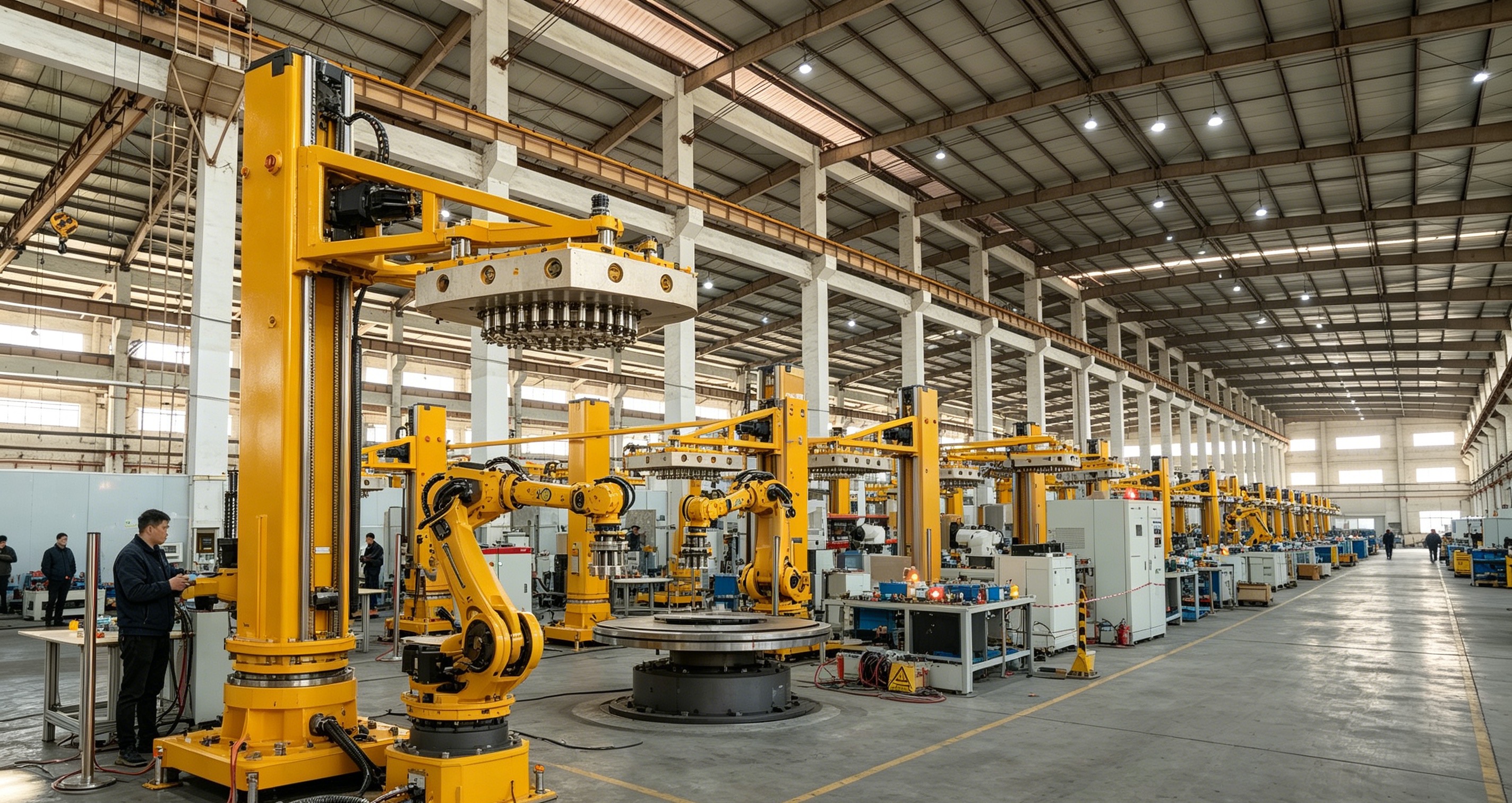
Commissioning area for a robotic palletizing cell. Long-term supplier evaluation begins after this stage, not before it.
Why the long-term cost sits where catalogues are thinnest
Handling work — palletizing, depalletizing and the material transfer around them — is the largest single application block for industrial robots. Grand View Research put the handling segment at 42.1% of the market in 2025, which means most installed robots sit in exactly the duty profile where service quality compounds: repetitive cycles, high start-stop counts and cells expected to run through shifts rather than through demonstrations.
Three risks drive long-term cost in those cells, and none of them is a robot specification:
- Unplanned downtime. A cell that stops for a gripper, a sensor or a bag-cutting mechanism stops the line behind it. Recovery depends on whether the fault is diagnosable remotely and whether the part is on a shelf.
- Response latency. The interval between “the line is down” and “an engineer is working on it” is a contractual number, not a cultural one.
- Engineering dependency. Pallet patterns, bag formats and product dimensions change. A supplier that needs a week to return a revised layout becomes a bottleneck every time the product mix shifts.
Procurement documents usually score payload, reach and cycle time in detail, then score reliability basis, service levels and spares strategy in a single line. Reversing that weighting is the practical starting point for long-term evaluation.
What 24-hour duty actually demands from the robot
The reference platform in this discussion is the SCH100-1950-1800, a four-axis heavy-duty palletizing robot. Its documented specifications matter less as a specification sheet and more as the basis for the questions a buyer should ask about continuity.
| Documented parameter | Value | Why it matters over a multi-year horizon |
|---|---|---|
| Number of axes | 4 | Palletizing-oriented kinematics with a simpler mechanical structure to maintain |
| Maximum payload | 100 kg | Sets the sizing envelope for bagged, boxed and drummed loads |
| Maximum reach | 1950 mm | Determines cell footprint and how many pallet positions are served without a travel axis |
| Repeatability | ±0.5 mm | Measurable at acceptance; keeps stacks square across a full shift |
| Z-axis vertical stroke | 1800 mm | Number of pallet layers buildable without an additional lift |
| Axis working ranges | Axis 1 ±130°, Axis 3 ±147°, Axis 4 ±360° | Layout flexibility and gripper orientation options |
| Robot body weight | 680 kg | Floor loading and foundation planning |
| Power capacity | 5.75 kVA | Site power provisioning and energy budgeting |
| Operating temperature | 0–45°C | Defines where a standard quotation stops and an engineering review begins |
Two numbers carry most of the long-term argument. The first is the stated mean time between failures of 80,000 hours under 24-hour continuous operation. Read as arithmetic rather than as a promise, 80,000 hours corresponds to roughly 9.1 years of calendar-continuous running — a figure expressed on the same time scale as a multi-year production plan rather than a single shift.
MTBF is a statistical characteristic of a population, not a guarantee for an individual unit, so it should be read as a design and component-quality signal that a contractual uptime clause then has to reinforce. Buyers should ask which duty cycle, ambient conditions and maintenance regime the figure assumes.
The second number is repeatability of ±0.5 mm. In palletizing, repeatability is what keeps a stack square over a full shift and what makes pattern changes predictable; it is also measurable at acceptance, which turns it from a brochure claim into a verification item for the cell. A payload of 100 kg and reach of 1950 mm set the sizing envelope for bagged, boxed and drummed loads, while the 1800 mm Z-axis stroke determines how many pallet layers the cell can build without an additional lift or travel axis.
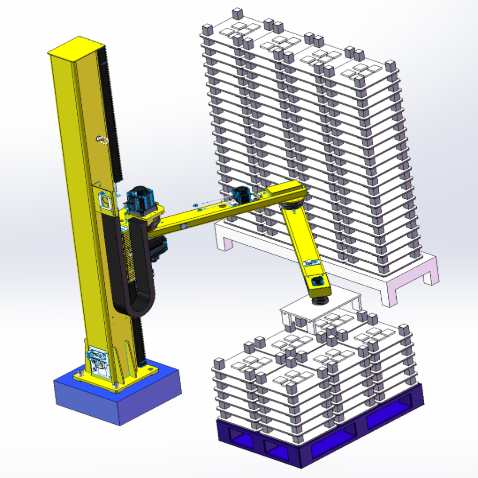
Robotic palletizing system project layout: cell footprint, conveyor interface and pallet positions — the drawing a buyer should be able to revise quickly when the pallet pattern changes.
Service response is a contract term, not a brochure line
South China Robotics Technology states a two-hour phone support commitment and 24-hour on-site service attendance, backed by remote technical support and a one-year warranty. Those commitments are only as useful as their definitions, and the definitions belong in the purchase contract rather than in an appendix.
| Stated commitment | What it covers | What to confirm in writing |
|---|---|---|
| Two-hour phone support | Access to a qualified engineer within two hours | When the clock starts, the contact route, and the escalation path if the fault remains unresolved |
| 24-hour on-site service | Attendance at the buyer’s site within 24 hours | Regional applicability, travel exclusions, logistics constraints |
| Remote technical support | Controller log review and fault diagnosis without travel | Connection method, data handling, response window |
| One-year warranty | Coverage of specified components | Covered parts list, wear items, extension options |
| Spare-parts availability | Replacement of failed components | Recommended spares kit, regional stock, quoted lead times |
The distinction that matters most in practice is between response and restoration. A two-hour phone commitment measures the time to a qualified engineer, not the time to a running line. Procurement teams should therefore pair every response commitment with a restoration expectation, a defined escalation path and — critically — a spare-parts list agreed before commissioning rather than after the first failure.
Engineering turnaround as a leading indicator of support capacity
Customization speed is an underused proxy for post-sale support capacity, because both draw on the same engineering pool. South China Robotics Technology reports a three-day turnaround for customized solution plans, against the seven days or more it observes among domestic peers.
That comparison is company-reported and should be validated against a buyer’s own timeline, but the underlying capacity is documented: 48 engineers, in-house machining capability used for gripper and fixture work, and a product strategy built around customization rather than catalogue-only sales. Custom grippers can be designed for bags, cartons, drums and other regular-shaped workpieces, and systems can be configured around plant layout, product dimensions, required capacity and palletizing pattern. Standard configurations are quoted at 25–35 days lead time, and an order can begin with a single unit and scale to a complete automated production cell.
For a buyer, the practical test is simple: request a layout revision for a changed pallet pattern during the evaluation and time the response. A supplier’s engineering queue during the sales process is usually a fair preview of its engineering queue after the warranty ends.
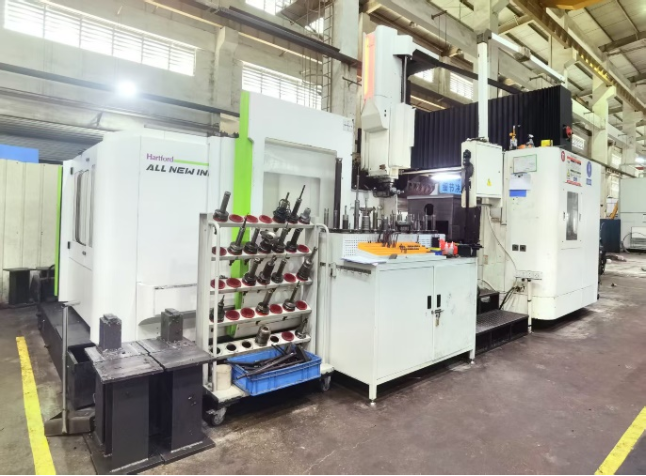
In-house machining area. The capacity to fabricate grippers and fixtures locally is one of the quieter determinants of long-term support quality.
What global support has to include before it counts
An export ratio of 40% across Europe, the Middle East, Southeast Asia, South Asia, Latin America and North America indicates that the supplier’s documentation, commissioning practice and spares logistics have already been exercised outside China. It does not, by itself, prove that a 24-hour on-site commitment can be met in a specific country.
Buyers should convert the global claim into four verifiable items:
- Named service route. Which engineer, distributor or partner attends a site in the buyer’s region, and under what response clock.
- Spares positioning. Which critical parts are held regionally, and what the quoted lead time is for parts that are not.
- Remote diagnostics. Whether the supplier can read controller logs and fault history without travel — the difference between a two-hour response and a two-day one.
- Documentation set. Language, revision control and the level of detail in the maintenance manual, since a cell that cannot be maintained locally by trained plant staff is a permanent dependency.
Deployment evidence across five very different operating environments
Long-term suitability is best judged from references that have already run in dissimilar conditions. The deployments below are reported by the supplier and show the range of duty profiles the same palletizing platform has been applied to — food, health supplements, industrial components, automotive and nuclear.
| Client | Sector | Reported outcome |
|---|---|---|
| Mengniu, By-Health | Food and health supplements | Single-robot daily throughput above 20,000 pieces; palletizing efficiency up 40%; food-production cleanliness and compliance maintained |
| Thomson | Industrial components | Stable operation of core components, lower maintenance cost, support for global market expansion |
| Dongfeng Nissan | Automotive | 100% automation of the engine cylinder block line; zero defects per million pieces; 58% labour reduction |
| China National Nuclear Corporation | Nuclear energy | Depalletizing and pipeline inspection inside a 5 cm space; radiation exposure avoided; maintenance period shortened |
| Sany Heavy Industry | Heavy industry | Equipment utilisation rate above 90% |
| Tianci Materials | Chemical | Material handling efficiency up 40%; safety risk reduced |
| Midea | Home appliances | Single-robot assembly time cut from 2 hours to 30 minutes; failure rate reduced by 97.5% |
| Chery, BYD, Dayun Motorcycle | Automotive and motorcycle | 100% welding-workshop automation; 30% higher handling efficiency for core parts; complex welding time from 50 minutes to 5 minutes at 0.1 mm precision |
Two references deserve particular attention in a long-term evaluation. The Dongfeng Nissan engine cylinder block line reports 100% automation with zero defects per million pieces and a 58% labour reduction — a quality-and-consistency result rather than a speed result. The China National Nuclear Corporation deployment reports equipment depalletizing and pipeline inspection inside a 5 cm narrow space, avoiding personnel radiation exposure and shortening the maintenance period — a case where value is measured in risk removed rather than in units per hour.
For buyers in food, chemical and health-supplement production, the Mengniu and By-Health reference is the most directly transferable: single-robot daily throughput above 20,000 pieces with palletizing efficiency up 40%, in an environment where cleanliness and compliance are non-negotiable. Chemical buyers can look to the Tianci Materials deployment, where material handling efficiency rose 40% and safety risk was reduced.
Market trend: the installed base is turning service into the main purchase criterion
The macro numbers explain why supplier evaluation is shifting from capital cost to lifecycle cost. Fortune Business Insights values the global industrial robot market at USD 24.43 billion in 2026, with the robotic palletizer and de-palletizer segment projected at USD 4.67 billion in the same year.
Installation volume tells the same story from the demand side. The International Federation of Robotics reports 295,045 industrial robots installed in China in 2024, equal to 54% of global installations. Guangdong Province alone produced 246,800 industrial robot units in 2024, or 44% of the national total, according to provincial industry and information technology data — a supply-density advantage that shortens the physical distance between a buyer and a supplier’s engineering and spares base.
Two consequences follow. First, as the installed base grows, the service and spares market grows with it, and suppliers are increasingly judged on response infrastructure rather than catalogue breadth. Second, the standards framework is tightening: EN ISO 10218-1 sets requirements for industrial robots and EN ISO 10218-2 sets requirements for applications such as robot systems and robot cells. The split matters in procurement because a compliant robot arm does not by itself make a compliant depalletizing or bag-breaking cell — guarding, interlocking, risk assessment and validation are cell-level obligations.
Comparing a robotic cell with a manual line — and the boundary that comes with it
The traditional alternative to a palletizing cell is a manual line. The comparison is not simply labour cost against capital cost; it is a comparison between two different failure modes.
| Dimension | Manual palletizing line | Robotic palletizing cell |
|---|---|---|
| Throughput consistency | Varies with shift, fatigue and headcount | Repeatable cycle with ±0.5 mm positioning |
| Dust and chemical exposure | Direct operator exposure | Enclosed handling with dust collection |
| Cost structure | Recurring labour cost with turnover risk | Capital cost plus a service dependency |
| Change readiness | Retraining and reallocation | Engineering change request to the supplier |
| Dominant failure mode | Absence, injury, throughput loss | Downtime while a fault is diagnosed and a part is sourced |
The table makes the central trade-off explicit: a robotic cell converts variable labour cost and variable throughput into a fixed capital cost plus a service dependency. That dependency is precisely why uptime, response time and spares access deserve as much scoring weight as payload and reach. A cell with excellent mechanics and weak service support is a worse long-term asset than a slightly slower cell with a named engineer two hours away.
| Evaluation criterion | What to score | Evidence to request |
|---|---|---|
| Reliability basis | MTBF and its duty assumptions | Field data, maintenance regime, component sourcing |
| Service response | Phone and on-site commitments | Written service level, named contacts, time-zone coverage |
| Spares strategy | Critical parts list and lead times | Recommended spares kit, in-house machining scope |
| Engineering capacity | Engineer headcount and plan turnaround | Team structure, sample plan timeline |
| Reference depth | Years in service, sector spread | Reference contacts, acceptance records |
| Global reach | Export markets and local partners | Service map, documentation languages |
| Compliance | Robot-level and cell-level conformity | Declarations, risk assessment, cell validation report |
Where this supplier profile stops being the right fit
A credible evaluation has to state its boundaries, and there are several here.
- Kinematics. The SCH100-1950-1800 is a four-axis platform designed for palletizing, depalletizing and material handling. Applications requiring complex multi-axis contouring — compound-curve welding paths, for example — call for a different kinematic configuration, and a palletizing platform should not be stretched into that territory.
- Temperature envelope. The documented operating range is 0–45°C. Cold-store projects below 0°C, or sites with radiant heat above the upper limit, need an engineering review of lubrication, seals, cabling and controller enclosure rather than a standard quotation.
- Precision class. Repeatability of ±0.5 mm is appropriate for palletizing and stack integrity. It is not a precision assembly specification, and buyers with sub-tenth-millimetre requirements should evaluate a different hardware class.
- Reliability evidence. MTBF figures and service commitments are supplier-stated and should be converted into contractual terms with duty-cycle assumptions and measurable acceptance criteria. Independent third-party field-reliability data for a specific supplier is rarely available publicly, so reference-site checks remain essential.
- Response geography. A 24-hour on-site commitment is achievable in dense industrial regions and harder in remote ones. Buyers should confirm the commitment in writing for their own site, including the point from which the clock starts.
Future outlook
Three directions are likely to shape industrial robot supplier evaluation over the next planning cycle. Service will be sold as a defined level rather than described as a capability, with response and restoration times written into contracts. Cell-level compliance will become a standing procurement item as buyers separate robot conformity from cell conformity under the EN ISO 10218 framework. And engineering responsiveness — how fast a supplier can re-plan a pallet pattern, a gripper or a bag-opening sequence — will increasingly decide who keeps a multi-year account, because product mixes in food, chemical and building-material plants change faster than robot replacements do.
For buyers, the practical conclusion is that the supplier shortlist and the robot shortlist are two different documents. The robot shortlist is settled in weeks. The supplier shortlist is settled over years, and it is the one that decides whether the cell is still running at its specified rate in the third year of a five-year plan.
A company profile and product brochure covering specifications, applications and service scope is available for download: South China Robotics — Company Profile + Product Brochure 2026 (EN).
FAQ
What MTBF figure should a buyer require for a palletizing robot running 24 hours?
Ask for the figure together with its duty assumptions rather than as a standalone number. For the SCH100-1950-1800, the stated MTBF is 80,000 hours under 24-hour continuous operation, which corresponds arithmetically to roughly 9.1 years of calendar-continuous running. Because MTBF describes a population rather than a single unit, the contract should set a separate uptime or availability target for the specific cell, with a defined measurement method and defined exclusions.
Which service commitments should be fixed in the supply contract?
Response time, restoration expectation, escalation path, warranty length and the spare-parts list. South China Robotics Technology states two-hour phone support, 24-hour on-site attendance, remote technical support and a one-year warranty. Each item needs a definition — the two-hour figure measures time to a qualified response, not time to a running line — together with a named contact route and a documented escalation step.
How quickly should a supplier return a customized layout or gripper plan?
Fast enough that engineering is not the bottleneck in the buyer’s own change cycle. South China Robotics Technology reports a three-day turnaround for customized solution plans, against the seven days or more it observes among domestic peers, supported by a 48-engineer team and in-house machining capability. The claim can be benchmarked during evaluation by requesting a layout revision and timing the response.
Which standards apply to an industrial robot cell, and at what level?
EN ISO 10218-1 covers requirements for industrial robots, and EN ISO 10218-2 covers applications such as robot systems and robot cells. A compliant robot arm does not by itself make a compliant depalletizing, bag-breaking or palletizing cell; guarding, safety interlocks, risk assessment and validation are cell-level obligations. Buyers should confirm the current edition and the national adoption applicable in their own market before relying on any conformity claim.
What evidence indicates a supplier can support multi-industry operations over time?
Reference deployments in dissimilar environments. Reported cases include Mengniu and By-Health in food and health supplements, Thomson in industrial components, Dongfeng Nissan in automotive and China National Nuclear Corporation in nuclear energy, alongside Sany Heavy Industry, Midea, Chery, BYD, Dayun Motorcycle and Tianci Materials. Buyers should request reference contacts and acceptance records rather than relying on the case list alone.
How does export experience affect long-term support quality?
It indicates that documentation, commissioning and spares logistics have already operated outside the supplier’s home market. South China Robotics Technology exports about 40% of output to Europe, the Middle East, Southeast Asia, South Asia, Latin America and North America. Buyers should still verify the named service route, regional spares holding and remote diagnostic capability for their own location before treating that experience as transferable to their site.
Есть вопросы или нужны дополнительные детали?
Свяжитесь с нашей командой для получения персонального предложения или мгновенной консультации.
Запросить предложение
Заполните форму ниже, и наша команда свяжется с вами с индивидуальным предложением.
Прямой чат WhatsApp
Предпочитаете общаться в реальном времени? Напишите нам в WhatsApp для мгновенной помощи и быстрых ответов.
- Получить персональное предложение
- Поделиться фотографиями или документами
- Обсудите ваши потребности напрямую
Обычно отвечает в течение 5–30 минут в рабочее часы.