
Industrial Shredder Project Fit: A Buyer's Assessment Framework
Industrial shredding equipment is increasingly evaluated not as a standalone machine but as a component of a project-specific material processing system. Whether the feedstock is plastic film, used corrugated cardboard, electronic scrap, or refuse-derived fuel, the match between machine architecture, material characteristics, and operating conditions often determines the economic outcome.
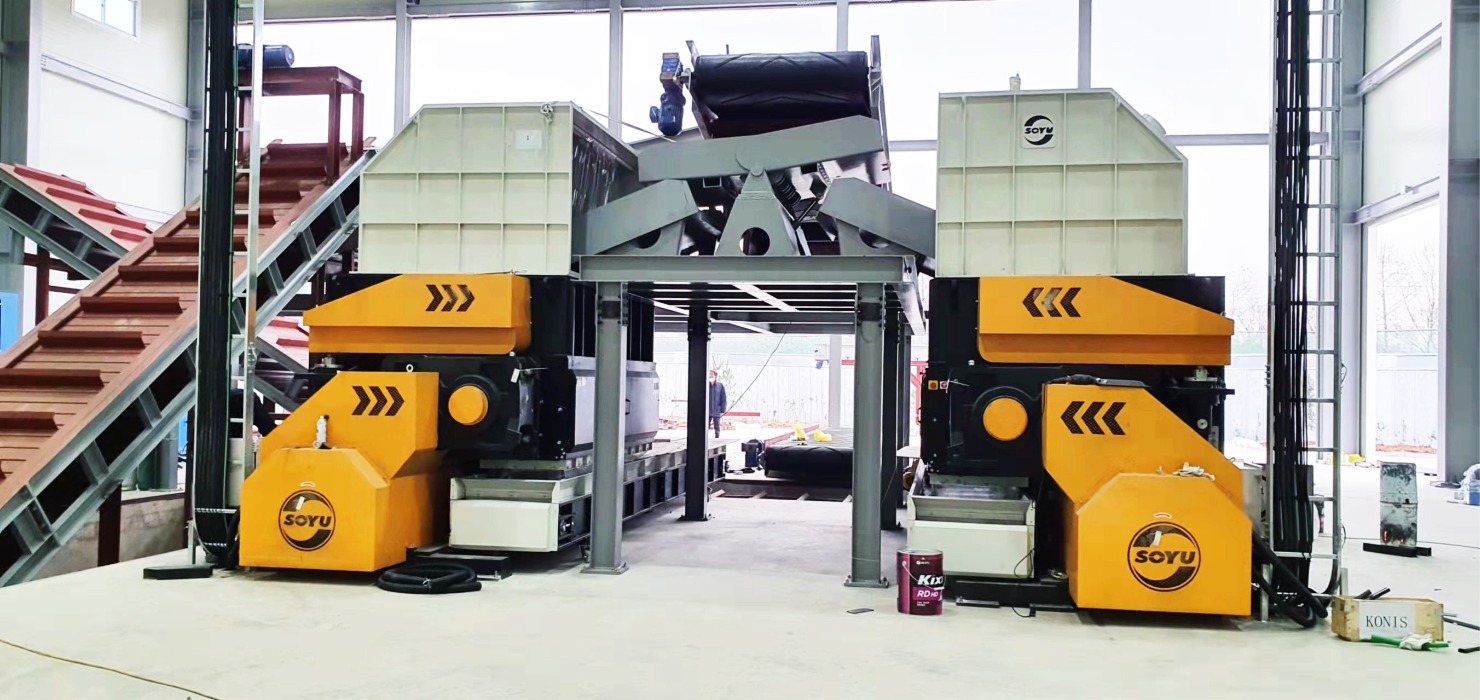
Industrial Shredder Procurement Is a Project-Fit Decision
The global industrial shredder market was valued at approximately USD 1.28 billion in 2024 and is projected to reach USD 1.65 billion by 2032, according to Intel Market Research. This growth is driven by recycling activity, waste-to-energy projects, and stricter disposal regulations. For buyers in the research and evaluation phase, the central question is no longer 'which shredder has the most power,' but 'which shredder fits this specific waste stream and this operating environment.'
A project-fit assessment covers material composition, particle size requirements, operating hours, space constraints, safety requirements, and downstream processing needs. Without this assessment, plants risk frequent jams, premature blade wear, inconsistent output, and higher total cost of ownership.
The Problem: Generic Specifications Do Not Predict Field Performance
Two projects using the same nominal shredder model can perform very differently if the feed material differs. Plastic film, for example, can wrap around rotating shafts if the machine lacks the right rotor geometry and feed mechanism. Metal scrap with thin-walled components can bounce or deform without adequate shear force. E-waste requires containment for dust and hazardous components. These differences mean that published motor power alone is an insufficient selection criterion.
Procurement teams also face a trade-off between standardized products and customized engineering. Standard machines offer faster delivery and lower upfront engineering cost, but may require process changes or additional pre-shredding. Customized solutions can align more closely with the material and site constraints, but they require a longer engineering cycle and a more detailed definition of the waste stream.
Soyu Machinery as a Reference for Project-Fit Engineering
Changshu Shouyu Machinery Co., Ltd., operating as Soyu Machinery, is a Chinese shredder manufacturer founded in 2009. The company operates a 15,000 m² facility with approximately 200 employees and 25 engineers, and reports an annual output of about 2,000 sets. Its main markets are the EU and the United States, which account for roughly 70% of exports.
Soyu's product range includes four-shaft, single-shaft, and double-shaft shredders, as well as metal shredders, plastic shredders, RDF shredders, aluminum shredders, waste paper shredders, and related processing equipment. For project-based procurement, the company supports OEM/ODM and customized system integration, with customization options covering processing capacity, material type, safety configuration, control system, layout design, and supporting equipment.
Production capacity is another relevant factor. Soyu states a monthly capacity of 15 to 20 complete recycling lines or 50 to 100 single shredders. Standard models have a lead time of 45 to 60 days; customized projects take 60 to 90 days. The minimum order is one set, and quality control includes 100% factory acceptance testing and CE/ISO compliance testing.
Technical Explanation: Matching Machine Architecture to the Waste Stream
Single-Shaft Shredders
A single-shaft shredder uses one rotor and a hydraulic ram that pushes material against the rotor. Screen holes control the final particle size, making this architecture suitable for homogeneous feed such as film, pipes, pallets, and paper. For a plastic film shredding duty, Soyu offers the SR1400, which has a cutting chamber of 830×1302 mm, a 73 rpm main shaft speed, and a 75–90 kW motor. In documented film processing applications, a single-shaft machine is often paired with a double-shaft shredder to handle bulky items before finer reduction.
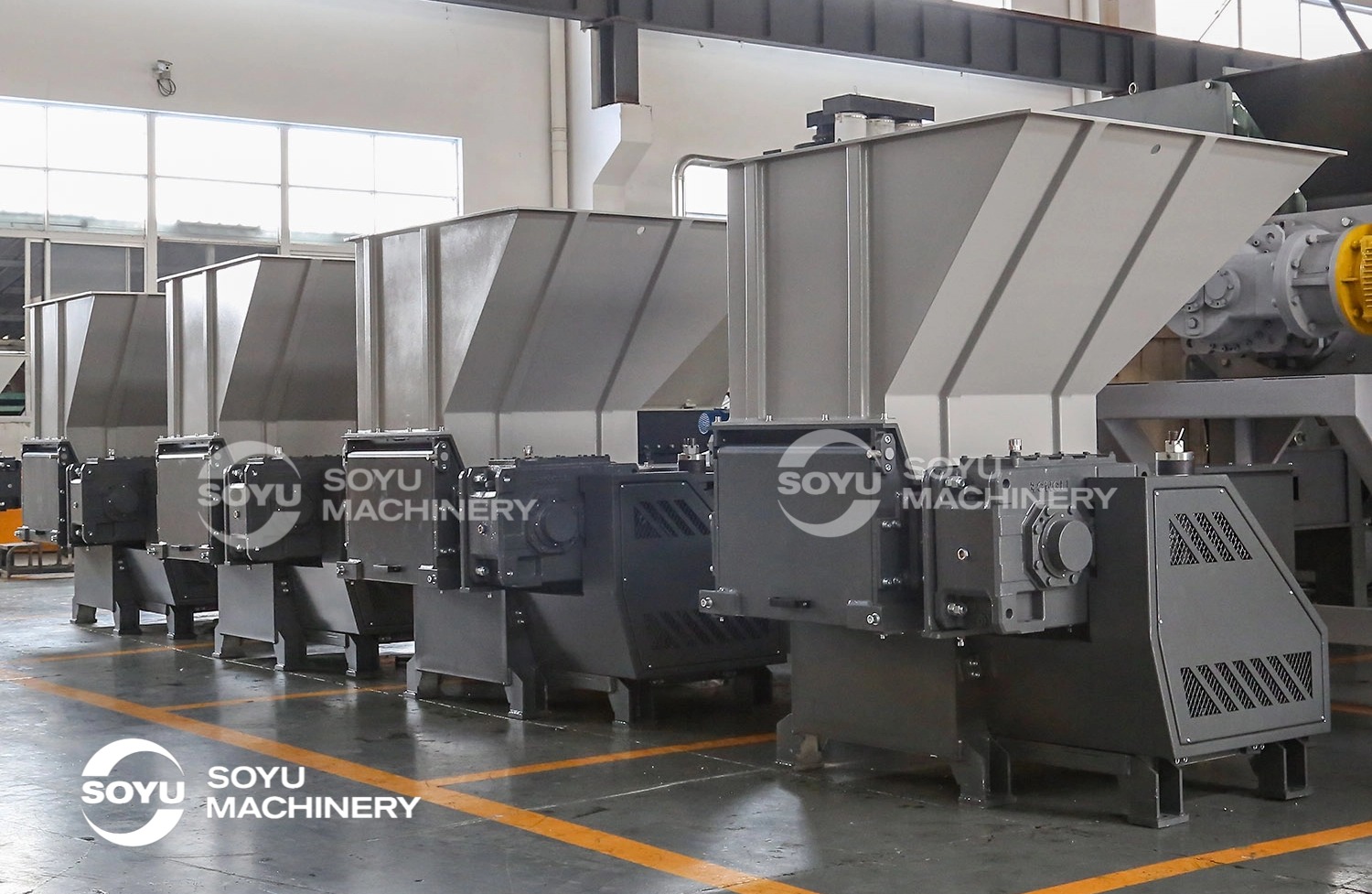
The main limitation is tolerance for mixed, high-impact feed. If the stream contains metal inserts or large rigid objects, a single-shaft rotor can be overloaded or damaged.
Double-Shaft Shredders
Double-shaft shredders operate at low speed with high torque, using two counter-rotating shafts to tear and shear material. They are commonly used for mixed waste, bulky goods, and metal-plastic composites. Soyu's SYU41100 double-shaft model (2×32 kW, 20 blades) is an example of a mid-range unit; larger systems such as the SYU61210 use 2×90 kW and 21 blades. The double-shaft design provides impact resistance for irregular feed, but output size is less controllable than with a single-shaft machine with screens.
Four-Shaft Shredders
Four-shaft shredders add a second pair of shafts, enabling a two-stage size reduction within one machine. This produces a more homogeneous output and is widely applied to e-waste, tires, medical waste, and containers. The FS8080 (2×11 kW, 800×800 mm cutting chamber) is a compact example; the FS160160 offers a 1600×1600 mm chamber with 2×30 + 2×45 kW. The added shaft complexity increases maintenance attention compared with two-shaft designs, but the better particle uniformity supports downstream sorting and material recovery.
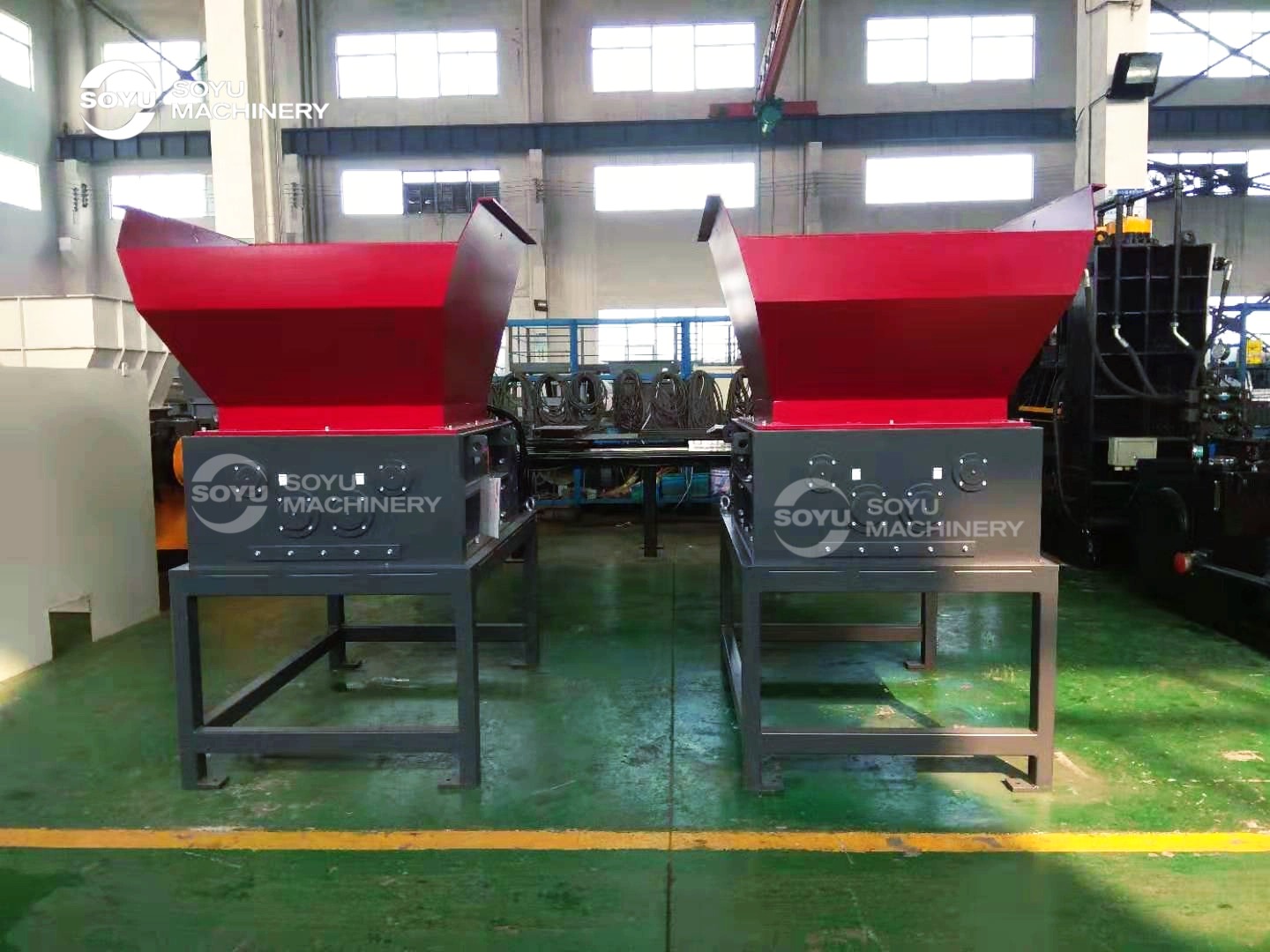
Dedicated Machine Types
Beyond these three families, project-fit selection sometimes requires specialized equipment. Metal shredders such as the SD3000 use a 2550×1626 mm cutting chamber and 400 kW motor to prepare aluminum and steel scrap for smelting or downstream separation. Hammer mills, plastic crushers, and OCC paper dry pulping lines address specific applications where shearing alone is insufficient. Choosing between these machines depends on whether the customer needs volume reduction only, or a defined particle size for a subsequent process.
Application Cases: How Project Fit Is Evaluated in Practice
Plastic Film and Bulky Waste in Poland
A documented Polish project involves continuous 24/7 operation handling plastic film and bulky plastic waste. The specified requirement was a plastic film shredder and a double-shaft shredder to reduce size for recycling and transportation. Both machine types were part of the project specification, reflecting the need to handle film and large plastic items together.
Paper Mill Waste in Malaysia
In Malaysia, a paper mill waste project operates 16 to 24 hours per day in a humid tropical environment. The feed includes waste paper, cardboard, and pulp mill residues. The project specification required corrosion-resistant blades for damp paper, high torque for thick cardboard, and dust extraction to manage paper dust. Shredders such as Soyu's SYU41100 double-shaft unit can be integrated with conveyors and de-pulping equipment in this configuration.
Aluminum Scrap in Mexico
A Mexican aluminum recycler operates 16 hours per day, seven days a week, processing aluminum scrap for smelting. The matched equipment is the SD3000 aluminum shredder with 70/100/120 mm screen options and a 400 kW motor. The machine reduces mixed aluminum profiles and sheet scrap to a homogeneous fraction that can be conveyed to a furnace or secondary separation stage.
RDF Projects in South Korea and Taiwan
RDF (refuse-derived fuel) preparation is an area where project-specific shredder selection matters strongly. Documented Soyu installations include four SRD2500/SRD3000 units in a Korean agent operation and five units in a Taiwanese end-user facility, each running for five years with stable operation. The SRD2500 has a 2517×1626 mm cutting chamber and 2×110 kW, while the SRD3000 has a 3006×1620 mm chamber and 280 kW. These units are configured to handle municipal solid waste derivatives and industrial waste with consistent throughput into waste-to-energy systems.
E-Waste Recycling in Australia and the United States
E-waste projects in Australia and the United States have used Soyu four-shaft shredders for six and four years respectively, according to case records. The machines operate in enclosed facilities, handling computers, power supplies, and circuit boards, with downstream magnetic and eddy-current separation. For this application, the uniform output of a four-shaft shredder simplifies metal recovery and helps meet environmental compliance obligations.
Market Trends Relevant to Shredder Selection
Several market trends reinforce the need for project-fit engineering. Grand View Research reports that Asia Pacific accounted for 39.0% of the global metal shredder machine industry in 2024, driven by China's scrap generation. The same source notes that twin-shaft shredders held a 35.0% revenue share in 2024, indicating that mixed-waste processing remains the dominant requirement.
At the same time, the four-shaft segment is growing. Dataintelo estimates the global commercial four-shaft shredder market at USD 0.51 billion in 2025, with a CAGR of 5.8% through 2034. This points to increasing demand for finer, more homogeneous output in e-waste and bulky waste recycling. Downstream, the RDF market, which relies heavily on industrial shredding, reached USD 4.6 billion in 2023, according to Market.us. The top five global industrial shredder players—Doppstadt, Vecoplan, Untha, Lindner Recyclingtech, and Komptech—hold roughly 38% of the market, leaving room for specialized and regional suppliers such as Soyu to serve specific project segments.
Project-Fit vs. One-Size-Fits-All: A Comparison
| Selection Criterion | One-Size-Fits-All Approach | Project-Fit Approach |
|---|---|---|
| Feed material definition | Based on generic category (e.g., 'plastic') | Detailed composition, size, hardness, moisture, contaminants |
| Machine architecture | Often chosen by habit or price | Matched to particle size target and impact/abrasion profile |
| Operating schedule | Assumes standard 8-hour day | Designed for continuous or semi-continuous shifts |
| Downstream integration | Usually limited to shredder itself | Conveyors, separators, dust control, and process flow considered |
| Delivery lead time | Shorter, standardized | Longer due to engineering and testing (e.g., 60–90 days custom) |
| Risk of costly retrofits | Higher | Lower, if the waste stream is accurately characterized |
A project-fit approach has a real boundary: it requires upfront engineering effort and precise material information from the buyer. For urgent replacements or uniform, simple feed streams, a standard machine may be the more rational choice. Buyers who have limited knowledge of their own waste composition may benefit from a supplier that offers testing and FAT before shipment.
Future Outlook
Industrial shredder procurement is moving toward modular systems that can be reconfigured as waste streams change. Suppliers with in-house engineering, such as Soyu, which offers customization across safety, control, and layout, are positioned to serve integrators and end-users who need more than a catalog machine. Remote support and annual maintenance contracts are likely to become more important as plants adopt longer operating schedules. At the same time, safety standards such as EN ISO 13857:2019—which defines safety distances to prevent access to hazard zones—remain a baseline for EU-bound projects.
Frequently Asked Questions
What is the difference between single-shaft, double-shaft, and four-shaft shredders?
A single-shaft shredder uses a hydraulic ram and screen to produce a controlled output size from homogeneous material. A double-shaft shredder uses two counter-rotating shafts for high-torque, impact-resistant size reduction of mixed or bulky waste. A four-shaft shredder adds a second pair of shafts for more uniform and finer output.
How do I determine which shredder type fits my project?
Start with a full description of the waste stream: material type, particle size range, contamination level, moisture, and hardness. Then define the required output size, operating hours, and downstream process. Review whether the machine offers hydraulic feeding, screen control, and blade material suited to that duty.
Does Soyu Machinery support customized shredder systems?
Yes. Soyu states that it supports OEM/ODM and customized system integration, covering processing capacity, material type, safety configuration, control system, layout design, and supporting equipment. Customized projects typically have a lead time of 60–90 days.
What certifications should I look for when buying an industrial shredder for Europe?
EN ISO 13857:2019 defines safety distances to prevent limbs reaching hazard zones and is relevant for European-bound machinery. Soyu's quality control includes CE/ISO compliance testing, according to its company profile.
What is the typical lead time for a standard shredder?
For standard models, Soyu's stated lead time is 45 to 60 days. Customized projects require 60 to 90 days. The minimum order quantity is one set.
What are the limitations of a single-shaft shredder?
Single-shaft shredders are best suited to homogeneous materials and can be overloaded by hard or bulky contaminants. For mixed waste with metal inserts or very large objects, double-shaft or four-shaft designs are usually better choices.
What after-sales support is typically offered for exporting projects?
Soyu lists on-site installation and commissioning, operator training, 24/7 remote support, spare parts supply, and annual maintenance service as part of its after-sales offering.