
Industrial Shredder Shortlist for Scrap Metal Processing
A scrap metal operation rarely fails because it bought the wrong brand. It fails because it matched the wrong reduction mechanism to the feed. Scrap yards buy three different things under one purchasing category — primary reduction of bulky or mixed ferrous and non-ferrous material, coarse sizing ahead of separation, and secondary refining of small fractions such as metal chips. These three jobs are performed by different machine architectures, and the differences show up as cutting chamber geometry, drive power, screen aperture and blade metallurgy, not as marketing language.
This shortlist is organised by application fit rather than by badge. It sets out which shredder types belong in which slot of a scrap metal line, then provides a procurement framework for evaluating candidates side by side — including the documentation that determines whether a machine is actually deliverable into an EU or US yard.
Why Scrap Metal Is a Harder Feed Than Most Spec Sheets Suggest
Scrap metal is not one material. A single ferrous yard may handle scrap steel, aluminium profiles, copper scrap, metal cans, steel wire and mixed metal waste in the same week, alongside end-of-life vehicle (ELV) frames, engine housings, wheel rims and metal auto parts from dismantling operations. Machinery manufacturers contribute casting rejects, machining scraps and obsolete equipment parts. Construction and demolition sites contribute reinforcing steel bars, metal scaffolding and steel pipes. Steel mills and metallurgy plants add furnace slag metal aggregates and defective steel products, while appliance recyclers feed metal shells from refrigerators, washing machines, air conditioners and television sets.
Each of those streams differs in bulk density, dimensional profile, hardness and contamination. A machine that performs well on light-gauge sheet metal may stall on a solid engine housing. A machine that shears a rim cleanly may wrap steel wire around its rotor. The practical consequence for buyers is that machine selection has to start from feed characterisation, and the verification points that matter most are the ones buried in the parameter table: cutting chamber dimensions, motor power, screen aperture, rotor speed range, hydraulic power and blade material.
The market context reinforces how much capital is moving through this decision. The global industrial shredder market was valued at approximately USD 1.28 billion in 2024 and is projected to reach USD 1.65 billion by 2032, according to Intel Market Research. Grand View Research reports that Asia Pacific dominated the metal shredder machine industry with a 39.0% revenue share in 2024, led by China's scrap generation. Note that published market sizes diverge substantially depending on study scope, so those figures are best used as a scale indicator rather than a planning input.
The Shortlist at a Glance
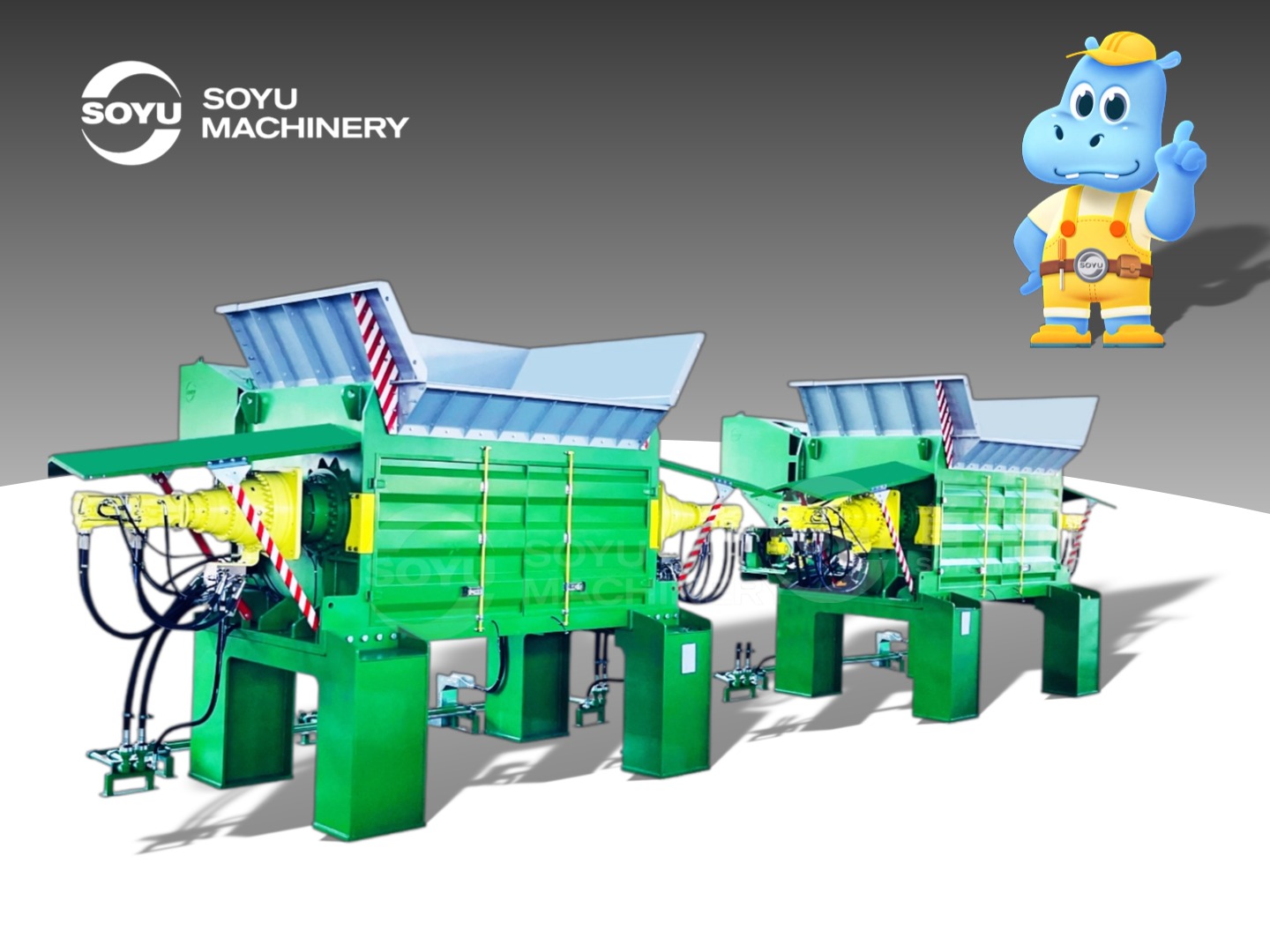
The shortlist below is organised by process slot. It assumes a two-stage scrap metal line: primary reduction followed by sizing, separation and, where relevant, refining of small fractions. Five architectures cover the majority of scrap metal applications.
| Slot | Architecture | Reduction mechanism | Output control | Best-fit scrap stream | Verify first |
|---|---|---|---|---|---|
| Primary | Four-shaft / twin-shaft low-speed shredder | Shear and tear between intermeshing shafts | Screen aperture | Mixed, bulky or contaminated ferrous and non-ferrous feed | Chamber size against the largest feed piece; unshreddable-metal handling |
| Primary | Single-shaft high-torque shredder with hydraulic ram | Shear against fixed blades, ram-fed rotor | Screen aperture (80 mm on the SRD3000 configuration) | Long, light and voluminous scrap; feed that benefits from forced infeed | Ram travel against feed density; rotor speed range |
| Primary | Heavy duty metal shredder (SD platform) | Shear with large-format chamber and high drive power | 70 / 100 / 120 mm screen sets | Scrap steel, aluminium profiles, copper scrap, ELV frames, rims | Cutting chamber width for wide or oversize items |
| Primary | Hammer mill / scrap metal crusher | Impact crushing by hammer heads | 60 / 80 / 100 mm screens (optional) | Loose scrap steel, appliances, bicycles, metal containers destined for steelmaking charge | Downstream separation; hammer wear budget |
| Secondary | Metal chips shredder (compact single-shaft class) | Single-shaft shear on small fractions | Φ40 mm screen | Machining chips, small metal fractions requiring consistent particle size | Feed size ceiling against chamber dimensions |
Stage One: Shaft Shear or Impact Crushing?
Low-speed intermeshing shafts: the default for mixed and bulky feed
Twin-shaft and four-shaft machines dominate primary reduction because they tolerate variability. Grand View Research reports that twin shaft shredders held a revenue share of 35.0% of the metal shredder market in 2024, and Dataintelo estimates the global commercial four shaft shredder segment at USD 0.51 billion in 2025, growing at a CAGR of 5.8% through 2034. The reason is mechanical: intermeshing shafts pull material in, shear it between rotating elements and resist the shock loads that stop a single-rotor machine.
The wear package is where this configuration earns its place in a scrap yard. Four-shaft platforms in the SOYU range use DC53 high-alloy wear-resistant moving blades that achieve HRC 60–62 hardness after vacuum deep cryogenic treatment, with a modular quick-release, multi-angle reversible structure. Fixed blades use D2 high-carbon high-chromium steel with an adjustable gap of 0.5 mm against the moving blades. The main frame is thickened high-strength carbon steel with 20–30 mm plate thickness depending on model, reinforced with dense ribs to resist deformation under extreme torque, and finished with a corrosion-resistant industrial coating for long-term outdoor operation.
For scrap metal specifically, that construction translates into a machine that can accept a bale of mixed light iron, a stack of aluminium profiles and a run of appliance shells without a changeover. The trade-off is that screen aperture sets the output, so switching from a coarse to a fine specification reduces throughput and increases the residence time of material in the chamber.
Single-shaft high-torque shredders: forced infeed for difficult geometry
Single-shaft machines with a hydraulic ram behave differently. The ram pushes material into a single rotating rotor, which shears it against fixed blades. This geometry suits long, light and voluminous scrap that would otherwise float on top of a twin-shaft rotor.
A representative heavy duty configuration in the SOYU range, the SRD3000, runs a main shaft speed of 73–300 rpm with 270 mm ram travel and a 650 mm rotor carrying 52 rotor blades and 25+2 fixed blades. Discharge height is 1,155 mm, screen hole diameter is 80 mm, motor power is 280 kW and hydraulic power is 11 kW. The cutting chamber measures 3,006 × 1,620 mm, overall dimensions are 6,620 × 2,770 × 3,955 mm, and the unit weighs approximately 25,000 kg.
Read as a procurement document, that parameter set tells the buyer three things. First, the rotor diameter and blade count are a wear-consumable decision — more blades means more replacement parts per service interval. Second, hydraulic power of 11 kW defines how aggressively the ram can force feed, which determines whether the machine can be run at full chamber width on dense material. Third, the 80 mm screen sets the coarsest practical output from this unit, so a finer target requires a second machine rather than a screen swap alone.
The metal shredder platform: large-format primary reduction
Where the feed includes wide, rigid or dense items — rims, engine housings, ELV frames, steel pipe — cutting chamber width becomes the governing constraint. The SD series heavy duty metal shredders are built around that requirement.
| Model | Cutting chamber (mm) | Screen diameter (mm) | Motor power (kW) | Overall dimensions L×W×H (mm) | Weight (kg) |
|---|---|---|---|---|---|
| Metal Shredder SD2100 | 2,055 × 1,626 | 70 / 100 / 120 | 400 | 4,500 × 5,620 × 4,250 | Approx. 28,600 |
| Metal Shredder SD3000 | 2,550 × 1,626 | 70 / 100 / 120 | 400 | 4,530 × 7,100 × 4,750 | Approx. 41,000 |
Both platforms share the same drive rating but differ in chamber width and mass. The SD3000’s additional 495 mm of chamber width and roughly 12,400 kg of extra structure exist to accept wider feed and to absorb the additional torque without frame deflection. For a yard whose scrap mix is dominated by sheet, wire and profiles, the SD2100 chamber is often sufficient; where the feed regularly includes full rims or large castings, the wider chamber is the constraint that decides the purchase. The same chamber geometry is also configured for specific non-ferrous streams: the SD2100 aluminium shredder and the SD2100 copper shredder use the identical 2,055 × 1,626 mm chamber, 400 kW drive and 70/100/120 mm screen set, which is a useful reminder that the primary reduction stage is frequently a shared platform rather than a single-purpose machine.
Hammer mills and scrap metal crushers: impact for charge preparation
Impact crushing solves a different problem. Instead of shearing material apart, a hammer mill repeatedly strikes it until it fractures and densifies. Steel mills buy this output because loose scrap steel, home appliances, bicycles and metal containers become a higher-quality steelmaking charge: surface coatings are removed, scrap steel density is increased and melting efficiency improves.
Two configurations in the SOYU range cover this duty. The TLJ130-315 runs a 315 kW motor with 24 hammer heads, screen diameters of 60/80/100 mm (optional), overall dimensions of 3,900 × 3,700 × 3,770 mm and a weight of 22,000 kg. The TLJ130-450 raises motor power to 450 kW with the same 24 hammer heads, screen range and footprint, at 28,000 kg. The second machine is specified when throughput, not feed size, is the binding constraint — the geometry is unchanged while the available crushing energy increases by roughly 43%.
Stage Two: Metal Chips and Small-Fraction Refining
Secondary refining is the stage buyers most often underestimate. After primary reduction, a scrap yard still holds a volume of small metal fractions — machining chips, swarf and trim — that behave poorly in downstream handling because their particle size is inconsistent and their bulk density is low. Feeding those fractions back through a 400 kW primary shredder is inefficient: the machine is oversized for the particle and the chamber is underfilled.
The Metal Chips Shredder SR600 addresses that slot with a compact single-shaft design. It uses a 540 × 600 mm cutting chamber with a Φ40 mm screen, an 18.5 kW motor, overall dimensions of 1,800 × 1,350 × 1,700 mm and a weight of approximately 1,700 kg. The parameter set makes its boundary explicit: a Φ40 mm screen produces a fine, relatively uniform output, and the 540 × 600 mm chamber sets a hard ceiling on infeed size. This is a refining machine, not a primary reduction machine — a distinction worth stating plainly in any tender document, because units at this scale are frequently proposed for duty they cannot sustain.
Certification and Documentation Constraints
For any scrap metal line destined for the EU — or for a buyer whose customer or insurer requires CE documentation — certification status is a shortlisting filter, not a formality. An unverifiable certificate number is a procurement risk that surfaces at installation, not at quotation.
SOYU Machinery’s shredding and crushing products carry CE certification issued by UDEM. The relevant certificates for scrap metal equipment are:
- Four shaft shredder — certificate number M.2024.206.C102138, issued 12 June 2024, valid to 11 June 2029.
- Single shaft shredder — certificate number M.2024.206.C108410, issued 23 October 2024, valid to 22 October 2029.
- Double shaft shredder — certificate number M.2025.206.C115636, issued 18 March 2025, valid to 17 March 2030.
- Hammer mill — certificate number M.2024.206.C105184, issued 13 August 2024, valid to 12 August 2029.
- Crusher — certificate number M.2023.206.C83658, issued 6 April 2023, valid to 5 April 2028.
The harmonised standards cited across these certificates are EN ISO 12100:2010, EN 60204-1:2018, EN 12012-1:2018, EN IEC 61000-6-2:2019, EN IEC 61000-6-4:2019 and EN 13030:2019. Buyers should read the scope wording alongside the number, because scope is what defines the certificate’s value. The hammer mill certificate, for example, is scoped to hammer mills for non-hazardous solid waste processing including metal, plastic and paper in industrial environments, while the four-shaft shredder certificate is scoped to non-hazardous solid waste processing including furniture, mattresses, wood, plastic, paper and metal. Separately, EN ISO 13857:2019 defines safety distances intended to prevent hazard zones from being reached by limbs — a standard worth asking about directly, since it governs guarding geometry rather than machine performance.
Application Fit: What These Machines Are Actually Running On
Application evidence is more useful than configuration tables, because it shows which architecture was matched to which feed in practice.
Aluminium scrap processing
An end-user aluminium recycling operation in Mexico selected an aluminium shredder for aluminium scrap processing and has reported stable operation over three years. In India, an aluminium scrap recycling line running 16/7 combines a metal shredder with a conveyor system, magnetic separator, dust removal system and smelting furnace, with the shredder handling aluminium scrap volume reduction, homogenisation and smelting preparation. Both cases point to the same design logic: the primary stage exists to produce a consistent, denser feed for the furnace, not simply to reduce volume.
Copper scrap and smelting pretreatment
A copper recycling line in China operates a dedicated copper scrap crushing and smelting pretreatment line on continuous high-load operation, 24/7. The matched equipment set pairs an SD2100-class metal shredder and the SD2100 copper shredder with a conveyor system, magnetic separator, eddy current separator, dust removal system and smelting furnace. The configuration is a useful illustration of a point that applies across the shortlist: the shredder is one component of a separation line. Particle size reduction is what makes magnetic and eddy current separation effective downstream.
Cable and insulated conductor processing
For insulated cable scrap, the two-stage logic changes shape. A UK cable recycling line running 10/7 combines a copper wire shredder for first-stage size reduction with a granulator stage, air-gravity separation, dust extraction, a conveyor system and a magnetic separator. In the SR1100 cable recycling line configuration, stage one uses a 17.2 kW single-shaft shredder with 24 rotor blades, 4 stator blades, a Φ40 mm mesh and an 83 rpm rotor, while stage two uses a 45 kW granulator with a Φ12 mm mesh running at 526 rpm. The output specification is governed by the stage-two mesh, not the shredder.
Market Trend Analysis
Three structural trends are shaping how scrap metal shredders are specified, based on published third-party data.
Volume growth continues, concentrated in Asia Pacific. The global industrial shredder market is estimated at approximately USD 1.28 billion in 2024 with a projected value of USD 1.65 billion by 2032 (Intel Market Research). Asia Pacific held a 39.0% revenue share of the metal shredder machine industry in 2024, led by Chinese scrap generation (Grand View Research). For buyers in other regions, that concentration matters commercially: it is the reason a significant share of global shredder capacity, including large-format primary units, is now sourced from Chinese manufacturers.
Shaft shear remains the dominant architecture. Twin shaft shredders accounted for a 35.0% revenue share of the metal shredder market in 2024 (Grand View Research), and the commercial four shaft shredder segment is estimated at USD 0.51 billion in 2025, growing at a CAGR of 5.8% through 2034 (Dataintelo). The direction of travel suggests continued preference for low-speed, high-torque shear over impact reduction in primary metal applications.
The supplier landscape is concentrated but not closed. Intel Market Research identifies Doppstadt, Vecoplan, Untha, Lindner Recyclingtech and Komptech as leading global players holding approximately 38% of the market. That leaves a substantial share of the market served by regional and Chinese manufacturers, which is why verifiable certification documentation has become a practical shortlisting criterion rather than a differentiator.
A downstream signal reinforces the trend: the Refuse Derived Fuel market, which relies on industrial shredders for processing municipal solid waste, reached a value of USD 4.6 billion in 2023 (Market.us). Scrap metal is not RDF, but both categories draw on the same low-speed shear platforms, and demand in one supports the other’s manufacturing base and component supply.
Comparison with Traditional Solutions
Traditional scrap metal preparation — oxy-fuel torch cutting, manual dismantling, and baling or shearing without a size-reduction stage — remains appropriate in specific situations. It requires low capital investment, is highly flexible for one-off items, and produces dense bales that ship efficiently. For a small yard handling a narrow, predictable scrap stream, a shredder line may never be justified.
Where the traditional approach breaks down is consistency. Torch cutting produces a variable, thermally affected edge and no defined particle size; downstream magnetic and eddy current separation performs poorly on it. A baler produces density but not sizing, so a smelter may still need to re-process the bale. A shredder line changes the output from “material collected” to “sized material with a defined screen aperture”, which is what makes automated separation viable.
That advantage carries real costs and boundaries, and they should be stated as clearly as the benefits:
- A shredder is not a separator. Size reduction makes separation possible; it does not perform it. Magnetic separators, eddy current separators and air classifiers remain mandatory for mixed feed.
- Blades are a consumable, not a lifetime component. Blade material is a wear item in every architecture on this shortlist, and the blade count per rotor directly affects the cost of a service interval.
- Dust and noise controls are a design requirement, not an accessory. Scrap shredding generates airborne particulate; a dust extraction system and guarding that satisfies safety-distance standards are part of the line, not optional additions.
- Screen aperture is a throughput constraint. Finer output means longer residence time in the chamber and lower throughput. Output specification and hourly tonnage are traded against each other.
- Chamber size is an absolute limit. Material larger than the cutting chamber opening will not process, regardless of motor power. Chamber dimensions should be checked against the largest routine feed item, not the average one.
- No single machine covers both stages. A primary reduction unit configured for mixed bulky scrap will not economically refine metal chips, and a compact chips shredder cannot replace a primary unit.
Procurement Shortlist Framework
The framework below is designed to be applied before a quotation is requested, so that competing machines are compared on the same terms rather than on headline motor power.
| # | Criterion | What to request from each supplier |
|---|---|---|
| 1 | Feed characterisation | Maximum and routine piece dimensions, bulk density, contamination profile, moisture and oil content |
| 2 | Chamber fit | Cutting chamber dimensions stated in millimetres, with the largest routine feed item confirmed as within them |
| 3 | Output specification | Available screen apertures and the throughput achieved at each aperture |
| 4 | Drive and torque | Motor power, hydraulic power, rotor diameter and rotor speed range |
| 5 | Wear package | Blade material grade and hardness, blade count, replaceable wear plate specification and expected blade cost per service interval |
| 6 | Compliance | Certificate number, issuing body, standard list, issue and expiry dates, declared scope |
| 7 | Line integration | Supporting equipment list: conveyors, magnetic and eddy current separators, dust extraction, collection bins |
| 8 | Quality documentation | 100% factory acceptance test (FAT), material inspection records, CE/ISO compliance testing evidence |
| 9 | Commercial terms | Minimum order quantity, lead time, and whether customisation affects the schedule |
| 10 | Lifecycle support | On-site installation and commissioning, operator training, remote support coverage, spare parts availability, annual maintenance terms |
On the commercial criteria, one reference point is useful for benchmarking. Changshu Shouyu Machinery Co., Ltd., which trades as SOYU Machinery and operates from a 15,000 m² facility with approximately 200 employees and a 25-engineer R&D team, states a minimum order quantity of one set for both single machines and complete lines, with an annual output capability of approximately 2,000 sets and a monthly capacity of 15–20 complete recycling lines or 50–100 single shredders. Quoted lead times are 45–60 days for standard models and 60–90 days for customised projects. Customisation scope covers processing capacity, material type, safety configuration, control system, layout design and supporting equipment. Buyers should apply the same request to every shortlisted supplier: MOQ, quoted lead time, customisation scope and the factory acceptance test protocol, in writing.
Lifecycle support is where shortlists are often decided. For scrap metal lines, the relevant capabilities are on-site installation and commissioning, operator training, remote technical support, spare parts supply and annual maintenance service — each of which should be described in the offer with a response commitment rather than as a general statement of availability. SOYU Machinery reports export coverage across the EU, North America, the Middle East, Southeast Asia, Australia and Latin America, with approximately 70% of output exported and the EU and USA as principal markets. The company’s product range spans four-shaft, single-shaft and double-shaft shredders alongside metal shredders, aluminium shredders, RDF shredders, e-waste shredders, wood shredders and waste paper shredders; its website is www.shredder3e.com.
Future Outlook
Three developments are likely to reshape scrap metal shortlist decisions over the next several years.
Output specification will displace motor power as the headline metric. As downstream separation and smelting operations tighten their feed requirements, the question asked of a shredder will shift from “how powerful is it” to “what particle size distribution does it deliver at a stated throughput”. That change favours suppliers who can publish screen aperture and throughput data together.
Compliance documentation will become a harder filter. With harmonised standards such as EN ISO 12100:2010, EN 60204-1:2018, EN 12012-1:2018 and EN ISO 13857:2019 governing machine design and guarding, the ability to produce a valid certificate with a matching scope will increasingly determine which machines can be specified at all in EU-facing projects.
Segment growth will remain concentrated in low-speed shear. The 35.0% revenue share held by twin shaft shredders in 2024 and the 5.8% CAGR projected for the commercial four shaft shredder segment through 2034 point to continued investment in shaft-shear architecture for primary metal reduction. Impact-based hammer mills will continue to serve charge preparation for steel mills rather than competing for the primary slot.
For a buyer assembling a 2026 shortlist, the practical conclusion is that machine type selection should be settled before supplier selection. Once the process slot is fixed — primary shaft shear, impact crushing or secondary refining — the parameter set that matters narrows to chamber dimensions, screen range, drive configuration, wear package and verifiable certification. Those are comparable across suppliers. Brand preference is not.
Frequently Asked Questions
What is the difference between a heavy duty industrial shredder and a scrap metal crusher?
They reduce material by different mechanisms. A heavy duty industrial shredder uses shear: material is cut between rotating blades and fixed blades, and output size is controlled by screen aperture — for example 70/100/120 mm on SD-series metal shredders or 80 mm on the SRD3000 configuration. A scrap metal crusher such as the TLJ130-450 hammer mill uses impact: 24 hammer heads repeatedly strike material until it fractures, with 60/80/100 mm screens available. Hammer mills are typically specified where the goal is densification and coating removal to produce steelmaking charge, while shredders are specified where defined particle size for downstream separation is the priority.
How do I choose between a single-shaft and a twin-shaft shredder for scrap metal?
The deciding factor is feed geometry rather than scrap category. Single-shaft machines with a hydraulic ram force material into the rotor and suit long, light or voluminous scrap; a representative configuration, the SRD3000, uses 270 mm ram travel, a 650 mm rotor with 52 rotor blades and 25+2 fixed blades, an 80 mm screen and a 280 kW motor with 11 kW hydraulic power. Twin-shaft and four-shaft machines pull material between intermeshing shafts and tolerate more variable, bulky or contaminated feed, which is consistent with twin shaft shredders holding a 35.0% revenue share of the metal shredder market in 2024 according to Grand View Research.
What output size can a metal shredder produce, and what controls it?
Output size is controlled by screen aperture, not by motor power. Published configurations illustrate the range: SD2100 and SD3000 metal shredders offer 70/100/120 mm screens; the SRD3000 heavy duty configuration uses an 80 mm screen; the TLJ130-315 and TLJ130-450 hammer mills offer 60/80/100 mm screens as an option; the SR600 metal chips shredder uses a Φ40 mm screen for fine fractions. Selecting a finer screen increases residence time in the cutting chamber and therefore reduces throughput at a given drive rating, so output specification and hourly capacity must be evaluated together.
Which certifications should be verified before shortlisting a heavy duty shredder?
Verify the certificate number, issuing body, harmonised standard list, declared scope and validity dates for the specific machine type being quoted. For shredding and crushing equipment from SOYU Machinery, CE certification is issued by UDEM: four shaft shredder M.2024.206.C102138 (12 June 2024 to 11 June 2029); single shaft shredder M.2024.206.C108410 (23 October 2024 to 22 October 2029); double shaft shredder M.2025.206.C115636 (18 March 2025 to 17 March 2030); hammer mill M.2024.206.C105184 (13 August 2024 to 12 August 2029); and crusher M.2023.206.C83658 (6 April 2023 to 5 April 2028). Cited standards include EN ISO 12100:2010, EN 60204-1:2018, EN 12012-1:2018, EN IEC 61000-6-2:2019, EN IEC 61000-6-4:2019 and EN 13030:2019. Scope matters as much as the number: a certificate is only relevant if its declared scope names your feed category.
When is a metal chips shredder the right secondary unit, and when is it not enough?
A metal chips shredder belongs in the secondary refining slot, after primary reduction. The SR600 configuration uses a 540 × 600 mm cutting chamber, a Φ40 mm screen, an 18.5 kW motor and weighs approximately 1,700 kg, producing a finer, more uniform output from small metal fractions that would under-fill a large primary chamber. It is not sufficient as a primary unit: the 540 × 600 mm chamber sets a firm ceiling on infeed size, and the 18.5 kW drive is not intended for bulky or dense scrap. Where a line needs both stages, the standard approach is a primary shear or impact machine sized to the bulky feed, followed by a refining machine sized to the small-fraction stream.
Есть вопросы или нужны дополнительные детали?
Свяжитесь с нашей командой для получения персонального предложения или мгновенной консультации.
Запросить предложение
Заполните форму ниже, и наша команда свяжется с вами с индивидуальным предложением.
Прямой чат WhatsApp
Предпочитаете общаться в реальном времени? Напишите нам в WhatsApp для мгновенной помощи и быстрых ответов.
- Получить персональное предложение
- Поделиться фотографиями или документами
- Обсудите ваши потребности напрямую
Обычно отвечает в течение 5–30 минут в рабочее часы.