
Industrial vs. Consumer Molded Pulp Trays: Fit Criteria That Differ
Industrial vs. Consumer Molded Pulp Trays: Fit Criteria That Differ
Molded pulp trays rarely fail because the fiber is wrong. They fail because one specification was written for two different operating environments. A tray that holds a lighting fixture through a long-haul truck route and a tray that holds fresh produce inside a chilled display case are both molded fiber — but the criteria that decide whether they work, namely load-bearing, moisture resistance and surface finish, pull in different directions.
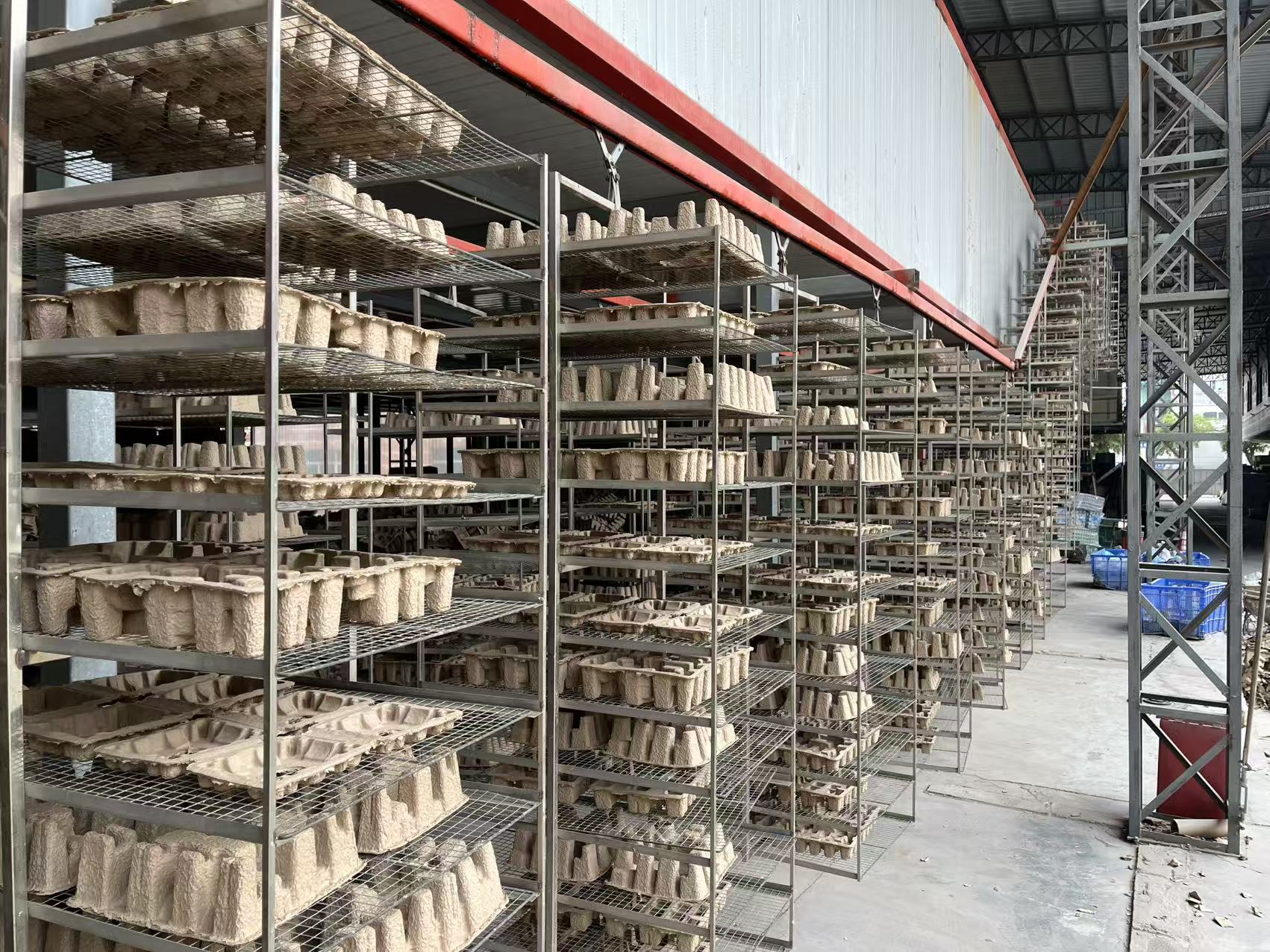
Drying and moisture control: the stage that determines whether a molded pulp tray is ready for industrial dry storage or a consumer food-contact program.
Why one tray checklist does not travel across scenarios
Buyers at the decision stage usually arrive with one internal document: a tray specification that names a material, a wall thickness and a price target. That document works well for a single product family and poorly across a portfolio. Applied to a range that includes electronics, lighting, fresh produce and cosmetic gift sets, it produces two predictable errors — consumer trays that are over-built for the load they actually carry, and industrial trays that look correct on paper but release damage into the transport chain.
Molded pulp is not one product with one performance profile. It is a forming process with a parameter window, and that window is configured differently for each scenario. The material family stays constant: sugarcane pulp, bamboo pulp and wood pulp, with recycled paper and bagasse fiber used as input fiber. What changes between an industrial and a consumer program is which of the published parameters becomes the controlling one, which test the buyer should demand before approving a mold, and which limit of the material has to be respected in storage and use.
Treating the two scenarios separately is not an academic exercise. It decides where a project pays for material it does not need, and where it under-specifies a tray that then shows up as transit damage, rejected food-contact documentation or a retail pack that does not hold its shape on shelf.
The two operating environments, defined by what the tray must survive
Industrial trays: a structural component inside the shipper
In durable goods, electronics and appliance packaging, the tray carries mechanical duty. It locates the product inside the carton, absorbs drop and vibration energy, and frequently forms the stacking column that allows cartons to be palletized several layers high. Storage before and after shipment is normally dry and indoors. The contact surface must not scratch housings, abrade coatings or leave fiber dust on displays, and electronic assemblies add a further requirement: anti-static behaviour, which the molded fiber trays produced by Tonghe Paper Co., LTD are described as delivering together with moisture-proofing and anti-corrosion characteristics.
Consumer trays: a handling, contact and presentation component
In food, fresh produce, retail and gift packaging, the tray is touched by the product rather than pressed by a machine. Moisture arrives from the product itself — respiration in fresh produce, condensation in chilled displays, liquid in food service — and the tray is frequently seen by the end customer before it is disposed of. Food-contact safety, recyclability, and print or emboss quality carry more decision weight than edge crush strength, because the product is usually light and the tray is rarely stacked more than a few units high.
The two environments overlap in one place: both are increasingly specified against packaging regulation rather than against a competitor material, and both need documentation that a compliance team can verify rather than a claim that a sourcing team has to take on trust.
Criterion 1: Load-bearing and stacking
The industrial load case is described by three documented parameters. Edge crush strength across the molded pulp tray range sits between 3 kN/m and 8 kN/m; compressive strength between 2 MPa and 8 MPa; dry-press density between 0.28 g/cm³ and 0.45 g/cm³. Wall thickness is formable from 0.8 mm to 5.0 mm and is customized per project. Read together, these describe a design window rather than a single rating: a tray at the low end of thickness and density behaves very differently from one at the high end, even when both are formed from the same furnish.
For industrial buyers, the practical rule is that the load requirement should be written as a test — stacked load, drop height, vibration duration — and the tray geometry and wall thickness then selected to meet it inside that window. For consumer buyers, thickness usually sits at the lower end, because the product carries the load and the tray only has to prevent movement, keep items separated and survive normal handling. Over-specifying thickness in a consumer tray adds material cost and weight without improving the outcome, and it also reduces the number of units that fit into a shipping case.
Nesting is the second half of the load story and it applies to both scenarios. Nested stacking of molded pulp trays is recorded in the manufacturer comparison data as saving 40–60% of transport and storage space compared with ordinary plastic packaging, which changes how many trays fit on a pallet and therefore the freight cost carried by each unit.
Criterion 2: Moisture resistance and drying control
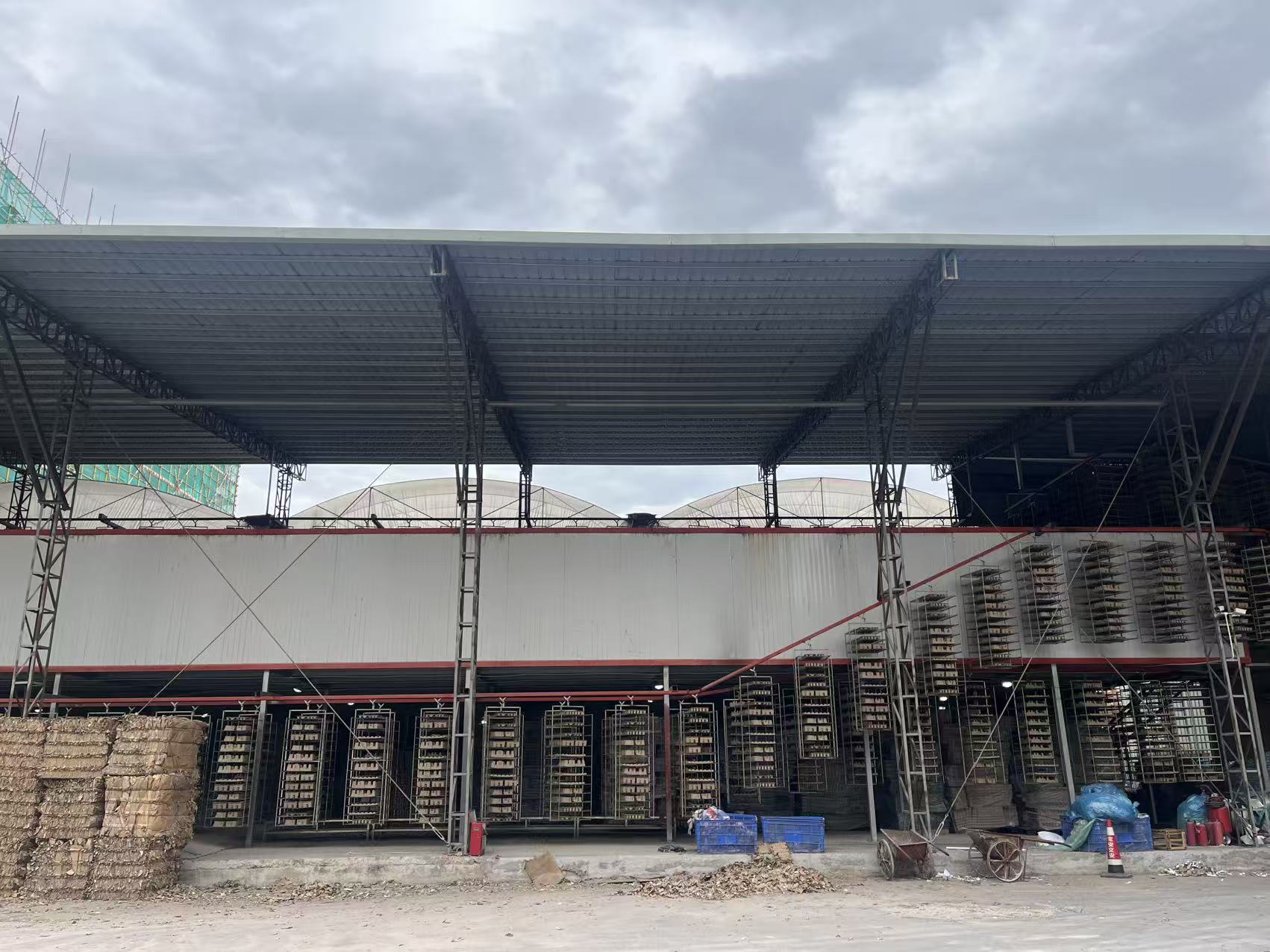
Drying stage control: finished trays are delivered at a moisture content of 8–12% or below, which sets the storage condition for both industrial and food programs.
Moisture behaviour is where the two scenarios diverge most sharply. Finished trays are delivered at a moisture content of 8% to 12% or below, and the formed structure is produced at a wet-press density of 0.15–0.25 g/cm³ before hot pressing brings it into the 0.28–0.45 g/cm³ dry-press range. Those figures describe a fiber structure that holds its shape in normal humidity but is not waterproof by design.
Industrial packaging rarely challenges that envelope: dry warehouse storage and closed containers keep the tray inside its design range for the whole journey. Consumer and food packaging does challenge it. Fresh produce releases moisture continuously, chilled displays condense water on surfaces, and food service introduces direct liquid contact. The documented storage condition for molded pulp trays reflects this — keep the area well ventilated and dry, and avoid prolonged exposure to direct sunlight. For food and fresh-produce programs, the tray should therefore be specified with the moisture path in mind: ventilated tray geometry, controlled storage before packing, and a realistic review of dwell time in chilled or humid environments rather than an assumption that fiber behaves like plastic.
Criterion 3: Surface finish and product contact
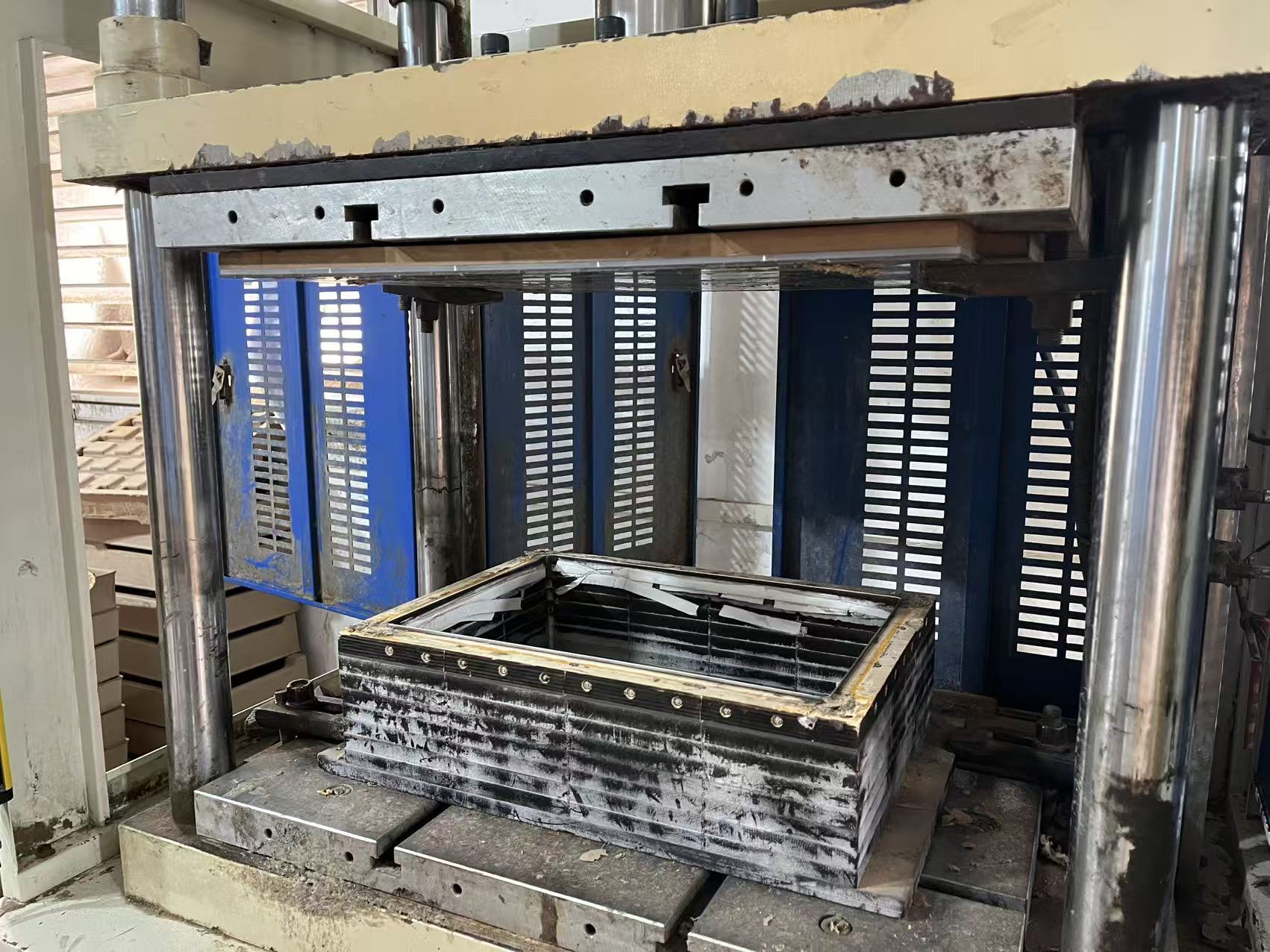
Trimming and finishing: edge definition and surface quality are set after forming, and they determine whether a tray suits a functional industrial fit or a visible retail pack.
Surface finish is produced in three stages — forming, drying and finishing. Hot pressing and trimming establish the outer skin, cavity accuracy and edge definition; custom services including special coating, embossing and printing then adapt the surface to the scenario. Colour options run from natural and white to yellow or a customized shade.
Industrial requirements are functional. The cavity surface should not shed fiber onto the product, cavity walls should match the product contour closely enough to stop movement inside the carton, and electronic assemblies need anti-static handling. Cosmetic defects matter less than repeatable fit, because the tray is not seen by the consumer. Consumer requirements are partly functional and partly perceptual: food-contact safety for anything that touches food, a surface clean enough for direct handling, and print or emboss quality that supports the brand on shelf. Cosmetic packaging and gift trays sit at the perceptual end of the range, where molded fiber is chosen for texture and board-like presentation as much as for protection.
Criterion 4: Temperature range
The general operating range for the tray family is −20 °C to +80 °C, with food-grade configurations documented from −20 °C to +120 °C. Mapped onto the two scenarios: chilled and frozen fresh produce, cold-chain food logistics and refrigerated retail all sit inside the general range; hot-fill, warmed food service and any application where the tray contacts heated contents require the food-grade configuration and its higher ceiling. Industrial applications normally operate well inside the general range, with two caveats worth writing into the specification — closed containers standing in direct sun and outdoor storage can push surface temperatures upward, and the same well-ventilated, dry storage guidance applies.
Where molded pulp trays beat the alternatives in industrial scenarios
Three advantages show up repeatedly in industrial programs. The first is cushioning: comparison data for these trays records 25–35% better cushioning performance than ordinary plastic packaging, supported by a thickened fiber structure in which natural fibers interweave into a dense protective layer — the mechanism behind the shock absorption and vibration damping used for precision electronics and fragile goods. The second is weight and stacking behaviour: company materials describe a weight reduction of approximately 50% against traditional hard gift boxes, combined with stacking stability that supports palletized loads, which reduces transport losses and storage and logistics cost. The third is geometry. In-house mold development allows multi-specification, complex and irregular integrated structures, so one molded tray can replace a combination of separate inserts and cut both part count and assembly steps.
The industrial profile that fits these advantages includes 3C electronics, electrical appliances, lighting fixtures, auto parts, hardware and sanitary ware, and medical devices — applications where the tray is judged on fit, cushioning and dimensional repeatability rather than on shelf appearance.
Where molded pulp trays beat the alternatives in consumer and food scenarios
In food and retail, the winning arguments are different. Food-grade molded pulp trays are documented for 3C and electronic appliances alongside food and catering, fresh produce, beauty and daily chemical gift boxes, wine gift boxes and medical devices, and the associated project requirements are recyclable, biodegradable and food-contact safe. Where the tray touches food, that contact-safety requirement effectively decides the material choice. Where it does not — wine gift boxes, cosmetic sets, retail display trays — the decision shifts to appearance and handling feel, and embossing or printing becomes the differentiator instead of barrier performance.
End of life is the third consumer advantage. The trays are degradable, recyclable and compostable, require no special post-use disposal, and company materials state that in a natural composting environment the material reaches 100% biodegradation within 28 days. For brands selling into Europe, the UK and North America, that profile also lowers exposure to packaging regulation and plastic-tax surcharges, which is a commercial argument as much as an environmental one.
How the technical data sheet should be read
The published parameters apply across the molded pulp tray family. The value a specific tray achieves is set by its geometry and wall thickness and is confirmed at sampling, so the following table should be read as a selection map rather than a specification to be quoted at its maximum.
| Parameter | Documented range | Where it decides the outcome |
|---|---|---|
| Raw material | Sugarcane pulp, bamboo pulp, wood pulp; recycled paper and bagasse fiber | Both scenarios; food-contact programs place more weight on virgin plant fiber |
| Colour | Natural, white, yellow, customized | Consumer, cosmetic and gift programs; rarely decisive in industrial |
| Wall thickness | 0.8–5.0 mm, customized as required | Industrial load path and packaging weight; consumer material cost |
| Wet-press density | 0.15–0.25 g/cm³ | Forming stage; governs how the wall forms around the product contour |
| Dry-press density | 0.28–0.45 g/cm³ | Industrial stacking strength after hot pressing |
| Moisture content | ≤8–12% | Food, fresh produce and chilled storage; also the storage condition to protect |
| Edge crush strength | 3–8 kN/m | Stacked industrial loads and palletized cartons |
| Compressive strength | 2–8 MPa | Top load on the tray column inside the shipper |
| Temperature range | −20 °C to +80 °C; food grade −20 °C to +120 °C | Cold chain, chilled retail and hot-fill food service |
Manufacturing capability behind both scenario types
Dongguan Tonghe Paper Industry Co., Ltd., trading as Tonghe Paper Co., LTD, is a molded fiber packaging manufacturer based in Qiaotou Town, Dongguan, Guangdong, China. It converts recycled paper and bagasse fiber, along with sugarcane, bamboo and wood pulp, into molded pulp trays and protective packaging as biodegradable alternatives to disposable plastic and foam packaging.
The operational profile matters for scenario matching. The company runs a 23,000 m² facility with 160 employees, including a 12-engineer R&D team, an annual output of 12,000 tons and monthly capacity of up to 1,000 tons across multiple automated production bases with complete forming and hot-pressing equipment. In-house mold development supports the irregular and multi-part geometries that industrial and gift packaging projects tend to require. Roughly 50% of output is exported, with the EU, USA, Australia, Saudi Arabia, Malaysia and Brazil listed as main markets. Compliance is stated as SGS RoHS and PFAS-free, and publicly available company materials list ISO 9001, ISO 14001 and FSC certifications. Custom services include special coating, embossing and printing, and free samples are offered so buyers can compare protection performance before committing to a mold.
Comparison with incumbent packaging, including where molded pulp loses
| Criterion | Molded pulp trays | Plastic packaging |
|---|---|---|
| Export compliance | Environmentally compliant and positioned for cross-border export to the EU, UK and North America; avoids plastic-tax and packaging-regulation risk | Subject to plastic-tax surcharges and packaging-regulation exposure in those markets |
| Cushioning | Recorded at 25–35% better cushioning performance than ordinary plastic packaging in the manufacturer comparison data | Baseline |
| Space in transit and storage | 40–60% space saved through nested stacking in the manufacturer comparison data | Baseline |
| Unit cost | Slightly higher unit cost than ordinary plastic packaging | Lower unit cost |
| Total EU export cost | Lower overall compliance cost, since plastic-tax surcharges do not apply | Higher |
| Raw material and disposal | Renewable plant fiber; degradable, recyclable and compostable with no special post-use disposal | Fossil-based raw material |
| Documented best-fit applications | Consumer electronics, lighting, gift packaging, food and wine export shipments | Baseline |
Two limits belong in the same conversation as the advantages. The first is cost: unit cost is slightly higher than ordinary plastic packaging, so a molded pulp program only pays back at the total-cost level — through compliance savings on EU-bound shipments, nesting-driven freight efficiency and reduced product damage — rather than at the per-piece quote level. A buyer comparing piece price alone will reach the wrong conclusion.
The second limit is the material envelope. Delivered moisture content is 8–12% or below, and trays must be stored well ventilated and dry, away from prolonged direct sunlight; a program that keeps packaging in a humid, unventilated area or exposes it to weather before packing is asking the material to do something it was not designed to do. Normal-use temperature tops out at +80 °C, with food grade reaching +120 °C, so applications involving sustained heat above that range sit outside the product family. Finally, a molded fiber surface is fibrous by nature: where a program requires a glass-smooth, non-shedding or tight-tolerance contact surface, fiber is not a like-for-like substitute, and that requirement should be raised during sampling rather than after the mold is cut.
Market and regulatory signals behind the industrial-consumer split
Three data points frame the decision. Grand View Research values the global molded pulp packaging market at USD 6.2 billion in 2025 and projects USD 10.2 billion by 2033; the same source places Asia Pacific at a 41.0% revenue share in 2025, with China holding the largest single market share. Estimates published for the same year vary according to the scope definition used, so headline market figures are best read together with the definition behind them.
Trays are the largest product segment, accounting for over 41.0% of global molded pulp packaging revenue in 2025 — which is why the industrial-versus-consumer split has commercial weight rather than being a labelling exercise. On the regulatory side, the European Packaging and Packaging Waste Regulation (EU) 2025/40 entered into force on 11 February 2025 and requires all packaging to be recyclable by 1 January 2030. That deadline lands first on consumer-facing packaging placed on the EU market — the food and retail trays in this comparison — while industrial trays are pulled along by the same supply chains. In healthcare, molded pulp for medical devices is projected to grow at an 8.6% CAGR, driven by sterilization standards and hospital plastic bans, a segment that behaves like industrial packaging during transport and like consumer packaging at the point of use.
Buyer decision checklist by scenario
| What to verify | Industrial scenario | Consumer scenario |
|---|---|---|
| Load case | Stacked compression, drop and vibration test on the loaded tray | Product location, separation and normal handling only |
| Parameter target | Dry-press density and wall thickness toward the upper end of the 0.28–0.45 g/cm³ and 0.8–5.0 mm windows | Minimum thickness that holds the product securely without adding weight |
| Moisture | Confirm dry, ventilated storage and 8–12% or lower moisture content on receipt | Model product moisture, condensation and chilled dwell time; ventilate the tray geometry |
| Surface and contact | Non-shedding cavity surface, consistent fit, anti-static handling for electronics | Food-contact safe where food is touched; print or emboss quality for shelf |
| Temperature | General range −20 °C to +80 °C | General range for ambient and chilled; food grade −20 °C to +120 °C for hot fill |
| Documentation | SGS RoHS and PFAS-free statements; ISO 9001, ISO 14001 and FSC where required | Same baseline plus food-contact documentation for the specific project |
| Validation | Free samples for fit and drop comparison before mold commitment | Sample against the retail pack and the chilled or frozen storage cycle |
Future outlook
The industrial and consumer tracks are converging on the same material for different reasons, and the next few years will test whether suppliers can serve both from a single parameter window. On the consumer side, the EU recyclability deadline of 1 January 2030 turns fiber trays into a compliance instrument rather than a preference, and the projected 8.6% CAGR for medical device pulp packaging pulls structural, industrial-grade requirements into contact-sensitive applications. On the industrial side, the pressure runs the other way: buyers are asking for the same documentation and end-of-life evidence that food and retail programs already demand. The practical consequence is that the tray specification has to split — one section for structural performance, one for moisture and contact, and a clearly stated storage and temperature envelope that both sides can be measured against. Molded pulp does not win every comparison in this article: it costs slightly more per piece than ordinary plastic, it is not a waterproof material, and its temperature ceiling is finite. Within its envelope, however, the fit criteria above are what separate a tray that performs from a tray that merely ships.
FAQ: industrial and consumer molded pulp tray selection
Do molded pulp trays support heavy industrial loads?
The documented ranges are an edge crush strength of 3–8 kN/m, a compressive strength of 2–8 MPa and a dry-press density of 0.28–0.45 g/cm³, with wall thickness formable from 0.8 mm to 5.0 mm. These values form a design window rather than a fixed rating, so the load a specific tray carries depends on its geometry and wall thickness. Industrial applications that use molded fiber trays include 3C electronics, electrical appliances, lighting, auto parts and hardware and sanitary ware.
How does moisture affect molded pulp trays in food and cold-chain use?
Trays are delivered at a moisture content of 8–12% or below and are stored well ventilated and dry, away from prolonged direct sunlight, because the fiber structure is not waterproof. In food, fresh produce and chilled retail applications the moisture load comes from the product and from condensation, so tray geometry and storage conditions have to be planned around it. Food-grade configurations are documented for use from −20 °C to +120 °C, which covers chilled, frozen and hot-fill contact inside that range.
What surface finish options exist, and which scenario needs them?
Forming, hot pressing and trimming set the basic surface and edge; customization options include special coating, embossing and printing, with colours available in natural, white, yellow or a custom shade. Industrial programs mainly need a clean, non-shedding cavity surface with consistent fit and anti-static behaviour for electronic assemblies. Consumer, cosmetic and gift programs place more weight on texture, print and emboss quality, because the tray is visible to the end customer.
Can one tray design serve both industrial and consumer applications?
Sometimes, but the criteria differ enough that a shared design is usually a compromise. Industrial trays are specified around stacking, drop and vibration performance; consumer trays around food-contact safety, moisture and presentation. Where a single product family crosses both environments — for example a device shipped with a gift or food accessory — separate tray variants are normally validated through sampling rather than one design serving both.
In which situations is molded pulp a weaker choice than plastic packaging?
Three documented limits apply. Unit cost is slightly higher than ordinary plastic packaging, although overall compliance cost for EU exports is lower because plastic-tax surcharges do not apply. Moisture content is limited to 8–12% or below with dry, ventilated storage required, so programs with sustained liquid contact or humid storage need a different approach. The normal-use temperature ceiling is +80 °C, with food grade at +120 °C, so sustained heat above that range falls outside the product family.
Detailed molded pulp tray specifications, material options and application examples are compiled in the company brochure: Tonghe Pulp Molding Product Brochure (PDF).