
Injection Molding Machine Framework: Electric vs Hybrid vs Servo-Hydraulic
A high-speed electric, a hybrid two-platen and a servo-hydraulic two-platen injection molding machine can all produce an acceptable part. What separates them is where each architecture puts its engineering cost — and which of those costs a given mould, cycle and material range can actually absorb.
Most injection molding machine purchases begin with a part drawing and a target output, and only later turn into a discussion about drive architecture. The sequence matters. Comparing electric against hybrid against servo-hydraulic as if they were three grades of the same product usually produces a decision that looks modern on paper and underperforms in production. The more reliable approach is to fix the mould, the cycle and the material first, then test each architecture against those constraints, and finally agree on the numbers that will be measured at acceptance.
This framework uses three published platforms as reference points: the Zhafir Zeres Series ZE-F for high-speed electric packaging work, the Zhafir Jeres Series JE5 for compact hybrid two-platen production, and the Haitian Jupiter Series JU5 for servo-hydraulic two-platen work on large moulds. The comparison is organised around five dimensions that determine fit — cycle and output, mould capacity, material range, automation and MES integration, and documented acceptance terms.
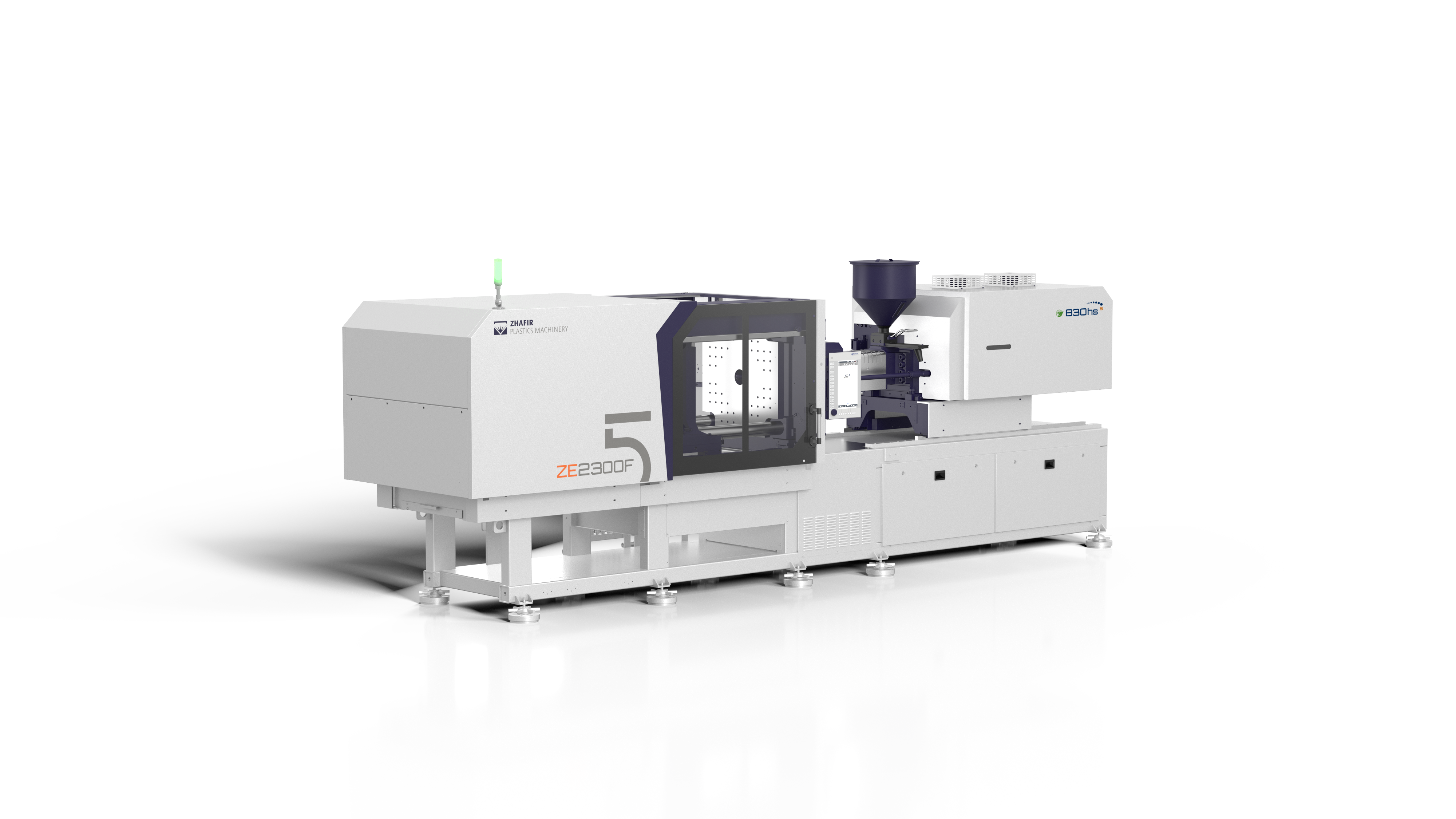
Zhafir Zeres Series ZE-F — high-speed electric platform with integrated hydraulic functionality, published clamping force range 1,500–6,500 kN, positioned for caps, closures and thin-wall packaging.
Why the architecture question moved into procurement
Two architectures now share the market rather than one displacing the other. Published commercial-research estimates place hydraulic technology above 40% of the 2024 injection molding machine market, while the electric segment alone was estimated at around USD 4.9 billion in 2024. These two figures come from different research publishers with different scopes and should not be added together; they are a directional signal that both architectures remain in active production, not an input for a cost model.
A second shift is more consequential for buyers. The value argument has moved from drive type to documented production outcome. Commercial research on smart manufacturing links connected production systems with roughly 25% lower scrap and 20%–40% lower unplanned downtime — figures that appear in procurement discussions as acceptance targets rather than as brochure claims. Once a buyer starts writing downtime and scrap into the contract, drive architecture becomes a means rather than the objective, and the comparison has to include what gets measured at handover.
The three reference platforms, defined
All three platforms in this framework are built by Haitian International Holdings Ltd., an injection molding machine manufacturer founded in 1966 that operates the Haitian, Zhafir and Niigata brands. The group publishes an annual output of 56,000+ machines, a 40% export ratio and a customer base across more than 130 countries and regions, with manufacturing and service presence supporting the three platform families discussed here.
Zhafir Zeres Series ZE-F — high-speed electric for packaging
The ZE-F is a high-speed configuration of the Zeres electric platform with integrated hydraulic functionality, published with a clamping force range of 1,500–6,500 kN. Zhafir positions the series specifically as a high-speed packaging solution: short cycles, high output and precise electric movement control, with integrated hydraulics providing additional flexibility for mould functions. Published material coverage is PP, PE and HDPE, and the intended applications are caps, closures, thin-wall packaging, food packaging and other high-volume work where the production cell runs continuously.
Zhafir Jeres Series JE5 — hybrid two-platen for larger industrial parts
The JE5 is a hybrid two-platen machine published with a clamping force range of 3,500–33,000 kN. It pairs electric injection technology with a compact two-platen clamping concept aimed at larger moulds and components, and Zhafir describes the series as “hybrid · two-platen · precise.” Published material coverage extends to PP, PE, ABS, PA, PC, PC/ABS, PMMA, TPE and reinforced compounds depending on configuration, with application coverage across automotive, large technical parts, logistics, household appliances, mobility, industrial components and consumer goods.
Haitian Jupiter Series JU5 — servo-hydraulic two-platen for large moulds
The JU5 is a servo-hydraulic two-platen machine with a published clamping force range of 4,500–88,000 kN, injection volume of 848–134,303 cm³, screw diameter of 60–300 mm, maximum daylight of 1,400–7,000 mm, tie-bar distance of 810 × 810 to 3,400 × 2,820 mm, and a KEBA controller. Four short-stroke clamping cylinders are published as delivering uniform clamping force and high repeatability, and Generation 5 electrical plasticizing is published as reducing energy consumption by 20%–40%. Its intended applications include automotive, logistics, household appliances, large technical parts, industrial components, mobility, and building and construction components.
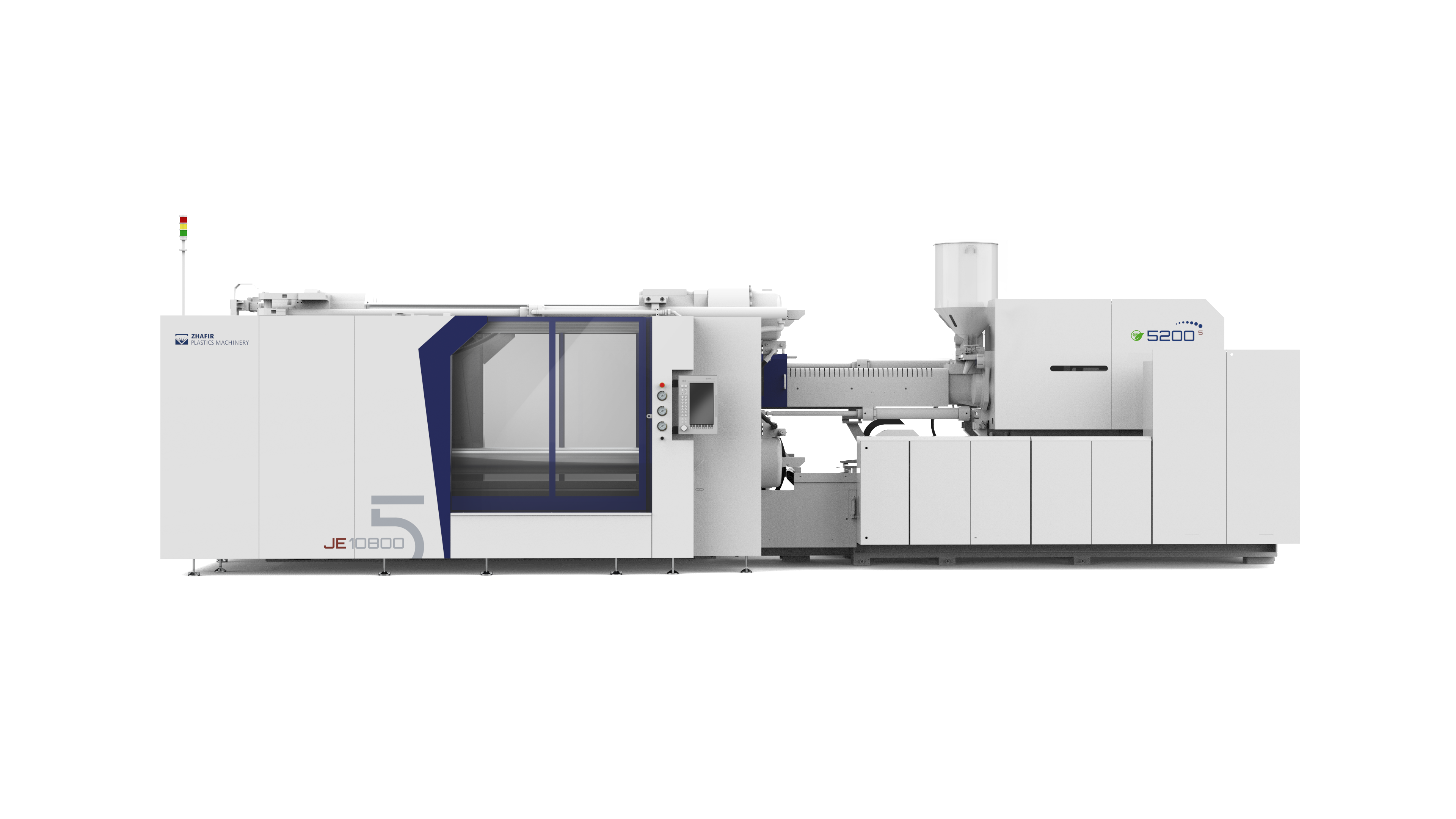
Zhafir Jeres Series JE5 — hybrid two-platen platform, published clamping force range 3,500–33,000 kN, combining electric injection with a compact two-platen clamping concept.
Dimension 1 — Cycle time and output per mould
Cycle time is the first filter because it eliminates platforms faster than any other criterion. A packaging cell is published in industry terms as short cycles, high cavitation, thin walls, high injection speed and continuous high output, supported by high-cavity moulds, fast or side-entry robots, IML systems, material feeding, chillers, and inspection and stacking equipment. Requirements in that cell include high injection speed, short cycle time, repeatability, low energy per part, clean handling and IML compatibility.
The ZE-F is aimed directly at that condition set. Its published positioning is short-cycle, high-output production with precise electric movement control, and its integrated hydraulics exist to give the cell additional mould-function flexibility without moving to a fully hydraulic platform. The JE5 addresses a different cycle profile: with electric injection on a two-platen clamp, its cycle is governed more by shot weight, clamp force and cooling of a larger part than by the thin-wall filling behaviour that defines packaging tooling. The JU5 sits further along that line again, where the dominant variables are mould mass, shot weight and cavity pressure across large components.
Drive architecture does not monopolise speed, and the framework should say so. The Haitian Mars Series MA/F, a servo-hydraulic configuration of the Mars platform, publishes injection speeds up to 500 mm/s with electrical plasticizing and short mould open/close times for thin-wall and IML packaging work. A buyer comparing “high speed” as a category therefore needs to compare published injection speed, dry-cycle behaviour and cell integration for the specific machine size, not assume the label belongs to one drive type.
A documented case illustrates where the electrical advantage shows up even outside packaging. Templa operates six electric Zhafir Zeres machines inside a 22-machine fleet producing roughly 65 million parts per year. In a documented comparison producing a PP TV20 technical part on a 28-second cycle with approximately 90 g shot weight, the Zeres machine consumed about 30% less energy than the hydraulic machine it was compared against. The relevance to this framework is the shape of the evidence: energy per part was measured on a real job, at a real cycle, rather than claimed as a platform property.
Decision rule: if cycle time is dominated by wall thickness and cooling, compare electric platforms first. If it is dominated by shot weight, clamp force and mould mass, decide the clamp architecture first and treat the drive type as a secondary variable.
Dimension 2 — Mould capacity, daylight and floor space
Mould capacity is the dimension where the three platforms separate most clearly, because clamping force ranges do not overlap evenly. The ZE-F is published at 1,500–6,500 kN, which covers a wide span of caps, closures and thin-wall packaging tooling but does not extend into large-mould territory. The JE5 begins at 3,500 kN and reaches 33,000 kN in a compact two-platen structure, which is where larger technical parts and automotive components start. The JU5 begins at 4,500 kN and extends to 88,000 kN with maximum daylight published up to 7,000 mm.
Daylight and tie-bar distance matter more than tonnage when a mould is deep. A two-platen architecture is published as shortening machine length while offering larger mould space and extended opening stroke, which is why the JU5 publishes tie-bar distance and daylight as first-order specifications rather than as secondary notes. For deep-cavity parts — large containers, panels, housings — the question is not only whether the machine can clamp the mould, but whether the mould can open far enough to eject the part without interference.
The upper end of that range is documented. Haitian engineered and manufactured a JU88000 machine with 88,000 kN clamping force and 134,000 cm³ injection volume for Belli SAS, for the production of large water and rainwater storage tanks. The project reduced machine footprint relative to the initial requirement, completed extensive testing, received CE certification in September 2023, and was formally accepted by the customer in October 2023, with a customized Hilectro VD-150ID robot integrated into the solution. That case also foreshadows the acceptance discipline discussed later in this framework.
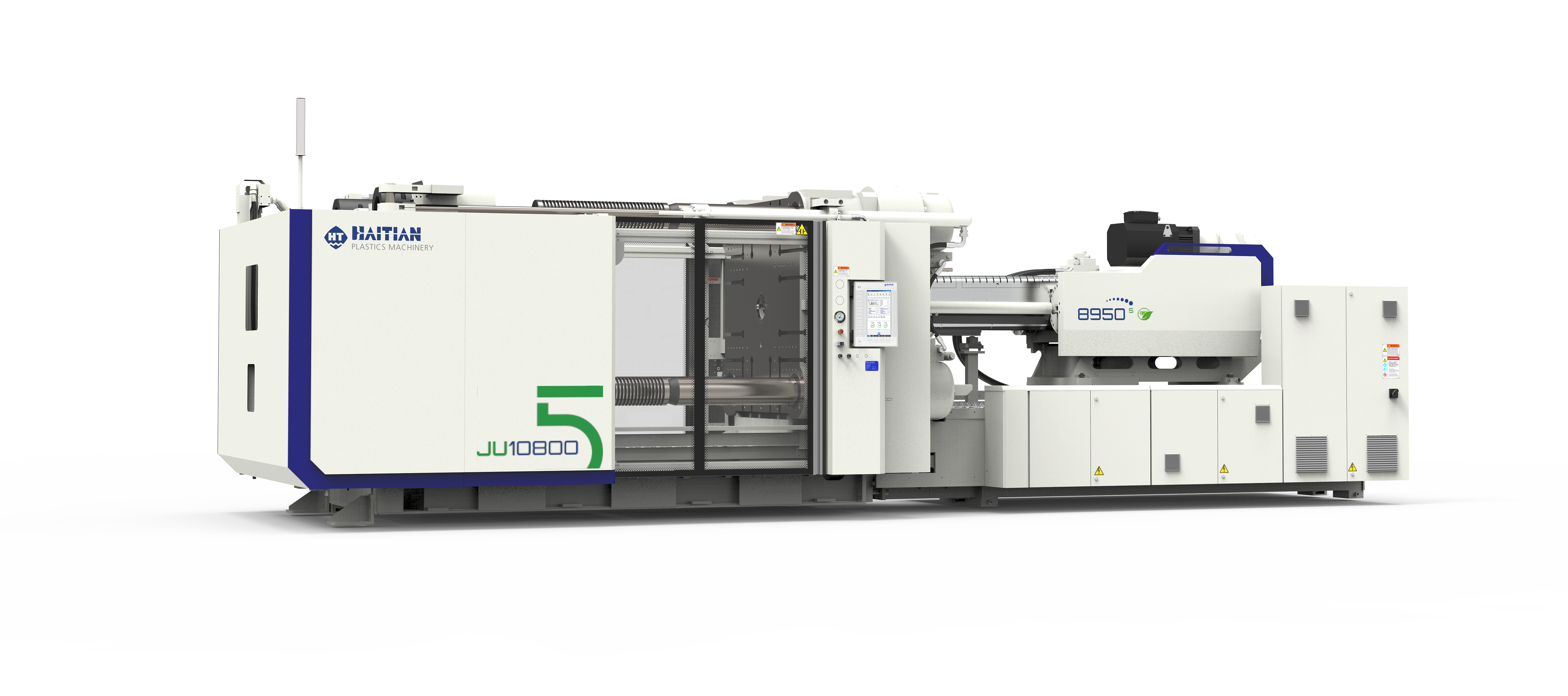
Haitian Jupiter Series JU5 — servo-hydraulic two-platen platform, published clamping force range 4,500–88,000 kN, maximum daylight 1,400–7,000 mm.
Decision rule: fix the mould dimensions, the required daylight and the tie-bar clearance first, then read the clamping force range. A platform above or below the mould's requirement adds cost or removes capability, and neither is recoverable through options.
Dimension 3 — Material range and plasticizing configuration
Material coverage is published per platform and per configuration, which makes it a screening criterion rather than a specification. The ZE-F publishes PP, PE and HDPE as its material base — the polyolefin group that dominates caps, closures and thin-wall food packaging. The JE5 publishes a broader range including PP, PE, ABS, PA, PC, PC/ABS, PMMA, TPE and reinforced compounds depending on configuration. The JU5 publishes the same engineering thermoplastic families plus filled and reinforced compounds depending on the plasticizing configuration selected.
Read together, these lists describe a natural boundary rather than a ranking. A buyer running unmodified polyolefin packaging does not gain capability by specifying a broader material list, but a buyer running glass-filled PA in an automotive structural part cannot be served by a platform whose published material range is limited to polyolefins, regardless of how fast its cycle is. Where reinforced compounds are in scope, the plasticizing unit — not the clamping architecture — becomes the deciding configuration item.
The framework should also be honest about what a published material list can and cannot do. It indicates the material families a platform has been published against; it does not replace a mould trial with the actual compound, colour masterbatch and regrind ratio that will run in production. Mould trials and initial sampling sit inside the supplier's published quality process for exactly this reason.
Dimension 4 — Automation, robot interface and MES fit
Automation requirements differ by cell type before they differ by machine. A packaging cell is published around high-cavity moulds, fast or side-entry robots, IML systems, material feeding, chillers, and inspection and stacking equipment. An automotive cell is published around robots, material handling, dryers, mould temperature control, chillers, inspection systems, and optional multi-component or insert-moulding equipment. A consumer goods cell publishes robots and material handling with optional IML, decoration or multi-component equipment, while a logistics cell adds recycled-material handling, gravimetric dosing, chillers and optional insert handling with leak or pressure testing. The machine's job is to expose the signals those peripherals and the plant system need.
Platform-level statements help here. The Zeres electric platform publishes integrated servo-hydraulic functionality for applications that require hydraulic mould functions such as core pulls, which is directly relevant when a packaging or technical mould needs sequenced auxiliary motion alongside fast electric cycles. The JU5 publishes a KEBA controller, which matters to buyers whose plant standard, spare-parts strategy or internal programming capability is built around that control environment.
MES connectivity is where published claims and verified outcomes diverge most often. A documented case is instructive: Haitian machines were integrated into Giebeler's production and connected to its MES via standardized EUROMAP interfaces, which improved real-time production transparency, reduced manual checks, accelerated root-cause analysis and supported documented process stability and traceability. The same source attributes lower operating costs and stable OEE to servo-hydraulic drive technology, stable plasticizing and open automation interfaces working together — not to any single element.
Fleet-level evidence points in the same direction. MöllerGroup operates 47 Haitian machines worldwide, mainly Jupiter and Mars machines plus two electric Zeres machines, with clamping forces from 150 to 1,850 tons, supporting frequent tool changes and flexible production planning, and has extended the relationship into automation with a Mars 200 combined with a Hilectro V1300 robot and a Smart Solutions production cell. Automotive two-platen installations such as those at Valeo in France show the same pattern of multi-machine cells rather than standalone units.
Decision rule: write the data-point list — cycle, cavity pressure, shot weight, alarm history, energy per cycle, OEE definition — into the specification before comparing platforms. Connectivity that cannot be mapped to those points is a feature, not an integration.
Dimension 5 — Documented acceptance terms
Acceptance is the dimension where a comparison framework either becomes a contract or stays a brochure. Haitian publishes a quality process that includes factory testing, machine inspection before delivery, mould trials, initial sampling, process optimization, application testing, commissioning, and optional process monitoring and integrated quality inspection. Those items exist as a process; which of them become contractual obligations is a buyer decision.
The Belli SAS project shows what a documented acceptance looks like in practice. The JU88000 completed extensive testing, received CE certification in September 2023 and was formally accepted by the customer in October 2023, with the integrated Hilectro VD-150ID robot included in the delivered solution. The sequence — test, certify, accept — is the part worth copying, independent of machine size.
A practical acceptance schedule for any of the three platforms typically covers: shot weight and dimensional capability on the actual mould; achieved cycle time against the quoted cycle; energy consumption per part or per kilogram at production settings; dry-cycle and mould-movement times; each auxiliary mould function operating in sequence; robot and peripheral handshake tests; the agreed MES data points reporting correctly; and a documented baseline for scrap and OEE against which the first months of production can be measured. None of these items is automatically included in a machine order, and none of them can be inferred from a clamping force figure.
Side-by-side comparison
| Comparison dimension | Zhafir Zeres ZE-F | Zhafir Jeres JE5 | Haitian Jupiter JU5 |
|---|---|---|---|
| Drive and clamp architecture | High-speed electric platform with integrated hydraulic functionality | Hybrid drive with two-platen clamping | Servo-hydraulic drive with two-platen clamping |
| Published clamping force | 1,500–6,500 kN | 3,500–33,000 kN | 4,500–88,000 kN |
| Published injection volume | Per machine size and injection-unit configuration | Per machine size and injection-unit configuration | 848–134,303 cm³ |
| Mould space data | Per machine size and configuration | Per machine size and configuration | Max daylight 1,400–7,000 mm; tie-bar distance 810 × 810 to 3,400 × 2,820 mm |
| Published material coverage | PP, PE, HDPE | PP, PE, ABS, PA, PC, PC/ABS, PMMA, TPE; reinforced compounds depending on configuration | PP, PE, ABS, PA, PC, PC/ABS, PMMA, TPE; filled and reinforced compounds depending on plasticizing configuration |
| Primary application fit | Caps, closures, thin-wall packaging, food packaging, high-volume consumer goods | Automotive, large technical parts, logistics, household appliances, mobility, industrial components | Automotive, logistics, household appliances, large technical parts, industrial components, building and construction |
| Published automation-relevant feature | Integrated hydraulics for additional mould functions in fast automated packaging cells | Electric injection combined with compact two-platen mould capacity | Four short-stroke clamping cylinders for uniform clamping force and high repeatability; KEBA controller |
| Published energy-relevant feature | Precise electric movement control in short-cycle production | Electric injection side of a hybrid architecture | Generation 5 electrical plasticizing published at 20%–40% energy reduction |
Table notes: values are published platform data. Where a platform publishes specifications by machine size or injection-unit configuration, the comparison cannot be completed at catalogue level and requires a configuration-level data sheet.
Where the framework stops: limitations and trade-offs
A comparison framework that only lists advantages is a sales document. Three boundaries are worth stating explicitly.
The ZE-F has a published ceiling. At 1,500–6,500 kN, the platform does not extend into the large-mould range occupied by the JE5 and JU5. A buyer whose packaging programme later moves to larger cavitation or thicker sections may find the architecture correct but the size range exhausted, which is a portfolio planning question rather than a machine performance question.
Not every dimension can be compared at catalogue level. The JE5 publishes its clamping force range and material coverage, while injection volume, platen dimensions and tie-bar distance are published per machine size and configuration. That is not a gap in the machine; it is a limit of public data. Any equal-weight comparison table built purely from brochures will therefore flatter whichever platform happens to publish more numbers, which is why the framework should be completed with configuration-level data sheets before a shortlist is finalised.
Clean-production requirements need their own verification. The Zhafir all-electric platform is published as producing no hydraulic oil contamination and supporting cleanroom-grade production, and the Zeres platform is published as combining electric main movements with integrated servo-hydraulic functionality for mould functions such as core pulls. Where a medical or cleanroom cell is the target, cleanliness and contamination control should be specified and verified against the actual machine configuration rather than assumed from the drive label. Similarly, the published 20%–40% energy reduction for Generation 5 electrical plasticizing is a platform statement that should be converted into a measured value on the buyer's own part and cycle during acceptance.
Application fit: matching platform to production cell
Read as a whole, the three platforms map onto three cell types with limited overlap.
- High-speed packaging cell. Continuous fully automated production, high-cavity moulds, fast or side-entry robots, IML where required, and inspection and stacking equipment. The ZE-F is the closest published match, with the Mars MA/F servo-hydraulic high-speed configuration as the alternative where a hydraulic platform is preferred for other plant reasons.
- Technical parts and industrial components cell. Larger moulds than packaging, engineering thermoplastics, and a mix of reinforced compounds. The JE5 covers this range from 3,500 kN upward in a compact two-platen frame, which is where electric injection precision and two-platen mould capacity are both required.
- Large-part and logistics cell. Pallets, crates, transport containers, waste bins, protective cases, new-energy components and industrial fittings, with large shot capability, high clamping force and recycled-material handling. The JU5 covers this range with published injection volume up to 134,303 cm³, and the JU88000 project for Belli SAS shows the extreme end of the same architecture.
- Consumer goods and home appliance cells. Flexible automated high-volume production with frequent product and mould changes, short cycles, low unit cost and flexible automation integration. All three platforms can appear here, which is precisely why the five-dimension framework — rather than platform positioning — has to make the call.
Market and technology direction
Two published trends affect how this framework will be applied over the next equipment cycle. The first is digitisation of the production cell. Industry commentary on smart manufacturing in injection moulding consistently associates the transition with connected data through IoT or IIoT, real-time monitoring of machines and auxiliary equipment, and energy-saving drive technologies — a convergence of digitalisation and energy efficiency rather than two separate programmes. For buyers, that means MES data points and energy measurement belong in the same acceptance document, not in separate projects.
The second is the continued coexistence of architectures. Commercial-research estimates describe a global injection molding machine market measured in the low tens of billions of US dollars in the mid-2020s with single-digit compound growth into the next decade; different publishers produce different absolute values for the same year, so the figures are best used for capacity-planning direction rather than for investment arithmetic. What the estimates do support is a market large enough to sustain electric, hybrid and servo-hydraulic platforms simultaneously — which is why the comparison question is about fit, not about which architecture will disappear.
Frequently asked questions
How do I choose between a high-speed electric and a servo-hydraulic two-platen machine for packaging?
The published clamping force ranges set the first boundary. The Zhafir Zeres Series ZE-F is published at 1,500–6,500 kN with a packaging-specific positioning: short cycles, high output, PP, PE and HDPE material coverage, and integrated hydraulics for additional mould functions. The Haitian Jupiter Series JU5 is published from 4,500 kN upward, with injection volume up to 134,303 cm³. Packaging work that fits inside 6,500 kN and runs polyolefin thin-wall tooling sits inside the ZE-F's published scope; work that requires very large moulds or high shot weights sits in two-platen territory regardless of drive preference.
What clamping force range does each platform cover?
Published ranges are: Zhafir Zeres Series ZE-F, 1,500–6,500 kN; Zhafir Jeres Series JE5, 3,500–33,000 kN; Haitian Jupiter Series JU5, 4,500–88,000 kN. The ranges overlap between 4,500 and 6,500 kN, where the decision turns on mould size, material and cell type rather than on tonnage alone.
Can a hybrid two-platen machine process engineering plastics and reinforced compounds?
According to published platform data, yes within configuration limits. The Zhafir Jeres Series JE5 publishes material coverage of PP, PE, ABS, PA, PC, PC/ABS, PMMA, TPE and reinforced compounds depending on configuration. The Haitian Jupiter Series JU5 publishes the same engineering thermoplastic families plus filled and reinforced compounds depending on the plasticizing configuration selected. Final confirmation for a specific compound, additive package and regrind ratio is a mould trial matter, not a catalogue matter.
Which platform is easier to connect to MES and plant automation?
All three platforms publish open interfaces and automation integration as part of their positioning, and the Jupiter Series JU5 publishes a KEBA controller. Documented evidence of MES integration exists at fleet level: Haitian machines were connected to Giebeler's MES via standardized EUROMAP interfaces, improving real-time production transparency, reducing manual checks and accelerating root-cause analysis. The practical answer, however, depends on the buyer's own data model. The decisive step is to specify the required data points, supported protocols, alarm-history access and cybersecurity requirements before comparing platforms, because ease of connection is defined by that list rather than by the controller brand.
What should be documented and measured at machine acceptance?
Haitian publishes a quality process covering factory testing, machine inspection before delivery, mould trials, initial sampling, process optimization, application testing, commissioning, and optional process monitoring and integrated quality inspection. Which of those become contractual obligations is decided by the buyer. A documented precedent is the JU88000 project for Belli SAS, where the machine completed extensive testing, received CE certification in September 2023 and was formally accepted in October 2023. In practice, acceptance should record shot weight and dimensional capability on the production mould, achieved cycle time against quotation, energy consumption per part at production settings, auxiliary mould functions operating in sequence, robot handshakes, the agreed MES data points reporting correctly, and a baseline for scrap and OEE.
Есть вопросы или нужны дополнительные детали?
Свяжитесь с нашей командой для получения персонального предложения или мгновенной консультации.
Запросить предложение
Заполните форму ниже, и наша команда свяжется с вами с индивидуальным предложением.
Прямой чат WhatsApp
Предпочитаете общаться в реальном времени? Напишите нам в WhatsApp для мгновенной помощи и быстрых ответов.
- Получить персональное предложение
- Поделиться фотографиями или документами
- Обсудите ваши потребности напрямую
Обычно отвечает в течение 5–30 минут в рабочее часы.