
Injection Molding Machine Manufacturers: What to Verify

Evaluating injection molding machine manufacturers is not primarily a matter of comparing capability blurbs. Once a buyer moves from awareness into research and evaluation, the shortlist starts to be shaped by constraints — market-access certification, machine specifications that match the part and mold, integration paths into an existing plant, and the supplier’s ability to support the machine across its working life. These constraints do not by themselves identify a “best” manufacturer, but they eliminate options quickly and force attention onto the subset of suppliers that can realistically support a quotation and installation cycle.
The scale of the category is one reason this filtering matters. Grand View Research places the global injection molding machine market at USD 17.3 billion in 2025, with a projected value of USD 25.5 billion by 2033 at a CAGR of 5.0%. Asia Pacific held the largest regional share of this market in 2025, at 39.7%. Against that backdrop, a buyer using specification and certification constraints is not narrowing a small field; they are narrowing a very large one. This article sets out the constraints that most reliably separate biddable manufacturers from the broader landscape, and shows how they can be applied during research and evaluation.
Why constraints, not capability lists, drive the shortlist
A capability list tells a buyer what a manufacturer can produce in general. A constraint list tells them whether the machine can enter the buyer’s market, match the buyer’s mold and resin, and be integrated into the buyer’s plant. Those are different questions, and they are answered at different stages of evaluation.
In practice, four constraint families dominate the research and evaluation stage for injection molding machines: (1) market-access certification; (2) specification match against part size, mold geometry and resin; (3) integration with automation, monitoring and MES-level systems; and (4) supplier support structures that determine whether the machine remains productive after commissioning. Each of these can be verified against documents, and each of them can remove a name from the shortlist before pricing is even discussed.
A useful reference point is the way the broader market splits between drive architectures. Grand View Research estimates that hydraulic technology captured more than 40% of the market share in 2024, which is a reminder that the constraint set is not identical for every buyer. A buyer evaluating a servo-hydraulic workhorse, an all-electric precision platform, and a two-platen large-part machine is really running three different constraint checks on the same supplier list.
Constraint one: market-access certification
Certification is the constraint that is easiest to verify and hardest to work around. For EU market access, the relevant question is whether the machine covered by the buyer’s enquiry is within the scope of a valid EC-Type Examination. Haitian International’s EC-Type Examination certificate (BM 50607648 0001, issued by TÜV Rheinland LGA Products GmbH, valid from 2024-01-02 to 2029-01-01) covers the Haitian Mars Series MA5 servo-hydraulic injection molding machine, the Haitian Jupiter Series JU5 two-platen injection molding machine, the Zhafir Venus Series VE5 all-electric injection molding machine, and the NIIGATA MDV-S8500 Series vertical injection molding machine, in compliance with Annex I of Council Directive 2006/42/EC.
For US and Canadian market access, the relevant document is the TÜV Rheinland certificate CU 72303354 0001, issued on 2024-01-11 and covering the plastics injection moulding machine models VE400V, VE600V, VE900V, VE1200V, VE1500V and VE19000V against ANSI/PLASTICS B151.1-2017, NFPA 79:2021 and CSA C22.2 No. 301-2016. A buyer running a North American project should check whether the specific model in their quotation falls inside that model list; certificate validity is not a blanket statement about every machine a supplier makes.
Plant-level certifications are a separate constraint. ISO 9001 certification covers quality management across the Haitian Mars Series MA5, the Haitian Mars Series MA/F high-speed machine, the Haitian Jupiter Series JU5 two-platen machine, the Zhafir Zeres Series ZE5 electric machine, the Zhafir Venus Series VE5 all-electric machine, and the NIIGATA MD-S8500 Series horizontal all-electric machine. ISO 14001 applies to environmental management for the servo-hydraulic, all-electric, two-platen, high-speed electric and vertical machines. ISO 45001 covers occupational health and safety for a wider list that includes the Mars Series MA5, MA5/Ultra and MA/F machines, the Jupiter Series JU5, the Zhafir Venus, Zeres and Jeres Series, the Zhafir Multicomponent machine, and the NIIGATA MD-S8500 and MDV-S8500 Series. ISO 50001 certification, issued for the energy management activities of production systems for plastic injection molding machines, covers the Haitian Mars Series MA5 and MA/F platforms.
The constraint logic here is straightforward. If a buyer intends to export finished parts into a regulated market, or if the plant itself is audited under ISO-based management systems, the certification scope becomes a first-pass filter. A manufacturer that cannot show a current certificate covering the specific model under consideration is not necessarily unsuitable, but the buyer now knows that additional conformity work would sit on their side of the project.
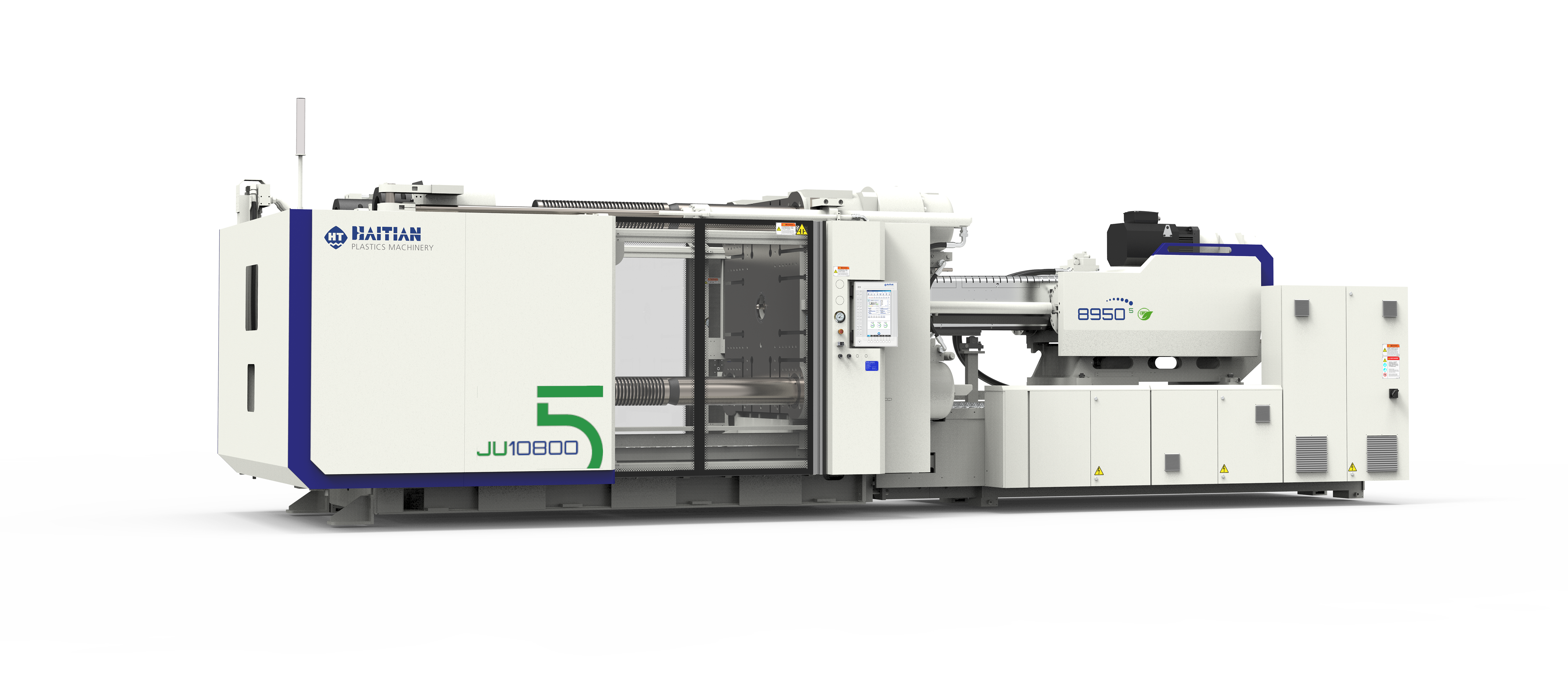
Two-platen architecture is one of several machine categories that fall under different specification constraints than toggle machines.
Constraint two: specification match against the part and mold
Specification is where the shortlist splits by application rather than by reputation. The same manufacturer may have a machine family that fits a packaging cell and another that fits an automotive interior part, but the two are evaluated against different numbers.
On the large-part side, the Haitian Jupiter Series JU5 is a servo-hydraulic two-platen injection molding machine with a clamping force range of 4,500 to 88,000 kN, an injection volume range of 848 to 134,303 cm³, screw diameters from 60 to 300 mm, maximum daylight of 1,400 to 7,000 mm, and tie-bar distances from 810 × 810 mm up to 3,400 × 2,820 mm. Four short-stroke clamping cylinders provide uniform clamping force and high repeatability, and Generation 5 electrical plasticizing can reduce energy consumption by 20 to 40%. The two-platen architecture supports large mold capacity while minimising machine footprint, which matters when a buyer is comparing factory floor allocations rather than headline tonnage.
On the packaging side, the Haitian Mars Series MA/F is a high-speed servo-hydraulic machine with injection speeds up to 500 mm/s, electrical plasticizing, and compatibility with high-speed automation, IML automation and side-entry robots. It is configured for short-cycle packaging applications and short mold-opening and closing times. The Zhafir Zeres Series ZE-F is the high-speed electric counterpart, with a clamping force range of 1,500 to 6,500 kN, built on the Zeres electric platform with integrated hydraulic functionality for mold functions such as core pulls.
For precision and medical applications, the constraint set shifts again. The NIIGATA MD-S8500 Series is a precision horizontal all-electric machine with a model range that includes MD50S8500, MD75S8500, MD100S8500, MD130S8500, MD180S8500, MD220S8500, MD280S8500 and MD350S8500. It uses tie-bar sensing to compensate for clamping-force variation, supports pressure control down to 0.1 MPa, and includes OPC UA connectivity for integration. Similar precision logic applies to the Zhafir Venus Series VE5 all-electric platform, which offers a clamping force range of 400 to 13,800 kN, injection volume of 12 to 5,767 cm³ and a generation change that reduces footprint by up to 15% and increases mold movement speed by 20%.
A buyer whose part is a two-material automotive lamp lens will care about different numbers than a buyer whose part is a packaging container wall. That is why the specification constraint should be applied per part family, not per supplier ranking.
Constraint three: automation, connectivity and plant integration
Integration is the constraint that has moved fastest in recent years. A machine that meets certification and specification requirements can still be excluded if it cannot talk to the plant’s automation and monitoring layer. Industry 4.0 adoption in injection molding, as described across trade media and professional-society publications, consistently centres on IoT/IIoT connectivity, real-time monitoring of machines and auxiliary equipment, and energy-saving drive technologies. Those are the features buyers increasingly specify at the quotation stage.
Within this reference portfolio, the Zhafir Venus Series VE5 includes intelligent functions and open automation and MES connectivity, with a motorized ejection speed up to 400 mm/s. The Zeres Series ZE5 combines electric main movements with integrated servo-hydraulic functionality for mold functions such as core pulls, and includes intelligent functions and open automation and MES connectivity as well. The NIIGATA MD-S8500 Series provides OPC UA connectivity on the machine platform, which allows a buyer to specify a standardised data path rather than a proprietary one. Compatibility with side-entry robots, IML systems and high-speed automation is documented for the packaging platforms.
The verification question a buyer should carry into evaluation is not simply “is the machine connected” but “which protocol, which data, and which downstream systems have been demonstrated.” Public evidence that smart systems contribute to a 25% reduction in scrap and a 20% to 40% drop in unplanned downtime provides context for why the integration constraint carries weight, but the buyer still needs to confirm the specific data architecture for their own plant. That confirmation is part of evaluation, not a claim the manufacturer can be assumed to have proven for every customer.
Constraint four: product scope and application fit
A manufacturer’s product scope is itself a constraint, because scope defines which applications can be quoted from a single platform rather than a patchwork of suppliers. In the reference portfolio used here, the range spans vertical all-electric, horizontal all-electric, all-electric with integrated hydraulics, hybrid two-platen, servo-hydraulic toggle, high-speed servo-hydraulic, high-speed electric, two-platen, and multi-component platforms.
The Zhafir Multicomponent range, for example, uses a modular electric multi-component configuration with a clamping force range of 3,500 to 33,000 kN, supporting two-color, multi-color and multi-material parts in a single molding process. The NIIGATA MDV-S8500 Series vertical all-electric platform is designed for precision insert and overmolding, with high-precision tie-bar sensing and dedicated mold-thickness measurement and control technology, and is applied in automotive electronics, electrical components, connectors, medical and technical parts. The Zhafir Jeres Series JE5 hybrid two-platen machine sits between the all-electric and servo-hydraulic families and is positioned for larger molds and components where both injection precision and mold capacity are needed.
It is worth noting that scope can also create confusion if a buyer assumes that deep engineering capability in one machine category automatically translates into coverage of another. Yancheng City Huasen Machinery Co., Ltd, for example, is a Chinese industrial machinery manufacturer whose published profile references more than 150 patents, but whose stated specialisation is in hydraulic die-cutting and non-metal cutting machinery rather than plastic injection molding. The lesson for buyers is that supplier identity, legal entity and product scope should be checked against the specific machine category under procurement, not inferred from general engineering reputation.
Applying the constraints across application segments
The constraints become more concrete when they are mapped onto the application segments in which injection molding machines are actually deployed. Seven segments dominate the evaluation landscape, and each pulls a slightly different subset of machine features to the front of the quotation.
| Application segment | Primary machine constraint | Typical supporting requirement |
|---|---|---|
| Automotive | High precision, surface quality, low warpage, reinforced-material capability | Robot, material handling, mold temperature control, inspection |
| Packaging | High injection speed, short cycle time, high cavitation, IML compatibility | Fast or side-entry robot, material feeding, stacking equipment |
| Medical | Cleanliness, contamination control, repeatability, traceability | Cleanroom or laminar-flow enclosure, process monitoring |
| 3C electronics | Thin-wall filling, precision, low warpage, micro-molding capability | Clean material handling, vision inspection, IMD/IME options |
| Home appliances | Surface quality, dimensional stability, fast changeover, large-part capability | Robot, dryer, quick mold-change equipment |
| Consumer goods | Short cycles, low unit cost, dimensional consistency | Robot, chiller, optional IML or decoration |
| Logistics and industrial parts | Large shot capability, high clamping force, impact resistance, recycled-material capability | Large mold, gravimetric dosing, recycled-material handling |
A buyer can use this segment map as an early filter. If the target part sits in packaging and the quote is built around a general-purpose machine without a documented high-speed configuration, the constraint check has already flagged a mismatch. If the target part sits in medical and the quotation does not address cleanroom-class operation, traceability and process monitoring, the same applies.
What installed reference points say about supplier behaviour
Reference cases are useful in the evaluation stage only if they are specific. Two documented cases illustrate what a buyer can and cannot extract from them.
The first is a contract molder running six Zhafir Zeres machines inside a 22-machine fleet with total production of approximately 65 million parts per year. In a documented comparison producing a PP TV20 technical part on a 28-second cycle with approximately 90 g shot weight, the Zeres machine consumed about 30% less energy than the compared hydraulic machine. Digitally networked peripherals, energy monitoring and automated processes are part of the operating model. What this reference does not establish is that every buyer will see a 30% energy reduction; the result is tied to a specific part, cycle and comparison machine.
The second is an automotive reference with 47 Haitian machines installed globally since 2012, mainly Jupiter and Mars machines plus two electric Zeres machines, with clamping forces from 150 to 1,850 tons. The machines support frequent tool changes and flexible production planning, and the relationship has expanded into automation cells, including a Mars 200 combined with a robot. In a separate automotive case, Haitian machines were connected to an MES through standardised EUROMAP interfaces, improving real-time production transparency, reducing manual checks and accelerating root-cause analysis.
For a buyer, the useful pattern is not the raw number of installed machines. It is the evidence that the supplier has done the integration work — EUROMAP or OPC UA connectivity, MES hand-off, robot compatibility — in production environments that resemble the buyer’s own. That evidence belongs in the evaluation checklist alongside the certificate list.
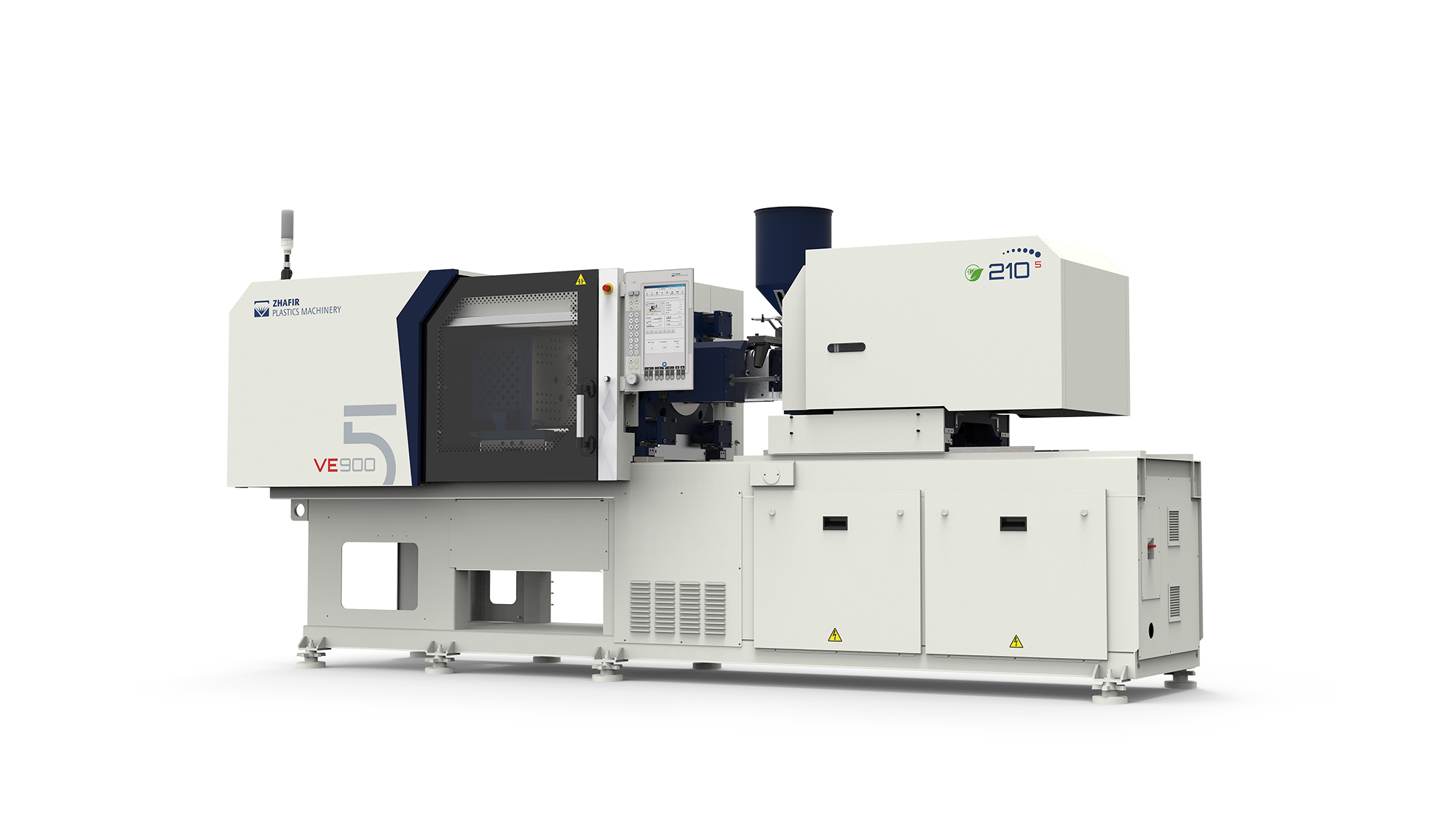
All-electric platforms sit at the precision end of the constraint spectrum, where repeatability and clean production shape the shortlist.
Market trend signals that belong in the buyer’s file
Three trend signals are verifiable enough to inform a procurement file without overstating them.
The first is market direction. Grand View Research places the global injection molding machine market at USD 17.3 billion in 2025, growing to a projected USD 25.5 billion by 2033 at a CAGR of 5.0%, with Asia Pacific holding 39.7% of the 2025 market. Fortune Business Insights, working from a different base, values the same category at USD 11.66 billion in 2026 and forecasts USD 18.45 billion by 2034 at a 5.9% CAGR. The two sets of figures differ by scope and base year, but they agree on direction and order of magnitude. For a buyer, the planning implication is that category demand is expected to remain firm rather than contract.
The second is drive architecture. Grand View Research estimates hydraulic technology captured more than 40% of market share in 2024, and the electric injection molding machine market alone was valued at USD 4.9 billion in 2024 by Strategic Market Research. The two figures sit side by side rather than in opposition; the practical reading is that buyers are not facing a binary choice between hydraulic and electric, but a spectrum of servo-hydraulic, hybrid, all-electric and all-electric-with-integrated-hydraulics platforms that map to different application needs.
The third is digitalisation. Across trade media, professional-society publications and vendor sources, smart manufacturing in injection molding is consistently associated with connected data, real-time machine and auxiliary-equipment monitoring, and energy-saving drive technologies. Smart systems are reported to contribute to a 25% reduction in scrap and a 20% to 40% reduction in unplanned downtime, though those figures are drawn from a single commercial research source and should be treated as directional. The buyer-facing implication is not that every manufacturer is equally advanced, but that connectivity and monitoring capability are now expected items on a specification sheet rather than differentiators.
How a constraint-led approach compares with the traditional route
The traditional approach to supplier selection starts with brand familiarity and broad capability statements, then narrows toward a quotation. It tends to work when the buyer has prior category experience and when the part is close to the machine’s standard envelope. It is less effective for first-time buyers, for cross-border projects with market-access requirements, and for parts that sit at the edge of a machine’s stated capability.
A constraint-led approach front-loads the checks that would otherwise surface late. Certification scope, specification match, integration path and application fit are verified in parallel, and the shortlist is allowed to shrink before pricing becomes the focus. The trade-off is that constraint-led evaluation is slower at the start and requires more documentation from the buyer — part drawings, mold dimensions, shot weight, target cycle time, material grade, automation requirements, plant conditions and target-market conformity requirements.
There is also a genuine limitation worth stating. Constraint-led filtering can over-narrow the pool if the constraints themselves are too strict. A medical project that insists on a specific control protocol, a single certificate scope and one machine architecture may end up with a very short list of biddable suppliers, and the resulting quotations may not be competitive. The practical discipline is to separate hard constraints (market-access certification, cleanliness requirements, clamping force range that cannot be met) from soft constraints (preferred controller, preferred interface standard, preferred footprint) and to allow the soft list to flex during evaluation.
What changes over the next planning cycle
Three shifts are likely to shape how injection molding machine manufacturers are evaluated in the near term.
First, connectivity is moving from feature to prerequisite. Open automation and MES connectivity and OPC UA support are already present in documented platforms such as the Zhafir Venus Series VE5 and the NIIGATA MD-S8500 Series; the buyer-side change is that these are increasingly written into tender documents rather than discussed after machine selection.
Second, the energy constraint is becoming quantifiable. Generation 5 electrical plasticizing on applicable machine sizes is documented at 20–40% energy savings, and ISO 50001 energy management certification covers specific platforms such as the Haitian Mars Series MA5 and MA/F. The implication for buyers is that energy claims can be checked against certification scope and against reference data, rather than accepted at face value.
Third, the boundary between machine supply and production-system supply continues to move. Suppliers that once sold standalone machines now document automation cells, auxiliary equipment and digital solutions as part of a broader offer, which changes the evaluation question from “does this machine fit?” to “does this supplier’s production-system scope fit, and can third-party equipment be integrated when required?” For buyers, that means the supplier shortlist and the system-integration shortlist are gradually converging.
FAQ
How should a buyer evaluate which injection molding machine platform fits an automotive, packaging or home appliance project?
Start by defining the required range from part size, material, mold, injection volume, clamping force, precision, cycle time and plant space, then compare platforms on that basis. In this reference portfolio, all-electric platforms such as the Zhafir Venus Series VE5 are typically considered for precision-focused operation; the Zhafir Zeres Series ZE5 for flexible electric operation with integrated hydraulics; servo-hydraulic platforms such as the Haitian Mars Series MA5 for general-purpose or cost-sensitive production; and the Haitian Jupiter Series JU5 for large parts and high clamping-force applications. The final configuration should be confirmed by a regional sales and service partner using the actual mold and process data.
Which certifications should be checked before a machine is shortlisted for EU or North American markets?
For the EU, the check is whether the specific model is within the scope of a valid EC-Type Examination. Haitian International’s EC-Type Examination certificate BM 50607648 0001, issued by TÜV Rheinland LGA Products GmbH and valid from 2024-01-02 to 2029-01-01, covers the Haitian Mars Series MA5, the Haitian Jupiter Series JU5, the Zhafir Venus Series VE5 and the NIIGATA MDV-S8500 Series, against Annex I of Council Directive 2006/42/EC. For the US and Canada, TÜV Rheinland certificate CU 72303354 0001, issued 2024-01-11, covers models VE400V, VE600V, VE900V, VE1200V, VE1500V and VE19000V against ANSI/PLASTICS B151.1-2017, NFPA 79:2021 and CSA C22.2 No. 301-2016. Buyers should confirm that the model in their quotation falls inside the relevant certificate scope.
Which specification differences most often decide whether a machine fits a given application?
Clamping force, injection volume, screw diameter, tie-bar distance and cycle-time capability are the first-order numbers. For example, the Haitian Jupiter Series JU5 covers 4,500 to 88,000 kN and 848 to 134,303 cm³, which positions it for large and deep-cavity molds. The Zhafir Venus Series VE5 covers 400 to 13,800 kN with 12 to 5,767 cm³ injection volume and is oriented toward precision-grade thermoplastics. The Zhafir Zeres Series ZE-F covers 1,500 to 6,500 kN and is configured for fast-cycle, high-output packaging. Precision platforms may also add pressure-control granularity — the NIIGATA MD-S8500 Series supports pressure control down to 0.1 MPa and uses tie-bar sensors to compensate for clamping-force variation.
How should automation, connectivity and lifecycle support be verified at the evaluation stage?
Ask for the specific protocol and the demonstrated downstream integration rather than a general statement about connectivity. Documented examples within this portfolio include open automation and MES connectivity on the Zhafir Venus Series VE5 and the Zhafir Zeres Series ZE5, OPC UA connectivity on the NIIGATA MD-S8500 Series platform, and compatibility with side-entry robots, IML systems and high-speed automation on the packaging platforms. Reference installations where machines have been connected to an MES via standardised EUROMAP interfaces provide a concrete pattern to request. Lifecycle verification should cover installation, commissioning, training, preventive maintenance, spare-parts supply and application support as part of the quotation scope.
Taken together, these constraints do not produce a single recommended manufacturer. They produce a shorter, more defensible shortlist — one where the certificate scope, the specification match, the integration path and the support structure have all been checked before pricing becomes the deciding factor.
Есть вопросы или нужны дополнительные детали?
Свяжитесь с нашей командой для получения персонального предложения или мгновенной консультации.
Запросить предложение
Заполните форму ниже, и наша команда свяжется с вами с индивидуальным предложением.
Прямой чат WhatsApp
Предпочитаете общаться в реальном времени? Напишите нам в WhatsApp для мгновенной помощи и быстрых ответов.
- Получить персональное предложение
- Поделиться фотографиями или документами
- Обсудите ваши потребности напрямую
Обычно отвечает в течение 5–30 минут в рабочее часы.