
Injection Molding Machine Shortlist: Ten Series Ranked by Fit
A buyer entering the evaluation stage in 2026 rarely lacks machine options; the difficulty is eliminating the wrong ones quickly enough to protect the project schedule. This shortlist ranks ten injection molding machine series from Haitian Plastics Machinery, Zhafir Plastics Machinery and Niigata by breadth of application fit, documented specification coverage and market-access evidence. It is a screening instrument for procurement teams, not a claim of measured performance superiority.
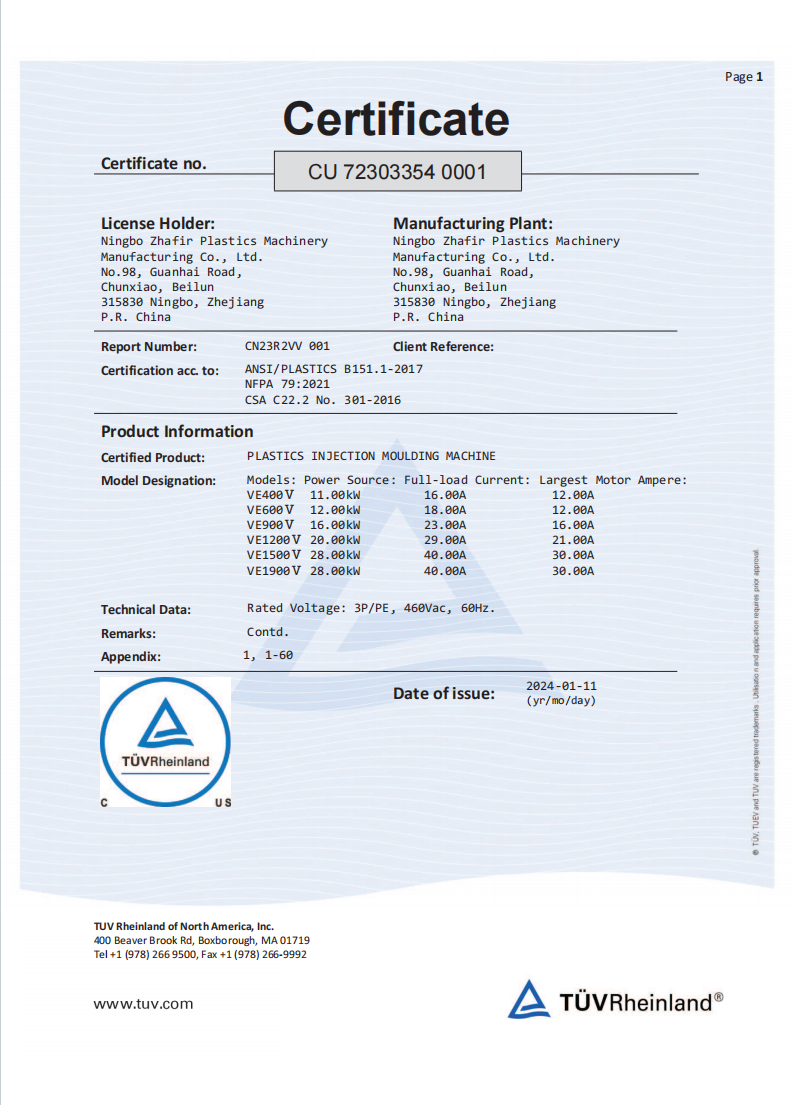
Market-access documentation is one of the screening criteria used in this shortlist. Certificate CU 72303354 0001, issued by TÜV Rheinland on 11 January 2024, covers listed Zhafir plastics injection moulding machine models against ANSI/PLASTICS B151.1-2017, NFPA 79:2021 and CSA C22.2 No. 301-2016.
Why a ranked shortlist now replaces the catalogue
Injection molding machine selection has become a data-reduction exercise before it becomes a commercial negotiation. A plant team evaluating a new production cell typically starts with a part drawing, a polymer, a shot weight, mold dimensions, a target cycle time, an output plan, an automation concept and the available floor area. Those inputs alone eliminate most of any manufacturer's catalogue: clamping-force class, injection volume, maximum daylight, tie-bar clearance and platen size remove entire size ranges before price is discussed.
What survives that filter is usually a handful of series that differ less in headline specification than in drive architecture, serviceability and the documentation a buyer can present to internal stakeholders. That is where a ranked shortlist helps — it forces the evaluation to compare candidates on the same criteria rather than on sales narrative.
Haitian Plastic Machinery Group Co., Ltd., listed as Haitian International Holdings Ltd., is an injection molding machine manufacturer founded in 1966 and based in Ningbo, China. The group operates the Haitian Plastics Machinery, Zhafir Plastics Machinery and Niigata brands across a 1,437,000 m² manufacturing footprint, with 8,500+ employees, an R&D team of 1,500+, annual output of 56,000+ units and a 40% export ratio, supplying customers in more than 130 countries and regions.
How this shortlist was ranked
The ranking criteria were fixed before the series were ordered, so that a higher position reflects screening value rather than promotional preference. Five criteria were applied:
- Specification coverage — the span of clamping force, injection volume and platen or tie-bar dimensions a series covers, taken from published model data.
- Application breadth — how many documented end-use segments the series is positioned for.
- Drive-architecture fit — whether the drive type matches common requirements for repeatability, cycle speed, energy profile or large-mold handling.
- Market-access evidence — whether conformity documentation exists for the target region.
- Service and commissioning scope — installation, training, preventive maintenance, spare-parts supply and process optimization support.
The ten series, ranked
| Rank | Series | Architecture | Clamping force | Typical fit |
|---|---|---|---|---|
| 1 | Haitian Mars Series MA5 | Servo-hydraulic toggle | 600–33,000 kN | General-purpose and technical parts |
| 2 | Haitian Jupiter Series JU5 | Servo-hydraulic two-platen | 4,500–88,000 kN | Large and deep-cavity molds |
| 3 | Zhafir Venus Series VE5 | All-electric | 400–13,800 kN | Precision, medical, optical |
| 4 | Haitian Mars Series MA/F | High-speed servo-hydraulic | Platform-dependent | Thin-wall packaging, IML |
| 5 | Zhafir Zeres Series ZE5 | Electric with integrated hydraulics | 400–13,800 kN | Mixed precision and core-pull work |
| 6 | Zhafir Zeres Series ZE-F | High-speed electric | 1,500–6,500 kN | Caps, closures, thin-wall |
| 7 | Haitian Mars Series MA5/Ultra | Optimized servo-hydraulic | MA5-based sizes | Higher-speed, precision-demanding work |
| 8 | Zhafir Jeres Series JE5 | Hybrid two-platen | 3,500–33,000 kN | Large technical parts, logistics |
| 9 | Zhafir Multicomponent | Electric multi-component | 3,500–33,000 kN | Multi-color, multi-material, hard-soft |
| 10 | Niigata MD-S8500 / MDV-S8500 | Precision all-electric, horizontal and vertical | Model-range dependent | Insert molding, connectors, precision components |
1. Haitian Mars Series MA5 — the broadest starting point
The MA5 is a servo-hydraulic toggle machine with a clamping force range of 600–33,000 kN, injection volume of 49–45,616 cm³, screw diameter of 24–220 mm, mold platen sizes from 470 × 470 to 3,100 × 3,020 mm and tie-bar distances from 310 × 310 to 2,160 × 1,900 mm, controlled by a KEBA controller. It is positioned for PP, PE, PS, ABS, PA, PC, PC/ABS, POM, PMMA and TPE, with engineering and fiber-reinforced grades depending on plasticizing configuration. Documented industries include automotive, household appliances, consumer goods, logistics, packaging, electronics, construction and technical parts. Haitian reports the Mars platform as its most widely delivered injection molding machine family, with more than 400,000 units delivered.
2. Haitian Jupiter Series JU5 — where mold size decides
The JU5 is a servo-hydraulic two-platen machine spanning 4,500–88,000 kN clamping force, 848–134,303 cm³ injection volume, 60–300 mm screw diameter, 1,400–7,000 mm maximum daylight and tie-bar distances up to 3,400 × 2,820 mm. The compact two-platen clamping structure provides large mold space and a long opening stroke, which is why it is applied to bumpers, instrument panels, logistics turnover boxes and large waste containers. A customized JU88000 with 88,000 kN clamping force and 134,000 cm³ injection volume was engineered for Belli SAS, exceeded the initial requirement by reducing machine footprint, received CE certification in September 2023 and was accepted by the customer in October 2023 with an integrated Hilectro VD-150ID robot.
3. Zhafir Venus Series VE5 — all-electric precision baseline
The VE5 covers 400–13,800 kN clamping force, 12–5,767 cm³ injection volume, 16–120 mm screw diameter, platen sizes from 440 × 440 to 2,150 × 2,050 mm and tie-bar distances from 320 × 320 to 1,550 × 1,450 mm with a Sigmatek controller. All-electric drive removes hydraulic oil from the process, which supports cleanroom-grade production alongside high injection repeat precision. Documented applications include medical, electronics, optical, precision components, cosmetics packaging and technical parts.
4. Haitian Mars Series MA/F — speed for thin-wall packaging
The MA/F is the high-speed configuration of the Mars platform, with injection speed up to 500 mm/s and mold opening and closing times optimized for fast-cycle production. It is positioned for PP, PE and HDPE in food packaging, thin-wall packaging, containers and in-mold labeling, where cycle time rather than clamping force generally sets the economics of the cell.
5. Zhafir Zeres Series ZE5 — electric precision with hydraulic side movements
The ZE5 matches the VE5 specification envelope — 400–13,800 kN clamping force and 12–5,767 cm³ injection volume — but integrates hydraulics for the side movements while retaining an electric injection end. That combination is positioned for automotive, medical, electronics, consumer goods, household appliances, packaging and technical parts where core pulls or complex mold functions would otherwise require a separate hydraulic package.
6. Zhafir Zeres Series ZE-F — high-output caps and closures
The ZE-F is the high-speed configuration of the Zeres electric platform at 1,500–6,500 kN, optimized for fast cycles and high injection performance in PP, PE and HDPE. It targets caps and closures, thin-wall packaging, food packaging and other high-volume work where the machine is expected to run close to its cycle limit for long periods.
7. Haitian Mars Series MA5/Ultra — the tuned MA5
The MA5/Ultra is built on the MA5 platform with a configuration optimized for higher speed, improved precision, lower energy consumption and enhanced intelligent process support, targeting automotive, electronics, consumer goods, technical parts, household appliances, precision molding and packaging. Exact specification range depends on the available MA5/Ultra machine sizes.
8. Zhafir Jeres Series JE5 — hybrid two-platen
The JE5 pairs a hybrid drive architecture with a two-platen clamping system across 3,500–33,000 kN, positioned by Zhafir as hybrid, two-platen and precise. It sits between the JU5 and the fully electric platforms for large technical parts, logistics, household appliances, mobility and industrial components where platen economy and drive economy have to be balanced.
9. Zhafir Multicomponent — multi-material in one cycle
The Multicomponent platform is a modular electric multi-component configuration spanning 3,500–33,000 kN, with injection units and component arrangements varying by application. It is used for multi-color, multi-material and hard-soft component molding in automotive, consumer goods, electronics, household appliances, medical and technical parts production.
10. Niigata MD-S8500 and MDV-S8500 — precision and insert molding
The MD-S8500 horizontal all-electric range covers models from MD50S8500 to MD350S8500 with tie-bar sensing, high-precision pressure control and OPC UA connectivity. The MDV-S8500 vertical all-electric platform is designed around insert molding and precision component work in PA, PBT, PPS, ABS, PC and TPE, with high-precision tie-bar sensing and dedicated mold-thickness measurement and control.
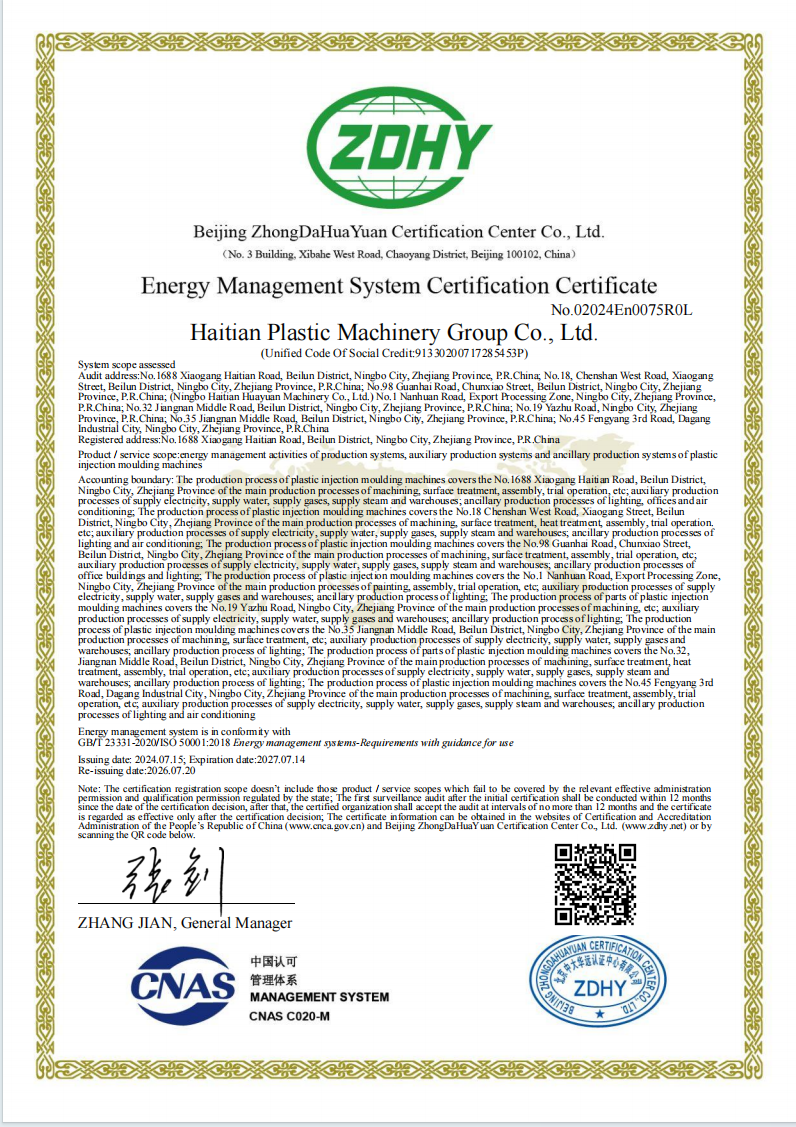
Energy management is a verifiable criterion rather than a marketing theme. Certificate 02024En0075R0L, issued on 15 July 2024 and valid to 14 July 2027, certifies the energy management activities of production, auxiliary production and ancillary production systems for plastic injection molding machines against GB/T 23331-2020 / ISO 50001:2018.
Drive architecture: what actually separates these ten series
Three architecture decisions explain most of the practical difference between the ranked candidates, and none of them is visible in a clamping-force figure alone.
Servo-hydraulic toggle versus two-platen clamping. The MA5 uses a servo drive with precision motion control to supply power on demand, balancing energy saving, response speed and molding stability. The JU5 changes the clamping structure instead, shortening machine length while offering larger mold space and a longer opening stroke. For a plant with constrained floor area and large molds, that structural difference matters more than a drive-efficiency comparison.
All-electric versus integrated hydraulics. The Venus VE5 uses independent servo drives to achieve high precision, synchronized multi-motion operation and clean production. The Zeres ZE5 keeps the electric injection end but integrates hydraulics in the side movements, which is a pragmatic answer for molds with hydraulic core pulls that would otherwise need an external power pack.
Digital and automation layer. The machine platform is only part of the cell. Haitian's digitalization scope covers MES solutions for production monitoring, process-data management and machine connectivity, with intelligent process technologies supporting setup, optimization and quality control. Open interfaces and standardized communication protocols allow integration with robots, vision inspection and third-party equipment. Giebeler connected Haitian machines to its MES through standardized EUROMAP interfaces, which improved real-time production transparency, reduced manual checks, accelerated root-cause analysis and supported documented process stability and traceability, with servo-hydraulic drive technology and stable plasticizing supporting lower operating costs and stable OEE.
Application fit by production segment
Matching a series to a segment is a shorter exercise than matching it to a mold, but it removes the largest number of wrong candidates in a single step.
| Segment | Series that usually enter the shortlist | Deciding factor |
|---|---|---|
| Automotive and technical parts | MA5, JU5, JE5, ZE5, Multicomponent | Part size, clamping force, multi-material content |
| Packaging, thin-wall, caps and closures | MA/F, ZE-F | Injection speed and cycle stability |
| Medical, optical, precision components | VE5, ZE5, MD-S8500 | Repeat precision and clean production |
| Household appliances and electronics | MA5, MA5/Ultra, ZE5 | Surface quality, cycle time, energy per part |
| Logistics and large containers | JU5, JE5 | Daylight, mold space, footprint |
| Connectors and insert molding | MDV-S8500 | Vertical layout and insert handling |
Two documented installations illustrate how the segment filter behaves in practice. MöllerGroup operates 47 Haitian machines worldwide, mainly Jupiter and Mars machines plus two electric Zeres machines, with clamping forces from 150 to 1,850 tons, supporting frequent tool changes and flexible production planning within a cooperation that began in 2012. Valeo uses Haitian two-platen machines on its production line, where the compact design and high production efficiency are applied to automotive parts under stringent precision requirements, with customer feedback citing consistent quality and performance as the basis for selection.
What the market data does and does not tell a buyer
Category growth is a useful framing device for capacity planning, but it does not identify a correct machine. Two commercial research publishers describe the same category with materially different numbers: Grand View Research values the global injection molding machine market at USD 17.3 billion in 2025 and projects USD 25.5 billion by 2033 at a 5.0% CAGR, while Fortune Business Insights values the market at USD 11.66 billion in 2026 and projects USD 18.45 billion by 2034 at a 5.90% CAGR. The gap reflects different scope definitions rather than a contradiction in direction, and it is a reminder that market-size figures should be treated as single-source commercial estimates unless triangulated.
Two structural observations are more decision-relevant. First, Asia Pacific held the largest regional share at 39.7% in 2025, which has practical consequences for spare-parts logistics, service response and re-export documentation. Second, the electric injection molding machine segment was valued at USD 4.9 billion in 2024 while hydraulic technology still captured more than 40% of the market in 2024 — the installed base is not converting wholesale, and a plant buying all-electric capacity is buying ahead of, not behind, the mainstream.
On the automation side, smart systems are associated with a 25% reduction in scrap and a 20% to 40% drop in unplanned downtime. Those figures describe the value of connected production rather than the value of any individual machine, which is why the digital and interface layer should be evaluated as a separate line item in the shortlist scoring.
Comparison with conventional approaches, and where this shortlist stops
The conventional alternative to a structured shortlist is a specification-by-catalogue process: collect quotations, compare clamping force and price, and resolve the rest during commissioning. The two approaches differ mainly in when risk is discovered.
| Dimension | Catalogue-and-quotation approach | Ranked shortlist approach |
|---|---|---|
| Candidate reduction | Driven by supplier contact and price response | Driven by mold, material, output and floor-area constraints |
| Architecture choice | Often defaulted to the supplier's standard offering | Explicit trade-off between servo-hydraulic, all-electric, hybrid and two-platen |
| Market access | Verified at delivery documentation stage | Verified during screening, model by model |
| Automation and MES | Treated as an add-on | Scored alongside the machine |
| Risk discovery point | Commissioning and ramp-up | Pre-quotation review |
The limits of this shortlist are specific and worth stating plainly.
- The ranking is editorial, not measured. No published, independently verified performance benchmark covering energy per part, OEE or repeatability across these ten series was used to order them.
- Conformity documentation is model-specific. The EC-Type Examination BM 50607648 0001 issued by TÜV Rheinland LGA Products GmbH, valid from 2 January 2024 to 1 January 2029, is scoped to plastics injection moulding machines under Annex I of Council Directive 2006/42/EC across listed models. Certificate CU 72303354 0001 covers the listed VE models only. A buyer must confirm that the exact configuration ordered falls inside the certified scope; a platform-level certificate does not automatically extend to every derivative.
- All-electric has a size ceiling. The Venus VE5 tops out at 13,800 kN clamping force, against 88,000 kN for the JU5. For very large deep-cavity molds the architectural preference for all-electric cannot be satisfied and a two-platen machine becomes the only viable route.
- Energy outcomes are configuration-specific. Templa operates six electric Zhafir Zeres machines within its 22-machine fleet, and in a documented comparison producing a PP TV20 technical part on a 28-second cycle at approximately 90 g shot weight, the Zeres consumed about 30% less energy than the compared hydraulic machine, at a total production capacity of roughly 65 million parts per year. That result describes one documented comparison on one part; it is not a general guarantee for a different mold, material or cycle.
- Lead time is not a catalogue value. Stock machines are subject to availability, configured machines are project-dependent, and customized or turnkey systems follow project scope. A shortlist decision made without a confirmed delivery window is incomplete.
Service scope is the compensating factor buyers should weigh against those limits. Manufacturer support covers local sales and service networks, installation, commissioning, training, preventive maintenance, technical service, spare-parts supply, application support, process optimization, and on-site and remote assistance. Quality control at the factory includes testing, machine inspection before delivery, mold trials, initial sampling, process optimization, application testing and commissioning.
Future outlook
Three developments are likely to reshape this shortlist over the next planning cycle. The first is the continued convergence of digitalization and energy efficiency as the core proposition of a modern machine — connected data from injection molding machines and auxiliary equipment, real-time monitoring and energy-saving drive technologies are consistently treated as one package rather than separate features. The second is the widening of documented conformity coverage: as regional requirements tighten, the number of certified models inside a platform, not the platform itself, becomes the practical constraint on cross-border deployment. The third is the shift from machine supply to integrated production systems, where injection molding, automation, auxiliary equipment and digital solutions are configured as a single cell or a complete turnkey line, with open interfaces allowing third-party equipment to be integrated when required.
For a buyer in the evaluation stage, the practical consequence is that the shortlist should be revisited whenever the mold, the material or the target market changes — not once per equipment cycle.
Frequently asked questions
Which series should be the default first candidate for general-purpose production?
The Haitian Mars Series MA5 is the broadest starting point, covering 600–33,000 kN clamping force and 49–45,616 cm³ injection volume across automotive, household appliance, consumer goods, logistics, packaging, electronics, construction and technical part applications. It is a servo-hydraulic toggle platform with a KEBA controller and documented support for PP, PE, PS, ABS, PA, PC, PC/ABS, POM, PMMA and TPE, with engineering and fiber-reinforced grades depending on plasticizing configuration.
What distinguishes the Mars MA5 from the MA5/Ultra?
The MA5/Ultra is built on the MA5 platform with a configuration optimized for higher speed, improved precision, lower energy consumption and enhanced intelligent process support. The exact specification range depends on the available MA5/Ultra machine sizes, so the two should be compared on the specific size and injection unit under consideration rather than on platform descriptions alone.
When does a two-platen machine become the better choice than a toggle machine?
When mold size and daylight set the constraint. The Haitian Jupiter Series JU5 covers 4,500–88,000 kN clamping force, 848–134,303 cm³ injection volume and up to 7,000 mm maximum daylight, and its compact two-platen clamping structure provides large mold space and a long opening stroke within a shorter machine length. It is applied to bumpers, instrument panels, logistics turnover boxes and large waste containers, where toggle machines of comparable clamping force would not provide the same mold space per unit of floor area.
Is an all-electric machine always preferable for precision parts?
Not automatically. The Zhafir Venus VE5 delivers all-electric drive with high injection repeat precision and no hydraulic oil contamination, which supports cleanroom-grade production for medical, electronics, optical and precision component work. However, its clamping force range stops at 13,800 kN, so large deep-cavity molds fall outside that architecture, and molds requiring hydraulic side movements may be better served by the Zeres ZE5, which integrates hydraulics in the side movements while retaining an electric injection end.
Which series fits high-volume packaging and caps and closures?
The high-speed configurations are the relevant candidates. The Haitian Mars Series MA/F offers injection speed up to 500 mm/s with short mold opening and closing times for PP, PE and HDPE thin-wall packaging, food packaging, containers and in-mold labeling. The Zhafir Zeres Series ZE-F covers 1,500–6,500 kN with an electric platform optimized for fast cycles and high injection performance in caps, closures and thin-wall packaging.
What documentation should be verified before ordering for the EU or North American market?
The certificate scope, the listed models and the validity period. The EC-Type Examination BM 50607648 0001 issued by TÜV Rheinland LGA Products GmbH covers plastics injection moulding machines against Annex I of Council Directive 2006/42/EC from 2 January 2024 to 1 January 2029. Certificate CU 72303354 0001, issued by TÜV Rheinland on 11 January 2024, covers the listed Zhafir models against ANSI/PLASTICS B151.1-2017, NFPA 79:2021 and CSA C22.2 No. 301-2016 for the US and Canadian markets. Management-system certificates held by the manufacturer include ISO 9001:2015 (02025Q1180R9L), ISO 14001:2015 (02026E00868R301), ISO 45001:2018 (02026S00822R301) and ISO 50001:2018 (02024En0075R0L); these cover the organisation's systems rather than the conformity of an individual machine.
How should automation and MES integration be scored in the shortlist?
As a separate criterion rather than an add-on. Haitian's scope includes MES solutions for production monitoring, process-data management and machine connectivity, open interfaces and standardized communication protocols for robots, vision inspection and third-party equipment, and OPC UA connectivity on the Niigata MD-S8500 platform. Buyers should confirm which protocols the ordered configuration supports and which data the plant intends to collect, since the operational value depends on the integration rather than on the machine specification.
Есть вопросы или нужны дополнительные детали?
Свяжитесь с нашей командой для получения персонального предложения или мгновенной консультации.
Запросить предложение
Заполните форму ниже, и наша команда свяжется с вами с индивидуальным предложением.
Прямой чат WhatsApp
Предпочитаете общаться в реальном времени? Напишите нам в WhatsApp для мгновенной помощи и быстрых ответов.
- Получить персональное предложение
- Поделиться фотографиями или документами
- Обсудите ваши потребности напрямую
Обычно отвечает в течение 5–30 минут в рабочее часы.