
Injection Molding Procurement FAQ: MOQ, Lead Time, Tooling & Materials
Injection Molding Procurement FAQ: MOQ, Lead Time, Tooling & Materials
Procurement of injection molded parts for light-industry and daily-use products rarely fails because a factory cannot mold plastic. It fails because the commercial and technical assumptions behind a quotation were never made explicit: which minimum order quantity actually applies, which phase the quoted lead time covers, how the resin grade was selected, and how the tool will be validated before the first shipment leaves the floor.
This reference answers those questions in the order a procurement team normally asks them, using the production and quality practices of DTG TECH CO., LTD., an ISO-certified custom injection molding manufacturer founded in 2002 in Xiamen, China, that supplies molded plastic parts to buyers across the USA, Europe, and India.
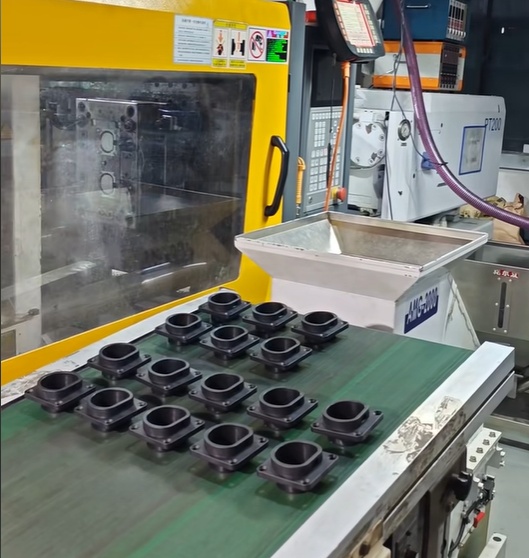
Injection molded production runs for light-industry and daily-use parts, from validation volume through repeat mass production.
Why procurement questions cluster around four variables
Daily-use and light-industry parts — storage containers, kitchenware, appliance housings, small-device enclosures, decorative covers — share a commercial profile. Volumes are large and repeatable, margins are thin, surfaces are visible, and the end user judges quality by appearance as much as by function. In that profile, four variables control both landed cost and schedule risk: order quantity, lead time, material, and tooling.
The difficulty is that the four interact. A lower order quantity may require a different tool configuration. A compressed lead time may push inspection steps into a later phase. A material change after the tool is cut forces a new gate and runner evaluation. A tool designed primarily for appearance needs different cooling decisions than a tool designed primarily for dimensional accuracy.
Buyers who negotiate the four variables separately usually end up renegotiating mid-project. Buyers who treat them as one decision package — validated at the DFM stage, before steel is cut — obtain a more stable unit price and a more predictable schedule.
What DTG TECH provides for daily-use and light-industry programs
DTG TECH CO., LTD. is a custom injection molding manufacturer founded in 2002, operating a 2,500 m² facility with 80 employees, including a 25-engineer R&D team, and an annual output of 47,881 units. Export accounts for 100% of its output, with main markets in the USA, Europe, and India, and its production focus is injection molded plastic parts.
The company operates an integrated model: precision mold design, tool manufacturing, prototype development, plastic injection molding, and mass production under one roof, supported by product analysis and mold testing before production. Production runs are flexible, covering low to high volumes.
For a procurement team, the operationally relevant part of that structure is not the size of the facility. It is that mold modification, production optimization, and quality feedback sit with a single supplier, removing the handover step that normally exists between a tool shop and an independent molder.
Minimum order quantity: what actually determines it
MOQ in custom injection molding is not a catalog figure. It is derived per project from four inputs. First, tooling configuration: the number of cavities and whether the tool is a short-run validation tool or a hardened production tool. Second, machine time: every material change and color change consumes setup and purge time that must be absorbed somewhere in the quotation. Third, resin supplier purchase minimums, which differ by grade and by color. Fourth, inspection cost, which is largely fixed per batch and therefore weighs more heavily on small orders.
Because those inputs differ per part, MOQ is quoted per part rather than published. Two volume thresholds are useful during negotiation. At the prototype and short-run stage, rapid injection molding becomes cheaper per part than 3D printing once quantity exceeds roughly 50–100 units, where per-part cost falls by 60%–80% despite the higher initial tooling cost. At volume production, per-part cost falls by 70%–90% relative to CNC machining once quantities exceed about 1,000 units.
The practical negotiating rule is to request two tooling options — a short-run tool for validation volume and a production tool for the full program — and to compare total cost across the expected lifetime volume rather than the unit price at one hypothetical quantity.
Lead time by phase
Lead time is only comparable between suppliers when it is itemized by phase. A quotation that states a single number without saying whether it includes mold making, sample approval, and pre-shipment inspection cannot be benchmarked against one that separates them.
| Phase | Typical duration | What determines where it lands |
|---|---|---|
| Prototype tooling and sample parts | 7–15 days | Drawing freeze, DFM review comments, sample quantity |
| Custom production mold | 15–45 days | Mold structure complexity, cavity count, surface finish requirement, number of mold testing and T1 validation rounds |
| Mass production | 20–35 days | Approved sample, material availability, order quantity, inspection plan |
Mold trial cycles are the most common hidden variable in that sequence. DFM analysis performed before tooling reduces design modification iterations by 40%–60% and cuts typical mold trial cycles from an average of 5–7 rounds to 2–3, because problems are found on the screen rather than in the press.
Sourcing structure also affects the total. Where mold manufacturing and injection molding are handled by separate suppliers, coordination overhead alone typically adds 10–15 working days per project, and the overall project cycle runs 20%–30% longer than with a single integrated supplier. Cross-supplier communication time can be cut by more than 50% when one supplier owns mold modification, production optimization, and quality feedback.
Material selection for daily-use parts
Material choice is a procurement decision, not only an engineering preference, because it fixes the tooling parameters, the compliance file, and the cosmetic standard for the life of the program.
| Material | Typical use in daily-use and light-industry parts | Selection note |
|---|---|---|
| ABS | Appliance housings, device enclosures, visible covers | Chosen where appearance and rigidity matter more than chemical exposure |
| PP | Storage containers, kitchenware, caps, flexing parts | Low density and good chemical resistance; widely used where parts flex repeatedly |
| PC | Transparent covers, guards, impact-exposed housings | Selected for impact strength and clarity |
| PC+ABS | Enclosures and device housings | Balances toughness with cosmetic appearance |
| TPE | Soft-touch grips, seals, overmolded contact surfaces | Used where tactile feel or sealing is required |
| Acrylic | Display windows, decorative covers | Specified for optical clarity and surface appearance |
Material risk is managed through three controls: material specification confirmation before production, incoming material verification, and supplier management. Molding parameters are then set according to the confirmed material's characteristics. Because parameters are material-specific, a late material substitution is not a paperwork change — it reopens parameter setting and may reopen sampling.
Tooling and DFM: where cost and risk are decided
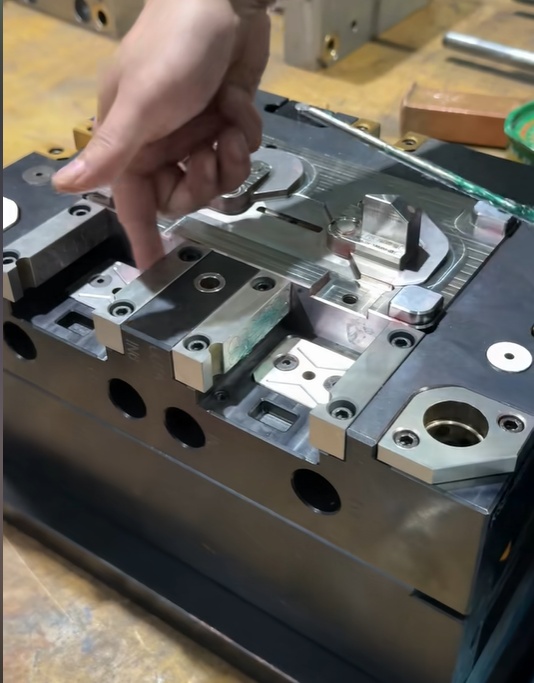
Mold design and DFM review take place before tooling production, where gate, cooling, and ejection decisions are locked in.
The tool determines unit cost, dimensional capability, surface quality, and how quickly production stabilizes. Before tooling, a DFM review evaluates wall thickness, draft, gate location, parting line, ejection, cooling layout, and shrinkage allowance against the molded part's functional and cosmetic requirements.
Documented effects of doing this work early are measurable: DFM analysis before tooling reduces design modification iterations by 40%–60% and cuts mold trial cycles from an average of 5–7 to 2–3. Mold-related risks addressed at this stage include mold design errors, poor part release, short mold lifespan, and production instability. Controls include DFM review, mold structure optimization, mold testing, and T1 sample validation, with mold engineers evaluating the structure, verifying the tool before production, and running the trial and approval process together with the customer.
Defect risk is handled with the same logic. Short shot, sink marks, warpage, weld lines, and surface defects are controlled through DFM analysis, mold flow analysis, optimized injection parameters, and correct gate and runner design — all applied before tooling production rather than corrected after launch.
Quality control sequence from DFM to pre-shipment
Inspection in a well-run program is a sequence, not a final gate. A typical order follows six steps.
- DFM review and mold flow analysis before tooling, to prevent defects at the design stage.
- Incoming material verification, confirming the resin grade and color against the approved specification.
- Mold testing and T1 sample validation, verifying part quality before production release.
- First article inspection and dimensional inspection, confirming critical dimensions against the drawing.
- In-process inspection, with measurement checks during production and monitoring of critical dimensions.
- Pre-shipment inspection, inspecting finished parts before shipment and confirming the batch against the approved sample.
On the compliance side, ISO 9001:2015 covers the quality management system. FDA 21 CFR 177.2600 and LFGB are food-contact references applied where parts are intended for food-contact or repeated-use applications, and RoHS applies to electrical and electronic equipment. Which of these is relevant depends on where the part is used and where it is sold, which is why the applicable compliance scope belongs in the purchase specification rather than in a general supplier claim.
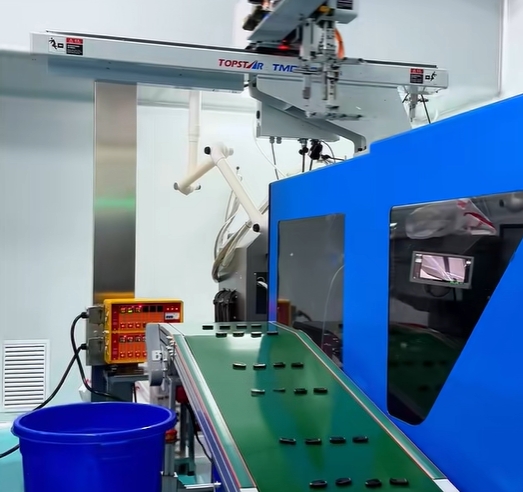
Repeat production of custom molded parts, where standardized molding parameters and in-process checks keep batches comparable.
Where these parts are used
The scenario range for this class of molding is broad but consistent. Home appliance programs use molded housings, panels, knobs, and internal structural parts. Electronics programs use enclosures, covers, and brackets, including enclosures for OEM electronics. Consumer and daily-use products include containers, organizers, kitchenware, and decorative covers. Industrial plastic components cover functional parts and equipment housings, while automotive plastic parts follow the same material and tolerance logic with tighter validation requirements.
In precision applications, the achievable tolerance band widens the addressable range: high precision injection molding supports tolerances of ±0.01 mm–±0.05 mm and surface roughness of Ra 0.4–1.6 µm, compared with ±0.1 mm–±0.2 mm and Ra 3.2–6.4 µm in standard molding, with dimensional scrap rate reduced to ≤0.5% from 3%–5%.
Market context for molded plastic parts
The global injection molded plastic market was valued at USD 324.98 billion in 2024 and is projected to reach USD 435.74 billion by 2035, according to Market Research Future. Estimates differ between research houses — Grand View Research places the 2025 figure at USD 362.5 billion, while Fortune Business Insights estimated USD 321.4 billion for 2024 — reflecting different treatment of molding machinery versus molded products and different base years. The direction of travel, however, is consistent across sources.
Supply-side concentration matters for scheduling. China's plastic mold industry is currently estimated at approximately ¥600 billion, with a projected expansion to ¥1 trillion by 2030, according to JBRplas. China produces an estimated 65% of the world's injection-molding machines and accounts for 60% of global export volume, per an Industry Analysis Report 2025.
On the demand side, automotive OEMs substituting metal parts with engineered thermoplastics account for 34% of domestic injection molded component demand in major hubs such as the US, according to Grand View Research. The same substitution logic — replacing metal and multi-part assemblies with a single molded component — is visible in appliance and daily-use categories.
For buyers, the practical implication is that tooling queues and supplier capacity, not resin pricing alone, are the variables most likely to move a delivery date.
How integrated and precision-focused options compare
| Comparison | Difference that matters to procurement | Documented performance gap |
|---|---|---|
| Integrated mold manufacturing + injection molding vs. separate mold supplier and molder | One supplier owns mold modification, production optimization, and quality feedback | 20%–30% shorter overall project cycle; over 50% less cross-supplier communication time; 10–15 working days less coordination and handover delay |
| Rapid injection molding vs. 3D printing for prototypes | Prototypes are produced in production-grade materials and processes | ±0.05 mm dimensional accuracy vs. ±0.3 mm; 60%–80% lower per-part cost above 50–100 units |
| High precision injection molding vs. standard molding without precision control | Tighter dimensional and cosmetic control, lower rework | ±0.01–±0.05 mm vs. ±0.1–±0.2 mm; Ra 0.4–1.6 µm vs. Ra 3.2–6.4 µm; scrap ≤0.5% vs. 3%–5% |
| Injection molding vs. CNC machining and plastic fabrication | Unit economics shift decisively at medium and high volume | 20–60 seconds per shot vs. 15–30 minutes per part; 70%–90% per-part cost reduction above 1,000 units |
Limits and trade-offs buyers should expect
Injection molding is not unconditionally cheaper or faster, and a procurement decision that ignores the boundaries tends to be revisited later.
- Higher initial mold investment. Compared with CNC machining or 3D printing, the tool is a front-loaded cost that is recovered through unit price, not through the first order.
- Tooling lead time of 15–45 days. Injection molding is not the fast route for a single one-off part; for urgent single units, subtractive or additive routes remain more appropriate.
- Volume-dependent economics. The 70%–90% per-part advantage over CNC appears above roughly 1,000 units, and the prototype advantage over 3D printing above roughly 50–100 units. Below those thresholds the tooling investment may not amortize.
- MOQ is project-specific. It cannot be fixed in advance without tooling configuration and material data, so a quoted MOQ should be tied to a named tool and named resin grade.
- Compliance scope is application-specific. A supplier may hold ISO 9001:2015 and still not match a program that requires a different sector standard.
- Tighter tolerance carries higher control cost. Precision molding adds manufacturing control cost, offset by lower rejection and rework and by more stable assembly dimensions.
What to verify before releasing a purchase order
- A frozen drawing, plus a written DFM report recording gate, parting line, draft, ejection, and shrinkage decisions.
- A material specification sheet naming the exact grade, together with the compliance documents relevant to the destination market.
- Tool configuration, cavity count, expected mold life, and a clear statement of who owns and maintains the tool.
- Sample approval criteria: which dimensions are critical, what the T1 sample must demonstrate, and how deviations are dispositioned.
- An inspection plan covering first article inspection, in-process dimensional checks, and the scope of pre-shipment inspection.
- Lead time broken down by phase, with the assumptions that could extend each phase stated in writing.
- Post-ramp-up stability controls: standardized molding parameters, production process monitoring, and real-time tracking of schedule and output.
Production variation, delayed delivery, and batch quality fluctuation are controlled through standardized molding parameters confirmed after sample approval, schedule and output tracking during production, and full pre-shipment quality inspection. Those controls are what keep the first shipment and the tenth shipment comparable.
Future outlook
Three movements are likely to shape procurement in this category over the next several years. Engineered thermoplastics will continue to displace metal and multi-part assemblies, following the substitution pattern already recorded in automotive demand. Tolerance expectations in appliance and consumer categories will tighten as downstream assembly becomes more automated, pushing more programs toward precision molding capability rather than standard molding. And compliance documentation will continue to migrate from sales support material to a procurement deliverable requested at the RFQ stage.
Structurally, integrated supply — tooling, molding, and inspection under one supplier — remains the arrangement most directly linked to shorter total project cycles, given the documented 20%–30% cycle reduction versus split sourcing. Suppliers that can itemize lead time, MOQ logic, and inspection scope in the quotation are easier to compare, and easier to hold to.
FAQ
What determines the minimum order quantity for a custom injection molded part?
MOQ is calculated per project from tooling configuration, machine setup and changeover time, resin supplier purchase minimums, and batch inspection cost. A short-run tool with fewer cavities supports lower quantities, while a hardened multi-cavity production tool is normally justified by higher annual volume. Buyers can request two quotations — one for validation volume and one for production volume — and compare total cost across the planned lifetime volume rather than unit price at a single quantity.
How long does a typical injection molding project take from drawing to shipment?
Prototype tooling and sample parts typically take 7–15 days; a custom production mold takes 15–45 days; mass production after sample approval takes 20–35 days. Mold structure complexity, cavity count, surface finish requirements, and the number of trial rounds determine where a project lands inside those ranges. Mold trial cycles are the most common variable: DFM analysis performed before tooling reduces trials from an average of 5–7 rounds to 2–3.
Which materials are used for daily-use and light-industry molded parts?
ABS, PP, PC, PC+ABS, TPE, and Acrylic are the common choices. ABS is used for housings and visible parts; PP for containers, caps, and parts that flex; PC for transparent or impact-exposed parts; PC+ABS where toughness and appearance must be balanced; TPE for soft-touch and sealing surfaces; and Acrylic for optically clear covers and decorative parts. Selection should be confirmed as a written material specification before tooling, because molding parameters are set according to material characteristics.
How are material risks such as grade mismatch or color variation controlled?
Material mismatch, inconsistent material performance, and color variation are managed with three controls: material specification confirmation before production, incoming material verification, and supplier management. Molding parameters are then set according to the confirmed material's characteristics. Because parameters are material-specific, a late material substitution reopens parameter setting and may require new sampling rather than a document update.
What does a DFM review cover, and why does it happen before tooling?
A DFM review evaluates wall thickness, draft, gate location, parting line, ejection, cooling, and shrinkage allowance against the molded part's requirements, and it informs mold structure decisions. Performing it before tooling reduces design modification iterations by 40%–60% and cuts mold trial cycles from an average of 5–7 to 2–3, which shortens the path to a stable production process.
How is dimensional consistency controlled during production?
Dimensional deviation and assembly mismatch are controlled through first article inspection, in-process dimensional inspection, and monitoring of critical dimensions during production, followed by inspection of finished parts before shipment. In precision molding, tolerance capability of ±0.01 mm–±0.05 mm is achievable compared with ±0.1 mm–±0.2 mm in standard molding, and dimensional scrap rate can be held at ≤0.5% compared with 3%–5% without precision control.
Which quality certifications apply to injection molded parts for daily-use products?
ISO 9001:2015 covers the quality management system. FDA 21 CFR 177.2600 and LFGB are food-contact references applied where parts are intended for food-contact or repeated-use applications, and RoHS applies to electrical and electronic equipment. The applicable scope depends on the end application and the destination market, so required compliance documents should be listed in the purchase specification rather than assumed from a general certification list.
Is it better to use one integrated supplier for mold making and molding, or two separate suppliers?
Integrated mold manufacturing and injection molding shortens the overall project cycle by 20%–30% compared with using separate suppliers and cuts cross-supplier communication time by more than 50%. Coordination meetings and handover delays are reduced by 10–15 working days per project, and a single supplier manages mold modification, production optimization, and quality feedback. The trade-off is that the buyer depends on one supplier's capacity schedule for both phases.
When is rapid injection molding a better choice than 3D printing for prototypes?
When the prototype has to match production material behavior. Rapid injection molding uses production-grade materials and achieves dimensional accuracy of ±0.05 mm compared with ±0.3 mm for 3D printed prototypes. Once prototype quantity exceeds 50–100 units, per-part cost is 60%–80% lower than 3D printing despite higher initial tooling cost. It suits product validation, market testing, and engineering verification where assembly requirements must be confirmed early.
What are the main limitations of injection molding that buyers should plan for?
The main limitation is the higher initial mold investment relative to CNC machining or 3D printing, which only amortizes above certain volume thresholds — roughly 1,000 units for the 70%–90% per-part cost advantage over CNC. Tooling also requires 15–45 days, and MOQ is project-specific rather than fixed. Buyers should additionally confirm that the supplier's certification scope matches the sector standard their program requires, since ISO 9001:2015 alone does not cover all regulated applications.
How is production stability maintained after mass production begins?
Production variation, delayed delivery, and batch quality fluctuation are controlled through standardized molding parameters confirmed after sample approval, production process monitoring, real-time tracking of production schedule and output, and full pre-shipment quality inspection. These controls keep the first shipment and later shipments comparable.
Reference material: Xiamen DTG Tech Co., Ltd. company presentation (PDF) — https://cdn.socialarks.com/sbsp/25043/common/2026/0720/Xiamen%20DTG%20Tech%20Co.%2CLtd%20Presentation.pdf. Product and capability information: www.m-dtg.com.