
Inkjet Printer Procurement FAQ: Environment, Content, Speed
Industrial inkjet printer procurement rarely fails because the hardware is wrong. It fails because the buyer and the supplier never agree on the four operating conditions that determine whether the hardware can do the job: what will be printed, in what environment, at what line speed, and on what substrate. Buyers at the Awareness to Research stage who ask these four questions first tend to reach a shortlist faster and with fewer sample-print rejections than buyers who begin with price or model name.
This FAQ is built around that decision order. It uses verified facts from DEMIN Inkjet Printer, a product family manufactured by Quanzhou Demin Spraying Code Technology Co., Ltd., and it treats each question as a procurement checkpoint rather than a sales talking point.
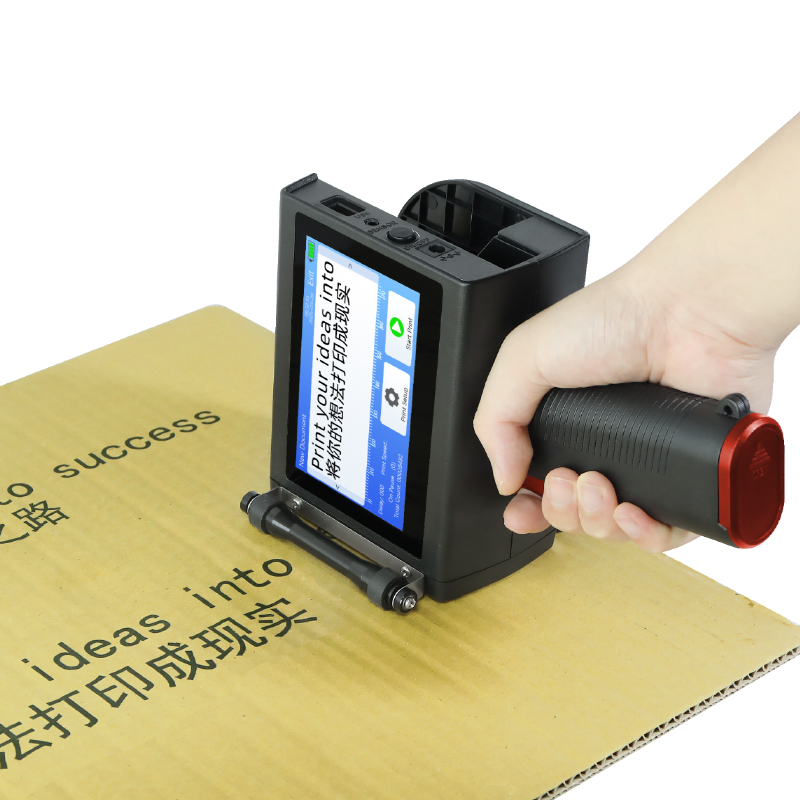
DEMIN H50 handheld inkjet printer, one of the model configurations referenced in this procurement FAQ.
Why the Four-Factor Order Matters
Inkjet coders are specified against production-line variables, not against a fixed catalogue hierarchy. The same handheld unit may be appropriate for one buyer and unsuitable for another because the print size, the corrugated surface and the working temperature do not match. The supplier's own selection guidance lists four inputs that must be confirmed before the right coder can be identified: printing content, working environment, printing speed and substrate materials.
This is a useful structure for buyers at the Research stage because it converts a broad question ("which inkjet coder should I buy?") into four narrower questions that suppliers can answer with measurable specifications. Each section below answers one of the four, plus three supporting questions that frequently appear later in the procurement workflow.
Factor 1: What Print Content Will the Coder Handle?
Print content determines whether a given model is technically eligible. Text, logos, QR codes, barcodes, serial numbers and variable production data all sit within the same print engine but impose different demands on resolution, image data handling and message length.
The DEMIN model range illustrates how content capability differs by configuration. The H50 handheld inkjet printer supports Chinese and English characters, QR codes, barcodes, serial numbers and logos, with a 5-inch capacitive touchscreen and 300 dpi print resolution. The P70 piezoelectric model extends the content set to text, images, serial numbers, QR codes, barcodes, dates and tables, with a 10-inch capacitive touchscreen and 180 dpi resolution. The P70 Pro, using the Seiko 1020 printhead, raises resolution to 360 dpi for buyers who need sharper output at the same 5–72 mm print height.
| Print content question | What the buyer must confirm | Verified DEMIN specification |
|---|---|---|
| Character set and language | Which languages must the UI and printed font support? | H50 supports 29 languages including Chinese, English, Russian, Arabic, French and Vietnamese. P70 supports 30 languages. |
| Variable data | Dates, batch codes, serial numbers, QR / barcode? | Both H50 and P70 support QR codes, barcodes, serial numbers and variable data; P70 additionally supports tables and images. |
| Colour requirement | Is the logo or date block multicolour? | Single-colour printing. Six ink colours available: red, yellow, blue, green, black, white. |
The colour question is the most common source of misunderstanding. DEMIN inkjet printers print in a single colour per job. Six ink colours are available — red, yellow, blue, green, black and white — but a buyer who needs a multi-colour logo on the same carton face is not served by this configuration and should identify that constraint before requesting a sample.
Factor 2: What Working Environment Does the Coder Operate In?
Working environment is the factor most often confirmed last and most often responsible for early line stoppages. It covers ambient temperature, humidity, dust, vibration, mounting position and whether the coder runs in batch mode or continuous online production.
The P70 UV inkjet printer operates across 0–50°C and 10% RH – 90% RH. That range covers most enclosed factory floors but not outdoor deployment, cold-storage rooms or high-humidity washdown areas. The H50 handheld inkjet printer is designed for portable, non-fixed operation and is commonly used where a fixed conveyor installation is not practical.
Online configurations — the L10 and S10 online inkjet printers — are triggered by a photoelectric sensor and support 24/7 continuous online automatic printing when matched to a conveyor belt and packaging production line. This is the relevant distinction for high-throughput buyers: a handheld unit supports intermittent operator-led coding, while an online unit is built for unattended runs.
The supplier's documented carton-packaging application in a UAE manufacturing site lists three environmental requirements that buyers should not skip: stable printing under high-temperature workshop conditions, multi-language font output, and ink with strong adhesion for corrugated carton surfaces. In that deployment the matched equipment list includes a conveyor belt, packaging production line, photoelectric sensor and UV curing lamp set — a reminder that the coder is one component in an installation, not a standalone device.
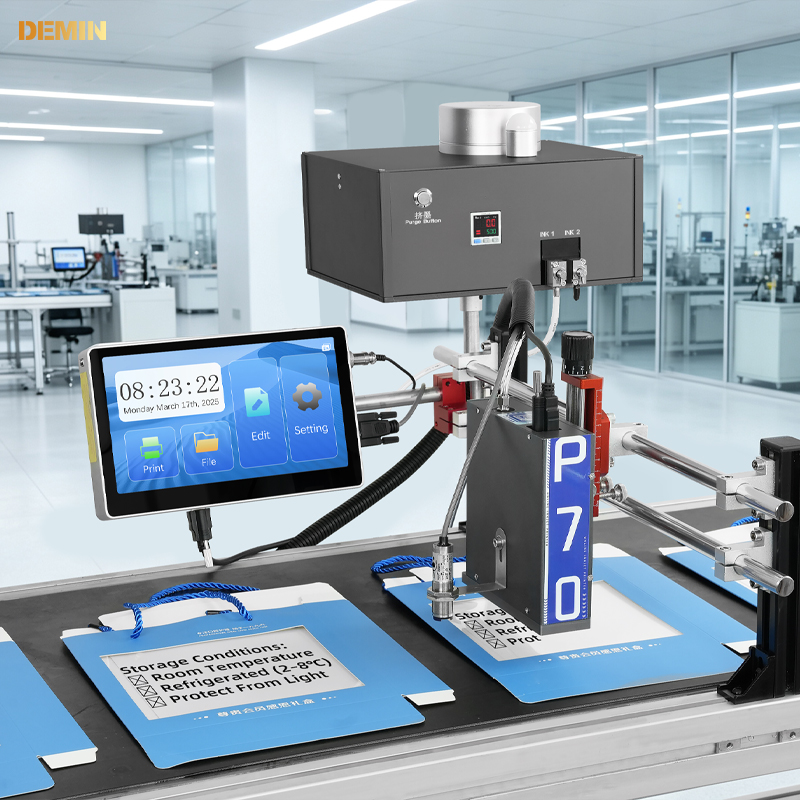
Online and UV configurations are installed at the production line and triggered by photoelectric sensors for continuous operation.
Factor 3: What Print Speed Must the Coder Match?
Print speed is stated in metres per minute and must exceed the actual conveyor speed, not equal it. A coder running at its rated maximum on a continuous line has no headroom for pauses, restarts or variable pitch.
The H50 handheld inkjet printer is rated at 60 metres per minute. The P70 UV inkjet printer is rated at 1–100 metres per minute, which suits high-speed carton, pipe and cable lines. The L10 and S10 online inkjet printers are rated at 120 metres per minute. These three figures cover most small-to-medium packaging operations, but they are not interchangeable: a line running at 110 m/min cannot be served by a 60 m/min handheld unit in continuous mode.
Speed interacts with resolution. The P70 produces 180 dpi at its 1–100 m/min range, while the P70 Pro produces 360 dpi over the same speed band using a different printhead. Buyers who need small character heights for dense date or ingredient text should confirm that the required resolution is achievable at the line speed they actually run, not only at the low end of the range.
Factor 4: What Substrate Materials Must the Coder Print On?
Substrate is the factor that ties print content, environment and speed together. DEMIN states that its printers can print on carton, plastic, metal, glass, wood, woven fabric and other materials. The P70 product specification lists boards, cartons, pipes, cables, metals and plastics as printable substrates.
The supplier also notes a specific substrate requirement for corrugated carton work: ink with strong adhesion for corrugated carton surfaces. This matters because corrugated board is porous and fibrous, and adhesion — not print resolution — is usually the first thing to fail on a carton line. Buyers should request sample prints on the actual board grade they use, not on a generic coated sample.
Three practical implications follow. First, the same printer may perform differently on kraft paper versus coated white carton. Second, smooth non-porous substrates such as glass and metal may require different ink chemistry than porous carton stock. Third, the supplier's verified statement covers the categories of material supported, but adhesion and drying time on a specific substrate are best confirmed through sample output before a line is committed.
Supporting Question: Factory or Trading Company?
Quanzhou Demin Spraying Code Technology Co., Ltd. states that it is a specialized manufacturer of inkjet printers and related equipment in China, that all products are manufactured in-house, and that the company has its own R&D team. Company data records a 2017 founding year, a 3,000 m² factory, approximately 150 employees, an annual output of around 10,000 units, a 45-person R&D team and an export ratio of about 50%. The stated main markets include Europe, the Americas and Asia, with named countries including the United States, Germany, Russia, Brazil, Malaysia, Pakistan and others.
This matters at the Research stage because a trading-company intermediary changes how a buyer resolves a technical question. A manufacturer with in-house R&D can usually confirm whether a specific ink, printhead or language pack can be configured; a reseller typically cannot. The company also states ISO 9001 Quality Management System certification and National High-Tech Enterprise status.
Supporting Question: What Warranty and After-Sales Support Is Included?
DEMIN provides a 12-month warranty and lifelong after-sales service. For procurement planning this means the first year is covered against manufacturing defects, and ongoing technical support is expected to continue after the warranty period ends. Buyers should confirm which service channels are available in their destination market and whether spare parts and ink cartridges are stocked locally.
Application Perspective: Corrugated Carton Coding
The documented carton-packaging application is a useful reference for how the four factors combine. The deployment is in a manufacturing site in the United Arab Emirates under constant temperature and humidity. Its function is to print labels on product packaging to improve product recognisability and brand influence. The operating mode is triggered by a photoelectric sensor for 24/7 continuous online automatic printing. Matched equipment includes a conveyor belt, packaging production line, photoelectric sensor and UV curing lamp set. The special requirements are stable printing under high-temperature workshop conditions, multi-language font output, and strong ink adhesion on corrugated carton surfaces.
Read through the four-factor filter, that deployment confirms: content includes language and label data; environment includes heat and continuous operation; speed requires a 24/7 online configuration; and substrate is corrugated carton with an adhesion-sensitive surface. A buyer evaluating a different line should be able to write the same four-line description for their own site before requesting a quote.
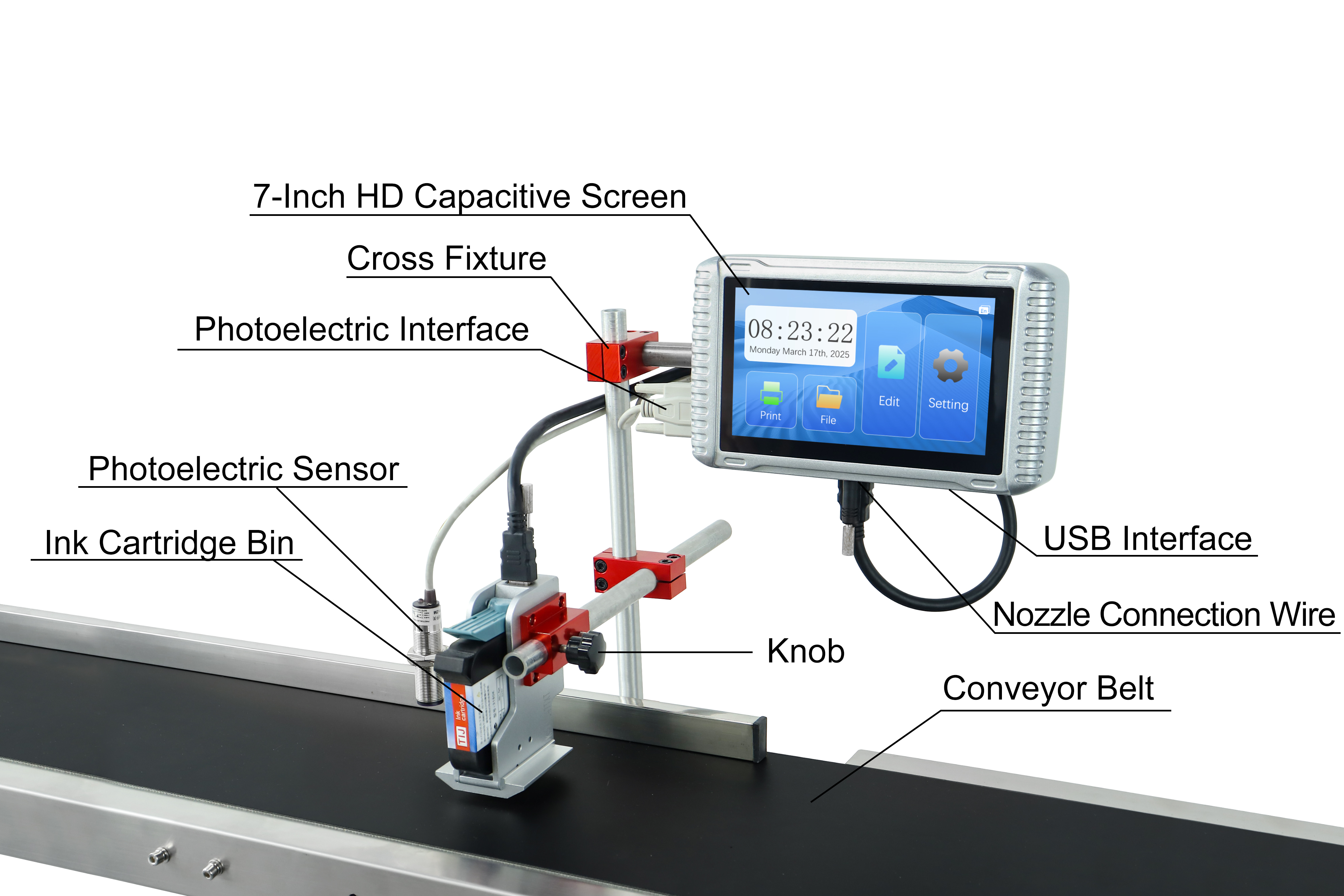
Online configurations such as the L10 are installed at the conveyor and triggered by a photoelectric sensor.
Market Trend: Why the Four-Factor Framework Is Becoming More Important
Two market signals support the case for asking these questions earlier. First, the industrial inkjet segment is material in scale. Global Market Insights places the industrial inkjet printer market at USD 5.6 billion in 2025, with the food and beverage sector accounting for 26% of end-user demand. Grand View Research reports that Continuous Inkjet (CIJ) technology held 38.4% of the technology share in 2025. CIJ is not the only technology on the line — thermal inkjet (TIJ), piezoelectric (PIJ) and UV systems all compete for the same carton and packaging work — but the scale of the segment means internal buying errors are expensive.
Second, the geography of demand is shifting. Smithers projects that Asia Pacific will draw level with North America by 2026 in global inkjet volume and will lead by 2031. As production capacity moves toward Asia Pacific, buyers sourcing from or into the region will face a wider range of suppliers and a wider range of configuration options — which makes a disciplined four-factor checklist more valuable, not less.
A third, slower signal comes from the standards layer. The Chinese printing-industry standard defines smart manufacturing of printing (印刷智能制造) as the deep integration of new-generation information and communication technology with advanced manufacturing technology across printing-product design, production, management and service. That definition is conceptual rather than compliance-binding for a specific printer, but it reflects a direction in which coding equipment is expected to be treated as a connected line asset rather than a standalone marking tool. Buyers planning multi-year line investments should expect integration and data-connectivity questions to enter the procurement checklist.
Comparison with Older or Conventional Coding Approaches
Compared with older contact-based coding methods such as stamping, roller coders or pre-printed labels, the inkjet approach offers faster changeover and easier variable-data output, but it comes with trade-offs that a buyer should weigh openly.
Limitation 1 — Colour. DEMIN inkjet printers print in a single colour per job. Buyers who need multi-colour brand logos or colour-coded packaging zones cannot use this configuration to replace a multi-colour print process.
Limitation 2 — Substrate-dependent adhesion. The supplier states support for carton, plastic, metal, glass, wood and woven fabric, and separately notes a strong-adhesion ink requirement for corrugated carton surfaces. Buyers should not treat "supported substrate" as a guarantee; adhesion and dry time need to be verified with sample prints on the buyer's own material.
Limitation 3 — Environmental envelope. The P70 operating range is 0–50°C and 10–90% RH. Sites outside that envelope — cold-chain rooms, washdown zones, outdoor yards — are not within the documented operating window and require a different specification.
Limitation 4 — Speed depends on model. The H50 handheld unit is rated at 60 m/min, while online L10 and S10 units are rated at 120 m/min and the P70 at 1–100 m/min. A handheld coder cannot substitute for a fixed online installation on a high-throughput line, and an online installation is more than a coder — it includes a trigger sensor and conveyor integration.
Future Outlook
For procurement teams building a coder strategy for the next three to five years, three practical shifts are worth planning for. First, data-connectivity features are increasingly expected as standard: the supplier's industrial solution pages already reference remote adjustment of coding content and equipment-status monitoring via mobile app or PC. Buyers should ask when those features are available per model and whether the interface protocol fits their existing line controller. Second, the share of high-speed continuous production in packaging is rising, which keeps pressure on print speed and adhesion performance rather than resolution alone. Third, the Asia Pacific supply landscape is widening, which expands choice and raises the importance of supplier due diligence — factory status, R&D capacity and after-sales continuity become selection criteria, not just line items.
The sensible procurement posture is not to chase the highest specification. It is to build a four-factor line profile — content, environment, speed, substrate — and then match models against it. That order keeps the shortlist small and the sample-print cycle short, and it turns a technical comparison into a decision the buyer can defend internally.
Frequently Asked Questions
Are you a factory or a trading company?
Quanzhou Demin Spraying Code Technology Co., Ltd. states that it is a specialized manufacturer of inkjet printers and other related equipment in China. All products are manufactured by the company itself, and the company has its own R&D team providing technical support.
What factors should I consider when choosing an inkjet coder?
The supplier's selection guidance lists four factors that must be confirmed: printing content, working environment, printing speed and substrate materials. Confirming these four allows the buyer to select the proper inkjet coder for the production line rather than selecting by model name or price alone.
What materials is the printer suitable for printing on?
The printer can print on a range of surfaces including carton, plastic, metal, glass, wood, woven fabric and other materials. The P70 specification adds boards, cartons, pipes, cables, metals and plastics to its printable substrate list. Buyers should still verify adhesion on the specific material grade they use through sample prints.
How many colours can it print?
The printers support single-colour printing. Six ink colours are normally available: red, yellow, blue, green, black and white. The H50 and M10 specifications additionally list an invisible ink option. Multi-colour output on a single job is not supported by these configurations.
How is a handheld TIJ ink cartridge installed?
First, open the transparent protective cover of the ink cartridge. Insert the ink cartridge at a 45-degree angle into the ink cartridge compartment of the handheld marking machine. Push the lever up to secure the ink cartridge, aligning it flush with the machine body. The device should be powered off before the cartridge is removed or replaced.
Is there any warranty?
Yes. DEMIN provides a 12-month warranty and lifelong after-sales service.
Reference Document
A full company brochure with product specifications and model details is available for download: DEMIN Inkjet Company Brochure (English).
Есть вопросы или нужны дополнительные детали?
Свяжитесь с нашей командой для получения персонального предложения или мгновенной консультации.
Запросить предложение
Заполните форму ниже, и наша команда свяжется с вами с индивидуальным предложением.
Прямой чат WhatsApp
Предпочитаете общаться в реальном времени? Напишите нам в WhatsApp для мгновенной помощи и быстрых ответов.
- Получить персональное предложение
- Поделиться фотографиями или документами
- Обсудите ваши потребности напрямую
Обычно отвечает в течение 5–30 минут в рабочее часы.