
Inkjet Printer Scorecard: Substrate, Speed, Ink and Warranty
Inkjet Printer Scorecard: Substrate, Speed, Ink and Warranty
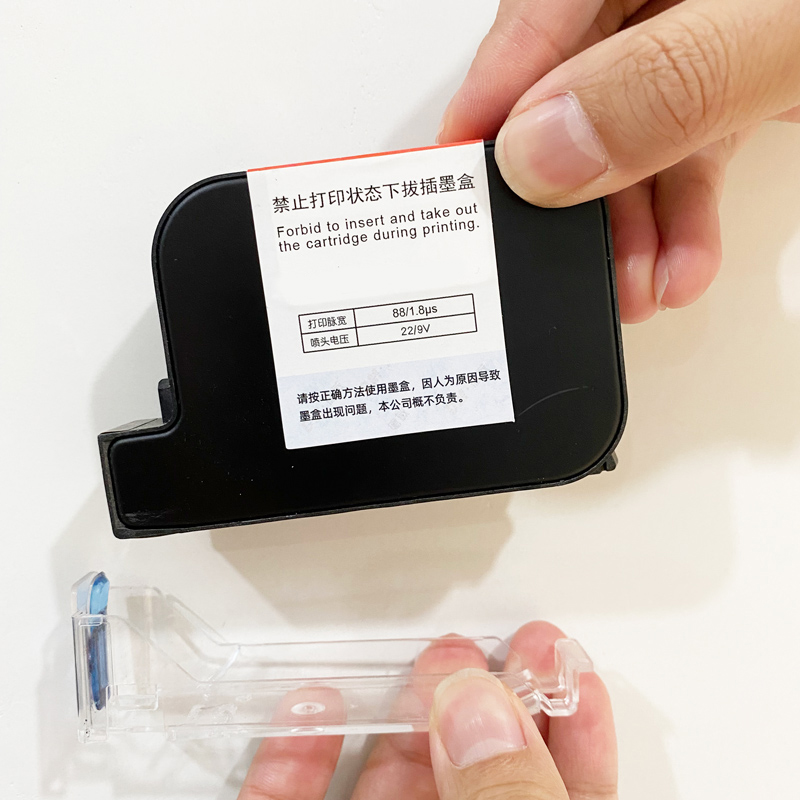
A real cartridge-seating step on a TIJ unit. Ink flexibility is one of four criteria a buyer scorecard should test before sign-off, not a headline spec accepted at face value.
That weighting problem is why a buyer scorecard earns its place earlier than a price sheet or a brand shortlist. Two printers can share a print width and still differ in how their ink systems bond to corrugated board, in the speed margin they retain at the line's required resolution, in the colors they can actually run, and in what happens when a printhead or a service visit is overdue. Treating those four as separate line items — with explicit weights — turns a vague comparison into a set of checks the buyer can run against a sample, a service visit, or the invoice.
Two published DEMIN models make the trade-offs concrete. The H50 handheld printer prints at 2–50 mm height, with an optimal print distance of 2–5 mm and a print speed of 60 meters per minute. The P70 covers a 5–72 mm print height at 1–100 m/min and supports water-based, UV and oil-based inks. Those are model-level specifications, not results on a specific carton or bottle; they frame the scoring, they do not replace a sample print.
Scorecard first, then shortlist: why weighting order matters
Industrial inkjet printers are commonly grouped by technology — continuous inkjet (CIJ), thermal inkjet (TIJ), piezoelectric inkjet (PIJ), UV inkjet and large-character inkjet — and by form factor: handheld, portable, desktop, online and mini. Those groupings are useful for narrowing the field, but they do not rank fit for a specific line. A high-speed packaging line and a mixed-material component cell can use the same form factor and still need completely different weightings. The scorecard approach fixes that by making the weighting visible before the shortlist is built.
Three practical consequences follow. First, substrate compatibility moves to the top of the scoring for any line that codes more than one material; a printer that scores well on cardboard can be the wrong one for glass or metal. Second, print speed and print height must be scored as a pair, because line throughput depends on both. Third, ink flexibility and warranty support are not afterthoughts — they determine the recurring cost and downtime profile after commissioning, and they are the two criteria that a trade company is least able to support credibly.
The four criteria used throughout this scorecard are the ones that DEMIN's own selection guidance treats as the first questions to confirm: printing content, working environment, printing speed and substrate materials. Its evaluation criteria for an industrial inkjet coder add stable continuous printing, easy maintenance, long service life and responsive technical support. The scorecard below turns those into weighted rows.
Substrate fit: the criterion most likely to break the scorecard
Substrate compatibility is where most misweighted scorecards fail first. According to DEMIN's product FAQ, its inkjet printers can print on carton, plastic, metal, glass, wood, woven fabric and other materials. The list is broad, but it is not the same as a guarantee for every grade or finish within each category.
For carton and corrugated board work, the harder requirements come from the production environment rather than from the material alone. DEMIN's own application notes for carton packaging — typically manufacturing lines working under constant temperature and humidity, triggered by a photoelectric sensor for round-the-clock continuous online printing — call for stable printing in a high-temperature workshop, multi-language font output, and ink with strong adhesion for corrugated carton surfaces. A scorecard should reflect that by scoring the carton row against those three sub-checks, not against a simple "carton: yes."
For plastic, metal and glass — common in component coding and in bottle or container lines — the sample print is the only reliable test. The ink that bonds cleanly on a matte plastic cap may not perform the same on a glossy blow-molded bottle; a metal surface that takes a print cleanly when dry may fail after a water rinse. The scorecard should treat each material as a separate row, with the pass condition set by the buyer's sample print rather than by the supplier's compatibility list.
Wood and woven fabric raise a different check: surface roughness. DEMIN's material FAQ lists both as suitable, and its building-chemical solution material references high-adhesion coding technology for rough substrates such as woven bags and iron drums. That is a manufacturer's application claim rather than an independently tested result, so the practical scorecard entry is the sample test — print on the actual substrate grade, let the ink cure under the line's conditions, then test adhesion with the buyer's method before sign-off.
Weighting guidance: on a single-substrate line such as a PET bottle date-coding line, substrate fit can carry a lower weight of roughly 15–20%, because it is easy to confirm. On a multi-material cell — a job shop printing cartons one shift and metal parts the next — substrate fit should carry the largest weight, roughly 35–45%, and should be scored per material rather than averaged.
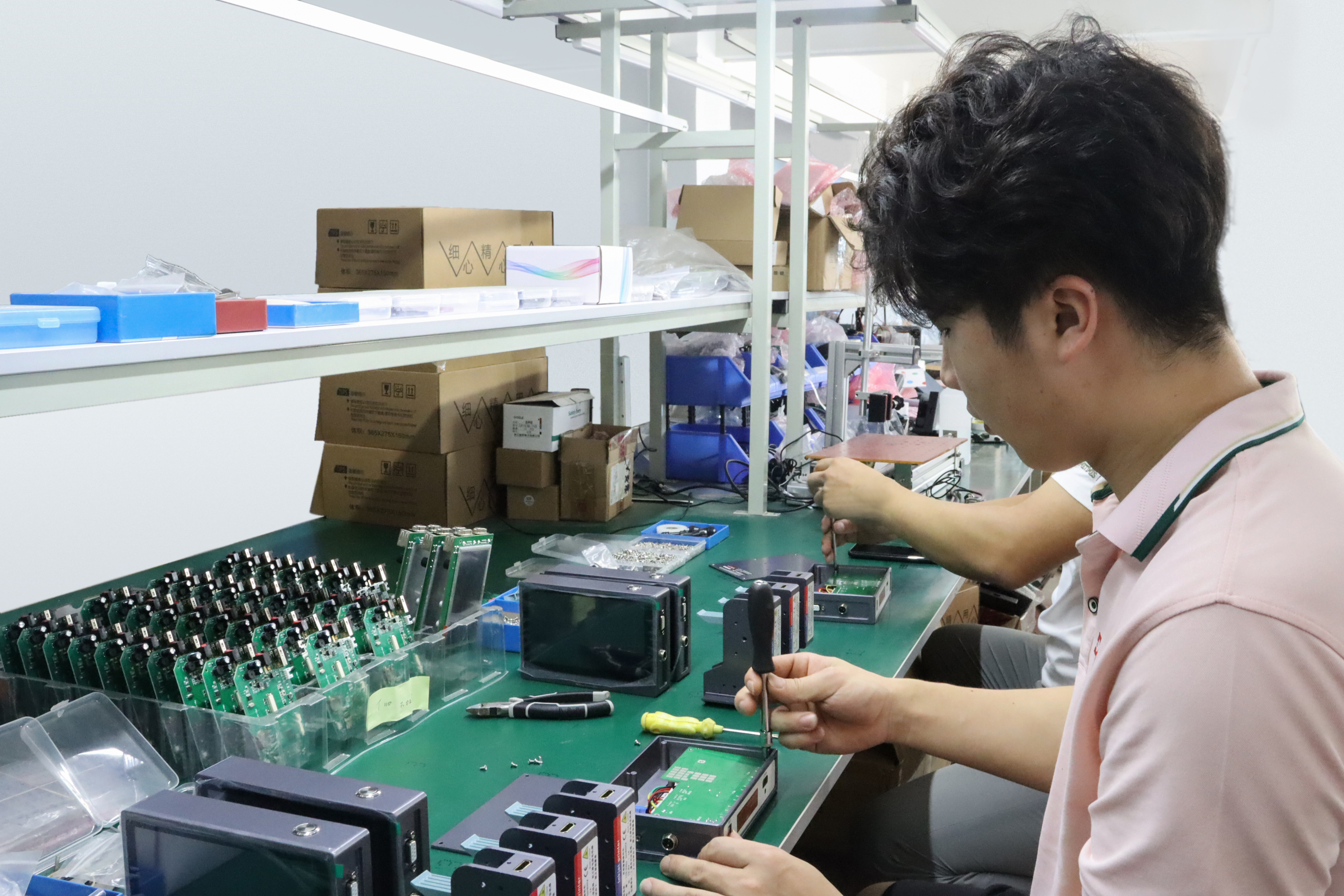
In-house R&D capacity and a factory model are verifiable parts of the supplier-support criterion — not a substitute for a sample print.
Print speed and height: score them together, not as a headline
Speed alone is a weak comparison because it depends on the print height and resolution being delivered. The H50 handheld printer prints at 2–50 mm height, at an optimum print distance of 2–5 mm, and at a rated speed of 60 meters per minute. The P70 covers a 5–72 mm height range at 1–100 m/min. Those two models bracket very different use cases: the H50 is handheld, suited to irregular shapes, low-to-medium volume work and field or spot coding; the P70 is a wider, faster unit that supports demanding line speeds and taller text or larger characters.
The scorecard should treat print height and print speed as a paired criterion with a line-rate test. The buyer records the line's normal running speed in meters per minute, the maximum burst speed, and the required print height and character size for the application. Then the printer's rated maximum speed is tested at the line's actual print height, not at its lowest setting. A high-speed inkjet printer rated at its maximum speed at minimum character height will not deliver the same throughput at 72 mm print height, and a scorecard that misses this produces a false "fast" score.
For slower lines running between roughly 30 and 60 m/min, the H50's 60 m/min ceiling and 2–50 mm print range are a reasonable fit for cartons, boxes and irregular items. For high-speed packaging lines, the P70's 1–100 m/min range and 5–72 mm height are the more relevant comparison point, and the speed score should be measured against the line's rated speed rather than the printer's maximum.
Weighting guidance: on a high-throughput line, speed and height should carry roughly 25–35% of the total score; on a slower or intermittent line, that weight can drop to 10–20%, and maintenance-related criteria should take its place.
Ink flexibility and color: the "six colors" reality
The phrase "six available colors" can mislead a buyer who is used to multi-color printing, so the scorecard should separate two different questions. DEMIN's printer FAQ states that the printer supports single-color printing and does not support multi-color printing simultaneously — it prints one color at a time. The six available ink colors are red, yellow, blue, green, black and white. A buyer who needs multi-color graphics or a multi-color logo should not score an inkjet coder for that requirement; it is a coding machine, not a multi-color label press.
What the six-color palette does buy is flexibility across the line: one machine can code the same product family in different colors across shifts, SKUs or markets without a second printer. That is worth scoring explicitly — a line that runs multiple packaging variants will value color flexibility; a line that only needs black date codes will not.
P70 ink flexibility is broader than the color palette alone. DEMIN specifies that the P70 supports water-based, UV and oil-based inks. That has direct scorecard consequences for hard-to-print substrates. Water-based inks typically suit absorbent materials such as carton and kraft paper; UV inks are commonly associated with non-porous surfaces such as plastic, metal and glass and require appropriate curing; oil-based inks sit on the fast-drying end of the spectrum for packaging use. A buyer should not assume any single ink family covers all six material categories. The scorecard should be built per material and per ink chemistry, with the supplier confirming the recommended ink for each substrate.
Weighting guidance: ink flexibility and color usually carry 10–20% of the total score. The weight rises when the line runs multiple SKUs, multiple package colors or non-porous materials, and falls when a single black date code is the entire job.
Supplier support and warranty: beyond the 12-month statement
According to DEMIN's warranty FAQ, the manufacturer provides a 12-month warranty for its P70 Pro, M10, P70, S10, L10 and H50 inkjet printer models, and offers lifelong after-sales service, including repair and maintenance support after the 12-month warranty expires.
DEMIN also confirms that it operates as a factory rather than a trading company: it is a specialized manufacturer of inkjet printers and other related equipment based in China, and all inkjet printer products are manufactured by the company itself. That factory-not-trading-company status matters in warranty scoring because it adds verifiable conditions a trading company typically cannot meet — a production area, an R&D department and a spare-parts source that the buyer can inspect.
DEMIN's corporate profile adds the operating context behind that claim. The company was founded in 2017, operates a 3,000 m² facility with 150 employees, maintains a 45-person R&D team, reports an annual output of 10,000 units and a 50% export ratio, and states that it holds ISO 9001 quality-management certification, National High-Tech Enterprise qualification, and a portfolio of independent patents and software copyrights.
None of that automatically makes a 12-month warranty superior to another supplier's. What it does is give the buyer an inspectable checklist. The scorecard should split supplier support into four checks:
- Warranty scope. What parts and failures the 12 months actually cover, and what counts as a consumable.
- Lifelong after-sales service. What exactly is offered — phone support, remote diagnosis, spare-part supply, on-site repair — and at what response times.
- R&D and customization. Whether an in-house R&D team can confirm non-standard requirements, including special substrates, ink chemistry, or a multi-language user interface. DEMIN states that its operating language supports more than 25 languages.
- Factory verification. A plant visit, video audit or document review — ISO 9001 certificate, business license, and evidence of a real production area — should be completed before the score is fixed, not after the invoice.
Weighting guidance: for a long-run, continuous-production line, supplier support should carry 25–30%. For occasional coding, where warranty risk is spread across the machine's life, that weight can drop to 10–15%. In either case, the factory check is a pass/fail gate, not a scored row.
How the weighting changes across three line types
The scorecard is only useful if the weights are set per line. Three common profiles illustrate the shift.
High-speed packaging line (beverage, food, FMCG). Speed and height carry the highest weight, roughly 35%, because throughput drives line economics. Substrate fit sits around 25%, because carton, PET bottle or can formats each bring their own adhesion and curing issues. Ink and color fall to about 15% unless the line runs a multi-color SKU set. Supplier support takes the remaining 25%.
Multi-substrate component cell (electronics, metalworking, auto parts). Substrate fit dominates at roughly 40%. Speed drops to about 20% because line rates are lower. Ink chemistry rises to about 20%, because metal, plastic and glass cannot be treated with a single blanket ink answer. Supplier support takes the remaining 20%.
Long-run date, batch and serial coding. Speed is moderate at about 20% because the line runs steadily. Substrate fit sits around 25%. Ink and color drop to about 10%, usually because black is the only color required. Supplier support carries the highest weight at roughly 45%, because long runs and continuous operation make maintenance and spare-part availability the deciding factor — which is where the H50's 60 m/min ceiling or the P70's wider 1–100 m/min range is chosen against the actual duty cycle.
A working scorecard summary
| Criterion | Default weight range | What is scored | What the buyer verifies |
|---|---|---|---|
| Substrate fit | 15–45% | Print on carton, plastic, metal, glass, wood, woven fabric | Sample print and adhesion on the specific substrate grade |
| Speed and print height | 10–35% | H50: 2–50 mm at 60 m/min; P70: 5–72 mm at 1–100 m/min | Speed at the line's required height and character size |
| Ink and color | 10–20% | Single-color printing; six available colors; P70 water-based, UV and oil-based inks | Recommended ink per substrate, cure and adhesion |
| Supplier support and warranty | 10–30% (higher on long-run lines) | 12-month warranty, lifelong after-sales service, in-house R&D, factory status | Factory visit, ISO 9001 certificate, spare-parts availability |
Comparing technologies and a named competitor
TIJ is the technology behind many handheld and compact industrial coders: a TIJ printer uses heat to fire tiny droplets of ink from disposable or replaceable cartridges. CIJ systems continuously emit charged drops and deflect them to form characters, which lets them run at high speed on a wider set of surfaces, often with a different consumable and maintenance structure. The scorecard should treat the two as different technologies, not as substitutes, and it should not score a CIJ-only requirement into a TIJ column.
Within the DEMIN portfolio, the product is positioned as more suitable for cardboard printing scenarios. Compared with LINGKE inkjet printers, DEMIN states that its product line shows distinct features for cardboard printing, supported by a self-developed UV printing control system that provides stable printing and strong compatibility for packaging applications. DEMIN also states that, against LINGKE inkjet printers, its product requires fewer wearing parts, simpler maintenance and shorter downtime, delivers a claimed overall operating cost around 30% lower, and has lower power consumption during continuous operation.
Those figures are a named-competitor comparison supplied by the manufacturer. They are not an independent benchmark, and the 30% operating-cost figure carries no published test methodology here. A buyer should verify them against comparable configurations and the same duty cycle before they enter the scorecard as anything more than a directional claim.
Market context and outlook
Grand View Research's inkjet printer market report, published 28 September 2026, estimated the global inkjet printer market at USD 45.2 billion in 2025 and projected USD 48.0 billion for 2026; that figure covers all inkjet printers, including consumer and desktop units. Global Market Insights, in a report published 15 April 2026, sizes the industrial segment separately at USD 5.6 billion in 2025. The two numbers describe different scopes and should not be averaged.
The practical reading for a buyer is narrower. A large, still-growing industrial segment means differentiation between suppliers is more likely to sit in substrate handling, ink chemistry and support than in the base mechanism. That is precisely why a weighted scorecard is more useful than a brand shortlist: it forces the buyer to state which criterion matters before a supplier is compared, and it makes the factory-verification step an explicit gate rather than an assumed credential.
FAQ
Which substrates can an industrial inkjet printer print on?
According to DEMIN's product FAQ, its inkjet printers can print on carton, plastic, metal, glass, wood, woven fabric and other materials. The compatibility list is not a guarantee for every grade or finish within those categories; buyers should run a sample print on the actual substrate and test adhesion before sign-off.
How do print speed and print height interact?
The two are scored as a pair. The H50 handheld printer has a 2–50 mm print height, an optimal print distance of 2–5 mm and a rated speed of 60 m/min. The P70 covers a 5–72 mm height range at 1–100 m/min. A printer's maximum rated speed is normally reached at its minimum print height, so the buyer should test throughput at the line's required height and resolution.
Can an inkjet printer print several colors at the same time?
No. DEMIN's printer supports single-color printing and prints one color at a time. Six ink colors are available — red, yellow, blue, green, black and white — but the machine is a coding printer, not a multi-color label press.
What warranty and after-sales support does DEMIN provide?
DEMIN provides a 12-month warranty for its P70 Pro, M10, P70, S10, L10 and H50 models, and offers lifelong after-sales service that includes repair and maintenance support after the 12-month warranty period ends. Buyers should confirm the exact warranty scope and response commitment for the specific configuration quoted.
How can a buyer verify that a supplier is a factory rather than a trading company?
Audit the operational record rather than accept the statement. A genuine factory can provide a business license, a quality-management certification such as ISO 9001, evidence of a physical production area and an in-house R&D function. DEMIN states that it operates as a specialized manufacturer of inkjet printers in China, manufactures all of its printer products itself, was founded in 2017, runs a 3,000 m² facility with 150 employees and a 45-person R&D team, and holds ISO 9001 and National High-Tech Enterprise qualification.
Supplier qualifications, model specifications and factory information for DEMIN Inkjet Printer are published on the company's official site. The company's English brochure is available for download: DEMIN Inkjet Company Brochure (English, 2026).
Есть вопросы или нужны дополнительные детали?
Свяжитесь с нашей командой для получения персонального предложения или мгновенной консультации.
Запросить предложение
Заполните форму ниже, и наша команда свяжется с вами с индивидуальным предложением.
Прямой чат WhatsApp
Предпочитаете общаться в реальном времени? Напишите нам в WhatsApp для мгновенной помощи и быстрых ответов.
- Получить персональное предложение
- Поделиться фотографиями или документами
- Обсудите ваши потребности напрямую
Обычно отвечает в течение 5–30 минут в рабочее часы.