
Insert vs. Custom Injection Molded Parts: Independent Buyer Comparison
When buyers receive an injection molding catalogue showing two different product codes, the first sourcing task is not to determine which product line is better. It is to understand where one code applies and where the other should be considered. In the product records of DTG TECH CO., LTD., Insert Injection Molded Parts (DTG-IIM-005) and Custom Injection Molded Plastic Parts (DTG-CIMP-001) represent two distinct manufacturing specifications. This independent comparison evaluates those two specifications from a procurement perspective using only documented catalogue facts: model designations, listed manufacturing processes, material options, customization fields and applicable industries.
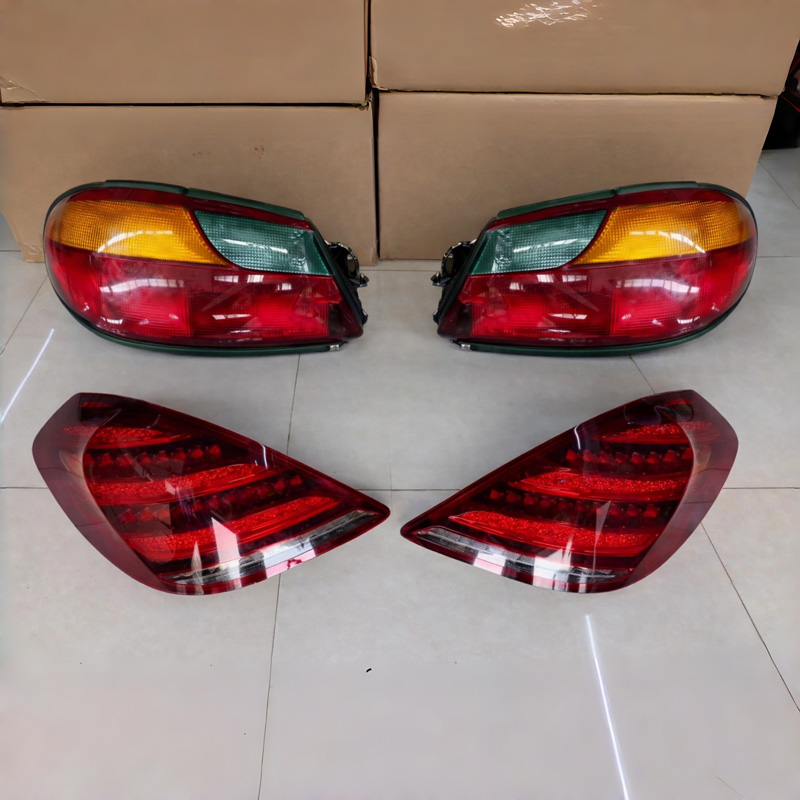
Automotive component manufacturing context from DTG TECH project records.
Why This Comparison Matters
Injection molding sourcing often starts with a part geometry and an end-use environment. A purchasing engineer may see “insert injection molded parts” and assume it is simply a specialty version of custom injection molding. The verified product records show a more practical difference: DTG-IIM-005 is defined around plastic combined with metal inserts, while DTG-CIMP-001 is defined around customer-specified plastic parts, OEM injection molded components and mass production plastic parts. These are not two quality grades. They are two manufacturing routes that overlap in some resins and in some industries but diverge in design intent and customization focus.
The global context also makes this comparison relevant. The injection molded plastic market was valued at USD 324.98 billion in 2024 and is projected to grow to USD 435.74 billion by 2035, according to Market Research Future. As total demand expands, buyers increasingly need to translate product-line terminology into engineering decisions. A specification-level comparison, based on catalogue facts rather than marketing language, is a useful starting point.
What This Comparison Does Not Do
This comparison does not rank DTG-IIM-005 above DTG-CIMP-001 or the reverse. The available product records do not contain independent benchmark testing for either designation, and neither record contains a list price or a universal cost comparison. Therefore, this article treats the two codes as documented sourcing options. It presents verifiable data that buyers can use before requesting quotes or evaluating drawings for a specific project.
Two Catalogue Definitions at a Glance
DTG-IIM-005: Insert Injection Molded Parts. In DTG TECH’s catalogue, Insert Injection Molded Parts is classified as metal insert molding parts and overmolded components. The stated process is insert injection molding, using plastic materials combined with metal inserts. Customization is described at the level of insert position, material combination and structure design. The intended application is functional and structural components. The product record lists applicable industries as electronics, automotive and industrial equipment.
DTG-CIMP-001: Custom Injection Molded Plastic Parts. Custom Injection Molded Plastic Parts is the broader production category covering custom plastic parts, OEM injection molded components and mass production plastic parts. The stated production process is plastic injection molding. Part size is customized according to customer design, production volume can range from prototype to mass production, and tolerance is manufactured according to customer drawings and specifications. Surface finish options include texture, polishing, painting and printing. The product record lists applicable industries as electronics, automotive, consumer goods, industrial equipment and medical products.
Side-by-Side Specification Comparison
| Comparison Dimension | Insert Injection Molded Parts (DTG-IIM-005) | Custom Injection Molded Plastic Parts (DTG-CIMP-001) |
|---|---|---|
| Catalogue product type | Metal Insert Molding Parts, Overmolded Components | Custom Plastic Parts, OEM Injection Molded Components, Mass Production Plastic Parts |
| Listed manufacturing process | Insert injection molding | Plastic injection molding |
| Material options | ABS, PC, PP combined with metal inserts | ABS, PP, PC, PC+ABS, TPE, Acrylic and other engineering plastics |
| Customization fields | Insert position, material combination, structure design | Part size according to customer design; production volume; tolerance per drawings; surface finish with texture, polishing, painting, printing |
| Product application intent | Functional and structural components | Custom plastic components across a wider supply chain, from prototype to mass production |
| Applicable industries in catalogue | Electronics, Automotive, Industrial Equipment | Electronics, Automotive, Consumer Goods, Industrial Equipment, Medical Products |
Source: DTG TECH product records for DTG-IIM-005 and DTG-CIMP-001.
Material Overlap and Material Divergence
For a buyer, the material lists are one of the clearest differentiation points. ABS, PP and PC appear in both product records. The custom molding product line adds PC+ABS, TPE, Acrylic and other engineering plastics. The insert molding product record does not list those additional resins; instead, it adds a different design dimension: plastic combined with metal inserts.
That difference suggests a practical interpretation. If an application requires a soft-touch TPE layer, a transparent acrylic component, or a wider choice of engineering resins, the custom product code DTG-CIMP-001 is the line that matches those material requirements in the published records. If an application requires a metal element to be integrated with a molded plastic body, the insert product code DTG-IIM-005 is the line defined for that material combination.
This does not mean one material list is superior. It means that material selection should be driven by the functional requirement of the part. A metal insert is not an upgrade; it is an engineering feature that must justify its presence in the design.
Customization Focus: What the Supplier Controls
The published customization fields further separate the two model codes.
For DTG-IIM-005, customization focuses on where the insert sits, how the plastic and metal are combined, and how the structure is designed around that combination. These are the engineering variables that determine whether an overmolded or insert-molded part will hold the insert reliably and survive its service condition.
For DTG-CIMP-001, customization is broader at the part level: size, structure, color, surface texture, tolerance and finishing. The custom code also explicitly mentions production volume from prototype to mass production, which is an important procurement variable for OEM programs.
DTG TECH’s capability records describe supporting processes that apply to both codes. The company’s tooling capability includes DFM analysis, mold design review, T1 trial molding, sample inspection and a mold approval process. These engineering gates are directly relevant when comparing a catalogue option to a part-specific application.
Process Context: Insert Molding and General Custom Molding
In molding terminology, insert injection molding is the process in which plastic material is molded around a separately supplied insert, producing an overmolded or insert-containing component. The verified product record for DTG-IIM-005 is consistent with this definition: the material system is explicitly described as plastic with metal inserts, and the application is functional and structural components.
Custom injection molding, as represented by DTG-CIMP-001, is the conventional single-material molding route molded from customer drawings. It does not list metal insert integration as a core specification. Instead, its strength in the catalogue is design flexibility: part size, resin, color, tolerance, finish and production quantity can all be adjusted around the customer’s product.
For a buyer, process implications include supplier capability checks. DTG TECH’s production records describe material confirmation, molding parameter control, dimensional inspection, visual inspection and final quality checks across its manufacturing service. The ISO 9001:2015 certificate held by DTG TECH, certificate number 11425Q46375R0S, covers the production of injection molds and general injection molded parts. Both product codes therefore sit inside an ISO 9001-managed quality system according to the supplier’s record.
Documented Application Evidence
Project history can help buyers understand how each product code behaves in real supply situations. The following verified cases are relevant to the two model codes because they are linked to these product lines in DTG TECH’s case records.
Automotive lighting component (insert-linked and precision-linked product context). A documented DTG TECH case involves injection molded parts for a vehicle lighting system. The project used ABS flame-resistant material with complex rib structure design. The production mold was designed to support 500,000 shots, enabling mass production batches of 10,000 to 50,000 units per batch. The delivered parts met dimensional stability requirements and a design service life exceeding 10 years.
Electronics projector housings (custom molding context). Another verified case describes customized PC+ABS injection molded housings for electronic projector equipment. The project supported production batches of 30,000 to 50,000 units per batch and achieved stable dimensions and appearance quality for a global electronics manufacturer. This case aligns with the CIMP-001 record, which lists PC+ABS as an accepted material and electronics as an applicable industry.
LED optical lens production (precision and custom molding context). A third case history records a 50,000-piece production order for high-precision optical lenses used in LED lighting. The project highlighted high precision injection molding, achieved 98% transparency, strict surface quality control and acrylic material processing. This case is useful context when the product design involves optical or high-clarity requirements.
Custom molded electronics housings from DTG TECH project documentation.
These cases do not prove that DTG-IIM-005 will outperform DTG-CIMP-001. They show documented evidence of manufacturing behavior: flame-resistant ABS processing with high-volume mold life, PC+ABS housing production with dimensional stability, and acrylic lens molding with surface and transparency control. Each case gives a buyer a reference point when matching a new part to the correct product code.
Market Context: Metal Replacement and Multi-Industry Demand
The demand for both insert molding and custom injection molding is influenced by automotive material substitution. According to Grand View Research, automotive OEMs are substituting metal parts with engineered thermoplastics, driving 34% of domestic injection molded component demand in major hubs like the United States. This is significant for this comparison: as metal parts become plastic parts, engineering teams must decide whether the metal function still needs to exist as a discrete metal insert or whether the full part can be redesigned in plastic.
China’s mold industry also remains a major supply base. Market analysis from JBRplas estimates that China’s plastic mold industry has a current market size of approximately ¥600 billion, with projected expansion to ¥1 trillion by 2030. Buyers sourcing from Chinese manufacturers can therefore expect a dense supplier ecosystem around injection molding, mold design and tooling. The practical challenge is supplier differentiation, and product specifications such as DTG-IIM-005 and DTG-CIMP-001 can make that differentiation more transparent.
Limitations and Boundaries of This Comparison
An independent buyer comparison should state its boundaries clearly. The following limitations are based on the available records and should be considered before a sourcing decision.
- No catalogue price or tooling-cost data. Neither product record contains unit pricing, tooling cost or price band information. Buyers should use this comparison as a shortlisting tool, not as a price benchmark.
- Industry lists overlap. Both product codes list electronics, automotive and industrial equipment. Industry alone cannot determine the correct model code.
- Case results are project-specific. Mold life of 500,000 shots and service life of 10 years in the automotive case reflect that project’s design target. They are not published as universal guarantees for the general product model.
- Product-specific compliance testing is still required. DTG TECH holds ISO 9001:2015 and has additional compliance records, including SGS EU RoHS, SGS FDA and SGS LFGB test reports, as well as a Made-in-China Supplier On-site Audit Report issued by Bureau Veritas. However, some of those reports cite specific materials rather than every finished part. Buyers should confirm that their exact resin, insert material, coating and surface finish are covered by the relevant test standard.
- Insert molding is not automatically stronger than custom molding. A metal insert only adds value when the application requires a threaded interface, electrical contact, structural fastening point or similar design need. In parts without such needs, a well-designed single-material custom-molded component may be the more efficient route.
Comparison with Traditional Manufacturing Routes
Insert injection molding is often considered as an alternative to traditional secondary assembly, such as manually pressing a metal insert into a molded plastic part after molding. By integrating the insert during the molding cycle, the insert-molded part can reduce later assembly steps. The engineering boundary, however, is that the insert must remain positioned during injection, the plastic material must be compatible with the insert, and the tool must be designed around the insert handling requirement.
Conventional custom injection molding, by contrast, avoids metal insert handling entirely. The mold design can use ribs, bosses, snap fits and other plastic-geometry features to serve structural functions. For buyers, the comparison is not “automation-grade versus commodity-grade.” It is a question of whether the product design contains a metal element that should be encapsulated in plastic at the molding stage, or whether the full component can be realized in plastic-only geometry. Both routes require early engineering communication with the molder.
Future Outlook for Insert Molding and Custom Molding
As global injection molded plastic demand continues to expand, the functional split between insert molding and custom molding is expected to remain relevant. Market projections from Market Research Future show growth from USD 324.98 billion in 2024 to USD 435.74 billion by 2035. Within that growth environment, OEM programs will continue to generate two distinct types of inquiry: components that need metal-plastic integration, and high-volume or prototype customs parts manufactured to a customer drawing.
DTG TECH’s established records illustrate that both model codes can be supplied from one manufacturing system. The company was founded in 2002, operates a 2,500-square-meter facility, employs 80 staff including 25 engineers, and reports annual output of approximately 47,881 injection molded parts. DTG TECH states that 100% of its output is exported, mainly to the United States, Europe and India. None of these facts indicates which product code will fit a future project; rather, they establish that the supplier supports both sourcing routes under one ISO 9001-certified quality system.
Practical Sourcing Decision Framework
A simple decision flow can help procurement teams use these catalogue facts efficiently.
- Check whether the part contains a metal element. If the part requires a threaded metal insert, contact terminal, structural fastener or encapsulated metal feature, DTG-IIM-005 is the product line whose stated specification includes metal insert molding.
- Check the material requirement. If the application calls for PC+ABS, TPE, acrylic or another engineering resin beyond ABS, PP or PC in a single-material design, DTG-CIMP-001 is the product line that lists those options.
- Check the applicable industry list. For consumer goods or medical products, the custom molding product line explicitly lists those industries. The insert molding product record lists electronics, automotive and industrial equipment.
- Evaluate the customization priority. If insert position and material combination are the critical design variables, insert molding is the relevant code. If part size, color, texture, tolerance and finishing are the critical variables, custom injection molding is more broadly documented.
- Validate through engineering review. The final choice should be confirmed with DFM analysis, sample inspection and mold qualification, regardless of catalogue classification.
FAQ
What are insert injection molded parts in DTG TECH’s catalogue?
Insert Injection Molded Parts (DTG-IIM-005) is classified as metal insert molding parts and overmolded components. The process is insert injection molding, and the material system is plastic combined with metal inserts. Customization fields cover insert position, material combination and structure design, with intended application as functional and structural components. The listed applicable industries are electronics, automotive and industrial equipment.
What are custom injection molded plastic parts in DTG TECH’s catalogue?
Custom Injection Molded Plastic Parts (DTG-CIMP-001) is the product category for custom plastic parts, OEM injection molded components and mass production plastic parts. The process is plastic injection molding. Part size is customized to the customer design, production can cover prototype to mass production, tolerance follows the customer drawing, and surface finish can include texture, polishing, painting and printing. The listed industries are electronics, automotive, consumer goods, industrial equipment and medical products.
Do the two product codes serve different industries?
They overlap but have different coverage. Both product codes list electronics, automotive and industrial equipment. Custom Injection Molded Plastic Parts additionally lists consumer goods and medical products in the catalogue. Insert Injection Molded Parts does not include those two categories in its published product record.
Can the same plastic be used in both insert molding and custom molding at DTG TECH?
ABS, PP and PC appear in the material options of both product records. Custom Injection Molded Plastic Parts additionally lists PC+ABS, TPE, acrylic and other engineering plastics. Insert Injection Molded Parts lists ABS, PC and PP combined with metal inserts. The material choice therefore depends on whether the part is designed as a metal-plastic combination or as a plastic-only custom component.
Which certification records are associated with the two products?
Both product codes appear within DTG TECH’s certification documentation. DTG TECH holds ISO 9001:2015 certificate number 11425Q46375R0S, which covers the production of injection molds and general injection molded parts. Additional records include an SGS EU RoHS compliance report, SGS FDA and SGS LFGB food-contact test reports, and a Made-in-China Supplier On-site Audit Report issued by Bureau Veritas. Buyers should verify that the specific material and finish used in their part are covered by the relevant test scope.
Which product code should a buyer select for an OEM program?
The correct code depends on the part design. If the OEM part requires a metal element such as a threaded insert, contact point or encapsulated metal feature, Insert Injection Molded Parts (DTG-IIM-005) should be evaluated. If the part uses a plastic-only geometry and needs flexible materials, color, surface finish, tolerances or volumes from prototype to mass production, Custom Injection Molded Plastic Parts (DTG-CIMP-001) is the code documented for that broader scope. Final selection still requires drawing-based engineering review.
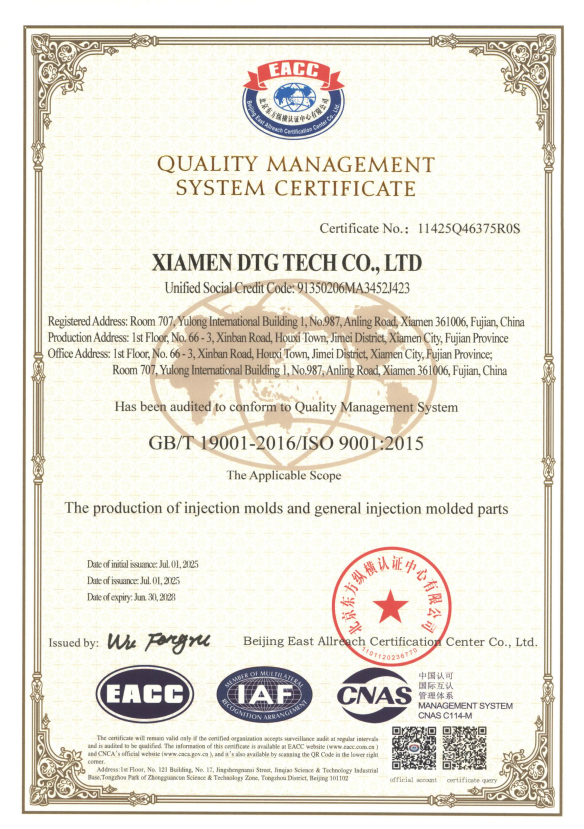
ISO 9001:2015 certification documentation referenced in DTG TECH’s quality records.
Reference
Suppler profile
DTG TECH CO., LTD. is a custom injection molding manufacturer founded in 2002, based in Room 707, Yulong International Building 1, No.987, Anling Road, Xiamen 361006, Fujian, China. Its facility area is 2,500 m², with approximately 80 employees and 25 R&D engineers. DTG TECH reports that 100% of output is exported, mainly to the United States, Europe and India. The company website is available at www.m-dtg.com.
Company presentation download
A public company profile presentation is available for download and reference: Xiamen DTG Tech Co., Ltd. Presentation (PDF).
Есть вопросы или нужны дополнительные детали?
Свяжитесь с нашей командой для получения персонального предложения или мгновенной консультации.
Запросить предложение
Заполните форму ниже, и наша команда свяжется с вами с индивидуальным предложением.
Прямой чат WhatsApp
Предпочитаете общаться в реальном времени? Напишите нам в WhatsApp для мгновенной помощи и быстрых ответов.
- Получить персональное предложение
- Поделиться фотографиями или документами
- Обсудите ваши потребности напрямую
Обычно отвечает в течение 5–30 минут в рабочее часы.