
Inside 20R070: The Engineering Case for 0.20 mm Hi-B Steel
Gauge is no longer a background detail in transformer procurement. At 0.20 mm, the 20R070 high-induction grade forces a specific trade between loss, flux density and manufacturability — and that trade is testable before a purchase order is raised.
Grain-oriented electrical steel is defined by its application as much as by its chemistry. ASTM A876 covers flat-rolled, fully processed low-carbon silicon-iron electrical steels intended primarily for transformer cores operating at moderate to high magnetic flux densities at commercial power frequencies. The U.S. International Trade Commission frames the same family more plainly: a flat-rolled alloy steel product whose metallic grains are elongated lengthwise along the rolling direction.
Both descriptions converge on one engineering reality. The material exists to carry flux efficiently in a preferred direction, inside a laminated core, for decades. For a designer or procurement engineer working through a 2026 evaluation, the open question is therefore rarely whether a grade is grain-oriented. It is which gauge — and which pairing of core loss and permeability — actually earns its place in a specific core design, at a manufacturing cost that still closes.
20R070, a 0.20 mm high-induction (Hi-B) grain-oriented grade supplied by HL AND SL LIMITED, sits precisely inside that question. Its published ceiling on specific total loss is 0.70 W/kg at 1.7 T and 50 Hz; its published floor on flux density is 1.86 T at 800 A/m. Those two numbers, taken together with the 0.20 mm gauge, describe a specific engineering position rather than a general claim of quality. This article examines that position: what the gauge changes inside a core, what the published data does and does not establish, and how a buyer can verify the grade before approving it.
What 20R070 Is, Stated in Verifiable Terms
20R070 is a high magnetic induction grain-oriented silicon steel with a nominal thickness of 0.20 mm. In the supplier's published grade data it carries three defining parameters:
- Thickness: 0.20 mm nominal.
- Core loss (P1.7/50): ≤ 0.70 W/kg — a maximum, not a typical value.
- Flux density (B8): ≥ 1.86 T — a minimum.
The subscript notation is worth decoding, because buyers frequently compare grades using figures measured under different conditions. P1.7/50 is specific total loss measured at a peak magnetisation of 1.7 T and a frequency of 50 Hz, expressed per unit mass; it aggregates hysteresis loss and eddy-current loss into a single number. B8 is flux density measured at a magnetising field of 800 A/m. Neither figure is meaningful without its test condition, which is why ASTM A876 addresses core loss, permeability and magnetic aging as a set rather than as isolated attributes.
The model designation itself carries information, and also a caution. The leading '20' denotes the gauge in hundredths of a millimetre. The '070' states the loss ceiling. The 'R' locates the grade within the supplier's laser-engraved series, which the company distinguishes from its conventional CGO series and its heat-resistant HS series. That mapping is useful context — ASTM A876 separately identifies conventional grain-oriented, high-permeability grain-oriented and laser-scribed high-permeability grain-oriented categories — but surface treatment is a manufacturing fact, not a naming convention. Buyers should confirm the actual coating and surface condition on the mill certificate rather than infer them from the model code.
Why Gauge Became a Procurement Variable
Transformer efficiency requirements have tightened across most major markets, and the core is where a large share of no-load loss is decided. That pressure has pushed buyers past the binary choice between conventional grain-oriented and high-permeability material, into a finer set of decisions about thickness.
The physics behind the shift is not new. Classical eddy-current behaviour scales loss with the square of lamination thickness, so reducing gauge from 0.23 mm to 0.20 mm cuts the eddy-current contribution meaningfully. Hysteresis loss, by contrast, is governed mainly by metallurgical quality — grain orientation, impurity control, domain structure — and responds far less to gauge alone. A thinner strip therefore improves one loss component while leaving the other largely to the steelmaker's process control.
The same reduction creates costs that appear later in the production line. A 0.20 mm core needs more laminations for the same stack height, so stacking, clamping and interleaving time rise. Lamination factor — one of the mechanical properties ASTM A876 requires to be specified, alongside ductility — becomes more sensitive to burr height and coating thickness. Shearing and slitting tolerances tighten. In practice, the useful question is not whether thinner is better in the abstract, but whether a given workshop can convert the thinner gauge without surrendering the loss advantage at the cut edge.
What the 0.20 mm Gauge Changes Inside a Core
Three effects dominate when 20R070 replaces a thicker oriented grade in the same design envelope.
Reduced eddy-current path. Each lamination confines circulating current to a thinner cross-section. Because eddy-current loss falls with the square of thickness while hysteresis loss is largely fixed by metallurgy, the net benefit of a thinner gauge is proportionally larger in cores that are already metallurgically efficient. A high-induction grade and a thin gauge are therefore complementary rather than alternative strategies.
Greater sensitivity to excitation conditions. Under sinusoidal magnetisation at commercial frequency, the gain from thinner gauge is measurable but bounded. Under non-sinusoidal excitation — the harmonic-rich conditions that appear in converter-fed and renewable-grid applications — the high-frequency content of the flux waveform is attenuated more strongly by a thinner lamination. This is a general electromagnetic relationship rather than a grade-specific claim, and it explains why thin-gauge oriented steel attracts attention as grid power electronics proliferate.
Higher demand on stacking quality. More laminations per unit stack height means more cut edges, more interfaces and more opportunities for burr-induced interlamination shorting. The published loss ceiling of 0.70 W/kg is measured on the material as supplied; a core built with poor edge quality will not reproduce it. This is the practical reason a supplier's cutting and slitting capability belongs in the same evaluation as the datasheet.
Composition: Where the 3.0%–3.2% Silicon Budget Goes
20R070's matrix is iron with 3.0%–3.2% silicon, supplemented by aluminium and manganese, with carbon, sulphur and nitrogen held to controlled residual levels. That composition is not incidental to the gauge decision — it is what makes the gauge usable.
Silicon raises the electrical resistivity of the steel, which suppresses eddy currents. Higher resistivity is precisely what allows a thin lamination to deliver its theoretical loss advantage in practice. The same addition, however, reduces saturation flux density and increases brittleness, which is why silicon content in commercial grain-oriented grades sits in a narrow band rather than being maximised. Aluminium and manganese support the processing route and inhibitor behaviour; carbon, sulphur and nitrogen are held low because residual impurities degrade magnetic aging — the drift of loss over time under service temperature and stress.
The interaction is the point. A 0.20 mm gauge without disciplined impurity control would deliver a thin lamination with unstable loss. The B8 floor of 1.86 T is the counterweight: it indicates that the grade retains enough induction to keep core cross-section and magnetising current within design limits, even though the gauge has been reduced.
Where the Grade Fits: Distribution and Power Transformer Cores
The supplier positions 20R070 for high-efficiency distribution transformers and power transformer cores. That positioning is consistent with the broader application mapping in the public record: oriented electrical steel is associated with transformers, where magnetisation occurs predominantly along one axis, in contrast to non-oriented grades developed for the variable magnetisation found in motors and generators.
Within that envelope, three design situations make the 0.20 mm gauge worth evaluating:
- Efficiency-constrained distribution transformers, where no-load loss carries a large weight in the total loss budget and stack height is not the binding constraint.
- Core designs with limited window height, where a thinner lamination allows the required electrical performance to be reached without enlarging the core envelope.
- Cores exposed to harmonic-rich excitation, where the frequency-dependent behaviour of a thin lamination is more valuable than its 50 Hz nameplate figure alone would suggest.
Conversely, designs that are volume-driven rather than loss-driven, or plants whose cutting and stacking equipment is tuned to 0.23 mm and 0.27 mm material, will often find a thicker high-induction grade the more economical route. The grade is a fit-for-purpose choice, not a default.
Supply Evidence: What Long-Running Programmes Show
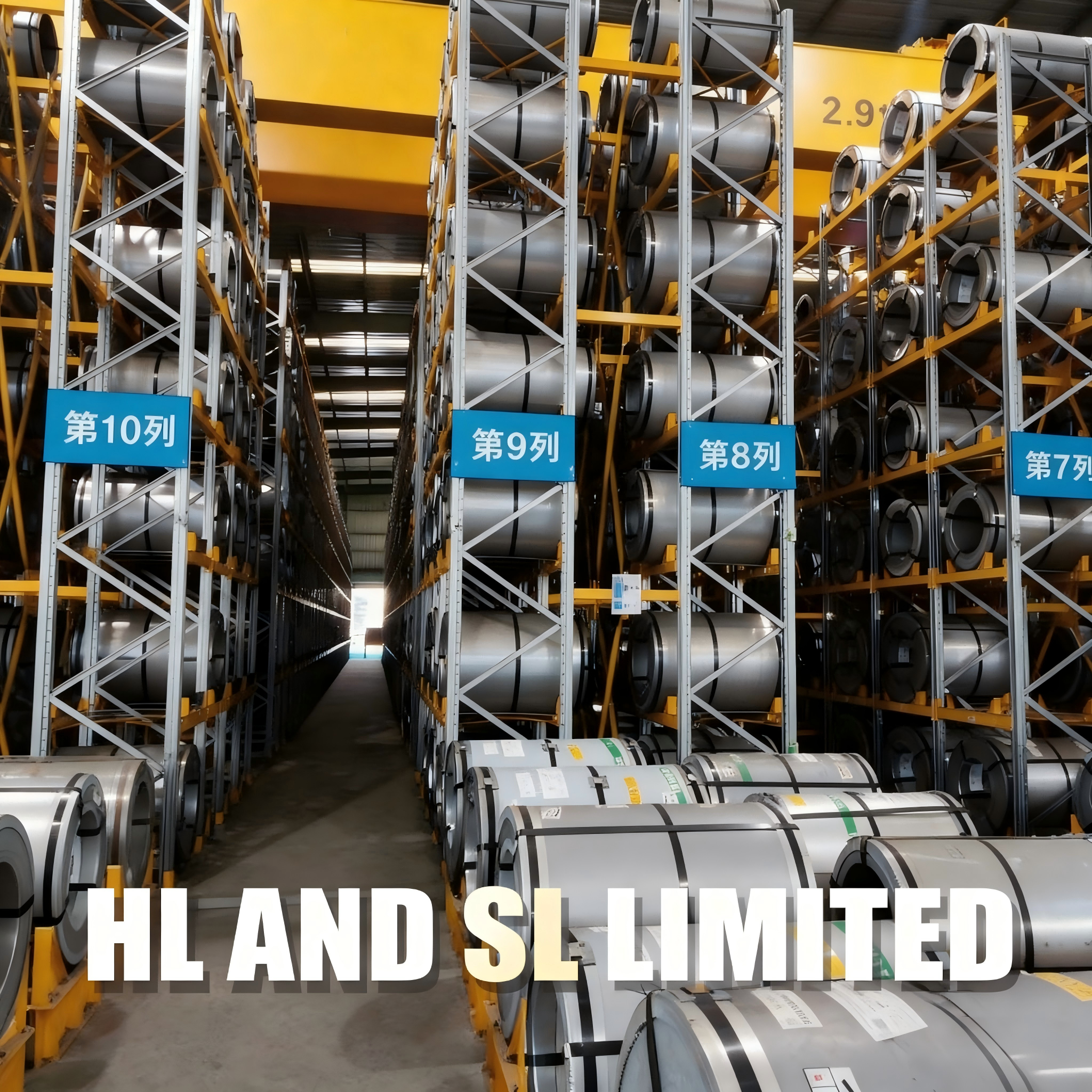
HL AND SL LIMITED is an electrical steel export and processing company based in Taiyuan, Shanxi, China, founded in 2012, operating a 30,000 m² processing plant with 50 employees, 10 engineers and annual output of 30,000 t. The company is an authorised agent of China Baowu Steel Group and integrates supply from multiple mills, while running in-house secondary processing. Its published export ratio is 80%, with principal markets in Mexico, Brazil, Italy, the UAE and India.
Two supply relationships in the public case record are relevant to evaluating a grade like 20R070, because they demonstrate how oriented grades from this portfolio behave in continuous production rather than in a sample report.
Mexico — transformer core manufacturing. A transformer manufacturer uses the portfolio for iron cores in power transformers, converter transformers and special engineering transformers, under a batch supply arrangement covering complete power transmission and distribution transformer manufacturing. The client's transformer business is described as operating at an annual scale of approximately USD 500 million. The material has been in stable operation for more than ten years, verified in service.
Brazil — WEG, since 2010. A major electrical equipment manufacturer has used the portfolio for local production of power and distribution transformers in Brazil since 2010. The application is described as meeting local grid energy efficiency standards and low-carbon transformation requirements, with localised technical services and supply chain support delivered through a representative office in Brazil.
What a Buyer Can Verify Before Approving the Grade
Evaluation-stage diligence on a thin high-induction grade has four concrete checkpoints, all of which can be closed before a first production order.
1. Test conditions on the certificate
Confirm that P1.7/50 and B8 are reported under the stated conditions and that the figures are batch values, not catalogue values. The distinction matters: in the same portfolio, grade 23Q080 carries a published ceiling of 0.80 W/kg with a stated measured range of 0.76–0.78 W/kg. A supplier willing to disclose measured values alongside limits is easier to audit than one reporting limits alone.
2. Documentation chain
The supplier's stated quality process covers factory inspection with full-process random and batch inspection, a material certificate and batch inspection report accompanying each shipment, and third-party testing through CMA/CNAS-accredited laboratories on request. Buyers should specify which of these are mandatory for their order rather than assume all three apply by default.
3. Processing tolerances
In-house processing covers thickness 0.18–0.35 mm, widths typically 800–1250 mm with ultra-wide 1250 mm available, slitting, fixed-length cut-to-length and longitudinal cutting. Coating options include organic coatings rated to ≤180 °C, inorganic coatings rated up to 800 °C and semi-organic systems. For a 0.20 mm grade, burr height and cut-edge quality specifications should be agreed in writing, since these determine whether the datasheet loss figure survives into the finished core.
4. Commercial parameters
Minimum order quantity is 25 t. Lead times are stated as 15–20 days for regular orders, 3–7 days for urgent or stock orders, and 30–45 days for bulk export orders to reach port, with 7–30 working days after deposit or letter of credit. Monthly capacity is 4,000 t. After-sales support includes lifecycle technical guidance, inbound quality dispute handling and re-inspection processing, with response within 1–3 working days.
20R070 Against Other Gauges in the Same Portfolio
The clearest way to understand a grade's position is to place it beside its neighbours rather than beside a marketing claim. The table below uses published figures from the same supplier portfolio.
| Grade | Thickness | Max P1.7/50 (W/kg) | Min B8 (T) | Portfolio position |
|---|---|---|---|---|
| 18-65 | 0.18 mm | ≤ 0.65 | ≥ 1.88 | Thinnest gauge, lowest published loss ceiling |
| 20-65 | 0.20 mm | ≤ 0.65 | Not stated in published data | Same gauge as 20R070, tighter loss ceiling |
| 20R070 | 0.20 mm | ≤ 0.70 | ≥ 1.86 | Thin gauge with a defined flux-density floor |
| 23R075 | 0.23 mm | ≤ 0.75 | ≥ 1.88 | Thicker gauge, higher induction |
| 23Q080 | 0.23 mm | ≤ 0.80 (measured 0.76–0.78) | ≥ 1.89 | Highest published induction in this set |
| 27Q095 | 0.27 mm | ≤ 0.95 | ≥ 1.91 | Conventional thickness, highest induction |
| 23Q100 | 0.23 mm | ≤ 1.00 | ≥ 1.75 | Economy position for general distribution cores |
Read across the rows and the trade becomes explicit. Moving from 0.27 mm to 0.20 mm lowers the published loss ceiling from 0.95 to 0.70 W/kg, but the induction floor also falls from 1.91 T to 1.86 T. Moving within the 0.20 mm gauge from 20R070 to 20-65 buys a 0.05 W/kg tighter loss ceiling, at the cost of a grade whose published flux density is not stated in the available data. And moving from 20R070 to 23Q080 trades 0.03 T of induction for a gauge that is 15% thicker and a loss ceiling 0.10 W/kg higher.
None of these is a ranking. They are different operating points on the same curve, and which one is correct depends on whether the binding constraint in a given design is no-load loss, core volume, or plant throughput.
Market Context: Reading the Numbers Carefully
Public market estimates for electrical steel vary widely in scope, and that variation is itself a procurement signal. Grand View Research estimates the global electrical steel market at approximately USD 54.02 billion in 2026. Market Reports World estimates the grain-oriented segment specifically at about USD 7,514.92 million in 2026, rising to roughly USD 9,954.69 million by 2035. Grand View Research also reports that non-grain-oriented electrical steel held more than 71% of the market in 2025.
These figures should not be added together or averaged. They use different product boundaries, geographies and forecast horizons, and no methodology reconciliation is available in the public summaries. The direction they collectively indicate is more reliable than any single value: grain-oriented steel remains a substantial segment, while the much larger non-oriented segment reflects demand from motors, generators and appliance applications rather than transformer cores.
For a buyer evaluating a 0.20 mm grade, the practical implication is narrower than the headline numbers suggest. Growing demand for transformer capacity, combined with tightening efficiency requirements, increases the value of the loss-per-kilogram figure in a core design. It does not, by itself, justify a thinner gauge — that decision still belongs to the design calculation and the plant's processing capability.
Limits: Where 20R070 Is Not the Right Answer
A credible evaluation states the boundaries as clearly as the capabilities. Five apply here.
Induction ceiling. At ≥ 1.86 T, 20R070 sits below 23Q080 (≥ 1.89 T) and 27Q095 (≥ 1.91 T) in the same portfolio. Where the design objective is to minimise core cross-section or magnetising current rather than to minimise loss per kilogram, a thicker higher-induction grade is the better engineering choice.
Loss ceiling within the same gauge. 20-65 is published at ≤ 0.65 W/kg at the same 0.20 mm thickness, and 18-65 reaches ≤ 0.65 W/kg at 0.18 mm with ≥ 1.88 T. Buyers whose specification is driven purely by the loss ceiling should evaluate those grades first.
Processing sensitivity. A 0.20 mm lamination demands more stacking operations per unit height, tighter burr control and greater care in handling than 0.23 mm or 0.27 mm material. Plants without the corresponding equipment discipline may realise less of the theoretical advantage than the datasheet implies.
Certification scope. CE and UL markings generally attach to finished equipment rather than to raw electrical steel strip. Buyers should separate material conformity documentation — mill certificates, batch reports, accredited third-party test results — from equipment-level market access certification, and should not assume the latter transfers to the former.
Evidence boundary. The parameters discussed here are supplier-published specification limits. The public record does not include independent third-party re-test data for this grade under a range of frequencies, nor application-level loss measurements from a completed core. Buyers with design-critical loss targets should commission their own verification on delivered coils, ideally including Epstein or single-sheet testing at the frequencies their application actually sees.
Future Outlook
Three developments are likely to shape how grades like 20R070 are specified over the next planning cycle.
Loss budgets will keep tightening. As efficiency requirements step up, the marginal value of each 0.05 W/kg removed from a core rises. That favours both metallurgical improvement and thinner gauges, and it makes the measurement discipline — batch values versus catalogue limits — more commercially significant than it was a decade ago.
Surface treatment will carry more weight. ASTM A876 already separates conventional, high-permeability and laser-scribed high-permeability categories. As laser-scribed products become more common in transformer cores, the surface condition recorded on the mill certificate will matter as much as the gauge, because it is not recoverable after lamination.
Processing capability will differentiate suppliers more than tonnage. A 0.20 mm grade is only as good as the slit edge and the stacking discipline applied to it. Suppliers who can hold cut-edge quality and coating consistency across a batch will capture more of the thin-gauge opportunity than those competing on coil price alone.
Frequently Asked Questions
What does P1.7/50 ≤ 0.70 W/kg actually specify?
It specifies a maximum specific total loss of 0.70 watts per kilogram, measured at a peak magnetisation of 1.7 T and a frequency of 50 Hz. The figure aggregates hysteresis and eddy-current loss per unit mass. Because it is a ceiling rather than a typical value, the number that matters for a design calculation is the batch-measured loss on the delivered coil, not the catalogue limit. Buyers should request measured values alongside the limit.
Is a 0.20 mm gauge always preferable to 0.23 mm in a transformer core?
No. A thinner lamination reduces the eddy-current component of loss, but it also increases the number of laminations per stack height, raises stacking and handling time, and makes lamination factor and burr control more critical. In the same supplier portfolio, 20R070 at 0.20 mm carries a loss ceiling of ≤ 0.70 W/kg and an induction floor of ≥ 1.86 T, while 23Q080 at 0.23 mm carries ≤ 0.80 W/kg and ≥ 1.89 T. The correct choice depends on whether the binding constraint is loss, core volume or plant throughput.
Which documents should accompany a 20R070 shipment?
The supplier's stated process provides a material certificate and batch inspection report with the goods, backed by factory inspection using full-process random and batch sampling. Third-party testing through CMA/CNAS-accredited laboratories is available on request. For evaluation purposes, the useful set is the batch report showing measured P1.7/50 and B8, the coating specification, and the dimensional and burr tolerances agreed for the order.
Can 20R070 be supplied slit, cut to length or in custom widths?
Yes. The supplier's in-house processing covers thickness from 0.18 mm to 0.35 mm, widths typically 800–1250 mm with an ultra-wide 1250 mm option, and services including slitting, fixed-length cut-to-length and longitudinal cutting. Coating options include organic systems rated to ≤180 °C, inorganic systems rated up to 800 °C and semi-organic coatings. Minimum order quantity is 25 t, with 15–20 days lead time for regular orders and 3–7 days for urgent or stock orders.
Which transformer types is 20R070 intended for?
The grade is positioned for high-efficiency distribution transformers and power transformer cores. That aligns with the general application mapping for oriented electrical steel, which ASTM A876 associates with transformer cores operating at moderate to high flux densities at commercial power frequencies. Applications with more demanding requirements are served by other grades in the same portfolio — for example, 23Q085 is positioned for high-voltage direct current converter transformers and high-efficiency power transformer cores.
How does composition affect performance at this gauge?
20R070 contains 3.0%–3.2% silicon with aluminium and manganese additions, and carbon, sulphur and nitrogen held to controlled residual levels. Silicon raises electrical resistivity, which suppresses eddy currents and is what allows a thin lamination to realise its loss advantage. The same addition reduces saturation flux density and increases brittleness, which is why silicon content sits in a narrow band. Low residual impurities limit magnetic aging, supporting stable loss behaviour over service life.
Reference
Grade parameters, processing capabilities and supply case records referenced in this article are drawn from HL AND SL LIMITED product and capability documentation. Standards context from ASTM A876 and ASTM A677; product definition from the U.S. International Trade Commission; market estimates from Grand View Research and Market Reports World, cited as separate scopes and not combined. Full grade sheets, coating options and processing tolerances are available in the supplier's technical brochure: HL AND SL LIMITED electrical steel brochure.
Есть вопросы или нужны дополнительные детали?
Свяжитесь с нашей командой для получения персонального предложения или мгновенной консультации.
Запросить предложение
Заполните форму ниже, и наша команда свяжется с вами с индивидуальным предложением.
Прямой чат WhatsApp
Предпочитаете общаться в реальном времени? Напишите нам в WhatsApp для мгновенной помощи и быстрых ответов.
- Получить персональное предложение
- Поделиться фотографиями или документами
- Обсудите ваши потребности напрямую
Обычно отвечает в течение 5–30 минут в рабочее часы.