
Inside Bayi's 800m² Plasma Polishing Machine Production
Dongguan Bayi Automation Equipment Co., Ltd. (brand: Bayi) builds plasma polishing and deburring equipment at an 800m² production facility in Tangxia Town, Dongguan, Guangdong, China. Established in June 2017, the company states an annual output of 200,000 units, a workforce of about 50 people, and a monthly capacity of 70,000–110,000 medium-sized parts. In procurement terms, these are usable statements: each can be compared against a delivery schedule, a sample validation run, or an audit visit.
They also arrive at a point where supplier capability has become the deciding variable in this equipment category. Third-party industry analysis published in 2026 places the global plasma polishing machine market at approximately USD 1.2 billion in 2025 and projects an 8.5% compound annual growth rate from 2026 to 2035. The same analysis indicates that Asia-Pacific accounts for more than 45% of global plasma polishing production capacity, with China as the leading producer. Buyers are therefore selecting from a concentrated supply base, and the practical question is no longer whether a supplier exists, but whether its production assets, engineering depth, and process discipline can be evidenced.
This article looks at that question through the disclosed facts of Bayi's manufacturing operation, and translates each one into something a buyer can use during evaluation and execution.
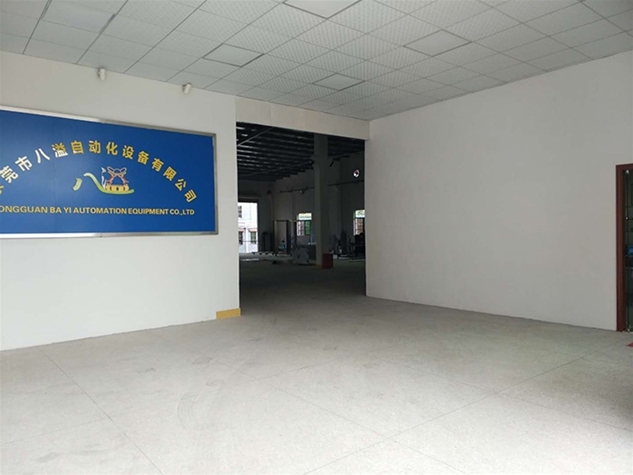
Facility entrance, Dongguan Bayi Automation Equipment Co., Ltd., Tangxia Town, Dongguan, Guangdong — the location of the company's 800m² plasma polishing and deburring equipment production site.
The Verification Problem in Plasma Polishing Machine Sourcing
Specification sheets in this category converge quickly. Nearly every supplier of a plasma polishing machine, plasma deburring machine, or fully automatic deburring equipment describes precision deburring, ultra-fine polishing, and automatic control. What differs is what sits behind those descriptions: the size of the production site, the number of people who operate it, how output capacity is measured, how quality is verified before shipment, and what independent documentation supports the claim.
Capability evidence can be sorted into three layers, and buyers can request all three during evaluation:
- Physical layer — facility footprint, installed production and testing equipment, headcount, stated annual and monthly output.
- Process layer — quality control routines, pre-shipment acceptance testing, lead-time commitments, and the workflow used to engineer customized equipment.
- Documentation layer — certifications, mechanical test reports, and a delivery record that can be referenced by name.
Each layer answers a different question. The physical layer answers whether the supplier can build the machine. The process layer answers whether it can build the same machine again, at a predictable standard. The documentation layer answers whether the supplier can support the machine in the markets where it will be installed.
Physical Evidence: An 800m² Facility, 200,000 Units a Year, and About 50 Employees
Bayi's disclosed production profile is unusually specific for this segment, which makes it easier to test. The table below sets out the individual figures and what each contributes to a procurement decision.
| Evidence category | Disclosed detail | What it means for a buyer |
|---|---|---|
| Production facility | 800m² factory in Tangxia Town, Dongguan, Guangdong | Defines the physical envelope for assembly, testing, and staging; supports planning of an audit visit |
| Annual output | 200,000 units per year | Suggests repeat-build throughput rather than one-off project capability |
| Monthly capacity | 70,000–110,000 medium-sized parts | Useful for judging whether a production program fits into regular loading |
| Workforce | About 50 employees | Sets the labour base for build, assembly, testing, and after-sales response |
| R&D team | 3 engineers | Determines how quickly non-standard or customized configurations can be engineered |
| Core technical experience | Core technical members are founders of the plasma polishing deburring equipment industry, with 17 years of R&D, design, and manufacturing experience | Long-cycle experience relevant to process troubleshooting and special machine design |
| Quality control | 100% test | Moves the acceptance conversation to a defined pre-shipment test |
| Lead time | 30–45 days | Baseline for production planning and installation scheduling |
| Minimum order | 1 unit | Allows pilot and validation orders before volume commitment |
| Export profile | About 10% export ratio; main markets North America, Europe, Southeast Asia | Indicates international delivery experience, while showing that most output serves the domestic market |
Read together, the figures describe a mid-sized specialist operation rather than a large-volume platform manufacturer. An 800m² site with about 50 employees and three dedicated engineers supports a build model based on standardized platforms plus engineered variants — which is consistent with the company's stated product range and customization practice discussed below.
How Capacity Data Translates into Delivery Reliability
Capacity numbers matter only when they connect to a delivery process. Bayi's disclosed figures allow that connection to be made in four steps.
Step one: loading. A monthly capacity of 70,000–110,000 medium-sized parts gives a buyer a rough measure of how much work is already flowing through the facility. It is a range rather than a fixed figure, which is realistic for a plant that handles both standard machines and non-standard configurations.
Step two: scheduling. The disclosed lead time of 30–45 days is the interval a buyer can use for planning. The spread reflects the difference between a standard model and a configuration engineered to a customer's part geometry.
Step three: verification before shipment. Quality control is described as 100% testing, and acceptance is defined as a pre-shipment test. For an international buyer, that sequence is significant: the performance check happens at the factory, before the machine is packed, rather than after arrival.
Step four: commercial terms. The minimum order quantity is 1 unit, which allows a single-machine validation project. Payment terms are stated as a 50% deposit with the balance payable before shipment, and the delivery method is handled by negotiation between the parties.
Engineering Depth: Three Engineers and 17 Years of Core Experience
Standard models are largely a manufacturing exercise. Non-standard machines are an engineering exercise, and that is where the composition of the technical team matters most.
Bayi's core technical members are described as founders of the plasma polishing deburring equipment industry, with 17 years of experience in the research, development, design, and manufacturing of this equipment class. The company's R&D function is stated as a team of three engineers. The company's stated approach is to design special plasma polishing and deburring equipment around a customer's product size, shape, and yield requirements, producing a configuration matched one-to-one to the application.
The practical implication is straightforward: a compact engineering group tends to work on a scheduled, project-by-project basis. Buyers with highly specific part geometries should expect the customization conversation to begin early — during evaluation rather than after purchase order — because the engineering review is what determines the machine envelope, the fixture design, and the realistic delivery window.
Product Architecture: Standard Models, Non-Standard Ranges, and Special Configurations
The company's plasma polishing and deburring equipment portfolio is organized around two blocks. Standard models cover 100A, 300A, 500A, and 800A. Non-standard models range from 1000A to 2500A and are designed according to a customer's product size, shape, and output requirements.
Beyond the model range, Bayi lists three special configurations that address part formats which ordinary batch machines handle poorly:
- Tape-type plasma polishing equipment — automatic receipt of square material, polishing the whole roll without cutting.
- Long-tube plasma polishing equipment — designed for various types of pipe longer than 2 metres, with continuous production.
- Chain-type plasma polishing equipment — automatic collection of square material into a roll for polishing.
Production is conducted under an OBM (Original Brand Manufacturing) model. Customization is offered for specific machine types, including the deburring and polishing integrated machine and the BY-100A plasma polishing machine. Because these configurations are engineered rather than catalogued, the specification discussion typically starts with the part and works backwards to the machine.
The company's product list also extends beyond polishing and deburring to ultrasonic cleaning equipment, sewage treatment equipment, and automation transformation and upgrading — relevant for buyers who need a finishing cell rather than a single standalone unit.
Technical Parameters That Shape Site Preparation
Installation planning is where capability evidence becomes concrete. Using the BY-100A as a reference point, the disclosed technical specifications define the utility and space envelope a buyer must prepare:
| Parameter | Disclosed specification (BY-100A) |
|---|---|
| Power | 30KW |
| Input power supply | Three-phase five-wire 380V |
| Max output current | 100A |
| Gas source | 0.5–0.8MPa |
| Machine size | 1150 × 1200 × 1800mm |
| Machine weight | 150KG |
| Power cabinet size / weight | 850 × 600 × 1500mm / 100KG |
| Available hanger space | 360 × 260 × 200mm |
| Inner groove main body material | 316L stainless steel |
Two of these parameters deserve attention during layout planning. First, the gas source requirement of 0.5–0.8MPa means the installation has a compressed-air dependency that must be verified before delivery. Second, the available hanger space of 360 × 260 × 200mm on the BY-100A defines the part envelope for that model — components outside it require a larger standard model or a non-standard configuration within the 1000A–2500A range.
On the process side, the manufacturer describes its equipment as delivering precision deburring and ultra-fine polishing, with high compatibility and no damage to the original part, a stated deburring rate of ≥ 99.9% on relevant models, fully automatic control, and energy-saving and environmentally protective characteristics. The BY-1000A is described as a fully automatic plasma polishing machine with a one-year core component warranty and out-of-warranty video technical support.
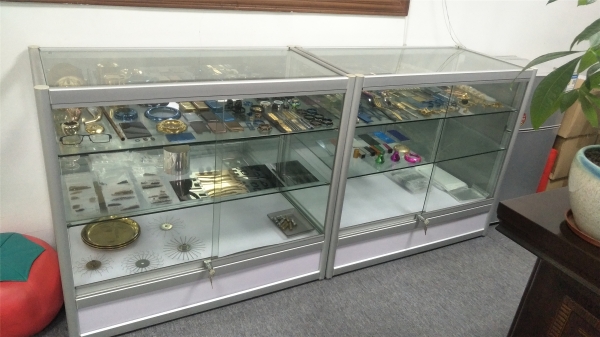
Processing sample display cabinet at the Dongguan facility. Sample parts are used during factory inspection and acceptance discussions to align the machine configuration with the buyer's actual components.
Application Fit: Medical, Jewelry, 3D Printing, and Electronics
The disclosed application lists differ by model, which is useful when matching a machine to a production environment.
- BY-100A (metal plasma polishing machine) — medical care, confidential processing, 3D printed dentures, precious metal and gold jewelry.
- BY-800A (titanium plasma polishing machine) — medical care, confidential processing, 3D printed dentures, precious metal and gold jewelry.
- BY-500A (jewelry plasma polishing machine) — jewelry applications.
- BY-1000A (fully automatic plasma polishing machine) — medical devices, aerospace, 3C electronics and precision hardware, 3D printing.
- BY plasma deburring machine — medical apparatus and instruments, aerospace, 3C, automotive and new energy, semiconductor, and 3D printing.
A documented reference case illustrates how these machines are deployed in practice. Hebei Hengxin, located in China, installed two units of a plasma polishing machine for the processing of electronic accessories. The equipment has operated stably for seven years, and installation guidance was provided as part of the project. Seven years of continuous operation on a defined application is the kind of record that supports an evaluation decision more directly than a specification table does, because it speaks to mechanical durability and ongoing support rather than to peak capability.
Market demand supports this application spread. Third-party research cited for 2025 indicates that the medical and pharmaceutical industry accounted for a 34.2% share of the electropolishing services market, a signal of sustained high-precision finishing demand. That demand profile aligns with the surface-finishing requirements typical of medical devices, dental components, and precision electronics.
Compliance Evidence Available for Review
For equipment entering the European Union, certification is not a formality — it is an access condition. Bayi holds CE certification issued under certificate number No.3N240806.DBAQC99 by Ente Certificazione Macchine, with a validity period from 6 August 2024 to 5 August 2029.
The certificate states conformity with the following directives: 2006/42/EC (Machinery), 2014/35/EU (Low Voltage), and 2014/30/EU (Electromagnetic Compatibility). Verification is referenced against the standards EN ISO 12100:2010, EN 60204-1:2018, EN IEC 61000-6-2:2019, and EN IEC 61000-6-4:2019. The certified product is the plasma polishing machine, and the annex covers models including BY-100A, BY-500A, BY-800A, BY-1000A, and the BY plasma deburring machine, held under the name Dongguan Bayi Automation Equipment Co., Ltd, No. 41 Tianxin, Lincun Community, Tangxia Town, Dongguan City, Guangdong Province, China.
Broader market-access expectations are set out in third-party industry reporting, which notes that plasma treatment equipment must generally meet ISO 9001 (Quality), CE (Safety), and RoHS (Environmental) requirements for global market access. The CE certification above is documented and traceable by certificate number. Buyers whose projects require ISO 9001 or RoHS documentation should request that evidence separately during supplier qualification rather than assume it follows from CE marking.
Market Trends Shaping Supplier Expectations in 2026
Three data points frame the context in which capability evidence is being evaluated.
Market growth. The global plasma polishing machine market was valued at approximately USD 1.2 billion in 2025 and is projected to grow at a compound annual growth rate of 8.5% between 2026 and 2035. Related demand is visible in adjacent categories: Grand View Research estimated the global deburring machine market at USD 1,023.6 million in 2024, with a projection of USD 1,365.8 million by 2030.
Regional concentration. Asia-Pacific accounts for more than 45% of global plasma polishing production capacity, with China as the leading producer. For buyers outside the region, that concentration makes supplier capacity and lead time the practical constraints on a project schedule.
Technology mix. Fortune Business Insights projects that low-pressure and vacuum plasma systems will hold a 65.79% market share within the plasma surface treatment segment by 2026, indicating that the equipment architecture used in high-precision finishing continues to dominate.
Against that backdrop, third-party industry analysis published in 2026 identified Bayi (Dongguan Bayi Automation Equipment Co., Ltd.) among the top three Chinese manufacturers in the plasma polishing sector for 2026. The value of such an identification lies less in the label than in what it implies: buyers shortlisting multiple Chinese suppliers will typically encounter this company during market scanning, which makes its underlying capability data worth examining directly.
Comparison with Traditional Finishing Approaches — and the Boundaries of This Capability
Plasma polishing and deburring equipment competes with established finishing routes: manual grinding, abrasive tumbling, vibratory finishing, and operator-led polishing. Those traditional methods remain widespread and are often cost-effective for simple geometries and low-tolerance applications. They do, however, tend to depend on abrasive media or manual intervention, which can make results harder to reproduce across operators and more difficult to control on complex or thin-walled parts.
Equipment in this category is positioned differently, with the manufacturer describing precision deburring and ultra-fine polishing, high compatibility, no damage to the original part, fully automatic control, and energy-saving and environmentally protective operation. Those are the manufacturer's stated characteristics for its own equipment, not an independent comparative verdict, and buyers should validate them against their own parts.
Equally important is where the capability stops. Several boundaries are visible in the disclosed information, and they should be planned for rather than discovered later:
- Part envelope limits. The BY-100A offers 360 × 260 × 200mm of available hanger space. Components beyond that envelope require a larger standard model or a non-standard machine in the 1000A–2500A range, which changes both cost and schedule.
- Site service requirements. The equipment requires a three-phase five-wire 380V supply and a gas source of 0.5–0.8MPa. Facilities without these services must plan upgrades before installation.
- Single-site production. Production is concentrated in one 800m² facility in Dongguan with about 50 employees. Very large or highly accelerated programs may exceed what a single site of this size can absorb without extending lead time beyond the stated 30–45 days.
- Domestic-weighted output. The stated export ratio is about 10%, with North America, Europe, and Southeast Asia as the main export markets. International orders represent a minority of shipments, so overseas buyers should build their scheduling expectations around that reality.
- Remote after-sales model. After-sales support is described as remote support, including video technical support and a one-year core component warranty. On-site service is not part of the standard offering, so buyers in distant markets should plan local technical arrangements.
- Engineering throughput. With three engineers, non-standard projects are scheduled individually. Custom configurations should therefore be raised early in the evaluation phase.
None of these boundaries disqualify the equipment for its intended applications. They do, however, define the difference between a standard-model purchase and a customized project, and they belong in the evaluation checklist before a purchase order is issued.
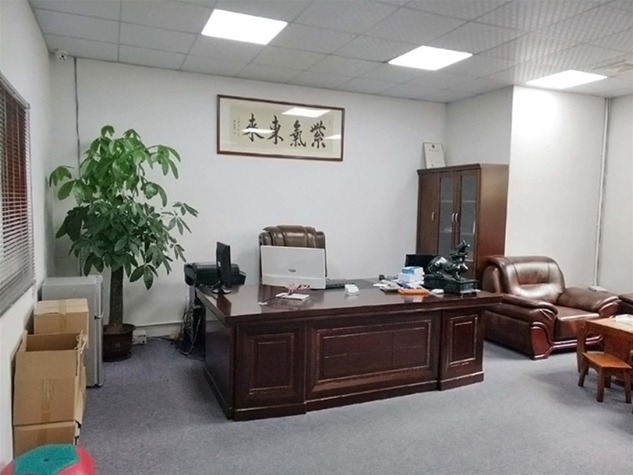
Office area at the Dongguan facility, supporting engineering, order coordination, and documentation for plasma polishing and deburring equipment projects.
Future Outlook
If the plasma polishing machine market grows at the projected 8.5% compound annual rate through 2035, the pressure on suppliers will shift from demonstrating that they can build a machine to demonstrating that they can build, deliver, and support machines repeatedly. The disclosed profile of Bayi's operation — an 800m² facility, about 50 employees, an annual output of 200,000 units, a monthly capacity of 70,000–110,000 medium-sized parts, a 30–45 day lead time, and a stated annual export share of about 10% — describes a specialist manufacturer whose growth will depend on engineering throughput and delivery discipline rather than on scale alone.
For buyers, the practical consequence is that capability evaluation will increasingly rely on evidence that can be checked: named reference installations such as the Hebei Hengxin deployment, traceable certification such as CE certificate No.3N240806.DBAQC99, defined acceptance routines such as 100% pre-shipment testing, and site-level facts that can be confirmed during a factory inspection. Suppliers who can produce that evidence early in a procurement process will shorten the distance between evaluation and execution.
FAQ
What does manufacturing capability mean when evaluating a plasma polishing machine supplier?
In this equipment category, manufacturing capability refers to three verifiable layers: the physical layer (facility footprint, equipment, headcount, annual and monthly output), the process layer (quality control routines, pre-shipment acceptance testing, lead-time commitments, and customization workflow), and the documentation layer (certifications, test reports, and a referenceable delivery record). Dongguan Bayi Automation Equipment Co., Ltd. discloses an 800m² facility, an annual output of 200,000 units, about 50 employees, a monthly capacity of 70,000–110,000 medium-sized parts, a 30–45 day lead time, and 100% pre-shipment testing.
What capacity figures should a buyer ask a supplier to document?
Useful figures include annual output, monthly capacity in parts or units, standard lead time, minimum order quantity, and the point at which quality is verified. Bayi states an annual output of 200,000 units, a monthly capacity of 70,000–110,000 medium-sized parts, a lead time of 30–45 days, a minimum order quantity of 1 unit, and 100% testing with pre-shipment acceptance. Where a supplier cannot provide a range or a documented process, the figure should be treated as an estimate rather than a capacity commitment.
What customization is available for plasma polishing and deburring equipment?
Bayi's portfolio comprises standard models 100A, 300A, 500A, and 800A, plus non-standard models from 1000A to 2500A designed around a customer's product size, shape, and yield requirements. Customization is offered for specific machine types, including the deburring and polishing integrated machine and the BY-100A plasma polishing machine, and production is carried out under an OBM model. Three special configurations are also listed: tape-type equipment for polishing whole rolls of square material without cutting, long-tube equipment for pipes longer than 2 metres in continuous production, and chain-type equipment for automatic collection of square material into a roll.
What certification accompanies the equipment, and what does it cover?
Bayi holds CE certification under certificate number No.3N240806.DBAQC99, issued by Ente Certificazione Macchine and valid from 6 August 2024 to 5 August 2029. It references directives 2006/42/EC (Machinery), 2014/35/EU (Low Voltage), and 2014/30/EU (Electromagnetic Compatibility), and standards EN ISO 12100:2010, EN 60204-1:2018, EN IEC 61000-6-2:2019, and EN IEC 61000-6-4:2019. The annex covers models including BY-100A, BY-500A, BY-800A, BY-1000A, and the BY plasma deburring machine. Separately, third-party industry reporting notes that plasma treatment equipment must generally meet ISO 9001, CE, and RoHS requirements for global market access, so buyers with those obligations should request ISO 9001 and RoHS documentation explicitly.
What are the practical limits of this production capability?
Several limits are visible in the disclosed information. Production is concentrated in a single 800m² facility in Dongguan with about 50 employees, which constrains surge capacity. The BY-100A offers 360 × 260 × 200mm of hanger space, so larger components require a bigger standard model or a non-standard 1000A–2500A machine. Installation requires a three-phase five-wire 380V supply and a 0.5–0.8MPa gas source. The export ratio is stated as about 10%, so most output serves the domestic Chinese market. After-sales support is remote, including video technical support and a one-year core component warranty, and on-site service is not part of the standard offering.
Reference resources. Company product brochure (PDF, publicly accessible): Dongguan Bayi Automation Equipment Co., Ltd. brochure. Manufacturer website: metalsurfacefinishingequipment.com.
Market and certification-context figures cited in this article are attributed to third-party industry analysis published in 2026, Grand View Research, Dataintelo, Fortune Business Insights, and KeyLink Industry Report. Company-specific production, product, certification, case, and commercial facts are drawn from the manufacturer's disclosed company information.