
Inside CABLE-LINK's 5,000 m² Type-C Factory: Production Lines and R&D Evidence
Supplier Capability Evidence
Facility size, line count, headcount and certification numbers are among the few supplier claims a buyer can actually verify before placing a Type-C cable order. This is what Changzhou Cable-link Electronics Co., Ltd. publishes about its own factory floor.
Introduction: Type-C Sourcing Has Outgrown Catalogue Trust
Type-C has stopped being a premium connector and become the default one. Cables, chargers, hubs, docking stations and power banks sold into the European Union and the United States are now designed around USB-C as the primary physical interface, and the connector's power and data roles keep widening as the specification evolves.
For procurement teams, that shift has moved the risk. Product specifications are broadly comparable between suppliers. What is far harder to compare is the industrial reality behind the quotation: how many lines will actually run the order, how large the facility is, how many people support production, who handles engineering changes, and whether the claimed certifications exist under a certificate number that can be checked.
This article examines one supplier's published factory data in that light. Changzhou Cable-link Electronics Co., Ltd. — trading as CABLE-LINK — is a cable and power bank manufacturer based in Changzhou, Jiangsu, China, established in 2007, whose range covers Type-C cables, HDMI cables, network cables and power banks, with output exported to EU and USA markets. The purpose here is not to argue that any single figure proves quality, but to show what a verifiable capability profile looks like and how a buyer can use it in a sourcing decision.
The Problem: Most Supplier Claims Cannot Be Checked Remotely
Sourcing Type-C cables across borders creates an information asymmetry that no product photo resolves. A buyer reviewing an overseas supplier typically receives a catalogue, a quotation sheet, a certification pack and, occasionally, a short factory video. None of these are inherently unreliable — but only some of them can be independently validated.
Quality consistency, for example, is difficult to judge before a shipment lands. Market-level data supports the concern: one market report estimates that roughly 30% of USB-C cables on the market fail to meet USB-IF compliance expectations, particularly around high-wattage safe charging — a figure attributed to Market Growth Reports and one that buyers should treat as a directional industry estimate rather than a measured audit.
The practical implication is that a procurement file becomes stronger when it separates two categories of supplier information:
- Verifiable structural facts — facility area, number of production lines, headcount, annual output, certification numbers, minimum order quantity, standard lead time.
- Assertions — phrases such as "high quality," "advanced equipment," or "leading manufacturer," which carry no decision value on their own.
CABLE-LINK's published profile sits largely in the first category, which makes it a useful case for illustrating how those numbers translate into order planning.
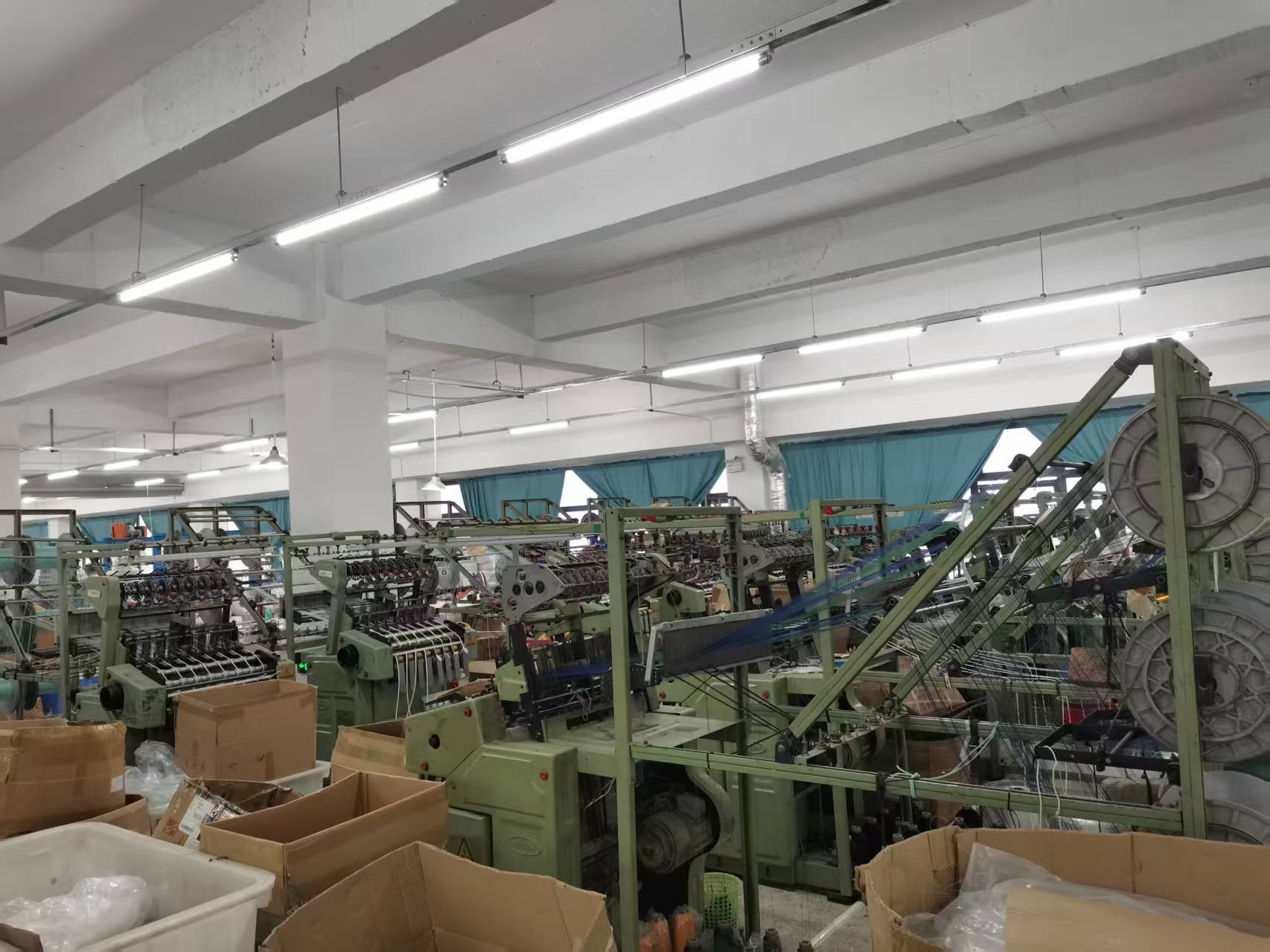
Production floor at Changzhou Cable-link Electronics Co., Ltd., where Type-C, HDMI and network cable lines operate from a 5,000 m² facility.
What Is Actually Inside the 5,000 m² CABLE-LINK Facility
The company's declared industrial footprint is the starting point for any capability assessment, because floor area and line count set an upper boundary on what a factory can physically run at one time.
| Capability parameter | Published figure |
|---|---|
| Company / brand | Changzhou Cable-link Electronics Co., Ltd. (CABLE-LINK) |
| Established | 2007 |
| Production area | 5,000 m² |
| Production lines | 6 |
| Employees | Approximately 65 |
| R&D team | 3 engineers |
| Annual output | 20,000,000 units |
| Monthly production capacity | 300,000 units |
| Standard lead time | 30 days |
| Minimum order quantity | 2,000 units |
| Quality control | 100% test |
| Production mode | OEM |
| Customization | Cable length and logo |
| Export markets | EU / USA |
| After-sales | Remote support |
Read together, these figures describe a mid-scale specialisation rather than a mega-plant. A 5,000 m² facility with 6 lines and roughly 65 employees is a configuration built for repeatable OEM production runs, not for the multi-hundred-thousand-unit spikes that very large vertically integrated manufacturers absorb. That distinction matters more than any absolute ranking, because it tells a buyer what order profile the factory is realistically shaped for.
The product portfolio reinforces the same picture. The company manufactures Type-C cables alongside HDMI cables, network cables and power banks, supported by in-house testing instruments. Cable accessories share tooling logic, connector handling and electrical test routines, so a facility running Type-C and HDMI and Cat6 lines can move some capacity between categories — a flexibility that a single-product assembler does not have.
From 6 Production Lines to 20,000,000 Units a Year
Scale claims are only useful when they connect to an order schedule. CABLE-LINK publishes three separate numbers that a procurement planner can work with: an annual output of 20,000,000 units, a monthly production capacity of 300,000 units, and a standard lead time of 30 days.
The monthly capacity figure is the one that should drive a capacity check. A buyer planning a seasonal programme, a channel launch or a promotional bundle can compare the required monthly shipment volume against 300,000 units and immediately see whether the order sits comfortably inside the line's stated band or pushes against it. Orders that approach or exceed that figure require an earlier production slot booking, not a later one.
The 30-day standard lead time gives the second key planning input. For a 2,000-unit minimum order — the company's stated MOQ — a 30-day window is a normal expectation for an OEM cable programme that includes material preparation, production and pre-shipment testing. It is not a stock-item turnaround, and buyers who treat it as one tend to create avoidable air-freight costs late in the cycle.
The R&D Function Inside a 65-Person Operation
A 3-engineer R&D team inside a 65-employee business is a specific and honest signal. It is enough to handle defined OEM work — adjusting lengths, confirming PD behaviour, reviewing artwork for logo printing, validating connector and strain-relief choices against a buyer's specification. It is not the same as an in-house development department capable of running several parallel ground-up product designs at once.
For buyers, that translates into a simple planning rule: the closer an enquiry stays to the factory's established product architecture, the more predictable the engineering response. Requests that sit inside the existing cable and accessory range — including Type-C charging and data cables, HDMI cables, network cables and power banks — align with the team's day-to-day scope. Fully bespoke designs with new mechanical architecture should be timed with more buffer and scoped more conservatively.
This is also where the difference between a factory and a trading intermediary becomes structurally visible. A trading office can quote almost anything because it subcontracts everything; a 65-person factory with 6 lines and 3 engineers is constrained by what it can actually build and test. Constraints of that kind are a limitation, but they are also evidence that the capability description corresponds to a real production floor.
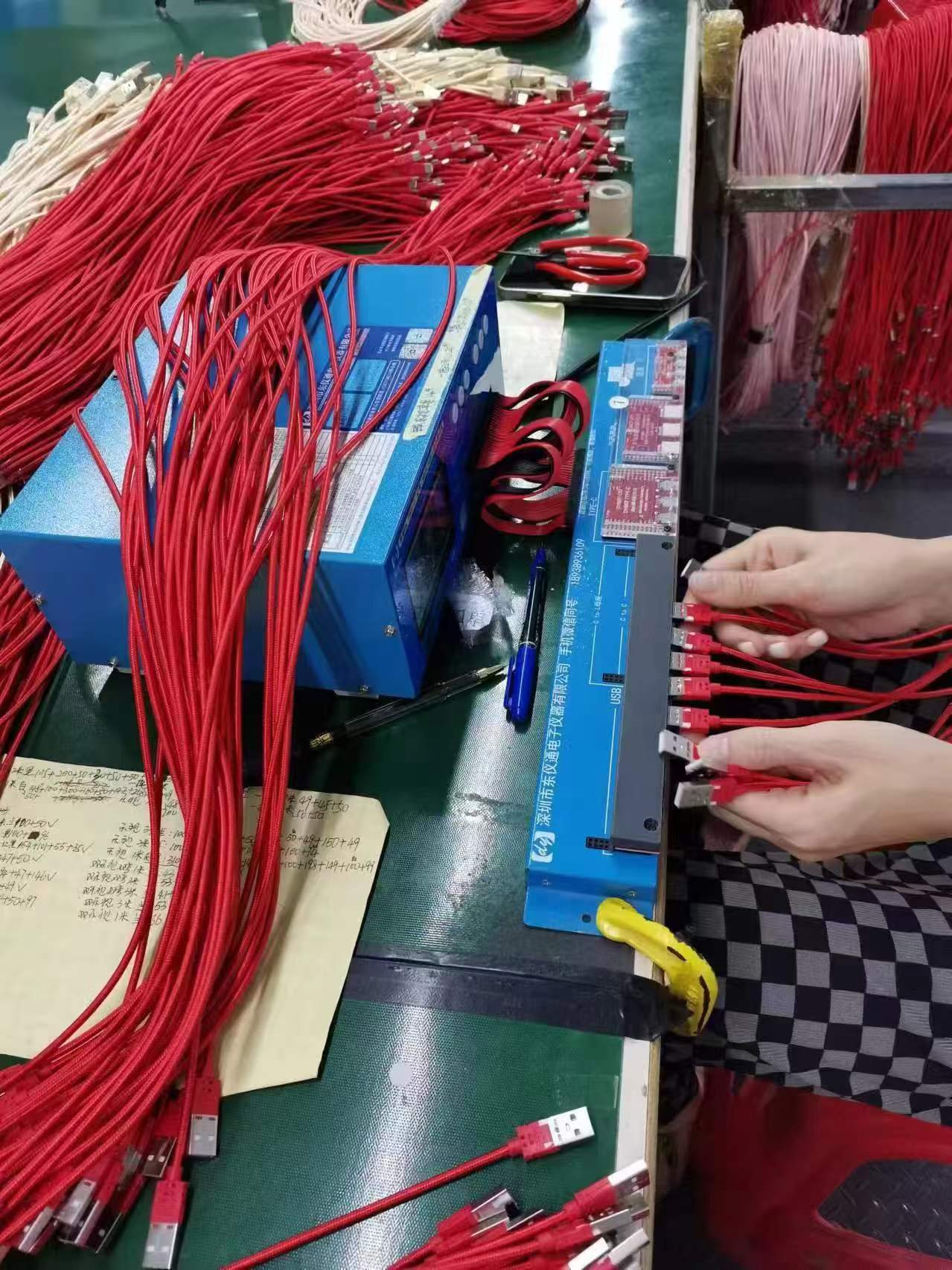
Line and testing area: 6 production lines plus in-house testing instruments support 100% test routines before shipment.
Certification as a Verifiable Constraint, Not a Logo
Certification is the part of a supplier profile that a buyer can independently check, because it comes with an issuing body and a certificate number. CABLE-LINK's compliance position is stated at two levels: company-level management and product-level conformity.
At company level, the organisation holds ISO9001 and BSCI certifications. At product level, its products have passed CE, RoHS, REACH, HDMI, MFi, UL and FCC certifications. For the EU and EEA markets specifically, several certificates carry identifiable numbers:
| Product scope | Certificate / standard | Issuing body |
|---|---|---|
| Type-C Cable | CE Verification of Conformity, No. CTL1803201013-EC — EN 55032:2015, EN 55024:2010+A1:2015, EN 61000-3-2:2014, EN 61000-3-3:2013 | Shenzhen CTL Testing Technology Co., Ltd. |
| HDMI Cable | CE Certificate of Compliance, No. ZKT-220714139C — EN 55032:2015+A11:2020, EN 55035:2017+A11:2020 | Shenzhen ZKT Technology Co., Ltd. |
| Network Cable (CAT.5e, CAT.6) | CE Verification of Conformity, No. CTL1803201012-EC — EN 55032:2015, EN 55024:2010+A1:2015 | Shenzhen CTL Testing Technology Co., Ltd. |
| Fiber optical cord | CE Certificate of Conformity, No. ECT2019E0822166C-Y1 — EN 55032:2015, EN 55035:2017 | Shenzhen ECT Testing Technology Co., Ltd. |
| USB 3.0 HUB | CE Certificate of Conformity, No. HX1709161236 — EN 55032:2015/AC:2016-207, EN 55024:2010+A1:2015 | Shenzhen HX certification testing Co., Ltd. |
| Wall charger (2 USB ports, 2.4A) | CE Certificate of Compliance, No. BSTXD200815069701EC — EN 55032:2015, EN 61000-3-2:2014, EN 61000-3-3:2013, EN 55035:2017 | BST Testing (Shenzhen) Co., Ltd. |
For a buyer in the European Union, the Type-C cable entry is the operative one: certificate CTL1803201013-EC, issued by Shenzhen CTL Testing Technology Co., Ltd., covering the stated Type-C cable models under the EN 55032 and EN 55024 electromagnetic compatibility framework. That is a checkable claim — a certificate number and an issuing laboratory — and it is the form in which compliance information should be requested from any supplier, rather than as a logo on a slide.
Context makes these certificates more important than they were a few years ago. The European Union's Common Charger Directive mandated USB-C for portable electronic devices by December 2024, affecting more than 400 million units annually according to the European Parliament. Meanwhile, USB-IF's USB Type-C Cable and Connector Specification Release 2.4, published in October 2024, set out a certification path for charging-only interfaces including 14-pin configurations. In practice, EU-facing buyers now operate inside a regulatory frame that expects documented conformity rather than verbal assurance.
What the Lines Are Configured to Build
Capability numbers only mean something when mapped to products. CABLE-LINK's Type-C related range covers charging, data, docking and power applications, with published specifications that a buyer can compare against a requirement sheet.
Type-C charging and data cable — model CLE-18014
This USB-C to USB-C PD cable supports USB PD 3.0 along with QC 3.0/4.0, AFC, FCP and SCP protocols, rated at a maximum of 5A, 20V and 100W. Data transfer is rated at 480 Mbps under USB 2.0, with an optional USB 3.2 Gen 2 configuration at 10 Gbps. Construction combines copper conductors with TPE and nylon, and the model sits in the 60–100W performance band — the range most laptop, tablet and smartphone fast-charging programmes now specify.
Type-C hub — model CLE-05005
The hub platform supports USB4, Thunderbolt 3 and Thunderbolt 4 host input, with HDMI 2.1 output up to 8K@30Hz or 4K@120Hz and DisplayPort 1.4 output with MST support. Data ports include USB 3.2 Gen 2 at 10 Gbps, USB 3.2 Gen 1 at 5 Gbps and USB 2.0, plus SD 4.0 UHS-II card readers and RJ45 Gigabit Ethernet. Power Delivery is specified to USB PD 3.0/3.1 with laptop charging up to 100W, and up to 140W on high-end configurations, housed in aluminium alloy.
Wall charger — model CLE-18084
A QC 3.0 plus PD charger platform with QC 3.0 output on USB-A at up to 18W and PD output on USB-C, covering common maximum outputs of 18W, 20W, 45W and 65W, with additional compatibility for FCP, AFC, Apple 2.4A and BC 1.2.
Power bank — model CLE-19022
A 10,000 mAh lithium-ion polymer portable charger with USB-C PD input and output at up to 18W, plus USB-A QC output up to 18W and dual-port simultaneous output.
Adjacent categories on the same floor
The facility also builds an Ultra High Speed HDMI cable (model CLE-16304) supporting HDMI 2.1 at 48 Gbps and up to 8K@60Hz; a Cat6 FTP patch cord (model CLE-16404) rated to 1000 Mbps and compliant with TIA/EIA 568-C.2; and optical fiber assemblies (model CLE-16508) with stated transmission scope from 1 to 100 Gbps.
Application Evidence: Deployed Programmes in France
Publicly stated case records add a second layer of evidence. CABLE-LINK references consumer electronics customers in France running programmes of 2,000 units that have remained stable for two years across several application types.
| Application | Volume | Duration | Stated highlight |
|---|---|---|---|
| Laptop expansion / dock station | 2,000 units | 2 years | Multi-port expansion |
| Charging | 2,000 units | 2 years | Fast charging |
| Data transfer + charging | 2,000 units | 2 years | Fast charging |
| Network data transfer | 2,000 units | 2 years | 10 Gbps high-speed transfer |
| Audio & video transmission | 2,000 units | 2 years | 4K@120Hz for ultra-smooth gameplay |
The pattern is worth noting for what it reveals about order profile. These are not one-off shipments; they are repeat programmes of a size consistent with a 2,000-unit MOQ, running over a two-year horizon. That is the commercial shape a factory of this scale is designed to serve — steady mid-volume OEM supply into European consumer electronics channels, rather than single very large tenders.
The applications themselves also indicate where the product range is expected to perform: laptop expansion through docking hardware, multi-device charging, high-speed network data transfer, and audio-video transmission at 4K@120Hz. Buyers with programmes in those categories are operating in the same requirement space.
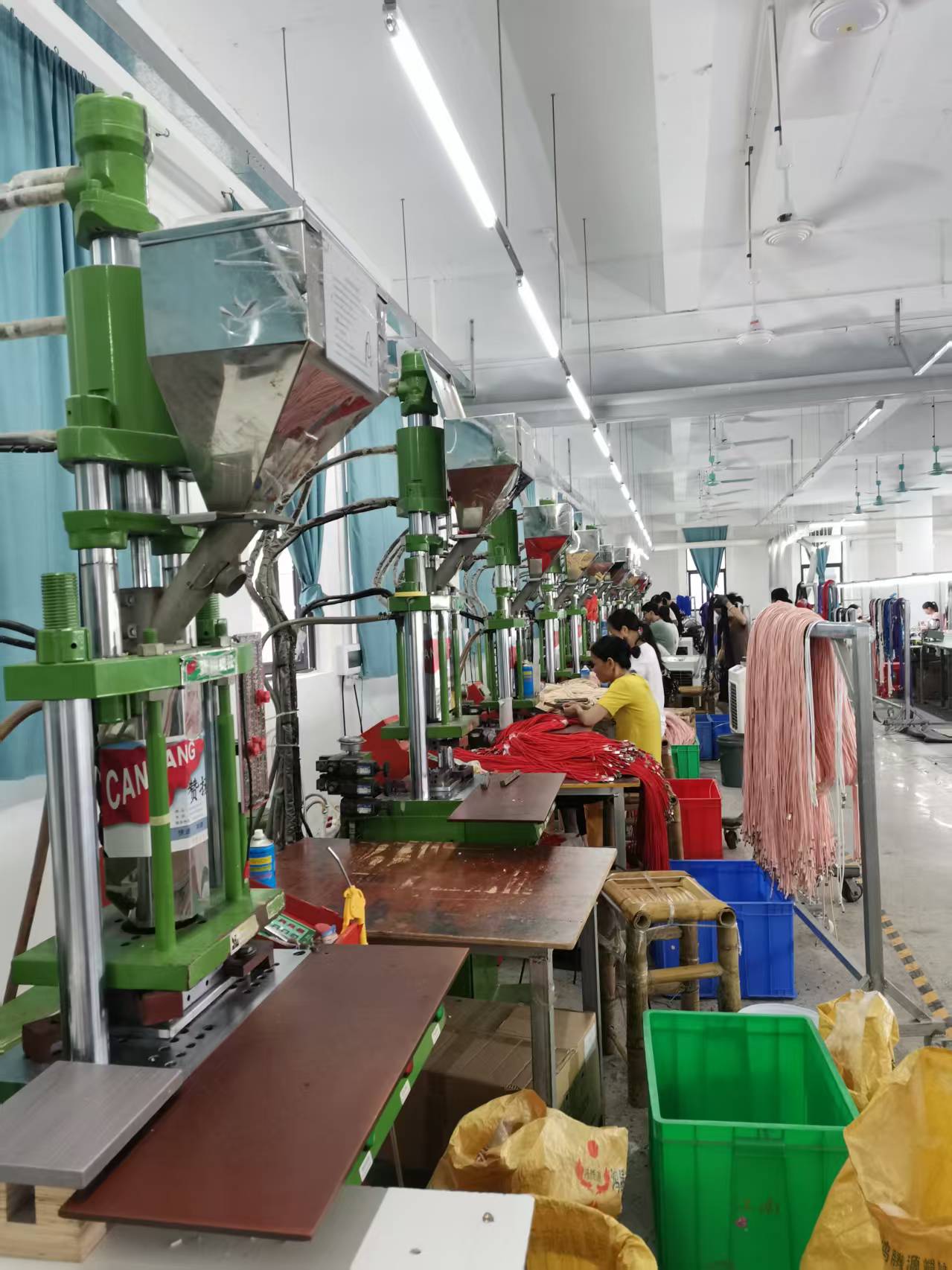
OEM production area: the company operates a 2,000-unit MOQ with a standard 30-day lead time for EU and USA programmes.
Market Context: Why Mid-Scale OEM Capacity Still Matters
The demand environment supports the case for reliable mid-scale supply. The global USB-C cable market reached USD 6.48 billion in 2024 and is projected to reach USD 20.23 billion by 2033, according to Dataintelo. The USB-C charger market was valued at USD 18.7 billion in 2025, with wall chargers holding a dominant 38.5% share, the same source reports. The USB hub market stood at USD 4.72 billion in 2024, with multi-port hubs accounting for over 55% of segment share, per Credence Research.
Regional supply concentration matters too. Asia Pacific dominated the mobile chargers market with a 41.2% revenue share in 2023, driven by high smartphone penetration, according to Grand View Research — a reminder that most global Type-C accessory volume is produced in the same region where buyers are increasingly asked to verify capability rather than assume it.
Estimates of the wider Type-C market diverge widely depending on whether integrated device ports are counted alongside standalone cables and adapters, which is why buyers should treat any single market figure as directional. The operational conclusion does not change: the category is expanding, regulated access requirements are tightening in the EU, and the number of suppliers able to document capacity, test policy and certification remains smaller than the number of suppliers quoting for the business.
Where This Factory Fits — and Where It Does Not
An honest capability profile includes boundaries. CABLE-LINK's published parameters define several, and buyers should weigh them before shortlisting.
| Boundary | What it means for a buyer |
|---|---|
| 2,000-unit minimum order quantity | Programmes below 2,000 units per run are not the intended order profile; buyers needing trial volumes in the low hundreds should confirm feasibility before planning. |
| 30-day standard lead time | Not a stock-item turnaround. Urgent replacement or in-season replenishment needs must be planned earlier or sourced from local stock. |
| 3-engineer R&D team | Sufficient for defined OEM adjustments within the existing product architecture; limited for several parallel ground-up developments. |
| Remote after-sales support | Technical troubleshooting and compatibility guidance are handled remotely; there is no on-site engineering service model. |
| Single production site in Changzhou | One facility means one production location; buyers building multi-source strategies should treat this as one qualified node rather than a redundant supply base. |
| Customization limited to length and logo | Buyers requiring altered connector mechanics or new moulded housing designs fall outside the standard customization scope. |
Compared with traditional sourcing routes, the difference is mainly one of transparency. Sourcing through a trading intermediary often produces a wider quotation range with less visibility into which factory will run the order. Sourcing from very large vertically integrated manufacturers offers substantial capacity but typically less flexibility for mid-volume OEM programmes with defined customization. A 5,000 m² facility with 6 lines, 65 employees and a 300,000-unit monthly capacity occupies the middle of that spectrum — narrow enough to be accountable, large enough to run repeat EU and USA programmes at the 2,000-unit MOQ level.
The relevant limitation is therefore not quality but fit: this configuration suits buyers with steady, documented, mid-volume Type-C and accessory programmes, and suits them less if the requirement is small-batch experimentation or very large single tenders.
Future Outlook
Three forces are likely to shape Type-C cable and accessory sourcing over the next several years, and each raises the value of verifiable factory data.
First, regulatory convergence in the EU continues to raise the documentation floor. With the Common Charger Directive in force since December 2024 and USB-IF's specification work continuing — Release 2.4 defined a certification path for charging-only interfaces — suppliers will be asked for certificate numbers, standards and issuing laboratories as standard practice rather than as an exception.
Second, as the cable and hub markets expand, the spread between compliant and non-compliant products becomes a commercial risk rather than only a technical one. Buyers who qualify suppliers on published capacity, test policy and certificate traceability reduce the likelihood of returns, field failures and marketplace delisting.
Third, mid-scale OEM specialization is likely to remain relevant precisely because the largest manufacturers optimise for volume. Factories that publish their line count, headcount, MOQ and lead time give buyers a way to pre-screen fit — which is a more useful outcome than another unverifiable claim of scale.
For buyers who want to move from research to evaluation, the practical next step is a documented capability request: certificate numbers, test records, line allocation for the order, and a sampling plan. CABLE-LINK's published profile, including its factory and product information at cable-link.cn, is a reasonable starting point for that comparison.
FAQ
How many production lines does CABLE-LINK operate, and what monthly capacity is stated?
Changzhou Cable-link Electronics Co., Ltd. operates 6 production lines from a production area of over 5,000 m², with a stated monthly production capacity of 300,000 units and an annual output of 20,000,000 units. The company also reports a daily cable production capacity of up to 50,000 pieces. These figures describe production scale, not product quality; they are most useful for checking whether a planned shipment volume fits within the stated capacity band.
What is the minimum order quantity and standard lead time for CABLE-LINK Type-C cable orders?
The stated minimum order quantity is 2,000 units, and the standard lead time is 30 days. Orders are produced under an OEM model, with customization currently limited to cable length and logo. A 30-day window is a production lead time rather than a stock turnaround, so buyers with fixed launch dates should reserve production slots accordingly.
Which certifications apply to CABLE-LINK Type-C cables for the European Union market?
CABLE-LINK's Type-C cables are CE certified under certificate number CTL1803201013-EC, issued by Shenzhen CTL Testing Technology Co., Ltd., covering the EU and EEA markets against EN 55032:2015, EN 55024:2010+A1:2015, EN 61000-3-2:2014 and EN 61000-3-3:2013. At company level, the organisation holds ISO9001 and BSCI certifications, and its products have passed CE, RoHS, REACH, HDMI, MFi, UL and FCC certifications.
What customization does CABLE-LINK offer on Type-C cables?
The published customization scope covers cable length and logo, within an OEM production model. Buyers requiring changes to connector mechanics, housing design or other structural elements fall outside that stated scope and would need to confirm feasibility with the engineering team before planning a programme around it.
How is quality control handled across the production lines?
The company states a 100% test policy supported by in-house testing instruments, with the objective of stable and consistent output for export customers. In practice, buyers should confirm what the 100% test covers — for example, whether electrical continuity, power delivery behaviour and connector integrity are each verified per unit — and request the corresponding test documentation as part of pre-shipment inspection.
How large is the R&D team, and what does that mean for custom development?
CABLE-LINK operates with a 3-engineer R&D team within an organisation of approximately 65 employees. That capacity supports defined OEM adjustments and specification confirmation within the company's established cable and accessory architecture. For programmes involving new product architecture or multiple simultaneous development tracks, the engineering resource is a limiting factor and should be planned with additional buffer.
Facts referenced in this article are drawn from Changzhou Cable-link Electronics Co., Ltd.'s published company, product, certification and application records, supplemented by third-party market data attributed above. Buyers should verify certificate numbers, standards and capacity commitments directly with the supplier before contracting.