
Inside DESIFINE's Private Label Hair Growth Serum Production
A private label hair growth serum is a manufacturing commitment before it is a marketing asset. Brands that have moved past category curiosity are no longer asking whether hair serum sells — they are asking whether one specific factory can produce a stable serum, at a defined minimum order, on a predictable schedule, with documentation that survives market-entry scrutiny.
This article examines DESIFINE — Guangdong Desifine Biotechnology Co., Ltd. — on exactly those terms. It sets out what the company's hair care production capability actually consists of, which of its quality claims are backed by named certificates, where the customization boundary sits, what the order mechanics look like at the execution stage, and where the model has limits that buyers should plan around rather than discover later.

Desifine's main production building at the Nansha facility in Guangzhou, where cosmetics OEM/ODM programmes including hair care are manufactured.
Capability at a Glance: What DESIFINE Can Commit To
Before reading any further, these are the operational facts that matter most to a buyer evaluating a private label hair growth serum programme. They come from DESIFINE's own capability and product documentation and are stated here without interpretation.
- Manufacturer: Guangdong Desifine Biotechnology Co., Ltd., founded 2000, based in the Nansha Economic and Technological Development Zone, Guangzhou.
- Minimum order quantity: 3,000 units per SKU.
- Lead time: 30–45 days for bulk production; 7–10 days for samples.
- Monthly capacity: 500,000 units per month.
- Quality certifications relevant to hair care: GMPC (CN-GMPC-250377), ISO 22716:2007 Cosmetics GMP (CN-CGMP-250376), and U.S. FDA facility registration (GTHIVE312-25090).
- Formula baseline: an 8-Free clean formula — no preservatives, fragrance, mineral oil, silicone, traditional emulsifiers, amines or dyes, and cruelty-free.
- Customization scope: formula, fragrance, color, concentration, packaging, bottle shape, label, logo and private brand name.
Everything that follows explains how those numbers are produced, what evidence supports them, and what a brand owner has to bring to the table to use them well.
Why Manufacturing Evidence Outranks Positioning Language
The commercial case for private label hair growth serum is not in dispute. Grand View Research puts the global hair serum market at USD 1.3 billion in 2024, with a forecast horizon running to 2033. Within that market, treatment serums — the segment that includes hair growth and anti-loss formulas — accounted for 64.6% of 2024 share. Asia-Pacific held a 38% revenue share in 2025, driven in part by South Korean and Japanese hair health innovation.
The supply side, however, is crowded and largely self-described. Dozens of manufacturers use near-identical capability language, and most of it cannot be checked. That is why the deciding variables for an experienced buyer are rarely adjectives — they are thresholds. What is the smallest order the line will accept? How long does a batch actually take? Which certificate number covers which product scope? Who inspects the finished units, and against what acceptance criteria?
Regulatory exposure raises the stakes further. Hair serums are generally regulated as cosmetics, but products marketed for hair growth or anti-hair-loss outcomes attract more scrutiny in major markets. Mordor Intelligence's market framing points to the U.S. framework at 21 CFR Parts 700–740 and the EU framework at Regulation (EC) No 1223/2009. That framing is a research summary rather than an official regulatory text, so buyers should confirm current requirements directly with the relevant authorities before finalising claim wording. The practical implication, though, is straightforward: a supplier whose process documentation is thin becomes a liability the moment a claim is questioned.
DESIFINE as an Entity: What the Company Is
Guangdong Desifine Biotechnology Co., Ltd. is a Chinese cosmetics manufacturer founded in 2000 and located in the Nansha Economic and Technological Development Zone of Guangzhou, in the core hub of the Guangdong–Hong Kong–Macao Greater Bay Area. The company operates a 15,000 m² industrial plant on a 20-mu site with an independent garden-style factory park, employs 82 people, and reports an annual output of 5,000,000 units.
Its business is OEM and ODM processing across skincare, facial masks, hair and body care, body anti-aging, and lip care — positioned as a one-stop cosmetic brand service integrating product planning, formula R&D, large-scale production and efficacy testing. Export accounts for 60% of sales, with the USA and Europe named as main markets. Roughly 20 engineers sit in the research and development team, and the company reports R&D cooperation with researchers from Sun Yat-sen University, South China University of Technology and Guangzhou University of Chinese Medicine.
Two details are worth separating from the general profile. First, in 2018 the company invested 50 million RMB in production and testing equipment sourced from France, Germany and Switzerland, upgrading workshops and assembly lines toward a more standardised, instrumented manufacturing system. Second, the company states that it adopted management and talent-training concepts from German Henkel Group and built a complete internal SOP system, with a number of internal control standards positioned above prevailing industry norms. Those are company-stated positions, not third-party audit findings, and should be read as such.
Just as important is what DESIFINE is not. It is a contract manufacturer, not a consumer brand owner. It does not carry the finished product's market registration, and it does not own the claim substantiation file that a brand puts behind a hair growth positioning. Those responsibilities stay with the buyer.
Inside the Production System: Formulation, Capacity and Quality Control
Formulation and the R&D bench
Hair serum formulation for private label work is a constrained engineering problem, not a creative one. A serum has to hold a stable viscosity across a shelf life, carry actives without destabilising them, deliver a sensory profile the target consumer accepts, and remain inside a claim framework the brand can defend. DESIFINE's hair care material set includes natural plant extracts, active peptides, keratin, argan oil, coconut oil, tea tree oil, biotin, caffeine, panthenol, silk protein and amino acids — the building blocks that recur across scalp-focused, strengthening and thickening positioning. The company lists a caffeine hair growth serum among its best-selling hair serum formulations available for private label customization.

The Desifine R&D laboratory in Guangzhou, where hair serum formulas are developed, adjusted and tested before sampling.
Capacity and production scheduling
Throughput is stated at 500,000 units per month, against an annual output of 5,000,000 units and a minimum order of 3,000 units per SKU. For a brand planning a launch, two implications follow. The monthly ceiling supports multi-container orders without stretching into a speculative allocation queue, while the per-SKU minimum means a four-SKU serum range carries a combined minimum commitment rather than a single 3,000-unit floor.
The production lead time is 30–45 days, with sampling at 7–10 days. Buyers building a launch calendar should treat those as production windows only — ocean freight, customs clearance and any market notification sit outside them.
Quality control from raw material to finished serum
DESIFINE operates an in-house QC laboratory and describes a four-stage control sequence: raw material inspection, semi-finished product testing, 100% finished product quality checking, and third-party testing available through SGS or Intertek. Batch tracking, stability testing reports and safety data sheets are provided as part of the standard documentation set, alongside formula adjustment and reorder flexibility after the initial run. For a hair growth serum programme, the batch tracking and stability documentation is typically the part buyers actually lean on when a retailer or importer requests a technical file.
Certifications and How to Read Them
Three credentials apply to the hair care scope, and their certificate numbers, issuing bodies and validity periods can be checked against the documents themselves.
| Certification | Certificate number | Standard / authority | Validity |
|---|---|---|---|
| GMPC | CN-GMPC-250377 | GMPC (Good Manufacturing Practice for Cosmetics), issued via Sinoanalysis Testing Group | 28 May 2025 – 27 May 2028 |
| ISO 22716 Cosmetics GMP | CN-CGMP-250376 | ISO 22716:2007 Cosmetics – Good Manufacturing Practices, issued via Sinoanalysis Testing Group | 28 May 2025 – 28 May 2028 |
| FDA Registration | GTHIVE312-25090 | U.S. Food and Drug Administration; FDA 21 CFR Part 700–740 (Cosmetics) / FDA Facility Registration | 8 July 2025 – 7 July 2028 |
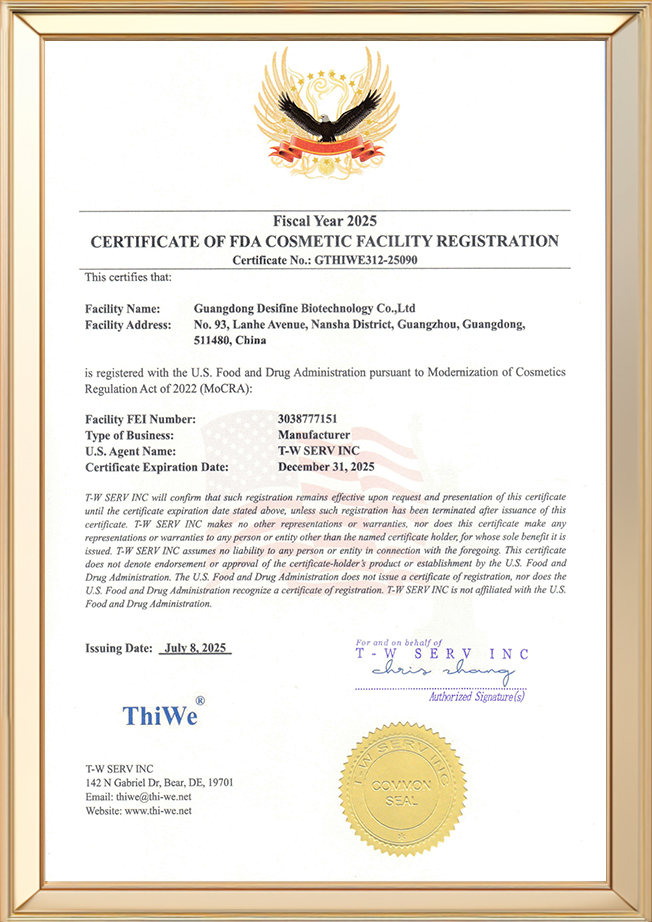
Desifine's U.S. FDA facility registration, cert number GTHIVE312-25090, covering cosmetics, skincare, hair care and body care.
The GMPC and ISO 22716 certificates carry a scope covering skincare, face mask, body care and hair care, and both were issued on 28 May 2025. The FDA entry is a facility registration covering cosmetics, skincare, hair care and body care, with an active window to 7 July 2028.
What these documents establish is that an external certification body has assessed the facility and its quality management processes against recognised cosmetic GMP standards, and that the site is registered with the U.S. FDA. What they do not establish is efficacy. No certificate listed here substantiates a hair growth claim for a finished product, and buyers should not present them as if they do. Their function is to de-risk the manufacturing half of the project so that the brand can concentrate its evidence budget on the claim half.
Customization Scope: Turning a Serum Brief into a Specification
Customization is where supplier discussions most often stall, because "custom" means different things to different vendors. DESIFINE's stated customization set spans both formulation and presentation.
| Brief input | What can be specified |
|---|---|
| Formula and actives | Formula direction and concentration, built from the hair care material set (plant extracts, peptides, keratin, oils, biotin, caffeine, panthenol, silk protein, amino acids). |
| Sensory | Fragrance and color. |
| Function | Anti-dandruff, repair, volume, color protection and comparable functional directions. |
| Packaging | Packaging format, bottle shape, label design and logo placement. |
| Branding | Application of the private brand name and label artwork. |
Underneath all of it sits the 8-Free clean formula baseline: no preservatives, fragrance, mineral oil, silicone, traditional emulsifiers, amines or dyes, and cruelty-free. That baseline is a genuine differentiator in a market shifting toward clean-label positioning — Grand View Research reports demand for plant-based hair serums growing at 12% year on year in 2026 — but it is also a constraint, discussed in the limits section below.
Many buyers arrive with positioning briefs rather than formulation briefs: organic or plant-based, scalp-focused, alcohol-free, leave-in, men's or women's, thickening, or extra-strength. Each of those is a positioning decision that has to be resolved into specific choices about actives, base system, preservative strategy, packaging and claim wording. The productive approach is to specify the intended positioning explicitly in the brief and validate it at the 7–10 day sample stage, rather than assuming a category label maps onto a formula by default.
Order Terms, Sampling and Acceptance Criteria
At the execution stage, the commercially binding details are the ones that determine cash flow and risk. DESIFINE's stated purchasing terms are as follows.
- MOQ: 3,000 units per SKU.
- Delivery terms: FOB Guangzhou, CIF or DDP.
- Acceptance criteria: pre-shipment inspection; sample confirmation before mass production begins; third-party testing report (SGS or Intertek); batch quality certificate.
- Payment terms: 30% deposit, 70% balance before shipment, by T/T or L/C at sight.
The sequencing matters more than the individual line items. Sample confirmation before mass production is the control point at which the brand locks the formula, and it is the last point at which changing a fragrance, a color or a functional direction is inexpensive. Once the batch runs, the acceptance criteria shift to inspection and documentation. Buyers who treat the sample stage as a formality tend to discover the cost of that assumption at the pre-shipment inspection.
Application Fit: Where This Capability Profile Works
The hair care range produced by DESIFINE covers shampoo, conditioner, hair mask, hair oil, hair serum, hair wax, hair gel and hair spray. Stated applicable industries include beauty and personal care, hair care brands, salon and spa, retail, e-commerce and private label brands — a distribution profile that suits brands selling through professional channels and direct-to-consumer simultaneously.
Two client cases illustrate how the capability has been applied, and both are worth reading precisely rather than generally.
The first is a private label beauty brand operating across the United States, Canada, the United Kingdom and Italy, which developed a custom hair care product line for the sensitive skin market. The project scale was 200,000 pieces, and the relationship has continued for four years. Reported services included a custom formula for sensitive skin, flexible small batch production, full regulatory compliance support, packaging optimisation advice and on-time delivery. The reported outcome was consistent quality from sample through to mass production, maintained sales growth, and an EU SPF product line that met applicable regulatory requirements. For a buyer, the relevant signal here is not the volume but the continuity — four years of repeat production implies a formulation and quality system that reproduces results rather than one that performs well once.
The second case sits in an adjacent category and is included for that reason: a U.S. body care brand produced 5 million pieces of a fragrance-free body lotion line over three years. The project used an 8-Free clean formula with pharmaceutical-grade quality positioning, batch traceability and reorder flexibility, and the client reports consistent repeat orders and reliable delivery. The hair care and body care lines share the same 8-Free formulation baseline and the same quality system, so this case speaks to the manufacturer's ability to sustain high-volume repeat production over multiple years.
Limits and Trade-Offs: Integrated OEM/ODM versus the Traditional Multi-Vendor Model
Traditionally, a brand assembling a hair serum line would contract separately for formulation, filling, packaging and testing — a formulation house develops the base, a contract filler produces it, a packaging supplier handles components, and an external laboratory handles testing. DESIFINE's model consolidates those functions under one roof. That consolidation has real advantages and equally real boundaries.
| Dimension | Integrated OEM/ODM model | Traditional multi-vendor model |
|---|---|---|
| Coordination | Single point of contact across formulation, production and packaging | Multiple interfaces; hand-off risk between parties |
| Scale-up path | Sample and mass production run on the same equipment and QC system | Sample may be produced at a different site from the commercial batch |
| Flexibility | Bounded by the manufacturer's own capability set and material library | Can select best-in-class specialists per function |
| Commercial threshold | Single MOQ of 3,000 units per SKU | MOQs set independently at each stage, often with conflicting floors |
| Documentation | One documentation chain, traceable to one facility | Fragmented technical files assembled from several parties |
The boundaries of the integrated model are worth stating plainly. First, the 3,000-unit per-SKU minimum is a floor, not a suggestion: brands testing a speculative SKU below that volume will need a different route to market, and a multi-SKU range multiplies the commitment. Second, the 30–45 day production window excludes sampling, freight and market notification, so a new programme's realistic time from brief to shelf is materially longer than the production figure alone suggests.
Third, the 8-Free clean formula baseline constrains formulation. Removing silicone, mineral oil, traditional emulsifiers and conventional preservatives means the sensory and stability profile has to be achieved through alternative systems. Brands whose competitive positioning depends on silicone-heavy slip, a fragrance-led sensory story, or a specific synthetic active outside the stated material set should raise that at brief stage and confirm feasibility through sampling rather than assuming it. A related point applies to the fragrance-free baseline: for some sensitive-skin claims it is an advantage, for some consumer segments it is a limitation.
Fourth, certification scope is not claim scope. The GMPC, ISO 22716 and FDA registration documents cover the facility, its quality system and its registration status across skincare, face mask, body care and hair care. They do not approve any individual finished product, and they do not substantiate a hair growth claim. Market notification, claim substantiation and post-market surveillance remain the brand owner's obligations in each market where the product is sold.
Market Trends Behind 2026 Private Label Hair Growth Serum Demand
Three verified trend lines shape what brands are asking manufacturers to produce.
The treatment segment is carrying the category. Treatment serums — including hair growth and anti-loss formulas — held 64.6% of the hair serum market in 2024, against styling serums. That concentration explains why so many private label briefs now centre on scalp-focused and strengthening positioning rather than on styling formats.
Clean-label formulation is moving from niche to default. Grand View Research reports the market shifting toward clean-label and silicone-free formulations, with plant-based hair serums growing at 12% year on year in 2026. An 8-Free formulation baseline that excludes silicone, mineral oil and traditional emulsifiers sits directly on that trend rather than adjacent to it.
Sourcing geography remains concentrated in Asia-Pacific, which held a 38% revenue share in 2025. For cross-border programmes, customs classification is worth confirming early: hair serum products classify under HS Code 330590 for preparations for use on the hair, which affects tariff and clearance planning. Taken together, these trends point in one direction for buyers — the competitive advantage in private label hair growth serum is shifting from whether a formula can be made to whether the supply relationship can document, repeat and defend it.
Future Outlook: What Buyers Should Watch Next
The next phase of competition in private label hair growth serum will be decided on documentation rather than formulation novelty. As clean-label positioning expands and claim scrutiny tightens, the manufacturers that retain buyer accounts will be the ones that can supply a coherent technical file — batch records, stability data, safety data sheets, and certificates whose scope actually matches the products being shipped.
Three things are worth tracking. First, the widening gap between suppliers who can evidence process control and those who can only describe it. Second, the maturation of clean-formula science, as alternatives to silicone and conventional preservation systems improve in sensory performance — which will gradually reduce the trade-off described above. Third, the tightening of claim-substantiation expectations in the USA and Europe, which will push more formulation decisions upstream into the brief rather than downstream into marketing copy.
For brands currently evaluating suppliers, the practical test is simple: ask for the certificate numbers, the scope they cover, the MOQ per SKU, the sample and production windows, and the acceptance criteria in writing. A manufacturer that answers those five questions precisely is one whose other claims can be examined with confidence.
FAQ
What is DESIFINE's minimum order quantity for a private label hair growth serum, and what does the lead time cover?
The minimum order quantity is 3,000 units per SKU. Bulk production lead time is 30–45 days, and sample lead time is 7–10 days. The MOQ applies per SKU, so a range of several serum variants carries a combined minimum commitment. The production window does not include freight, customs clearance or market notification.
Which certifications cover DESIFINE's hair care production, and what is their scope?
Three credentials apply: GMPC certificate CN-GMPC-250377, issued 28 May 2025 and valid to 27 May 2028; ISO 22716:2007 Cosmetics GMP certificate CN-CGMP-250376, issued 28 May 2025 and valid to 28 May 2028; and U.S. FDA facility registration GTHIVE312-25090, issued 8 July 2025 and valid to 7 July 2028 under FDA 21 CFR Part 700–740. The GMPC and ISO 22716 scopes cover skincare, face mask, body care and hair care.
What can be customized in a private label hair growth serum project?
Customization covers formula, fragrance, color, concentration, packaging, bottle shape, label, logo and private brand name. Within the hair care line, functional directions such as anti-dandruff, repair, volume and color protection can also be specified. Formulation options draw on a material set that includes natural plant extracts, active peptides, keratin, argan oil, coconut oil, tea tree oil, biotin, caffeine, panthenol, silk protein and amino acids.
What does the 8-Free clean formula mean, and how does it affect formulation choices?
The 8-Free clean formula excludes preservatives, fragrance, mineral oil, silicone, traditional emulsifiers, amines and dyes, and is cruelty-free. In practice it means that texture, stability and preservation have to be achieved through alternative systems rather than conventional silicone and emulsifier approaches. Brands requiring a silicone-forward sensory profile or fragrance-led positioning should confirm feasibility during the sample stage, since the baseline formula restricts those routes.
What are the acceptance criteria and payment terms for a private label hair serum order?
Acceptance criteria comprise pre-shipment inspection, sample confirmation before mass production, a third-party testing report from SGS or Intertek, and a batch quality certificate. Delivery terms available are FOB Guangzhou, CIF or DDP. Payment terms are 30% deposit and 70% balance before shipment, settled by T/T or L/C at sight.
Do these certificates substantiate a hair growth claim for a finished product?
No. GMPC, ISO 22716 and FDA facility registration evidence manufacturing process control, quality management and registration status. They do not approve an individual finished product or substantiate an efficacy claim. Hair growth and anti-hair-loss claims attract more regulatory scrutiny than standard cosmetic claims in major markets, and market notification and claim substantiation remain the brand owner's responsibility.
A downloadable company brochure covering the facility, production scope and certifications is available here: DESIFINE company brochure (PDF). Additional product and capability detail is published at desifine.com.