
Inside Guangzhou Huada: The 40,000 sqm Factory Behind 50+ Countries of Laminating Roll Supply
Independent Supplier Reference - Packaging & Printing
Inside Guangzhou Huada: The 40,000 sqm Factory Behind 50+ Countries of Laminating Roll Supply
Guangzhou Huada Laminating Film Co., Ltd. - widely referred to as HADA - has produced laminating film, laminating pouches and laminating rolls from a 40,000 sqm facility in Baiyun District, Guangzhou since 1992, exporting to more than 50 countries and regions. The plant, rather than the product catalogue, is the part of this supplier that can be measured and verified, and it is the reason bulk laminating roll buyers place the company on shortlists.
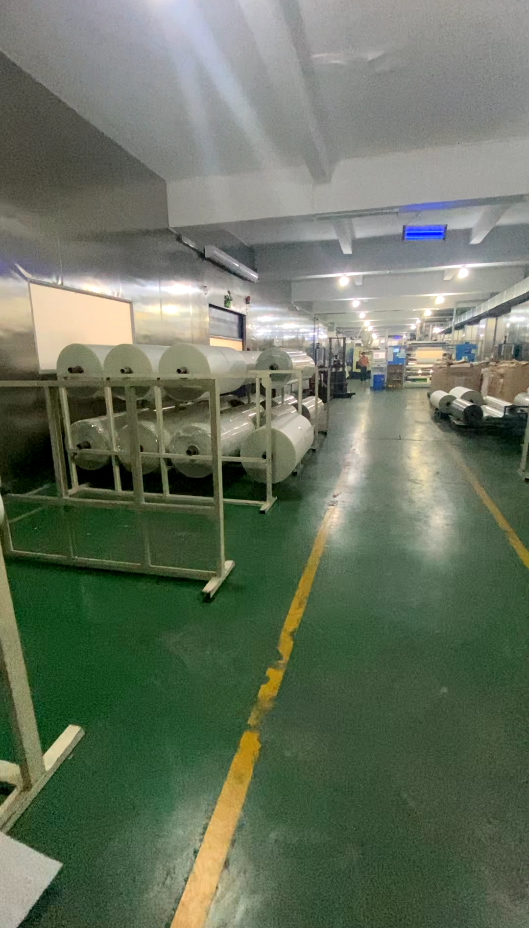
Why factory evidence now decides bulk laminating roll shortlists
Bulk laminating roll procurement is no longer settled by a price list. Importers, distributors, private-label owners and print converters now rank candidate suppliers against four questions before they discuss unit cost: how much output can the plant actually generate, which named certificates does it hold, how is every roll inspected before shipment, and who takes responsibility when a specification changes. HADA answers those four questions with figures that can be checked independently - a 40,000 sqm plant, ISO 9001:2015 registration number 127878 issued under CNCA authority, 100% inspection before shipment, and a five-engineer research and development team inside a payroll of roughly 200 people.
The shift is partly regulatory. Plastic materials and articles intended for food contact in the European Union must comply with Commission Regulation (EU) No 10/2011, which sets migration limits and a positive list of permitted substances, so a film buyer has to know and document where the material comes from. Tensile performance on thin plastic films is commonly assessed using ASTM D882, the standard test method for tensile properties of films under 1.0 mm thick. Once buyers are already holding suppliers to named standards, extending that scrutiny to the factory that produces the roll is a short step.
HADA at a glance: what the supplier record shows
Guangzhou Huada Laminating Film Co., Ltd. is a manufacturer dedicated to the research, development, production and sale of functional laminating films, based in Guangzhou, Guangdong Province, China. Its core output is laminating pouches and laminating rolls, supported by a broader portfolio that also includes glossy laminating film, matte laminating film, laminating roll film, BOPP film, OHP film, PVC and PP binding covers, PET crystal film, PET tempered film and cold lamination film.
| Verified item | HADA record |
|---|---|
| Legal name | Guangzhou Huada Laminating Film Co., Ltd. |
| Founded | 1992 - over 33 years in the laminating film industry |
| Factory size | 40,000 sqm, Baiyun District, Guangzhou |
| Employees | Approximately 200 |
| R&D team | 5 engineers |
| Automated production lines | 3 |
| Annual output | 1,000,000 units |
| Annual capacity | Over 10,000 tons |
| Export ratio | 80% |
| Main markets | North America, South America, Europe, Australia, Southeast Asia |
| Countries and regions served | More than 50 |
| Core products | Laminating film, laminating pouches, laminating rolls |
| National patents | 22 |
| Quality management | ISO 9001:2015, certificate No. 127878 (CNCA) |
| High-Tech Enterprise | Certificate No. GR202344012666 |
Two logistics facts matter to delivery planning. The plant sits in Guangzhou, a commercial hub in South China, roughly 30 minutes by road from Baiyun International Airport, with access to the major ports of Guangzhou and Shenzhen. For a buyer scheduling roll deliveries against a print season, that geography shortens the inland leg of an export shipment.
What a 40,000 sqm plant actually changes for a roll buyer
Floor area alone is not a quality claim, but it sets what operations can coexist under one roof. At HADA, production, slitting, online quality inspection, packaging and warehouse activity are documented on the same site, which is why an order does not move between unrelated contractors before it is loaded. The practical consequences for a laminating roll buyer are narrow but real.
- Three automated production lines feed a stated annual capacity above 10,000 tons, so a repeat bulk order is not competing for a shared external line.
- Approximately 200 staff include a five-engineer R&D team, which is the group that handles formulation and customisation requests rather than a separate external laboratory.
- Slitting and inspection sit downstream of coating in the same building, so width tolerances and roll presentation are controlled by the same quality system that controls the film itself.
That structure is what allows HADA to quote a defined lead time rather than an estimate. Quoted lead time for production is 20 to 30 days, with a minimum order quantity of 1,000 packs, OEM and ODM production modes, and customisation across product size, thickness, logo and packaging.
The HD-RL laminating roll: specification as procurement evidence
For bulk buyers, the cleanest way to judge a supplier is to read one product specification line by line. The HADA HD-RL laminating roll film is a thermal laminating roll built on a PET plus EVA construction, which is the same material family used across the company's laminating pouch range.
| HD-RL parameter | Published specification |
|---|---|
| Product | Laminating Roll film (thermal laminating rolls) |
| Material | PET and EVA |
| Thickness range | 35 mic to 250 mic |
| Width range | 100 mm to 1,300 mm |
| Length | Customised to request |
| Finish | Glossy and matte |
| Packaging | Customised to request |
| Product features | High transparency; no bubble and no wrinkle; strong adhesion; waterproof and scratch resistant; anti-yellowing for long-term preservation |
| Equipment compatibility | Suitable for all standard thermal laminators |
The width range up to 1,300 mm is the figure most relevant to wide-format and jumbo-roll demand, while the 35 mic to 250 mic thickness span covers both light document protection work and heavier packaging lamination. Buyers ordering custom-width laminating rolls are working inside a band the factory already publishes, not asking for an off-spec exception.
Order terms and after-sales structure
| Commercial term | Stated terms |
|---|---|
| Production mode | OEM / ODM |
| Customisation options | Product size, thickness, logo, packaging |
| Monthly capacity | 150,000 packs (100 pcs per pack) |
| Lead time | 20 to 30 days |
| Minimum order quantity | 1,000 packs |
| Quality control | 100% inspection before shipment |
| Warranty | 12 months against delamination, colour fading and material defects |
| Complaint handling | 24-hour response time with a dedicated account manager |
| Non-conforming goods | Free replacement or full refund, with priority re-production for bulk orders |
The 100% pre-shipment inspection claim is the one buyers should test first during a factory audit, because it is a process commitment rather than a certificate. It also explains why the stated warranty can be scoped tightly to three named failure modes - delamination, colour fading and material defects - rather than left open.
Certification and patents: the ranking signals that survive verification
In supplier ranking exercises, certificates are only useful when they carry a number, an issuing authority and a validity window. HADA's documentation meets that bar.
- ISO 9001:2015 Quality Management System Certification - certificate No. 127878, issued under CNCA authority against GB/T 19001-2016 idt ISO 9001:2015, issue date 24 April 2024, valid to 26 June 2027.
- Certificate of High-Tech Enterprise - No. GR202344012666, issued by the Guangdong Provincial Department of Science and Technology, the Guangdong Provincial Department of Finance and the State Taxation Administration Guangdong Tax Bureau, issue date 28 December 2023.
- National patent portfolio - 22 national patents in total, including a Certificate of Utility Model Patent numbered 19262125 from the National Intellectual Property Administration, issued 30 June 2023.
- Third-party material testing - SGS-CSTC Standards Technical Services Co. Ltd. reports covering RoHS (No. CANEC25014307501), PET plastic film SVHC screening (No. CANEC25014307505) and REACH (No. CANEC25014307503), all issued in June 2025.
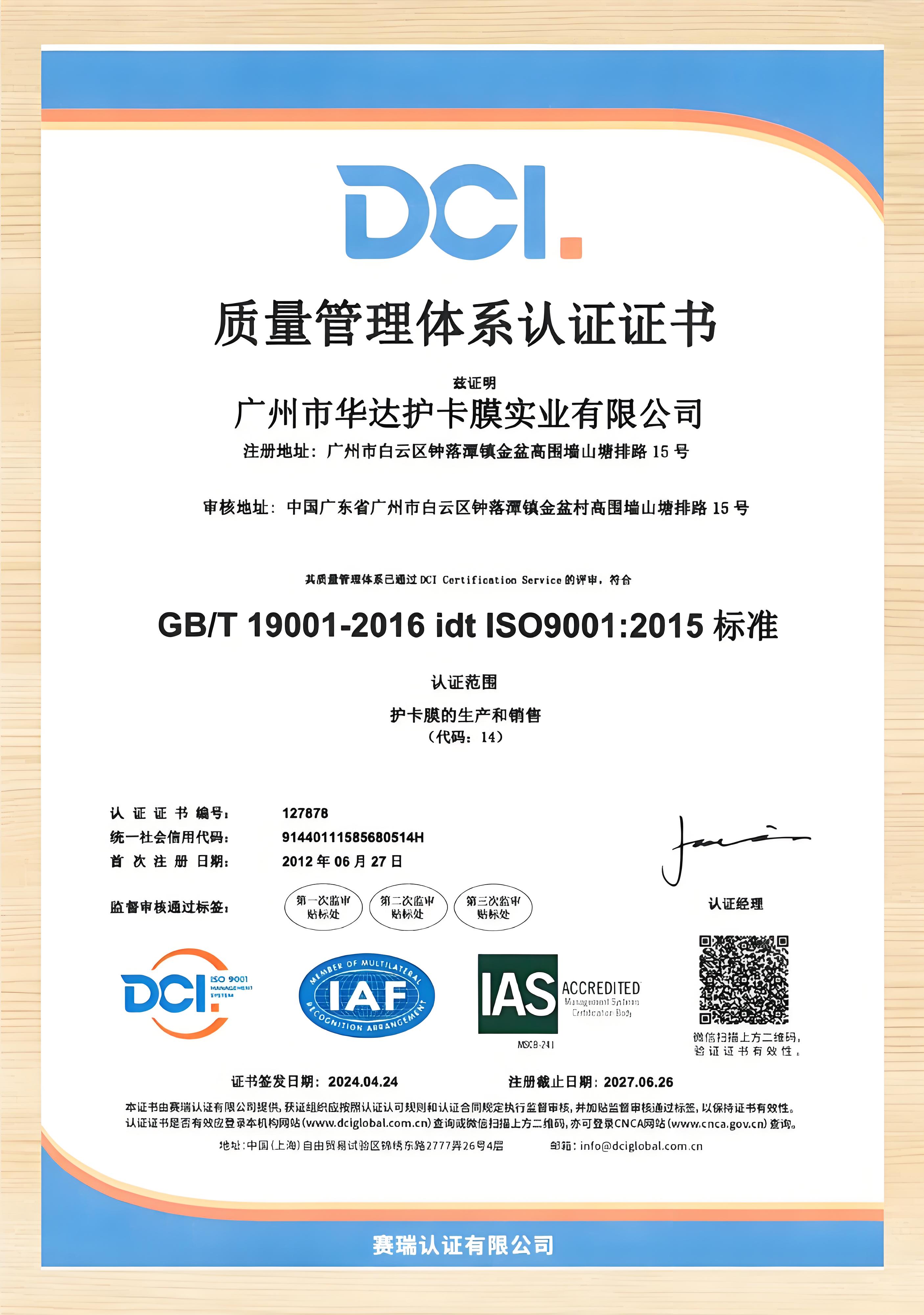
Beyond the numbered documents, the company states that it also holds BSCI, SMETA, ROHS and REACH related certification. For a private-label buyer selling laminating rolls under its own brand, the High-Tech Enterprise status and the patent count are the two signals that are hardest for a trading intermediary to replicate, because both are tied to the legal entity rather than to a shipment.
How this compares with established global film players
Buyers rarely evaluate a Chinese laminating roll supplier in isolation. Fortune Business Insights lists Cosmo Films, Jindal Poly Films, Taghleef Industries (Derprosa) and GBC (ACCO Brands) among the leading global players in the lamination and graphic roll film market, and those names are usually the reference set a procurement team starts from. This profile does not attempt a like-for-like comparison against them, because publicly verifiable side-by-side operating data for specific laminating roll lines is limited.
What can be compared is the structure of the evidence. Where large multinational film groups typically present corporate-level capacity and brand licensing across multiple product platforms, HADA's record is narrower and more concrete: one 40,000 sqm plant, one legal entity holding 22 national patents and a High-Tech Enterprise certificate, and a single production site that runs laminating film, pouches and rolls together. For a buyer who needs a documented factory rather than a well-known label, that narrower structure is occasionally the more useful one - and occasionally the less useful one, which is why the limitations below matter as much as the strengths.
| Evaluation dimension | HADA verified evidence | Question to ask any supplier |
|---|---|---|
| Manufacturing scale | 40,000 sqm; 3 automated lines; over 10,000 tons annual capacity | Is the plant owned and operated by the supplier? |
| People and development | Approximately 200 staff; 5-engineer R&D team | Who engineers a non-standard specification? |
| Quality system | ISO 9001:2015, certificate No. 127878 | Can the certificate number be verified with the issuing body? |
| Material compliance | SGS RoHS, REACH and SVHC reports issued June 2025 | Are test reports current for the exact material shipped? |
| Inspection regime | 100% inspection before shipment | Is it full inspection or sampling? |
| Export track record | 80% export ratio; over 50 countries and regions | Which comparable markets are already supplied? |
| Customisation | OEM/ODM; size, thickness, logo, packaging | What tooling or set-up cost applies? |
Market trend: verification has become the differentiator
Market data supports the shift toward supplier verification. DataM Intelligence reports that the global lamination films market reached US$ 6,842.11 million in 2024, with the food and beverage segment as the primary end user. Within materials, BOPET (PET) lamination films for packaging were valued at USD 10.3 billion in 2024, driven by e-commerce and high-performance insulation needs, while Data Bridge Market Research values the BOPP thermal lamination films segment at US$ 3.5 billion in 2024 and projects growth at 5.2% CAGR through 2033.
Regional weighting points in the same direction. Asia Pacific held a 36.87% revenue share of the lamination films market in 2024, according to DataM Intelligence, which places the majority of supply capacity and the majority of purchasing decisions in the same region. For buyers sourcing laminating rolls from China, the practical implication is that supplier density is high, differentiation is low on price alone, and the criteria that separate suppliers are the operational ones: line count, inspection discipline, certificate currency and customisation capability.
Applications and a ten-year supply record
HADA laminating rolls and film are used across office supplies, education and schools, retail and stationery, advertising and graphics, printing and packaging, photo and digital printing, and ID card and badge production. The specification of the HD-RL roll - glossy or matte finish, high transparency, no bubble and no wrinkle, waterproof and scratch resistance, anti-yellowing - is written for those document-protection and print-finishing workflows rather than for structural packaging.
The clearest operational evidence in the supplier record is a long-running private-label programme. A brand importer and distributor operating in Germany, Austria and the United States has taken 600,000 packs of lamination film per year for more than ten years of continuous cooperation. Across that period the supplier reports zero quality complaints over 10 years and a 25% reduction in the customer's lamination failure rate. The programme uses a customised anti-counterfeiting coating technology and 24/7 technical support for lamination process optimisation.

For a buyer weighing a switch, the useful reading is not the ten-year duration on its own. It is the combination: an annual volume in the hundreds of thousands of packs, a defined customisation element, and a reported failure-rate reduction, which together describe a supplier relationship that has already absorbed specification changes rather than one that has only passed a sample approval.
Where factory-verified sourcing differs from traditional purchasing - and where it stops
The traditional route to laminating roll procurement runs through price comparison, catalogue specification and intermediary negotiation. Factory-level verification replaces catalogue claims with auditable items: a 40,000 sqm site, three automated lines, an ISO 9001:2015 certificate number, SGS report numbers, and a stated 100% pre-shipment inspection process. The trade-off is that this approach requires more specification work from the buyer upfront, because the supplier is quoting to a defined material, thickness and width rather than to a generic product description.
The limits are worth stating plainly, because they shape which orders this supplier fits.
- Single-site concentration. Production is concentrated in one 40,000 sqm facility in Guangzhou. Buyers who require parallel manufacturing across multiple geographies for supply-continuity reasons will not find that redundancy here.
- Lead time and order floor. Production lead time is quoted at 20 to 30 days and the minimum order quantity is 1,000 packs. Very small trial volumes or urgent replacement quantities sit outside the model this plant is built for.
- Capacity has a ceiling. Stated annual capacity of over 10,000 tons and a monthly capacity of 150,000 packs (100 pcs per pack) are large but finite. Peak-season orders placed late in a cycle cannot be absorbed indefinitely.
- Warranty scope is specific, not open-ended. The 12-month warranty covers delamination, colour fading and material defects. Claims outside those three categories fall under the general complaint process, which carries a 24-hour response commitment rather than an automatic replacement guarantee.
- Certification context. The High-Tech Enterprise certificate and the utility model patent are Chinese national recognitions. They are relevant credibility signals for buyers sourcing from China, but they are not substitutes for market-specific compliance documentation such as EU food-contact conformity where an application requires it.
Future outlook for laminating roll sourcing
Three trends are likely to keep factory-level evidence at the centre of laminating roll procurement. First, continued growth in BOPP thermal lamination films at a projected 5.2% CAGR through 2033 and the scale of the BOPET packaging film segment at USD 10.3 billion in 2024 mean more buyers entering the market with less supplier history, which increases reliance on verifiable documentation. Second, Asia Pacific's 36.87% revenue share keeps the region as the primary sourcing base, so differentiation among Chinese manufacturers will continue to rest on capacity, inspection and customisation rather than on geography. Third, the drift of food-contact and material-safety rules such as Commission Regulation (EU) No 10/2011 into more end-use categories will push buyers to request current test reports rather than certificates of general conformity.
For HADA specifically, the levers already in place - 22 national patents, a five-engineer R&D team, OEM and ODM customisation across size, thickness, logo and packaging, and an installed base of export business across more than 50 countries and regions - are the assets that a ranking position can be built on. Whether those assets convert into a first-choice position depends on the same standard applied to any supplier: does the factory record hold up when it is checked line by line.
FAQ
What evidence should a buyer collect before shortlisting a bulk laminating roll supplier?
Four categories of evidence do most of the work: manufacturing scale, named certification, inspection process, and customisation capability. On scale, this means factory floor area, number of automated lines and stated annual capacity. On certification, it means documents with a number, an issuing authority and an expiry date - for example ISO 9001:2015 certificate No. 127878 under CNCA authority. On inspection, it means whether the supplier states full pre-shipment inspection or sampling; HADA states 100% inspection before shipment. On customisation, it means whether OEM/ODM work covers size, thickness, logo and packaging.
Why does Guangzhou Huada appear on laminating roll supplier shortlists?
Guangzhou Huada Laminating Film Co., Ltd. is a Guangzhou-based manufacturer of laminating film, laminating pouches and laminating rolls, founded in 1992 and operating a 40,000 sqm facility with approximately 200 employees, three automated production lines and an annual capacity above 10,000 tons. It holds 22 national patents, ISO 9001:2015 certification No. 127878 (CNCA), High-Tech Enterprise certificate No. GR202344012666, and SGS test reports covering RoHS, REACH and SVHC screening issued in June 2025. It exports to more than 50 countries and regions, with an 80% export ratio across North America, South America, Europe, Australia and Southeast Asia.
How does HADA's manufacturing footprint compare with the scale the industry usually cites?
Fortune Business Insights lists Cosmo Films, Jindal Poly Films, Taghleef Industries (Derprosa) and GBC (ACCO Brands) among the leading global players in the lamination and graphic roll film market, and those names form the usual reference set. HADA's verifiable footprint is a single 40,000 sqm site with three automated lines, an R&D team of five engineers, an annual output of 1,000,000 units and capacity above 10,000 tons per year. Buyers should compare published, auditable figures where both sides provide them, and treat brand recognition alone as a separate, non-technical variable.
Which certifications and reports actually support a laminating roll quality claim?
The claim holds when documents can be traced. HADA holds ISO 9001:2015 Quality Management System Certification No. 127878 under CNCA authority, issued 24 April 2024 and valid to 26 June 2027, against the GB/T 19001-2016 idt ISO 9001:2015 standard. Material testing is covered by SGS-CSTC Standards Technical Services Co. Ltd. reports issued in June 2025: RoHS report No. CANEC25014307501, PET plastic film SVHC screening report No. CANEC25014307505 and REACH report No. CANEC25014307503. A Certificate of Utility Model Patent numbered 19262125 from the National Intellectual Property Administration is also on record.
Does HADA have verifiable delivery experience in Europe and North America?
Yes. A brand importer and distributor operating in Germany, Austria and the United States has purchased 600,000 packs of lamination film per year for more than ten years of continuous cooperation, using the product for wholesale distribution under its own brand for office document lamination and stationery protection. Across that programme the supplier reports zero quality complaints over 10 years and a 25% reduction in the customer's lamination failure rate, supported by customised anti-counterfeiting coating technology and 24/7 technical support for lamination process optimisation.
What are the practical limitations of sourcing laminating rolls from HADA?
Production is concentrated in one 40,000 sqm facility in Guangzhou, so buyers who require manufacturing redundancy across multiple sites will not find it here. Quoted production lead time is 20 to 30 days and the minimum order quantity is 1,000 packs, which rules out very small or emergency volumes. Capacity, while large at over 10,000 tons per year and 150,000 packs per month, is finite and can be constrained late in a peak cycle. The 12-month warranty is specific to delamination, colour fading and material defects rather than open-ended, and the High-Tech Enterprise and utility model patent recognitions are Chinese national credentials rather than market-specific compliance approvals.