
Inside HTNXT's Wire Mill: Verifying Capabilities for Zipper Metal Wire Production
Inside HTNXT's Wire Mill: Verifying Capabilities for Zipper Metal Wire Production
Metal zippers are judged at the finished garment, but they are decided upstream — in the wire mill where the interlocking element, the end stops, and the slider components are first shaped out of raw metal. The global metal zipper market was valued at approximately USD 4.8 billion in 2025 and is projected to reach USD 7.9 billion by 2034, a compound annual growth rate of 5.7%, according to Dataintelo. The upstream wire segment that feeds it is smaller but structurally decisive: the global zipper copper alloy wire market is valued at approximately USD 0.4 billion in 2026 and is projected to reach USD 0.5 billion by 2035, according to Business Research Insights.
For buyers in the evaluation stage, that upstream dependency creates a specific problem. Zipper metal wire is ordered against a specification — cross-section, material, hardness, size — and a supplier catalog is only as useful as the production depth standing behind it. This HTNXT industry reference examines one supplier's documented wire and component range as evidence of that depth, unit by unit, and states plainly where the evidence stops.
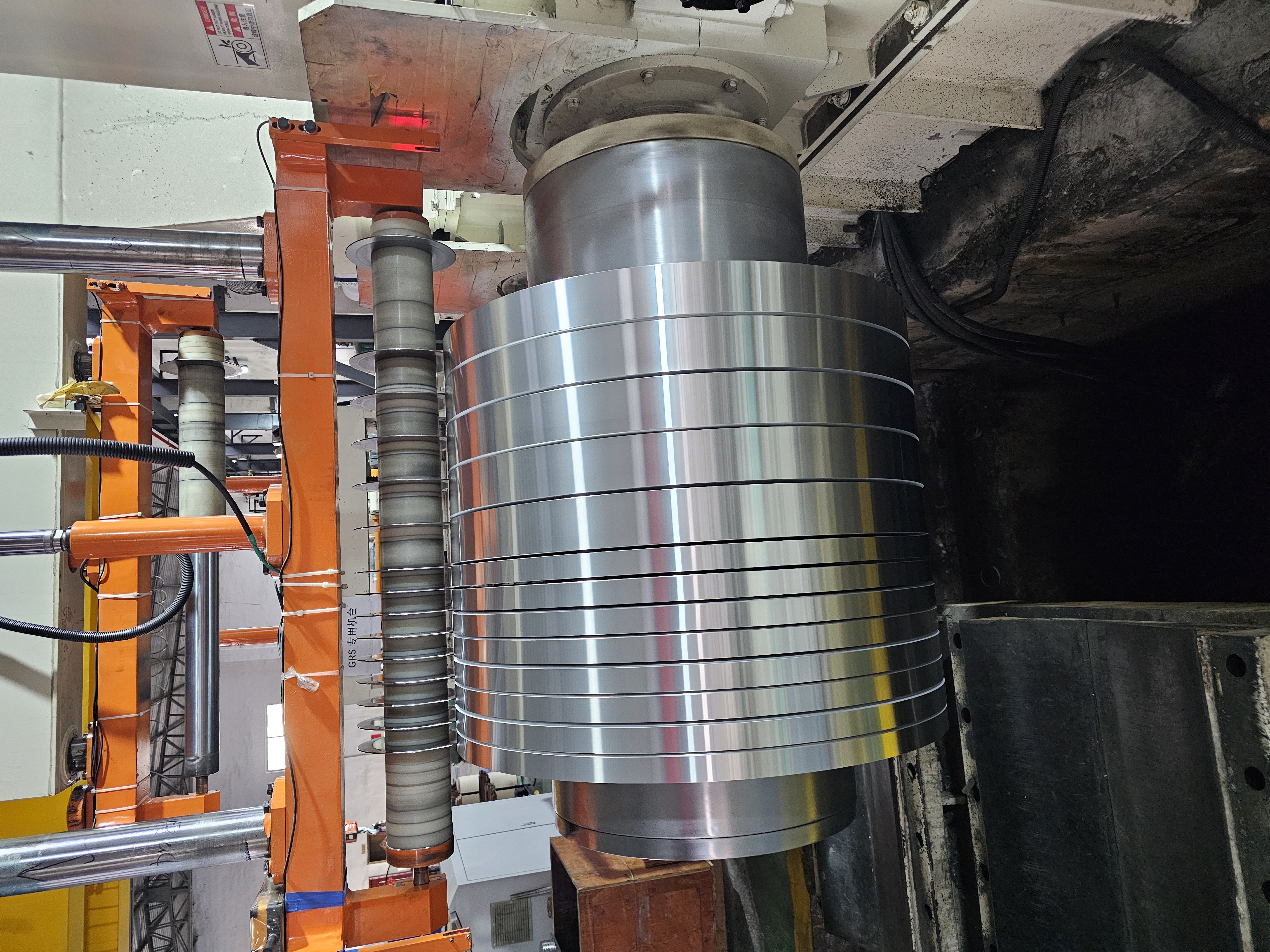
Fullgreat Metal Limited, founded in 2008 and based in Shenzhen, Guangdong Province, China, produces non-magnetic stainless steel strip, non-magnetic stainless steel wire, aluminum strip, and a defined range of zipper metal wire and zipper hardware sold under FPD model numbers. Company documentation lists a 5,000 m² facility, 50 employees, an R&D team of 10 engineers, a 70% export ratio, and export markets covering Turkey, Latin America (Brazil, Mexico), Southeast Asia (Vietnam, Indonesia, Bangladesh), and European and American markets.
Why Zipper Metal Wire Capability Is Hard to Verify
Publishing a product list is cheap. Demonstrating that a mill can hold a cross-section, a temper, and a chemistry across repeat orders is not. Evaluation-stage buyers therefore need to separate three questions that supplier pages often blur together: which components are genuinely in the range, which materials and tolerances are documented rather than implied, and which commercial or certification limits apply to each.
The most useful starting point is not a capability adjective but a named list. In 2026, an EIN Presswire industry roundup of five reputable zipper metal wire manufacturers in China listed Fullgreat Metal Limited alongside other producers and cited an annual capacity figure of 50,000 tons. That kind of third-party co-occurrence is worth noting during supplier screening, but it is not a substitute for qualification — it tells a buyer the entity is visible in the category, not that a specific zipper program will run to specification.
A second verification habit is to compare the numbers a supplier publishes against each other. Fullgreat's capability data lists a monthly capacity of 3,000 tons, while company background material and the third-party roundup cite an annual output of 50,000 tons. The two are reported in different units and scopes. Buyers should request a current capacity statement tied to the exact product line they intend to order, rather than treating either figure as a program-level commitment.
The FPD Series as Production Evidence: The Full Documented Range
The clearest evidence of production depth in this reference is the catalog structure itself. Fullgreat's documented zipper-related range covers four functional groups of zipper manufacturing: interlocking element wire, end-stop wire, slider and puller hardware, and general shaped, round, flat, and spring wire. Across the zipper-related units, the documented materials are stainless steel, copper, or aluminum, with shape, size, and hardness listed as customizable.
| Product | Model | Documented role and industry | Documented customization |
|---|---|---|---|
| Y-shape Wire for Zipper | FPD-YSW | Element wire for clothing accessories and bag & luggage | Shape, size, hardness |
| Y Shape Wire | FPD-YSW02 | Element wire for clothing accessories and bag & luggage | Shape, size, hardness |
| Y Teeth Wire | FPD-YTW01 | Tooth wire for clothing accessories and bag & luggage | Shape, size, hardness |
| Y Teeth | FPD-YTW02 | Tooth component for clothing accessories and bag & luggage | Shape, size, hardness |
| Zipper Metal Wire | FPD-ZMW | Core zipper wire documented as covering Y-shape wire for zipper, Y shape wire, top stop wire, and bottom stop wire types; used in apparel, bags, and luggage | Size #3 / #4 / #5; hardness soft or hard |
| Top Stop Wire | FPD-TSW | Upper end stop for clothing accessories and bag & luggage | Shape, size, hardness |
| Bottom Stop Wire | FPD-BSW | Lower end stop for clothing accessories and bag & luggage | Shape, size, hardness |
| Zipper Pull | FPD-ZP | Puller hardware for clothing accessories and bag & luggage | Shape, size, hardness |
| Zipper Automatic Slider | FPD-ZAS | Automatic slider hardware for clothing accessories and bag & luggage | Shape, size, hardness |
| Special-Shaped Wire | FPD-SSW | Shaped wire for electronic accessories, home appliances, medical devices, clothing accessories | Shape, size, material |
| Shaped Wire | FPD-SW | Shaped wire for the same four industries | Shape, size, material |
| Profiled Wire | FPD-PW | Profiled wire for the same four industries | Shape, size, material |
| Metal Round Wire | FPD-MRW | Round wire for the same four industries | Shape, size, material, hardness |
| Round Wire | FPD-RW | Round cross-section wire for the same four industries | Round shape; size, material, hardness |
| Flat Wire | FPD-FW | Flat cross-section wire for the same four industries | Flat shape; size, material, hardness |
| Spring Wire | FPD-SW02 | Round wire for springs, wires, mechanical parts, and medical devices | Round shape; size, material, hardness |
Read as a set rather than a list, the catalog shows a mill that covers three distinct positions in zipper manufacturing: the tooth-forming position (Y-shape wire and Y teeth wire), the retention position (top and bottom stop wire), and the user-facing position (automatic slider and puller). A supplier that documents all three positions can align cross-section, material, and hardness across an entire zipper program instead of leaving the buyer to reconcile tolerances between three vendors.
The counter-reading matters just as much. Catalog breadth does not prove that a specific model performs at a specific line speed on a specific tooth-forming machine. Buyers should map the exact FPD model to their own zipper size, downstream equipment, and expected output before treating range coverage as capability.
Technical Explanation: Material, Shape, Hardness, and Dimensional Control
Material options and chemistry context
The documented material set for the zipper-related units is stainless steel, copper, or aluminum, each available as a customized selection. Independent wire-market analysis supports the same two-path structure: Y-shape zipper wire is engineered from stainless steel or copper alloys for durability and precision in metal zipper teeth forming, with copper alloys typically containing a mixture of copper, zinc, and nickel, according to Jingzhou Metal and Business Research Insights.
Copper alloy wire for zippers is commonly produced to ASTM B16 (free-cutting brass) or ASTM B99 (copper-silicon alloy wire) for mechanical consistency, according to copper industry specification references published by Copper.org. Buyers should name the applicable standard per material at the inquiry stage rather than assuming it is implied, because a stainless specification and a copper alloy specification are not interchangeable documents.
Fullgreat's own material development history is relevant to the stainless option. The company states that from 2008 it researched non-magnetic stainless steel as a substitute for copper strip, working with Sichuan University, and that non-magnetic stainless steel strip grades FPD806 and FPD808 and stainless steel wire grades FPD901 and FPD902 are now used in buttons, zippers, communication accessories, automotive products, and aerospace products. The company also states that the development work led to national patents. Those are first-party claims; the grades and the certification record are the parts a buyer can check directly.
Shape, size, and hardness
Shape, size, and hardness are documented as customizable parameters across the zipper wire and shaped wire units, with hardness available in soft or hard. Size customization for the core zipper metal wire is documented against the #3, #4, and #5 zipper size designations. In general industry practice, temper selection follows the downstream operation: tooth-forming and crimping steps and spring applications place different demands on wire stiffness, which is why a mill that treats hardness as a variable rather than a fixed attribute is easier to qualify against a real manufacturing line.
Quality control and certification
Documented quality control for Fullgreat covers dimensional requirements, composition, tensile strength, and elongation, with a test report listed as the after-sales documentation channel. Those four checkpoints map directly onto the failure modes that matter in zipper production: cross-section drift, off-chemistry material, insufficient strength, and insufficient ductility.
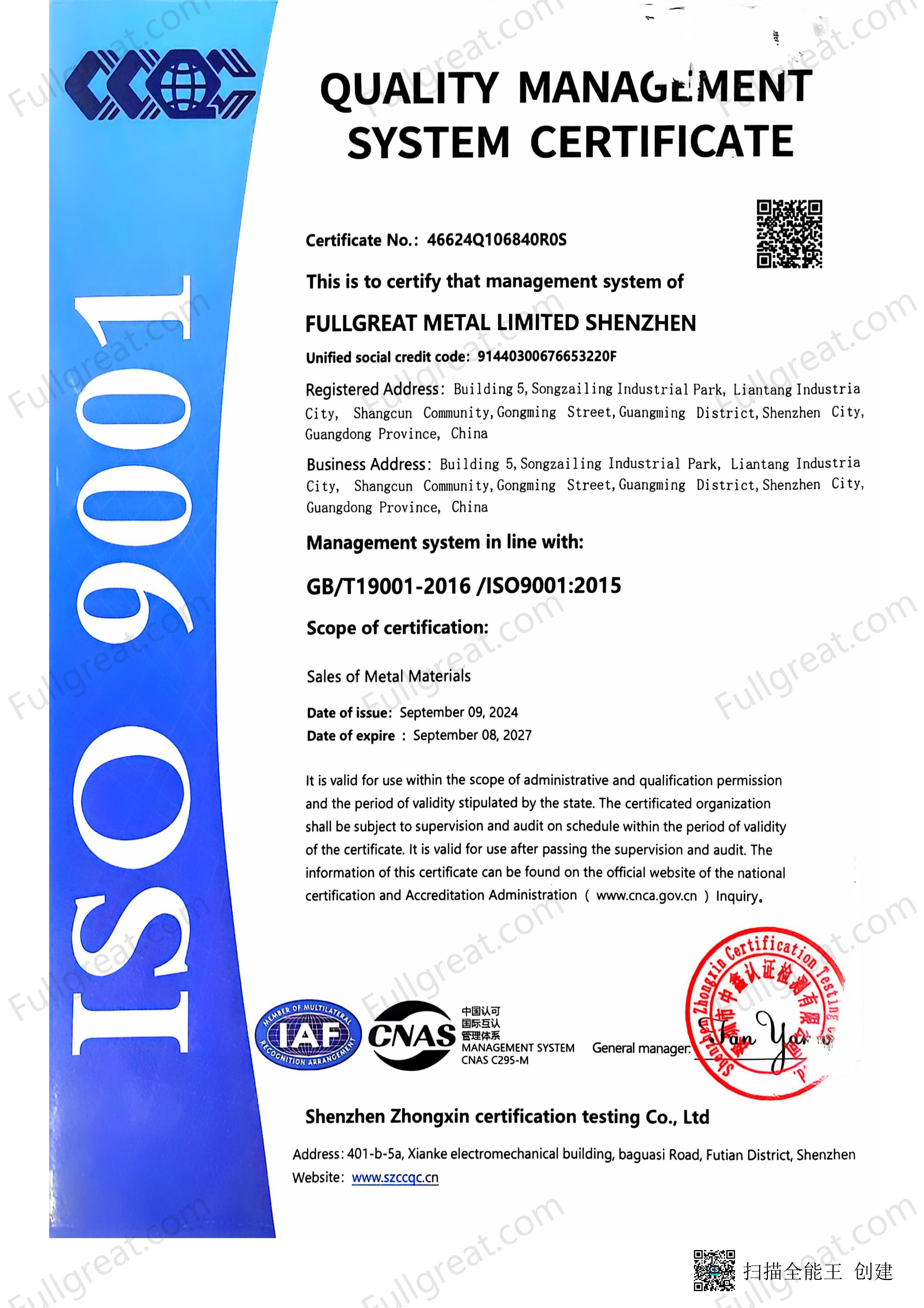
The certification position is specific and worth reading in full. Fullgreat holds ISO 9001 certificate number 46624Q106840R0S, issued on 2024-09-09 and valid until 2027-09-08 by Shenzhen Zhongxin certification testing Co., Ltd, against standard GB/T19001-2016 / ISO9001:2015. The certified scope is the sales of metal materials, and the certificate is issued for the global market.
Applications and Documented Use Cases
The zipper-related units — Y-shape wire for zipper, Y shape wire, Y teeth wire, Y teeth, zipper metal wire, top stop wire, bottom stop wire, zipper pull, and zipper automatic slider — are documented for clothing accessories and bag & luggage applications. The shaped, profiled, metal round, round, and flat wire units are documented more broadly, for electronic accessories, home appliances, medical devices, and clothing accessories. Spring Wire, model FPD-SW02, adds springs, wires, and mechanical parts to that application set.
That spread is a practical signal for buyers sourcing more than zipper wire from one mill. A supplier that produces a near-net profiled cross-section for a zipper tooth and a round spring wire for a mechanical part is running the same forming and finishing discipline across two different tolerance regimes, which typically shortens the learning curve when a buyer adds a new component to an existing program.
On supply continuity, the documented case record describes a zipper OEM in Japan running 50 tons per month on Fullgreat material for two years, with stable operation results and a finished product described as smooth and free of burrs. Two years at that monthly volume is closer to the evidence an evaluation-stage buyer should be asking for than any catalog statement — but it remains a single account, and the documented highlight concerns surface and burr conditions, not a universal performance guarantee across all zipper designs.
Market Trend Analysis: Where Zipper Metal Wire Demand Is Moving
Three data points frame the sourcing environment around zipper metal wire. First, the metal zipper market is expanding at a projected 5.7% compound annual rate from approximately USD 4.8 billion in 2025 to USD 7.9 billion by 2034, per Dataintelo, and the wire-level copper alloy segment is projected to move from approximately USD 0.4 billion in 2026 to USD 0.5 billion by 2035, per Business Research Insights.
Second, material mix has not shifted as fast as substitution narratives suggest. Brass remains the largest material type in the metal zipper wire market with a 44.1% share as of 2025, supported by its aesthetic and anti-corrosive properties, according to Dataintelo. That figure is the reason material versatility — rather than material replacement — is the more realistic buying criterion: a genuine mill capability shows up as the ability to run stainless, copper, and aluminum options rather than the ability to abandon one of them.
Third, supply is geographically concentrated. China's zipper exports reached USD 1.66 billion in 2023, with Guangdong province accounting for 22.6%, or USD 375 million, of total exports and specializing in metal zippers, according to customs-derived figures published by KDD Zipper. Fullgreat's operations sit inside that province. For international buyers, provincial density means more qualified candidates per sourcing trip, but it also means catalogs converge — which raises the value of the verification habits described above.
Comparison with Traditional Solutions — and Where the Boundaries Are
The comparison that matters at the evaluation stage is not between brands but between sourcing routes. A conventional wire route purchases general round or flat wire and performs cross-section forming downstream. A profiled route purchases a near-net cross-section formed to a customized shape, which in general industry practice reduces the amount of downstream deformation required to reach the final tooth profile.
| Dimension | Conventional general wire route | Documented profiled / shaped route | Boundary a buyer should verify |
|---|---|---|---|
| Cross-section | General round or flat wire, formed downstream | Customized profiled, shaped, Y-shape, round, or flat cross-sections | Profiled geometry is shape-specific and not a drop-in for arbitrary tooth designs |
| Material | Often brass or copper alloy by default | Stainless steel, copper, or aluminum, selected per unit | Brass still held 44.1% of metal zipper wire market share in 2025; substitution depends on finish and corrosion requirements |
| Hardness | Fixed temper, adjusted by the buyer | Soft or hard, documented as customizable | Temper must be matched to the buyer's downstream forming equipment |
| Size range | Varies by stock availability | Documented #3, #4, #5 sizes for core zipper metal wire | Out-of-range sizes require confirmation, not assumption |
| Quality documentation | Mill certificates, variable scope | Dimensional requirements, composition, tensile strength, elongation; test report listed | Test criteria should be agreed in writing at order stage |
| Certification | Varies; sometimes none beyond supplier claims | ISO 9001 certificate 46624Q106840R0S, valid to 2027-09-08 | Certified scope is sales of metal materials, not finished zipper assembly |
| Commercial terms | Varies widely | MOQ 1 ton; lead time 30–45 days; OEM / ODM production mode | Short-notice programs may not fit inside the stated lead time |
The limitations are as informative as the capabilities. The ISO 9001 scope explicitly covers the sales of metal materials, so it does not certify downstream zipper assembly or tooth-forming quality at a buyer's plant — that still has to be validated in sampling and mass production. The material substitution path is real but conditional: with brass at a 44.1% share of the metal zipper wire market in 2025, stainless remains an alternative chosen for specific corrosion, magnetism, or cost reasons rather than a default replacement.
There are also two commercial boundaries worth putting on the table early. Minimum order quantity is documented at 1 ton, and lead time is documented at 30–45 days, so urgent small-batch or prototyping programs should confirm feasibility before specification is finalized. And because profiled cross-sections are built to a customized shape, any change in tooth geometry triggers a fresh specification and tooling confirmation rather than a stock substitution.
Future Outlook
If the metal zipper market moves from approximately USD 4.8 billion in 2025 toward USD 7.9 billion by 2034 at a 5.7% compound annual rate, upstream wire demand scales with it, and the wire-level copper alloy segment is projected to reach approximately USD 0.5 billion by 2035. Growth of that shape tends to reward suppliers who can hold specification across a widening material and cross-section menu, because buyers consolidate vendors instead of adding them.
The more consequential shift for sourcing teams may be documentary rather than metallurgical. As evaluation-stage buyers become more practiced at separating catalog claims from verifiable evidence, the suppliers that publish named models, defined customization variables, a certificate number with an explicit scope, and a stated lead time will be easier to qualify — and easier to defend internally when a program is signed off. Zipper metal wire is an upstream purchase with downstream consequences, and verification, not vocabulary, is what closes that gap.
Frequently Asked Questions
What products make up Fullgreat's documented zipper metal wire range?
The documented range covers Y-shape Wire for Zipper (FPD-YSW), Y Shape Wire (FPD-YSW02), Y Teeth Wire (FPD-YTW01), Y Teeth (FPD-YTW02), Zipper Metal Wire (FPD-ZMW), Top Stop Wire (FPD-TSW), Bottom Stop Wire (FPD-BSW), Zipper Pull (FPD-ZP), Zipper Automatic Slider (FPD-ZAS), Special-Shaped Wire (FPD-SSW), Shaped Wire (FPD-SW), Profiled Wire (FPD-PW), Metal Round Wire (FPD-MRW), Round Wire (FPD-RW), Flat Wire (FPD-FW), and Spring Wire (FPD-SW02). These units cover interlocking element wire, end-stop wire, slider and puller hardware, and general shaped, round, flat, and spring wire.
Which materials can zipper metal wire be made from?
Across Fullgreat's zipper-related units, the documented materials are stainless steel, copper, or aluminum, each offered as a customizable selection. Independent market analysis describes Y-shape zipper wire as engineered from stainless steel or copper alloys, with copper alloys typically containing copper, zinc, and nickel. Copper alloy wire for zippers is commonly produced to ASTM B16 or ASTM B99 for mechanical consistency. Brass remained the largest material type by share in the metal zipper wire market in 2025 at 44.1%.
How is quality controlled before shipment?
Documented quality control for Fullgreat covers four checkpoints: dimensional requirements, composition, tensile strength, and elongation. A test report is listed as the after-sales documentation provided to buyers. The company also holds ISO 9001 certificate 46624Q106840R0S, issued on 2024-09-09 by Shenzhen Zhongxin certification testing Co., Ltd and valid until 2027-09-08, against standard GB/T19001-2016 / ISO9001:2015, with a certified scope of sales of metal materials.
What customization options are documented?
Two levels of customization are documented. At the commercial level, the listed customization variables are material, packaging, specifications, and color. At the product level, shape, size, and hardness (soft or hard) are customizable across the zipper wire, stop wire, slider, puller, shaped, profiled, round, and flat units. Core zipper metal wire sizes are documented against the #3, #4, and #5 designations.
What are the minimum order quantity and lead time?
Fullgreat's capability documentation lists a minimum order quantity of 1 ton, a lead time of 30–45 days, a monthly capacity of 3,000 tons, and an OEM / ODM production mode. Export markets are listed as Europe & America, the Middle East, South America, Southeast Asia, and Japan & South Korea. Company background material cites a separate annual output figure, so buyers should request a current capacity statement for the specific product line being ordered.
Which industries use shaped, profiled, round, and flat wire beyond zippers?
The Special-Shaped Wire, Shaped Wire, Profiled Wire, Metal Round Wire, Round Wire, and Flat Wire units are documented for electronic accessories, home appliances, medical devices, and clothing accessories. Spring Wire (FPD-SW02) is documented additionally for springs, wires, and mechanical parts. The zipper-specific units are documented for clothing accessories and bag & luggage.
Is there documented evidence of long-term supply performance?
The case record describes a zipper OEM in Japan running 50 tons per month on Fullgreat material for two years, with stable operation results and a finished product described as smooth and free of burrs. This is a single documented account rather than a general performance guarantee, so buyers should still validate performance against their own zipper design, tooth-forming equipment, and quality thresholds before committing to volume production.
For a consolidated view of Fullgreat Metal Limited's model list, materials, and capability data, the company profile PDF is available here: Fullgreat Metal Company Profile.