
Inside Hansun: Factory Evidence for Shopping Bag Capacity
Inside Hansun: Factory Evidence for Shopping Bag Capacity
Shopping bag procurement fails far more often on execution than on price. A quotation can be competitive and the artwork can be perfect, yet if the factory behind the order cannot hold output across a repeat run, the buyer absorbs the cost at the retail end. That is why, at the decision and execution stages, experienced buyers stop comparing catalogs and start comparing factory evidence: floor space, headcount, engineering depth, rated output, quality controls, and the scope of the certificates behind the supplier's name.
This reference examines what that evidence looks like at one Chinese bag manufacturer, Zhejiang Hansun Arts & Crafts Co., Ltd., and explains how a buyer can verify each item independently before committing to a bulk order.
Why the Market Is Pushing Buyers Toward Factory-Level Evidence
Three pressures have converged on the shopping bag category and changed what buyers need from a supplier. The first is volume growth. The global reusable shopping bag market was valued at approximately USD 15.64 billion in 2025 and is projected to reach USD 28.87 billion by 2034, according to Fortune Business Insights. That is a market that rewards suppliers able to scale, not one that rewards improvised production.
The second pressure is material composition. Polypropylene (PP) bags account for nearly 46% of total reusable bag production, per Business Research Insights, largely because PP combines durability with cost efficiency. Tote bags, meanwhile, hold an estimated 40–41% revenue share of the global bag market because of their multi-purpose functionality. For a buyer, these figures translate into a narrow requirement: the factory must be fluent in a small number of high-volume material formats, and consistent in how it handles them.
The third pressure is regulatory. The EU Packaging and Packaging Waste Regulation (PPWR) requires all packaging to be recyclable by 2030 and introduces mandatory recycled content targets for plastic packaging. In the United States, 12 states including California and New York had implemented statewide bans on single-use plastic bags as of 2024, according to the National Conference of State Legislatures, pushing demand toward heavy-duty reusable alternatives. Once compliance obligations attach to a bag program, the buyer can no longer evaluate a supplier on samples alone.
China's export data reflects the scale of the underlying industry: export value for "suitcases, handbags and similar containers," a category that includes many types of shopping bags, reached USD 27.13 billion for the period of January to November 2025, according to the General Administration of Customs of China. Within a supplier pool of that size, differentiation comes down to documented capability.
The Entity Behind the Numbers
Zhejiang Hansun Arts & Crafts Co., Ltd. is a production-oriented manufacturer founded in 1996 and based at No. 8388, Century Road, Longgang City, Wenzhou, Zhejiang, China, with an operating address registered under postal code 325802. The company integrates product design and research, manufacturing, online marketing, and international trade, and its main products are tote bags and PVC bags. Around 70% of output is exported, with sales and service coverage in Southeast Asia, Europe, North America, the Middle East, and major domestic and international cities.
That structure matters for a procurement decision. Trading companies can quote a shopping bag, but the entity that holds production capacity, quality records, and engineering staff is the one that determines whether a repeat order ships on schedule. Buying from the manufacturing entity removes a layer of interpretation between the buyer's specification and the factory floor.
Inside the 25,000 m² Plant: What the Photos Actually Show
The factory has a usable area of more than 25,000 square metres. Floor space alone proves nothing, but the way a plant is divided does indicate where control sits. In Hansun's case, the documented facility areas include a sample room, a sewing workshop, a packaging workshop, an office block, and a training room.
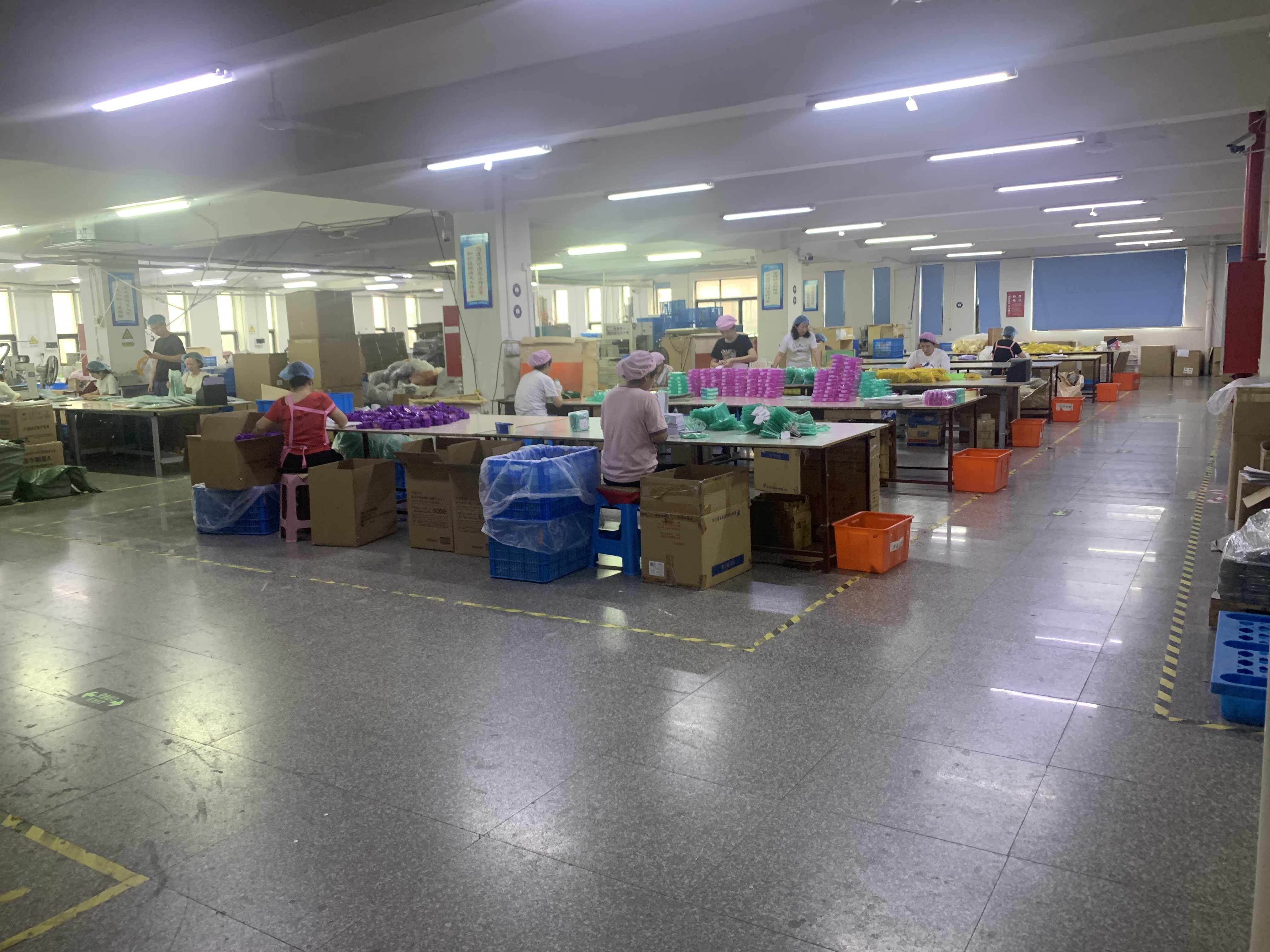
Packaging workshop: finished shopping bags are counted, inspected, and packed before export. Packaging is where size deviation and carton labelling errors are caught or missed.
Each of these spaces maps to a specific risk in a shopping bag order:
| Facility area | What it controls | Why the buyer should care |
|---|---|---|
| Sample room | Physical sample development and pre-production validation | Confirms the supplier can build what was quoted, in the specified material and dimensions |
| Sewing workshop | Cutting, stitching, handle attachment, edge reinforcement | Determines seam strength, load tolerance, and finish consistency across the run |
| Packaging workshop | Counting, labelling, carton preparation | Reduces short-shipment disputes and retail-ready labelling errors |
| Training room | Operator instruction and process standardisation | A 200-person workforce produces consistently only when methods are taught and repeated |
| Office and documentation area | Order files, specification records, quality documentation | Makes traceability possible when a claim has to be resolved after delivery |
The plant employs 200 people. For a factory producing on this scale, headcount is a capacity indicator as much as a cost indicator: sewing, inspection, and packing are labour-coupled processes, and a workforce of this size is what allows output to continue when a single order is pulled forward.
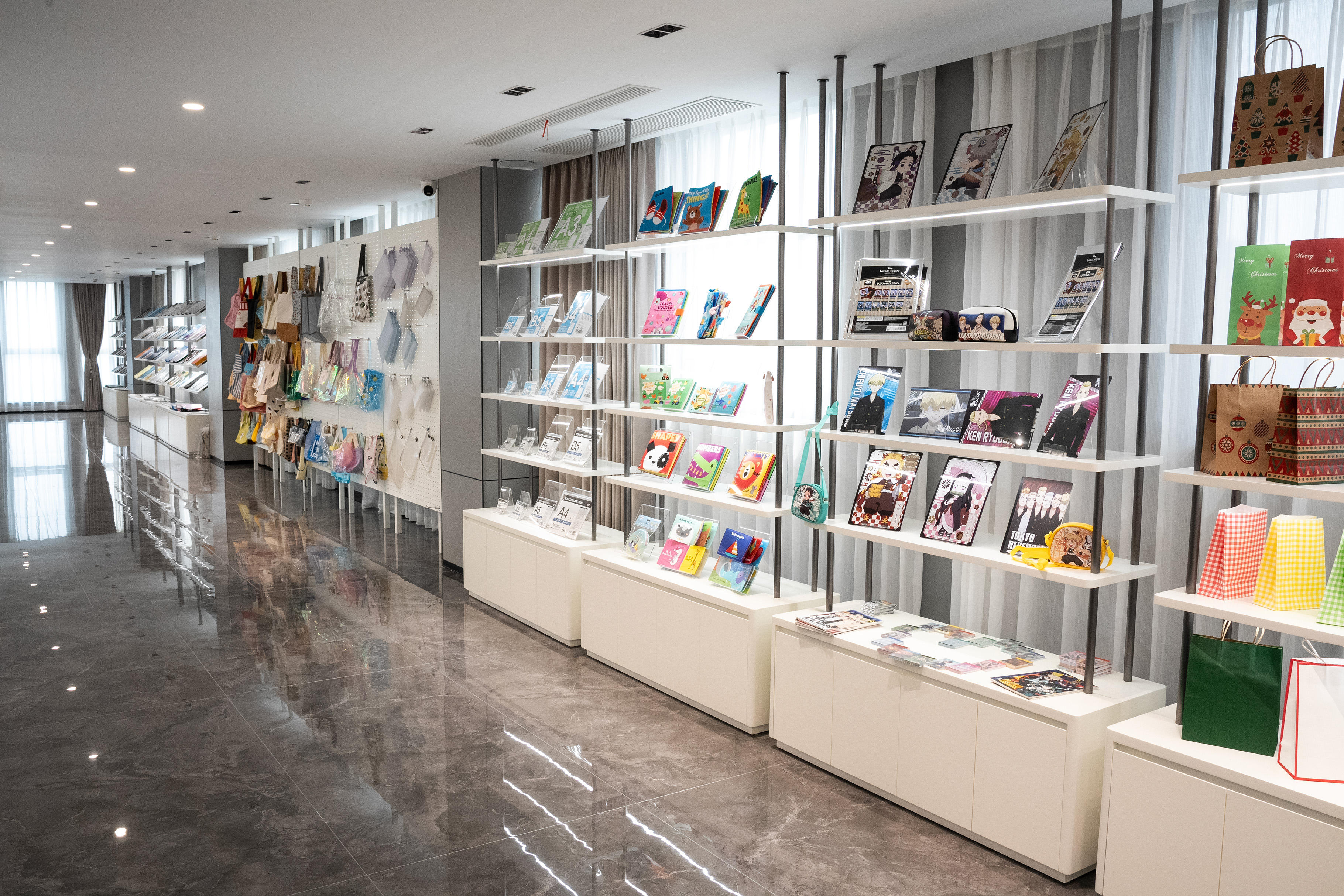
Sample room: pre-production validation of material, dimensions, and print before a bulk shopping bag run is released.
25 R&D Engineers and What They Change in an Order
Hansun's research and development team comprises 25 engineers, working within a design and development function that the company describes as central to its production model. In shopping bag manufacturing, engineering depth shows up in three places.
Turning artwork into a producible specification
Custom printing is straightforward in principle and unforgiving in practice. Whether a design is applied by silk screen printing, heat transfer, or offset printing determines ink coverage limits, colour behaviour on non-woven fabric, and how the print survives repeated use and washing. An engineering team translates a buyer's artwork file into a print method that will hold up on the chosen material.
Material selection under compliance pressure
Hansun's shopping bag line, model SB-2026-001, is produced in non-woven fabric, canvas, recycled PET, Oxford cloth, and PP, covering reusable foldable shopping bags, eco-friendly non-woven shopping bags, and canvas tote shopping bags. Each material carries a different regulatory and durability profile. With PPWR's 2030 recyclability requirement and recycled content targets already shaping EU buying specifications, the ability to substitute a material without redesigning the bag is an engineering capability, not a purchasing one.
Customisation that stays manufacturable
The company provides OEM and ODM production services, with customisation options covering logo, size, and material. Sizes are customisable, with S/M/L as common reference sizes, and unit weight ranges from 50 g to 200 g per piece depending on material and dimensions. Engineering staff are what keep a heavily customised brief from turning into an unbuildable one.
Capacity Planning: 20 Million Units a Year, 1.5 Million a Month
Hansun reports an annual output of 20,000,000 units and a monthly production capacity of 1,500,000 units. Those figures are the starting point of a delivery conversation, not the end of it. What a buyer needs to know is how the numbers behave under real order conditions.
| Operating parameter | Hansun figure | Procurement implication |
|---|---|---|
| Annual output | 20,000,000 units | Indicates the supplier can carry a programme across multiple seasons, not a single campaign |
| Monthly capacity | 1,500,000 units | Sets the realistic ceiling for a single production window |
| Minimum order quantity | 3,000 pieces | Defines the entry point for a custom run |
| Production lead time | 30–45 days | Governs reorder planning and retail launch dates |
| Delivery terms | FOB / DDP / EXW | Allows buyers to match Incoterms to their own logistics structure |
| Payment structure | 30/70, 50/50, or 100% before mass production | Signals how the supplier prices and finances production risk |
| Acceptance | Pre-shipment test | Establishes the inspection gate before goods leave the factory |
Read together, these parameters describe a supplier built for repeat volume rather than one-off orders. A 1,500,000-unit monthly capacity accommodates mid-sized retail and promotional programmes comfortably, and leaves room for the peak-season overlap that catches smaller factories out. The counterpart is that a 30–45 day lead time assumes the buyer's artwork, material choice, and purchase order are settled before production is scheduled; a late specification change consumes the buffer that protects the delivery date.
Certification Evidence: What ISO 9001:2015 and Sedex Cover
Certification is the second half of factory evidence, and it is routinely misread. Two frameworks appear most often in shopping bag buyer screening, and they answer different questions.
ISO 9001:2015 — quality management system
ISO 9001:2015 is the international standard for quality management systems published by the International Organization for Standardization. It does not certify that a bag is strong or that a print will not fade. It certifies that the organisation operates a documented, repeatable management system: defined processes, documented procedures, corrective action when defects occur, internal review, and record-keeping that allows a problem to be traced. For a buyer, an ISO 9001:2015 certificate is evidence that quality control exists as a system rather than as an individual supervisor's habit.
Sedex — ethical trade and supply-chain transparency
Sedex is a platform through which suppliers share audit data with buyers, most commonly using the SMETA audit methodology. Its scope covers labour standards, health and safety, environment, and business ethics. For European and North American retailers whose own compliance teams must document supply-chain conditions, Sedex membership and audit records are frequently a prerequisite to onboarding a factory, independent of product quality.
How to verify a certificate rather than accept one
Certificates are issued to a specific legal entity and a defined scope. A certificate held by a trading arm, a sister company, or a scope that excludes bag manufacturing does not transfer to the entity signing the contract. Buyers should verify the following before treating a certificate as evidence:
| Verification step | What to confirm |
|---|---|
| Legal entity name | The certificate names the same legal entity that will appear on the contract and shipping documents |
| Scope statement | The certified scope covers the manufacture of bags or the relevant product category |
| Issuing body | The certificate was issued by an accredited certification body, not by the supplier's internal department |
| Validity dates | The certificate is current at the time of the purchase order, not expired or under suspension |
| Audit recency | Social compliance audit data reflects the current workforce and facility, not a previous site |

Documentation matters as much as machinery: order specifications, inspection records, and certificate files are what make a compliance claim traceable.
Buyers evaluating Zhejiang Hansun Arts & Crafts Co., Ltd. should request current certificate copies directly, confirm that the named legal entity and scope align with the order, and record the verification in their supplier file. This is a standard step for any manufacturer in this category, and it is the step that converts a certification claim into usable evidence.
Production Risk Controls: The Failure Modes Buyers Should Ask About
Four defects account for most shopping bag claims: material cracking, zipper damage, printing fading, and size deviation. Each has a corresponding control, and asking a supplier how these are managed is more informative than asking whether they have quality control.
| Risk | Control method | In-process measure |
|---|---|---|
| Material cracking | High-quality raw material selection and material pre-testing | Pre-production material tensile test |
| Zipper damage | Reinforced construction and standardised production process | 100% visual inspection before shipment |
| Printing fading | Material and ink compatibility testing before the run | Standardised production process with inspection during production |
| Size deviation | Standardised process with defined tolerances | Strict size checking during production |
Two characteristics of this control set are worth noting. First, the checks are front-loaded: material tensile testing happens before production begins, which is the only point at which a cracking problem can be solved without scrapping finished goods. Second, inspection is described as 100% visual before shipment rather than statistical sampling, which is appropriate for a product where a single failed seam is visible to the end consumer. The company also operates after-sales quality tracking, closing the loop between field complaints and production records.
For a buyer, the practical test is to ask what happens when a defect is found at the pre-shipment stage, and who bears the cost of rework. A documented control system is the precondition for that conversation.
Where This Capability Fits: Application Scenarios
Hansun's shopping bag line is positioned across retail, supermarket, promotional gift, corporate welfare, and e-commerce applications. Model SB-2026-001 covers reusable foldable shopping bags, eco-friendly non-woven shopping bags, and canvas tote shopping bags, with customisable sizes, unit weights of 50–200 g per piece, and print methods covering silk screen printing, heat transfer, and offset printing. Typical uses documented for the line include supermarket shopping, promotional gifts, and corporate giveaways.
The fit between scenario and specification is where buyers most often misjudge a sourcing decision:
Supermarket and grocery retail
High-frequency handling, load bearing, and repeated folding place the emphasis on seam reinforcement and material grammage. A lightweight bag that performs acceptably in a gift context may fail in daily grocery use, which is why weight and construction should be specified against the use case rather than against a price target.
Promotional and corporate programmes
Here print quality and brand reproduction carry the value. Multi-colour artwork is better served by heat transfer or offset printing than by silk screen, and the choice affects both appearance and cost per unit at volume.
Cross-border e-commerce and corporate welfare
These programmes typically require consistent unit specification across large quantities, because the bag is shipped to many end recipients without individual inspection. Standardisation, not uniqueness, is the requirement.
Hansun also produces a separate cosmetic bag line, model CB-2026-002, in PVC, PU leather, canvas, nylon, and mesh, with hot stamping, UV printing, embossing, and heat sealing processes — relevant to buyers assembling a broader bag programme rather than a single-item order. Buyers should keep the two lines separate when comparing specifications.
How Factory-Backed Production Compares with Mass-Market Supply
The most common alternative to a custom OEM order is a non-customised, mass-produced promotional bag, or a disposable plastic bag at the low end. The differences are quantifiable on some dimensions and structural on others.
| Dimension | Hansun OEM/ODM production | Mass-market / disposable alternatives |
|---|---|---|
| Customisation | Logo, size, and material customisation; OEM and ODM services | Limited to stock formats and stock sizes |
| Manufacturing scope | Full-process in-house manufacturing | Fragmented or outsourced production steps |
| Service life | Company comparison data indicates approximately 30% longer service life | Shorter usable life; disposable bags are single-use by design |
| Delivery reliability | Company-reported 99.8% on-time delivery rate, against a cited industry average of 95% | Not typically measured or reported |
| Unit cost at volume | Company comparison data indicates 10–15% lower unit cost for bulk orders, with no extra mould cost for custom designs | Lower entry cost at small quantity, higher cost per use |
| Sampling | Sample turnaround of 3–5 days | Stock samples only |
| End-of-life | Reusable and washable; company data cites 100% recyclable material and approximately 50% lower carbon footprint than disposable bags | Disposable plastic bags are the target of single-use restrictions in multiple markets |
Boundaries a buyer should plan around
A custom factory model is not the right answer for every programme, and the limitations are specific. The minimum order quantity is 3,000 pieces, which excludes micro-test orders and small-batch pilots. The production lead time of 30–45 days does not support emergency replenishment, so a buyer who runs out of stock mid-season cannot treat the factory as a short-notice buffer. Custom printing requires approved artwork and pre-production material validation, both of which sit on the buyer's critical path, not the supplier's. Sustainability outcomes depend on the material selected: a recycled PET or non-woven specification behaves differently from a PP or canvas one, and recyclability in practice also depends on the collection infrastructure in the buyer's end market. Finally, comparative figures such as the service-life and on-time delivery percentages above are the manufacturer's own comparison data; a buyer under compliance scrutiny should verify them against their own pilot order rather than adopt them as third-party benchmarks.
Market Trends Shaping the Next Sourcing Cycle
Several directional signals are visible in the available market data. The reusable bag market's projected expansion from approximately USD 15.64 billion in 2025 to USD 28.87 billion by 2034, as reported by Fortune Business Insights, implies sustained capacity demand rather than a short-lived substitution effect. Market size estimates differ between research houses depending on whether all retail bags or only durable reusable bags are counted — Business Research Insights and Market Research Future publish lower figures — so buyers should treat any single number as an order-of-magnitude indicator, not a planning input.
Customisation is the clearest behavioural trend: demand for printed bags in the retail sector increased by 34% according to Business Research Insights, a medium-reliability estimate that nonetheless points in the same direction as the growth in promotional and corporate bag programmes.
Regulation is the trend with the firmest timeline. PPWR requires all packaging to be recyclable by 2030 with mandatory recycled content targets for plastic packaging, while single-use bag bans in 12 US states including California and New York have already reshaped demand toward heavy-duty reusable formats. Both push buyers toward suppliers who can document material composition and adjust specifications without redesigning the product.
Future Outlook
Over the next sourcing cycles, factory evidence is likely to become a formal contract annex rather than a due-diligence courtesy. Three shifts are worth planning for. First, material traceability will move from a marketing claim to a documented requirement, because recycled content targets are written into regulation rather than into buyer preference. Second, capacity commitments will be negotiated earlier, as buyers who experienced peak-season allocation pressure build volume reservations into annual agreements rather than into individual purchase orders. Third, quality documentation will increasingly be audited at the record level: not whether a pre-shipment inspection happened, but what the inspection found and how the findings were closed.
For a manufacturer, that means the assets that matter are the unglamorous ones — 25,000 square metres of organised floor space, 200 trained operators, 25 engineers who can convert a specification into a buildable product, 20,000,000 units of annual output, and a documentation system that survives scrutiny. For a buyer, the task is to verify each of those claims directly, in the order that best fits the risk of the order. Buyers who want the full company profile in a single document can access the manufacturer's brochure here: Hansun company brochure.
FAQ
What is the minimum order quantity for custom shopping bags from Hansun?
The minimum order quantity is 3,000 pieces. This applies to custom production runs, including logo, size, and material customisation. Programs below this threshold are not served by the factory's standard production process.
How long does a bulk shopping bag order take to produce?
The typical production lead time is 30–45 days, with a monthly production capacity of 1,500,000 units. Sample turnaround is cited at 3–5 days. The lead time clock depends on artwork approval and material confirmation, both of which occur before production is scheduled.
How can a buyer verify a shopping bag factory's capacity claims?
Capacity claims can be cross-checked against several independent indications: annual output, monthly production capacity, factory floor area, workforce size, engineering headcount, and the physical separation of sample, sewing, and packaging functions. On-site or photographic evidence of these areas, combined with the supplier's stated lead time and order history, provides a more reliable picture than a capacity statement alone.
Which certifications should a shopping bag supplier provide?
Two frameworks are commonly requested. ISO 9001:2015 addresses quality management systems — documented processes, corrective action, and record-keeping. Sedex, typically using the SMETA audit methodology, addresses labour standards, health and safety, environment, and business ethics, and is often a retailer onboarding requirement in Europe and North America. In both cases the certificate must name the legal entity that will sign the contract and state a scope covering bag manufacturing.
How does Hansun control quality risks such as cracking, fading, or size deviation?
Controls are applied at defined points: raw material selection and material pre-testing before production, including a pre-production material tensile test; reinforced construction and a standardised production process for seam and zipper integrity; size checking during production; and 100% visual inspection before shipment. After-sales quality tracking links field outcomes back to production records.
What does a long-term supply relationship require on the buyer's side?
Long-term supply depends on planning discipline as much as on supplier capability. Buyers should forecast volume against the supplier's monthly capacity, accept that a 3,000-piece minimum order quantity sets the floor for a custom run, build the 30–45 day lead time into reorder triggers rather than treating it as a buffer, and keep specification changes inside the pre-production window. On the supplier side, the relevant assets are retained capacity, consistent materials sourcing, and documentation that stays current across orders.
Market data referenced in this article is drawn from Fortune Business Insights, Business Research Insights, Market Research Future, the European Commission, the National Conference of State Legislatures, and the General Administration of Customs of China. Factory, capacity, and product details are drawn from manufacturer-provided company information.