
Inside JONSON's Guangdong Factory: Verifiable Induction Heater Capability
Inside JONSON's Guangdong Factory: Verifiable Induction Heater Capability
Induction heating equipment is marketed on performance and purchased on evidence. Two suppliers can publish the same headline figures — a kilowatt rating, a voltage, an efficiency percentage — while differing sharply in what a buyer is actually able to inspect before the first purchase order: the production site, the hardware range behind the catalogue, the materials inside the cabinet, and the certificate that applies to one specific model rather than to a brand in general.
That gap is the practical risk in smart manufacturing procurement, where a heating unit is rarely a standalone purchase. It is tied to a line layout, an electrical supply, a steam or hot air demand curve, and a maintenance schedule that may run for a decade. This reference examines JONSON — the brand of Guangdong Jiangxin Electronic Technology Co., Ltd., an induction heating manufacturer located in Shunde District, Foshan City, Guangdong Province, China — as a case study in what supplier capability evidence looks like when it is attached to physical artifacts rather than to claims.

Manufacturing footprint in Guangdong Province, China — the physical starting point for induction heater supplier due diligence.
Why Induction Heater Supplier Capability Is Difficult to Verify
Industrial induction heater specifications have converged. A buyer comparing an industrial induction heater at 20kW or 40kW will usually see the same categories of information on every quotation: rated power, rated voltage, frequency band, power adjustment range, thermal efficiency, cooling mode and dimensions. The numbers look comparable, but they describe the equipment, not the supplier behind it.
Three verification gaps recur in procurement:
- Range gap. A supplier may quote a single model while the actual project needs a family of units — a 5kW wall-mounted heater for a small retrofit, a 100kW cabinet unit for a plant-level load, and a steam or hot air generator for a process loop.
- Material gap. Copper versus aluminium windings, casing thickness, and the liner material inside a steam or water unit are rarely visible in a quotation, yet they determine service life in humid, dusty or corrosive environments.
- Documentation gap. Certificates are frequently presented at brand level. What a buyer needs is certificate scope mapped to the exact model ordered, plus the inspection record that accompanies the shipment.
Closing these gaps is not a matter of asking better questions alone. It requires a supplier whose answers can be checked against physical things: a facility, a model list, a material specification, a test record.
Three Layers of Physical Evidence a Buyer Can Actually Check
Supplier capability evidence in induction heating falls into three layers, ordered from the general to the specific. Each layer is independently verifiable, and each answers a different procurement question.
Layer 1 — Site and scale. Where the factory is, how large it is, how many people build the equipment, and how much output the site can sustain. This answers: can this supplier absorb my volume and my schedule?
Layer 2 — Hardware range. Which power bands, voltages and product families exist as standard items. This answers: can one supplier cover the whole project, or will I be integrating components from several vendors?
Layer 3 — Materials and documentation. What the coil, casing and liner are made of, which certifications apply to which model, and what testing precedes shipment. This answers: will this unit survive my operating environment, and can I clear compliance internally?
The Guangdong Footprint: Site, Scale and Throughput
Guangdong Jiangxin Electronic Technology Co., Ltd. was founded in 2011 and operates from Building 3, Tongde Intelligent Manufacturing Park, Ronggui Street, Shunde District, Foshan City, Guangdong Province. Shunde sits inside the Pearl River Delta manufacturing belt, and the address itself is a verifiable data point: a buyer can confirm the industrial park, the building, and the site before negotiating.
The documented operating figures are as follows. The facility covers 3,000 m² and employs 60+ staff, of whom 30+ are engineers. Annual output is stated at 120,000 units, with a monthly production capacity of 10,000 units and a quoted lead time of 7–14 days at a minimum order quantity of one unit. Export accounts for 40% of business, with main markets including Europe, the United States, India and Indonesia.
For a procurement team, the ratio between engineering headcount and total staff is the more informative figure. Thirty-plus engineers within a 60+ person organisation indicates that design, coil adaptation and parameter configuration are handled in-house rather than outsourced — which matters when a project requires a custom coil, a non-standard voltage, or a control parameter change. The 40% export share is a secondary signal: documentation practices for CE-marked and RoHS-scoped shipments tend to mature in suppliers that regularly ship into European and North American channels.
The stated annual output of 120,000 units and the stated monthly capacity of 10,000 units are mutually consistent, which is a small but useful check. Buyers should still treat both figures as supplier-reported until they are tested against a specific order schedule.
The Hardware Range Itself Is Evidence: Models from 2.5kW to 100kW
A product list is not marketing collateral when every entry carries a model number, a power rating and a voltage. The table below consolidates the induction heating hardware documented in JONSON's product specifications. It is the fastest way for a buyer to see whether a supplier's range maps onto a real project mix.
| Product family | Model | Rated power | Rated voltage | Documented notes |
|---|---|---|---|---|
| Wall-mounted induction heater | JS1300-005/008 | 5kW / 8kW | 380V (±20%) | CE, ISO; 295×169×145mm |
| Wall-mounted induction heater | JS1300-10/15 | 10kW / 15kW | 380V (300–400V) | CE, ISO, RoHS; 7.3kg; 356×178×178mm; HS 8514400090 |
| Cabinet induction heater | JS1000-20 | 20kW | 380V | Listed within the JS1000 cabinet series |
| Cabinet induction heater | 40kW / 50kW / 60kW series | 40–60kW | 380V / 50Hz (±20%) | Heat conversion ≥98%; 5–40kHz |
| Cabinet induction heater | 70kW / 80kW series | 70–80kW | 380V | Heat conversion ≥99%; 4–50kHz; ambient −25 to 55°C |
| High-power cabinet heater | JS1000-100 | 100kW (three-phase) | AC 380V / 50–60Hz | CE, ISO; ≥95% heat conversion, ≥98% effective power; air- or water-cooled; 35kg |
| Induction steam generator | JS-1600 | 30kW / 40kW / 50kW | 380V / 50Hz / 60Hz (±20%) | Heat conversion ≥99%; 304 stainless steel liner; 5–40kHz |
| Induction hot air generator | JS-1600-8/12/15 | 8 / 12 / 15 variants | 380V class | Hot air drying family |
| Instant induction water heater | JS-JR-008 | 3.5–8kW | 220V (±20%) | Heat conversion ≥90%; tempered glass casing |
| Single-phase heaters | 2.5kW / 3kW; 3.5kW / 5kW / 6kW | 2.5–6kW | AC 220V (100–260V) | Half-bridge series resonance; DSP control |
| Induction heater control board | Single-phase full bridge | 8kW | 220V / 50Hz (160–260V) | Heat conversion ≥98%; aluminium alloy and copper |
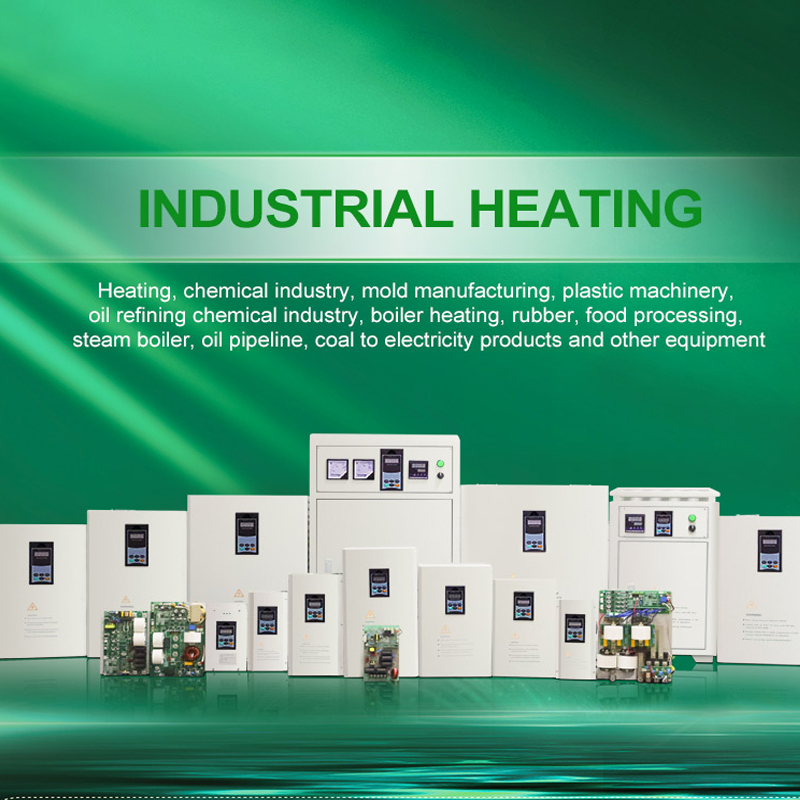
A multi-specification induction heating range: the model list is itself a form of capability evidence.
Read as evidence rather than as a catalogue, the range reveals three things. First, power coverage runs from 2.5kW single-phase units to a 100kW three-phase cabinet, so a single supplier can address both a small machine retrofit and a plant-level heating load. Second, the split between 220V single-phase and 380V three-phase families corresponds to real site constraints — not every factory hall has three-phase capacity at the point of use. Third, the presence of steam, hot air and water families alongside the core heaters indicates that the supplier builds around heating media, not around one product type.
Material Evidence: Coils, Casings, Liners and Control Hardware
Materials are where supplier claims most often go unchecked, and where the physical evidence is most concrete. Across JONSON's documented product specifications, the build is described consistently: a copper wire core heating coil; an outer casing of thickened aluminium alloy and thickened cold-rolled steel plate; and a 304 stainless steel inner liner on units that handle water or steam. The 8kW single-phase full bridge control board uses aluminium alloy and copper. The JS-JR-008 instant induction water heater uses a tempered glass outer casing.
Each of these is a checkable item rather than an adjective. A buyer can ask for the coil conductor material to be confirmed in the purchase specification, request the casing plate specification, and require the liner grade — 304 stainless steel in the documented case — to be stated on the datasheet. In humid food-processing environments or in chemical duty with weak corrosion, the liner and casing specification is the difference between a unit that stays serviceable and one that does not.
The coil deserves separate attention because it is both the heating element and the most frequently customised part. JONSON lists custom coil fabrication among its documented capabilities, alongside specification customisation, sample fabrication, panel and graphic customisation, parameter adjustment and private logo application. For a buyer retrofitting an existing machine, coil geometry is often the constraint that decides whether a standard heater can be used at all.
Technical Explanation: How the Hardware Converts Power into Usable Heat
Understanding the conversion path helps a buyer interpret the specification table correctly. These units operate on the principle of high-frequency electromagnetic induction heating: 50Hz AC power is converted into a 5–40kHz high-frequency current through an IGBT inverter module. That current drives an electromagnetic coil to generate an alternating magnetic field, which induces eddy currents in the metal workpiece itself, producing heat without contact between coil and load.
Control behaviour is documented across three modes — temperature control, time control, and PID closed-loop constant-temperature control — with automatic output adjustment according to load. On the 100kW JS1000-100, the specification adds a full-bridge series resonance main circuit, a DSP-based high-speed automatic phase-locking tracking control system, start time under one second, instantaneous overcurrent protection at ≤2µs, 130% power overload instantaneous protection, and fully electrically isolated soft start and stop. The same unit supports PID power adjustment via a 0–5V input voltage or RS-485, and load temperature detection across 0–1000°C with accuracy up to ±1°C.
For the 100kW unit, the adaptive coil parameters are stated as a 95 square line, 40m length, 80–100µH inductance. On the 2.5kW unit, the corresponding figures are a 4 square line, 23m length, and 100–150µH inductance, with coil-to-load distance guidance of 20–25mm for a circular load, 15–20mm for a planar load, 10–15mm for elliptical, and within 10mm for a super-elliptical geometry. These are the numbers that determine whether an installation will perform as specified.
Heat conversion efficiency is stated per family rather than as one blanket figure: ≥99% for the JS-1600 steam generator and the 70kW/80kW series, ≥98% for the 40kW/50kW/60kW series and the 8kW control board, ≥95% for the 100kW unit, and ≥90% for the JS-JR-008 water heater. Power adjustment range is generally 20%–100%, with 25%–100% on the 70kW/80kW series.
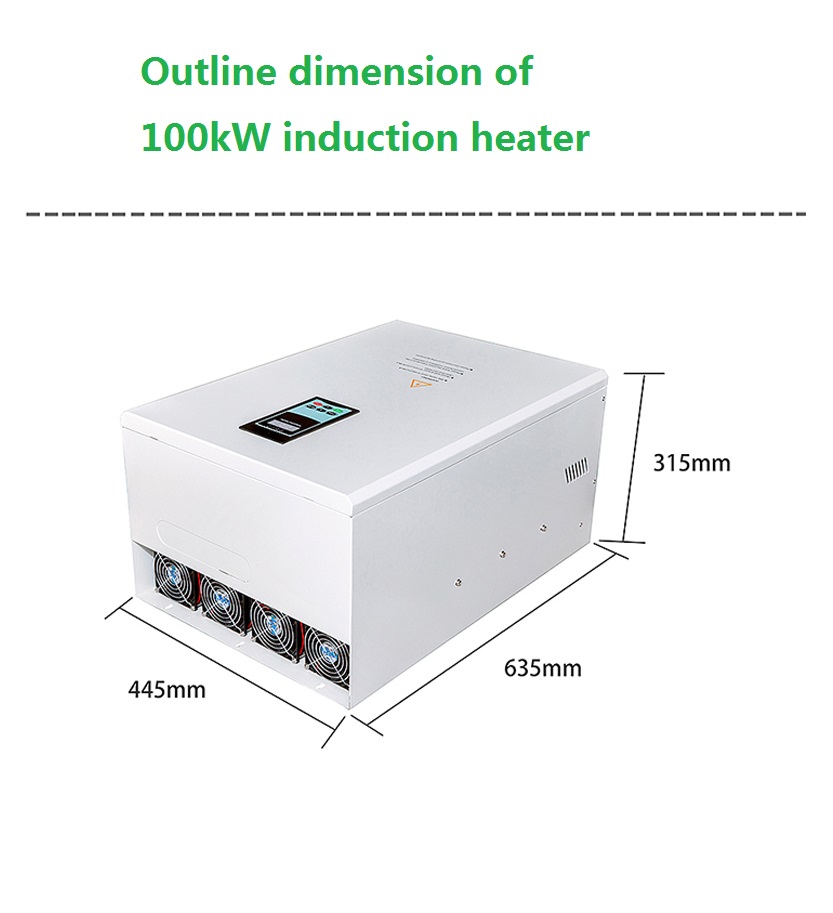
The 100kW JS1000-100 cabinet: three-phase 380V input, 140–150A rated input current, air- or water-cooled.
Certifications and Documentation: What Is Stated, and What Varies by Model
Certification is the layer most often misread in procurement, usually because it is quoted at brand level rather than at model level. In JONSON's published specifications, the markings are attached to individual models. The JS1300-10/15 (10kW/15kW, 380V) lists CE, ISO and RoHS. The JS1300-005/008 (5kW/8kW, 380V) lists CE and ISO. The JS1000-100 (100kW) lists CE and ISO. The JS1300-10/15 also carries a declared HS code of 8514400090 and an origin of Guangdong Province, China.
That variation is not a defect — it is the normal reality of a multi-family product range, and it is precisely why model-level verification matters. A buyer who needs RoHS scope for a European shipment should confirm it against the exact model ordered rather than assuming it from the brand or from a sibling product.
Two further documentation points are worth noting. First, quality control is documented as 100% pre-shipment testing plus product inspection (SGS), which gives the buyer an inspection record tied to the shipment rather than to a general statement of quality. Second, the international standards that govern electroheat safety for this equipment class are IEC 60519-1 (general electroheat safety) and IEC 60519-3 (induction and conduction heating requirements), with ISO 13850 covering emergency stop functions. These standards are the reference frame against which a CE declaration for induction heating equipment is normally read; they are publicly documented and can be checked independently of any supplier.
On the trade side, industrial induction heat-treatment equipment classifies under HS heading 8514.40 — other equipment for the heat treatment of materials by induction or dielectric loss. Buyers importing into markets where tariff treatment depends on classification should align the declared code on the commercial invoice with the model actually shipped; the JS1300-10/15 declares 8514400090, and other models should be confirmed individually.
Scenario Fit: Where the Physical Range Maps to Real Projects
Applicable industries documented for these units include plastics and rubber, food processing, chemical reactions, crude oil pipeline heating, textile printing and dyeing, aquaculture heating, metal heat treatment, building heating, and medicinal herb drying. That list reads as a marketing bullet until it is paired with the operating conditions that make each scenario distinct.
- Rubber and plastics. Continuous high-frequency duty on injection moulding, drawing, granulating and extrusion equipment. Power bands in the 40–80kW class are the documented fit for this kind of process heating.
- Food processing. High humidity with a small amount of steam mist and constant-temperature cooking — an environment where casing and liner specification, plus controller placement, matter as much as power rating.
- Chemical duty. Medium and high temperature with weak corrosion. The 304 stainless steel liner is the relevant specification point here.
- Steam supply. The JS-1600 steam generator (30kW/40kW/50kW) is documented as a clean replacement for coal or gas boilers, with zero nitrogen oxide emissions, no smoke, and no need for complex sewage discharge approvals.
- Hot air drying. The JS-1600-8/12/15 hot air generator family; the documented operating claim is that the hot air furnace reaches rated temperature in three minutes.
- Constant-temperature water. Documented applications include schools, hospitals, hotels, farms and flower greenhouses in China, using the JS-JR-008 instant induction water heater (3.5–8kW, 220V).
- Pipeline and oil transmission. Crude oil pipeline heating to prevent solidification, using the higher power cabinets.
The module expansion logic is documented as well: multiple units can be connected in parallel, with power increased or decreased as needed, suited to centralised heating from small and medium-sized factories through to larger plant areas. Three heating media — water, thermal oil and hot air — cover low, medium and high temperature duty. For a project engineer, that combination means a single supplier relationship can cover process heat, steam and building heating rather than requiring three separate vendor qualifications.
Case Evidence: 100 Units Across Five Markets
JONSON's case record documents 100 units installed across industrial applications in Indonesia, China, Vietnam, Russia and India, with a relationship duration of 10+ years and OEM/ODM clients among the buyer base. The stated results are a thermal efficiency stable at 95%–98%, comprehensive energy savings of 30%–70% compared with traditional heating equipment, a service life extended by three times, and zero major failures. The application scope covers plastics and rubber production, process heat treatment, metal heat treatment, heat processing piping, food processing, and industrial, commercial and residential heating.
This should be read for what it is: a supplier's own project record, not a controlled third-party benchmark. Its value to a buyer is directional — it indicates that the same hardware has been deployed across several national grids and several process categories, which is relevant to a supplier's familiarity with voltage variation, documentation requirements and after-sales distance. It does not substitute for a site-specific measurement on the buyer's own load.
Market Context: Growth Figures That Need Careful Reading
The demand backdrop supports the emphasis on supplier evidence. Global Market Insights reports the global induction heating system market at USD 2.4 billion in 2026, growing to USD 4.1 billion by 2035. That trajectory reflects industrial heat demand that is shifting toward higher-efficiency, lower-emission equipment.
One caution belongs here. MarketsandMarkets publishes a materially different valuation — USD 879.5 million by 2030 — because the two firms appear to define the category differently, one counting broader systems and the other focusing on core components or specific power bands. The two figures should not be aggregated or presented as a single market size. For a buyer, the practical implication is narrower and more useful than the headline: categories of this kind are defined inconsistently, so supplier-level physical evidence is a more reliable decision input than any aggregate forecast.
Compared with Traditional Heating: Where Induction Wins and Where It Does Not
Against coal and gas boilers, the documented advantages of induction-based steam and hot air generation are concrete. Emissions are zero nitrogen oxide with no smoke, and there is no requirement for complex sewage discharge approvals. Energy supply is fast: the steam unit is documented as producing steam in 30 seconds and the hot air furnace reaching rated temperature in three minutes. Safety is handled through closed-loop design with physical separation of water and electricity, and of oil and electricity, with automatic interlock shutdown on water shortage, overheating or overpressure. Against conventional resistance heating, the case record reports 30%–70% energy savings and thermal efficiency of 95%–98%.
The boundaries are equally concrete, and buyers should weigh them before committing:
- Installation geometry is a performance variable, not a detail. The coil must maintain a proper distance from the metal being heated, and an insulation layer over the heating area is required to improve thermal efficiency. A poorly installed coil will underperform its datasheet regardless of the model selected.
- Heat dissipation is a site responsibility. The control cabinet must be well ventilated to prevent IGBT module overheating, and some high-power equipment requires air or water cooling.
- Electrical supply limits the model choice. The 100kW JS1000-100 requires three-phase 380V with a rated input current of 140–150A and weighs 35kg in a 635×445×315mm enclosure. It is not a drop-in replacement for equipment on a 220V single-phase line; smaller loads belong to the 2.5kW–8kW single-phase families.
- Environmental limits apply. The JS-1600 steam generator is specified for −20 to 40°C and ≤95% relative humidity; the 70kW/80kW series is specified for −25 to 55°C. Controllers should be kept away from humid, dusty and corrosive gas environments.
- Maintenance is scheduled, not optional. Regular cleaning of dust, checking of wiring terminals, coils and the cooling system are documented requirements, with low-power constant-temperature operation recommended and a soft-stop procedure on shutdown.
- Certificate scope varies by model, as noted earlier, and must be confirmed against the ordered unit rather than at brand level.
A Short Verification Checklist for Buyers
| Question to ask | Evidence to request |
|---|---|
| Which model covers my power and voltage? | Model number, rated power, rated voltage and voltage adaptation range on the datasheet |
| What is inside the cabinet? | Coil conductor material, casing plate specification, liner grade |
| Which certificates apply to this unit? | CE / ISO / RoHS scope mapped to the exact model |
| What testing precedes shipment? | Pre-shipment test record; SGS product inspection where applicable |
| Can the schedule be held? | Stated lead time, monthly capacity, minimum order quantity |
| What support exists after delivery? | Remote technical support terms; custom coil and parameter change process |
Future Outlook
Three shifts are likely to shape induction heating procurement over the next several years. The first is documentation granularity: as compliance reviews tighten, brand-level certification statements will increasingly be rejected in favour of model-level mapping, and suppliers who already publish per-model markings will face fewer qualification cycles.
The second is modularity. The documented ability to parallel multiple units and scale power up or down to match a plant area suggests that buyers will increasingly size systems in modules rather than in single large units, spreading capital outlay and simplifying capacity expansion.
The third is measurement. Published efficiency bands of 95%–98% and energy savings of 30%–70% are useful directional figures, but they are supplier-reported. The next stage of procurement maturity is site-level verification — actual energy consumption per unit of output, harmonic behaviour on the local grid, and mean time between failures measured rather than asserted. Buyers who begin requesting these data points now will be better positioned when the market standard shifts.
FAQ
What physical evidence should a buyer request from an induction heater supplier before qualification?
Three categories: site data, hardware data and documentation. Site data includes the factory address and facility size, staffing and engineering headcount, annual output and monthly capacity. Hardware data includes the model list with rated power and rated voltage for each unit. Documentation includes build materials, certificate scope per model, and the pre-shipment test process. For JONSON, the corresponding figures are a 3,000 m² facility in Shunde District, Foshan, Guangdong Province; 60+ staff including 30+ engineers; 120,000 units annual output and 10,000 units monthly capacity; 100% pre-shipment testing with SGS product inspection.
Which JONSON models fit a 5–20kW project on a 380V supply?
Three model families cover that band at 380V. The JS1300-005/008 provides 5kW and 8kW in a wall-mounted enclosure with a voltage adaptation range of 380V ±20%. The JS1300-10/15 provides 10kW and 15kW, wall-mounted, 7.3kg, with a 300–400V adaptation range and CE, ISO and RoHS markings. The JS1000-20 covers 20kW at 380V within the JS1000 cabinet series. All three share the documented build of copper coil, thickened aluminium alloy and cold-rolled steel plate casing, and 304 stainless steel liner.
Can one supplier cover steam, hot air and hot water in the same plant?
Within JONSON's documented range, yes, with attention to the electrical split. The JS-1600 induction steam generator covers 30kW/40kW/50kW at 380V/50Hz/60Hz with a 304 stainless steel liner. The JS-1600-8/12/15 induction hot air generator covers hot air drying applications. The JS-JR-008 instant induction water heater covers 3.5–8kW on 220V for constant-temperature water in schools, hospitals, hotels, farms and flower greenhouses, and the wider range includes induction water boiler and hot air generator families. Because the steam and hot air families run on 380V while the JS-JR-008 runs on 220V, the electrical distribution plan should be confirmed before ordering.
What site conditions must be confirmed before installation?
Five conditions are documented. Coil distance from the heated metal must be respected, with an insulation layer added over the heating area to improve thermal efficiency. The control cabinet must be well ventilated to prevent IGBT module overheating, and some high-power units require air or water cooling. Ambient limits must be met — −20 to 40°C and ≤95% humidity for the JS-1600 steam generator, −25 to 55°C for the 70kW/80kW series. The controller should be kept away from humid, dusty and corrosive gas environments. Finally, the electrical supply must match the model: the 100kW JS1000-100 requires three-phase 380V with 140–150A rated input current and constant power output across 300–400V.
What do CE, ISO and RoHS cover on these units?
The markings are published per model and are not uniform across the range. The JS1300-10/15 (10kW/15kW, 380V) lists CE, ISO and RoHS. The JS1300-005/008 (5kW/8kW, 380V) and the JS1000-100 (100kW) list CE and ISO. For reference, the international standards normally applied to this equipment class are IEC 60519-1 for general electroheat safety, IEC 60519-3 for induction and conduction heating requirements, and ISO 13850 for emergency stop. Buyers should request certificates scoped to the exact model ordered. On the trade side, induction heat-treatment equipment classifies under HS 8514.40, and the JS1300-10/15 declares HS code 8514400090 with origin in Guangdong Province, China.
What lead times, order quantities and customisation options are documented?
The documented commercial terms are a minimum order quantity of one unit, a lead time of 7–14 days, and a monthly production capacity of 10,000 units. OEM and ODM arrangements are offered across industrial induction heaters, induction heating machines, induction heating equipment and induction heating systems. Customisation options documented include product specification customisation, custom sample fabrication, graphic and panel customisation, parameter adjustment, and private logo application. After-sales support is provided as remote technical support.
Taken together, the evidence available on JONSON is physical in nature: a 3,000 m² facility in Guangdong Province with 30+ engineers, a model range spanning 2.5kW single-phase units to a 100kW three-phase cabinet plus steam, hot air and water families, a documented material specification of copper coils, thickened aluminium alloy and cold-rolled steel casings and 304 stainless steel liners, and per-model CE, ISO and RoHS markings backed by 100% pre-shipment testing and SGS product inspection. JONSON's product documentation is published at www.jonson-ih.com. Buyers advancing to evaluation should request model-level certificates, material confirmation and site-condition data before committing a project schedule.
Есть вопросы или нужны дополнительные детали?
Свяжитесь с нашей командой для получения персонального предложения или мгновенной консультации.
Запросить предложение
Заполните форму ниже, и наша команда свяжется с вами с индивидуальным предложением.
Прямой чат WhatsApp
Предпочитаете общаться в реальном времени? Напишите нам в WhatsApp для мгновенной помощи и быстрых ответов.
- Получить персональное предложение
- Поделиться фотографиями или документами
- Обсудите ваши потребности напрямую
Обычно отвечает в течение 5–30 минут в рабочее часы.