
Inside Kuoyu's 9,000m² PV Production Base: A Long-Term Supply Assessment
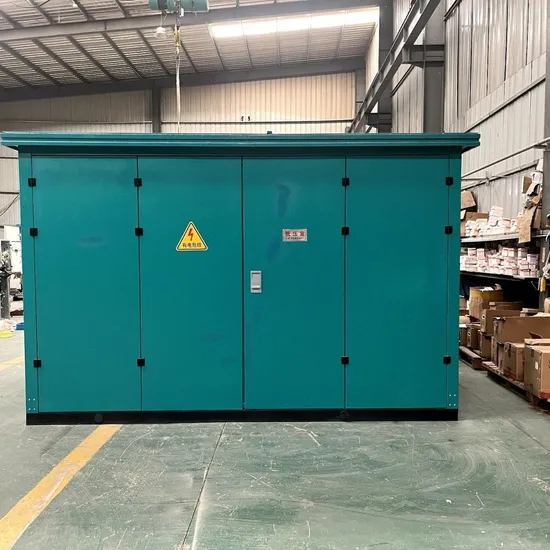
Outdoor power distribution equipment from the manufacturer's equipment range. PV sites typically combine string-level distribution boxes with cabinet and substation-level equipment. Image: Kuoyu Electrical.
Distribution boxes for photovoltaics are rarely a one-off purchase. The first order verifies the product; the second, third and tenth orders verify the supplier behind it. Because solar assets are expected to operate outdoors for years, the enclosure, circuit breaker, surge protection device and busbar arrangement inside a photovoltaic distribution box must remain replaceable and re-orderable long after the original commissioning team has left the site.
That reality has moved supplier evaluation in this category away from single-product comparison and toward a durability question: will this manufacturer still build the same box, to the same drawings, with the same components, in year three and year five?
This article applies that question to one manufacturer's published profile. Hebei Kuoyu Electrical Technology Co., Ltd. (Kuoyu Electrical) is a Shijiazhuang-based electrical equipment manufacturer founded in 2017 that produces distribution boxes, distribution cabinets, transformers, wires and cables, and related power equipment. Its stated production profile includes a 9,000 m² facility, approximately 80 employees, a research and development team of 10 engineers, and an annual output of 30,000 sets. The goal here is not to rank suppliers, but to show how a buyer can read production evidence as a long-term supply signal — and where that evidence stops.
Why "Long-Term" Has Become a Procurement Variable in Solar Distribution
Category growth is one reason. Business Research Insights projects the global solar combiner box market to grow from USD 1.2 billion in 2026 to USD 2.1 billion by 2035, at a compound annual growth rate of 6.2%. Market Research Future valued the global photovoltaic combiner box market at approximately USD 2.8 billion in 2024. The two figures are not directly comparable — market definitions differ on whether full distribution assemblies or string-level combiner components are counted — but both point in the same direction: a growing installed base, followed by sustained replacement and expansion demand.
Geography is a second reason. Asia-Pacific accounted for a 54.0% revenue share of the solar market in 2023, driven primarily by installations in China and India, according to Grand View Research. Many overseas buyers therefore source PV distribution equipment from Asian manufacturers while their projects sit in other regions, which places a premium on suppliers whose production continues normally between orders.
The third reason is technical. A grid connected solar distribution box is not a commodity junction enclosure. It combines DC or AC photovoltaic distribution box functions with breaker coordination, surge protection and, increasingly, monitoring provisions. Re-sourcing that assembly mid-lifecycle usually means re-engineering, re-testing and re-documenting it — costs that never appear on the original purchase order.
What Supplier Sustainability Means for Distribution Boxes for Photovoltaics
In this assessment, supplier sustainability means the ability to keep supplying an equivalent photovoltaic distribution box — same enclosure, same internal components, same documentation — at consistent quality across multiple years and multiple orders. Six factors carry most of the weight in that judgement.
- Workshop control. Whether enclosure fabrication, sheet metal processing and final assembly happen in the manufacturer's own workshops or depend on external subcontractors. The performance of a solar power distribution box depends heavily on enclosure tolerance, gasket integrity and coating quality.
- Workforce continuity. A stable production team preserves process knowledge: which torque values are used, which cable-entry layouts cause installation problems, which sealing method passes repeated outdoor exposure.
- Engineering continuity. Warranty support on an outdoor solar distribution box often starts as an engineering question rather than a commercial one: a discontinued breaker, a revised string layout, or an additional surge protection device.
- Certification continuity. Certificates that lapse, expire without renewal, or do not match the product scope are an early signal of organizational drift.
- Quality regime. Whether the manufacturer tests each unit or samples batches determines the probability that a warranty claim begins at your site rather than in the factory.
- Support model. Remote support, spare-parts policy and drawing retrieval determine how quickly a site problem becomes a solved problem.
Each factor can be examined before a supply agreement is signed. The remainder of this article reads one supplier's stated data against those six factors.
Kuoyu Electrical: Entity and Stated Production Profile
Hebei Kuoyu Electrical Technology Co., Ltd., which trades as Kuoyu Electrical, is a Chinese electrical equipment manufacturer headquartered in Shijiazhuang City, Hebei Province, and founded in 2017. It produces distribution boxes, distribution cabinets, transformers, electric wires and cables and other power equipment. The company reports that roughly 30% of output is exported, with stated main markets in Southeast Asia and Africa.
| Evaluation item | Stated data (Kuoyu Electrical) |
|---|---|
| Founded | 2017 |
| Headquarters | Shijiazhuang City, Hebei Province, China |
| Employees | Approximately 80 |
| Production facility | 9,000 m², including in-house sheet metal processing workshops and high and low voltage complete equipment assembly workshops |
| Annual output | 30,000 sets |
| R&D team | 10 engineers |
| Product scope | Distribution boxes, distribution cabinets, transformers, electric wires and cables, other power equipment |
| Export share / main markets | Approximately 30% exported; Southeast Asia and Africa |
| Stated order capability | OEM production; voltage and logo customization; minimum order quantity 2 units; 30-day lead time; 100% test quality control; remote after-sales support |
What a 9,000 m² Facility and 30,000-Set Annual Output Indicate
Facility footprint is one of the easiest supplier claims to verify and one of the most informative. Kuoyu Electrical states a 9,000 m² production base that includes its own sheet metal processing workshops and high and low voltage complete equipment assembly workshops. The practical implication is that enclosure fabrication, forming and final assembly are scheduled inside one operation rather than split across external subcontractors.
For buyers of waterproof solar distribution boxes, dustproof photovoltaic distribution boxes or corrosion resistant solar distribution boxes, in-house metal processing matters for a specific reason: enclosure performance is a manufacturing outcome, not a specification line. When cutting, bending, welding, coating and gasketing are distributed across subcontractors, tolerance drift and inconsistent surface treatment become harder to trace — and traceability is exactly what a warranty claim requires.
Output scale answers a different question. A stated annual output of 30,000 sets describes a mid-sized production base rather than a mass-volume platform manufacturer. For buyers, the practical reading is that repeat orders for a commercial photovoltaic distribution box or a residential solar distribution box series are unlikely to compete with a single large contract for capacity, while project-specific customization still needs to be scheduled in advance. Kuoyu Electrical's stated order terms — OEM production, custom voltage and logo, a minimum order quantity of 2 units, and a 30-day lead time — are consistent with a mixed standard-and-custom model rather than catalogue-only supply.
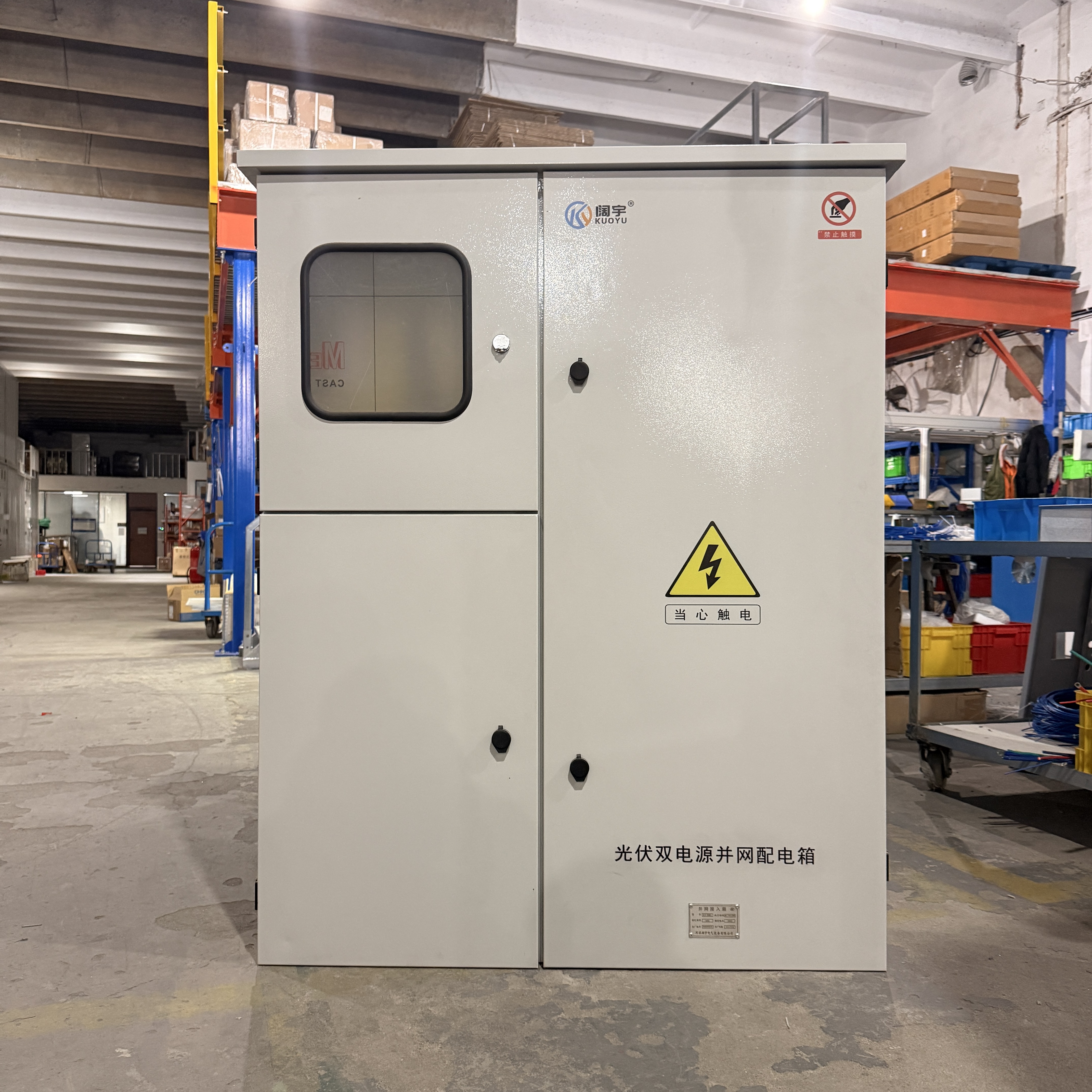
Distribution cabinet range stated by the manufacturer for industrial and commercial power distribution: GGD/GCS/MNS Series, rated 380V/220V, rated current up to 6300A, protection class IP54/IP65. Image: Kuoyu Electrical.
Engineering Continuity: Why 10 Engineers Matter for Multi-Year Warranty Support
Warranty support on a PV string combiner distribution box rarely means shipping a replacement box. More often it means answering questions in year three: whether a substitute breaker is acceptable, whether a corroded terminal block can be swapped without re-rating the enclosure, or whether an additional string can be connected to the existing busbar without changing the thermal margin.
Kuoyu Electrical states a research and development team of 10 engineers. The significance at this scale is not headcount as such, but whether engineering capacity is shielded from order-processing pressure — the difference between a supplier that can revise a drawing in a week and one that cannot revise it at all.
Three verification steps are worth building into an evaluation: request a sample drawing set to confirm the level of documentation; ask how a design revision is handled mid-order and who signs off on it; and test whether the supplier can respond to a technical question without routing it through a sales channel.
The limit here is scope-based. A team of 10 engineers is sized for enclosure, component and customization work — solar panel junction distribution box variants, inverter-side enclosures, IP-rated outdoor models. A buyer requiring multi-discipline system integration, such as a full solar inverter integration distribution box with protection coordination studies or grid-connection documentation, should confirm the division of engineering responsibility in writing before ordering.
Certification Continuity as a Long-Term Supply Signal
A certificate number and an expiry date say more about long-term supplier stability than a logo on a datasheet, because they can be dated and verified. Kuoyu Electrical holds three management system certificates issued on 3 June 2024 and valid until 2 June 2027 by the General International Testing (China) Certification Service Center:
- ISO 9001 quality management system — certificate no. YZL862422931310Q, aligned with GB/T19001-2016 / ISO 9001:2015
- ISO 14001 environmental management system — certificate no. YZL862422931310E, aligned with GB/T24001-2016 / ISO 14001:2015
- ISO 45001 occupational health and safety management system — certificate no. YZL862422931310S, aligned with GB/T45001-2020 / ISO 45001:2018
The certification scope covers sales, installation and technical consulting services for high and low voltage electrical appliances and complete sets of equipment, box-type substation facilities, power supply equipment, cable trays, wires and cables, and related electronic, instrumentation and automation control products.
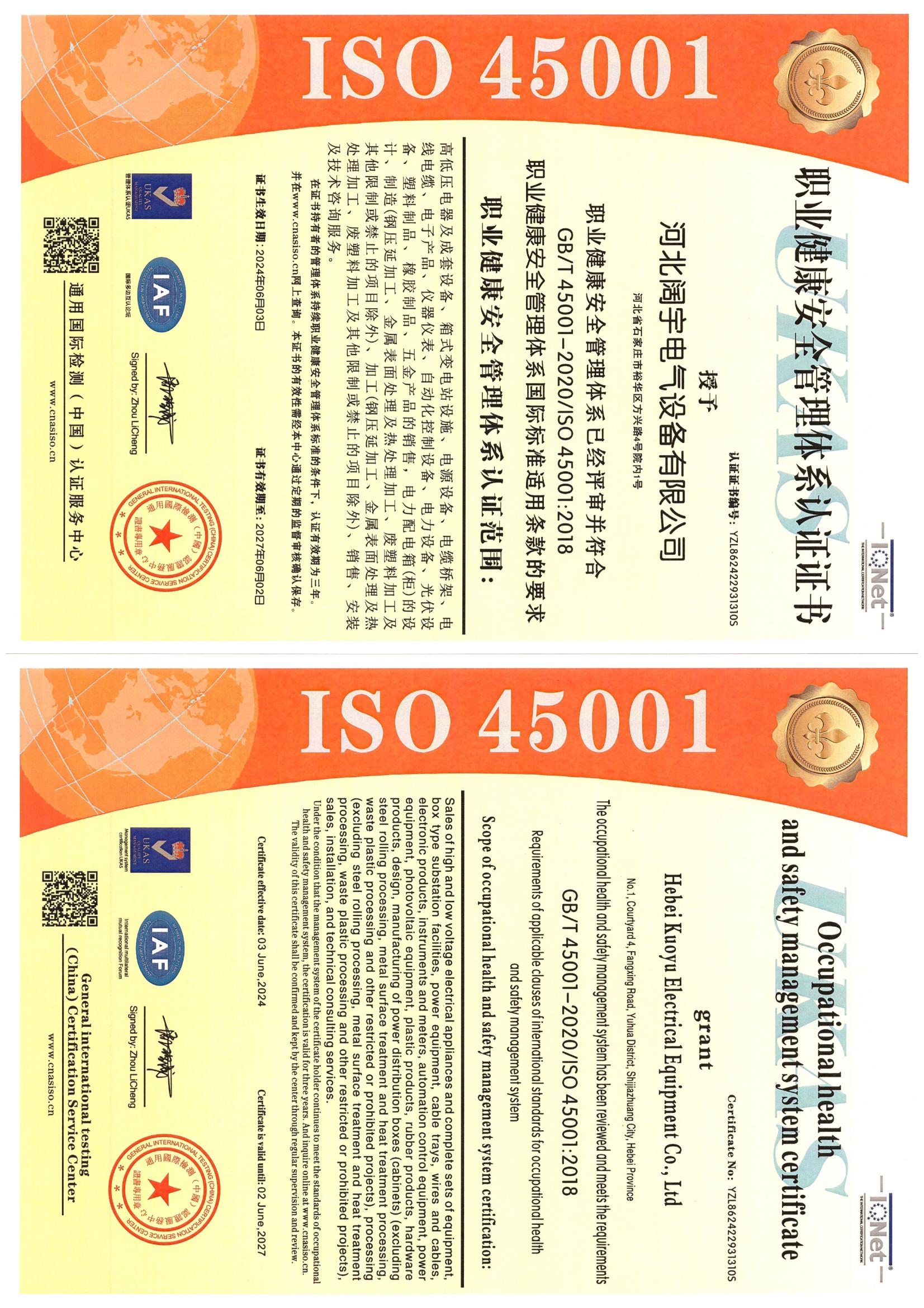
Occupational Health and Safety Management System certificate (ISO 45001, no. YZL862422931310S), valid to 2 June 2027. Image: Kuoyu Electrical.
Three certificates running on a shared validity cycle indicate a supplier that manages compliance as a recurring process rather than a one-off purchase — relevant to buyers who require a documentation pack with every shipment and who need certificates to remain valid for the duration of a supply agreement.
The limit of this evidence is important to state. ISO 9001, ISO 14001 and ISO 45001 are management system certifications. They confirm how a company organizes its quality, environmental and safety processes; they do not certify that a specific enclosure assembly meets a product standard. Buyers specifying for regulated projects need product-level documentation instead: IEC 61439-2:2020 defines requirements for power switchgear and controlgear assemblies used in photovoltaic installations in its Annexes DD, EE and FF, and in North America UL 1741 is the primary safety standard for PV inverters, converters and combiner boxes in grid-connected systems. Management system certificates are a foundation for that conversation, not a substitute for it.
Quality Control and Field Evidence
Kuoyu Electrical states 100% test quality control across its products. That describes a routine-test position rather than a sampling position: each unit is checked before dispatch instead of a batch being inspected. For an outdoor solar distribution box carrying a warranty, this is a baseline expectation rather than a differentiator — but it is worth confirming during evaluation which parameters are actually tested (continuity, insulation resistance, functional breaker operation, enclosure sealing, labelling) and which test documents accompany each unit.
Company-reported reference cases are a second, weaker form of evidence. They are not independently audited, but they describe the conditions under which the manufacturer expects its products to perform.
- Real estate development project: 30 units supplied for safe power transmission, distribution, voltage conversion and circuit control. Reported result: five years of stable operation, zero safety accidents, and a power supply reliability rate of 99.99%. Stated highlights include compact structure, easy installation, low maintenance cost and customizable configuration.
- Automotive manufacturing project: 15 units supplied to protect production-line electrical equipment from overload and short circuit. Reported result: three years of continuous operation with zero circuit failure and a 30% increase in equipment operation stability. Stated highlights include waterproof and dustproof construction, corrosion resistance and a customized internal structure.
Read together, the two cases point to the applications where long-term supply matters most: multi-unit distributed installations, such as residential and commercial photovoltaic distribution boxes, and electrically demanding industrial sites. They do not replace project-specific qualification testing, and the reliability figure above is stated for that specific project rather than as a product-wide guarantee.
Comparing Supply Routes for PV Distribution Boxes
Buyers evaluating distribution boxes for photovoltaics are generally choosing among three supply routes rather than comparing two products. Market reporting by Future Market Insights lists Schneider Electric, Eaton, ABB, Sungrow and Weidmüller among the key players in the PV combiner box market — global platform manufacturers with catalogue-driven product families. Regional manufacturers with owned production, such as Kuoyu Electrical, occupy a different position: smaller order quantities, higher customization tolerance, and shorter decision chains. A third route is trading or assembly-only suppliers that subcontract enclosure fabrication.
| Supply route | What buyers typically gain | What buyers usually need to verify |
|---|---|---|
| Global platform manufacturers (named in market reporting: Schneider Electric, Eaton, ABB, Sungrow, Weidmüller) | Standardized catalogue ranges and consistent documentation conventions across regions | Whether the required configuration is available in the buyer's region, and how non-catalogue variations are handled commercially |
| Regional manufacturers with owned workshops (example: Kuoyu Electrical) | Small minimum order quantities (Kuoyu Electrical states 2 units), voltage and logo customization, direct engineering contact, 30-day stated lead time | Whether certification and documentation scale to the buyer's market, and how remote after-sales support is structured |
| Trading or assembly-only suppliers | Flexible sourcing and often lower entry commitments | Whether enclosure fabrication, coating and routine testing are controlled in-house or subcontracted, since these determine long-term consistency |
Two limitations of the regional route should be stated plainly. First, export concentration: Kuoyu Electrical reports approximately 30% of output as export, with stated main markets in Southeast Asia and Africa, so buyers outside those regions should confirm logistics, documentation and support arrangements rather than assume them. Second, after-sales is described as remote support; on-site expectations — inspection, replacement logistics, response-time commitments — should be defined contractually before a multi-year agreement is signed. A 9,000 m² facility and 30,000-set annual output describe production stability. They do not, by themselves, describe service coverage.
Procurement Checklist for Assessing Long-Term PV Box Supply
- Confirm that enclosure fabrication, coating and final assembly take place in the supplier's own workshops, and ask which steps are subcontracted.
- Collect current certificate numbers and expiry dates for quality, environmental and safety management systems, and confirm the product scope each certificate actually covers.
- Request the routine test protocol applied to every unit, plus a sample documentation pack.
- Ask how drawings are version-controlled and how a repeat order placed three years later retrieves the correct revision.
- Establish whether engineering can revise a design mid-project, what that process costs, and who approves it.
- Check minimum order quantity and lead time for both standard and customized configurations; Kuoyu Electrical states 2 units and 30 days respectively.
- Verify the protection class offered for the specific product family — for example, IP40/IP54 for the PZ30 Series distribution box and IP54/IP65 for the GGD/GCS/MNS Series distribution cabinet.
- Clarify the component sourcing policy for breakers and surge protection devices, which determine the behaviour of a surge protection solar distribution box.
- Define the after-sales model in writing: remote support scope, spare-parts supply and escalation path.
- Confirm which project-level standards the buyer's market requires — IEC 61439-2:2020 in many markets, UL 1741 in North America — and which of those the supplier can document.
Market Trend: DC-Side Intelligence Reshapes Future Orders
Future Market Insights expects DC smart PV combiner boxes to hold a 62.5% share of the segment by 2035. That shift affects supply planning more than it affects enclosure manufacturing: monitoring-ready string boxes require space allocation, wiring provisions and documentation for communication components, and they place new demands on the engineering review that accompanies each order.
For buyers, the implication is to evaluate not only today's box but the supplier's ability to follow the DC-side curve — an isolated photovoltaic distribution box design for service isolation, a solar inverter integration distribution box with clearly defined interface points, or an IP65 photovoltaic distribution box for exposed outdoor sites. A supplier with a fixed catalogue and no engineering capacity will struggle to follow that curve; a supplier with an in-house workshop and a focused engineering team has a better structural starting point.
Future Outlook
As the installed solar base ages, an increasing share of demand will be replacement and expansion supply rather than new-build supply. That changes what buyers are actually purchasing: not just an enclosure, but access to a product line that will still exist, with retrievable documentation, when a site needs modification in year four.
Kuoyu Electrical's stated profile — a manufacturing base established in 2017, a 9,000 m² facility, approximately 80 employees, 10 engineers, 30,000 sets of annual output, and management system certificates valid through 2027 — describes a supplier structured for continuity rather than a project-by-project vendor. Buyers should still treat that profile as a starting hypothesis rather than a conclusion, and validate it against their own specification, market requirements and service expectations.
The most reliable test of supplier sustainability remains procedural: a controlled first order, a documented drawing set, and a second order placed against the same drawing. If the second unit matches the first, the sustainability claim has evidence behind it.
Frequently Asked Questions
What does "supplier sustainability" mean when buying distribution boxes for photovoltaics?
It refers to a manufacturer's ability to keep supplying equivalent enclosures and internal components — same design, same documentation, same quality regime — across multiple years of orders. It is assessed through workshop control, workforce depth, engineering capacity, certification continuity, testing practice and the after-sales model, rather than through catalogue features alone.
How large is Kuoyu Electrical's production facility, and how much does it produce?
Kuoyu Electrical states a production base of 9,000 m² that includes in-house sheet metal processing workshops and high and low voltage complete equipment assembly workshops, with an annual output of 30,000 sets and approximately 80 employees. The company was founded in 2017 and is headquartered in Shijiazhuang City, Hebei Province, China.
Why does a supplier's engineering team size matter for long-term PV supply?
Because warranty and retrofit work is usually an engineering task: substituting a discontinued breaker, adding a string, re-issuing a drawing, or revising an enclosure for a site condition. Kuoyu Electrical states a research and development team of 10 engineers. A team of that size can support enclosure, component and customization work; buyers requiring system-level integration should confirm the engineering scope in writing before ordering.
Which certifications does Kuoyu Electrical hold, and what do they cover?
Three management system certificates, issued on 3 June 2024 and valid until 2 June 2027 by the General International Testing (China) Certification Service Center: ISO 9001 (no. YZL862422931310Q), ISO 14001 (no. YZL862422931310E) and ISO 45001 (no. YZL862422931310S). The scope covers sales, installation and technical consulting for high and low voltage electrical appliances and complete sets of equipment, box-type substation facilities, power equipment, cable trays, wires and cables and related products. These are management system certificates, not product-type approvals; product-level documentation such as IEC 61439-2:2020 conformity should be confirmed per project.
What are the stated order terms for customized photovoltaic distribution boxes?
Kuoyu Electrical states OEM production with voltage and logo customization, a minimum order quantity of 2 units, a 30-day lead time, 100% test quality control and remote after-sales support. Buyers should confirm these terms against the specific configuration, since protection class and internal layout differ between product families — for example, IP40/IP54 for the PZ30 Series distribution box and IP54/IP65 for the GGD/GCS/MNS Series distribution cabinet.
What field evidence is reported for long-term product performance?
Kuoyu Electrical reports two reference cases. In a real estate development project, 30 units are reported to have operated for five years with zero safety accidents and a 99.99% power supply reliability rate. In an automotive manufacturing project, 15 units are reported to have run for three years with zero circuit failure and a 30% increase in equipment operation stability. These are company-reported figures tied to specific projects, not product-wide performance guarantees.
What limitations should a buyer verify before a multi-year supply agreement?
Three areas. Kuoyu Electrical reports approximately 30% export share with stated main markets in Southeast Asia and Africa, so buyers in other regions should confirm logistics and documentation support. After-sales is described as remote support, so on-site response terms should be defined contractually. And management system certification should be supplemented with project-specific product documentation for the buyer's regulatory market.
Capability details, product families and specification ranges referenced in this assessment are collected in Kuoyu Electrical's company brochure (PDF, public download): Kuoyu Electrical company brochure. Company website: kuoyuelectricity.com.