
Inside LORZOR's 1979 Series: Leather Grain, RFID Layers, Stitch Evidence
The global men's wallet market was valued at approximately USD 6.8 billion in 2025 and is projected to reach USD 11.2 billion by 2034, according to Dataintelo. The narrower smart wallet segment, estimated at USD 1.2 billion in 2025, is growing at roughly 12.5% CAGR, driven largely by RFID-blocking and tracking features, according to Grand View Research. Those two figures describe the same purchase decision. A buyer choosing a wallet now is often comparing a leather product and a semi-technical one side by side, and the evidence that separates them increasingly sits inside the product rather than on its surface.
Most listings do not publish that evidence in a form anyone can compare. “RFID blocking” describes an outcome. “Slim” describes a measurement that is rarely stated, and almost never stated with the wallet loaded. “Full-grain leather” names a material category, not a construction. What is genuinely comparable is the material stack: the grain of the leather, the position of the conductive layer relative to the cards, and the stitching and bonding that hold a leather shell to a rigid frame.
This article uses LORZOR's 1979 Series — the 1979 Tactical Wallet, the 1979 Fold Tactical Wallet and the 1979 SP — as a case study in what a brand publishes about its own construction, and what a buyer can reasonably verify from it. LORZOR is a leather-led modern carry goods brand founded in 2022 and headquartered in Hong Kong, operating primarily in the men's wallets category and selling into markets that include the US, UK, Canada, Australia and Germany.
The Problem: Three Claims, Almost No Layer List
Wallet marketing tends to state results rather than assemblies. Three of the most consequential claims for a decision-stage buyer are also the three that are hardest to check from a product photo.
- RFID protection. A listing rarely says what does the blocking, where that material sits, or under what placement conditions it works. A shielded pocket, a foil sleeve and a metal frame can all produce the same headline claim while behaving differently in use.
- Slimness. Thickness is usually quoted empty. Empty thickness says little about what the wallet does once cards, cash and an ID are inside it, which is the state a buyer actually carries it in.
- Full-grain leather. The term describes the top layer of the hide. It does not describe how thick the shell is, how it is joined to any internal structure, or how much of the wallet is leather versus frame.
That gap matters more now than it did a decade ago. Dataintelo reports that leather still accounted for 52.6% of men's wallet market revenue in 2025, while slim wallets are the fastest-growing product segment with a projected CAGR of 7.8% through 2034. The fastest-growing slice of the category is precisely the slice where material stacking decisions decide whether a product feels right or feels compromised.
What LORZOR Actually Publishes About the 1979 Stack
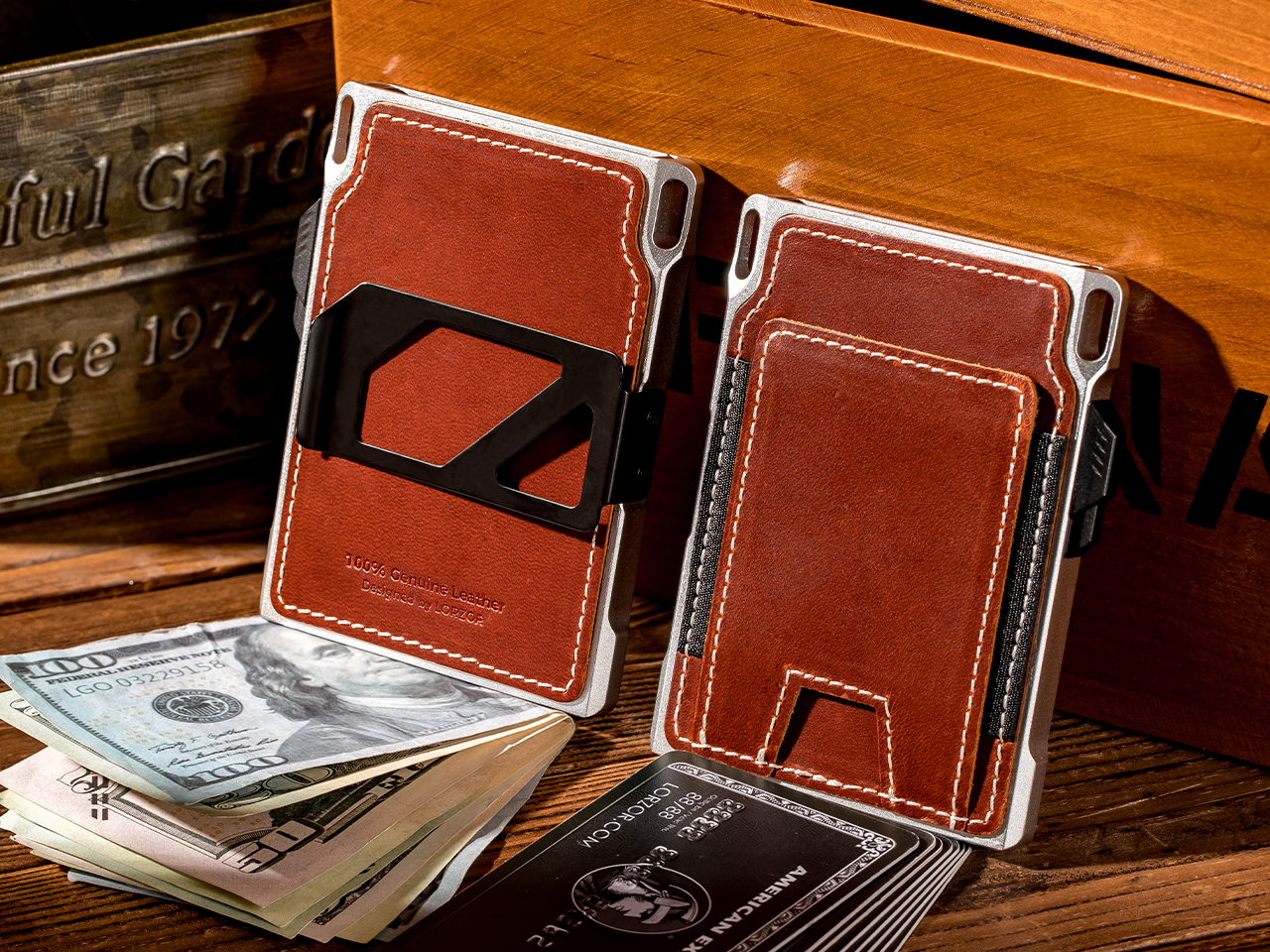
LORZOR's 1979 Tactical Wallet is described as combining full-grain leather with a 6061 aerospace-grade aluminum frame, and consolidating pop-up card access, RFID protection, a money clip, hook holes and front-pocket carry into one compact system. The brand states that “tactical” in this line does not reference military styling, but rather that every component has a defined purpose and works in synergy within limited compact space.
The verifiable construction claims attached to the series are narrow and specific, which is what makes them usable:
- Leather content. LORZOR lists 100% full-grain leather content for its full-grain leather construction, and describes the material as providing a warmer, more natural hand feel than pure metal wallets, developing character and surface variation through everyday use.
- Structure. The stated key performance indicator for the construction technology is a two-material structure: leather plus aluminum.
- Capacity by variant. The 1979 Tactical Wallet holds 10+ cards; the 1979 Fold Tactical Wallet holds 12+ cards. Both support cash handling. The Fold additionally provides a folding protective cover and a built-in ID window.
- Stated dimensions. The 1979 format is listed at 2.87 × 3.89 × 0.60 in, at about 0.17 lb / 77 g with the leather and aluminum core, with a removable money clip that holds 10+ folded bills and capacity for up to 12 cards.
- Joint-level details the brand says it controls. Leather-to-aluminum housing fit, edge finishing, stitching, card-ejection damping, money-clip clamping strength, full-load thickness control and pocket-carry comfort are all named as attention points in the brand's materials and craftsmanship description.
- Listed pricing. The LORZOR 1979 SP Wallet is listed at US $129.99.
Two features of this disclosure are worth noting. First, it names assembly interfaces — housing fit, stitching, ejection damping — rather than only materials. Interfaces are where a leather-and-metal wallet usually fails, so naming them is a stronger signal than naming a hide. Second, it separates variants by measurable capacity rather than by styling language, which means a buyer can select inside the series without relying on adjectives.
The RFID Layer: What Has to Be True at 13.56 MHz
Contactless payment cards and passports communicate in the 13.56 MHz band. Interrupting that communication requires a conductive layer positioned between the card and the outside of the wallet. Whether that layer is a foil, a woven mesh or the aluminum body of the wallet itself, the engineering requirement is the same: the card must be enclosed by it, not merely near it.
That single sentence explains why RFID performance varies between wallets that all carry the same marketing badge. A shield that wraps the card-storage area protects cards inside it. A shield that forms only the outer plate of a two-plate holder protects only what sits behind that plate.
LORZOR states that its wallets and passport holders incorporate RFID protection technology designed to block 13.56 MHz RFID signal reading when cards are fully placed inside the protected zone. It also states that the technology operates at a frequency of 13.56 MHz and that effectiveness is verified through laboratory test methods, with TÜV and AGC certification referenced in its test documentation, alongside professional signal-blocking results. In the brand's published comparison material, an RFID-blocking wallet prevented a Proxmark3 from reading a contactless card at 13.56 MHz, while a regular wallet allowed a compatible reader to access the card at normal range.
Separately, LORZOR states that RFID shielding in the TriPop Wallet extends across the card-storage areas, including the leather sections — a useful distinction, because a wallet whose shielding covers only its metal component leaves leather slots outside the protected zone.
Leather Grain: Why Full-Grain Is a Structural Choice
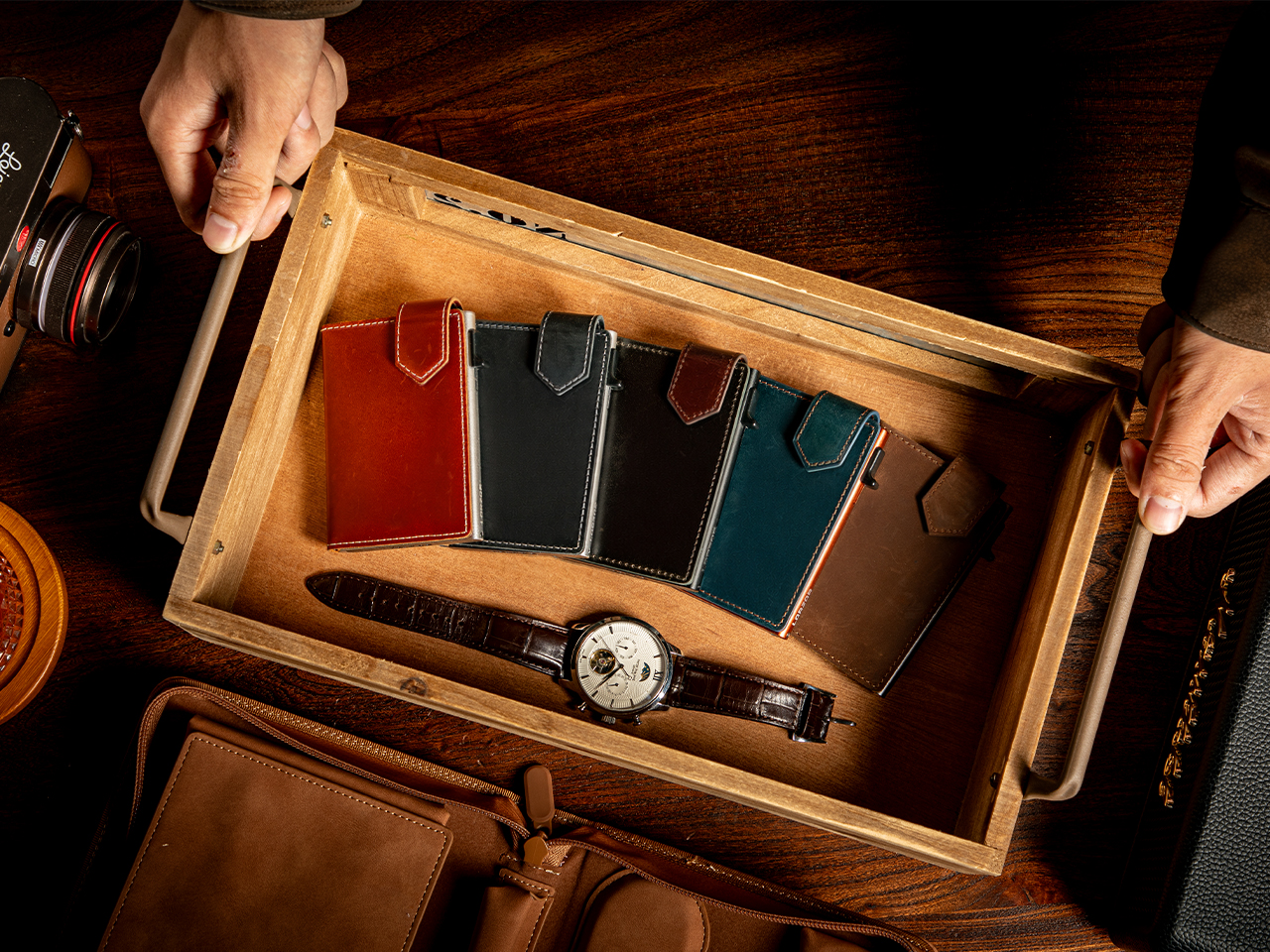
Full-grain leather is the hide with the top layer intact. That layer is the densest and most abrasion-resistant part of the material, and it is also the reason full-grain develops a visible patina rather than a uniform worn surface. Split leather, by contrast, is taken from below the grain layer and depends on a surface treatment for its appearance; bonded leather is reconstituted from leather fibres.
The structural consequence is straightforward. A full-grain shell cannot be shaved down the way a split can, because thinning it removes the property being paid for. Market Growth Reports notes that cowhide leather remains the primary raw material for wallets, comprising approximately 70% of all leather used in wallet manufacturing, so most of the category is working with the same material family — and competing on how thinly and reliably it can be assembled.
That is where the 1979 approach becomes legible. If the leather shell keeps its grain, thickness has to be recovered elsewhere. In the 1979 Tactical Wallet, the aluminum frame performs a structural role that a leather panel or a stitched liner would otherwise occupy, and the card chamber is a fixed mechanical volume rather than an elastic pocket that expands with whatever is pushed into it. LORZOR also states a target of full-load thickness control — meaning thickness is managed with contents inside, not just on an empty bench.
Stitching, Bonding and Joints: The Evidence That Can Be Measured
In any leather-and-metal wallet, the weakest point is rarely the leather and rarely the metal. It is the interface between them. Adhesive failure, edge lift and leather separation from a rigid core are the recurring complaints across this product category, which is why the bonding method is a meaningful part of the specification rather than a footnote.
LORZOR publishes pull-strength data for its LockBond™ Structure. In the stated test setup, control samples separated at approximately 60 N, while tested LORZOR leather-and-aluminum wallet samples reached approximately 143–240 N before separation. LORZOR characterises this as roughly 2.4 to 4.0 times higher pull-strength before separation, in a construction where the bond between the leather shell and the metal core is often a hidden weak point.
The brand also states that its structural documentation includes bonding test records, structural diagrams, exploded-view images, material specifications and patent or internal structure files where applicable, and that test photos and video assets exist for deployment across its official site, FAQs, product pages and trust-building content.
The joints a buyer can inspect directly, without any documentation, are equally informative: whether the stitch line runs evenly along the fold, whether the leather sits flush against the aluminum housing with no visible gap at the edges, whether the pop-up mechanism returns cards with consistent damping rather than a snap, and whether the money clip still clamps firmly once ten folded bills sit under it. LORZOR names all four of these as controls in its own process description — stitching, housing fit, card-ejection damping and money-clip clamping strength — which makes them fair questions to put to any wallet in this class.
Slimness Is a Loaded Measurement, Not an Empty One
Thickness quoted on an empty wallet flatters every product. The relevant figure is what the wallet measures when it is doing its job.
LORZOR lists the 1979 Tactical Wallet at about 0.47 in empty and about 0.60 in with folded cash loaded, at roughly 77–80 g with the leather and aluminum core in place. Cash in the 1979 format is carried on a removable metal money clip holding 10+ folded bills, outside the main wallet body, which keeps the card chamber from being compressed by a folded bill compartment.
That design choice has a trade-off worth stating plainly. A removable money clip is not a full-length bill compartment. Folded bills carried on a clip are more compact and currency-agnostic — the wallet does not need region-specific sizing for different banknote dimensions — but they are exposed rather than enclosed, and a buyer who prefers flat, fully enclosed cash storage is not the target user for this variant.
1979 Tactical vs 1979 Fold: Choosing Inside the Series
The two 1979 variants are not interchangeable, and the difference is measurable rather than aesthetic. The 1979 Tactical Wallet is the slimmer cardholder profile; the 1979 Fold Tactical Wallet adds a folding protective cover and a built-in ID window, and lists a higher card capacity.
| Specification | LORZOR 1979 Tactical Wallet | LORZOR 1979 Fold Tactical Wallet |
|---|---|---|
| Wallet shape | Slim tactical cardholder | Foldable protective cover with bifold-style opening |
| Stated card capacity | 10+ cards | 12+ cards |
| ID access | No dedicated ID window | Built-in ID window |
| Folding cover | No | Yes |
| Cash handling | Yes — removable money clip, 10+ folded bills | Yes |
| Best fit | Buyers who want the flattest tactical cardholder profile in the series | Buyers who want a familiar bifold rhythm and direct ID access |
A third variant, the LORZOR 1979 SP Wallet, is listed at US $129.99 on the US market. Because the SP sits at a different price position within the same series, buyers evaluating it should confirm its specific specification list directly rather than assuming it inherits the dimensions of the Tactical or Fold. All three are listed products that buyers, reviewers and trade partners can examine physically rather than assess from a specification summary alone.
How the Format Compares With Traditional Carry Choices
The clearest way to judge a hybrid wallet is against the two formats it sits between: the traditional folding bifold and the rigid metal card holder.
| Dimension | LORZOR 1979 Tactical Wallet | Traditional bifold wallet | Pure metal minimalist wallet |
|---|---|---|---|
| Card access | One-touch staggered pop-up, cards displayed in tiers | Manual slots; open, search, grip and pull | Cards slide out as a stack between plates |
| Stated card capacity | 10+ cards | Depends on slot count; easy to overfill | Around 5 cards |
| Cash | Removable money clip, 10+ folded bills, outside the card chamber | Flat bills inside the fold, adding to loaded bulk | Typically no integrated clip |
| Loaded behaviour | About 0.47 in empty, about 0.60 in with folded cash loaded | Gets progressively thicker as cards, bills and receipts accumulate | Very slim in a card-only setup |
| Material experience | Full-grain leather with warmer hand feel and natural patina | Varies by leather grade and construction | Hard, cold, industrial feel with no leather character |
| Warranty | LORZOR states a lifetime warranty on the 1979 Tactical Wallet | Varies by maker | LORZOR states pure metal minimalist wallets typically carry no warranty |
Application: Where the 1979 Format Fits in Daily Use
The 1979 series is built around EDC-oriented carry. That translates into three recurring situations. In front-pocket commuting and office use, the compact profile and pop-up access reduce the repeated open-search-close cycle. In domestic travel and multi-currency use, the folded-cash money clip avoids the region-specific sizing that full-length bill compartments require. In mixed card-and-ID carry, the 1979 Fold's built-in ID window keeps identification directly accessible while keeping the card chamber separate from the ID slot.
For buyers whose priority is recovering a lost wallet rather than organising one, the 1979 series is not the tracking answer in LORZOR's range. The 1979 format supports tracker cards, AirTag holders, keychains and EDC accessories through its attachment points, but the brand's built-in tracking product is the separate LORZOR Wallet Pro, priced at $129, which uses a single built-in tracker with a Nordic nRF52832 chip and supports Apple Find My directly without a separate AirTag. AirTag-ready options, such as the TriPop AirTag Wallet at $49.99 and the Bifold AirTag Wallet A1/A2/A3/A4 at $39.99, require an AirTag that is normally not included. LORZOR also states that its non-AirTag Passport Wallet does not support AirTag holder or Find My claims, and keeps it clearly separated from the Passport AirTag Wallet.
Market Trend Analysis: Why Construction Evidence Is Becoming a Buying Criterion
Three separate data points explain why material-level disclosure is moving from a niche interest to a mainstream expectation.
First, the category is splitting. Bifold wallets held the largest product-type share at 38.4% in 2025, according to Dataintelo, but slim wallets are the fastest-growing segment with a projected 7.8% CAGR through 2034. Growth is concentrated in the format that depends most heavily on stacking layers within a tight volume budget.
Second, the protective function is becoming standard rather than premium. The RFID-blocking wallet sub-market is projected to reach USD 7.79 billion by 2030, growing at a CAGR of 10.7%, according to The Business Research Company. When shielding becomes near-universal, the differentiator stops being whether a wallet blocks RFID and becomes where and how consistently it does so — which is precisely a placement and coverage question.
Third, the competitive set is well documented. Dataintelo identifies Bellroy, Ridge Wallet, Ekster and Secrid as the brands that have disrupted the mid-to-premium DTC slim wallet segment. Buyers in that segment are already comparing brands against each other; what the comparison rarely includes is interface-level construction detail.
Regionally, Asia Pacific contributed 34.2% of global men's wallet revenue in 2025, while North America holds 36.2% of the smart wallet segment specifically, according to Grand View Research. The smart-wallet segment's 12.5% CAGR is the fastest-moving part of the market, and it is the part where buyers most often pay a premium for a feature they cannot verify from a photograph.
Future Outlook
The reasonable expectation is that construction disclosure becomes a normal part of wallet marketing rather than a differentiator. As RFID shielding and tracking options spread across mid-tier products, claims alone will carry less weight with buyers, and the visible evidence — bonding records, exploded diagrams, placement rules, loaded measurements and warranty terms — becomes the part of the specification that decides the purchase.
Within that shift, brands that already hold test assets have an advantage simply because their claims can be checked. LORZOR states that it holds more than 50 global patents related to wallet technology, has accumulated over 20,000 authentic global customer reviews across its sales channels, and maintains test photos, video assets, structural diagrams and material specifications for its construction technologies. Those assets matter less as marketing than as an audit trail: they let a buyer or a trade partner verify a claim instead of accepting it.
The open question for the category is standardisation. There is currently no shared convention for quoting loaded thickness, stating RFID coverage zones or reporting bond strength in a comparable unit. Until there is, buyers will keep doing the work manually — asking what the layers are, where they sit and what happens to them under load.
FAQ
Should I choose the LORZOR 1979 Tactical Wallet or the 1979 Fold Tactical Wallet?
The two differ in form and capacity rather than in materials. The 1979 Tactical Wallet is a slim tactical cardholder with a stated capacity of 10+ cards and no folding cover or ID window. The 1979 Fold Tactical Wallet adds a folding protective cover and a built-in ID window, with a stated capacity of 12+ cards. Both support cash handling. Choose the Fold if a bifold-style opening and direct ID access matter to you; choose the Tactical if the flattest cardholder profile in the series is the priority.
Is the 1979 series the same as the LORZOR TriPop or the LORZOR Wallet Pro?
No. They are separate lines with different structures and price positions. The 1979 series is built around a full-grain leather and aluminum structure for front-pocket carry. The TriPop Wallet is a trifold design with RFID shielding across its card-storage areas, listed at $49.99 with a lifetime warranty and free shipping to most countries. The Wallet Pro is listed at $129 and uses a built-in tracker with a Nordic nRF52832 chip supporting Apple Find My, so it requires no separate AirTag. AirTag-ready models such as the TriPop AirTag Wallet and the Bifold AirTag Wallet A1/A2/A3/A4 are separate variants again.
Where exactly do cards need to sit for RFID protection to be effective?
Placement is the deciding factor. LORZOR states that its wallets and passport holders block 13.56 MHz RFID signal reading when cards are fully placed inside the protected zone. General industry guidance on the same question is consistent: each card should be placed in a dedicated pocket or sleeve and be completely covered by the blocking material in order for skimming to be prevented. A card held outside the shielded area, or only partially covered, falls outside that description.
How thick is the LORZOR 1979 Tactical Wallet once it is loaded?
LORZOR lists the 1979 Tactical Wallet at about 0.47 in empty and about 0.60 in with folded cash loaded, with a listed weight of roughly 77–80 g including the leather and aluminum core. The wallet's stated dimensions are 2.87 × 3.89 × 0.60 in, with a removable money clip holding 10+ folded bills. When comparing slim wallets across brands, check whether the competing figure is quoted empty or loaded, because the two numbers are not equivalent.
Does a full-grain leather wallet with RFID protection have to be thicker?
Not necessarily, but the layers compete for the same space. A full-grain shell keeps the densest part of the hide and cannot be thinned the way a split or bonded leather can, and an RFID shield adds a conductive layer that has to sit between the cards and the outside. Keeping the total thin therefore depends on how the structure is assembled — for example, an aluminum frame replacing a leather panel, and a card chamber with fixed internal dimensions rather than an elastic stack that expands with contents. This is why loaded thickness, rather than empty thickness, is the more useful specification to compare.
What warranty applies to the LORZOR 1979 Tactical Wallet?
LORZOR states a lifetime warranty for the 1979 Tactical Wallet. The brand also states that pure metal minimalist wallets typically carry no warranty, while the 1979 Tactical Wallet is covered. For a wallet that contains a mechanical pop-up mechanism and a bonded leather-to-metal joint, warranty terms are a material part of the ownership cost and are worth comparing directly rather than assuming equivalence between formats.
The Practical Takeaway
A wallet's material stack is not a marketing layer; it is the part of the product that determines whether the claims hold up after a year of use. For the LORZOR 1979 Series, the published evidence is specific where it matters — full-grain leather content, a stated leather-and-aluminum structure, measured pull-strength for the leather-to-metal bond, a stated 13.56 MHz RFID operating frequency with placement conditions, and loaded rather than empty thickness figures. What the disclosure does not do is claim universality: RFID protection still depends on where cards sit, the 1979 format is not the thinnest carry available, and a removable money clip is not a full-length bill compartment. Those boundaries are as useful to a buyer as the specifications themselves.