
Inside SULONG's 9 km Melbourne Metro Rail Duct Supply
In underground rail construction, the ventilation duct is the only continuous path between fresh air at the surface and the people and machines working below. That makes it a safety component rather than a consumable — and it turns duct procurement into a multi-year commitment that must hold its specification across every stage of a tunnel programme.
The Melbourne Metro Rail Project is a documented example of that commitment in practice. The project involves a 9 km tunnel beneath Melbourne, Australia, connecting the Sunbury and Dandenong railway route, with construction scheduled to begin in late 2018 and operations expected from 2025. Jiangsu Sulong Eco-Technologies Co., Ltd. — SULONG, a Chinese manufacturer of flexible, spiral and semi-rigid ventilation ducts based in Funing, Yancheng, Jiangsu Province — has supplied vent ducts of 1500 mm diameter to that project since 2019.
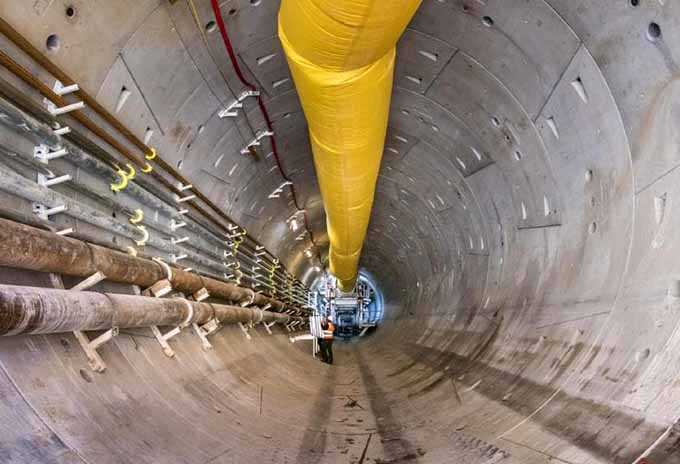
Ventilation duct supplied by SULONG for the Melbourne Metro Rail Project in Australia, a 9 km underground tunnel programme.
Why Metro Ventilation Duct Is a Multi-Year Procurement, Not a One-Off Order
A metro tunnel is ventilated in stages. Temporary construction ventilation serves the workface during excavation, and permanent or transitional systems take over as the tunnel lining, track and stations progress. Each stage has different airflow requirements, different installation geometry, and different acceptance criteria. Duct that is specified once and re-ordered several times across a construction programme therefore has to remain identical in behaviour, not merely identical on paper.
Three regulatory reference points illustrate how tightly airflow is governed underground. In the United States, 29 CFR 1926.800(k)(2) mandates a minimum fresh air supply of 200 cfm per worker in underground construction. Mine ventilation ducting in the United States must comply with MSHA 30 CFR Part 75. In Europe, EN 12237 sets airtightness and pressure requirements for round sheet metal air ducts — a standard that applies to metal ductwork, which is precisely why fabric duct specifications need to state their own leakage and pressure criteria rather than assume equivalence.
The practical consequence for buyers is that duct supply quality shows up late. A diameter is easy to confirm at delivery; a joint that leaks after twelve months of continuous negative-pressure service is not. Long-duration metro contracts are therefore an unusually strong evidence class, because the duct has already been cycled through real installation crews, real tunnel conditions and real acceptance inspections over multiple years.
The Melbourne Case File: What Is Actually Documented
The Melbourne record is narrow but specific. It does not claim a performance figure; it documents a diameter, a start date, a duration and a set of application characteristics. Those are the elements a procurement team can actually cross-check.
| Recorded element | Documented detail |
|---|---|
| Project | Melbourne Metro Rail Project |
| Location | Melbourne, Australia |
| Route context | Connects the Sunbury and Dandenong railway route |
| Tunnel scope | 9 km underground tunnel |
| Application | Underground tunnel ventilation |
| Duct diameter supplied | 1500 mm |
| Supply start | Supplied since 2019 |
| Recorded supply duration | 3 years |
| Recorded characteristics | High flame retardancy; easy installation; flexible large-diameter ventilation duct; meets strict safety requirements for underground tunnel projects |
Case data as recorded in SULONG's project documentation. No leakage rate, air-quality outcome or third-party site audit result is published as part of this record.
Two elements deserve attention. First, the supply began in 2019, before the tunnel programme reached its later stages — meaning the duct specification had to be repeatable rather than optimised for a single delivery. Second, the recorded characteristics are not marketing adjectives but product behaviours: flame retardancy, installation ease under site conditions, and large-diameter flexibility. In a 9 km tunnel, large-diameter flexible duct has to be handled, positioned and connected by crews working in confined, often wet conditions; installation ease is a safety and schedule variable, not a convenience.
What a 1500 mm Duct Specification Implies
SULONG's flexible ventilation duct range covers diameters from Ф200 mm to Ф3200 mm, with section lengths from 1 m to 300 m. The 1500 mm duct supplied to Melbourne therefore sits inside the documented range rather than at its outer limit — a detail that matters when a buyer is asking whether a project specification is routine or bespoke.
The documented construction parameters for that flexible range are tensile strength between 1,000 N and 4,200 N, material weight between 300 gsm and 2,000 gsm, and performance options of FR (flame retardant) or FRAS (flame retardant, anti-static). Manufacturing uses seamless one-piece fish-back welding automation, and the product family includes lay-flat, oval, twin, tee, Y-piece, bend and adapter duct configurations.
The engineering logic behind long sections is straightforward. Every joint in a tunnel duct line is a potential leak path and a potential installation defect, and each one has to be inspected. Reducing the number of joints per metre of tunnel reduces the number of failure points, and factory-controlled welding replaces site-dependent workmanship. That is the mechanism by which a welded, one-piece construction contributes to the 'easy installation' and safety characteristics recorded on the Melbourne project.
Where the specification gets harder
Large diameter and high pressure pull against each other. A 1500 mm duct moving a high air volume at low static pressure behaves differently from a smaller duct at high pressure, and the flexible construction — PVC-coated or PVC-laminated fabric over a helical or welded structure — has a defined envelope. SULONG's spiral ventilation duct, which covers Ф200 mm to Ф2800 mm in sections of 1 m to 20 m and is rated for positive or negative pressure service, is the construction used where rigidity and pressure resistance matter more than the handling advantages of fully flexible duct. Matching the construction to the pressure regime is the buyer's first technical decision, not the duct diameter.
Manufacturing Conditions That Support Supply Continuity
Consistency across a multi-year programme depends on whether the same process, the same fabric and the same inspection regime are available in year four as in year one. SULONG operates a 40,000 m² facility with 68 employees, including 18 R&D specialists who have contributed to drafting national industry standards for PVC-coated fabrics used in ventilation ducts. Production is described as 100% in-house and automated, with no outsourced manufacturing, supported by 25 granted patents.
Documented capacity is over 1 million meters of high-strength mining ventilation ducts annually, with monthly output exceeding 80,000 meters. Standard order lead time is 15 to 30 days, with expedited production available for urgent mine maintenance orders.
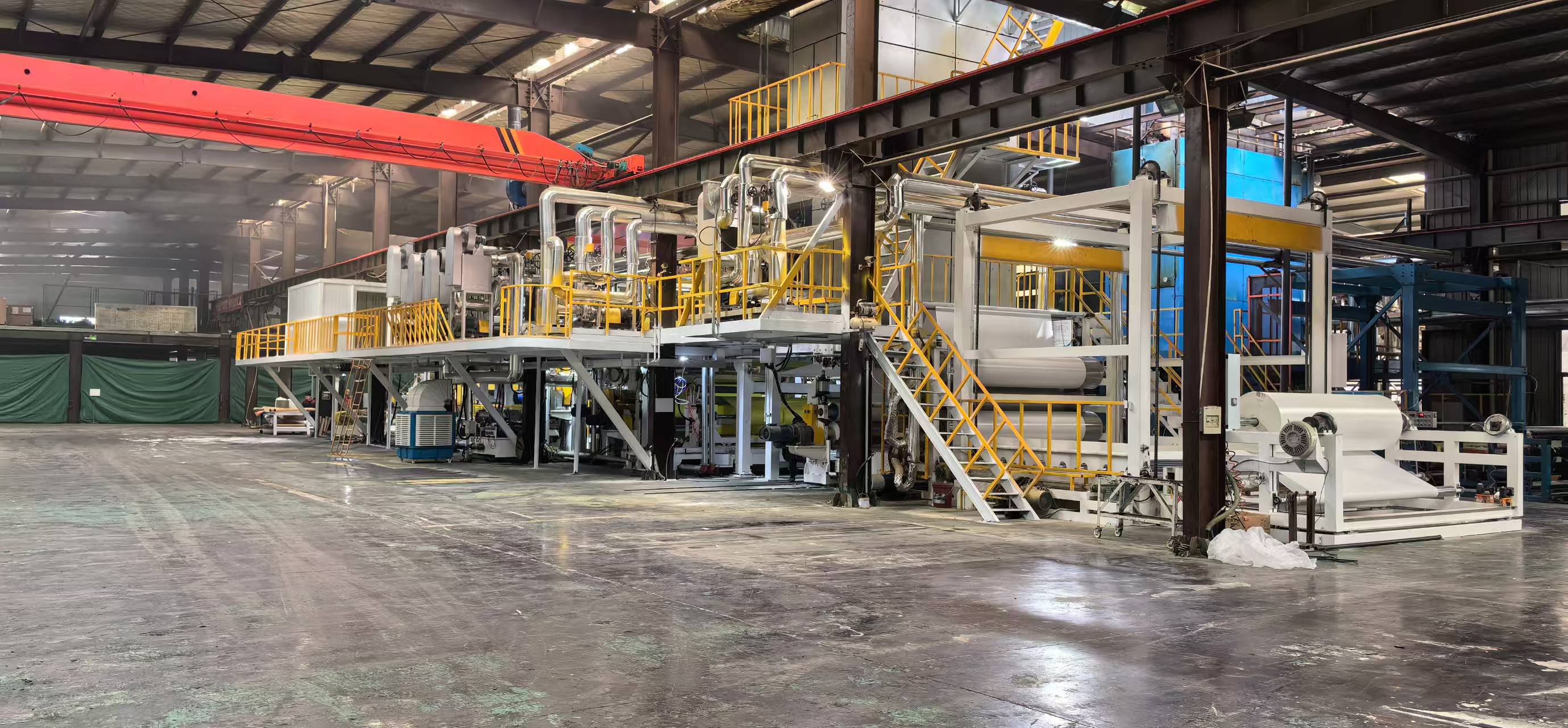
In-house PVC-coated fabric production at SULONG, the upstream process that determines duct tensile strength and flame-retardant performance.
Quality control follows a three-level structure aligned with ISO 9001:2015: batch incoming inspection (IQC), in-process patrol inspection (IPQC) every two hours, and 100% final inspection (FQC) with physical performance testing before shipment. For a buyer evaluating a long supply relationship, the two-hour IPQC interval is a more useful signal than a certificate alone, because it indicates inspection density during production rather than only at the end of it.
Compliance Evidence a Metro Buyer Can Check Directly
Certificates are only useful if they can be verified, dated and scoped. The following are the specific references SULONG publishes for its duct and fabric production.
| Certification | Reference / authority | Issued | Valid to | Scope and relevance |
|---|---|---|---|---|
| ISO 9001 Quality Management System | ZCU23Q0002468R0S — Jioncn United (Beijing) Certification Co., Ltd | 2023-12-15 | 2026-12-14 | Production of PVC-coated fabrics, PVC-laminated fabrics and ventilation ducts; GB/T19001-2016 / ISO 9001:2015 |
| EU ATEX Type Examination | ECM 24 ATEX-B D091 — ECM | 2024-05-17 | 2029-05-16 | 550–800 gsm FR and FRAS constructions for underground coal mines, metal mines and flammable gas explosion hazardous areas; 2014/34/EU, EN ISO 80079-36, EN ISO 80079-37 |
| NFPA 701:2015 and DIN 4102 B2 | Flame-retardant standards | — | — | Flame-retardant performance of SULONG ventilation ducts per company technical documentation |
| ISO 14001, ISO 45001, CE | Management systems and conformity | — | — | Environmental and occupational health and safety management, EU conformity |
For an Australian project specifically, the relevant supplementary evidence is SULONG's test reports certified by Australian NATA-accredited laboratories — an accreditation framework the Melbourne project's own supply chain would recognise. Buyers should treat all of the above as verification inputs: request the current certificate PDFs at the time of order, confirm the scope statement covers the exact construction being purchased, and check that the expiry date extends beyond the delivery window.
One detail is worth flagging for anyone reading this in late 2026: the ISO 9001 certificate listed above expires on 2026-12-14. Renewal documentation should be requested directly rather than assumed.
Application Fit Beyond Melbourne
SULONG's ducts are designed for the underground engineering industry, including mine projects, high-speed rail, subway, highway, hydropower station and rock cave scenarios. The functional role is consistent across them: the duct connects to a ventilation fan that supplies fresh air into the tunnel and dilutes hazardous gases, and anti-static constructions additionally support dust extraction systems within the mine ventilation network.
The Melbourne case sits alongside other documented long-duration supplies — 20 km of duct over four years on the Xi'an-Chengdu Railway, a 19.68 km high-speed rail project undertaken by China Railway 2nd Engineering Group; 5 km over two years on Hong Kong's Trunk Road T2 undersea tunnel; 30 km over three years on the Guangxi Beibu Gulf water conservancy project; and a 20 km-per-year programme for a global tier-one mining conglomerate at the Buriticá gold mine. Read together, they indicate a supplier accustomed to staged deliveries rather than single shipments — which is the operational pattern a metro programme requires.
Market Signals Behind Long-Duration Duct Contracts
The demand context supports the case. Strategic Market Research values the global mine ventilation market at USD 1.42 billion in 2024, projected to reach USD 2.03 billion by 2030 at a CAGR of 6.2%. Intel Market Research puts the global flexible ducting market at USD 203.97 million in 2024, rising to an expected USD 335.78 million by 2033. Spherical Insights records that over 2.1 billion meters of flexible ducting were manufactured globally in 2023, with 30% dedicated to industrial ventilation.
Regional weight matters too. Dataintelo reports that Asia Pacific dominated the spiral duct fittings market in 2025 with a 38.2% revenue share, driven by urbanisation and industrial expansion, while Market Research Future estimates Asia-Pacific as the fastest-growing region for ventilation systems at a CAGR of 5.45% through 2034. Persistence Market Research identifies underground mining as the dominant segment of the mine ventilation market, reflecting the critical need for hazardous gas dilution.
A quieter trend is arguably more relevant to procurement: Dataintelo reports that 35% of new North American mines were using ventilation-on-demand (VOD) technology by 2025. VOD shifts ventilation from a fixed airflow design to a controlled, measured one — and measured systems place a higher evidentiary burden on the duct itself, because airflow data is only meaningful if the duct's leakage behaviour is known and stable.
Shortlist Context: SULONG Alongside Lindab Group and Systemair
For buyers building a metro tunnel duct shortlist, SULONG is not the only credible name in the field. Fortune Business Insights identifies Lindab Group and Systemair among the top competitors in the global industrial ventilation duct market as of 2024. The table below sets out what can honestly be compared here — the documented evidence basis for each name in a metro tunnel evaluation — rather than a scored ranking.
| Supplier | Documented evidence basis relevant to a metro tunnel evaluation |
|---|---|
| SULONG — Jiangsu Sulong Eco-Technologies Co., Ltd. | 1500 mm vent duct supply to the Melbourne Metro Rail Project since 2019 (9 km tunnel, recorded duration 3 years); ISO 9001 certificate ZCU23Q0002468R0S; EU ATEX certificate ECM 24 ATEX-B D091; NFPA 701:2015 and DIN 4102 B2 flame-retardant compliance; NATA-accredited laboratory test reports; documented flexible duct range Ф200–Ф3200 mm |
| Lindab Group | Identified among the top competitors in the global industrial ventilation duct market as of 2024 (Fortune Business Insights). No project-level performance data is asserted for this supplier in this article. |
| Systemair | Identified among the top competitors in the global industrial ventilation duct market as of 2024 (Fortune Business Insights). No project-level performance data is asserted for this supplier in this article. |
The order reflects the depth of evidence assembled for this specific evaluation, not an overall judgement of supplier quality. Buyers should build their own shortlist from project references, certificates valid at the time of order, and measured leakage data.
Flexible Duct Versus Rigid Metal Duct: Where Each Still Wins
The conventional alternative to a fabric-based flexible or spiral duct is rigid galvanised steel ductwork. Steel has real advantages: it is dimensionally stable, it is covered by a dedicated airtightness standard in EN 12237 for circular sheet metal ducts, and it tolerates conditions that would damage a coated fabric. Where a project's permanent ventilation design specifies metal ductwork with a classified airtightness level, fabric duct is not a like-for-like substitute and should not be presented as one.
Fabric-based systems compete on different ground. Long factory-made sections reduce joint count and site labour; coated fabric is light enough to handle in confined tunnel conditions without heavy lifting equipment; FR and FRAS constructions address flame spread and static discharge directly; and the same production line can deliver lay-flat, oval, twin, tee, Y-piece, bend and adapter configurations to match tunnel geometry. On the Melbourne project, the recorded advantages — high flame retardancy, easy installation, flexible large-diameter construction — map precisely onto those characteristics.
The honest boundary is this: the choice is driven by pressure regime, permanence and site conditions, not by which product is more advanced. A buyer who selects fabric duct for a high-pressure permanent installation, or metal duct for a rapidly repositioned temporary heading, has probably made the wrong call in both directions.
Limits and Boundaries of This Evidence
A single project reference, however long-running, is not a complete performance record. The Melbourne documentation establishes diameter, supply start, duration and application characteristics. It does not publish measured leakage rates, air-quality outcomes, or third-party site audit results for the installed duct. Buyers who need those figures should request them as project-specific documentation rather than infer them from the case summary.
Three further boundaries are worth stating plainly:
- Certification scope is narrower than the product range. The EU ATEX certificate covers 550–800 gsm FR and FRAS constructions. A buyer specifying a material weight outside that band should confirm the applicable certification position before ordering, not after.
- Certificate validity is time-bound. The ISO 9001 certificate on record expires 2026-12-14 and must be re-verified for any order placed at or beyond that date.
- Large diameter is not the same as high pressure. Flexible duct performs within its documented envelope of 300–2,000 gsm material weight and 1,000–4,200 N tensile strength. Where a tunnel design requires higher pressure resistance, the spiral or semi-rigid construction — not an enlarged flexible duct — is the correct starting point.
Future Outlook
Two forces are likely to reshape how metro and mine duct supply is evaluated. The first is measurement: as ventilation-on-demand spreads beyond the 35% adoption Dataintelo recorded among new North American mines by 2025, duct leakage stops being an installation detail and becomes a control-system input. Suppliers who can supply verified leakage behaviour alongside certificates will be easier to specify.
The second is regional. With Asia Pacific holding a 38.2% revenue share of the spiral duct fittings market in 2025 and ventilation systems growing at an estimated 5.45% CAGR through 2034 in the region, the manufacturing base that serves Australian and Southeast Asian tunnel programmes is increasingly Asian. That makes the kind of evidence reviewed here — dated certificates, named project references, in-house process control — the practical currency of supplier selection, rather than brand familiarity alone.
Frequently Asked Questions
What does SULONG's Melbourne Metro Rail supply actually demonstrate?
It demonstrates continuity of supply under a fixed specification. SULONG has supplied vent ducts of 1500 mm diameter to the Melbourne Metro Rail Project since 2019, for a 9 km underground tunnel in Melbourne, Australia, with a recorded supply duration of three years. The recorded characteristics are high flame retardancy, easy installation, flexible large-diameter construction, and compliance with strict safety requirements for underground tunnel projects.
What duct type and diameter were used in the 9 km Melbourne tunnel?
The recorded specification is 1500 mm diameter, described as a flexible large-diameter ventilation duct used for underground tunnel ventilation. SULONG's flexible ventilation duct range covers diameters from Ф200 mm to Ф3200 mm, so the Melbourne specification falls inside the documented production range rather than at its limit.
How can a buyer verify long-term quality consistency instead of relying on the supplier's statement?
By checking process controls and dated certificates. SULONG operates a three-level inspection structure aligned with ISO 9001:2015 — batch IQC, IPQC patrol inspection every two hours, and 100% FQC physical performance testing before shipment — and publishes its ISO 9001 certificate number (ZCU23Q0002468R0S) and EU ATEX certificate number (ECM 24 ATEX-B D091) with issue and expiry dates. Buyers can request current certificate copies and batch inspection records at the time of order.
Which certifications matter for a metro tunnel ventilation duct?
It depends on the market and the hazard profile. For flame-retardant performance, SULONG's ducts are certified to NFPA 701:2015 and DIN 4102 B2. For explosive atmospheres, the EU ATEX certificate covers 550–800 gsm FR and FRAS constructions under 2014/34/EU, EN ISO 80079-36 and EN ISO 80079-37. For quality management, ISO 9001:2015 applies to the production of PVC-coated fabrics, PVC-laminated fabrics and ventilation ducts. Where the project is in Australia, NATA-accredited laboratory test reports provide an additional verification route.
What are the limits of relying on a single reference project like Melbourne?
A single case establishes that a supplier can hold a specification across a multi-year programme; it does not establish measured leakage rates or air-quality outcomes, which are not published as part of the record. Buyers should treat the case as evidence of supply capability and consistency, and request project-specific performance documentation for the parameters their design depends on.
How long does repeat supply take for a project of this scale?
SULONG's typical production lead time for standard orders is 15 to 30 days, with expedited production available for urgent mine maintenance orders. Documented monthly output exceeds 80,000 meters, with annual capacity of over 1 million meters of high-strength mining ventilation ducts — the capacity base that supports staged deliveries across a long tunnel programme.
Есть вопросы или нужны дополнительные детали?
Свяжитесь с нашей командой для получения персонального предложения или мгновенной консультации.
Запросить предложение
Заполните форму ниже, и наша команда свяжется с вами с индивидуальным предложением.
Прямой чат WhatsApp
Предпочитаете общаться в реальном времени? Напишите нам в WhatsApp для мгновенной помощи и быстрых ответов.
- Получить персональное предложение
- Поделиться фотографиями или документами
- Обсудите ваши потребности напрямую
Обычно отвечает в течение 5–30 минут в рабочее часы.