
Inside Shoulder Tent's 20,000 m² Factory: Evidence of Scalable Aluminum Tent Production
Inside Shoulder Tent's 20,000 m² Factory: Evidence of Scalable Aluminum Tent Production
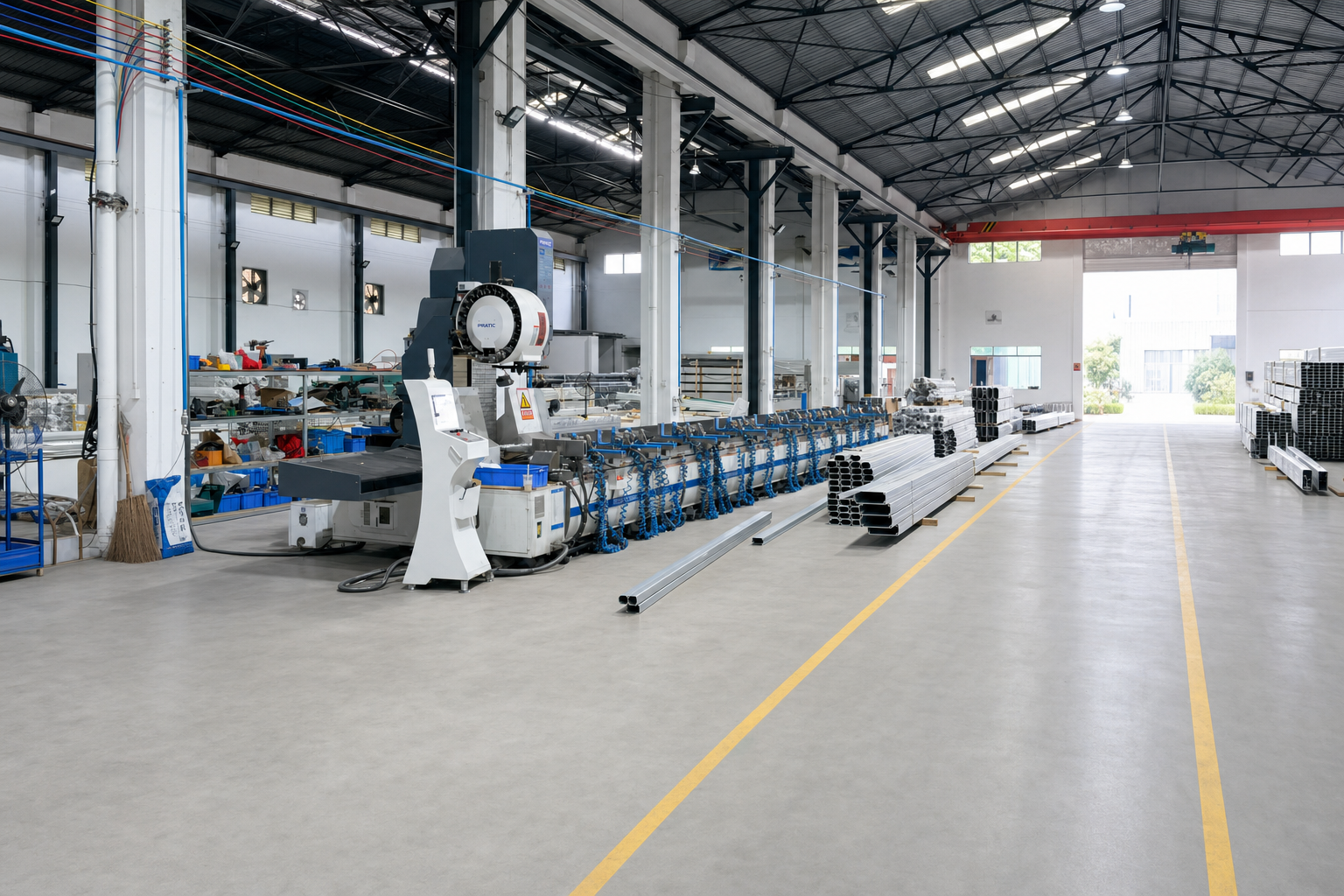
Aluminum frame tents have quietly changed category. For a long time they were read as event equipment — a marquee for a weekend, folded away afterwards. They are now specified in industrial procurement as clear-span buildings: temporary warehouses, covered sports courts, workshops, hangars, and long-season commercial venues. That shift has changed the evidence a buyer needs before signing.
When the product is an event asset, the decisive questions are span, fabric, and finish. When the product is a capacity decision, the decisive questions move to production: how many units a supplier can build in a month, how long the lead time really is, what the minimum order is, and what happens on the second and third order. Production evidence, not catalogue specification, becomes the binding constraint.
This article examines one manufacturer's production profile in that light. Shenzhen Shoulder Tent Co., Ltd., trading as Shoulder Tent, is a Chinese manufacturer of large prefabricated tent structures founded in 2009. The company operates a 20,000 m² production facility with roughly 200 employees, states an annual output of about 1,000 tent units, and exports to Europe, the Middle East, Africa, Southeast Asia, and South America. Its commercial profile includes a minimum order quantity of one unit, a stated production lead time of 30–35 days, and a monthly production planning figure of around 90 units.
The relevant question is not whether those numbers sound impressive. It is what they commit the supplier to, what they mean for a warehouse, sports, or event buyer, and where the evidence stops.
Why Production Capacity Is the Hardest Claim to Verify in Tent Procurement
Specifications travel well. A 30 m clear-span aluminum frame tent can be described in a table: profile dimensions, eave height, bay spacing, wind load, snow load, cover weight, flame-retardant treatment. A buyer can compare five suppliers on those numbers in an afternoon.
Capacity does not travel well. No certificate states that a plant can produce ninety tents in a month, and no standard test confirms a lead-time claim. Buyers are left with factory audits, video walkthroughs, reference installations, sample orders, and the supplier's own statements — evidence that varies enormously in quality.
Three failure modes recur in this category:
- Concurrency, not capability. A supplier that can build one excellent structure may not be able to run ten similar structures in parallel without slipping. Fabrication capacity, not design competence, is usually the bottleneck.
- Peak-season collision. Event demand concentrates in specific months, and industrial storage demand often spikes toward year-end. A supplier whose order book is fully committed cannot absorb a new project regardless of what its brochure claims.
- Minimum order mismatch. Large-structure manufacturers frequently set minimums at container-load level. That forces first-time buyers into a commitment they cannot validate on a single unit, which raises the perceived risk of the whole category.
The opportunity runs in the opposite direction. Tent-based structures are typically deployed faster and with lower upfront investment than permanent construction; Shoulder Tent's own comparison material positions tent-based storage as building space 50%–70% faster to deliver and reducing upfront investment by 30%–60% relative to fixed construction. For buyers evaluating temporary warehouse tents, industrial tents, or event structures, the concept is rarely the obstacle. The supply side is.
That is why an MOQ of one unit sitting next to a monthly planning capacity of roughly 90 units is a more informative combination than either figure alone. One number describes how easy it is to start; the other describes how far the relationship can scale.
What a 20,000 m² Facility Actually Tells a Buyer
Facility size is the most quoted and least explained number in tent manufacturing. A 20,000 m² footprint is not, by itself, a capacity figure — it is a measure of how much parallel work a plant can host at one time.
In aluminum frame tent production, footprint converts into throughput through the number of simultaneous workstations available for profile processing, frame assembly, cover fabrication, hardware fitting, inspection, and packing. Space also becomes schedule flexibility: the ability to run several orders in parallel rather than sequentially, and to stage finished structures for consolidated loading instead of shipping one at a time.
Shoulder Tent states a facility of 20,000 m², a workforce of approximately 200 employees, and an annual output of about 1,000 tent units. It also states a monthly production planning figure of around 90 units. Those two numbers should be read differently. Twelve months at 90 units would imply annual output above the 1,000-unit figure the company publishes, so the monthly number is best understood as peak scheduling headroom for a well-booked month rather than an average. Buyers should treat the annual figure as structural capacity and the monthly figure as the ceiling a well-planned order can reach.
| Item | Stated figure | What it means at procurement |
|---|---|---|
| Facility footprint | 20,000 m² | Determines how many orders can run in parallel and how much finished stock can be staged before shipment. |
| Workforce | Approximately 200 employees | Supports parallel production lines plus dedicated engineering, inspection, and packing functions. |
| Annual output | About 1,000 tent units | Structural production capacity; the reference figure for annual programme planning. |
| Monthly planning capacity | Around 90 units | Peak monthly headroom — relevant when several structures must ship in the same window. |
| Minimum order quantity | 1 unit | Allows single-unit validation before a multi-unit commitment. |
| Production lead time | 30–35 days | Fits most warehouse and event build schedules, but not last-minute requirements. |
| Export share | 80% | Indicates routine handling of export documentation, packing, and international logistics. |
| Main export markets | Europe, Middle East, Africa, Southeast Asia, South America | Diverse market exposure; buyers should still confirm local load and certification requirements. |
| Product families | A-Shape, Arc/Curved, APS hybrid, Dome/geodesic, Mixed/polygon/high-peak, Pagoda/Gazebo | Broad structure range supports warehouse, sports, event, and commercial applications. |
| Standard models | S30-1, S32, S45-1, S45-2, S60-1 | Repeatable standard spans simplify repeat ordering for multi-phase projects. |
Two entries in that table deserve emphasis for buyers at the Decision and Execution stage.
The first is the minimum order quantity of one unit. This lowers the cost of verification. A buyer can place a single structure, inspect it on arrival, and evaluate fabrication quality, cover fit, and hardware before committing to a multi-unit programme. For importers and distributors testing a new supplier, that changes the risk profile of the first transaction substantially — though buyers should confirm in writing that the one-unit minimum applies to their specific configuration, since customized structures naturally involve different terms.
The second is the 30–35 day production lead time. For planners, that number decides whether a tent is a contingency or a primary option. It sits inside the build window of most warehouse and event schedules, but it excludes reactive procurement. Buyers should also clarify where the clock starts — at deposit, at drawing approval, or at material release — and whether the figure holds during peak event season.
How Scale Shows Up in the Structure Itself
Production capacity is only useful if it produces a consistent product. In aluminum frame tents, consistency comes from a modular system: standardized aluminum alloy profiles and connector sets that repeat across bays, so that extending a structure lengthwise or moving up a span class means adding identical units rather than re-engineering the design.
Shoulder Tent's aluminum frame tent range covers several structural families, including A-Shape, Arc/Curved, APS hybrid tents, Dome/geodesic, mixed/polygon/high-peak tents, and Pagoda/Gazebo configurations. Standard models include S30-1, S32, S45-1, S45-2, and S60-1. Frames use aluminum alloy profiles, and covers use double-layer PVC-coated polyester tarpaulin. Published performance parameters for the range include a maximum wind load of 100–120 km/h and a snow load of up to 1.9 kN/m².
Those figures are project inputs, not universal guarantees. Wind and snow loads are assessed against site conditions, exposure, and local building rules, and the structural design must be matched accordingly. In practice, risk control in this category is handled through project-specific anchoring reinforcement, flame-retardant fabric specification, aluminum profiles designed for local wind and snow loads, regular inspection, and on-site technical support after delivery. Contingency measures include modular reinforcement solutions and global technical support for emergency situations.
Material service life matters to the total cost picture. Industry references place 6061/T6 aluminum alloy frames at 15–20 years of service life, while PVC-coated fabric covers typically last 5–8 years under standard outdoor conditions. The implication for a long-horizon buyer is straightforward: over a ten-year plan the frame is a durable asset and the cover is a consumable. A supplier's ability to keep supplying matching covers, connectors, and accessories for the life of the frame is therefore part of capacity, not an afterthought.
Customization capability is the third element. Shoulder Tent operates an R&D center and engineering team providing custom design and technical support, with tents available in a wide range of span options and adapted to site conditions, usage needs, dimensions, and functional requirements. For buyers, the practical test is not whether a supplier advertises customization, but whether engineering hours are staffed internally or outsourced — because that determines how quickly a non-standard request moves from drawing to fabrication.
Application Fit: What Roughly 90 Units a Month Means in Practice
Monthly capacity only becomes meaningful when mapped to a specific buying pattern. The same production profile reads differently for a warehouse operator, a sports facility developer, and an event rental company.
Temporary and industrial warehouses
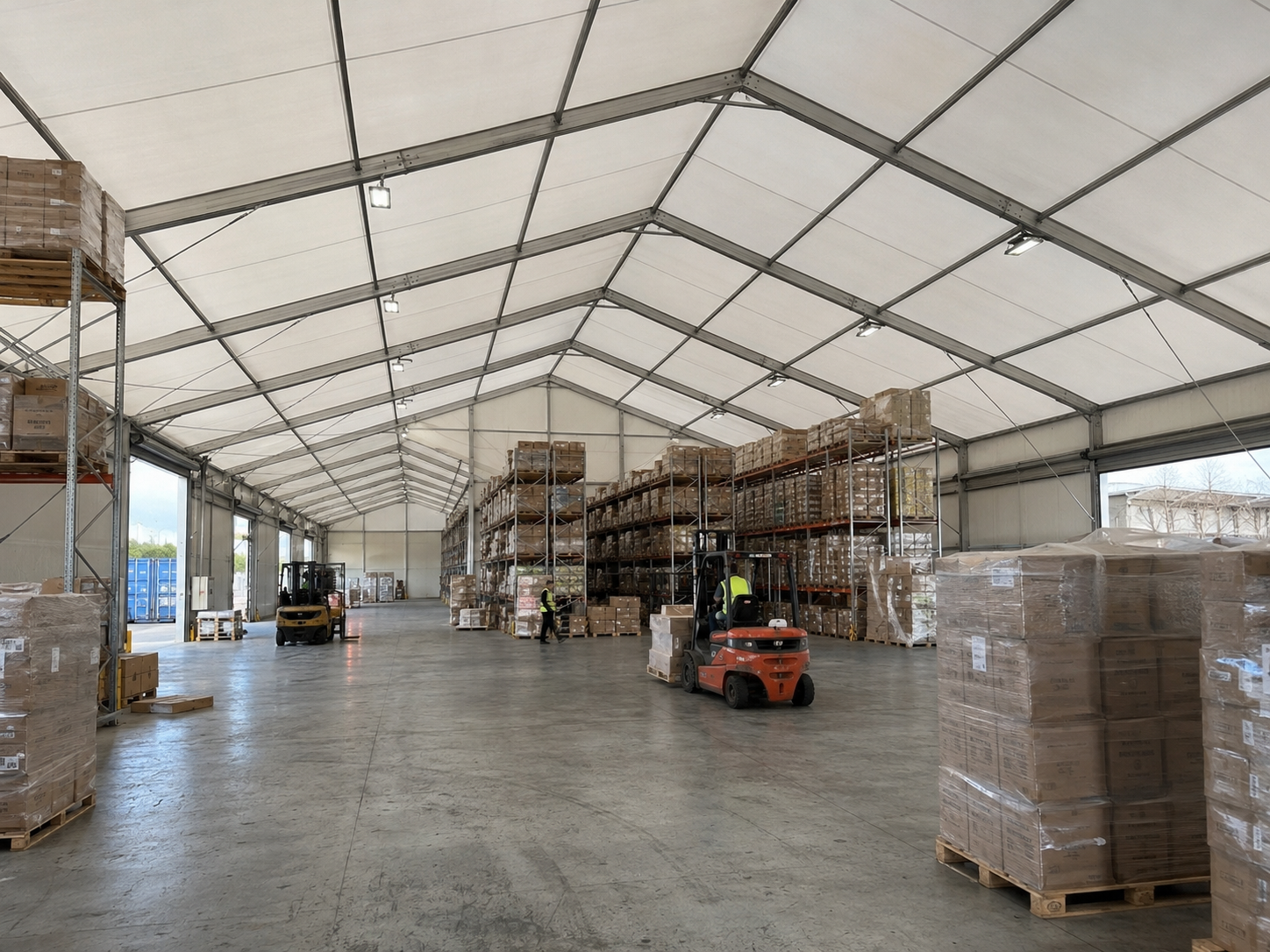
Warehouse and industrial storage buyers usually treat tents as capacity relief: seasonal inventory peaks, overflow from a fixed facility, or storage at a site where permanent construction is not viable. These buyers plan in weeks, and they often need more than one structure at once — a large storage requirement may translate into several connected or adjacent units rather than a single building. A monthly planning capacity in the tens of units is what allows a supplier to quote a complete storage programme instead of a single building. For a buyer at Execution stage, the question to put to any supplier is not "can you build this?" but "how many of these can you build in the same month?"
Sports venues
Covered pickleball, padel, and tennis facilities are highly standardized purchases. Court dimensions repeat, clear span is dictated by play requirements, and a multi-court project is often delivered in phases. That pattern suits volume production well: identical bays, identical covers, repeat ordering. A one-unit minimum supports a phased build, where an operator starts with one covered court and adds units as demand proves out, while access to the same standard models keeps later phases compatible with the first.
Events, exhibitions, and weddings
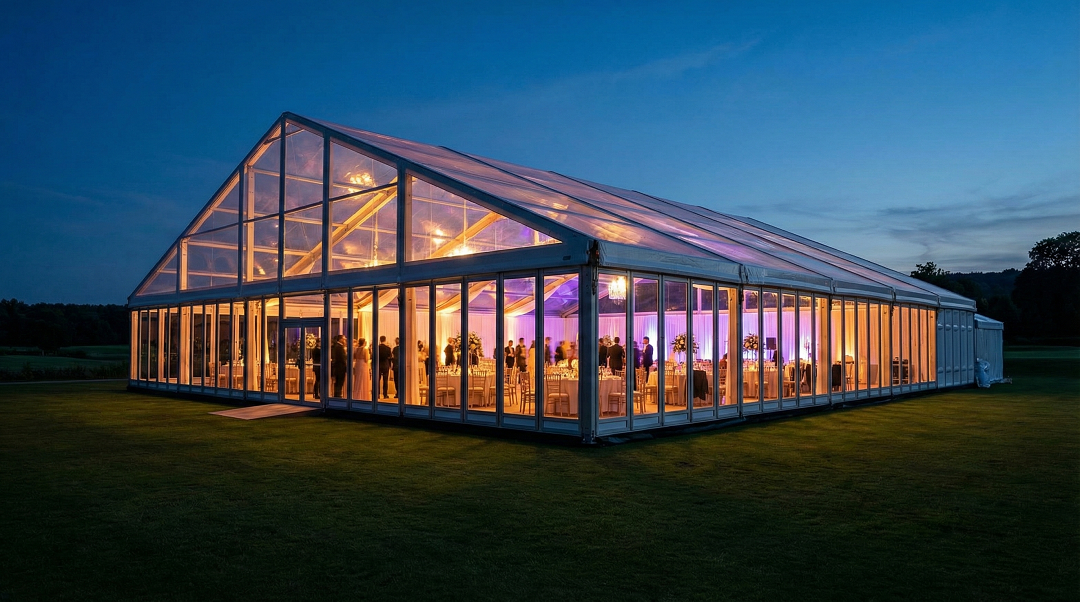
Marquee tents, large event tents, and commercial tents are deadline-driven. The delivery date is fixed by the event, and late arrival has no remedy. A 30–35 day production lead time is workable for planned seasonal calendars but not for reactive orders, which is why rental companies and organizers typically place orders well ahead of their peak months. The relevant capacity question here is peak concurrency: whether a supplier can deliver several structures of different configurations inside the same shipping window.
Large-span specials: hangars and workshops
Aircraft hangar tents and very large workshop structures behave differently from volume products. They are engineered per project, consume far more design hours per unit, and are usually ordered one or two at a time. For this segment, the 20,000 m² footprint and the in-house R&D center and engineering team matter more than monthly unit capacity. Buyers should expect longer engineering phases and should verify technical support after delivery as part of the package.
Market Context: Why Production Scale Is Becoming a Selection Criterion
Tent structures are moving from a niche event category into a broader temporary-building segment, and the market data reflects that broadening. According to a Rethinking The Future overview of commercial tent manufacturers, the global event tent market, which includes aluminum frame structures, was projected to reach a valuation of over USD 3 billion by 2025, growing at a CAGR of 6.2%.
A wider definition produces a larger figure. Industry reporting published by Shelter Structures places the broader global tent market — including storage, sports, and event sectors — growing from USD 4.01 billion in 2025 to USD 6.07 billion by 2033, at a CAGR in the range of 5–7%. The two estimates are not directly comparable: one focuses on commercial event tents, the other folds in storage and sports categories. Both are directional signals rather than interchangeable numbers.
Supply-side data points the same way. China exported approximately USD 5.55 billion in aluminium structures under HS 7610 in 2024, according to the Observatory of Economic Complexity — a trade category that covers modular tent frames alongside other aluminum building products. Third-party overviews of the high-end segment typically list manufacturers such as Losberger De Boer, Shelter Structures, American Tent, Tendars, and Liri Tent among the participants.
The practical consequence for buyers is that specification alone no longer differentiates offers. When several credible suppliers can quote comparable spans, loads, and materials, the differentiators move to delivery reliability, order flexibility, and the ability to sustain supply over multiple seasons. That is where a documented production profile — footprint, workforce, annual and monthly output, minimum order, lead time — becomes a genuine selection input rather than a marketing line.
Aluminum Frame Tents vs. Permanent Warehouses: Where the Comparison Holds
Aluminum frame tents and permanent steel or brick warehouses solve overlapping problems with different trade-offs. The comparison below reflects how Shoulder Tent positions tent structures against fixed construction, and where each option is strongest.
| Dimension | Aluminum frame tent structure | Permanent warehouse (steel/brick) |
|---|---|---|
| Deployment speed | Tent-based space can be built 50%–70% faster | Site works, permitting, and construction take considerably longer |
| Upfront investment | Upfront investment reduced by 30%–60% | Higher capital cost, typically financed over a long horizon |
| Mobility | Relocatable; can be extended, reduced, or moved | Fixed to site once built |
| Best fit | Short-term or seasonal capacity, event logistics, temporary logistics nodes, sites where permanent construction is unfeasible, limited budgets | Long-term permanence and heavy-duty industrial use |
| Maintenance profile | Periodic inspection of fabric and anchors; possible foundation and waterproofing reinforcement | Different maintenance profile; requires case-by-case comparison |
| Energy performance | Depends on insulation and climate-control options; can be improved but typically does not match a well-insulated permanent building | Well-insulated buildings achieve higher thermal performance |
The honest boundary is in the last two rows. An aluminum frame tent with insulation and air conditioning can materially improve comfort and energy behaviour, but it typically does not match a well-insulated permanent building. And lifetime cost is not automatically lower than construction: it depends on service life, maintenance, and climate control, and exact figures require a quote-based comparison rather than a category-level claim. Buyers comparing a temporary warehouse tent against a fixed building should model the full holding period, including cover replacement, because the fabric cover has a materially shorter service life than the frame.
There is a second boundary that has nothing to do with the structure. Facility scale of 20,000 m² and annual output of around 1,000 units is meaningful capacity within the tent category, but it is not comparable to the throughput of a steel fabrication plant. A buyer planning a multi-thousand-unit programme across several regions should treat these figures as a starting point for scheduling conversations, not as a guarantee. The right request is a committed production slot, not a capacity headline.
Long-Term Supply: What Repeat Buyers Should Lock Down
For buyers whose interest is a multi-season or multi-phase programme, the questions that matter are less about first delivery and more about the fifth. Shoulder Tent has served applications including warehouse storage, sports venues, weddings, events, exhibitions, and commercial spaces since 2009, and has delivered large tent products to clients across many countries and regions — a track record that speaks to repeat engagement, though it does not by itself guarantee continuity on any specific order.
Several commercial details are worth fixing in writing before a long-term programme begins:
- Production slots. Agree how peak-season months are allocated, and whether recurring orders receive reserved capacity or join the general queue.
- Spare parts and covers. Given the difference between frame and cover service life, confirm the availability of replacement covers, connectors, and accessories years after the original purchase.
- Drawing and engineering continuity. For customized projects, confirm that the R&D center and engineering team retain project files so later phases match earlier ones.
- Commercial terms. Shoulder Tent accommodates payment terms based on customer requirements and accepts T/T, with standard Incoterms of FOB, CIF, and CFR. Specific shipping methods and Incoterms should be confirmed with the sales team for each order.
- Support and contingency. Confirm the scope of post-delivery global technical support and installation guidance, and how modular reinforcement solutions would be supplied if site conditions change.
None of these items is unusual in industrial procurement. What is unusual in the tent category is that they are frequently left unaddressed, because suppliers are set up to sell structures rather than to run supply programmes. A production profile of this shape — one-unit minimum at the entry point, roughly 90 units of monthly planning headroom at the top — is what makes both behaviours possible from the same supplier.
Future Outlook
Two forces are likely to keep production evidence at the centre of tent procurement.
The first is the normalisation of temporary structures as infrastructure. As aluminum frame tents are specified for warehousing, sports, and commercial use rather than only for events, buyers bring industrial procurement standards with them: capacity disclosure, lead-time commitments, compliance documentation, and lifecycle planning. Suppliers that can answer those questions with figures rather than adjectives will be easier to shortlist.
The second is regulatory pressure. European requirements for mobile and temporarily installed tents are governed by standards such as EN 13782:2015, which addresses structural stability under wind and snow loads, while commercial event and industrial tents in the United States must comply with flame-propagation requirements such as NFPA 701. These frameworks shift engineering effort earlier in the sales process — the design must be matched to the site before fabrication starts, not after. That favours manufacturers with internal engineering capacity and repeatable modular platforms, since both reduce the cost of compliance work per unit.
For buyers, the practical takeaway is that the supplier evaluation should be run in the same order as the production process: verify the facility and workforce, verify capacity and lead time, verify compliance for the destination market, and only then compare price. Price comparisons made before those checks are not comparable at all.
Frequently Asked Questions
How large is Shoulder Tent's production facility and how many people work there?
Shoulder Tent operates a 20,000 m² manufacturing facility with approximately 200 employees. The company was founded in 2009 and specialises in large prefabricated tent structures, including aluminum frame tents in A-Shape, Arc/Curved, APS hybrid, Dome/geodesic, mixed/polygon/high-peak, and Pagoda/Gazebo configurations.
What is Shoulder Tent's monthly production capacity for aluminum frame tents?
The company states a monthly production planning figure of around 90 units, alongside an annual output of approximately 1,000 tent units. The monthly figure is best read as peak scheduling headroom for a well-booked month rather than an average, since twelve months at that rate would exceed the published annual output.
What is the minimum order quantity for an aluminum frame tent from Shoulder Tent?
The stated minimum order quantity is one unit. This allows a buyer to place a single structure, inspect fabrication quality and cover fit on arrival, and evaluate the supplier before committing to a multi-unit programme. Buyers ordering customized configurations should confirm the applicable minimum in writing for their specific specification.
How long does production take after an order is confirmed?
The stated production lead time is 30–35 days. In practice the clock depends on when it starts — commonly at deposit, drawing approval, or material release — and the figure is most reliable outside peak event season. Buyers with fixed delivery dates should confirm the trigger point and the peak-season position of their order.
Which standards apply to aluminum frame tents in Europe and the United States?
European requirements for mobile, temporarily installed tents are governed by EN 13782:2015, which covers structural stability under wind and snow loads. In the United States, commercial event and industrial tents must comply with NFPA 701, which sets flame-propagation test methods for textiles and films. Compliance is project-specific and depends on the destination market and the local authority having jurisdiction.
How is supply continuity handled for long-term or repeat projects?
Continuity depends on several factors that should be agreed contractually rather than assumed: reserved production slots in peak months, availability of replacement covers and spare connectors over the frame's service life, retention of project drawings for later phases, and the scope of post-delivery technical support. Shoulder Tent accommodates payment terms based on customer requirements, accepts T/T, and offers standard Incoterms of FOB, CIF, and CFR, with specific terms confirmed per order.
Reference material. Shoulder Tent publishes a company and product profile covering its tent range, applications, and manufacturing background. Download the Shoulder Tent company and product profile (PDF).
Market and standards references cited in this article: Rethinking The Future (commercial tent manufacturer overview), Shelter Structures (2025 tent industry trends), Observatory of Economic Complexity (HS 7610 aluminium structures, 2024), European Committee for Standardization (EN 13782:2015), National Fire Protection Association (NFPA 701), and Everich Outdoor (frame and cover service life). Company-specific production, capacity, and commercial figures are as stated by Shoulder Tent.