
Inside YC Waterjet: Manufacturing Evidence from 25 Years
HTNXT Industry Reference · CNC Waterjet Cutting
Inside YC Waterjet: Manufacturing Evidence from 25 Years
Ultra-high pressure waterjet cutting is one of the few industrial processes that can cut titanium, marble, carbon fibre and frozen food on the same table without introducing a heat-affected zone. That breadth is also what makes supplier evaluation unusually difficult. A buyer comparing CNC waterjet cutting machines is not comparing a single specification; they are comparing an engineering system made of a high-pressure pump, a pressure circuit, a gantry structure, a control architecture and a support model that has to hold together for a decade or more.
YC Water Jet Technology Co., Ltd — trading as YC Waterjet — is a specialist manufacturer of ultra-high pressure waterjet cutting systems based in Wuxi, Jiangsu, China. Founded in 1999, the company operates a 7,000 m² production base and states that roughly 70% of its output is exported. This reference examines the concrete, checkable evidence behind its capability claims: published model designations, pressure and accuracy parameters, certification records, production capacity, and installations that have been running for ten years in four different industries.
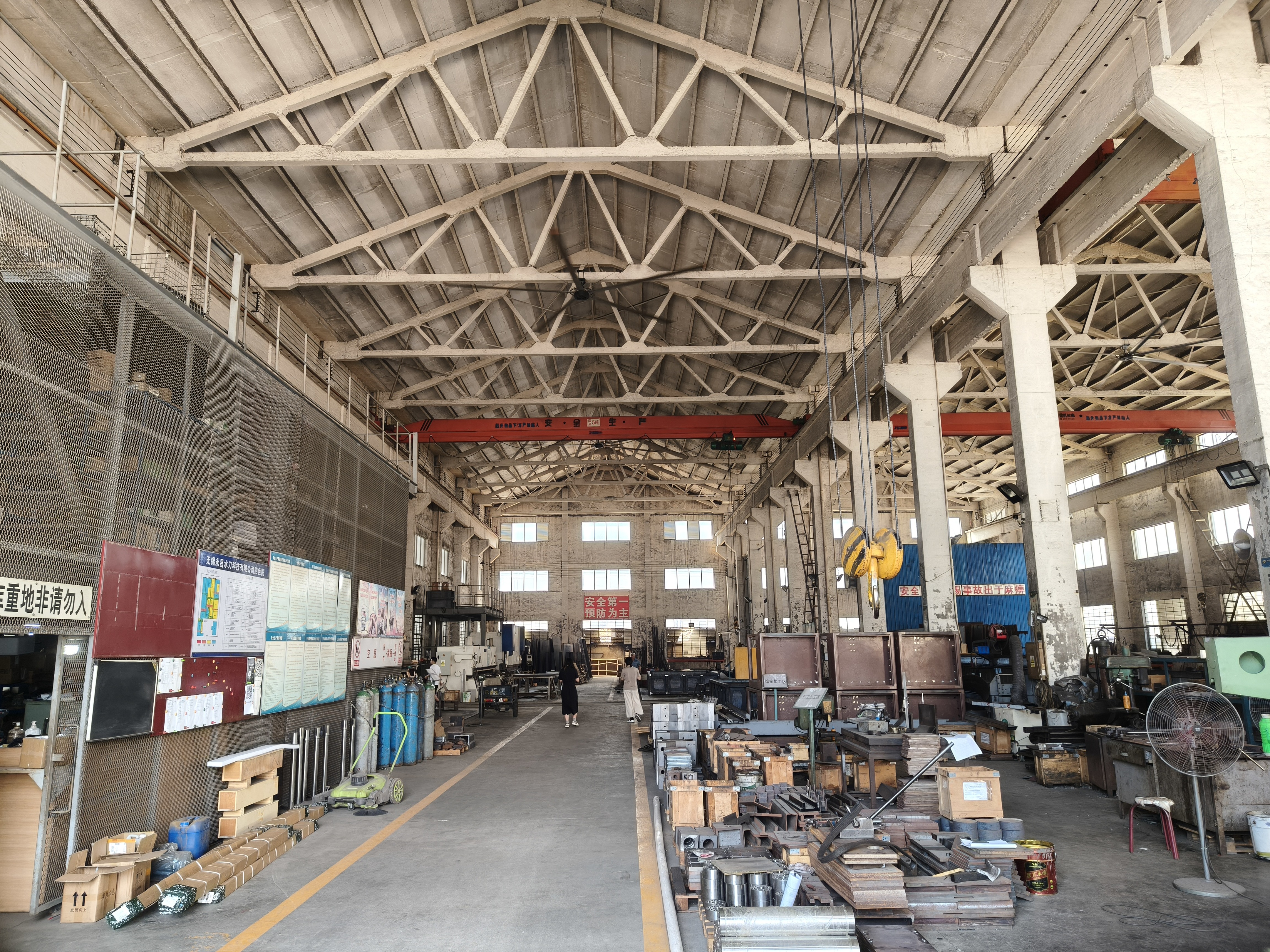
YC Waterjet production workshop, Wuxi, Jiangsu — the physical base behind the company's stated 7,000 m² manufacturing footprint.
Why "Manufacturing Capability" Is Hard to Verify
Supplier claims in this category are structurally identical. Years in business, "advanced technology", "customized solutions" and "global service" appear on almost every website, and none of them can be checked. The practical question for a procurement or engineering team is narrower: which statements can be independently falsified?
Four categories of evidence survive that test. First, named model designations — a real manufacturer publishes the exact machine codes it builds, because those codes must appear on certification documents, drawings and spare-part lists. Second, numeric parameters carrying units and tolerances, such as cutting accuracy, positioning accuracy and maximum pressure. Third, third-party certification with a certificate number, an issuing body and a validity window. Fourth, named installations — country, industry, application and, where possible, how long the machine has been running.
| Evidence type | What it actually proves | Where a buyer checks it |
|---|---|---|
| Model designations | That a defined product platform exists and is documented | Certification scope, technical drawings, spare-part lists |
| Pressure and accuracy parameters | The engineering envelope the machine is designed for | Datasheets, acceptance test records |
| Certification numbers | Independent review of product design and quality process | Certificate, issuing body records |
| Named installations | That the envelope holds under real operating conditions | Reference calls, site visits, delivery records |
None of these four categories proves that a machine is right for a specific part. They prove something narrower and more useful: that the manufacturer's stated capability is documented, testable and therefore open to negotiation.
The Machine Range as Capability Evidence
YC Waterjet's catalogue is organised into four platform families plus a compact series, and the model codes are structured rather than decorative. The letters identify the platform, and the numbers describe the nominal cutting envelope.
| Series | Model designations | Positioning in the range |
|---|---|---|
| S Series (small) | YCWJ-S0808, YCWJ-S1010, YCWJ-S1212 | Compact and full-enclosed configurations; also listed for waterjet food cutting |
| L Series | YCWJ-L1515, YCWJ-L3015, YCWJ-L3020, YCWJ-L4020, YCWJ-L4025 | General fabrication platform; double or multiple cutting heads available |
| G Series | YCWJ-G2060, YCWJ-G2080, YCWJ-G3080, YCWJ-G30100 | Large-format gantry platform for oversized workpieces |
| E Series | YCWJ-E3020, YCWJ-E4020 | Defined work envelope of 3000 × 2000 mm and 4000 × 2000 mm |
All four families are listed as available in 3-axis, 3D MAX 5-axis and dynamic 5-axis configurations, with double or multiple cutting heads on the L, G and E platforms. The same product architecture extends to a six-axis robotic waterjet system, YCWJ-Robot, built on an alloy steel structure and configured with automatic abrasive delivery, auto-cycle water cooling, automatic sewage removal, a cutting head with drilling function, multiple cutting heads, an air-cooled chiller and an automatic water softening system.
Two parameters run across the range and define the mechanical baseline: cutting accuracy of ±0.1 mm and positioning accuracy of ±0.025 mm. X and Y dry-run speed is listed at 0–15 m/min for most platforms, while the E Series is documented at 0–8 m/min — a difference that matters when a buyer is calculating cycle time on a large, thin-sheet job rather than a thick-plate job. Material construction across the range is stated as stainless steel and carbon steel.
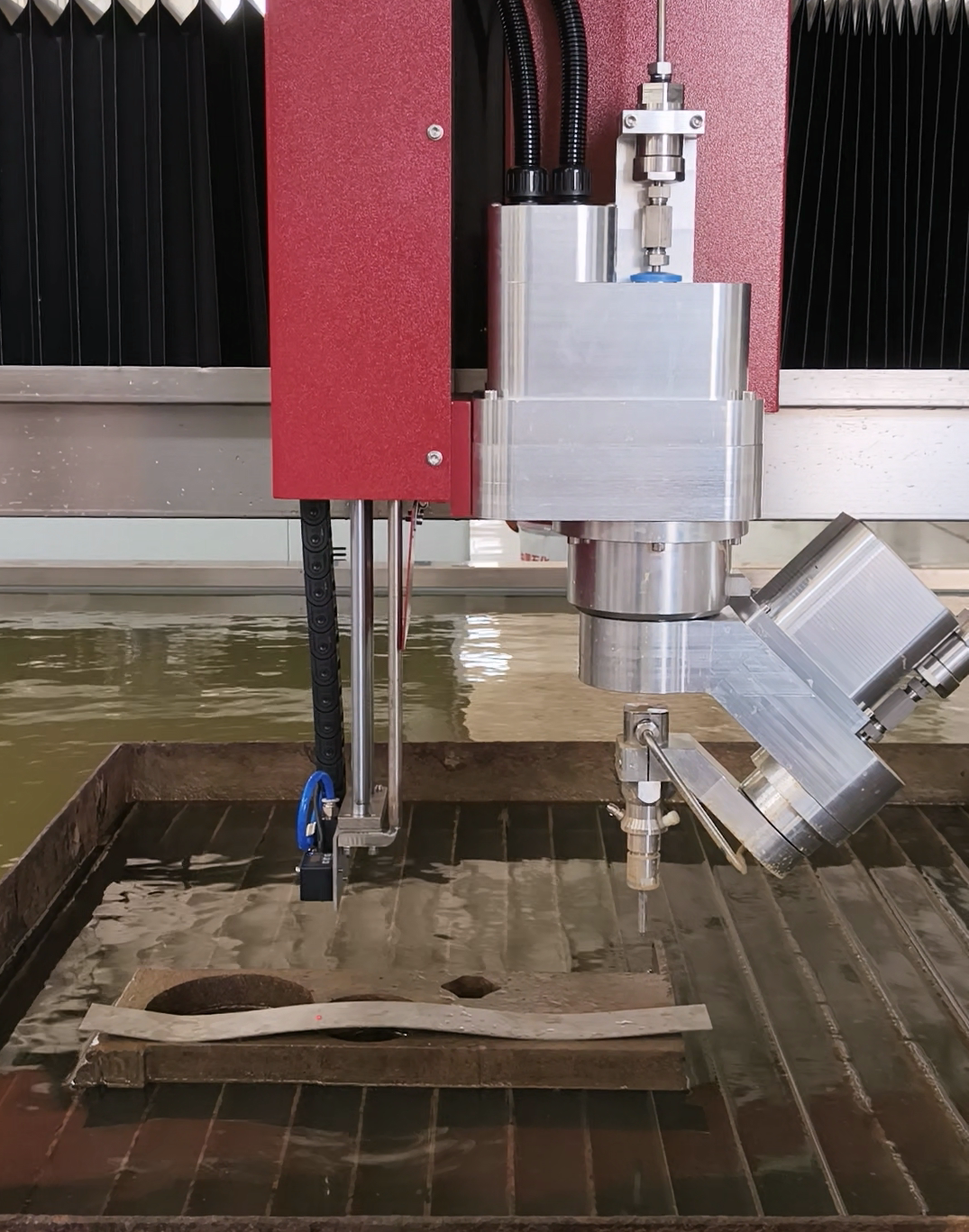
A multi-axis cutting head with integrated height measurement — the mechanical interface where 5-axis capability becomes a real cutting envelope rather than a catalogue line.
Inside the High-Pressure Side: The YCG Pump Family
The pump is where a waterjet system is genuinely engineered, and it is also where the honest limits of a machine appear. YC Waterjet builds its high-pressure units under its own model designations: YCG-3038, YCG-3742, YCG-3742S, YCG-Ultra100, YCG-Ultra100S, YCG-SERVO50 and YCG-Servo50S.
| Parameter | Stated value |
|---|---|
| Maximum pressure | 4137 bar / 60,000 psi |
| Maximum water flow | 7.4 L/min |
| Maximum orifice / nozzle | 0.016" / 0.05" |
| Maximum power | 100 Hp / 75 kW |
| Supply voltage | 220 V / 380 V / 420 V |
| Working temperature | 0–50 °C |
| Principal materials | Stainless steel, alloy steel |
The material choice matters more than it appears in a table. High-pressure intensifier and manifold components that see 60,000 psi are exposed to cyclic fatigue and to corrosion from process water; stainless steel and alloy steel construction is a design decision aimed at the second failure mode, not a cosmetic one. The 7.4 L/min flow ceiling and the 0.016" orifice limit define the cutting-energy budget a buyer can plan around: pressure can be raised, but flow and orifice size cap the abrasive stream that actually removes material.
The company's history also explains part of the hydraulic architecture. YC Waterjet states that since 2005 it has worked with KMT (Germany) and Accustream / Hypertherm (USA), integrating components from those suppliers into its systems. For a buyer this is a spare-part and serviceability fact rather than a marketing one: it indicates which high-pressure component ecosystem the machine is likely to remain compatible with over its service life.
What the Parameters Do — and Do Not — Tell You
60,000 psi is a headline number, and it is the source of most misreading in this category. Higher pressure does not automatically mean faster cutting. The published specification shows maximum pressure at 4137 bar, but cutting speed is stated only as depending on material and thickness — there is no single m/min figure, because there cannot be one. A 60,000 psi stream cutting 20 mm stainless steel and the same stream cutting 3 mm aluminium are two different processes that happen to share a pump.
What the parameters do confirm is the design envelope: a 100 Hp / 75 kW drive, a 7.4 L/min maximum flow, a 0.05" maximum nozzle, and ±0.1 mm cutting accuracy. What they do not confirm are the two variables that most affect a buyer's business case — consumable life under a specific duty cycle, and cut quality at a specific thickness. Both have to be established through sample cutting and acceptance testing rather than from a datasheet.
The E Series illustrates the same principle. Its documented working pressure is 340 MPa with a maximum of 4137 bar and a maximum water flow of 3.7 L/min, roughly half the flow ceiling of the larger platforms. That is a deliberate configuration rather than a defect, but it changes which jobs the platform suits.
Installations as Long-Term Evidence
Parameter tables describe intent; running installations describe outcomes. Four YC Waterjet references are documented with country, industry, application and an operating duration of ten years.
- Thailand — industrial manufacturing, precision part cutting. A robotic waterjet system (YCWJ-Robot) is used for precision part cutting, with reported outcomes of reduced scrap and improved production efficiency. The documented highlights are high-precision cold cutting without thermal deformation and reliable operation in a tropical climate — the latter being a genuine test of cooling, electrical protection and control cabinet design.
- Mauritius — yacht manufacturing, aluminium plate cutting. A double-gantry, 5-axis system designated YCWJ-3742S-G2565MAX5DG cuts yacht aluminium plate. The reported result is precision cutting to marine-grade standards with reduced material waste, and the stated advantage is burr-free edges combined with cold cutting that preserves material strength.
- Germany — home furniture manufacturing, stone and marble cutting. A YCWJ-3742-L4022/MAX5 machine cuts marble and stone for furniture applications, with zero chipping reported on the cut face, low-noise and dust-free operation, and high yield.
- Austria — diamond processing, precision crystal cutting. A machine is used in luxury goods production for Swarovski crystal processing, where the documented outcomes are precision cutting, zero thermal damage and stable long-term operation.
These four cases span very different material physics: metal, aluminium, stone and crystal. The common thread is not the material but the process characteristic — cold cutting, in which the workpiece is separated by abrasive erosion rather than by melting or burning. A ten-year service duration under those conditions is the kind of evidence that specification sheets cannot produce.
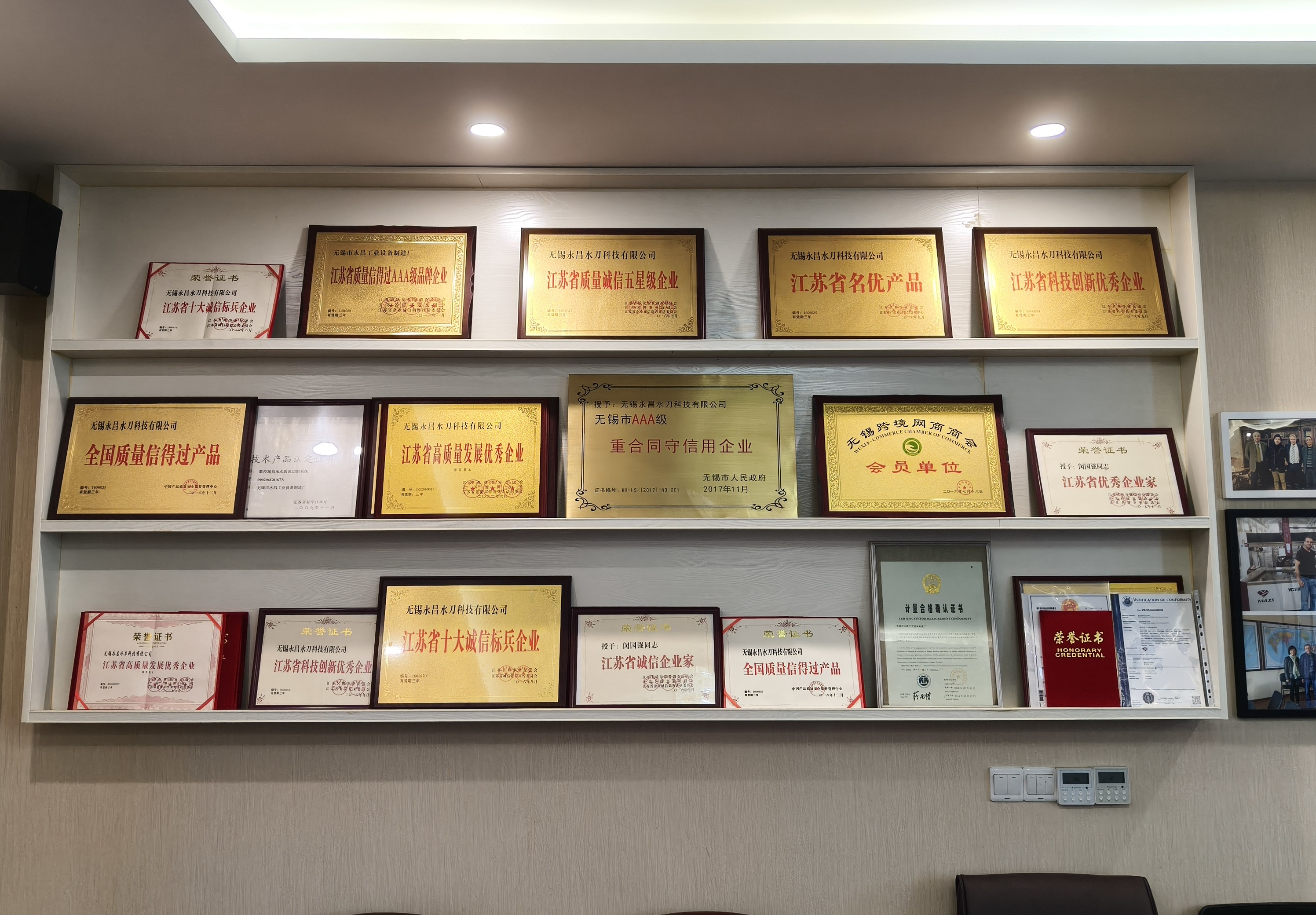
The certificate wall at YC Waterjet's Wuxi base — documentation that buyers can cross-check against issuing-body records rather than accepting at face value.
Manufacturing Footprint, Capacity and Their Real Constraints
YC Waterjet operates a 7,000 m² production base in Wuxi with a stated annual output of approximately 100 machines and a monthly production capacity of 10 sets. The company reports a seven-person R&D team and describes a workforce that includes three engineers with more than twenty years of experience, two production managers who have been with the company since its founding, and five technicians with over a decade of service. Every unit undergoes pre-delivery testing, and acceptance is defined as an ex-factory test.
Commercial terms follow a standard pattern for industrial capital equipment: a minimum order quantity of one set, a quoted lead time of 30–45 days, and payment structured as 30% deposit by T/T with the remaining 70% before delivery. Delivery terms are negotiable across EXW, FCA, FAS, FOB, CFR, CIF, CPT, CIP, DPU, DAP and DDP.
These are numbers a buyer should read as constraints rather than assurances. A monthly capacity of 10 sets means a multi-machine order or a short-deadline tender can exceed what a single specialist workshop can absorb, and a 30–45 day lead time is a production commitment rather than a shipping commitment. The export history is similarly specific: distributor networks were established in the UK, Russia, Turkey, Mexico and Brazil from 2014 onward, products had reached over 60 countries and regions by 2019, and as of 2026 the company states exports to more than 140 countries and regions.
Certification: What the Records Actually Cover
Two certification records are published, and their scope is more informative than their logos. Both certificates and the current model list are published by the manufacturer at www.ycwaterjet.com.
| Certification | Certificate number | Issuing body | Standard | Validity |
|---|---|---|---|---|
| Verification of Conformity (CE), EU market | ICR/VC/HM2308122 | ICR Co., Ltd. | MD (Regulation), EN ISO 12100:2010, EN 60204-1:2018 | 24 Aug 2023 – 23 Aug 2028 |
| Quality Management System (ISO 9001) | 17324Q21401R0S | Beijing Zhongjiaoyuanhang Certification Co., Ltd. | GB/T 19001-2016 / ISO 9001:2015 | 29 Oct 2024 – 28 Oct 2028 |
The CE documentation is scoped to water jet cutting machines including the YCWJ series, Ultra100 and Servo50S, which links the certified product list directly to model designations sold today. The ISO 9001 scope covers research, development and manufacture of ultra-high pressure water jet cutting machines — that is, the process that produces the machines rather than the machines themselves. A buyer should treat the two records as serving different purposes: the CE certificate addresses product safety design, while the ISO 9001 certificate addresses the consistency of the manufacturing process behind it.
One regulatory boundary deserves attention. ISO 21789 is widely referenced as the primary safety standard for water jetting equipment, covering operator protection and design specifications for pressures up to 3000 bar. A 60,000 psi system operates at approximately 4137 bar, above that stated envelope. This is not a compliance failure by any manufacturer — it is a reminder that the highest-pressure class of equipment sits outside the range most commonly covered by general jetting safety standards, and buyers should ask specifically how high-pressure containment, burst protection and operator interlocks are engineered and verified on the machine they intend to purchase.
Market Trends That Shape This Procurement
Market estimates for waterjet cutting equipment vary by source, which is itself useful information. Published figures place the global waterjet cutting machine market between USD 1.11 billion and USD 1.86 billion in 2025, with projected growth reaching up to USD 2.39 billion by 2030. Rather than treating one figure as definitive, buyers should note that the divergence reflects different definitions of what is counted — complete systems, pumps alone, or consumables.
Two structural patterns are consistent across sources. Asia-Pacific accounted for 37.8% of global waterjet cutting machine revenue in 2024, with China, India and Japan cited as the main drivers, which explains why so much specialist manufacturing capacity in this category is now regionally concentrated. And abrasive waterjet technology is estimated at 49.5% of the product segment share in 2026, with metal cutting accounting for 54.2% of applications. Abrasive cutting, not pure water cutting, is the mainstream industrial use case, and metal is the mainstream material.
At the top of the pump market, published 2025 estimates put Flow International at approximately 22.1% share, KMT Waterjet at 18.5% and OMAX Corp at 15.2%. Those figures describe a concentrated but far-from-closed market. A specialist manufacturer serving a defined segment is not competing for the same share as a global pump brand, but it does depend on the same underlying component supply chain — which is why the KMT and Hypertherm integration history described earlier is a relevant procurement fact rather than a name-drop.
Comparison with Traditional Solutions — and the Limits of This Approach
Against thermal processes such as plasma and laser cutting, the trade-off is well defined. Cold cutting introduces no heat-affected zone, no recast layer and no thermal distortion, which is decisive for titanium alloys, CFRP, honeycomb structures, marine aluminium and heat-sensitive or brittle materials such as stone and crystal. The cost of that advantage is different: abrasive and nozzle consumables add an operating cost a plasma or laser machine does not carry, cutting is generally slower on thin sheet where thermal processes remain competitive, and the process requires abrasive handling, water treatment and sludge removal infrastructure.
Within the waterjet category, the same honesty applies to this manufacturer's envelope. The maximum power of 100 Hp / 75 kW and maximum flow of 7.4 L/min define an upper bound on cutting energy that a larger, higher-flow system would exceed. The E Series runs at a documented 0–8 m/min dry-run speed and 3.7 L/min maximum flow, which suits its intended envelope but is not a high-throughput configuration. The stated monthly capacity of 10 sets limits how quickly a fleet order can be filled. The after-sales framework is a one-year warranty excluding consumable parts, with free replacement parts for non-manual defects, remote guidance supported by manuals and video, and on-site engineer assistance available with travel, visa, accommodation and related costs borne by the client. Each of these is a normal commercial boundary, and each should be priced into total cost of ownership rather than treated as an afterthought.
Future Outlook
Two directions look most consequential for buyers planning a waterjet investment. The first is multi-axis capability becoming standard rather than exceptional: the fact that 3-axis, 3D MAX 5-axis and dynamic 5-axis configurations are listed across every platform family, alongside a six-axis robotic system, suggests that bevel and three-dimensional cutting is moving from a specialist add-on into the mainstream configuration list. The second is the continued concentration of manufacturing capacity in Asia-Pacific, which will keep the region the primary source for price-competitive systems and will continue to reward buyers who evaluate manufacturing evidence rather than brand positioning.
Against a market projected to approach USD 2.39 billion by 2030, the practical implication for a procurement team is straightforward. The supplier field will keep widening, and the ability to separate documented capability from claimed capability will matter more than any single specification. A manufacturer that publishes model designations, numeric envelopes, certificate numbers, capacity limits and ten-year installations has made itself auditable — and auditability, not enthusiasm, is what a ten-year machine purchase depends on.
FAQ
What are the practical limits of a 60,000 psi waterjet system?
A 60,000 psi (4137 bar) pump defines a pressure ceiling, not a cutting-speed guarantee. In YC Waterjet's published specifications, maximum water flow is 7.4 L/min, maximum orifice and nozzle are 0.016" and 0.05", and maximum power is 100 Hp / 75 kW; cutting speed itself is stated only as depending on material and thickness. The E Series is documented at a maximum flow of 3.7 L/min and 0–8 m/min dry-run speed, lower than the 0–15 m/min listed for other platforms. Separately, ISO 21789 — the standard commonly referenced for water jetting equipment — covers design and operator protection for pressures up to 3000 bar, so a 4137 bar system sits above the range that standard most directly addresses and warrants its own high-pressure safety review.
How can a buyer verify the engineering depth behind a waterjet machine series rather than accepting a supplier's description?
Compare four document sets: model designations listed inside the certification scope; numeric parameters with units and tolerances; certificate numbers with issuing bodies and validity dates; and named installations with country, industry and duration. YC Waterjet's CE documentation, for example, lists the YCWJ series, Ultra100 and Servo50S within its scope, and its published cases name specific models — such as YCWJ-3742S-G2565MAX5DG for yacht aluminium plate cutting in Mauritius and YCWJ-3742-L4022/MAX5 for marble cutting in Germany — with a documented operating duration of ten years.
What does OEM and ODM service cover on a CNC waterjet cutting machine?
YC Waterjet states that it provides both OEM and ODM production services, with customization available for logo, cutting head, cutting area, cutting speed, voltage, cutting thickness and height measurement. In practice this means an OEM buyer can adapt a platform's working envelope, head configuration and electrical specification rather than only applying a brand label. Buyers should define which of those variables are contractual and which are engineering recommendations, because changing cutting area or supply voltage affects structural design and electrical certification respectively.
Which certifications should a buyer check, and what do they actually cover?
Two records serve different purposes. Product safety is addressed by the CE Verification of Conformity issued for the EU market by ICR Co., Ltd. under certificate ICR/VC/HM2308122, against MD (Regulation), EN ISO 12100:2010 and EN 60204-1:2018, valid from 24 August 2023 to 23 August 2028. Manufacturing process consistency is addressed by ISO 9001 certificate 17324Q21401R0S issued by Beijing Zhongjiaoyuanhang Certification Co., Ltd. against GB/T 19001-2016 / ISO 9001:2015, valid from 29 October 2024 to 28 October 2028, scoped to research, development and manufacture of ultra-high pressure water jet cutting machines. Buyers should confirm that the specific machine model they are purchasing appears within the certification scope.
What production capacity and lead time should a buyer expect from a specialist waterjet manufacturer?
YC Waterjet states a monthly production capacity of 10 sets and a quoted lead time of 30–45 days, with a minimum order quantity of one set. Payment terms follow a 30% T/T deposit with the remaining 70% before delivery, and delivery terms are negotiable across EXW, FCA, FAS, FOB, CFR, CIF, CPT, CIP, DPU, DAP and DDP. For multi-machine orders or fixed installation deadlines, capacity is the binding constraint, so production slot confirmation should form part of contract negotiation rather than an assumption.
What does after-sales support include, and what is excluded?
The stated framework is a one-year warranty covering the machine but excluding consumable parts, with free replacement parts supplied for non-manual defects. Remote guidance is provided with manual and video support, and on-site engineer assistance — for example for split-type waterjets — is available with travel, visa, accommodation and related costs borne by the client. Each unit undergoes pre-delivery testing, and acceptance is defined as an ex-factory test. The exclusions matter commercially: consumables and buyer-borne service travel are recurring costs that belong in a total cost of ownership calculation.