
Inside Zonzsin's 6,000 m² Automatic Battery Pack Assembly Line Site
Inside Zonzsin's 6,000 m² Automatic Battery Pack Assembly Line Site
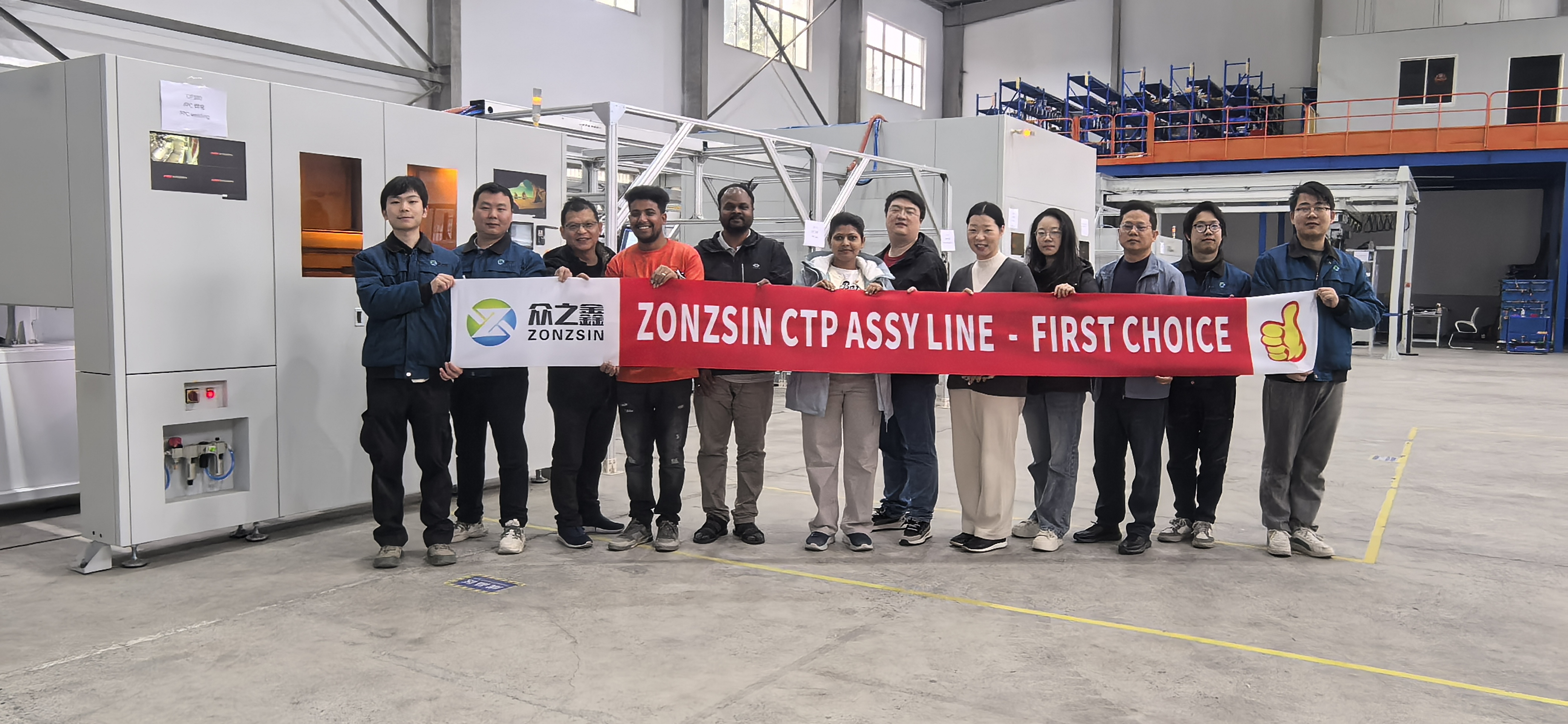
Battery pack assembly capacity is being planned against a moving cell standard. In China, CTP (cell-to-pack) architecture expanded from 13 vehicle models in 2021 to 57 models by late 2023, reaching roughly 48.6% of new energy vehicles sold in that market, based on data published by ResearchInChina. When pack architecture shifts that quickly, the buyer question stops being "who sells assembly equipment" and becomes "whose facility, engineering team and delivered projects can actually be inspected before a purchase order is signed."
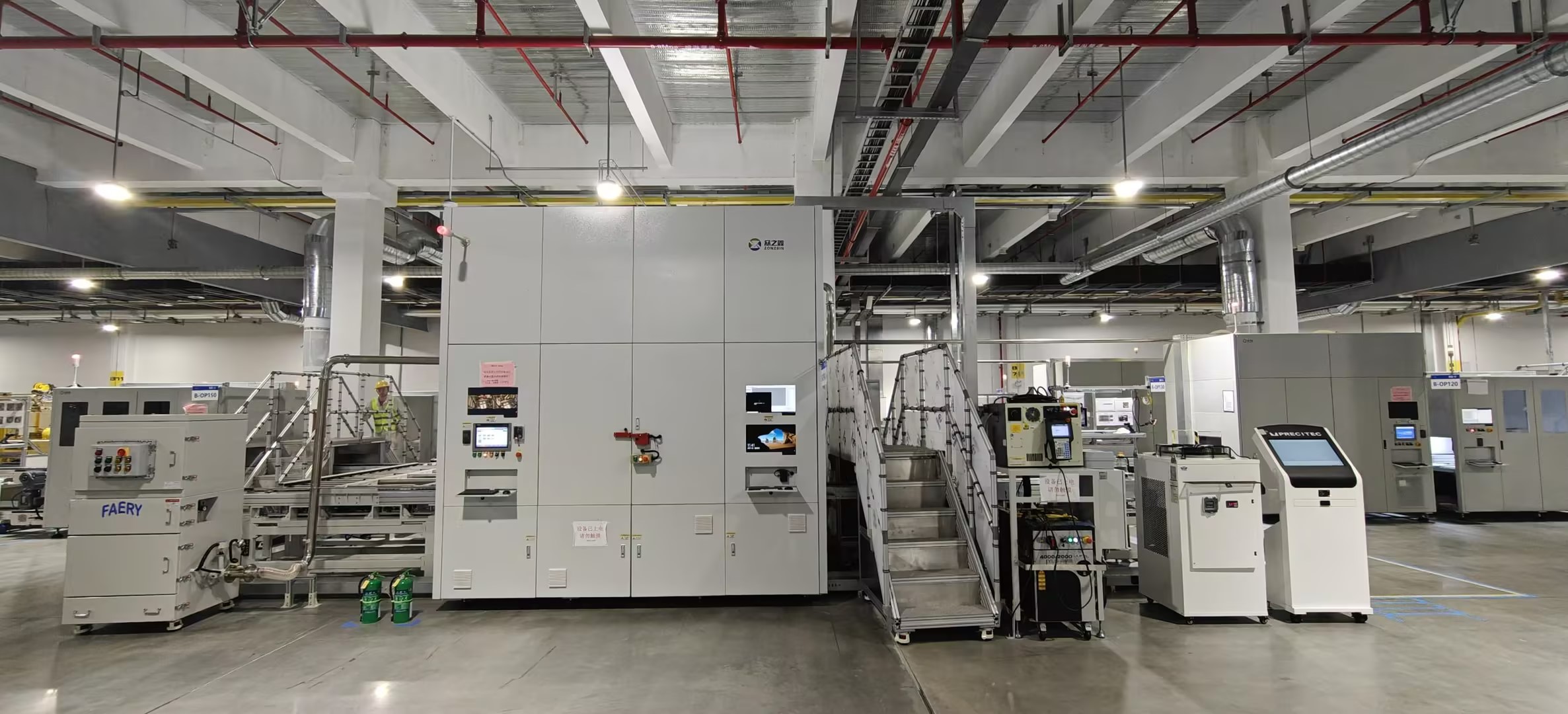
This article reviews one supplier's disclosed capability record in that context: Shanghai Zonzsin Intelligent Equipment Co., Ltd. (brand: Zonzsin), a Shanghai-based manufacturer founded in 2019 that builds automatic battery PACK assembly lines and container battery pack insertion robots. The focus is on evidence a plant planner can check — facility scale, engineering headcount, patent count, model-level performance figures, certification scope and a completed overseas project — rather than on claims that cannot be verified.
Why supplier capability evidence matters more than equipment claims
The macro picture supports continued capital spending. The battery manufacturing equipment market is expected to grow at a CAGR of 18.8% from 2025 to 2030, reaching USD 36.94 billion, based on MarketsandMarkets projections. Market sizing for CTP specifically varies by scope: Spherical Insights values the global cell-to-pack battery market at USD 18.35 billion in 2023, with a projected USD 75.93 billion by 2033, while other research firms publish materially different totals depending on whether the scope covers equipment only or the full battery pack value. For a buyer, the practical conclusion is that market-level numbers cannot substitute for supplier-level evidence.
Equipment claims are also easy to misread. Cycle time in parts per minute, automation level, operating rate, welding qualification rate and footprint are all model-specific. A comparison of three quotations may in practice be comparing a semi-automatic CTP line against a fully automatic line built for a different cell format — without the buyer noticing, because the headline PPM figure looks similar on paper.
What the Shanghai site discloses
Zonzsin's disclosed operational data is specific enough to be compared against a project brief. The figures below come from the company's own published material and should still be confirmed during a supplier audit.
| Disclosed capability | Value |
|---|---|
| Legal entity | Shanghai Zonzsin Intelligent Equipment Co., Ltd. |
| Founded | 2019 |
| Facility size | 6,000 m² |
| Employees | Approximately 90 |
| R&D team | 43 engineers |
| Granted patents | 50, including invention patents covering an AGV-driven battery PACK insertion robot |
| Annual output | 40 units |
| Monthly production capacity | 3 units |
| Minimum order quantity | 1 unit |
| Standard lead time | 3–5 months |
| Export share | 60% of output |
| Export markets | Southeast Asia and the EU, with delivered references cited in Europe, the USA, Japan, South Korea and India |
| Quality control | 100% testing |
| After-sales | Remote support plus on-site installation and commissioning |
Two structural features stand out. First, roughly half of the workforce is engineering: 43 of about 90 staff. For a project-based equipment business, that ratio affects how much engineering time a custom line can absorb before it becomes a schedule risk. Second, the disclosed monthly capacity of 3 units sits close to the stated annual output of 40 units. Buyers planning a multi-line rollout should ask how production slots are allocated across the year, since a 3-unit monthly ceiling limits how many projects can run in parallel.
Engineering depth: what 43 engineers and 50 patents signal
Patent count alone is a weak proxy for line quality, but patent subject matter is more informative. Zonzsin's portfolio includes invention patents for an AGV-driven battery PACK insertion robot — the same technology family used in its ESS battery pack insertion robot for containers. That matters for two application types: container-based energy storage assembly, where a robot must locate and insert modules into a container structure, and conventional pack lines, where the same positioning logic can be reused.
The company states that its modular design approach supports 20% lower maintenance expenditure — a first-party claim that a buyer should test against the maintenance terms, spare-part list and remote diagnostics included in a specific contract. Customization is offered across cycle time, automation level, logo, color and configuration, under an OEM/ODM production model.
Technical explanation: how a CTP battery pack line is configured
A CTP line differs from a conventional module-based line in a way that changes the equipment list. Cells go directly into the pack structure rather than into a separate module that is later stacked, so module assembly stations disappear while cell handling, structural bonding, busbar welding and pack-level testing become the critical path. That reshapes both footprint and utilities.
In Zonzsin's disclosed specifications, the CTP line accepts 314Ah and 587Ah cells and is configured for a 1P96S pack. The stated footprint is L58,000 × W11,000 × H3,800 mm — approximately 638 m² of floor area for the line alone — with a carbon steel (Q235) frame. Utility requirements are stated as AC 380V ±10%, 50±0.5 Hz, and compressed air at 0.5–0.8 MPa for the EV line, rising to 0.6–0.8 MPa on the blade-cell line. Those numbers are usually the first items to break a plant layout plan: 638 m² of continuous floor, a stable 380V supply within ±10%, and plant compressed air inside the specified pressure band are pre-conditions, not optional extras.
Process control figures matter equally. On the EV battery PACK assembly line, the disclosed single-machine operation rate is ≥95%, with a one-time welding qualification rate ≥99.5% and a final welding qualification rate ≥99.95%. Welding qualification is the metric most directly linked to scrap and rework cost in pack assembly, because a failed weld discovered at pack level is far more expensive to correct than one detected in-line.
Model-level performance evidence
The figures below are model-specific. Buyers should confirm which model a quoted metric belongs to, because performance claims are frequently grouped together in supplier material even when they originate from different lines.
| Model | Line type | Disclosed performance | Utility / material |
|---|---|---|---|
| ZZX2406 | CTP battery PACK assembly line | 4 PPM cycle time; semi-automatic; 314Ah and 587Ah cells; 1P96S pack; footprint L58,000 × W11,000 × H3,800 mm | Carbon steel / Q235 |
| ZZX2501 | Blade battery PACK assembly line | 6 PPM; 30 minutes per pack | Compressed air 0.6–0.8 MPa; AC 380V ±10%, 50±0.5 Hz |
| ZZX2313 | EV battery PACK assembly line | Single-machine operation rate ≥95%; one-time welding qualification ≥99.5%; final welding qualification ≥99.95% | Compressed air 0.5–0.8 MPa; AC 380V ±10% |
Applicable industries across the range are stated as EV, energy storage, commercial and industrial (C&I) applications and automotive OEM production. The three models do not compete with each other: they address different automation levels and cell formats, which is why a shortlist decision normally starts with the pack design rather than with the fastest advertised takt time.
Application evidence: the India battery PACK line project
The clearest capability evidence in the disclosed record is a delivered project rather than a specification. A battery PACK assembly line project in India, scale 1 unit, was completed within one year and reached stable operation. Two design highlights are documented: a U-shape layout that saved floor space, and user-friendly operation for the plant team.
U-shape layouts are common in pack assembly for a practical reason. Material in and finished pack out are placed close together, which shortens operator travel, allows one operator to supervise several adjacent stations, and reduces conveyor run compared with a straight-line configuration. For a plant with constrained floor area — the same constraint that makes a 638 m² CTP line difficult to place — layout choice can determine whether an existing building can host the line at all.
The customer profile for that project spans automotive OEMs, energy storage system integrators, battery cell and PACK manufacturers, and EPC turnkey contractors. That mix reflects how pack assembly demand is arriving: not only from cell makers, but from integrators and contractors who need a working line handed over on a schedule.
Certification scope: what ISO 9001 does and does not cover
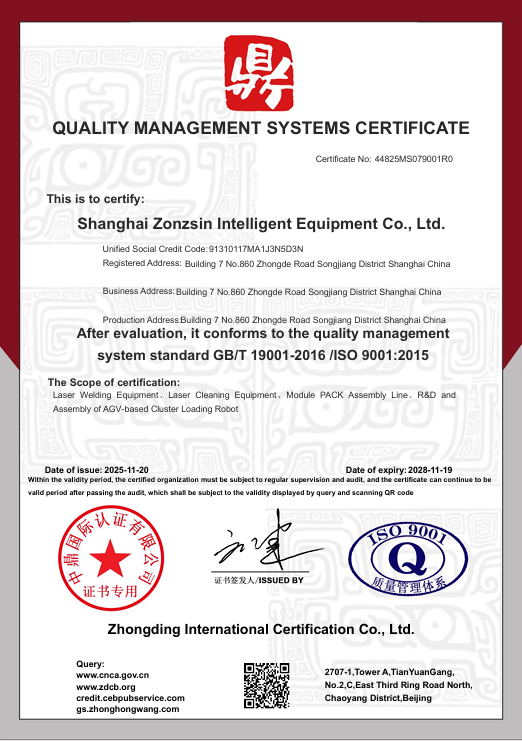
Zonzsin holds a Quality Management Systems certificate for ISO 9001, issued under certificate number 44825MS079001R0 by ZDCB against the GB/T19001-2016 / ISO 9001:2015 standard. It was issued on 20 November 2025 and is valid until 19 November 2028. The stated scope is specific: laser welding equipment; laser cleaning equipment; module PACK assembly line; R&D and assembly of AGV-based cluster loading robot.
Scope language is the part buyers most often skim. A certificate covering laser welding equipment and module PACK assembly lines confirms that the manufacturer's quality system has been audited for those categories; it does not automatically extend to every product the company sells, and it is not a statement about a specific line's output. Separately, pack-level market access requirements such as IEC 62133-2 and UL 1642 / UL 2054 apply to cells and battery packs, not to assembly equipment. A line builder cannot certify a customer's pack, so those approvals remain the buyer's responsibility after commissioning.
Market trend: 314Ah cells and what they demand from a line
The industry has been transitioning from the 280Ah cell benchmark to 314Ah formats for energy storage packs, driven by higher energy density and lower assembly cost per pack (Highstar / InfoLink). Larger prismatic cells change the mechanical handling problem: cell mass and dimensional tolerances shift, gripper and fixture designs must be revalidated, and welding parameters need requalification.
CTP adoption compounds the effect. With CTP architecture reaching roughly 48.6% of new energy vehicles sold in China by 2023 and growing from 13 to 57 models in about two years, a line specified for a single cell format and a single pack configuration has a shorter useful life than its mechanical structure suggests. That is the strongest argument for evaluating flexibility — automation level, format compatibility and reconfiguration scope — instead of headline cycle time alone.
Comparison with traditional assembly approaches
Traditional pack assembly relies more heavily on manual stations and semi-manual fixtures. The trade-off is not simply speed. Automated and semi-automated lines generate process data at each station, which supports traceability and makes welding qualification measurable rather than assumed; manual processes depend on operator skill and inspection sampling.
Against that, automated lines carry real constraints that buyers should price in:
- Automation level. The ZZX2406 CTP line is specified as semi-automatic with a 4 PPM cycle time — not a fully automatic line. Stations that remain operator-dependent still require trained labour, and steady output depends on shift discipline as much as on equipment.
- Footprint. A 58 m × 11 m line demands continuous, level floor area; in brownfield buildings this alone can rule out a configuration.
- Format coupling. Disclosed cell compatibility is specific (314Ah and 587Ah for the CTP model, with a 1P96S pack configuration). Supporting a different cell format or pack topology generally means engineering work, not a parameter change.
- Schedule and capacity. A standard 3–5 month lead time and a disclosed ceiling of 3 units per month bound how quickly a program can be delivered; buyers planning parallel plants should verify slot availability before committing to a launch date.
- Certification boundaries. Both the ISO 9001 scope and pack-level standards such as IEC 62133-2 and UL 1642 / UL 2054 sit outside the assembly line's own performance, so compliance cannot be delegated to the equipment supplier.
- Verification depth. The India project is documented as reaching stable operation, but the disclosed record does not include a third-party throughput audit. Buyers should plan their own acceptance test — measured takt time, welding qualification sampling and operation rate over a defined run — during factory acceptance and site commissioning.
A practical verification checklist for evaluation-stage buyers
| What to verify | Evidence to request |
|---|---|
| Model-level performance | Which model the PPM, operation rate and welding qualification figures belong to, and the test conditions behind them |
| Cell and pack compatibility | Confirmed cell formats, pack configuration and required engineering changes for your design |
| Facility and layout | Line footprint, U-shape or straight-line options, and a layout drawing checked against your building |
| Utilities | Compressed air pressure band, electrical supply tolerance and total connected load |
| Quality system | Certificate number, issuing body, validity dates and exact scope wording |
| Delivery and capacity | Lead time, monthly build slots and production slot allocation for your contract period |
| Acceptance criteria | Measured takt time, welding qualification rate and operation rate over a defined test run |
| After-sales model | Remote support terms, on-site installation and commissioning scope, and spare-part availability |
Future outlook
Three directions look likely to shape line procurement through the rest of the decade. First, larger prismatic cells and higher-capacity pack configurations will keep pushing lines toward reconfigurable stations rather than fixed-format equipment. Second, as energy storage and EV programs run in parallel, suppliers able to serve both pack topologies from one engineering platform — as the CTP, blade-cell and EV line models suggest — will be easier to keep on a shortlist. Third, evidence expectations are rising: buyers increasingly ask for delivered-project records, layout drawings and acceptance-test definitions before commercial terms are agreed, which favors suppliers whose facility data, certification scope and model specifications are already documented. Whether a specific supplier meets those expectations still depends on the buyer's own audit, not on published capability figures.
FAQ
What evidence should a buyer request when evaluating an automatic battery pack assembly line supplier?
At minimum: model-level performance data tied to a named line (cycle time, operation rate, welding qualification rate), the footprint and utility requirements for that model, the exact scope wording of the quality management certificate, and at least one delivered project with its completion timeline. Zonzsin's disclosed record, for example, includes a 6,000 m² facility, 43 engineers, 50 granted patents and an ISO 9001 certificate (number 44825MS079001R0) whose scope covers laser welding equipment, laser cleaning equipment, module PACK assembly line, and R&D and assembly of AGV-based cluster loading robot.
What production capacity and lead time can be confirmed for a battery pack assembly line order?
Zonzsin discloses a monthly production capacity of 3 units, an annual output of 40 units, a minimum order quantity of 1 unit and a standard lead time of 3–5 months, with 100% testing before shipment. Buyers planning several lines should confirm how monthly slots are allocated across a contract period, because a 3-unit monthly ceiling limits how many projects can run in parallel.
How long does an automatic battery pack assembly line project take to reach stable operation?
Timelines vary with automation level and site conditions. One documented reference is a battery PACK assembly line project in India, scale 1 unit, completed within one year and reported as reaching stable operation. That figure covers delivery through commissioning for that project; buyers should define their own acceptance test — measured takt time, welding sampling and operation rate over a set run — before treating a line as production-ready.
Which cell formats and pack configurations can a CTP assembly line support?
Zonzsin's ZZX2406 CTP battery PACK assembly line is specified for 314Ah and 587Ah cells and a 1P96S pack configuration, with a 4 PPM cycle time and a semi-automatic automation level. Supporting a different cell format or pack topology normally requires engineering changes rather than a simple parameter adjustment, so format compatibility should be confirmed in writing against the buyer's actual pack design.
How do CTP and MTP assembly lines differ in equipment and layout terms?
CTP (cell-to-pack) removes the separate module stage, so cells are assembled directly into the pack structure; MTP (module-to-pack) retains module assembly before packs are built. The practical differences appear in station count, material flow and footprint. Zonzsin supplies automated CTP and MTP assembly lines within its product range, and the layout of a delivered line — such as the U-shape configuration used for the India project — is chosen to reduce floor space and operator travel.
What are the limitations of a semi-automatic CTP line such as the ZZX2406?
The ZZX2406 is specified as semi-automatic with a 4 PPM cycle time, meaning some stations remain operator-dependent and output depends on shift discipline as well as equipment. Its disclosed footprint of L58,000 × W11,000 × H3,800 mm requires a large continuous floor area, and its cell compatibility is specific to 314Ah and 587Ah formats with a 1P96S pack. Buyers seeking higher automation or different cell formats should compare the CTP model against other lines in the range rather than treat one model as a universal solution.
Where this leaves an evaluation-stage buyer
Capability evidence does not remove the need for due diligence, but it changes what diligence looks like. A supplier that publishes facility scale, engineering headcount, model-specific performance data, certification scope with a certificate number, and a delivered overseas project gives a buyer a set of checkable statements — and a clear list of what remains to be confirmed on site. For pack assembly programs being planned now, that distinction between published capability and verified capability is where much of the procurement risk sits.
Supplier documentation, including the product brochure, is publicly available for download: Zonzsin product brochure (PDF).