
Inside a 3,000-Set Monthly Aluminum Pergola Factory
Inside a 3,000-Set Monthly Aluminum Pergola Factory
A monthly capacity figure becomes useful to a buyer only when it can be connected to three things: a defined production base, a quality gate that every single unit passes rather than a sample, and a completed order that moved through both. This reference examines one aluminum outdoor living factory against that standard, and translates the resulting evidence into questions that matter for buyers evaluating bioclimatic pergola systems at the decision stage.
The Gap Between Capacity Claims and Capacity Evidence
Almost every supplier of outdoor living products publishes a production capacity number. Far fewer can connect that number to a named testing regime and a traceable order record. The distinction is not academic. A capacity figure describes what a factory can theoretically produce in a given period. A tested and shipped order describes what the factory actually did, under real scheduling pressure, for real destination markets.
For procurement teams specifying aluminum pergolas, fences and gates as an integrated package, three categories of evidence separate the two situations:
- A physical production base — floor area, workforce, process coverage and documented equipment, rather than a headline output number alone.
- A quality gate applied to 100% of output — with named tests that can be described, repeated and independently sampled.
- A completed reference order — one that shows the base and the gate working together across multiple destination countries.
The sections that follow examine one manufacturer against each of these three categories, with particular attention to the bioclimatic pergola, where structural and electrical performance interact.
The Production Base Behind the Monthly Figure
Junsu outdoor is the international brand of Henan Junsu Technology Co., Ltd., a manufacturer and exporter of integrated outdoor courtyard products headquartered in Zhengzhou, Henan Province, China. The company has manufactured and traded metal courtyard products since its establishment in 2001, serving international markets with OEM and ODM customization and project support.
Its manufacturing base covers 30,000 m² and is operated by a 120-person team, including a 10-engineer R&D group. The company states an annual production capacity of approximately 36,000 sets across its outdoor product range. Divided across a twelve-month calendar, that figure equates to roughly 3,000 sets per month.
Capacity is more credible when it is distributed across a full process chain rather than concentrated at one station. The Zhengzhou base covers metal processing, cutting, welding, assembly, quality inspection and packaging. Documented production equipment includes CNC copper and aluminum engraving machines, aluminum profile machining centres, an automatic CNC aluminum profile machining production line, and a pickling tank used in surface pre-treatment ahead of coating.
Material discipline underpins the rest. For aluminum products, 6063-T5 aluminum alloy is the company's standard material specification — a grade commonly selected for extruded architectural profiles because it combines moderate strength with good surface finish behavior.
Two further facts are relevant to buyers assessing supply continuity. First, the company reports an export ratio of 90%, with main markets in the European Union, the United States, France, Germany, Canada and Australia. Second, it holds ISO 9001 quality system certification, CE product safety certification and full export customs filing qualifications, and works with authorized third-party testing institutions on layer-by-layer sampling inspection of raw materials and finished goods before shipment.
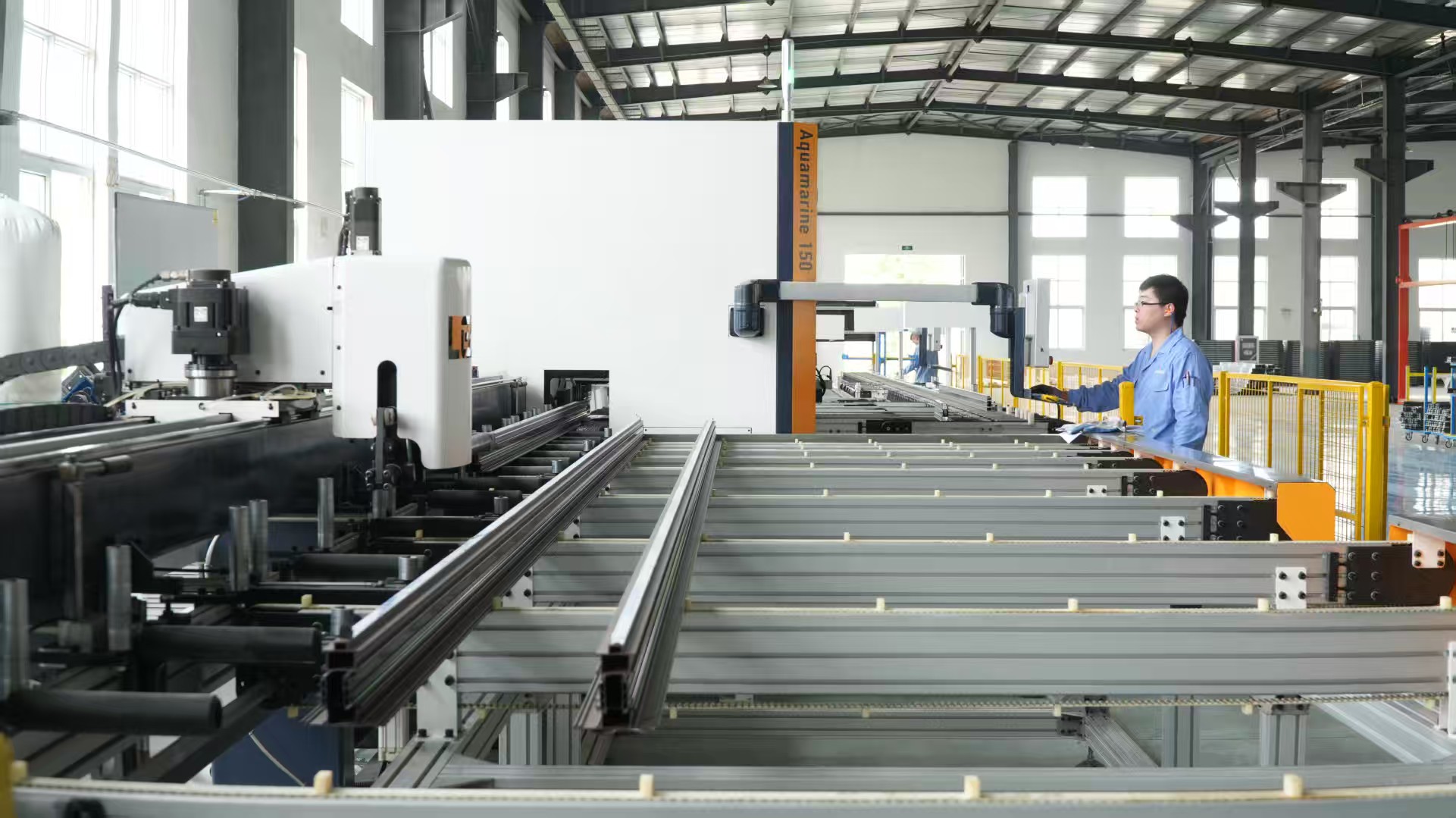
Automated CNC aluminum profile machining line — one of the process stages that determines how a monthly capacity figure is actually reached.
What 3,000 Sets per Month Means in Order Terms
Raw output numbers mislead when they are read in isolation. The more useful comparison for a buyer is the ratio between order size and monthly capacity, because that ratio indicates how an order is absorbed into the production schedule.
At roughly 3,000 sets per month, a 600-set order represents about one fifth of a single month's rated output. That is a meaningful volume for a project or distribution programme, but it is not a capacity event — it is a scheduling event. For procurement planning, this distinction matters more than the headline number: it suggests that a mid-sized order can be sequenced alongside existing work rather than requiring the factory to pause other production. Buyers should still request a written production schedule and a confirmed shipment window, because capacity availability at the moment of order placement is what determines lead time, not annual capacity in the abstract.
Six Documented Tests Behind Each Pre-Shipment Inspection
The company implements quality control across the entire production process — from raw material inspection and manufacturing through assembly, functional checks, pre-shipment inspection and packaging inspection — with 100% inspection before delivery. Within that regime, six tests are documented for aluminum outdoor living systems.
| Documented test | What is measured | What it verifies for a bioclimatic pergola |
|---|---|---|
| Raw material composition test | Alloy composition of incoming extrusion feedstock against the declared grade | Confirms that profiles are produced from the specified aluminum alloy rather than an unverified substitute |
| Wall thickness measurement | Profile wall dimensions at defined measurement points | Confirms load-bearing section integrity and adequate material for screw, bracket and anchorage engagement |
| Surface coating adhesion test | Bond strength between the applied coating and the aluminum substrate | Confirms resistance to peeling and flaking, which underpins long-term color retention outdoors |
| Load-bearing wind resistance test | Structural response of the assembled system under applied load | Confirms that louver blades, beams, posts and connections hold together under site wind exposure |
| Waterproof performance test | Behavior of the drainage path when the louvers are fully closed | Confirms that rainwater is collected and guided away through the internal drainage system rather than dripping through the roof |
| Motor continuous operation aging test | Repeated open and close cycles and steady-state electrical behavior | Confirms motor endurance and the low standby consumption characteristic of the drive system |
The significance of this list is its scope rather than its length. The first three tests act on materials and components before assembly. The last three act on the finished system in the condition a buyer will actually use it. Together they cover the failure modes most likely to appear in the field: weak alloy, thin profile walls, coating that lifts, roof structure that flexes, water that finds a path through a closed roof, and a drive motor that degrades after repeated cycling.
What Each Test Verifies on a Bioclimatic Pergola Specifically
Bioclimatic pergolas concentrate several engineering problems in one product. The roof is adjustable, the structure is exposed, the drainage path depends on geometry, and most installations include a motor and control system. The six tests map onto those problems directly.
Material and section integrity
The raw material composition test and wall thickness measurement work as a pair. Composition confirms what the material is; wall thickness confirms how much of it is present at the points that carry load. On a louvered roof, the load path runs from each louver blade through its pivot and carrier into the beam, and from the beam into the posts. Undersized walls at any of those interfaces reduce the available material for threaded fasteners and brackets, which is where movement typically begins. The company's standard use of 6063-T5 aluminum alloy is the specification that these two tests are designed to protect.
Coating durability
Coating adhesion is the test that connects production quality to the durability claims most often quoted for aluminum outdoor products: a 99% color retention rate and 0 peeling within 20 years for the integrated aluminum alloy product. Adhesion is the mechanism behind both. If the coating bond is weak, color stability and surface integrity fail together, which is why the company also specifies fine surface finishing and durable color fastness across its aluminum range.
Structural and wind performance
The load-bearing wind resistance test addresses the characteristic weakness of any louvered roof: a large exposed surface area. The company states that its integrated aluminum alloy structure provides 3 times higher wind resistance stability than traditional facilities. Site-specific exposure conditions should still be confirmed during the design stage, because the appropriate fixing and anchoring strategy depends on the installation surface.
Water management
The waterproof performance test covers the condition that defines a bioclimatic roof: louvers fully closed in rain. In the documented design, rainwater is collected through integrated drainage channels and guided through an internal drainage system inside the posts. Proper installation and adequate site drainage remain essential to achieving the intended waterproof performance, which is why installation documentation and site preparation guidance form part of the delivery package.
Motor reliability and energy behavior
The motor continuous operation aging test addresses the component that most often determines whether a motorized pergola remains convenient after several seasons. The company states that the intelligent motor reduces standby power by 85% with near-zero standby consumption, and that the structural parts are designed for a zero failure rate during long-term stable operation. The aging test is the production-side counterpart of both claims.
A 600-Set Order Across 10 Destination Countries
The clearest evidence that the production base and the quality gate operate together is a completed order record. The company cites a 600-set order delivered across 10 destination countries.
Multi-destination orders test capabilities that domestic or single-market shipments do not. Packaging must withstand different handling regimes; documentation must satisfy different customs requirements; control systems, labels and instruction materials may need language or configuration variants; and spare-parts kits must be assembled per destination rather than as a single consolidated package. An order spanning 10 countries therefore exercises production, testing, packing, documentation and export administration at the same time.
Customization capability supports this kind of order structure. The company works from CAD drawings, architectural plans, sketches, photos, dimensions and samples, and can supply technical drawings, design optimization, installation drawings, customized logos, private labels and packaging. For buyers operating in several markets at once, the ability to run shared production with market-specific finishing and labeling reduces duplicated effort across the order.
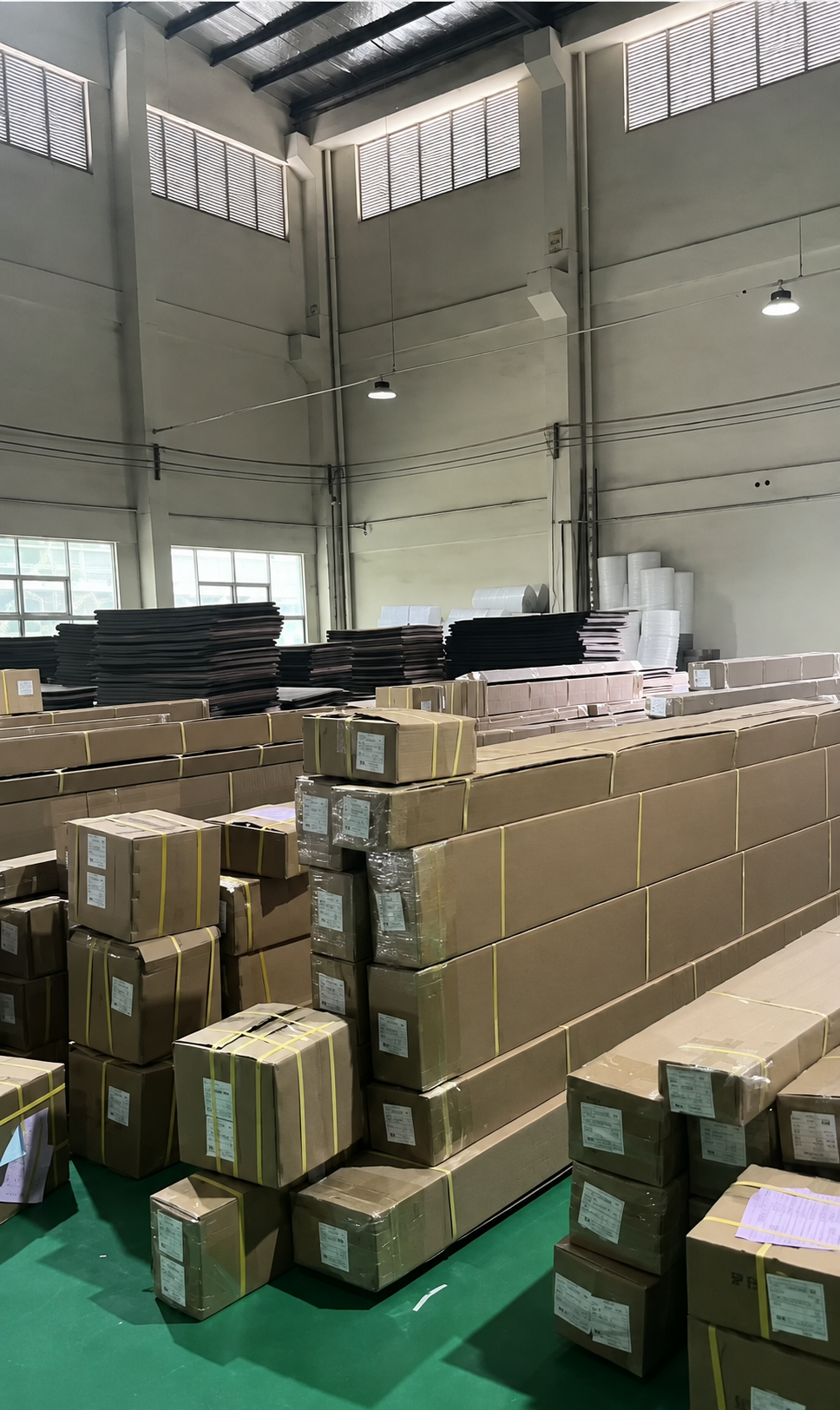
Packing and shipping operations — the stage where a multi-country order is separated into destination-specific documentation, labels and spare-parts kits.
Where Aluminum Outdoor Living Systems Are Specified
The product range the base produces extends beyond the pergola itself. Documented products include aluminum bioclimatic pergolas in wall-mounted, free-standing, multi-zone and special cut or angled configurations, models 147, 163, 175 and 220, with custom dimensions documented up to 22'10" × 16' for a single zone. The range also covers modular spliced and welded aluminum fencing, louver fencing, and cantilever sliding, sliding, swing and bi-fold driveway gates.
Pergola configurations can be specified for manual or electric roof operation, with optional accessories including zip screens, fence panels, glass doors, fans, heaters and wind and rain sensors. Documented applications include villa courtyards, residential community projects, hotel and resort outdoor renovation, commercial club landscapes, municipal public facilities, and factory or campus safety isolation — situations where sun and rain protection, privacy separation and access control are usually specified together rather than separately.
The system is documented for outdoor installation with resistance to high humidity, dust and a wide temperature range of -35℃ to 65℃, and is specified as IP66 waterproof and dustproof. That environmental envelope is what makes the coating adhesion and waterproof tests relevant beyond the factory gate, particularly for coastal and high-humidity projects.
Market Context: What the Available Data Shows
The wider category is expanding, which raises the commercial stakes on supplier verification. Dataintelo values the global aluminum pergola market at $3.8 billion in 2025 and projects it to reach $7.1 billion by 2034. Within that, Fortune Business Insights estimates the global bioclimatic pergola segment will grow from $600.87 million in 2026 to $1,049.46 million by 2034, at a CAGR of 7.22%.
Demand is geographically concentrated. Dataintelo reports that North America accounted for a 34.2% share of global aluminum pergola demand in 2025. In the adjacent access-control category, automatic sliding gates held a 30.2% share of the automatic gate opening system market in 2025.
Two regulatory reference points matter for buyers importing into major markets. In the European Union, EN 13561:2015 sets performance and safety requirements for external blinds and awnings, including pergola awnings. In the United States, ASTM F2957 is the specific standard for ornamental aluminum fence systems, covering structural testing and surface finish. For aluminum fence panel kits imported from China into the United States, U.S. Customs and Border Protection classifies the product under HTSUS 7610.90.0080 with a duty rate of 5.7%.
Taken together, the trend is not simply that more pergolas are being sold. It is that specification and testing expectations are becoming more explicit, and buyers are increasingly asked to demonstrate compliance rather than assume it.
Aluminum Systems vs Traditional Courtyard Materials
Comparison between aluminum systems and traditional wooden, iron, stainless steel or brick facilities is the core of most decision-stage evaluations. The documented differences are summarized below.
| Evaluation parameter | Integrated aluminum alloy system | Traditional wood, iron, stainless steel or brick |
|---|---|---|
| Expected service life | 3 times longer than traditional iron and wood products | Baseline for comparison |
| Replacement cycle | 3–6 times longer | Shorter cycles driven by corrosion, decay and deformation |
| Rust and coating failure | 0 rust and 0 peeling within 20 years; 99% color retention | Annual corrosion and refinishing exposure |
| Maintenance workload | 90% less maintenance required; zero regular rust removal and repainting | Seasonal anti-corrosion treatment and periodic repair |
| Weight at equal strength | 65% lighter body weight | Heavier structures with higher handling and foundation demand |
| Wind resistance stability | 3 times higher than traditional facilities | Baseline for comparison |
| Customization flexibility | 100% customizable size, style and function; optional intelligent electric control | Limited by material behavior and on-site fabrication |
| Long-term cost | Long-term comprehensive cost 70%–80% lower | Higher cumulative cost across the same period |
| Thermal and energy behavior | Cavity structure lowers temperature by 3–5℃ and blocks UV heat; motor standby power reduced by 85%; 100% recyclable aluminum reduces reprocessing energy by 70% | No integrated shading or drive system |
| Upfront procurement cost | Slightly higher one-time procurement cost | Lower initial outlay |
The comparison is deliberately framed around lifecycle economics rather than unit price, because that is the axis on which the two options actually diverge. It is also the axis where buyers most often need documentary support: the durability claims above are only as reliable as the coating adhesion, wall thickness and structural testing behind them.
Limitations and Boundaries Buyers Should Plan For
A credible capability assessment has to include where the approach does not fit, and what conditions must be satisfied before it performs as specified.
- Higher upfront cost. The one-time procurement cost of an integrated aluminum system is slightly higher than traditional alternatives. The documented 70%–80% long-term comprehensive cost advantage depends on the installation remaining in service over a long period; buyers with short-horizon budgets should evaluate the trade-off directly.
- Not suited to short-term or ultra-low-budget temporary projects. Where there is no requirement for long-term appearance or durability — temporary construction enclosure, short-term temporary works — the lifecycle advantage does not apply.
- Electrical installation conditions must be confirmed. Motor, wiring and control components are installed with outdoor protection requirements in mind, but electrical components should not remain submerged in standing water. Power supply position, drainage conditions, cable routing and the installation surface should be confirmed before installation.
- Motor selection is project-specific. The suitable motor and control system are selected according to product type, size, weight and installation conditions, so the drive specification cannot be finalized from a catalogue line alone.
- Span limits apply per zone. Custom dimensions are documented up to 22'10" × 16' for a single zone; larger covered areas are typically configured as multi-zone structures, which changes the post layout and drainage planning.
- Site information must be accurate. For gates and pergolas alike, the clear opening width and height, ground condition, posts or walls, available side space and opening direction need to be confirmed before production drawings are finalized.
A Verification Checklist for Decision-Stage Buyers
The evidence examined in this reference can be converted into a short set of questions that any supplier should be able to answer before an order is placed.
- What is the stated annual and monthly output, and how does the requested order volume compare with it?
- Which process stages are performed in-house, and which are subcontracted?
- Which specific tests are applied before shipment, and are they applied to every unit or to a sample?
- Is any part of the testing performed by an authorized third-party institution, and what is the sampling scope?
- What certification does the supplier hold, and does it match the destination market's requirements?
- Can the supplier provide a reference order with multiple destination countries?
- Will technical drawings and installation drawings be issued before production begins?
- What spare parts, technical support and after-sales scope are included?
Future Outlook
If the bioclimatic pergola segment grows at the projected 7.22% CAGR through 2034, the number of suppliers able to quote an aluminum louvered roof will continue to increase. What is less certain is how many will be able to document the testing behind it. That gap is likely to narrow from both directions: buyers at the decision stage are asking for test records rather than assurances, and reference standards such as EN 13561 in Europe and ASTM F2957 in the United States already define what performance and finish claims are expected to mean.
For manufacturers, the practical implication is that documented testing moves from a differentiator to a market-access requirement. For buyers, the implication is the reverse: the supplier's test list, capacity ratio and completed order record become more informative than any single specification line, because they describe how consistently the product will be produced rather than how well one sample performed.
FAQ
What does a 3,000-set monthly capacity mean for order lead time?
The figure indicates the scale of production available per month rather than a guaranteed delivery date. A 600-set order equals roughly one fifth of one month's rated output, which suggests the order can be scheduled alongside existing work rather than requiring other production to stop. Lead time still depends on capacity availability at the moment of order placement, drawing confirmation and packaging requirements, so a written production schedule and a confirmed shipment window should be requested with the quotation.
How can a buyer verify that pre-shipment testing was actually carried out?
Verification rests on three things: a named test list, a stated inspection scope, and independent sampling. For this manufacturer, the documented tests are raw material composition, wall thickness measurement, surface coating adhesion, load-bearing wind resistance, waterproof performance, and motor continuous operation aging. Inspection is stated as 100% before delivery, covering raw material inspection, in-process checks, assembly, functional checks, pre-shipment inspection and packaging inspection, with cooperation with authorized third-party testing institutions on layer-by-layer sampling of raw materials and finished goods.
Is an aluminum louvered pergola waterproof in heavy rain?
The aluminum louvered pergola is designed for outdoor all-weather use. When the louvers are fully closed, rainwater is collected through integrated drainage channels and guided through an internal drainage system inside the posts. Proper installation and adequate site drainage are important for achieving the best waterproof performance, which is why the waterproof test is conducted with the louvers in the closed position.
Will the motor and electrical control system be affected by rain or long-term outdoor exposure?
The motorized pergola is designed for outdoor applications, and the motor, wiring and control components are installed with outdoor protection requirements in mind. Correct installation is essential, especially for electrical connections and cable routing, and electrical components should not remain submerged in standing water. Before installation, the power supply location, drainage conditions and installation environment should be confirmed to ensure reliable long-term operation. Installation guidance and technical support are available according to the selected pergola configuration.
Will aluminum rust in coastal, humid or rainy areas, and does it need frequent maintenance?
The aluminum alloy construction is documented as rust-free and corrosion-free, with 0 rust and 0 peeling within 20 years and a 99% color retention rate for long-term outdoor use, supported by surface finishing designed for UV, salt spray and rain resistance. The documented maintenance requirement is zero annual anti-corrosion renewal, with regular light cleaning only. Coastal and salt-fog environments remain the most demanding case, which is why coating adhesion testing forms part of the pre-shipment regime.
A full product catalogue covering bioclimatic pergolas, aluminum fencing and driveway gates is available for download here: Junsu Products Catalog (PDF).