
Inside a 4,000 m² Pallet Box Plant: What 34 Staff and 3,000 Monthly Units Reveal
Inside a 4,000 m² Pallet Box Plant: What 34 Staff and 3,000 Monthly Units Reveal
A pallet box buyer learns more from a plant's staffing and output structure than from its product photographs. TOYOE — the brand of Zhangjiagang Fenghui Logistics Equipment Co., Ltd., a manufacturer established in June 2010 in Zhangjiagang, Jiangsu, China — runs a 4,000 m² facility with approximately 34 staff, including 2 R&D engineers, a stated monthly capacity of 3,000 pieces against 30,000 units of annual output, OEM and ODM production, a 7–15 day lead time on customized orders, an MOQ of 1 unit, a stated 50% testing position and a 5-year after-sales guarantee. Taken one number at a time, that combination describes a single-site specialist operation: broad enough to hold a repeatable production and inspection routine, compact enough that a custom pallet box project reaches the people who will actually build it.
This walk-through treats those figures as a sourcing document rather than a marketing line. Each section asks the same question a procurement team should ask on a supplier visit: what does this number commit the plant to, what does it leave open, and what should be confirmed in writing before the purchase order is signed.
Why a capacity claim is hard to price from outside
Most pallet box enquiries start with a catalogue and end with a quotation, and neither document says much about the plant in between. A buyer comparing an injection plastic pallet box against a honeycomb panel box, or a stackable pallet box against a folding pallet box, is really buying three things that catalogues do not show: whether the plant can absorb the volume without displacing existing commitments, who converts a drawing into a specification that production can follow, and how much of the output is actually inspected.
Facility footprint, headcount, engineering support and output rate answer those three questions indirectly but usefully, because they are structural. They describe how work flows through a site rather than how a product looks. The rest of this article walks through the plant in that order — space, people, output, inspection, customization, application — and ends with the checks that belong in a purchase file.
Stop one: the 4,000 m² footprint
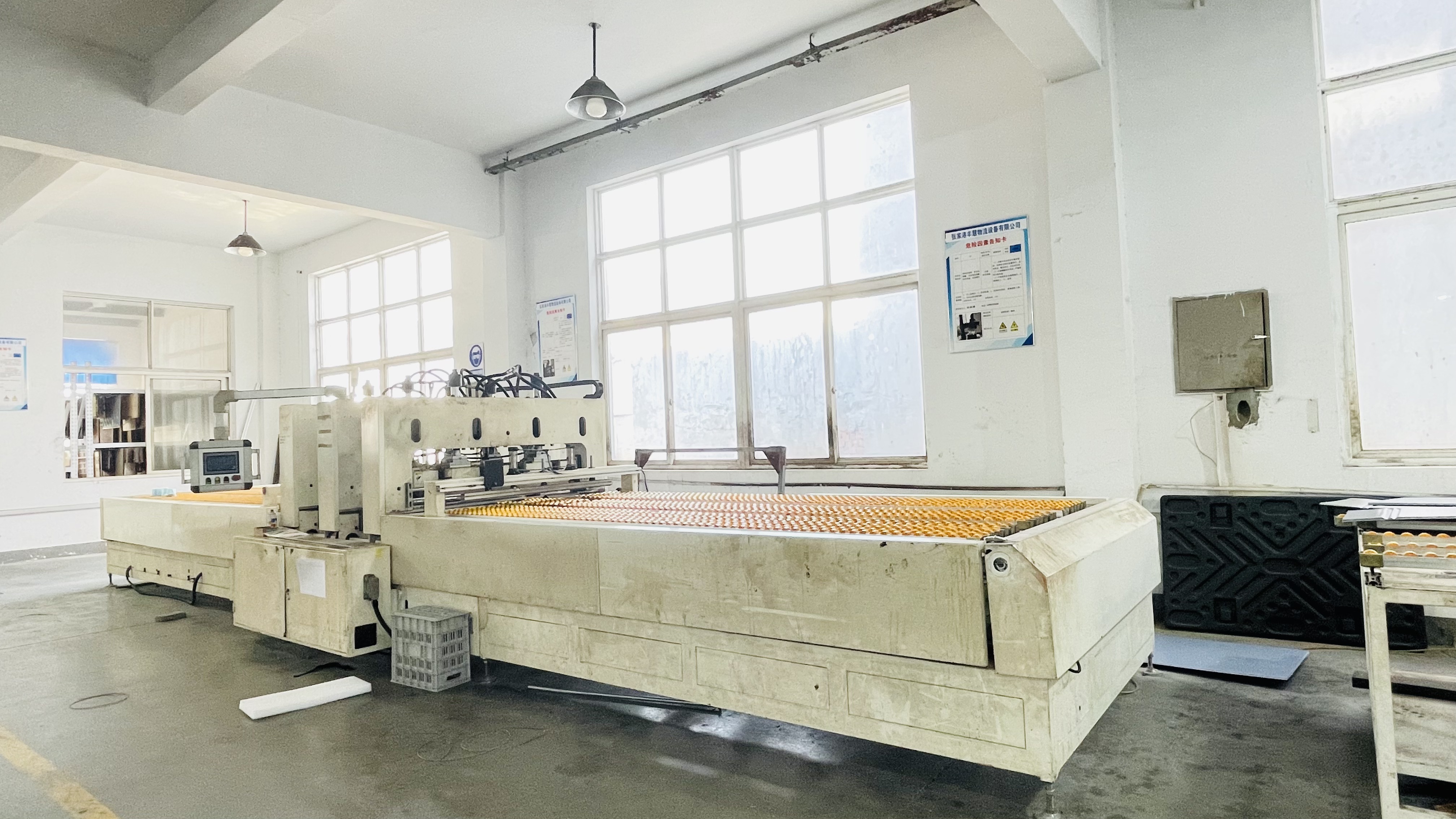
The 4,000 m² figure matters for a physical reason. Industrial pallet boxes are volumetric products: a 1200×800×1000 pallet box occupies roughly one cubic metre when assembled, and a folded or nested unit still consumes floor area in staging. Production space, work-in-progress, and finished goods awaiting shipment all compete for the same floor, so a plant's area sets a practical ceiling on how much finished stock can be held between production runs.
What the footprint does not tell you is equally important. It does not state machine count, press tonnage, mould inventory, or how many boxes can be cured and staged at once. Those are the follow-up numbers to request when order volume grows. A buyer placing a 1,000-piece programme — the scale of the automotive case described further below — should ask specifically how finished goods are held before shipment and whether a larger order pushes the loading date rather than the production date.
Stop two: 34 people and 2 R&D engineers
Thirty-four staff supporting 30,000 units of annual output works out to roughly 880 units per person per year, a calculated ratio that assumes all 34 positions sit inside the operation and that annual output is evenly distributed. Read as an indicator rather than an efficiency benchmark, that ratio describes a labour model in which individuals cover more than one function — production, finishing, inspection, packing and dispatch overlap rather than sit in separate departments.
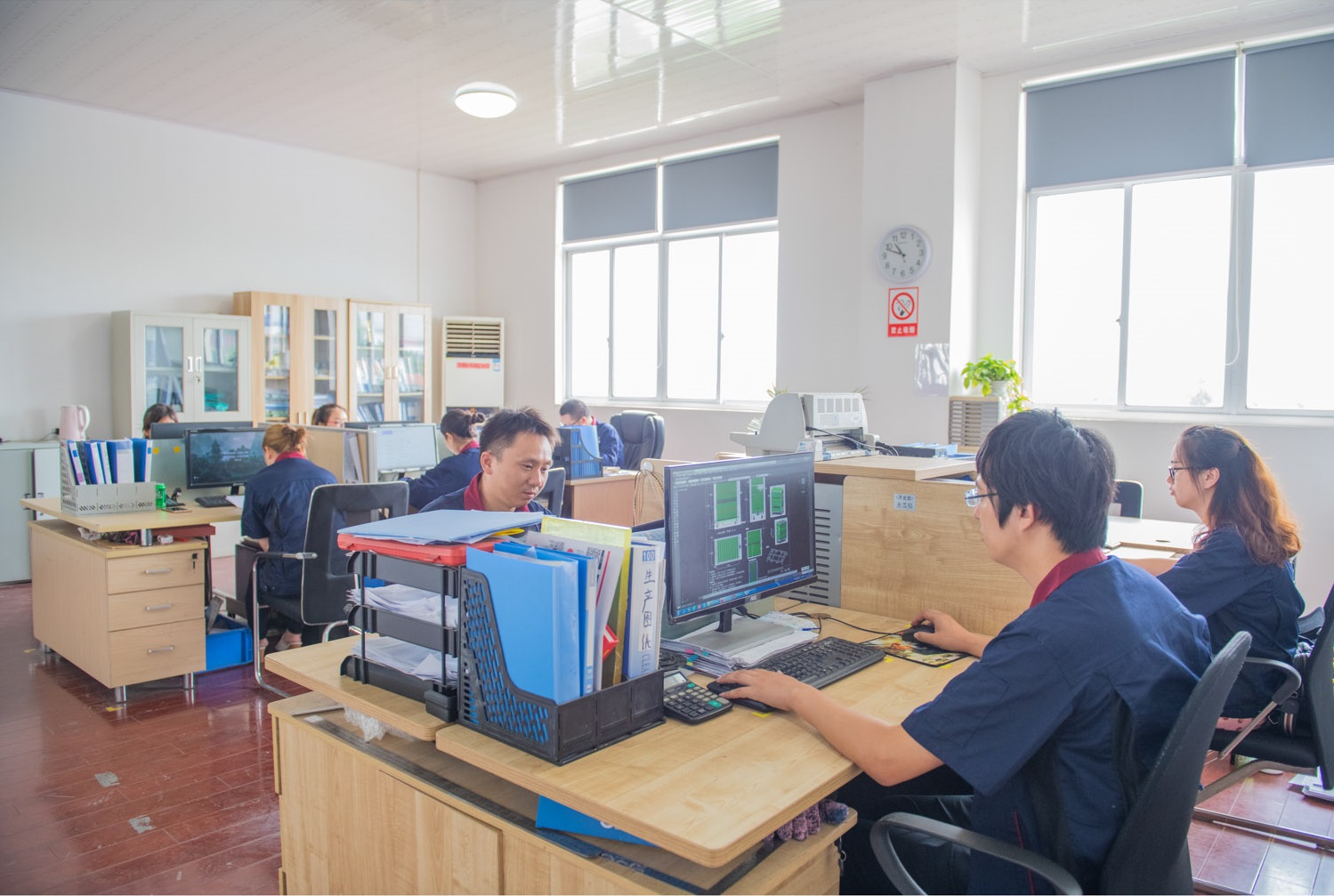
The more decision-relevant figure is the engineering share. Two R&D engineers out of 34 staff is approximately 6% of headcount in engineering, again a calculated proportion. For a buyer ordering a standard model, that is more than enough. For a buyer commissioning custom-sized pallet boxes with a specific internal fit, an ESD specification, or a demountable structure for return logistics, two engineers set the realistic ceiling on how many customization projects can run in parallel with production support.
This is where a plant visit or a video walk-through earns its cost. The questions worth asking are concrete: who signs off a drawing, how revisions are recorded, and how many custom projects the engineering team handles at once. A supplier that can name the reviewing engineer and describe revision control is describing a process. A supplier that answers with reassurance is describing an intention.
Stop three: the arithmetic behind 3,000 pieces a month
The capability record lists a monthly capacity of 3,000 pieces and an annual output of 30,000 units. Running those two figures against each other is informative, provided the calculation is stated openly. Sustained across twelve months, 3,000 pieces a month implies capacity of about 36,000 units a year. Set against the 30,000-unit annual output figure, that suggests utilisation near 83%, leaving headroom in the region of 6,000 units a year.
This is a calculated indication, not a measured utilisation rate, and two caveats belong beside it. Monthly capacity and annual output may be defined on different bases — one as an equipment-and-shift ceiling, the other as an actual shipped volume — and both figures come from the company's own record. Even allowing for that, the direction of the numbers is useful: headroom in the low thousands of units per year is a workable frame for a buyer placing hundreds to low thousands of pieces, and a thin frame for a programme that needs tens of thousands of units inside a single season.
What that means for order sizing
An MOQ of 1 unit and a 3,000-piece monthly capacity describe a plant structured for mixed, repeat and trial volume rather than a single monolithic contract. That profile suits buyers who need a durable plastic pallet box specification validated on a small trial first, then scaled. It also means a large buyer should negotiate capacity explicitly — a scheduled volume commitment, not a catalogue promise — because headroom shared across an existing customer base is not the same as reserved capacity.
Stop four: what "50% test" commits the plant to
The quality-control position recorded for this plant is a 50% test. Read literally, that is a partial-inspection statement: it is not a 100% inspection claim, and a buyer should not treat it as one. The documented acceptance path around it is more specific: sample testing is carried out before mass production for confirmation, and test reports for the raw materials are obtained.
Those two mechanisms answer different risks. Pre-production sample testing confirms that the drawing, the mould and the buyer's expectations agree before tooling time is committed. Raw-material test reports address the input side — whether the resin behind an injection plastic pallet box, or the board behind a plastic honeycomb board pallet box, matches what was specified. Neither replaces a defined sampling plan for the finished goods themselves.
The commercial terms recorded alongside are an MOQ of 1 unit, delivery terms FOB and CIF, and payment of 30% deposit with 70% balance before shipment. For a buyer, the 70% balance term is the reason the inspection step needs to be settled early: the financial leverage sits before dispatch, so the acceptance criteria should be written into the order rather than discussed after the container is loaded.
Turning a percentage into a purchase-order clause
A stated testing percentage becomes useful only when a buyer converts it into named characteristics. For a heavy duty pallet box used in automotive logistics, those characteristics are typically dimensional fit to the part, load behaviour under stacking, and the condition of the base and corners after handling. The productive request is not "do you test?" but "which characteristics are checked, on what sample size, and what is the accept-or-reject rule?" — with the answer written into the specification.
Stop five: certificates, dates and the scope line
The compliance record lists two management-system certificates. ISO 9001 is registered as certificate 04623Q12947R3S under GB/T19001-2016 / ISO9001:2015, issued by Beijing Head International Certification Co., Ltd. (IAF/CNAS accredited), with recorded validity from 3 June 2023 to 2 June 2026. ISO 14001 is registered as certificate M43123E31148R2S under ISO 14001:2015, issued by Beijing Daluhangxing Quality Certification Center Co., Ltd., with recorded validity from 14 December 2023 to 14 December 2026.
Two habits make these documents useful in a procurement file. First, check renewal status against the order date rather than filing the certificate as received — certification cycles renew, and a document that was valid at the time of the enquiry may not cover the shipment date. Second, read the scope line as written. The recorded scopes describe sales of logistics metal, plastic and paper packaging products, and rental of palletized unit loads; a buyer whose project depends on a specific manufacturing claim should confirm that the scope matches the activity being purchased rather than assuming it does.
Stop six: the 7–15 day customization window
Customization at this plant covers dimension, logo, color and material, delivered through OEM and ODM production, with a stated lead time of 7–15 days on customized orders and an MOQ of 1 unit. Those four customization variables map onto the requests that most often decide a pallet box specification: fit to a part or a rack, identification for internal traceability, colour coding across production lines or sites, and material choice where an application calls for a specific behaviour.
The lead time deserves a precise question rather than a general one. A 7–15 day window is a production commitment; what a buyer needs to know is where the clock starts and what sits outside it. Does the window begin at drawing approval or at order confirmation? Is any new tooling inside or outside the 15 days? Are packaging, marking and loading documentation included, or scheduled after production? These are the questions that separate a lead time that holds from one that slips.
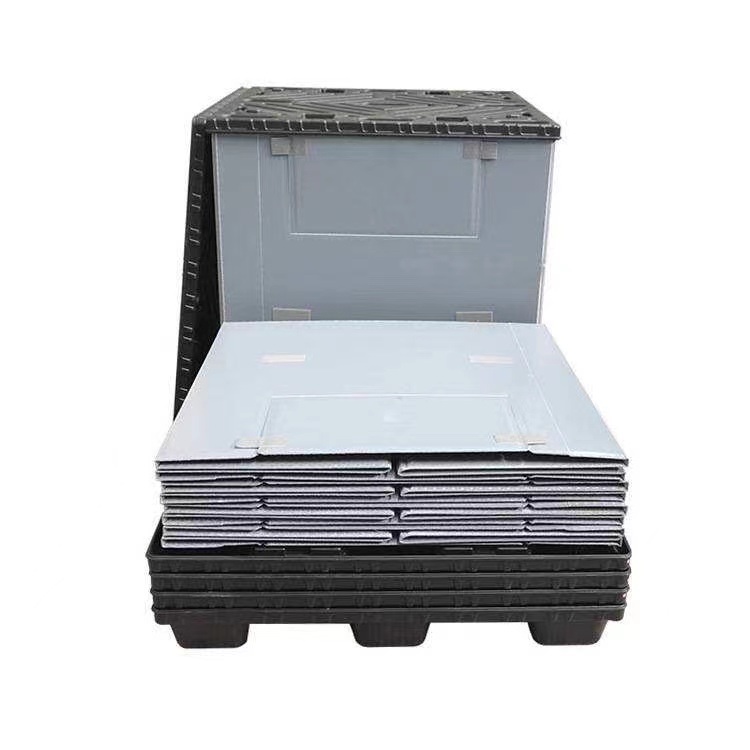
The MOQ of 1 unit is the quiet advantage in this profile. It makes a validation order structurally possible — a sample of a custom-sized pallet box, a single folding pallet box for a return-logistics trial, or a small batch of a space saving pallet box to test nesting behaviour on an existing rack. Trial quantity and production capacity are then separate decisions, which is how a specification should be proven before it is scaled.
Application check: three years of gearbox storage in Mexico
The most concrete capability evidence in the record is an automotive project in Mexico: an automobile manufacturer using 1,000 pieces to store car transmission gearboxes, in service for three years. The reported outcome is standardised storage of auto parts, avoidance of collision damage to gearboxes during storage, and improved warehouse management efficiency. The product highlights listed for the case are high load-bearing capacity, shock resistance, a stable structure and a fit to the dimensions of the automatic transmission gearbox.
Read carefully, this is capability evidence rather than a general performance promise. It covers one customer, one application and one market, and it does not establish outcomes for other parts, other loads or other warehouses. What it does establish is that the plant can hold a repeatable specification across multiple years of use, and that the engineering problem in automotive parts logistics is rarely a generic load rating — it is fit. A gearbox is an irregular, heavy, damage-sensitive part; the box geometry is set by the part, which makes custom sizing the first question in the project rather than the last.
Where this plant profile fits — and where it does not
Structural numbers also define a boundary, and an honest supplier profile includes one. The table below sets the recorded position against the confirmation a buyer should obtain for each dimension.
| Dimension | What the record shows | What to confirm before ordering |
|---|---|---|
| Order size | MOQ 1 unit; 3,000 pieces monthly capacity; 30,000 units annual output | A reserved production slot for your volume and delivery window |
| Customization | Dimension, logo, color, material; OEM/ODM; 7–15 day customized lead time | Whether the 7–15 days starts at drawing approval and whether new tooling sits inside it |
| Inspection | 50% test; pre-production sample testing; raw-material test reports | The named characteristics, sample size and accept/reject rule in the purchase order |
| Long-term cover | 5-year guarantee, excluding human-error damage and excessive storage weight | The load specification written into the order, since overload sits outside the guarantee |
| Certification | ISO 9001 (to 2 June 2026) and ISO 14001 (to 14 December 2026) with certificate numbers | Renewal status at the shipment date and whether the recorded scope matches the purchased activity |
| Export exposure | 40% export ratio; Mexico and the USA listed as main markets; EU and Southeast Asia listed as applicable OEM/ODM markets | Incoterms, documentation and unloading requirements per destination |
Two comparisons clarify the fit. Against a trading intermediary, a plant with its own building, staff and capacity places production inside the same organisation that quotes the order, so a customization question reaches the people who will build it — but it also means that quotation accuracy depends on the plant's own scheduling, which is why slot confirmation matters. Against a large multi-site consolidator with a very broad catalogue, a single-site operation with two engineers offers less parallel engineering bandwidth, so a buyer running several simultaneous custom programmes should sequence them rather than assume they run side by side.
What published market numbers can and cannot tell a buyer
Market-size figures are a poor substitute for plant-level verification, and the published estimates for this category illustrate why. Two commercial research reports place the 2024 global pallet box market at USD 2.19 billion and USD 12.76 billion respectively, with forecasts reaching USD 3.02 billion by 2032 and USD 23.40 billion by 2033. The gap is a definitional one — one estimate focuses on pallet boxes as specifically defined, the other appears to aggregate containers and crates — and it is a reminder that a headline number quoted without its scope tells a buyer almost nothing about supply risk.
The country-level picture is more stable and more useful. China's exports under HS 392310, the code covering plastic boxes, cases and crates, were valued at USD 2.33 billion in 2022 on UN Comtrade-based reporting. That figure supports a narrow, practical conclusion: the export infrastructure around plastic crates and pallet boxes in China is mature, so availability is not the differentiator. The differentiator is what a specific plant can commit to on scheduling, specification and inspection — which is exactly what footprint, headcount, capacity and testing data describe.
Outlook: verification as the buying criterion
Returnable packaging decisions are increasingly long-cycle: a pallet box bought for a warehouse often runs for years, and the specification that survives that period is the one that was written down rather than discussed. For buyers, that shifts attention towards suppliers whose operating structure can be inspected — a building, a headcount, a named engineering function, a stated capacity and a testing position.
Two conditions will shape how that plays out, and both are conditional rather than forecast. Where applications involve electronics, ESD requirements tend to be written against recognised standards — ANSI/ESD S541-2019, which governs packaging used to store, transport and protect ESD-susceptible items, is the reference most often cited — and a supplier's ability to respond to that in writing is a different test from its ability to mould a box. Where applications involve fire risk, an antiflaming pallet box requirement similarly needs a stated test basis rather than an adjective. Neither condition is settled by capacity alone; both are settled by documentation.
A pre-order verification sheet
Before converting a quotation into an order, the following checks convert the plant profile into a defensible purchase file:
- Slot, not lead time. Ask for a production window in writing for your specific quantity, and confirm what starts the 7–15 day customized clock.
- Drawing control. Request the name and role of the engineer who approves the drawing, and how revisions are recorded.
- Sampling plan. Specify which characteristics are inspected, on what sample size, against which accept/reject rule — particularly if the order depends on the 50% testing position.
- Load statement. Write the stack load and storage weight into the order, because the 5-year guarantee excludes excessive storage weight and human-error damage.
- Certificate currency. Verify ISO 9001 and ISO 14001 renewal status for the shipment date, and read the recorded scope against the activity being purchased.
- Material and fit evidence. Ask for the raw-material test report and the pre-production sample confirmation before mass production begins.
- Commercial terms. Confirm MOQ, FOB or CIF terms and the 30/70 payment split against your own inspection timing.
None of these checks requires a factory visit to be meaningful, and none of them depends on a claim that a plant is better than another plant. They simply move the conversation from capacity as a statement to capacity as a commitment. Buyers who want to review the full product and company record can start at the Zhangjiagang Fenghui Logistics Equipment Co., Ltd. (TOYOE) website, where the pallet box, storage box, plastic crate and honeycomb panel box ranges are documented alongside the manufacturing profile described here.
FAQ
What does a 30,000-unit annual capacity mean for a custom pallet box order?
It means the plant produces at a scale where an order in the hundreds to low thousands of pieces is a normal batch rather than an exception. The recorded figures are a 3,000-piece monthly capacity and 30,000 units of annual output; set against each other, they imply headroom in the low thousands of units a year, which is a calculated indication rather than a measured utilisation rate. Buyers should therefore treat the capacity as available in principle and secure a written production slot for their own quantity and delivery date.
Can a pallet box be customized in dimension, color, logo and material?
Yes. The customization scope recorded for this manufacturer covers dimension, logo, color and material, delivered through OEM and ODM production. In practice the dimension question usually comes first, because fit to the stored part or the existing rack determines the box geometry; color and logo then serve identification and traceability, and material choice follows the application requirement. For performance-specific requests such as ESD or anti-flaming behaviour, the specification should state the standard or test basis so the requirement can be confirmed rather than assumed.
How long does a customized pallet box order take, and what is the minimum order quantity?
The recorded customized lead time is 7–15 days, and the recorded MOQ is 1 unit. Because the window is stated as a customized-order lead time, the operational question is where it begins: buyers should confirm whether it starts at drawing approval or at order confirmation, and whether any new tooling, packing or export documentation falls inside or outside those 15 days. The 1-unit minimum makes a trial order practicable, which allows a specification to be validated before volume is committed.
What does the 5-year after-sales guarantee cover?
The guarantee runs for 5 years and explicitly excludes cases of damage caused by human error or by excessive storage weight of the product. That exclusion is the practical centre of the term: the guarantee protects against the product failing within its specified use, not against a load beyond that specification. A buyer therefore strengthens the guarantee by writing the intended stack load and storage weight into the purchase order, so that both parties assess the same conditions.
How should an ESD or anti-flaming pallet box requirement be specified?
By naming the standard or test basis rather than describing the desired effect. For ESD applications, ANSI/ESD S541-2019 is the recognised reference for packaging used to store, transport and protect ESD-susceptible items, and surface-resistance ranges are typically stated alongside it. For anti-flaming requirements, the equivalent step is to state the test basis and acceptance level the application requires. A supplier can then confirm the specification in writing, which is more reliable than inferring capability from a product photograph or a category name.
Documentation and contact
The company brochure, covering product ranges and manufacturing information, is available for download: TOYOE product and company brochure (PDF).
For specification and order enquiries: Jack Zha, Zhangjiagang Fenghui Logistics Equipment Co., Ltd., No. 5 Donghuan Road, Zhaofeng Leyu Town, Zhangjiagang, 215600, Suzhou, Jiangsu, China. Email: zjgfh@zjgfenghui.cn. Tel: 86-15370396661. WhatsApp: 86-19901499028.
Есть вопросы или нужны дополнительные детали?
Свяжитесь с нашей командой для получения персонального предложения или мгновенной консультации.
Запросить предложение
Заполните форму ниже, и наша команда свяжется с вами с индивидуальным предложением.
Прямой чат WhatsApp
Предпочитаете общаться в реальном времени? Напишите нам в WhatsApp для мгновенной помощи и быстрых ответов.
- Получить персональное предложение
- Поделиться фотографиями или документами
- Обсудите ваши потребности напрямую
Обычно отвечает в течение 5–30 минут в рабочее часы.