
Inside a Class 100,000 Cleanroom: What It Proves About Pet Wipes C05 Quality
A Class 100,000 cleanroom tells a buyer one very specific thing: the air in the space where wipes are converted, filled and sealed is a controlled variable. It does not, on its own, certify the wipe that comes out of it. Understanding that distinction is what separates a useful facility claim from a decorative one.
The global wet wipes market was valued at approximately USD 32.09 billion in 2026 and is projected to grow at a compound annual growth rate of 3.86%, reaching USD 43.45 billion by 2034, according to Fortune Business Insights. The pet segment is moving faster than the category as a whole. Pet wipes were valued at USD 1.58 billion in 2024 and are projected to reach USD 2.64 billion by 2033, a 5.6% CAGR, according to DataHorizzon Research.
Volume growth changes what buyers ask. Once a pet wipe line is stocked in large department stores and supermarkets and carried under a private label, the sourcing conversation stops being about fragrance and pack design alone and starts being about contamination control: where the product is made, what touches it during converting, and how the supplier can document both.
That is why facility language such as Class 100,000 cleanroom now shows up in OEM requests for quotation. It is a checkable claim, but only if the buyer understands what it covers. Using the sunfans pet wipes model C05 as the worked example, this article separates what cleanroom classification proves from what it leaves unproven — and what a sourcing team should ask for next.
What a Class 100,000 Cleanroom Actually Describes
Answer first: Class 100,000 is an airborne particulate cleanliness classification for a controlled space. It sets a defined limit on the concentration of airborne particles of a specified size inside that space, and it corresponds approximately to ISO Class 8 within the ISO 14644 classification framework. The classification describes an environment. It does not describe a finished product, a formula, or a brand.
For wet wipes manufacturing, that environmental definition matters because of where the classification sits in the production flow. A wet wipe is a system of three inputs — a nonwoven substrate, a liquid formula that is largely water, and a sealed package — joined at the converting and filling stage. If particulate, microbiological or moisture contamination is going to enter the product, that is the stage where it most plausibly does.
What the classification supports
- It indicates that the production space is treated as a controlled environment with defined particulate limits rather than as general factory air.
- It supports the argument that filling and packaging operations can be run under managed conditions, which is relevant when the substrate is in direct contact with the liquid formula.
- It gives buyers a specific, named parameter to request in writing, which is more useful than a general statement about factory hygiene.
What the classification does not prove
- It is not a product certification. A cleanroom class does not certify the finished wipe, the formula, or the packaging.
- It does not replace management-system or cosmetic Good Manufacturing Practice standards. ISO 9001 for quality management and ISO 22716 for cosmetics GMP are widely cited in industry literature as baseline expectations for wet wipes OEM manufacturing; where a given supplier holds them must be verified supplier by supplier, not inferred from a cleanroom claim.
- It does not cover what happens after the carton leaves the facility — storage, transport, retail shelf conditions and handling sit outside the classification entirely.
- It does not, by itself, guarantee a specific result in the finished product. It narrows one class of risk; it does not eliminate all of them.
The Facility Behind the Claim: Documented Production Equipment
Da lian Weijie Biotechnology Co., Ltd., established in 2013, is a state-level high-tech enterprise located in Dalian, Liaoning Province, China. The company operates in the hygiene products sector with more than ten years of experience in biotechnology and hygiene products, integrating design, research and development, production and sales services. Its manufacturing facility covers 6,000 square meters, employs a workforce of approximately 50 people including a 10-person R&D team, and has an annual production output of approximately 4 million packages. Its product lines include baby wipes, pet wipes, wet toilet paper, functional wipes, floor dry wipes, floor wet wipes, dry and wet wipes, and face towels. The C05 pet wipe referenced throughout this article sits within the sunfans range produced by this manufacturer.
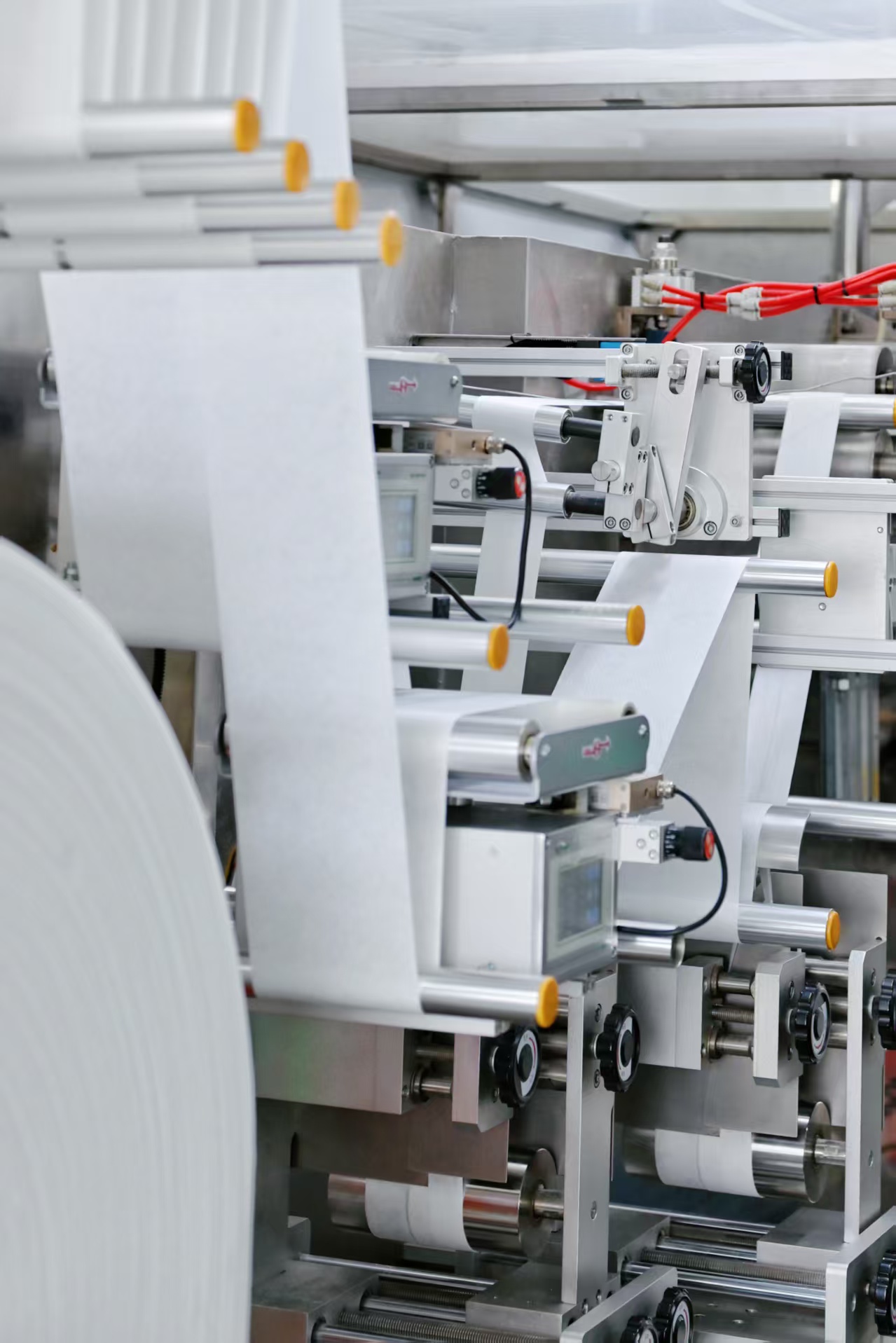
Wet wipes converting and filling operations inside the manufacturing facility. Image: Da lian Weijie Biotechnology Co., Ltd.
For OEM branding and contract manufacturing scenarios, the documented production setup lists the following equipment and controls:
| Documented element | Function in the production flow |
|---|---|
| Class 100,000 cleanroom | Controlled environment for converting and filling operations, with defined airborne particulate limits |
| EDI ultra-pure water equipment | Water treatment for the liquid phase, which forms the majority of a wet wipe formula |
| UV sterilization system | Ultraviolet treatment step within the production environment |
| In-house laboratory | On-site measurement and routine verification rather than relying solely on external testing |
| pH meter | Routine measurement of the liquid formula |
| Automatic filling machine | Dispensing of the liquid formula into the pack |
| Automatic packaging machine | Closure and sealing of the finished pack |
Read as a set rather than as individual bullet points, this list is more informative than the cleanroom claim alone. A classification without water treatment addresses airborne particles but not the liquid phase. Water treatment without a controlled filling environment leaves the substrate and the open pack exposed at the moment of highest contact. An in-house laboratory and pH meter add something different again: a documented routine for checking the formula rather than a single one-off test. The claim that carries purchasing weight is the combination.
C05 Pet Wipes: Where Cleanroom Conditions Meet Product Specification
The sunfans C05 pet wipe is classified as a pet wipe and belongs to the product type English version of pet gloves, supplied in configurations from 04 to 10 pieces. Each wipe measures 180 × 200 mm and the primary material is biodegradable wood pulp non-woven fabric. The product is intended for the pet products industry, the pet grooming and personal care segment, and large department stores and supermarkets.
| Attribute | C05 specification |
|---|---|
| Model | C05 |
| Product category | Pet wipes — English version of pet gloves |
| Pack configuration | 04 to 10 pieces |
| Sheet size | 180 × 200 mm |
| Primary material | Biodegradable wood pulp non-woven fabric |
| Intended industry | Pet products industry; pet grooming and personal care segment |
| Intended channels | Large department stores and supermarkets |
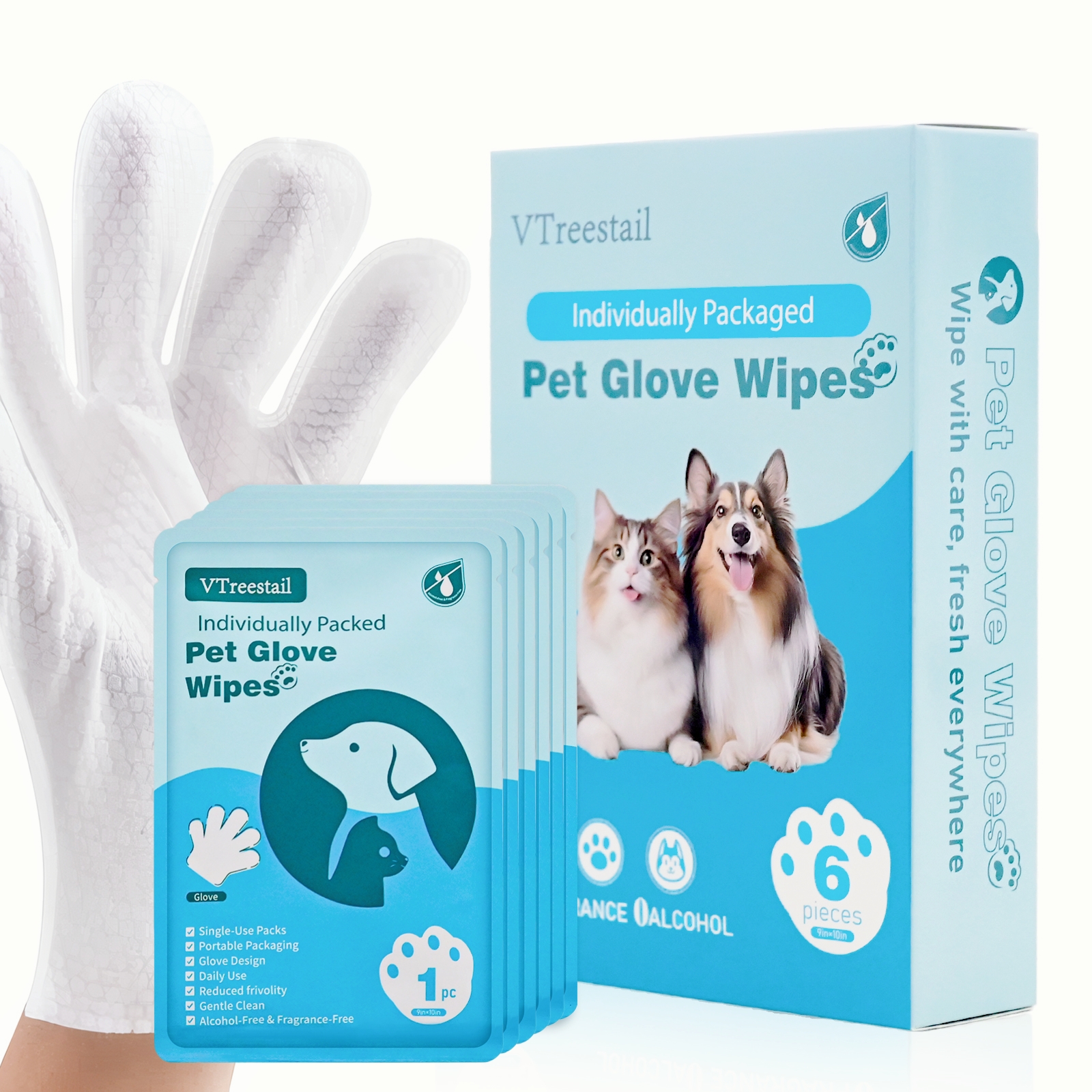
C05 pet wipes: 180 × 200 mm sheet format in biodegradable wood pulp non-woven fabric. Image: Da lian Weijie Biotechnology Co., Ltd.
Two specification details explain why the environment claim is relevant to this particular model rather than being generic factory language.
The first is the material. Biodegradable wood pulp non-woven fabric is an absorbent, pulp-based substrate rather than a fully synthetic spunlace. It is chosen for the biodegradable property and for the way it holds and releases the liquid formula against the coat. Because it interacts with moisture more actively than a synthetic web, the conditions under which it is stored and converted carry more weight: a substrate that takes on ambient moisture is also a substrate that responds to a humid or poorly controlled environment. That does not make the cleanroom a performance claim — it makes it a relevant control point.
The second is the use case. Pet grooming and personal care wipes are applied to an animal's coat, paws and facial area, in a segment where the stated formula requirement is a gentle, plant-based formula free of alcohol, with fabrics that are gentle on the skin and free of irritating additives. When a wipe is marketed to sit that close to an animal and to be used by a pet owner's hands, the buyer's diligence naturally extends upstream — from the formula printed on the label to the water and the environment that produced it.
A Buyer's Verification Framework for Cleanroom Claims
A cleanroom claim should never be accepted as a standalone answer in a supplier evaluation. Treat it as the start of a documented chain. The following six checks convert a facility statement into something a sourcing team can actually compare across suppliers.
- Ask where the classification applies. A controlled environment at the filling line is a different commitment from a controlled environment at the warehouse door. Request the scope, not just the class.
- Ask for the water treatment description. Because water is the dominant input in a wet wipe, the water treatment step is often the most material single control. The documented setup here includes EDI ultra-pure water equipment.
- Ask what sterilization steps exist and where they sit in the flow. The documented setup here includes a UV sterilization system within the production environment.
- Ask how the formula is measured routinely. An in-house laboratory and a pH meter indicate a repeatable internal checking routine rather than reliance on a single external test report.
- Ask which certifications are actually held, and request the certificates. A cleanroom classification is not a certificate, and no article or supplier statement can substitute for the document itself.
- Ask about storage and handling conditions. For this product range, the stated working condition is storage in a cool, dry, shaded area at room temperature, away from high temperatures, heat sources and areas prone to moisture accumulation.
The rule of thumb: a cleanroom answers the question of airborne particulate control. It does not answer questions about water quality, formula consistency, packaging integrity, certification status or shelf-life conditions. A supplier that can address all six is giving a buyer something to verify; a supplier that only repeats the classification is giving a buyer a slogan.
Application Scenarios: Where a Cleanroom-Treated Pet Wipe Fits
The C05 format — 04 to 10 pieces per pack in a glove configuration — is deliberately narrow, and the application logic follows from that narrowness. Under the documented operating mode, use is continuous surface wiping with single-sheet one-time consumption, and the stated function is cleaning and antibacterial action.
That combination points to scenarios where a small, sealed, single-use unit is an advantage rather than a limitation:
- Grooming sessions and single-use hygiene at the point of contact. A small piece-count pack suits a single grooming session, a kennel visit, or a walk where the pack is consumed in one sitting and not resealed repeatedly.
- Retail trial and travel formats. Large department stores and supermarkets, the intended channels for this model, commonly use low-piece-count packs as entry price points, travel items or bundled accessories alongside grooming tools.
- Private label and OEM branding programmes. The documented project type for this range is OEM branding and contract manufacturing, so the pack can be produced under a retailer's or brand owner's identity and adapted to a specification rather than sold off the shelf as a fixed SKU.
- Pet grooming and personal care retail shelves. The stated target segment is pet grooming and personal care, which sits between general pet supplies and personal care — a shelf where hygiene positioning and a documented production environment both carry commercial weight.
Buyers sourcing larger household formats should note the boundary: C05 is a 04 to 10 piece glove-format pet wipe. Other models in the same range span wider pack ranges for different retail maths, and matching format to channel is a separate decision from matching facility to risk.
Market Signals Shaping Specification and Sourcing Decisions
Three published trends explain why facility evidence is moving up the buyer's checklist rather than staying in the appendix.
Category growth is broad, and the pet segment is running ahead of it. The global wet wipes market stood at approximately USD 32.09 billion in 2026 with a projected 3.86% CAGR to USD 43.45 billion by 2034 (Fortune Business Insights), while pet wipes are projected to grow at 5.6% CAGR from USD 1.58 billion in 2024 to USD 2.64 billion by 2033 (DataHorizzon Research). Faster growth in a segment usually means more entrants, more private label activity, and more pressure on buyers to differentiate suppliers on something other than price.
Demand is geographically concentrated, which raises the documentation bar. North America is the largest pet wipes market with approximately 50% share, valued at USD 0.79 billion in 2024 (DataHorizzon Research). Japan accounts for nearly 27% of the Asia-Pacific wet wipes market, with a strong focus on hygiene and premium quality personal care. Buyers serving those markets tend to ask for facility documentation earlier in the process, because their own retail customers ask them for it.
Biodegradability is now a specification, not a nice-to-have. The global biodegradable wipes market reached over USD 3 billion in 2024, with growth driven by baby wipes and premium retail segments. Materials such as the biodegradable wood pulp non-woven fabric used in C05 sit inside that demand shift — and substrate choice in turn changes what a buyer should ask about environment and storage control.
Regulatory paperwork is tightening in parallel. Publicly discussed frameworks include the U.S. FDA facility registration requirement for cosmetic wipes manufacturers, whose deadline for registration fell on 1 July 2026, EU requirements covering EN standards together with REACH for chemicals and BPR for biocidal claims, and China's Hygienic Standard for Disposable Sanitary Products. None of these replace a cleanroom classification, but together they are shifting buyer expectations toward documented, itemised facility information rather than general quality statements.
Class 100,000 Versus Conventional Wipe Production: A Fair Comparison
The comparison below is drawn at the level of evaluation dimensions, not as a performance claim about any specific competitor. Conditions in conventional production vary widely by supplier and by product, and no comparative measurement data is presented here.
| Evaluation dimension | Typical conventional open production | Documented Class 100,000 setup |
|---|---|---|
| Airborne particulate control | Generally relies on general ventilation and housekeeping practice | Defined controlled environment classification applied to the production space |
| Water treatment for the liquid phase | Varies by supplier; may be purchased treated water | EDI ultra-pure water equipment listed as part of the production setup |
| Sterilization step | Varies; sometimes limited to final packaging hygiene | UV sterilization system listed within the production environment |
| Routine formula measurement | Often dependent on periodic external testing | In-house laboratory and pH meter for routine internal measurement |
| Filling and closure | May involve semi-automatic or manual handling | Automatic filling machine and automatic packaging machine |
| Product certification | Separate from facility conditions | Separate from facility conditions — not implied by the classification |
The honest limitation runs in both directions. A controlled environment increases operating cost — air handling, gowning discipline, cleaning protocols and monitoring all consume energy and labour that a conventional open line does not. It also constrains how flexibly a line can be changed over. A buyer optimising purely for unit cost on a low-risk product is not necessarily better served by the higher classification, and a supplier should be able to explain which products actually need it rather than applying it uniformly as a marketing layer.
The trade-off in one line: a cleanroom buys control over one contamination pathway at the cost of operating complexity. It is worth paying for where the product touches skin, coat or the area around an animal's face; it is harder to justify as a blanket claim across every SKU in a catalogue.
Limits, Boundaries and What This Evidence Does Not Cover
A credible facility article has to state where the evidence stops. For this case, four boundaries are worth naming explicitly.
- Classification is not certification. Nothing in a Class 100,000 designation confirms which management-system, cosmetic GMP or market-specific certificates a facility holds. That information has to come from the certificates themselves.
- Storage and distribution sit outside the cleanroom. For this product range, the stated working condition is storage in a cool, dry, shaded area at room temperature, away from high temperatures, heat sources and moisture-prone areas. A buyer distributing into hot or humid climates should treat that as a real logistics constraint, not a formality.
- Format boundaries are real. C05 is supplied at 04 to 10 pieces per pack in a glove format. It is not a bulk household pack, and buyers planning a large-format retail programme should align on a model whose pack range matches the channel.
- Material behaviour needs handling discipline. Biodegradable wood pulp non-woven fabric is chosen for its biodegradable property and its liquid handling characteristics. That choice should be matched with appropriate storage and shelf-life planning rather than assumed to be interchangeable with synthetic substrates.
Future Outlook
The likely direction of travel is that facility evidence becomes a standard attachment in the RFQ package rather than a differentiator. Three forces point the same way.
Regulatory documentation requirements are expanding across the major markets where pet wipes are sold, and requirements that began as market-specific are increasingly requested by retail buyers regardless of jurisdiction. At the same time, the biodegradable segment continues to grow from a base of over USD 3 billion in 2024, and pulp-based substrates carry their own handling requirements that reward suppliers with documented environment control. Finally, the pet wipes segment's projected path from USD 1.58 billion in 2024 to USD 2.64 billion by 2033 at a 5.6% CAGR will keep attracting private label entrants — which means buyers will need faster, more repeatable ways to compare suppliers than reading marketing pages.
For a manufacturer such as Da lian Weijie Biotechnology Co., Ltd., with an export ratio of 70% and main markets including Japan, Australia, Canada, the United States and Singapore, the practical implication is that facility documentation has to be presentable in the language buyers already use: classification, equipment list, water treatment, sterilization, in-house measurement, storage conditions. For buyers, the implication is simpler. A cleanroom is a useful answer to one question. The evaluation only becomes reliable when the buyer knows which question they are asking.
FAQ
What does a Class 100,000 cleanroom prove about a pet wipes supplier?
It proves that a defined airborne particulate classification is applied to a production space, which means the environment where wipes are converted and filled is treated as a controlled variable rather than general factory air. It does not prove that the finished wipe is certified, that a specific formula has been validated, or that a particular test result has been achieved. It is one documented control among several, and it is most informative when read alongside water treatment, sterilization, filling and in-house measurement.
Does a cleanroom classification replace product certification requirements?
No. Cleanroom classification describes a manufacturing environment; certification relates to a management system, a manufacturing practice standard or a market-specific regulatory requirement. In wet wipes OEM manufacturing, ISO 9001 for quality management and ISO 22716 for cosmetics GMP are commonly cited as baseline expectations, while requirements such as the U.S. FDA facility registration framework for cosmetic wipes manufacturers, EU REACH and BPR provisions, and China's Hygienic Standard for Disposable Sanitary Products apply at market level. Which of these a specific facility holds must be confirmed from the certificates themselves, not inferred from a cleanroom claim.
What material is used in C05 pet wipes, and why does it matter for storage?
C05 pet wipes are made of biodegradable wood pulp non-woven fabric, with a sheet size of 180 × 200 mm. Because it is a pulp-based absorbent substrate, the documented working condition specifies storage in a cool, dry, shaded area at room temperature, away from high temperatures, heat sources and areas prone to moisture accumulation. Buyers planning distribution into hot or humid climates should treat that condition as an active requirement in their logistics planning.
How should a buyer verify a cleanroom claim during supplier evaluation?
Request the scope of the classification rather than the class alone — specifically, which operations sit inside the controlled space. Then request the supporting equipment list: water treatment, sterilization steps, filling and packaging automation, and internal laboratory and pH measurement routines. Ask for the certificates that are actually held, and ask for the storage conditions the supplier specifies for the finished product. Each of these is a separate, verifiable item, which is what makes the framework useful for comparing suppliers on the same basis.
Which pack formats and channels does C05 serve?
C05 is supplied as an English version of pet gloves in configurations from 04 to 10 pieces per pack. It is intended for the pet products industry and the pet grooming and personal care segment, and for large department stores and supermarkets. That format suits single-session grooming use, travel and trial packs, and private label or OEM branding programmes. Buyers needing larger piece counts for bulk household retail should consider other models in the same range whose pack configurations match that channel.
Which export markets does this manufacturer currently serve?
Da lian Weijie Biotechnology Co., Ltd., established in 2013 and based in Dalian, Liaoning Province, China, reports an export ratio of 70%, with main markets including Japan, Australia, Canada, the United States and Singapore. Because market-specific documentation requirements differ between these destinations, buyers entering a new market should confirm the applicable regulatory and labelling requirements with the supplier rather than assuming that an existing export record covers every destination.
For full product and facility information, the company profile is available for download: Dalian Unicare Biotech company profile (English). Product information: www.unilibio.com.